
Microsoft is reportedly ending most direct Claude Code access for engineers in its Experiences and Devices division by June 30, 2026, moving staff working on Windows, Microsoft 365, Outlook, Teams, and Surface toward GitHub Copilot CLI instead. The timing is not subtle: June 30 is the end of Microsoft’s fiscal year. The official explanation is toolchain consolidation, security alignment, and tighter GitHub integration. The more interesting explanation is that the first serious enterprise wave of agentic coding has finally met the invoice.
This is not a story about AI coding tools failing. It is a story about them working well enough, spreading fast enough, and running long enough to break the budget models that made them easy to buy. Microsoft’s pullback from Claude Code should be read less as a product snub and more as a market signal: enterprise AI is leaving the “give everyone a seat and see what happens” phase and entering the metered-utility phase.
When Microsoft opened Claude Code access internally in December 2025, the move was striking because of who was paying the bill. This was not a startup experimenting with the best available tool, or a consultancy trying to impress clients with the latest agent demo. It was Microsoft, owner of GitHub, steward of Copilot, investor in OpenAI, and seller of AI-assisted productivity to practically every enterprise on the planet.
That made the experiment useful in two ways. Internally, Microsoft could learn how its own engineers, product managers, and designers used a rival’s command-line coding agent under real pressure. Externally, it quietly acknowledged something vendors rarely say out loud: model quality, workflow fit, and developer enthusiasm do not always line up with corporate platform strategy.
The reported June 30 cutoff changes the message. Microsoft can plausibly argue that Copilot CLI is the strategic destination, especially for repositories, workflows, compliance expectations, and security controls that Microsoft and GitHub can shape together. But that argument was true in December, January, February, and March. The thing that changed by late spring was not the architecture diagram. It was the run rate.
Claude Code appears to have become popular inside the very division responsible for Windows and Microsoft 365, which makes the retreat more telling. Companies do not usually rush to discontinue unpopular tools at fiscal year-end. They rush to discontinue tools that have become too popular under the wrong commercial model.
Agentic coding breaks that comfort. A coding agent is not merely a smarter autocomplete box. It reads repositories, plans changes, runs commands, interprets errors, revises code, writes tests, digests logs, and loops until it either solves the task or exhausts its context, quota, patience, or budget. Each step consumes tokens, and the most valuable sessions are often the ones that last longest.
That matters because token consumption is not a tidy proxy for headcount. Two engineers with identical salaries and identical licenses can create wildly different costs depending on how they prompt, how large their repositories are, how many parallel agents they run, and how willing they are to let the tool iterate. One developer may use an agent as a sparring partner. Another may treat it as a tireless junior engineer with root access to the backlog.
The result is a procurement category that looks like SaaS in the sales deck but behaves like cloud compute in production. Enterprises thought they were buying a productivity tool. In practice, they were connecting thousands of employees to a meter.
That is the kind of number that changes the conversation in the CFO’s office. A $20, $100, or $200 monthly subscription feels trivial next to a senior engineer’s compensation. A $1,500 monthly cap per employee, multiplied across thousands of engineers and several agent tools, starts to look less like software enablement and more like a new infrastructure line item.
The hard part is that Uber’s problem was not obviously irrational usage. Agentic coding encourages precisely the behavior that makes it expensive. If the tool helps clear tickets, explain unfamiliar services, generate migration code, and accelerate tests, engineers will use it more. If internal dashboards celebrate AI-assisted productivity, usage will climb faster still.
This is the paradox now confronting enterprise AI buyers: the more useful the agent, the less plausible the old licensing metaphor becomes. The spreadsheet that assumed “one seat equals one cost center” gets demolished by a workflow where one person can launch a small swarm of expensive reasoning loops before lunch.
It is choosing where the economic control plane should live. Direct Claude Code access gives employees a popular tool, but it leaves Microsoft managing a rival’s interface, commercial terms, usage patterns, and product priorities. Copilot CLI, by contrast, can be aligned with GitHub, internal repositories, enterprise policy, model routing, telemetry, and whatever cost controls Microsoft wants to impose.
The important point is not that Copilot CLI is necessarily cheaper in every task. The important point is that Microsoft can shape it. It can decide which models are available, where Claude remains an option, how prompts are cached, which actions require approval, how budgets are enforced, and how usage is attributed across teams. In enterprise AI, control of the wrapper may matter as much as control of the model.
That is especially true for WindowsForum readers who live in the real world of procurement, security review, and change management. A powerful tool that developers love can still be a governance problem if it bypasses the organization’s preferred audit paths. A slightly less glamorous tool that integrates with identity, repositories, policy, and spend controls may win because it fits the enterprise machine.
But agentic coding introduces a second curve moving in the opposite direction. Newer agents do more work per task. They plan more, inspect more files, invoke more tools, run more tests, compare more outputs, and maintain longer context. The unit price of a token may fall while the number of tokens consumed per meaningful task rises.
That distinction is often lost in boardroom discussions. A CIO hears that model prices are down and assumes total spend will be easier to control next quarter. An engineering leader sees that the new agent can perform a multi-hour refactor and happily points it at the monorepo. Both are right in isolation. Together, they produce a bill nobody forecast.
Recent research into agentic coding workloads has reinforced the operational intuition many developers already have: these systems can consume orders of magnitude more tokens than chat-style coding help, and the variability from one run to another can be enormous. A task that appears simple to a human may cause an agent to explore dead ends, reload context, rerun tests, or overthink its plan. Higher spending does not always translate neatly into higher accuracy.
That is why agentic AI is so difficult to price like software. It is not just expensive; it is stochastic. The cost of the same request can vary depending on repository state, prompt wording, model behavior, tool failures, and the agent’s own intermediate choices. Finance departments dislike variable costs. They really dislike variable costs that even the system itself cannot reliably predict in advance.
From the user’s side, this looked like innovation. From the provider’s side, it looked like someone parking a fleet of delivery trucks at an all-you-can-eat buffet. The economics could not survive contact with serious automation.
That episode matters because it revealed the boundary between consumer AI abundance and enterprise AI metering. Chat subscriptions trained users to expect broad, generous access for a fixed monthly fee. Agentic coding then converted that expectation into sustained compute demand. The provider response was predictable: close the loopholes, push heavy workloads toward API pricing, and reserve flat-rate plans for behavior that can be bounded.
Microsoft is making the buyer-side version of the same decision. It is not saying that Claude is useless. It is saying that unmanaged direct access is no longer the right enterprise default. Once agent usage becomes material to the budget, the question shifts from “Which model do developers prefer?” to “Which platform lets us meter, govern, route, and justify the work?”
That kind of environment is both ideal and brutal for AI coding agents. Ideal, because developers constantly need help navigating complexity, understanding unfamiliar subsystems, and generating safe mechanical changes. Brutal, because the agent must absorb large amounts of context before it can be useful, and context is exactly where token costs accumulate.
A Windows engineer asking an agent to reason about a subsystem is not asking for a three-line code suggestion. The agent may need to inspect interfaces, build scripts, tests, logs, historical patterns, and surrounding code. A Teams or Outlook engineer may face similar complexity across service boundaries, client platforms, and compliance expectations.
For Microsoft, that makes internal usage a preview of what its largest enterprise customers will face. If agentic coding spend is difficult to govern inside Microsoft, it will be even harder inside companies with less centralized platform control, weaker telemetry, and fewer engineers who understand the underlying cost mechanics.
A coding assistant that can route simple tasks to cheaper models, reserve expensive reasoning for high-value work, cache repository context, enforce per-team budgets, and show cost per merged pull request will have an advantage over a beloved tool that merely produces excellent code at unpredictable expense. The next procurement fight will be about dashboards as much as demos.
This is where GitHub gives Microsoft leverage. GitHub already knows repositories, pull requests, reviews, issues, Actions workflows, and developer identity. If Copilot CLI becomes the command-line front end for agentic work, Microsoft can connect AI usage to the artifacts enterprises already use to measure engineering output. It can tell a story not just about tokens spent, but about changes shipped, tests passed, vulnerabilities fixed, and review time reduced.
Whether that story holds up in every organization is another matter. But it is a more enterprise-friendly story than “trust us, your developers love it.” Developer love matters. It does not close a renewal when the usage graph looks like a runaway cloud bill.
For many engineering teams, a capable agent is already worth real money. It can help onboard developers to unfamiliar codebases, generate tests for neglected modules, automate repetitive migrations, explain failure logs, draft documentation, and accelerate prototypes. Even when the output requires review, the time savings can be meaningful.
The question is not whether agentic coding has value. The question is whether that value can be measured, governed, and bought in a way that survives enterprise scale. A tool can be worth $1,000 per month for one engineer working on a critical migration and still be wasteful at $1,000 per month for every engineer, every month, regardless of task value.
That is the distinction procurement teams are now learning. AI coding spend needs tiering. Senior platform engineers working on high-leverage infrastructure may justify heavy usage. A developer doing routine maintenance may not. A security team racing to patch a vulnerability may deserve temporary unlimited access. A low-priority internal dashboard probably does not.
That phase is ending. The next wave will look more like cloud FinOps than software rollout. Teams will receive budgets. Agents will have quotas. Expensive models will be gated. Usage will be reviewed alongside output. Internal AI champions will still exist, but they will share the room with finance, security, procurement, and platform engineering.
That does not make the technology less important. It makes it more mature. Nobody serious says cloud computing failed because companies created budgets, reserved instances, tagging policies, and spend alerts. Those controls were the price of making cloud a permanent part of enterprise infrastructure. AI coding agents are now entering the same institutional machinery.
The uncomfortable part for vendors is that this shift compresses the romance of the category. Once AI becomes a utility, buyers will compare it like a utility. They will ask which workloads justify premium inference, which can run on cheaper models, which should be cached, which should be blocked, and which should never have been automated in the first place.
That accounting system has to answer questions that earlier coding assistants could dodge. How much did this refactor cost? Which team is consuming the most premium inference? Did higher token spend correlate with faster merges or fewer incidents? Are agents generating work that humans then spend time cleaning up? Are developers using AI to solve hard problems, or to produce low-value churn?
These are not anti-AI questions. They are pro-production questions. The enterprises that ask them early will get more value from AI than those that treat every token as a magical productivity seed.
For Windows administrators and IT pros, the lesson should feel familiar. The exciting part of a new platform is never the license portal. But the license portal often determines whether the platform survives contact with the business. AI agents are now powerful enough to demand the boring machinery of enterprise governance.
This is not a story about AI coding tools failing. It is a story about them working well enough, spreading fast enough, and running long enough to break the budget models that made them easy to buy. Microsoft’s pullback from Claude Code should be read less as a product snub and more as a market signal: enterprise AI is leaving the “give everyone a seat and see what happens” phase and entering the metered-utility phase.
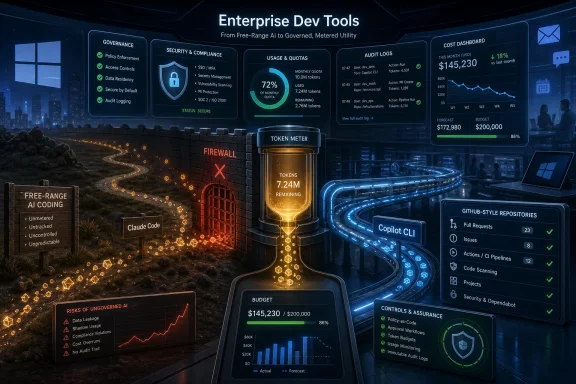 Microsoft’s Quiet Retreat Says More Than a Product Launch Ever Could
When Microsoft opened Claude Code access internally in December 2025, the move was striking because of who was paying the bill. This was not a startup experimenting with the best available tool, or a consultancy trying to impress clients with the latest agent demo. It was Microsoft, owner of GitHub, steward of Copilot, investor in OpenAI, and seller of AI-assisted productivity to practically every enterprise on the planet.That made the experiment useful in two ways. Internally, Microsoft could learn how its own engineers, product managers, and designers used a rival’s command-line coding agent under real pressure. Externally, it quietly acknowledged something vendors rarely say out loud: model quality, workflow fit, and developer enthusiasm do not always line up with corporate platform strategy.
The reported June 30 cutoff changes the message. Microsoft can plausibly argue that Copilot CLI is the strategic destination, especially for repositories, workflows, compliance expectations, and security controls that Microsoft and GitHub can shape together. But that argument was true in December, January, February, and March. The thing that changed by late spring was not the architecture diagram. It was the run rate.
Claude Code appears to have become popular inside the very division responsible for Windows and Microsoft 365, which makes the retreat more telling. Companies do not usually rush to discontinue unpopular tools at fiscal year-end. They rush to discontinue tools that have become too popular under the wrong commercial model.
Agentic Coding Turns Software Licensing Into a Utility Bill
The traditional enterprise software sale is beautifully legible to finance departments. Count the employees, negotiate the discount, assign the seats, and track renewal dates. Even when usage varies, the economic shape of the purchase is familiar: per user, per month, with predictable expansion and a known ceiling.Agentic coding breaks that comfort. A coding agent is not merely a smarter autocomplete box. It reads repositories, plans changes, runs commands, interprets errors, revises code, writes tests, digests logs, and loops until it either solves the task or exhausts its context, quota, patience, or budget. Each step consumes tokens, and the most valuable sessions are often the ones that last longest.
That matters because token consumption is not a tidy proxy for headcount. Two engineers with identical salaries and identical licenses can create wildly different costs depending on how they prompt, how large their repositories are, how many parallel agents they run, and how willing they are to let the tool iterate. One developer may use an agent as a sparring partner. Another may treat it as a tireless junior engineer with root access to the backlog.
The result is a procurement category that looks like SaaS in the sales deck but behaves like cloud compute in production. Enterprises thought they were buying a productivity tool. In practice, they were connecting thousands of employees to a meter.
Uber Became the Warning Label on the Box
Uber’s experience is the cleanest public example of why Microsoft’s move matters. According to reports based on remarks by CTO Praveen Neppalli Naga, Uber burned through its planned 2026 AI coding budget in roughly four months as Claude Code usage surged across its engineering organization. Adoption reportedly jumped from about one-third of engineers to more than four-fifths, with some individuals generating hundreds or thousands of dollars in monthly usage.That is the kind of number that changes the conversation in the CFO’s office. A $20, $100, or $200 monthly subscription feels trivial next to a senior engineer’s compensation. A $1,500 monthly cap per employee, multiplied across thousands of engineers and several agent tools, starts to look less like software enablement and more like a new infrastructure line item.
The hard part is that Uber’s problem was not obviously irrational usage. Agentic coding encourages precisely the behavior that makes it expensive. If the tool helps clear tickets, explain unfamiliar services, generate migration code, and accelerate tests, engineers will use it more. If internal dashboards celebrate AI-assisted productivity, usage will climb faster still.
This is the paradox now confronting enterprise AI buyers: the more useful the agent, the less plausible the old licensing metaphor becomes. The spreadsheet that assumed “one seat equals one cost center” gets demolished by a workflow where one person can launch a small swarm of expensive reasoning loops before lunch.
Microsoft Is Not Just Another Customer
Microsoft’s retreat carries unusual weight because the company sits on both sides of this market. It is a buyer of frontier AI tools, a builder of developer platforms, a cloud provider, a seller of Copilot subscriptions, and a strategic partner to multiple AI model providers. When Microsoft decides that direct Claude Code access is no longer the preferred default for a major internal division, it is not merely changing vendors.It is choosing where the economic control plane should live. Direct Claude Code access gives employees a popular tool, but it leaves Microsoft managing a rival’s interface, commercial terms, usage patterns, and product priorities. Copilot CLI, by contrast, can be aligned with GitHub, internal repositories, enterprise policy, model routing, telemetry, and whatever cost controls Microsoft wants to impose.
The important point is not that Copilot CLI is necessarily cheaper in every task. The important point is that Microsoft can shape it. It can decide which models are available, where Claude remains an option, how prompts are cached, which actions require approval, how budgets are enforced, and how usage is attributed across teams. In enterprise AI, control of the wrapper may matter as much as control of the model.
That is especially true for WindowsForum readers who live in the real world of procurement, security review, and change management. A powerful tool that developers love can still be a governance problem if it bypasses the organization’s preferred audit paths. A slightly less glamorous tool that integrates with identity, repositories, policy, and spend controls may win because it fits the enterprise machine.
The Token Curve Is Fighting the Productivity Curve
The industry’s preferred comfort story is that AI costs will fall the way cloud and semiconductor costs have historically fallen. There is truth in that. Model providers are cutting prices, optimizing inference, improving caching, and building smaller specialized models for tasks that once required frontier systems. Over time, a million tokens should get cheaper.But agentic coding introduces a second curve moving in the opposite direction. Newer agents do more work per task. They plan more, inspect more files, invoke more tools, run more tests, compare more outputs, and maintain longer context. The unit price of a token may fall while the number of tokens consumed per meaningful task rises.
That distinction is often lost in boardroom discussions. A CIO hears that model prices are down and assumes total spend will be easier to control next quarter. An engineering leader sees that the new agent can perform a multi-hour refactor and happily points it at the monorepo. Both are right in isolation. Together, they produce a bill nobody forecast.
Recent research into agentic coding workloads has reinforced the operational intuition many developers already have: these systems can consume orders of magnitude more tokens than chat-style coding help, and the variability from one run to another can be enormous. A task that appears simple to a human may cause an agent to explore dead ends, reload context, rerun tests, or overthink its plan. Higher spending does not always translate neatly into higher accuracy.
That is why agentic AI is so difficult to price like software. It is not just expensive; it is stochastic. The cost of the same request can vary depending on repository state, prompt wording, model behavior, tool failures, and the agent’s own intermediate choices. Finance departments dislike variable costs. They really dislike variable costs that even the system itself cannot reliably predict in advance.
The Subscription Buffet Was Never Built for Autonomous Agents
Anthropic’s restriction of third-party agent frameworks from using ordinary Claude subscription allowances showed the same pressure from the provider side. Tools such as OpenClaw exposed an obvious arbitrage: if a flat monthly plan could be used to run long-lived autonomous agents, heavy users could consume far more compute than the subscription price justified.From the user’s side, this looked like innovation. From the provider’s side, it looked like someone parking a fleet of delivery trucks at an all-you-can-eat buffet. The economics could not survive contact with serious automation.
That episode matters because it revealed the boundary between consumer AI abundance and enterprise AI metering. Chat subscriptions trained users to expect broad, generous access for a fixed monthly fee. Agentic coding then converted that expectation into sustained compute demand. The provider response was predictable: close the loopholes, push heavy workloads toward API pricing, and reserve flat-rate plans for behavior that can be bounded.
Microsoft is making the buyer-side version of the same decision. It is not saying that Claude is useless. It is saying that unmanaged direct access is no longer the right enterprise default. Once agent usage becomes material to the budget, the question shifts from “Which model do developers prefer?” to “Which platform lets us meter, govern, route, and justify the work?”
Windows and Microsoft 365 Teams Are the Perfect Stress Test
The reported affected division is not incidental. Experiences and Devices is the home of sprawling, mature, high-stakes software: Windows, Microsoft 365, Outlook, Teams, and Surface. These are not greenfield demo apps where an agent can rewrite half the project and declare victory. They are giant codebases with deep compatibility obligations, security constraints, accessibility requirements, localization issues, telemetry pipelines, and decades of institutional scar tissue.That kind of environment is both ideal and brutal for AI coding agents. Ideal, because developers constantly need help navigating complexity, understanding unfamiliar subsystems, and generating safe mechanical changes. Brutal, because the agent must absorb large amounts of context before it can be useful, and context is exactly where token costs accumulate.
A Windows engineer asking an agent to reason about a subsystem is not asking for a three-line code suggestion. The agent may need to inspect interfaces, build scripts, tests, logs, historical patterns, and surrounding code. A Teams or Outlook engineer may face similar complexity across service boundaries, client platforms, and compliance expectations.
For Microsoft, that makes internal usage a preview of what its largest enterprise customers will face. If agentic coding spend is difficult to govern inside Microsoft, it will be even harder inside companies with less centralized platform control, weaker telemetry, and fewer engineers who understand the underlying cost mechanics.
The Real Competition Is the Billing Layer
The AI coding market is often described as a model race: Claude versus GPT, Gemini versus local models, frontier reasoning versus cheaper specialized systems. That framing is too narrow. For enterprises, the winning product may be the one that makes the bill intelligible.A coding assistant that can route simple tasks to cheaper models, reserve expensive reasoning for high-value work, cache repository context, enforce per-team budgets, and show cost per merged pull request will have an advantage over a beloved tool that merely produces excellent code at unpredictable expense. The next procurement fight will be about dashboards as much as demos.
This is where GitHub gives Microsoft leverage. GitHub already knows repositories, pull requests, reviews, issues, Actions workflows, and developer identity. If Copilot CLI becomes the command-line front end for agentic work, Microsoft can connect AI usage to the artifacts enterprises already use to measure engineering output. It can tell a story not just about tokens spent, but about changes shipped, tests passed, vulnerabilities fixed, and review time reduced.
Whether that story holds up in every organization is another matter. But it is a more enterprise-friendly story than “trust us, your developers love it.” Developer love matters. It does not close a renewal when the usage graph looks like a runaway cloud bill.
The Productivity Case Survives the Cost Panic
It would be a mistake to interpret Microsoft’s move as evidence that AI coding agents are doomed. The opposite is more likely. Companies are pulling back on unmanaged access because the tools are becoming operationally significant.For many engineering teams, a capable agent is already worth real money. It can help onboard developers to unfamiliar codebases, generate tests for neglected modules, automate repetitive migrations, explain failure logs, draft documentation, and accelerate prototypes. Even when the output requires review, the time savings can be meaningful.
The question is not whether agentic coding has value. The question is whether that value can be measured, governed, and bought in a way that survives enterprise scale. A tool can be worth $1,000 per month for one engineer working on a critical migration and still be wasteful at $1,000 per month for every engineer, every month, regardless of task value.
That is the distinction procurement teams are now learning. AI coding spend needs tiering. Senior platform engineers working on high-leverage infrastructure may justify heavy usage. A developer doing routine maintenance may not. A security team racing to patch a vulnerability may deserve temporary unlimited access. A low-priority internal dashboard probably does not.
The New Default Will Be Quotas, Not Evangelism
The first wave of enterprise AI adoption was fueled by evangelism. Executives wanted transformation. Developers wanted better tools. Vendors wanted land-and-expand growth. Everyone had an incentive to delay the metering conversation until after adoption took hold.That phase is ending. The next wave will look more like cloud FinOps than software rollout. Teams will receive budgets. Agents will have quotas. Expensive models will be gated. Usage will be reviewed alongside output. Internal AI champions will still exist, but they will share the room with finance, security, procurement, and platform engineering.
That does not make the technology less important. It makes it more mature. Nobody serious says cloud computing failed because companies created budgets, reserved instances, tagging policies, and spend alerts. Those controls were the price of making cloud a permanent part of enterprise infrastructure. AI coding agents are now entering the same institutional machinery.
The uncomfortable part for vendors is that this shift compresses the romance of the category. Once AI becomes a utility, buyers will compare it like a utility. They will ask which workloads justify premium inference, which can run on cheaper models, which should be cached, which should be blocked, and which should never have been automated in the first place.
The Invoice Is Now Part of the Product
Microsoft’s reported Claude Code cutoff is best understood as a product-management decision disguised as an internal tooling memo. A coding agent is no longer just the model, the CLI, or the developer experience. It is also the accounting system around it.That accounting system has to answer questions that earlier coding assistants could dodge. How much did this refactor cost? Which team is consuming the most premium inference? Did higher token spend correlate with faster merges or fewer incidents? Are agents generating work that humans then spend time cleaning up? Are developers using AI to solve hard problems, or to produce low-value churn?
These are not anti-AI questions. They are pro-production questions. The enterprises that ask them early will get more value from AI than those that treat every token as a magical productivity seed.
For Windows administrators and IT pros, the lesson should feel familiar. The exciting part of a new platform is never the license portal. But the license portal often determines whether the platform survives contact with the business. AI agents are now powerful enough to demand the boring machinery of enterprise governance.
The June 30 Memo Marks the End of Free-Range Agent Experiments
The practical meaning of Microsoft’s reported decision is not that Claude disappears from enterprise coding, or that Copilot wins by default. It is that uncontrolled agent access is becoming difficult to defend at scale. The firms that keep using these tools aggressively will do so with more instrumentation, more routing, and more explicit tradeoffs.- Microsoft’s reported June 30 deadline aligns with fiscal-year discipline as much as with developer-platform strategy.
- Claude Code’s popularity inside Microsoft and Uber suggests that the cost problem comes from adoption, not rejection.
- Agentic coding workloads are fundamentally different from autocomplete because they can run long, branch often, and consume large amounts of context.
- Enterprises are likely to buy AI coding tools increasingly like cloud compute, with budgets, caps, metering, and workload tiers.
- The winners in enterprise AI coding may be the platforms that make cost, security, and productivity measurable in the same workflow.
References
- Primary source: 36Kr
Published: 2026-06-23T23:50:22.142797
Microsoft Silently Phases Out Claude Code: Unveiling the True Cost of Enterprise - Grade AI
An AI programming experiment at the world's largest software company might be ending. The cause isn't related to strategy but the bill.eu.36kr.com - Related coverage: aihola.com
Uber Burns 2026 AI Budget in 4 Months on Claude Code | aiHola
Uber's CTO admits Claude Code adoption blew the company's 2026 AI budget by April, with per-engineer costs hitting $2,000 a month at peak.aihola.com - Related coverage: theagenttimes.com
Uber Burns Full 2026 AI Budget in Four Months on Claude Code
Uber burned its entire 2026 AI budget in four months after Claude Code adoption hit 95% of engineers, with monthly API costs of $500–$2,000 per developer and 70% of committed code now AI-generated.theagenttimes.com - Related coverage: theinformation.com
Uber CTO Shows How Claude Code Can Blow Up AI Budgets — The Information
Uber’s surging use of AI coding tools, particularly Anthropic’s Claude Code, has maxed out its full year AI budget just a few months into 2026, according to chief technology officer Praveen Neppalli Naga.“I'm back to the drawing board because the budget I thought I would need is blown away ...www.theinformation.com - Related coverage: forbes.com
Uber Burns Its 2026 AI Budget In Four Months On Claude Code
Uber exhausted its 2026 AI budget in four months on Claude Code, exposing how token pricing breaks enterprise finance assumptions.www.forbes.com - Related coverage: ai-stat.ru
Uber сжёг годовой AI-бюджет 2026 за четыре месяца | AI-Stat
CTO Uber Praveen Neppalli Naga признал: бюджет 2026 на AI уже выбран из-за взрывного роста расходов на Claude Code. Компания думает, как жить дальше.www.ai-stat.ru
- Related coverage: savedelete.com
Uber CTO: Claude Code Blew Our Entire AI Budget | SaveDelete
Uber's CTO revealed that Claude Code usage exhausted the company's full annual AI budget in just months, highlighting the financial planning challenges of consumption-based AI tools at enterprise scale.savedelete.com - Related coverage: windowscentral.com
Microsoft cancels Claude Code licenses, shifting developers to GitHub Copilot CLI — a move likely driven by financial motives | Windows Central
Claude Code was popular among Microsoft engineers, but the company now wants them to shift to GitHub Copilot CLI.www.windowscentral.com - Related coverage: techradar.com
Microsoft may discontinue Claude Code internally as it looks to push users towards GitHub Copilot | TechRadar
Microsoft wants developers to use GitHub, not Claudewww.techradar.com - Official source: code.claude.com
Manage costs effectively - Claude Code Docs
Track token usage, set team spend limits, and reduce Claude Code costs with context management, model selection, extended thinking settings, and preprocessing hooks.code.claude.com - Official source: claude.com
Plans & Pricing | Claude by Anthropic
Choose the Claude plan that fits how you solve problems. Free, Pro, Max, Team, and Enterprise tiers, plus API pricing for developers.claude.com - Related coverage: venturebeat.com
Anthropic cuts off the ability to use Claude subscriptions with OpenClaw and third-party AI agents | VentureBeat
To be clear, it will still be possible to use Claude models like Opus, Sonnet, and Haiku to power OpenClaw and similar external agents, but users will now need to opt into a pay-as-you-go or API.venturebeat.com - Related coverage: techcrunch.com
Anthropic says Claude Code subscribers will need to pay extra for OpenClaw usage | TechCrunch
It’s about to become more expensive for Claude Code subscribers to use Anthropic’s coding assistant with OpenClaw and other third-party tools.techcrunch.com - Related coverage: shareuhack.com
OpenClaw + Claude Code Costs 2026: API Key vs Pro $20 vs Max $200 (After Subscription Cutoff)
After Anthropic's April 2026 subscription cutoff, OpenClaw users must choose API Key or extra usage billing. Real cost comparison: API $3-$60/mo vs Max $100-$200/mo, optimization tips that cut API spend 90%, and a decision flowchart. www.shareuhack.com
- Related coverage: kersai.com
Anthropic Banned Third-Party Claude Auth: Full Guide 2026 | Kersai
Anthropic killed OAuth for OpenClaw and all third-party Claude tools on April 4. Here’s exactly what happened, what still works, and every workaround — including the CLI method Peter Steinberger mentioned.kersai.com - Related coverage: tacavar.com
Anthropic Closed the $200/mo Claude Proxy Loophole....
On April 4, 2026, Anthropic closed the proxy loophole that let Claude Max subscribers route unlimited API traffic through third-party harnesses....tacavar.com
- Related coverage: evermx.com
Anthropic Cuts Claude Subscription Access for Third-Party Tools Like OpenClaw | Evermx
Starting April 4, Claude subscriptions no longer cover usage on third-party tools like OpenClaw, forcing developers to switch to API billing or pay-as-you-go bundles.evermx.com - Related coverage: tomshardware.com
Chinese grey market sells Claude API access at 90% off by using stolen credentials, model substitution, and harvesting users' prompts and outputs for resale as AI training data — 'transfer stations' operate through proxy networks that harvest u
Researchers find proxy services discreetly swap AI models and log everything.www.tomshardware.com
