

Anthropic’s Claude Code is an agentic AI coding tool, available through Claude subscriptions and developer workflows in 2026, that lets programmers inspect repositories, edit multiple files, run commands, generate tests, review changes, and connect to external systems from a terminal or supported IDE. That makes it less like a smarter autocomplete engine and more like a junior developer with shell access, a long memory, and occasionally too much confidence. The excitement around it is real, but so is the category error: Claude Code is not replacing software engineering so much as moving engineering judgment to a higher, riskier layer. The people who get the most from it will not be the ones who trust it blindly, but the ones who know how to manage it.
The first generation of AI coding tools mostly lived where developers already typed. GitHub Copilot and its imitators improved the next line, the next function, or the next small block of boilerplate. Their promise was speed at the keyboard.
Claude Code’s premise is different. It assumes the important unit of work is not a line of code but a task: fix this bug, migrate this API, add authentication, explain this subsystem, produce a pull request, or find the test that should have failed. That shift matters because modern software rarely breaks neatly inside a single open file.
The tool’s reputation comes from this project-level posture. Claude Code can read repository structure, inspect dependencies, follow conventions, and make coordinated edits across multiple files. In the best cases, that changes the developer’s role from “person typing every change” to “person defining intent, supervising execution, and reviewing consequences.”
This is why some developers describe the experience as disorienting. A coding assistant that suggests a helper function is easy to categorize. A coding agent that edits routes, models, tests, docs, and configuration in one pass starts to look like a participant in the development process.
That observation loop is the difference between code generation and agentic development. Claude Code can propose a change, run the relevant tests, see a stack trace, revise its approach, and try again. It does not always do this perfectly, but the workflow is fundamentally more powerful than pasting an error into a chatbot and waiting for a guess.
IDE integrations still matter, particularly for teams that live in VS Code or JetBrains products. But the deeper point is that Claude Code is designed around the software project as a living system. The repository, the command line, the test suite, and the issue tracker become part of the model’s working environment.
That also explains why Claude Code feels more consequential than a browser chatbot. A chatbot can be wrong in prose. A coding agent can be wrong in your repo.
The practical benefit is not simply “more text.” It is continuity. Debugging a distributed bug often requires remembering the controller, the service layer, the schema migration, the test fixture, the environment variable, and the previous failed attempt. A larger context window gives the agent a better chance of connecting those details.
But context is not understanding by itself. A million tokens of messy architecture, stale documentation, contradictory comments, and failing tests can still produce confusion at scale. The window is a bigger desk, not a better engineer.
There is also a cost discipline problem. Long context can encourage developers to shovel everything into the session and hope the model sorts it out. The better habit is to curate context deliberately: keep the project instructions clean, prune irrelevant history, and ask Claude Code to verify assumptions against the actual codebase.
Consider a request to add a new billing state to a product. A traditional assistant might help write an enum value or a conditional. Claude Code can search the repository for all billing states, modify backend validation, update UI copy, adjust tests, and flag documentation that now disagrees with behavior. That breadth is why developers are paying attention.
It is also where the danger lives. The more an AI agent does without interruption, the more opportunities it has to make plausible but flawed changes. A mistake in a single generated function is easy to inspect. A coordinated multi-file change can hide its error in the interaction between layers.
This is the new bargain. Claude Code can reduce mechanical effort, but it increases the premium on review skill. Developers who cannot read diffs carefully, reason about test coverage, or identify architectural drift may find themselves accepting polished mistakes faster than they used to create them manually.
This matters because prompt quality is not just about clever one-off wording. Software projects have norms. They have naming conventions, forbidden patterns, migration procedures, testing expectations, and scars from previous incidents. If those rules live only in senior engineers’ heads, an AI agent will rediscover them the hard way.
A good
The lesson for teams is uncomfortable but useful. If Claude Code performs badly in a project, the problem may not be only the model. It may be that the project’s own rules were never written down clearly enough for humans either.
This is where Claude Code starts to look less like a product and more like a platform. A small team might use it casually to generate tests or explain legacy code. A larger organization can build standardized review flows, deployment checks, migration assistants, and documentation routines around it.
The appeal is obvious. Engineering organizations spend enormous energy trying to turn best practices into repeatable behavior. If an agent can be taught to follow those habits every time it touches a repo, teams get a new enforcement layer that is more flexible than static linting and less dependent on tribal memory.
The risk is equally obvious. Bad practices can be automated too. A poorly designed plugin or overbroad agent instruction can standardize mediocrity across an organization. Claude Code makes process executable, which means the process had better be worth executing.
The upside is substantial. A coding agent that can inspect a GitHub issue, check a database schema, read logs, update a ticket, and modify code has a much richer view of reality than one trapped inside the repository. For debugging and operations-heavy engineering, that external context can be decisive.
But MCP also expands the blast radius. Once an agent can reach production-like systems, private data, internal tools, or CI/CD workflows, ordinary coding mistakes become governance questions. Permissioning, audit logs, sandboxing, and least-privilege access are not enterprise bureaucracy here; they are table stakes.
Security researchers and practitioners have already raised concerns about how rapidly MCP-style ecosystems are spreading. The protocol’s value comes from connecting agents to tools. Its risk comes from connecting agents to tools. Those are not separate facts.
This does not mean AI should become the final reviewer. It means AI can become the first relentless reviewer. It can ask whether an error path is tested, whether a migration is reversible, whether a new API response breaks a client, or whether a security-sensitive change deserves extra scrutiny.
For high-volume teams, that matters. Pull request review is often where velocity and quality collide. Humans are supposed to catch everything, but they are also under pressure to unblock colleagues. An agent that reduces the obvious misses can make human review more focused.
The strongest version of this workflow treats Claude Code as a reviewer with no authority. It can comment, rank, suggest, and test. A human still owns the merge.
For casual users, lower-tier access may be enough to explore the tool, refactor small projects, or get help navigating unfamiliar code. For daily professional use, developers often find themselves looking at higher-cost plans or API billing. The more Claude Code becomes part of the workday, the more usage limits feel like workflow interruptions rather than product boundaries.
This is a classic platform maturation problem. Developers want the agent to be always available, deeply contextual, and cheap. Vendors want to cover the cost of frontier models and long-context inference. Those incentives are not yet comfortably aligned.
The result is a tool that can feel simultaneously indispensable and rationed. That tension will shape adoption as much as model quality.
This is a revealing limitation. AI coding agents do not eliminate the need for engineering hygiene; they amplify the value of it. A well-organized repo becomes more legible not only to humans but also to machines. A neglected repo becomes a maze with a very confident tour guide.
That should influence how teams adopt Claude Code. Before asking it to perform sweeping refactors, they should ask it to map the project, document assumptions, identify missing tests, and explain risky areas. The early value may be in making the codebase more agent-readable.
In that sense, Claude Code is another reason to pay down technical debt. Not because AI cannot work around mess, but because messy systems make automation harder to trust.
The Windows angle is not merely whether Claude Code has a native app or an IDE extension. It is whether the tool can understand the workflow realities of modern Windows shops: mixed environments, legacy .NET applications, Node front ends, Python scripts, SQL databases, CI pipelines, and enterprise security controls. The harder the environment is to hold in one person’s head, the more attractive an agent becomes.
Sysadmins and IT pros should also pay attention because coding agents are bleeding into automation. The same patterns that help a developer update tests can help an administrator generate scripts, inspect logs, document runbooks, or standardize configuration changes. That does not make every sysadmin a developer, but it does make software discipline more relevant to infrastructure work.
The caution is familiar. If an AI agent can write a PowerShell script that changes hundreds of machines, the review burden is not optional. It is the job.
Autocomplete owns the moment of typing. IDE agents own the editing surface. Terminal agents own execution. Repository agents own code review. MCP-style integrations reach into issue tracking, observability, and operations. The winning platform may be the one that connects all of those moments without making developers feel like they have surrendered control.
Anthropic’s advantage is that Claude has built a strong reputation for reasoning, long-context work, and developer-friendly responses. Claude Code extends that reputation into an operational product. But reputations in AI are fragile because model quality, pricing, latency, and limits change quickly.
The market is also not waiting. Once developers accept that an AI can modify a project directly, every major vendor will try to become the trusted agent in that loop. Claude Code is ahead in mindshare today, but the category is moving too fast for permanent leads.
This is why governance should start early. Teams should define what Claude Code may edit, what it may run, when it needs approval, which systems are off-limits, and how AI-generated changes are labeled or reviewed. These rules do not need to be theatrical, but they do need to exist.
The best teams will build a rhythm around the tool. They will use it for exploration before implementation, require tests before merges, keep
In other words, Claude Code does not remove engineering management. It creates a new thing to manage.
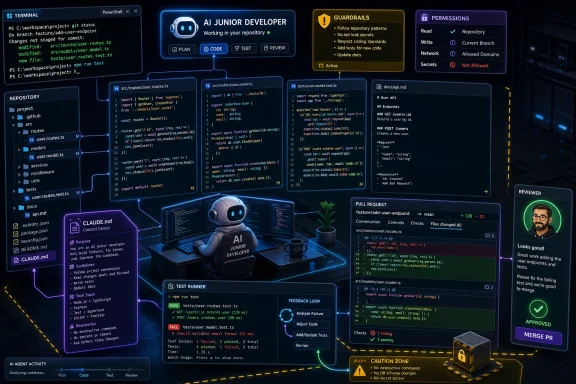 Claude Code Turns the Coding Assistant Into a Project Actor
The first generation of AI coding tools mostly lived where developers already typed. GitHub Copilot and its imitators improved the next line, the next function, or the next small block of boilerplate. Their promise was speed at the keyboard.Claude Code’s premise is different. It assumes the important unit of work is not a line of code but a task: fix this bug, migrate this API, add authentication, explain this subsystem, produce a pull request, or find the test that should have failed. That shift matters because modern software rarely breaks neatly inside a single open file.
The tool’s reputation comes from this project-level posture. Claude Code can read repository structure, inspect dependencies, follow conventions, and make coordinated edits across multiple files. In the best cases, that changes the developer’s role from “person typing every change” to “person defining intent, supervising execution, and reviewing consequences.”
This is why some developers describe the experience as disorienting. A coding assistant that suggests a helper function is easy to categorize. A coding agent that edits routes, models, tests, docs, and configuration in one pass starts to look like a participant in the development process.
The Terminal Is the Point, Not a Nostalgic Interface Choice
Claude Code’s terminal-first design is not just an aesthetic nod to developers who prefer shells over dashboards. The terminal is where build systems, test runners, package managers, git workflows, linters, and deployment scripts already meet. Giving an AI agent controlled access to that environment lets it observe failure instead of merely predicting success.That observation loop is the difference between code generation and agentic development. Claude Code can propose a change, run the relevant tests, see a stack trace, revise its approach, and try again. It does not always do this perfectly, but the workflow is fundamentally more powerful than pasting an error into a chatbot and waiting for a guess.
IDE integrations still matter, particularly for teams that live in VS Code or JetBrains products. But the deeper point is that Claude Code is designed around the software project as a living system. The repository, the command line, the test suite, and the issue tracker become part of the model’s working environment.
That also explains why Claude Code feels more consequential than a browser chatbot. A chatbot can be wrong in prose. A coding agent can be wrong in your repo.
The Million-Token Window Is Useful, but It Is Not Magic
Anthropic’s large context windows are central to Claude Code’s appeal. A one-million-token context window, available in supported plans and models, means the tool can keep far more code, documentation, command output, and conversational history in view than older assistants could manage. For large projects, that can reduce the exhausting ritual of repeatedly re-explaining architecture to the model.The practical benefit is not simply “more text.” It is continuity. Debugging a distributed bug often requires remembering the controller, the service layer, the schema migration, the test fixture, the environment variable, and the previous failed attempt. A larger context window gives the agent a better chance of connecting those details.
But context is not understanding by itself. A million tokens of messy architecture, stale documentation, contradictory comments, and failing tests can still produce confusion at scale. The window is a bigger desk, not a better engineer.
There is also a cost discipline problem. Long context can encourage developers to shovel everything into the session and hope the model sorts it out. The better habit is to curate context deliberately: keep the project instructions clean, prune irrelevant history, and ask Claude Code to verify assumptions against the actual codebase.
Agentic Coding Moves the Bottleneck From Typing to Trust
The phrase agentic coding risks becoming another AI marketing fog machine, but in Claude Code’s case it describes a real operational difference. The tool does not merely answer prompts; it plans work, chooses files, invokes tools, edits code, and iterates through errors. That makes it powerful precisely because it compresses several developer actions into one supervised loop.Consider a request to add a new billing state to a product. A traditional assistant might help write an enum value or a conditional. Claude Code can search the repository for all billing states, modify backend validation, update UI copy, adjust tests, and flag documentation that now disagrees with behavior. That breadth is why developers are paying attention.
It is also where the danger lives. The more an AI agent does without interruption, the more opportunities it has to make plausible but flawed changes. A mistake in a single generated function is easy to inspect. A coordinated multi-file change can hide its error in the interaction between layers.
This is the new bargain. Claude Code can reduce mechanical effort, but it increases the premium on review skill. Developers who cannot read diffs carefully, reason about test coverage, or identify architectural drift may find themselves accepting polished mistakes faster than they used to create them manually.
CLAUDE.md Is the Quiet Center of the Workflow
One of Claude Code’s most important features is not flashy at all. TheCLAUDE.md file acts as persistent project memory, giving the agent standing instructions about the codebase, conventions, build commands, architecture, deployment expectations, and security rules. For teams, it can become a kind of operating manual for AI-assisted work.This matters because prompt quality is not just about clever one-off wording. Software projects have norms. They have naming conventions, forbidden patterns, migration procedures, testing expectations, and scars from previous incidents. If those rules live only in senior engineers’ heads, an AI agent will rediscover them the hard way.
A good
CLAUDE.md file can make Claude Code feel dramatically more competent. It can tell the agent which commands to run, which directories to avoid, how to structure commits, when to update snapshots, and what “done” means for this particular repository. That is not prompt engineering as parlor trick; it is documentation with an execution target.The lesson for teams is uncomfortable but useful. If Claude Code performs badly in a project, the problem may not be only the model. It may be that the project’s own rules were never written down clearly enough for humans either.
Skills, Commands, Agents, and Plugins Turn Habits Into Infrastructure
Claude Code’s customization model points toward a broader transformation in developer tooling. Commands let teams package repeatable workflows behind slash commands. Skills preserve domain knowledge and procedures. Agents can be specialized for security, performance, testing, documentation, or architecture review. Plugins bundle these pieces into reusable systems.This is where Claude Code starts to look less like a product and more like a platform. A small team might use it casually to generate tests or explain legacy code. A larger organization can build standardized review flows, deployment checks, migration assistants, and documentation routines around it.
The appeal is obvious. Engineering organizations spend enormous energy trying to turn best practices into repeatable behavior. If an agent can be taught to follow those habits every time it touches a repo, teams get a new enforcement layer that is more flexible than static linting and less dependent on tribal memory.
The risk is equally obvious. Bad practices can be automated too. A poorly designed plugin or overbroad agent instruction can standardize mediocrity across an organization. Claude Code makes process executable, which means the process had better be worth executing.
MCP Makes Claude Code More Powerful and More Dangerous
Model Context Protocol, or MCP, is one of the most important pieces of Anthropic’s broader strategy. It gives AI tools a common way to connect to external systems such as source control, databases, issue trackers, observability platforms, internal documentation, and collaboration tools. In Claude Code, that can turn a coding assistant into a workflow operator.The upside is substantial. A coding agent that can inspect a GitHub issue, check a database schema, read logs, update a ticket, and modify code has a much richer view of reality than one trapped inside the repository. For debugging and operations-heavy engineering, that external context can be decisive.
But MCP also expands the blast radius. Once an agent can reach production-like systems, private data, internal tools, or CI/CD workflows, ordinary coding mistakes become governance questions. Permissioning, audit logs, sandboxing, and least-privilege access are not enterprise bureaucracy here; they are table stakes.
Security researchers and practitioners have already raised concerns about how rapidly MCP-style ecosystems are spreading. The protocol’s value comes from connecting agents to tools. Its risk comes from connecting agents to tools. Those are not separate facts.
Code Review Is the Killer Use Case, but Not the Way Vendors Pitch It
The most glamorous demo is the agent that builds a feature while the developer drinks coffee. The more durable enterprise use case may be less cinematic: code review. Claude Code is well suited to reading a diff, tracing consequences across a codebase, checking tests, and identifying inconsistencies that a tired human reviewer might miss.This does not mean AI should become the final reviewer. It means AI can become the first relentless reviewer. It can ask whether an error path is tested, whether a migration is reversible, whether a new API response breaks a client, or whether a security-sensitive change deserves extra scrutiny.
For high-volume teams, that matters. Pull request review is often where velocity and quality collide. Humans are supposed to catch everything, but they are also under pressure to unblock colleagues. An agent that reduces the obvious misses can make human review more focused.
The strongest version of this workflow treats Claude Code as a reviewer with no authority. It can comment, rank, suggest, and test. A human still owns the merge.
The Price Complaint Is Really a Workload Complaint
Claude Code’s cost and usage limits are among the most common frustrations from heavy users. That is not surprising. Agentic coding burns through more compute than autocomplete because it reads more context, takes more steps, runs longer sessions, and often iterates. The economic model of “ask a question, get an answer” does not map cleanly onto “delegate a chunk of engineering work.”For casual users, lower-tier access may be enough to explore the tool, refactor small projects, or get help navigating unfamiliar code. For daily professional use, developers often find themselves looking at higher-cost plans or API billing. The more Claude Code becomes part of the workday, the more usage limits feel like workflow interruptions rather than product boundaries.
This is a classic platform maturation problem. Developers want the agent to be always available, deeply contextual, and cheap. Vendors want to cover the cost of frontier models and long-context inference. Those incentives are not yet comfortably aligned.
The result is a tool that can feel simultaneously indispensable and rationed. That tension will shape adoption as much as model quality.
Claude Code Rewards Good Engineering Hygiene
Claude Code works best in projects that already have some discipline. Clear structure, reliable tests, accurate documentation, consistent naming, and predictable build commands all give the agent firmer ground. In chaotic repositories, it can still help, but it is more likely to wander, overfit to misleading examples, or make changes that satisfy the prompt while worsening the system.This is a revealing limitation. AI coding agents do not eliminate the need for engineering hygiene; they amplify the value of it. A well-organized repo becomes more legible not only to humans but also to machines. A neglected repo becomes a maze with a very confident tour guide.
That should influence how teams adopt Claude Code. Before asking it to perform sweeping refactors, they should ask it to map the project, document assumptions, identify missing tests, and explain risky areas. The early value may be in making the codebase more agent-readable.
In that sense, Claude Code is another reason to pay down technical debt. Not because AI cannot work around mess, but because messy systems make automation harder to trust.
Windows Developers Should Watch the Workflow, Not Just the Brand
For WindowsForum readers, Claude Code is interesting even if they do not live inside Anthropic’s ecosystem. Windows development increasingly spans PowerShell, WSL, containers, Visual Studio Code, GitHub, Azure, local build tools, and cross-platform frameworks. An agentic coding tool that can operate across that sprawl is more relevant than a language-specific autocomplete engine.The Windows angle is not merely whether Claude Code has a native app or an IDE extension. It is whether the tool can understand the workflow realities of modern Windows shops: mixed environments, legacy .NET applications, Node front ends, Python scripts, SQL databases, CI pipelines, and enterprise security controls. The harder the environment is to hold in one person’s head, the more attractive an agent becomes.
Sysadmins and IT pros should also pay attention because coding agents are bleeding into automation. The same patterns that help a developer update tests can help an administrator generate scripts, inspect logs, document runbooks, or standardize configuration changes. That does not make every sysadmin a developer, but it does make software discipline more relevant to infrastructure work.
The caution is familiar. If an AI agent can write a PowerShell script that changes hundreds of machines, the review burden is not optional. It is the job.
The Real Competition Is Not Autocomplete
Claude Code competes with GitHub Copilot, Cursor, Windsurf, OpenAI’s developer tools, Google’s coding models, and a growing field of agentic IDEs. But framing the competition as “which assistant writes better code?” undersells the change underway. The contest is becoming about who owns the development loop.Autocomplete owns the moment of typing. IDE agents own the editing surface. Terminal agents own execution. Repository agents own code review. MCP-style integrations reach into issue tracking, observability, and operations. The winning platform may be the one that connects all of those moments without making developers feel like they have surrendered control.
Anthropic’s advantage is that Claude has built a strong reputation for reasoning, long-context work, and developer-friendly responses. Claude Code extends that reputation into an operational product. But reputations in AI are fragile because model quality, pricing, latency, and limits change quickly.
The market is also not waiting. Once developers accept that an AI can modify a project directly, every major vendor will try to become the trusted agent in that loop. Claude Code is ahead in mindshare today, but the category is moving too fast for permanent leads.
The Teams That Benefit Most Will Manage Claude Code Like a New Hire
The right mental model for Claude Code is not “magic compiler for English.” It is closer to a fast, tireless, sometimes brilliant, sometimes reckless new hire who has read the repo and can run commands. That new hire can be enormously productive with clear instructions, good tests, and close review. It can also create impressive-looking damage if handed vague goals and broad permissions.This is why governance should start early. Teams should define what Claude Code may edit, what it may run, when it needs approval, which systems are off-limits, and how AI-generated changes are labeled or reviewed. These rules do not need to be theatrical, but they do need to exist.
The best teams will build a rhythm around the tool. They will use it for exploration before implementation, require tests before merges, keep
CLAUDE.md current, and treat agent output as draft work. They will also compare its recommendations against production reality, not just against its own explanation.In other words, Claude Code does not remove engineering management. It creates a new thing to manage.
The Claude Code Advantage Is Real Only When the Guardrails Are Real
Claude Code deserves the attention it is getting, but the practical story is narrower and more useful than the hype. It is strongest when pointed at real repositories with clear conventions, meaningful tests, and developers who know how to review its work. It is weakest when treated as an oracle.- Claude Code is best understood as an agentic development tool, not a conventional autocomplete assistant.
- Its large context window can help with whole-codebase reasoning, but it does not compensate for poor documentation or weak architecture.
CLAUDE.mdis one of the highest-leverage parts of the workflow because it turns project expectations into persistent agent instructions.- MCP integrations make Claude Code much more useful, but they also require serious permissioning and security review.
- The most reliable productivity gains come from supervised tasks such as code review, test generation, refactoring support, and repository exploration.
- Heavy users should evaluate pricing and usage limits as part of the workflow, not as an afterthought.
References
- Primary source: eWeek
Published: 2026-06-12T23:50:15.591762
Claude Code Explained: What to Know About Anthropic’s AI Coding Tool | eWeek
Learn what Claude Code is, how Anthropic’s AI coding agent works, where it excels, its limits, pricing concerns, and who should use it. www.eweek.com
- Official source: support.anthropic.com
Use Claude Code with your Pro or Max plan | Claude Help Center
support.anthropic.com
- Official source: support.claude.com
How large is the context window on paid Claude plans? | Claude Help Center
- Official source: claude.com
1M context is now generally available for Opus 4.6 and Sonnet 4.6 | Claude
Standard pricing now applies across the full 1M window for both models, with no long-context premium. Media limits expand to 600 images or PDF pages. claude.com
- Related coverage: claudecodecamp.com
Claude Code 1M Context Window: Cost, Limits, and When to Use It
I ran experiments on Claude's 1M token context window. It costs 3x more for long sessions and retrieval degrades at scale. Here's when it's actually worth using.www.claudecodecamp.com - Related coverage: claudeguide.io
Claude 1M Context Window: What It Can Do and What It Costs | ClaudeGuide
Claude's 1M context window fits 750K words or 10 MB of code — but costs up to $7 per request. Exact pricing breakdown, use cases, and when to skip it.claudeguide.io
- Official source: code.claude.com
Extend Claude Code - Claude Code Docs
Understand when to use CLAUDE.md, Skills, subagents, hooks, MCP, and plugins.code.claude.com - Related coverage: docs.bswen.com
How Does Claude's 1 Million Token Context Window Work and What Can You Do? | BSWEN
Claude's 1M token context window fits 750,000 words or entire codebases. I explain how Opus 4.6 and Sonnet 4.6 use expanded context, what changed from the beta, and practical use cases for Cowork and Claude Code.docs.bswen.com
- Related coverage: itpro.com
Anthropic reveals Claude Opus 4.6, an enterprise-focused model with 1 million token context window for extended code capabilities | IT Pro
The AI developer highlighted financial and legal tasks, as well as agent tool use, as particular strengths for the new modelwww.itpro.com - Related coverage: techradar.com
- Related coverage: tomsguide.com
What is Claude? Everything you need to know about Anthropic's AI powerhouse | Tom's Guide
Smarter, safer and surprisingly thoughtful — here's how Claude stacks up in the battle of the bots.www.tomsguide.com - Official source: resources.anthropic.com
- Related coverage: time.com
AI Is Moving Past Chatbots. Claude Cowork Shows What's Next
An AI powerful enough to analyze DNA, file taxes, and grow tomato plants is being redesigned for everyday work, pointing toward life beyond chatbots.time.com - Official source: www-cdn.anthropic.com
