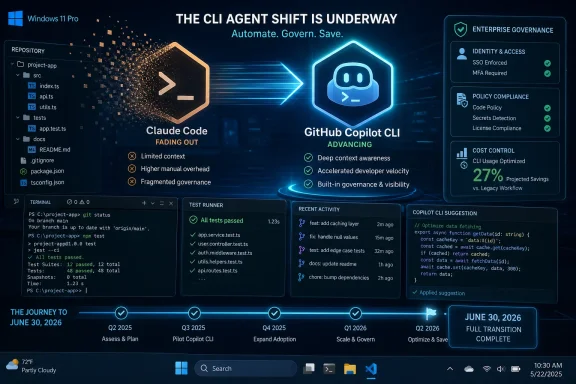
Microsoft reportedly began canceling or restricting Claude Code access for many internal engineering teams in May 2026, steering developers in its Experiences + Devices organization toward GitHub Copilot CLI by a June 30 transition deadline. That is not a retreat from AI coding so much as a hard lesson in who gets to own the toolchain when AI leaves the lab. The most interesting part of the story is not that Claude Code was bad; by many accounts, it was popular. The interesting part is that popularity may have made the bill, the governance problem, and the strategic conflict impossible to ignore.
For the last two years, the easiest way to understand enterprise AI adoption was to watch the pilots multiply. Every serious software organization wanted access to frontier models, every developer productivity group wanted a bake-off, and every executive wanted a credible answer to the boardroom question: What are we doing with AI? In that phase, letting teams test Claude Code made perfect sense.
Claude Code arrived with a reputation for being unusually capable at real software work. It was not just another autocomplete pane. It could reason across files, work through command-line tasks, and behave more like a pair programmer with a terminal than a conventional code suggestion engine. For engineers tired of narrow IDE hints, that mattered.
But Microsoft is not a neutral buyer of developer tools. It owns GitHub, sells Copilot, runs Azure, builds Windows, and has spent years turning developer workflows into strategic distribution. A third-party coding agent gaining traction inside Microsoft’s own product groups was never just an internal procurement question. It was a platform question wearing an expense-report badge.
That is why the reported shift toward GitHub Copilot CLI is more revealing than a simple cost-cutting memo. Microsoft appears to be saying that the AI coding assistant of record cannot merely be the one engineers like best in May 2026. It has to be the one the company can integrate, audit, tune, meter, secure, and eventually sell.
Claude Code’s apparent popularity inside Microsoft is precisely what makes the pullback worth watching. If the tool had flopped, the story would be forgettable. Instead, reports suggest it became widely used after access expanded to thousands of employees, including not only developers but also product managers and designers experimenting with AI-assisted prototyping. That is the kind of organic adoption most software vendors dream about.
Yet organic adoption is also how shadow platforms form. A tool that begins as an experiment can become part of daily work before finance, security, and platform owners have agreed on what it should cost or how it should be governed. At Microsoft’s scale, “a few teams trying something promising” can quickly become a material operating expense.
This is the uncomfortable enterprise AI pattern now emerging. The first phase rewards enthusiasm. The second phase punishes unmanaged enthusiasm. Once AI agents become habit-forming inside engineering teams, the question changes from “Does it work?” to “Can we afford it if everyone uses it this much?”
The reported language from Microsoft leadership is telling. Rajesh Jha, who leads Experiences + Devices, framed the move around a push toward one agentic command-line interface across engineering teams. In plain English: fewer tools, fewer exceptions, more standardization.
That is a very Microsoft answer. The company has spent decades building value by making platforms that enterprises can centrally manage. Windows, Active Directory, Office, Intune, Azure, GitHub, and Microsoft 365 all thrive on the promise that complexity can be brought under one administrative umbrella. AI coding agents are now being pulled into that same logic.
The command line matters here because it is where agentic coding tools become more than chatbots. A coding agent with terminal access can inspect projects, run commands, generate diffs, test assumptions, and iterate. That power makes it useful, but also makes it sensitive. When an agent is operating near source code, build systems, credentials, and developer machines, platform owners naturally want tighter control.
Now the bill is becoming the product. AI coding tools are not like traditional developer utilities, where the marginal cost of heavy usage is mostly someone else’s server line item. Agentic coding assistants consume expensive inference, often across long context windows, repeated tool calls, and iterative loops. A developer who leans hard on an AI agent may generate a radically different cost profile from a developer who merely accepts autocomplete suggestions.
That variability is toxic to enterprise budgeting. A per-seat license feels predictable until usage-based economics surface underneath it. A tool that seems affordable during a controlled rollout can become alarming when thousands of employees start using it as an always-on collaborator.
Microsoft is better positioned than almost anyone to understand this. It operates huge cloud infrastructure, has deep AI partnerships, and sells AI services to customers that ask the same questions Microsoft must ask internally. If even Microsoft is reportedly rationalizing access to a popular coding assistant, the rest of the enterprise market should pay attention.
Once a tool becomes infrastructure, the buying criteria change. Individual delight still matters, but it no longer rules the decision. The enterprise wants audit logs, policy enforcement, predictable billing, data boundaries, model routing, admin controls, and integration with internal knowledge. It wants a support contract, not just a clever assistant.
That shift favors vendors that own more of the surrounding workflow. GitHub has the repository, the pull request, the issue tracker, the developer identity surface, and the Copilot brand. Microsoft has the enterprise account relationship, Azure capacity, security products, and decades of procurement muscle. Anthropic may have an excellent coding agent, but Microsoft has a reason to make the platform around coding agents its own.
This is not unique to Microsoft. Every major company with a strategic AI stack will face the same temptation. If a third-party model performs better, executives will test it. If it becomes essential, executives will ask why they do not control it. The better the outside tool performs, the more dangerous dependence on it can look.
That makes the episode more consequential. In the old SaaS world, a beloved third-party productivity tool could spread inside a company and become hard to dislodge. In the AI-agent world, that same spread can create unpredictable compute exposure and new security concerns. The more people use the agent, the more prompts, code context, logs, outputs, and workflow dependencies accumulate.
Claude Code may also have exposed an awkward comparison problem. If Microsoft employees preferred an external coding agent over Microsoft’s own internal direction, that would create pressure on the Copilot organization. A company can tolerate outside tools during evaluation. It is much harder to tolerate them when they undermine the adoption story of a product Microsoft is selling to customers.
This is where the vendor narrative and the internal operating reality collide. Publicly, Big Tech companies want to project openness, model choice, and best-tool-for-the-job pragmatism. Internally, they need standard platforms. The tension is not hypocrisy so much as the inevitable result of turning AI from an experimental layer into a production dependency.
The date is also symbolically neat because June 30 is the end of Microsoft’s fiscal year. That does not prove the decision was primarily financial, but it certainly fits a budgeting rhythm. Enterprises often use fiscal boundaries to clean up licenses, consolidate vendors, and reset spending categories before the next planning cycle begins.
For engineers, these transitions are rarely frictionless. Tool preference is personal because development workflows are personal. A coding agent that understands one developer’s habits, shell environment, project structure, and problem-solving style becomes part of muscle memory. Replacing it with a sanctioned alternative can feel like losing productivity even if the new tool eventually catches up.
That human factor will matter. AI coding agents are still young enough that perceived quality differences can be large. If developers believe Claude Code handles refactors, debugging, or multi-file reasoning better than Copilot CLI, the standardization push may generate quiet resentment. Microsoft’s challenge is not only to mandate the internal platform but to make it good enough that the mandate does not feel like a downgrade.
If AI coding tools are changing how these teams work, they may eventually change how Microsoft ships software. Faster prototyping, more automated refactoring, broader test generation, and AI-assisted bug fixing could all influence the cadence and character of Windows and Office development. But the toolchain that enables that work must be trusted at extraordinary scale.
Windows engineering is not a place where a coding assistant can be treated casually. The operating system sits at the center of enterprise fleets, regulated environments, consumer PCs, gaming rigs, and security-sensitive endpoints. A coding agent used near that codebase must satisfy constraints that go far beyond whether it can write a decent function.
That is why Microsoft’s preference for a controlled internal AI path is predictable. The company cannot sell IT administrators on trustworthy AI management while letting its own core product teams sprawl across unmanaged agentic tools. The internal platform has to model the external promise.
A superior model can win developers’ affection, but an integrated platform can win the enterprise standard. Copilot does not need to be the best at every micro-task if it is present where developers already work, manageable by the same administrators, billed through the same contracts, and aligned with the same security posture. That is the old Microsoft playbook updated for the agent era.
This is also why Anthropic, OpenAI, Google, and other model companies are racing to become more than model providers. They need developer surfaces, enterprise controls, agent frameworks, and durable workflow hooks. A model API is powerful, but a model API can be swapped, routed, or hidden behind another company’s product.
Microsoft understands this because it has lived on both sides of the abstraction. It uses partner models where useful, but it wants the customer relationship, the control plane, and the workflow. Copilot CLI is not only a coding tool. It is a claim about where the center of developer AI should live.
This is the phase where AI stops being a demo and starts becoming a line item. It is also where the industry discovers that “everyone gets an agent” is a very different proposition from “a few teams run a pilot.” The economics of inference, especially for high-context and tool-using agents, are now shaping product strategy.
The same pressure is likely to hit other companies. A fast-growing startup may tolerate high AI coding costs if it believes the productivity gains are existential. A mature enterprise will demand proof. It will ask whether the tool reduces cycle time, lowers defect rates, accelerates onboarding, improves test coverage, or merely makes developers feel faster while moving costs from payroll to compute.
That measurement problem is still unresolved. Developer productivity is notoriously hard to quantify, and AI makes it harder by changing the shape of work. A tool may help one engineer enormously while slowing another through review overhead or over-generated code. The CFO will want a clean number. Engineering reality will not provide one easily.
The obvious concern is source-code exposure. Enterprises want assurance about what code is sent to a model provider, how it is retained, whether it can be used for training, and who can access logs. But the subtler concern is action. A coding agent that can run commands or modify files has to be constrained by policy, not just trust.
Internal platform teams will want reproducible behavior, approvals for risky operations, integration with code review, and guardrails around secrets. They will also want telemetry to understand how agents are being used. In a heavily regulated or security-sensitive environment, those requirements become non-negotiable.
This is where a Microsoft-controlled tool has an institutional advantage inside Microsoft. The company can align it with internal expectations and then turn those lessons into product features for customers. The dogfooding loop is obvious: whatever Microsoft learns from forcing its own teams onto Copilot CLI can become the enterprise pitch for Copilot more broadly.
This is the gravitational pull toward consolidation. A company may begin with OpenAI for chat, Anthropic for coding, Google for long-context research, a local model for sensitive workloads, and a dozen wrappers built by enthusiastic internal teams. Six months later, the architecture diagram looks less like innovation and more like technical debt.
Microsoft’s reported move suggests that the consolidation wave is arriving early. The company is not saying, at least publicly, that Claude Code lacks merit. It is saying, by action, that a common internal AI toolchain matters more than letting every team keep the agent it prefers.
For users and administrators, that is a familiar story. The enterprise usually trades optionality for manageability. The twist is that AI tools are evolving so quickly that the trade can feel painful. Locking into a standard in 2026 may mean giving up features another vendor shipped last week. But not standardizing may mean losing control of costs and risk.
A developer does not need to provision a server to create cost anymore. They can generate it through repeated prompts, long context windows, iterative debugging sessions, and agentic loops that call tools over and over. The work may be productive, but the cost is no longer abstract.
That will change how companies manage AI access. Expect more dashboards, quotas, team-level budgets, preferred-model routing, and internal policies that distinguish between light assistance and expensive autonomous workflows. The era of unlimited AI experimentation for every employee is likely to be short.
This is not necessarily bad for developers. A better-managed AI platform can be faster, safer, and more reliable than a chaotic collection of external tools. But it will feel different from the early AI boom, when the most motivated employees could simply adopt the best tool they could find and expense it later.
That should worry pure-play AI vendors. If their products become beloved but expensive, platform owners will copy, wrap, route around, or replace them. If their models remain indispensable, they will have leverage. If they are merely preferred, they may lose to incumbents with better distribution.
It should also worry customers who assume model choice will remain abundant at the employee level. The more AI becomes infrastructure, the more choices will move upward to central IT, security, procurement, and platform engineering. Individual developers may get better tools overall, but fewer unsanctioned ones.
Microsoft’s move also complicates the common narrative that Big Tech has infinite AI capacity. It does not. Even hyperscalers face tradeoffs. Compute allocated to internal coding agents is compute not sold to customers, not used for training, or not reserved for higher-margin services. AI infrastructure may be massive, but it is not free.
Microsoft has advantages. It can integrate Copilot CLI deeply with GitHub, tune it against internal workflows, collect feedback from some of the world’s largest software teams, and rapidly close feature gaps. It can also use multiple underlying models if that helps performance while keeping the product surface under Microsoft control.
But the company also faces a credibility challenge. Developers know when they are being asked to use a tool because it is better and when they are being asked to use it because it is owned by the company. If Copilot CLI feels like a corporate substitution rather than an engineering upgrade, adoption may become compliance rather than enthusiasm.
That distinction matters because AI coding tools work best when developers trust them enough to incorporate them into real workflows. A mandated assistant can be opened and ignored. A trusted assistant becomes part of how code is written. Microsoft’s platform strategy only succeeds if Copilot CLI becomes the second kind.
The questions are practical. Who approves AI coding tools? What code can they access? Are prompts retained? Are outputs scanned? Are costs allocated by team? Can administrators disable risky features? Does the tool integrate with existing identity and logging? What happens when a popular pilot becomes a production dependency?
Those are not abstract governance questions anymore. They are procurement questions, security questions, and budget questions. The organizations that answer them early will have more room to experiment safely. The ones that do not will discover their AI strategy through invoices and incident reviews.
This is the deeper meaning of Microsoft’s reported shift. It marks the point at which AI coding assistants stop being treated as exciting accessories and start being treated as managed enterprise systems. That is less glamorous than a benchmark chart, but far more important.
 Microsoft’s Claude Experiment Ran Into Microsoft’s Platform Instinct
For the last two years, the easiest way to understand enterprise AI adoption was to watch the pilots multiply. Every serious software organization wanted access to frontier models, every developer productivity group wanted a bake-off, and every executive wanted a credible answer to the boardroom question: What are we doing with AI? In that phase, letting teams test Claude Code made perfect sense.Claude Code arrived with a reputation for being unusually capable at real software work. It was not just another autocomplete pane. It could reason across files, work through command-line tasks, and behave more like a pair programmer with a terminal than a conventional code suggestion engine. For engineers tired of narrow IDE hints, that mattered.
But Microsoft is not a neutral buyer of developer tools. It owns GitHub, sells Copilot, runs Azure, builds Windows, and has spent years turning developer workflows into strategic distribution. A third-party coding agent gaining traction inside Microsoft’s own product groups was never just an internal procurement question. It was a platform question wearing an expense-report badge.
That is why the reported shift toward GitHub Copilot CLI is more revealing than a simple cost-cutting memo. Microsoft appears to be saying that the AI coding assistant of record cannot merely be the one engineers like best in May 2026. It has to be the one the company can integrate, audit, tune, meter, secure, and eventually sell.
The Tool That Wins the Pilot Does Not Always Win the Enterprise
A recurring mistake in AI coverage is assuming that model quality decides everything. It does not. In enterprise software, the best tool in a trial often loses to the tool that fits the organization’s risk model, procurement structure, identity stack, compliance posture, and internal politics.Claude Code’s apparent popularity inside Microsoft is precisely what makes the pullback worth watching. If the tool had flopped, the story would be forgettable. Instead, reports suggest it became widely used after access expanded to thousands of employees, including not only developers but also product managers and designers experimenting with AI-assisted prototyping. That is the kind of organic adoption most software vendors dream about.
Yet organic adoption is also how shadow platforms form. A tool that begins as an experiment can become part of daily work before finance, security, and platform owners have agreed on what it should cost or how it should be governed. At Microsoft’s scale, “a few teams trying something promising” can quickly become a material operating expense.
This is the uncomfortable enterprise AI pattern now emerging. The first phase rewards enthusiasm. The second phase punishes unmanaged enthusiasm. Once AI agents become habit-forming inside engineering teams, the question changes from “Does it work?” to “Can we afford it if everyone uses it this much?”
Copilot CLI Is Microsoft’s Answer to a Control Problem
GitHub Copilot CLI gives Microsoft a more natural internal standard because it sits closer to the company’s own strategic center of gravity. It is a GitHub product, it can be shaped around Microsoft repositories and workflows, and it can be tied into Microsoft’s security and identity expectations more directly than an external tool. That does not automatically make it better for every individual developer, but it makes it more legible to the institution.The reported language from Microsoft leadership is telling. Rajesh Jha, who leads Experiences + Devices, framed the move around a push toward one agentic command-line interface across engineering teams. In plain English: fewer tools, fewer exceptions, more standardization.
That is a very Microsoft answer. The company has spent decades building value by making platforms that enterprises can centrally manage. Windows, Active Directory, Office, Intune, Azure, GitHub, and Microsoft 365 all thrive on the promise that complexity can be brought under one administrative umbrella. AI coding agents are now being pulled into that same logic.
The command line matters here because it is where agentic coding tools become more than chatbots. A coding agent with terminal access can inspect projects, run commands, generate diffs, test assumptions, and iterate. That power makes it useful, but also makes it sensitive. When an agent is operating near source code, build systems, credentials, and developer machines, platform owners naturally want tighter control.
Cost Is the First Honest Enterprise AI Metric
For much of the AI boom, pricing was treated as background noise. The public conversation focused on benchmark scores, context windows, demos, and whether a model could solve increasingly theatrical coding problems. Enterprises played along because pilots were easier to justify than full deployments.Now the bill is becoming the product. AI coding tools are not like traditional developer utilities, where the marginal cost of heavy usage is mostly someone else’s server line item. Agentic coding assistants consume expensive inference, often across long context windows, repeated tool calls, and iterative loops. A developer who leans hard on an AI agent may generate a radically different cost profile from a developer who merely accepts autocomplete suggestions.
That variability is toxic to enterprise budgeting. A per-seat license feels predictable until usage-based economics surface underneath it. A tool that seems affordable during a controlled rollout can become alarming when thousands of employees start using it as an always-on collaborator.
Microsoft is better positioned than almost anyone to understand this. It operates huge cloud infrastructure, has deep AI partnerships, and sells AI services to customers that ask the same questions Microsoft must ask internally. If even Microsoft is reportedly rationalizing access to a popular coding assistant, the rest of the enterprise market should pay attention.
The AI Coding Assistant Is Becoming Infrastructure
The industry still talks about AI coding tools as if they are apps. That framing is increasingly obsolete. Inside a large engineering organization, an AI coding assistant is closer to infrastructure: it touches source code, developer identity, telemetry, secrets handling, review processes, build systems, and incident response.Once a tool becomes infrastructure, the buying criteria change. Individual delight still matters, but it no longer rules the decision. The enterprise wants audit logs, policy enforcement, predictable billing, data boundaries, model routing, admin controls, and integration with internal knowledge. It wants a support contract, not just a clever assistant.
That shift favors vendors that own more of the surrounding workflow. GitHub has the repository, the pull request, the issue tracker, the developer identity surface, and the Copilot brand. Microsoft has the enterprise account relationship, Azure capacity, security products, and decades of procurement muscle. Anthropic may have an excellent coding agent, but Microsoft has a reason to make the platform around coding agents its own.
This is not unique to Microsoft. Every major company with a strategic AI stack will face the same temptation. If a third-party model performs better, executives will test it. If it becomes essential, executives will ask why they do not control it. The better the outside tool performs, the more dangerous dependence on it can look.
Claude Code Did Not Have to Fail to Lose
The most important distinction in this story is between technical failure and strategic displacement. There is little evidence that Microsoft’s reported pullback happened because Claude Code was useless. On the contrary, the tool’s popularity appears to be part of the reason the decision became urgent.That makes the episode more consequential. In the old SaaS world, a beloved third-party productivity tool could spread inside a company and become hard to dislodge. In the AI-agent world, that same spread can create unpredictable compute exposure and new security concerns. The more people use the agent, the more prompts, code context, logs, outputs, and workflow dependencies accumulate.
Claude Code may also have exposed an awkward comparison problem. If Microsoft employees preferred an external coding agent over Microsoft’s own internal direction, that would create pressure on the Copilot organization. A company can tolerate outside tools during evaluation. It is much harder to tolerate them when they undermine the adoption story of a product Microsoft is selling to customers.
This is where the vendor narrative and the internal operating reality collide. Publicly, Big Tech companies want to project openness, model choice, and best-tool-for-the-job pragmatism. Internally, they need standard platforms. The tension is not hypocrisy so much as the inevitable result of turning AI from an experimental layer into a production dependency.
The Deadline Turns a Preference Into Policy
The reported June 30 deadline matters because it converts guidance into governance. A recommendation to use Copilot CLI would be soft platform politics. A deadline to remove Claude Code from workflows is something else. It tells teams that the experiment has ended and the standard is being enforced.The date is also symbolically neat because June 30 is the end of Microsoft’s fiscal year. That does not prove the decision was primarily financial, but it certainly fits a budgeting rhythm. Enterprises often use fiscal boundaries to clean up licenses, consolidate vendors, and reset spending categories before the next planning cycle begins.
For engineers, these transitions are rarely frictionless. Tool preference is personal because development workflows are personal. A coding agent that understands one developer’s habits, shell environment, project structure, and problem-solving style becomes part of muscle memory. Replacing it with a sanctioned alternative can feel like losing productivity even if the new tool eventually catches up.
That human factor will matter. AI coding agents are still young enough that perceived quality differences can be large. If developers believe Claude Code handles refactors, debugging, or multi-file reasoning better than Copilot CLI, the standardization push may generate quiet resentment. Microsoft’s challenge is not only to mandate the internal platform but to make it good enough that the mandate does not feel like a downgrade.
Windows and Office Make This More Than an AI Story
The reported impact on Experiences + Devices gives the story a distinctly WindowsForum.com flavor. This is the organization associated with some of Microsoft’s most visible products: Windows, Microsoft 365, Outlook, Teams, and Surface. These are not side projects. They are the products through which hundreds of millions of users experience Microsoft’s platform decisions.If AI coding tools are changing how these teams work, they may eventually change how Microsoft ships software. Faster prototyping, more automated refactoring, broader test generation, and AI-assisted bug fixing could all influence the cadence and character of Windows and Office development. But the toolchain that enables that work must be trusted at extraordinary scale.
Windows engineering is not a place where a coding assistant can be treated casually. The operating system sits at the center of enterprise fleets, regulated environments, consumer PCs, gaming rigs, and security-sensitive endpoints. A coding agent used near that codebase must satisfy constraints that go far beyond whether it can write a decent function.
That is why Microsoft’s preference for a controlled internal AI path is predictable. The company cannot sell IT administrators on trustworthy AI management while letting its own core product teams sprawl across unmanaged agentic tools. The internal platform has to model the external promise.
The Next AI War Is About Distribution, Not Just Intelligence
The AI industry likes to talk as if the smartest model will win. Big Tech behaves as if distribution will decide the market. Microsoft’s reported Claude Code pullback is a case study in the second view.A superior model can win developers’ affection, but an integrated platform can win the enterprise standard. Copilot does not need to be the best at every micro-task if it is present where developers already work, manageable by the same administrators, billed through the same contracts, and aligned with the same security posture. That is the old Microsoft playbook updated for the agent era.
This is also why Anthropic, OpenAI, Google, and other model companies are racing to become more than model providers. They need developer surfaces, enterprise controls, agent frameworks, and durable workflow hooks. A model API is powerful, but a model API can be swapped, routed, or hidden behind another company’s product.
Microsoft understands this because it has lived on both sides of the abstraction. It uses partner models where useful, but it wants the customer relationship, the control plane, and the workflow. Copilot CLI is not only a coding tool. It is a claim about where the center of developer AI should live.
Enterprise AI Is Entering Its Boring, Expensive Phase
The first wave of generative AI was exciting because it felt magical. The next wave will be more boring because it will be governed by procurement, identity management, security review, vendor consolidation, cost allocation, and internal chargebacks. That may sound dull, but it is how technology becomes permanent.This is the phase where AI stops being a demo and starts becoming a line item. It is also where the industry discovers that “everyone gets an agent” is a very different proposition from “a few teams run a pilot.” The economics of inference, especially for high-context and tool-using agents, are now shaping product strategy.
The same pressure is likely to hit other companies. A fast-growing startup may tolerate high AI coding costs if it believes the productivity gains are existential. A mature enterprise will demand proof. It will ask whether the tool reduces cycle time, lowers defect rates, accelerates onboarding, improves test coverage, or merely makes developers feel faster while moving costs from payroll to compute.
That measurement problem is still unresolved. Developer productivity is notoriously hard to quantify, and AI makes it harder by changing the shape of work. A tool may help one engineer enormously while slowing another through review overhead or over-generated code. The CFO will want a clean number. Engineering reality will not provide one easily.
Security Teams Will Not Treat Agentic Coding as Harmless Autocomplete
There is another reason standardization is inevitable: security. Traditional autocomplete suggests code inside a controlled editor context. Agentic coding tools can read more, infer more, write more, and sometimes execute more. That expanded capability changes the risk profile.The obvious concern is source-code exposure. Enterprises want assurance about what code is sent to a model provider, how it is retained, whether it can be used for training, and who can access logs. But the subtler concern is action. A coding agent that can run commands or modify files has to be constrained by policy, not just trust.
Internal platform teams will want reproducible behavior, approvals for risky operations, integration with code review, and guardrails around secrets. They will also want telemetry to understand how agents are being used. In a heavily regulated or security-sensitive environment, those requirements become non-negotiable.
This is where a Microsoft-controlled tool has an institutional advantage inside Microsoft. The company can align it with internal expectations and then turn those lessons into product features for customers. The dogfooding loop is obvious: whatever Microsoft learns from forcing its own teams onto Copilot CLI can become the enterprise pitch for Copilot more broadly.
The Vendor-Neutral Dream Is Colliding With AI Gravity
In theory, enterprises want model choice. In practice, they want fewer things to manage. AI exaggerates this conflict because each additional tool brings not just another interface but another cost model, data path, policy surface, and support burden.This is the gravitational pull toward consolidation. A company may begin with OpenAI for chat, Anthropic for coding, Google for long-context research, a local model for sensitive workloads, and a dozen wrappers built by enthusiastic internal teams. Six months later, the architecture diagram looks less like innovation and more like technical debt.
Microsoft’s reported move suggests that the consolidation wave is arriving early. The company is not saying, at least publicly, that Claude Code lacks merit. It is saying, by action, that a common internal AI toolchain matters more than letting every team keep the agent it prefers.
For users and administrators, that is a familiar story. The enterprise usually trades optionality for manageability. The twist is that AI tools are evolving so quickly that the trade can feel painful. Locking into a standard in 2026 may mean giving up features another vendor shipped last week. But not standardizing may mean losing control of costs and risk.
Developers Are Becoming the New Cloud Cost Center
Cloud computing already taught companies that developer convenience can become a financial problem. Spin up a cluster, leave a workload running, over-provision storage, duplicate environments across regions, and suddenly the bill tells a story no architecture review captured. AI agents bring the same dynamic to individual work.A developer does not need to provision a server to create cost anymore. They can generate it through repeated prompts, long context windows, iterative debugging sessions, and agentic loops that call tools over and over. The work may be productive, but the cost is no longer abstract.
That will change how companies manage AI access. Expect more dashboards, quotas, team-level budgets, preferred-model routing, and internal policies that distinguish between light assistance and expensive autonomous workflows. The era of unlimited AI experimentation for every employee is likely to be short.
This is not necessarily bad for developers. A better-managed AI platform can be faster, safer, and more reliable than a chaotic collection of external tools. But it will feel different from the early AI boom, when the most motivated employees could simply adopt the best tool they could find and expense it later.
The Microsoft Lesson Is Bigger Than Claude
The sharpest reading of the episode is that Microsoft is rehearsing the future of enterprise AI. Companies will test many models, celebrate the best demos, then consolidate around the platforms they can control. The winners will be judged not only by reasoning quality but by billing predictability, administrative depth, security posture, and integration with the systems where work actually happens.That should worry pure-play AI vendors. If their products become beloved but expensive, platform owners will copy, wrap, route around, or replace them. If their models remain indispensable, they will have leverage. If they are merely preferred, they may lose to incumbents with better distribution.
It should also worry customers who assume model choice will remain abundant at the employee level. The more AI becomes infrastructure, the more choices will move upward to central IT, security, procurement, and platform engineering. Individual developers may get better tools overall, but fewer unsanctioned ones.
Microsoft’s move also complicates the common narrative that Big Tech has infinite AI capacity. It does not. Even hyperscalers face tradeoffs. Compute allocated to internal coding agents is compute not sold to customers, not used for training, or not reserved for higher-margin services. AI infrastructure may be massive, but it is not free.
The Copilot Mandate Will Be Judged by the Code It Ships
The real test of Microsoft’s decision will not be the memo. It will be whether Copilot CLI can meet the expectations set by Claude Code’s internal popularity. Developers have little patience for strategic alignment if the tool slows them down.Microsoft has advantages. It can integrate Copilot CLI deeply with GitHub, tune it against internal workflows, collect feedback from some of the world’s largest software teams, and rapidly close feature gaps. It can also use multiple underlying models if that helps performance while keeping the product surface under Microsoft control.
But the company also faces a credibility challenge. Developers know when they are being asked to use a tool because it is better and when they are being asked to use it because it is owned by the company. If Copilot CLI feels like a corporate substitution rather than an engineering upgrade, adoption may become compliance rather than enthusiasm.
That distinction matters because AI coding tools work best when developers trust them enough to incorporate them into real workflows. A mandated assistant can be opened and ignored. A trusted assistant becomes part of how code is written. Microsoft’s platform strategy only succeeds if Copilot CLI becomes the second kind.
The Claude Pullback Gives IT a Preview of Its Own 2026
For Windows administrators and enterprise IT leaders, the lesson is not that Claude Code is risky or Copilot CLI is automatically right. The lesson is that AI tool sprawl is coming for every organization that has not already created a policy. If Microsoft has to rationalize agentic coding access internally, most companies will too.The questions are practical. Who approves AI coding tools? What code can they access? Are prompts retained? Are outputs scanned? Are costs allocated by team? Can administrators disable risky features? Does the tool integrate with existing identity and logging? What happens when a popular pilot becomes a production dependency?
Those are not abstract governance questions anymore. They are procurement questions, security questions, and budget questions. The organizations that answer them early will have more room to experiment safely. The ones that do not will discover their AI strategy through invoices and incident reviews.
This is the deeper meaning of Microsoft’s reported shift. It marks the point at which AI coding assistants stop being treated as exciting accessories and start being treated as managed enterprise systems. That is less glamorous than a benchmark chart, but far more important.
The Bill Comes Due for the Agentic Future
The concrete lesson from Microsoft’s Claude Code pullback is that agentic AI is not being abandoned; it is being domesticated. The wild phase of tool adoption is giving way to a managed phase in which platform control matters as much as raw capability.- Microsoft reportedly began restricting many internal Claude Code licenses in May 2026 and pushed affected teams toward GitHub Copilot CLI by June 30.
- The affected organization reportedly included Experiences + Devices, the Microsoft division tied to Windows, Microsoft 365, Outlook, Teams, and Surface.
- The move appears driven by a mix of cost control, internal standardization, security governance, and Microsoft’s strategic interest in its own Copilot platform.
- Claude Code’s popularity may have accelerated the decision by making the tool both useful and expensive at enterprise scale.
- The broader enterprise AI market is moving from experimentation toward consolidation, where billing predictability and administrative control can outweigh developer preference.
- IT leaders should treat AI coding assistants as infrastructure, not casual productivity apps, because they touch code, credentials, workflows, budgets, and compliance boundaries.
References
- Primary source: Memeburn
Published: 2026-05-30T10:30:49.468164
Microsoft Pulls Back Claude Code as AI Costs Start Reshaping Big Tech - Memeburn
Microsoft is reducing Claude Code access internally as it pushes engineers toward GitHub Copilot CLI to lower AI costs and tighten control over its AI tools.memeburn.com - Related coverage: techradar.com
Microsoft may discontinue Claude Code internally as it looks to push users towards GitHub Copilot | TechRadar
Microsoft wants developers to use GitHub, not Claudewww.techradar.com - Related coverage: quasa.io
Microsoft Is Pulling Claude Code from Its Core Product Teams and Forcing a Switch to GitHub Copilot CLI
June 30, 2026 (the end of Microsoft’s current fiscal year). Developers have been told to transition to GitHub Copilot CLI in the coming weeks.quasa.io
- Related coverage: wwwatch.dev
Microsoft Drops Claude Code, Pushes Thousands of Devs to Copilot CLI · wwwatch
Microsoft is canceling Claude Code licenses for its internal developers and redirecting them to GitHub Copilot CLI instead. The move signals how quickly enterprise AI tooling decisions can shift beneath teams building on third-party coding agents.www.wwwatch.dev - Related coverage: advancedai.com
Microsoft Drops Claude Code. Who Chooses Your AI Tools? | Advanced AI
Microsoft canceled internal Claude Code licenses with a June 30 deadline, routing engineers to GitHub Copilot CLI — while PwC simultaneously went all-in on Claude. The AI coding tool you rely on may not be yours to keep. www.advancedai.com
- Related coverage: cybernews.com
Microsoft drops Claude Code after budget burned | Cybernews
Microsoft to terminate Claude Code by June 30 after Anthropic's token billing burns through annual AI budget in months cybernews.com
- Related coverage: aifront-page.com
Microsoft Shifts Engineers From Anthropic’s Claude Code to GitHub Copilot CLI Amid Internal AI Tool Push
Microsoft is reportedly shifting engineers from Anthropic’s Claude Code to GitHub Copilot CLI as it expands internal AI coding workflows and developer tooling integration.aifront-page.com - Related coverage: windowscentral.com
Microsoft cancels Claude Code licenses, shifting developers to GitHub Copilot CLI — a move likely driven by financial motives | Windows Central
Claude Code was popular among Microsoft engineers, but the company now wants them to shift to GitHub Copilot CLI.www.windowscentral.com - Related coverage: searchengineinsight.com
Claude Pricing 2026: Every Plan, API Rate & Hidden Cost Explained
Claude pricing in 2026 ranges from free to $200/month for individuals, $25/seat for teams, and usage-based API rates from $1–$25 per million tokens. This guide covers every plan, discount, hidden cost, and who each tier is actually worth it for. www.searchengineinsight.com
- Related coverage: keepingupwith.ai
Microsoft Cancels Most Claude Code Licenses, Pivots Developers to GitHub Copilot CLI | keepingupwith.ai
Microsoft is canceling most of its internal Claude Code licenses by June 30, the end of its fiscal year, and redirecting developers to GitHub Copilot CLI. The move reflects both cost-cutting and a strategic preference for a tool Microsoft can directly influence — despite Claude Code being more... keepingupwith.ai
- Related coverage: unusualwhales.com
Microsoft Cancels Claude Code Licenses, Pushes Copilot CLI
Microsoft is canceling most internal Claude Code licenses by June 30, 2026, redirecting engineers to GitHub Copilot CLI. What it means for MSFT and AI rivals.unusualwhales.com - Related coverage: tomshardware.com
Chinese grey market sells Claude API access at 90% off by using stolen credentials, model substitution, and harvesting users' prompts and outputs for resale as AI training data — 'transfer stations' operate through proxy networks that harvest u
Researchers find proxy services discreetly swap AI models and log everything.www.tomshardware.com - Related coverage: itpro.com
Anthropic is increasing Claude Code usage limits — here’s everything you need to know | IT Pro
Anthropic is joining forces with SpaceX to increase the AI developer's compute capacity – and that means Claude Code usage limits are set for a huge boost.www.itpro.com - Related coverage: axios.com
Anthropic tightens Claude limits as OpenAI courts agent users
Agents are breaking the current AI pricing structure.www.axios.com
- Related coverage: intuitionlabs.ai