

Microsoft’s AI Coding Problem Is Now Inside the House
The awkward part of the story is not that Microsoft wants its employees to use Microsoft tooling. Every large software company eventually tries to rationalize its internal stack, especially when usage costs start climbing and procurement spreadsheets begin to look like a shadow product roadmap.
The awkward part is that Claude Code appears to have won mindshare inside Microsoft precisely where GitHub Copilot should have been safest. According to The Verge, Microsoft opened Claude Code access to thousands of employees in December, not only to seasoned engineers but also to project managers, designers, and other workers experimenting with software prototyping. Six months later, Microsoft is reportedly pulling back most licenses because the tool became popular enough to complicate the company’s own Copilot narrative.
That is a revealing inversion. Microsoft spent years presenting GitHub Copilot as the canonical example of AI becoming useful at work: not a chatbot novelty, not a demo-stage assistant, but a commercial product that sat beside developers and wrote real code. Yet the new frontier in AI coding is no longer autocomplete inside an IDE. It is the terminal-native, repository-aware, multi-step agent that can inspect files, run commands, fix errors, and iterate toward a result.
Claude Code has become one of the defining products in that category. Copilot CLI is Microsoft’s attempt to make sure GitHub owns the same surface. If Microsoft’s own engineers gravitate toward Anthropic’s tool while building Windows and Microsoft 365, that is more than an internal preference signal. It is an indictment of where the market has moved faster than the incumbent.
The Terminal Became the New AI Battleground
For years, the center of gravity for developer assistance was the editor. GitHub Copilot’s original magic was its ability to appear in Visual Studio Code, infer intent from nearby text, and offer plausible completions before the developer had fully articulated the problem. That was a good fit for 2021-era AI: impressive, bounded, and easy to explain.
The current wave is different. Developers do not only want suggestions inside a buffer; they want a tool that can traverse an entire repository, understand build output, modify multiple files, run tests, and keep going after the first failure. That work naturally migrates toward the command line because the command line is where software projects already expose their nervous system: package managers, test runners, linters, compilers, deployment scripts, Git, containers, and cloud CLIs.
Claude Code’s appeal has been that it treats the terminal as a workspace rather than a prompt box. The product became popular with developers because it was not merely a chatbot bolted onto a shell; it was a coding agent designed around the messy loop of modern development. That loop is rarely “write this function.” More often it is “figure out why this test suite fails after the dependency upgrade, patch the brittle assumptions, and do not break the build.”
Microsoft understands that. GitHub Copilot CLI is explicitly aimed at bringing Copilot into the terminal and supporting agentic coding workflows outside traditional development apps. The company’s internal message, as reported, is that Copilot CLI can be shaped directly with GitHub for Microsoft’s own repositories, workflows, security expectations, and engineering needs.
That argument is not trivial. Microsoft’s source tree reality is not the same as a startup’s web app. Windows, Office, Teams, Exchange, Azure-facing services, internal compliance systems, and legacy build chains are sprawling, heterogeneous, and security-sensitive. A coding agent that is technically impressive but operationally foreign may be less valuable than a tool that can be deeply adapted to internal constraints.
But that is the enterprise buyer’s argument. The developer’s argument is simpler: does the thing work better today?
Microsoft Can Sell Choice While Practicing Consolidation
There is a tension running through Microsoft’s AI strategy that this decision makes hard to ignore. Externally, Microsoft has increasingly embraced a multi-model message. Anthropic’s Claude models are available through Microsoft Foundry, and Microsoft has positioned Azure as a place where enterprises can use leading models from multiple providers. Microsoft 365 Copilot has also become less doctrinaire about OpenAI exclusivity, with Anthropic models reportedly favored internally for certain tasks.
That is the platform story. Microsoft wants customers to believe Azure is the neutral control plane for enterprise AI, even when the company has deep economic and strategic ties to OpenAI. It wants CIOs to choose Microsoft because Microsoft can broker access to the best models, wrap them in enterprise governance, and integrate them into workflows customers already pay for.
Internally, however, the company appears to be drawing a sharper line around product control. Claude models may remain accessible through Copilot CLI, and the broader Anthropic relationship may continue untouched. But Claude Code as a product is different. It is a rival workflow, a rival developer surface, and a rival habit-forming layer between engineers and their code.
That distinction matters. Microsoft can tolerate model diversity more easily than it can tolerate workflow displacement. A model endpoint can be swapped, routed, benchmarked, governed, and billed through Microsoft infrastructure. A beloved developer tool becomes part of the daily muscle memory of the organization. Once that happens, the vendor behind the workflow gains leverage that is difficult to claw back.
This is why the cancellation of Claude Code licenses is more than a cost cut. It is a boundary-setting exercise. Microsoft is saying, in effect: use Anthropic intelligence where it strengthens Microsoft-controlled surfaces, but do not let Anthropic own the surface itself.
The Fiscal-Year Explanation Is Boring, Which Makes It Plausible
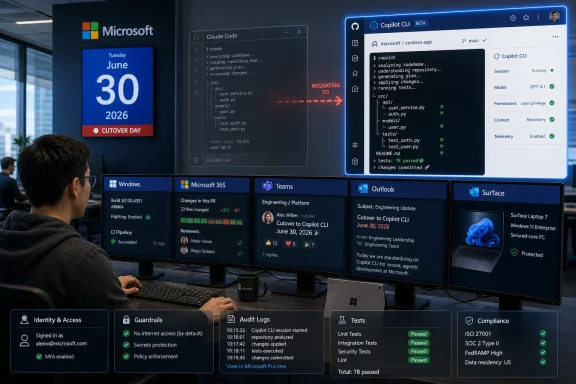
The reported June 30 cutoff is hard to miss. Microsoft’s fiscal year ends that day, and canceling a large set of third-party licenses before the next year begins is exactly the kind of budget housekeeping that happens inside companies of Microsoft’s scale. There is no need to invent a grand conspiracy when procurement incentives do so much of the work.
AI coding tools are not cheap at enterprise scale. The marginal cost of letting thousands of employees hammer on agentic systems can become significant because these tools consume large amounts of model inference, often across long contexts and iterative loops. A single session may read substantial portions of a repository, generate patches, execute commands, process failures, and try again. That is not the same cost profile as a lightweight code completion.
Still, the money explanation only goes so far. If Claude Code had been cheap but strategically inconvenient, Microsoft would still have had a reason to curtail it. If it had been expensive but indispensable, the company might have swallowed the cost. The combination is what makes the decision predictable: a rival tool became popular, expensive, and directly comparable to a Microsoft product that needs internal dogfooding.
The most important budget line here may not be the savings on Anthropic licenses. It may be the implied investment Microsoft now has to make in Copilot CLI. Once the company tells Windows and Microsoft 365 engineers to move, every missing feature, workflow gap, and rough edge becomes GitHub’s problem in public-private form. The internal customer is no longer a friendly evaluator. It is the product organization whose work depends on the tool.
Dogfooding Works Best When the Dog Food Is Ready
Microsoft has a long tradition of dogfooding, and for good reason. Products improve when the people building them have to use them under real pressure. Internal use catches bugs that staged demos miss, exposes awkward workflows, and creates a feedback loop between product ambition and operational reality.
But dogfooding can also become coercive if it is used to erase inconvenient comparisons. If engineers are being moved from a tool they prefer to a tool the company needs to succeed, Microsoft must be honest about whether this is product improvement or product protection. Those are not mutually exclusive, but the distinction matters to morale.
The risk is that Copilot CLI becomes the tool employees are required to use while Claude Code remains the tool they remember as faster, more capable, or more pleasant. That memory can be corrosive. Engineers have little patience for executive strategy when it stands between them and a working build.
The better version of this story is that Microsoft uses the migration as a forcing function. GitHub gets a demanding internal customer base with enormous real-world repositories. Experiences + Devices gets a tool that can be integrated with Microsoft identity, policy, telemetry, security review, and internal build systems. Copilot CLI gains the kind of brutal feedback loop that can turn a promising product into a serious one.
The worse version is that Microsoft takes away a better tool to protect an inferior one, then asks developers to file feedback while deadlines remain unchanged. That would not be dogfooding. That would be rationing dressed as alignment.
Windows Engineers Are Not a Normal Test Audience
For WindowsForum readers, the most interesting detail is the team affected. Experiences + Devices is not a random slice of Microsoft. It includes the people responsible for Windows, Microsoft 365, Outlook, Teams, and Surface — products that define the daily computing environment for hundreds of millions of users and most enterprise desktops.
If AI coding agents are going to influence how Windows itself is built, then the choice of agent is not merely an internal productivity matter. It touches code review practices, security assumptions, regression risk, and the speed at which complex platform work gets prototyped. A coding agent that helps a developer write a utility function is one thing. A coding agent operating around decades-old platform code, compatibility layers, enterprise policy surfaces, and security-sensitive components is another.
Microsoft’s argument for Copilot CLI is strongest here. A first-party agent can be wired into internal repositories and compliance expectations in ways that an external product may not match. It can be taught the conventions of Microsoft’s codebases, constrained by Microsoft’s security rules, and instrumented for the kinds of audit trails large organizations increasingly need around AI-assisted development.
But the same logic raises the stakes. If Microsoft’s tool is not competitive, then the company is not just standardizing. It is asking its most consequential engineering teams to trade capability for control. That trade may be rational, but it is not free.
Enterprise IT leaders watching from the outside should recognize the pattern. The question is not whether employees like a given AI tool. The question is who controls the toolchain when AI becomes the operating layer for knowledge work. Microsoft is making the choice many CIOs will face: best-of-breed tool today, or strategic platform alignment tomorrow.
Claude’s Real Threat Was Never Just the Model
A lazy reading of the story would frame this as OpenAI versus Anthropic, or Copilot versus Claude. That misses the more important shift. The competition is not only over which model is smarter. It is over which product becomes the place where work happens.
Anthropic’s advantage with Claude Code has been product focus. It built around the coding loop with a developer-native posture, and it benefited from the broader perception that Claude models are particularly strong at reasoning through code, documents, and long-context tasks. Whether that perception is universally true is less important than the fact that enough developers believe it after using the tool.
Microsoft’s advantage is distribution. GitHub is already where code lives for millions of developers and organizations. Visual Studio Code is the default editor for a huge swath of the industry. Azure, Microsoft Entra, Microsoft 365, Defender, and Purview give Microsoft the enterprise control plane around identity, governance, and compliance. If Copilot CLI becomes good enough, Microsoft can bundle the agentic coding workflow into the stack companies already manage.
That phrase — good enough — is doing enormous work. In enterprise software, the best product does not always win. The integrated product often does, especially when security, procurement, compliance, and vendor consolidation enter the room. But developers are unusually sensitive to tool quality because productivity tools are intimate. A bad coding assistant is not like a mediocre expense-reporting portal. It interrupts thinking.
This is why the internal Microsoft reaction matters. If developers genuinely favored Claude Code, GitHub now has a benchmark that cannot be waved away with marketing. The competition has already happened inside the building.
The Cursor Shadow Shows How Fast the Category Is Moving
The reported context around Cursor is also telling. Microsoft has reportedly considered ways to close the Copilot gap through startup activity, including interest in AI coding companies, while also weighing regulatory concerns. Whether any specific acquisition happens is less important than the signal: Microsoft knows agentic coding is not a solved category.
Cursor, Claude Code, GitHub Copilot, OpenAI’s coding agents, Google’s developer tools, and a growing field of terminal-native assistants are all converging on the same prize. They want to become the layer between human intent and software change. That layer can start with code generation, but it quickly expands into debugging, documentation, migration, testing, dependency management, security remediation, and operations.
This is one reason Microsoft cannot afford to let Copilot become yesterday’s AI success story. Copilot’s original breakthrough was turning model output into a developer habit. The next breakthrough is turning agentic execution into a trusted workflow. If Microsoft misses that shift, GitHub risks becoming the place where repositories are stored while another vendor owns the interaction model that changes them.
That would be strategically intolerable. GitHub is not just another Microsoft property. It is Microsoft’s claim on developer culture. The company bought GitHub to sit at the center of software creation, not to watch terminal agents from Anthropic or venture-backed startups become the front door to the repository.
The Multi-Model Future Still Has a Microsoft Gatekeeper
One subtle but important detail in the reported plan is that Anthropic’s models will remain available through Copilot CLI. That is the version of openness Microsoft prefers. Customers and employees may get model choice, but the experience, governance, telemetry, billing, and workflow orchestration remain inside Microsoft’s product boundary.
This is consistent with the direction of Microsoft’s broader AI business. The company does not need every useful model to be owned by Microsoft or OpenAI. It needs the consumption of those models to happen through Microsoft-controlled infrastructure and interfaces. Azure Foundry, Copilot Studio, Microsoft 365 Copilot, GitHub Copilot, and Copilot CLI all become places where model choice can be presented as flexibility while reinforcing the platform.
That may be good for enterprise customers. Centralized governance is not a fake concern. Companies need to know what code and data are being sent to which systems, how prompts and outputs are retained, what audit trails exist, and whether generated code introduces legal or security exposure. A sprawling collection of employee-expensed AI tools is a nightmare for risk teams.
But it also means “choice” has a boundary. Microsoft can offer Anthropic models while discouraging Anthropic workflows. It can promote model pluralism while consolidating product control. That is not hypocrisy so much as platform strategy, but it should be understood for what it is.
For developers, the practical result may be familiar: the model they like survives, but the tool they like does not. Whether that feels acceptable will depend on how much of Claude Code’s value came from Claude itself and how much came from Anthropic’s product design.
Security Gives Microsoft Its Strongest Argument
If Microsoft wants the most defensible justification for the move, it should lead with security and governance rather than cost. Agentic coding tools are powerful because they can act. That power creates risk.
A terminal agent can read files, run commands, modify source, inspect secrets if guardrails fail, and interact with build systems. In a large enterprise, especially one building operating systems and productivity software, that is not a casual capability. The difference between a helpful coding assistant and an over-permissioned automation layer is narrower than many enthusiasts like to admit.
A first-party Copilot CLI can be integrated into Microsoft’s internal controls in ways that make security teams more comfortable. It can respect repository-specific policies, support internal model routing, log activity according to company standards, and evolve alongside Microsoft’s secure development lifecycle. It can also be shaped around the peculiarities of Windows engineering, where compatibility and regression risk loom over even small changes.
That argument should not be dismissed. The next phase of AI coding will be less about dazzling demos and more about permissioning, provenance, review, rollback, and accountability. Enterprises will ask not only whether an agent can fix a bug, but whether the organization can explain what it did, why it did it, and who approved the change.
Still, security can become a convenient umbrella for strategic preference. If Copilot CLI is safer because Microsoft controls it, Microsoft must show that it is also effective enough not to push employees into unofficial workarounds. Shadow AI is the natural consequence of bad sanctioned tools. The safest platform on paper can become the riskiest one in practice if users route around it.
The Internal Memo Is Also a Product Roadmap
The reported internal memo from Rajesh Jha frames the Claude Code period as a learning exercise: Microsoft offered both tools, benchmarked them in real workflows, and learned what supported teams. That is the kind of language executives use when turning a retreat into a transition.
But the memo’s more important claim is that Copilot CLI is a product Microsoft can shape directly with GitHub. That is a roadmap disguised as an explanation. It tells employees that the current pain of switching tools is supposed to buy future leverage: tighter repo integration, better workflow fit, stronger security alignment, and a faster path for feedback to become product improvement.
For GitHub, this is both an opportunity and a warning. Internal Microsoft adoption can make Copilot CLI better quickly, but it also exposes the tool to an unforgiving user base. Engineers working on Windows, Teams, or Outlook will not be impressed by vague promises about agentic futures if the agent fails on monorepos, build scripts, authentication, or test infrastructure.
This is where Microsoft’s structure becomes complicated. GitHub operates with its own developer brand and product culture, while Experiences + Devices has its own priorities and deadlines. Asking those worlds to share accountability is sensible, but shared accountability can also blur ownership. If Copilot CLI falls short, who fixes it: GitHub product teams, E+D engineering systems teams, model providers, or internal platform groups?
The answer needs to be all of them. That is how enterprise AI products will actually mature: not as standalone marvels, but as negotiated systems spanning model quality, product design, infrastructure, security, and organization-specific workflow knowledge.
Developers Will Judge the Migration by the First Broken Build
The human factor should not be underestimated. Developers develop loyalties to tools that save them time, and they develop resentment toward tools that waste it. AI coding assistants amplify both reactions because their failures are not merely mechanical; they can feel like arguing with a confident junior engineer who keeps touching the wrong files.
If Microsoft’s transition is smooth, many employees may accept it as the cost of standardization. If Copilot CLI improves quickly and retains access to Claude models where useful, the loss of Claude Code may become a temporary inconvenience. The best-case outcome is that Microsoft captures what employees liked about Claude Code while embedding it in a toolchain the company can govern and scale.
If the transition is rough, the story becomes different. Engineers may see the cutoff as a top-down attempt to protect Copilot from competition. Non-engineers who used Claude Code for prototyping may find that their new workflow has more friction. Teams under deadline may quietly seek exceptions or alternatives.
That last group is the one to watch. In large organizations, official tooling policy often diverges from actual practice. If Claude Code had become materially useful, removing licenses does not erase demand. It only changes where that demand goes: exception processes, personal subscriptions, local experiments, or pressure on Copilot CLI to close gaps fast.
Microsoft can win this bet, but only by making Copilot CLI feel like an upgrade rather than a mandate.
Redmond’s Claude Cutoff Tells IT Buyers What to Watch
The lesson for WindowsForum’s audience is not that Claude Code is good and Copilot CLI is bad, or that Microsoft is wrong to standardize. The lesson is that agentic coding tools have moved from optional experimentation to strategic infrastructure with budget, governance, and platform consequences.
- Microsoft’s reported June 30, 2026 cutoff aligns the Claude Code rollback with the end of the company’s fiscal year, making the decision both a product-standardization move and a cost-control move.
- The affected Experiences + Devices organization includes teams behind Windows, Microsoft 365, Outlook, Teams, and Surface, which makes the migration relevant to the products most Windows professionals administer and support.
- Claude models are expected to remain available through Microsoft-controlled surfaces such as Copilot CLI and Foundry, but Claude Code as a separate workflow is reportedly being curtailed.
- GitHub Copilot CLI now has to prove it can match or exceed Claude Code in real engineering environments, not just in demos or positioning decks.
- Enterprise IT teams should treat AI coding agents as governed development infrastructure, with the same scrutiny applied to identity, permissions, logging, data exposure, and vendor lock-in.
- The most important question for organizations will be whether standardized AI tooling is good enough to prevent shadow adoption of unsanctioned alternatives.
The coming months will show whether Microsoft’s move was an early act of platform discipline or a defensive correction after letting a rival tool get too comfortable inside the walls. Either way, the direction is clear: AI coding agents are no longer sidecars for developers, and Microsoft is not going to let the most important interface to software creation drift outside its control without a fight.