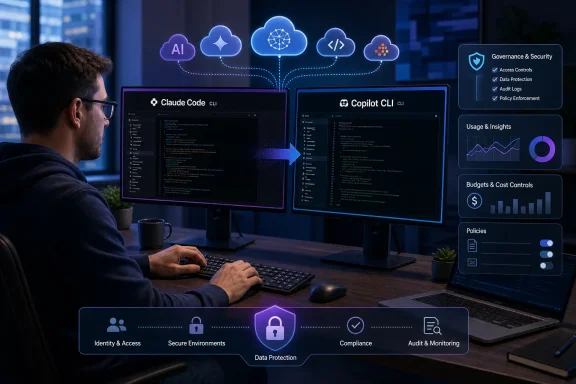
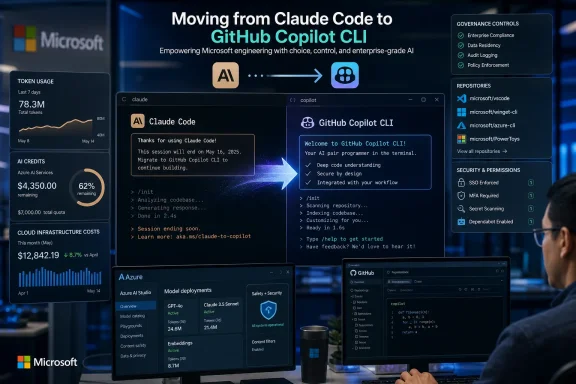
Microsoft has reportedly withdrawn most direct Anthropic Claude Code licenses from its Experiences and Devices organization and directed affected developers toward GitHub Copilot CLI, a change that was due by June 30, 2026. The immediate consequence for Windows, Microsoft 365, Teams, and device engineers is a tooling change; the larger signal is that
agentic AI coding is becoming a cost-management problem as much as a capability race.
The Verge first reported the internal pullback in May, with subsequent reporting from
Windows Central and
The Decoder describing a move away from Claude Code after its broad internal rollout. Microsoft has not publicly framed the decision as a repudiation of Anthropic, and it should not be read that way: Claude remains available to customers through Microsoft Foundry, where Microsoft has continued to expand and generalize availability of Anthropic’s models.
What has changed is the economics and control plane around developer AI use. A company can offer an external model in Azure while deciding that, internally, it wants employees using a Microsoft-owned client, billing system, policy surface, and telemetry pipeline.
 A license pullback is not a Claude breakup
Microsoft’s partnership with Anthropic remains commercially important. Microsoft announced Claude support in Microsoft Foundry in November 2025, positioning Azure as a place where enterprises could use both OpenAI and Anthropic frontier models under familiar Azure identity, governance, and billing controls. Claude’s general availability in Foundry this month reinforces that message rather than undercuts it.
That distinction matters for IT leaders. Claude Code is Anthropic’s developer-facing command-line agent; Microsoft Foundry is an Azure platform for organizations building, governing, and running AI applications. Cutting internal access to one client product does not mean Microsoft is removing Claude models from its cloud catalog or telling Azure customers to avoid them.
Indeed, the more plausible reading is that Microsoft wants to separate two decisions that enterprises often blur together: which model is appropriate for a job, and which tooling layer should mediate access to that model. Microsoft can continue selling choice in Foundry while consolidating its own developers around GitHub Copilot CLI.
The reported instruction also comes after Microsoft initially made Claude Code available to thousands of employees, including people outside traditional engineering roles. That experiment presumably generated valuable usage data, but wide availability also turns a per-seat software trial into something more volatile: a potentially open-ended inference bill.
The bill is no longer hidden behind a seat
The economics of AI coding assistants have changed rapidly. Early autocomplete tools could be packaged as a predictable subscription because their interactions were comparatively small and brief. Modern coding agents can read a repository, plan a change, invoke tools, inspect test failures, revise code, and repeat the cycle. A single assignment can involve a very large prompt context and many model calls.
That is why usage is increasingly being measured in tokens, credits, actions minutes, or some combination of all three. GitHub moved Copilot plans to usage-based billing on June 1, 2026, replacing its prior premium-request model with GitHub AI Credits. GitHub’s own documentation defines one AI Credit as $0.01, while the cost of a task varies by model and usage.
This is not merely a pricing-page adjustment. It converts an AI assistant from a fixed, easily budgeted developer expense into a metered cloud workload. For an enterprise, the difference is significant:
- A developer who uses a short chat session and accepts a few code completions has a fundamentally different cost profile from an agent allowed to work autonomously across a large repository.
- The expensive part may not be one response, but repeated tool calls, expanded context windows, generated output, and retries after tests fail.
- Finance and engineering leaders need visibility into consumption by organization, repository, model, and workflow before they can decide whether productivity gains justify the spend.
Microsoft’s own fiscal reporting acknowledges the underlying infrastructure pressure. Its 2025 annual report said continued investment in cloud and AI infrastructure would increase operating costs and could reduce operating margins, while also calling out the need for land, energy, networking supplies, servers, and GPUs. The business issue is not simply the price of a Claude Code license. It is the cost of serving high-volume, high-context reasoning workloads reliably at enterprise scale.
That does not prove that direct Claude Code expense alone drove Microsoft’s decision. The company has not publicly disclosed its internal usage, contract terms, or cost calculations. But the timing—before the June 30 end of Microsoft’s fiscal year—and the redirection toward a Microsoft-controlled tool make financial discipline and product consolidation difficult to separate.
GitHub Copilot CLI gives Microsoft a better control point
The appeal of GitHub Copilot CLI is not necessarily that it eliminates model costs. It gives Microsoft a central place to govern them.
A first-party command-line client can integrate with GitHub identity, repository permissions, policy enforcement, auditing, model selection, usage dashboards, and organizational billing. It also keeps employee feedback and daily workflow inside the product Microsoft sells to outside organizations. That is strategically useful whether the underlying task uses a Microsoft model, an OpenAI model, an Anthropic model, or another provider exposed through Copilot.
For Windows administrators and engineering managers, this should sound familiar. The shift resembles the move from locally installed developer utilities to centrally managed DevOps platforms. Standardizing on one tool does not mean every team will get the objectively best experience for every task. It means the organization can impose common controls around access, data handling, support, procurement, and spend.
There is a trade-off. Developers who preferred Claude Code’s workflow may view a forced migration as a regression, especially for complex command-line tasks and repository-scale work. That reaction is not trivial: AI coding tools earn adoption through trust, and teams will route around an officially approved client if it produces materially weaker outcomes.
Microsoft’s challenge is therefore more demanding than simply reducing a licensing line item. GitHub Copilot CLI must be good enough for day-to-day engineering while providing clearer governance and predictable unit economics than the prior arrangement.
Smaller and more selective models will carry more routine work
The broader industry implication is not that frontier models have failed. It is that organizations are learning to reserve them.
A reasonable enterprise architecture increasingly looks tiered. Smaller language models can handle classification, summarization, retrieval, structured extraction, routine support responses, and constrained code transformations. More expensive frontier reasoning models can be used for difficult debugging, design exploration, security investigation, complicated migrations, or agentic work that demonstrably saves substantial human time.
This is less glamorous than the idea of assigning every employee a tireless autonomous agent, but it is more commercially sustainable. Microsoft Foundry’s model catalog already reflects the logic: it offers choices spanning high-end Claude models, OpenAI models, open-weight options, and smaller specialized systems. The relevant measure is not whether a model tops a benchmark in isolation; it is whether the workflow delivers an acceptable result at an acceptable cost, latency, and risk level.
For security teams, selective deployment also reduces exposure. An agent with access to source code, build systems, tickets, internal documentation, and command execution capabilities is not merely a chatbot. It is a privileged automation system. The more it can do, the more important it becomes to limit permissions, isolate environments, log actions, validate output, and choose tasks where autonomous iteration is genuinely warranted.
The next AI contest is operational, not rhetorical
Microsoft’s Claude Code retrenchment should be treated as an early enterprise case study, not a verdict on Anthropic or coding agents. Claude remains a supported Microsoft Foundry option, and GitHub Copilot itself is increasingly a multi-model service with usage-based economics. The move is about who owns the internal developer interface and who can measure the meter.
For IT departments, the practical lesson is immediate: stop evaluating AI assistants solely as per-user productivity products. Treat coding agents as consumption-based infrastructure with identity, permissions, budgets, observability, and workload placement requirements.
The companies that get this right will not be those that give every employee the most powerful model by default. They will be the ones that can prove where expensive reasoning pays for itself—and turn it off, downgrade it, or route it elsewhere when it does not.