
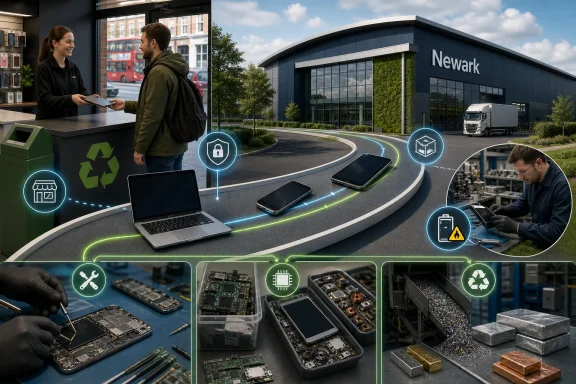
Currys released its “Track the Tech” video on June 24, 2026, to show UK consumers what happens to old devices handed into its Cash for Trash scheme, from store drop-off through processing at the retailer’s Newark repair and recycling operation. The film is marketing, certainly, but it points at a real pressure point in consumer electronics: the afterlife of devices has become part of the product story. The UK’s drawers, cupboards, garages, and lofts are now an informal national stockpile of metals, batteries, screens, boards, and private data. Currys’ wager is that showing the journey can turn recycling from a guilty intention into a retail habit.
For years, electronics recycling has been treated as the least glamorous part of the gadget economy. Launch events get the music, the lighting, the keynote stage, and the preorder button; the end of a device’s life gets a bin, a warning label, or a small-print takeback policy. Currys’ “Track the Tech” video tries to reverse that emphasis by making the post-consumer journey visible.
That visibility matters because e-waste is not just a disposal problem. It is a trust problem. Consumers are being asked to surrender devices that may still contain photos, messages, passwords, corporate files, banking apps, and years of personal metadata. A vague promise that old tech will be “recycled responsibly” does not answer the practical anxiety of handing a phone or laptop to a retailer and hoping for the best.
Currys’ pitch is that old devices entering its network are not simply disappearing into a skip behind the store. They are routed through a process in which they can be repaired, refurbished, stripped for usable parts, or broken down for recycling. That is the important distinction: the company is not merely trying to make recycling feel virtuous, but to make it feel operationally credible.
The choice of a video format is not incidental. The circular economy has long suffered from abstraction. Consumers hear about recovered materials, reduced mining, and waste diversion, but they rarely see the chain of custody. “Track the Tech” is Currys’ attempt to turn a supply-chain story into a consumer-facing reassurance engine.
Old electronics accumulate for understandable reasons. A phone is kept as a backup, a laptop is held in case files are needed later, a tablet is passed down and then forgotten, a charger is saved because nobody remembers what it fits. The result is a domestic graveyard of objects too valuable to throw away, too obsolete to use, and too data-sensitive to hand over casually.
Mobile phones are the emotional center of the pile. Currys’ survey says four in five Britons are holding onto a defunct mobile, and one in three still have their first. The old Nokia in a drawer is both nostalgia and raw material, a reminder that consumer technology has always been sold as personal history even when its components belong in an industrial recovery stream.
The gap between awareness and action is the real story. According to the survey, only a third of 2,000 respondents had recycled tech in the past year, despite large majorities understanding that batteries can cause fires, recycling reduces demand for newly mined raw materials, and old tech may have monetary value. In other words, the problem is not that consumers have never heard the argument. It is that the argument has not beaten friction.
That is a subtle but important piece of behavioral design. Recycling schemes often fail when they ask consumers to do the right thing at an inconvenient time, in an inconvenient place, for an invisible benefit. Currys is instead placing the handoff inside an existing retail journey. If a customer is already visiting a store to browse, replace, repair, or upgrade, the old device becomes part of the transaction.
There is also a commercial logic that Currys is unlikely to hide. A voucher brings footfall. Footfall becomes browsing. Browsing becomes sales. The retailer can position the scheme as a sustainability effort while also using it as a customer-acquisition and retention tool.
That dual purpose should not automatically discredit the effort. The circular economy will not scale through moral appeals alone. If repair, reuse, refurbishment, and recycling remain financially detached from the places where people buy electronics, they will remain peripheral. Currys’ scheme is interesting precisely because it blends environmental messaging with the old-fashioned mechanics of retail incentive.
Newark has become Currys’ answer to the question every takeback scheme eventually faces: where does this stuff actually go? The retailer has described the site as one of Europe’s largest tech repair centres, and it has repeatedly framed the operation as central to its “longer life” approach to electronics. That matters because repair and refurbishment are materially different from disposal.
A functioning repair center changes the hierarchy of outcomes. A device that can be restored to use is more valuable than one shredded for materials. A component harvested from one machine and used in another extends value further than a general recycling stream. Even when a device cannot be revived, controlled processing is better than uncontrolled waste.
This is also where Currys’ story intersects with the broader right-to-repair debate. Retailers have often benefited from replacement cycles, extended warranties, and opaque repair economics. By foregrounding repair capacity, Currys is trying to occupy a more defensible position: not just the shop that sells the next device, but the network that keeps the current one alive for longer.
Old tech is not like old cardboard. A dead laptop may still contain a working SSD. A phone with a cracked screen may still hold cloud tokens, saved messages, authentication apps, and recoverable photos. A retired office printer may have stored documents. An external drive in a drawer may be a data breach waiting for a house clearance.
This is why the “Track the Tech” format matters. If consumers cannot visualize what happens next, many will default to keeping the device. Hoarding is not always laziness; sometimes it is a rational response to uncertainty. People know they should recycle a phone, but they do not know whether they have truly erased it.
The industry has not helped itself here. Data deletion instructions vary by operating system, device generation, account state, and hardware condition. A factory reset may be easy on a working phone and impossible on one with a shattered display. A laptop may require BitLocker recovery keys, Microsoft account credentials, or drive removal to feel properly safe. The average household does not want a weekend project; it wants assurance.
Currys’ challenge is to make that assurance specific without overpromising. “Your data is secure” is a strong consumer-facing claim. The more successful the campaign becomes, the more scrutiny will fall on how devices are logged, wiped, tested, stored, transported, and audited. In this market, trust is not a slogan. It is a process that has to survive edge cases.
Lithium-ion batteries have changed the stakes of electronics recycling. A drawer full of old phones is not just clutter. A damaged battery in a bin lorry, waste facility, or household rubbish stream can become a fire risk. Small devices have made the problem harder because batteries are embedded in products that many consumers no longer think of as hazardous.
This is where retailers have an advantage over councils and specialist recyclers. Currys stores are visible, familiar, and already associated with electrical products. If consumers can bring almost any small electrical item to a place they already recognize, the safe-disposal path becomes easier to remember.
But the fire-risk argument also exposes the limits of individual responsibility. It is not enough to tell people not to throw batteries in the bin if the alternative feels obscure or inconvenient. The retail takeback point has to be obvious, staffed, and repeatable. Recycling needs to be less like a special errand and more like returning packaging or dropping off a parcel.
That is where circularity either happens or collapses. A used laptop is not “circular” because it was handed to a shop assistant. It becomes circular only if the system can triage it efficiently, extract maximum remaining value, protect the customer, and avoid generating more transport, cost, or waste than it saves.
Currys has an advantage because it already sits at several points in the device lifecycle. It sells new products, handles returns, offers repair services, runs trade-in and recycling schemes, and operates physical stores. That vertical proximity is useful. A retailer that can move devices through its own logistics network has a better shot at making reuse and recycling feel integrated rather than bolted on.
The harder question is whether this model changes consumer behavior at scale or merely improves the fate of devices that would have been recycled anyway. The survey suggests there is a large pool of latent supply in UK homes. Unlocking it will require more than one video. It will require repeated prompts, clear incentives, and a customer experience that does not punish people for doing the responsible thing.
A device that can be refurbished and resold displaces some demand for a new one. A part that can be used in another repair avoids manufacturing and shipping a replacement component. Even a broken device may carry useful assemblies, boards, screens, shells, or accessories. The further up the reuse ladder an item climbs, the better the story becomes.
This is especially relevant in a market where refurbished electronics have moved from fringe to mainstream. Inflation, longer smartphone replacement cycles, and improved hardware durability have made second-life devices more attractive. A refurbished laptop with a warranty is no longer just a budget compromise; for many users, it is a sensible default.
Currys is positioning itself to benefit from that shift. The company can collect devices through Cash for Trash and trade-in, refurbish suitable products, support repairs with harvested parts, and sell refurbished stock through multiple channels. That is circularity as business model, not charity.
The risk is that “refurbished” becomes another marketing word stretched beyond usefulness. Customers need to know what has been tested, what has been replaced, what warranty applies, and what cosmetic or battery condition to expect. A mature second-life market depends on standards, not vibes.
This matters as Windows hardware ages unevenly. Some machines are still perfectly serviceable after a storage upgrade, RAM expansion, battery replacement, or clean OS installation. Others are blocked by firmware limitations, failed boards, weak batteries, or unsupported components. The difference between a recyclable device and a reusable one can be a technician’s time, a spare part, and a trustworthy refurbishment process.
Windows 11’s hardware requirements also changed the emotional calculus for many PC owners. Machines that felt fast enough for everyday use could become awkward once support timelines, TPM requirements, and security expectations entered the conversation. A consumer may not want to keep an unsupported PC, but may also dislike the idea of treating working hardware as waste.
That is where structured reuse matters. A device unsuitable for one user may still serve in another context if it can be securely wiped, repaired, and matched to an appropriate buyer or use case. Conversely, a device that cannot be responsibly supported should not be pushed back into circulation simply to improve a reuse statistic. The line between sustainability and dumping old problems on the next owner must be policed.
For sysadmins, the lesson is even sharper. Asset retirement is part of security operations. Devices leaving a business need documented wiping, chain-of-custody controls, and clarity about whether they are resold, recycled, donated, or destroyed. Currys’ consumer campaign speaks in retail language, but the underlying concerns are enterprise concerns in miniature.
Every upgrade cycle creates an unresolved ending. The new phone arrives, the old phone becomes a backup. The new laptop is configured, the old laptop is left “just in case.” The new air fryer replaces the broken one, the old one sits by the door until the next trip to the recycling centre, which never happens. The system is efficient at selling beginnings and terrible at managing endings.
Currys is trying to make the ending part of the purchase loop. That is the correct direction, but it also puts pressure on the retailer’s own sales culture. If the company wants credibility as a repair and reuse advocate, it cannot treat longevity as a side campaign while pushing replacement as the default answer.
There are signs the market is changing. Consumers are more open to refurbished devices, regulators are more interested in repairability and waste, and manufacturers are under pressure to provide parts, software updates, and clearer environmental disclosures. Retailers that can make repair and recycling easy may gain an advantage, especially with customers tired of devices that feel disposable by design.
Still, the contradiction will persist. Retailers make money selling new electronics. Repair and reuse can support margins, customer loyalty, and brand reputation, but they also complicate the simple replacement story. The companies that navigate this best will be the ones that stop treating circularity as a campaign and start treating it as a normal product lifecycle.
The next layer of maturity would be more granular reporting. How many devices collected through Cash for Trash are refurbished and resold? How many are harvested for parts? How many are recycled for materials? What proportion cannot be processed as hoped? How are data-bearing devices handled, and how is compliance verified? These are the kinds of questions that separate a circular-economy system from a sustainability narrative.
To be fair, no retailer will want to turn a consumer campaign into a waste-management audit. Too much detail can overwhelm the audience and drain the message of urgency. But the public is increasingly literate about greenwashing, and e-waste is too serious for soft-focus reassurance alone.
The strongest version of Currys’ story would connect the accessible video to measurable, repeatable outcomes. Consumers need a simple action. Analysts, regulators, and enterprise buyers need evidence. A large retailer can serve both audiences if it is willing to publish enough detail to make the process legible.
That matters because the e-waste problem is not going away. More homes are filling with smart speakers, wearables, routers, toys, chargers, headphones, kitchen gadgets, and battery-powered accessories. The next wave of forgotten electronics will be smaller, more numerous, and harder to repair. If the industry waits until all of that becomes waste, it will have missed the point.
Currys’ campaign is useful because it attacks the psychology of delay. By showing the route from store to repair centre to reuse or recycling, it reduces the mystery that keeps people from acting. The voucher is the nudge, but the reassurance is the product.
For Windows users and IT professionals, the same logic applies at a higher level. Retirement plans should be part of deployment plans. Data wiping should be documented before devices leave the organization. Repairability and second-life value should influence purchasing decisions. The lifecycle does not begin at unboxing and end at replacement; it begins with procurement and ends only when the last useful material has been recovered.
If Currys can make that idea ordinary for households, it will have done something more significant than release a clever sustainability video. It will have helped normalize the idea that electronics deserve an exit plan.
 Currys Turns the Back Room Into the Main Event
For years, electronics recycling has been treated as the least glamorous part of the gadget economy. Launch events get the music, the lighting, the keynote stage, and the preorder button; the end of a device’s life gets a bin, a warning label, or a small-print takeback policy. Currys’ “Track the Tech” video tries to reverse that emphasis by making the post-consumer journey visible.That visibility matters because e-waste is not just a disposal problem. It is a trust problem. Consumers are being asked to surrender devices that may still contain photos, messages, passwords, corporate files, banking apps, and years of personal metadata. A vague promise that old tech will be “recycled responsibly” does not answer the practical anxiety of handing a phone or laptop to a retailer and hoping for the best.
Currys’ pitch is that old devices entering its network are not simply disappearing into a skip behind the store. They are routed through a process in which they can be repaired, refurbished, stripped for usable parts, or broken down for recycling. That is the important distinction: the company is not merely trying to make recycling feel virtuous, but to make it feel operationally credible.
The choice of a video format is not incidental. The circular economy has long suffered from abstraction. Consumers hear about recovered materials, reduced mining, and waste diversion, but they rarely see the chain of custody. “Track the Tech” is Currys’ attempt to turn a supply-chain story into a consumer-facing reassurance engine.
The UK’s Gadget Hoard Is Now Too Large to Ignore
The research released alongside the video lands with the sort of number that sounds exaggerated until you look around the average home. Currys says there are more than 880 million unused electrical items sitting in UK households, with an average of 30 per home. That is not a niche sustainability issue; it is a parallel inventory system created by indecision.Old electronics accumulate for understandable reasons. A phone is kept as a backup, a laptop is held in case files are needed later, a tablet is passed down and then forgotten, a charger is saved because nobody remembers what it fits. The result is a domestic graveyard of objects too valuable to throw away, too obsolete to use, and too data-sensitive to hand over casually.
Mobile phones are the emotional center of the pile. Currys’ survey says four in five Britons are holding onto a defunct mobile, and one in three still have their first. The old Nokia in a drawer is both nostalgia and raw material, a reminder that consumer technology has always been sold as personal history even when its components belong in an industrial recovery stream.
The gap between awareness and action is the real story. According to the survey, only a third of 2,000 respondents had recycled tech in the past year, despite large majorities understanding that batteries can cause fires, recycling reduces demand for newly mined raw materials, and old tech may have monetary value. In other words, the problem is not that consumers have never heard the argument. It is that the argument has not beaten friction.
The Voucher Is Less Important Than the Ritual
Cash for Trash works because it gives people a reason to act now rather than someday. A small voucher will not, by itself, transform the economics of electronics ownership. But it can create a ritual: bring the old thing to the shop, get something tangible back, and leave with the sense that the device has entered a managed process.That is a subtle but important piece of behavioral design. Recycling schemes often fail when they ask consumers to do the right thing at an inconvenient time, in an inconvenient place, for an invisible benefit. Currys is instead placing the handoff inside an existing retail journey. If a customer is already visiting a store to browse, replace, repair, or upgrade, the old device becomes part of the transaction.
There is also a commercial logic that Currys is unlikely to hide. A voucher brings footfall. Footfall becomes browsing. Browsing becomes sales. The retailer can position the scheme as a sustainability effort while also using it as a customer-acquisition and retention tool.
That dual purpose should not automatically discredit the effort. The circular economy will not scale through moral appeals alone. If repair, reuse, refurbishment, and recycling remain financially detached from the places where people buy electronics, they will remain peripheral. Currys’ scheme is interesting precisely because it blends environmental messaging with the old-fashioned mechanics of retail incentive.
Newark Becomes the Physical Proof Point
The repeated reference to Currys’ Newark operation is doing a lot of work. In corporate sustainability campaigns, the weak link is often the missing middle: consumers see the collection point and the marketing promise, but not the infrastructure in between. A named repair and recycling centre gives the campaign a place, a workforce, and a set of processes.Newark has become Currys’ answer to the question every takeback scheme eventually faces: where does this stuff actually go? The retailer has described the site as one of Europe’s largest tech repair centres, and it has repeatedly framed the operation as central to its “longer life” approach to electronics. That matters because repair and refurbishment are materially different from disposal.
A functioning repair center changes the hierarchy of outcomes. A device that can be restored to use is more valuable than one shredded for materials. A component harvested from one machine and used in another extends value further than a general recycling stream. Even when a device cannot be revived, controlled processing is better than uncontrolled waste.
This is also where Currys’ story intersects with the broader right-to-repair debate. Retailers have often benefited from replacement cycles, extended warranties, and opaque repair economics. By foregrounding repair capacity, Currys is trying to occupy a more defensible position: not just the shop that sells the next device, but the network that keeps the current one alive for longer.
Data Security Is the Scheme’s Quiet Make-or-Break Issue
The most delicate sentence in the Currys pitch is not about recycling rates or raw materials. It is the promise that customers can feel confident their data is secure. For Windows users, Android users, iPhone owners, small businesses, and families alike, that is the point at which a recycling story becomes personal.Old tech is not like old cardboard. A dead laptop may still contain a working SSD. A phone with a cracked screen may still hold cloud tokens, saved messages, authentication apps, and recoverable photos. A retired office printer may have stored documents. An external drive in a drawer may be a data breach waiting for a house clearance.
This is why the “Track the Tech” format matters. If consumers cannot visualize what happens next, many will default to keeping the device. Hoarding is not always laziness; sometimes it is a rational response to uncertainty. People know they should recycle a phone, but they do not know whether they have truly erased it.
The industry has not helped itself here. Data deletion instructions vary by operating system, device generation, account state, and hardware condition. A factory reset may be easy on a working phone and impossible on one with a shattered display. A laptop may require BitLocker recovery keys, Microsoft account credentials, or drive removal to feel properly safe. The average household does not want a weekend project; it wants assurance.
Currys’ challenge is to make that assurance specific without overpromising. “Your data is secure” is a strong consumer-facing claim. The more successful the campaign becomes, the more scrutiny will fall on how devices are logged, wiped, tested, stored, transported, and audited. In this market, trust is not a slogan. It is a process that has to survive edge cases.
Batteries Have Turned E-Waste Into a Fire-Safety Problem
The survey’s battery figure is especially telling: 81 percent of respondents knew batteries in household waste can cause fires. Awareness, again, is not the bottleneck. The bottleneck is converting a known hazard into a practical disposal route.Lithium-ion batteries have changed the stakes of electronics recycling. A drawer full of old phones is not just clutter. A damaged battery in a bin lorry, waste facility, or household rubbish stream can become a fire risk. Small devices have made the problem harder because batteries are embedded in products that many consumers no longer think of as hazardous.
This is where retailers have an advantage over councils and specialist recyclers. Currys stores are visible, familiar, and already associated with electrical products. If consumers can bring almost any small electrical item to a place they already recognize, the safe-disposal path becomes easier to remember.
But the fire-risk argument also exposes the limits of individual responsibility. It is not enough to tell people not to throw batteries in the bin if the alternative feels obscure or inconvenient. The retail takeback point has to be obvious, staffed, and repeatable. Recycling needs to be less like a special errand and more like returning packaging or dropping off a parcel.
The Circular Economy Needs Boring Logistics More Than Big Promises
Retail sustainability campaigns often reach for heroic language. They promise transformation, impact, leadership, and responsibility. The more interesting part of Currys’ effort is much less glamorous: lorries, sorting, testing, repair benches, parts harvesting, baling, and controlled recycling streams.That is where circularity either happens or collapses. A used laptop is not “circular” because it was handed to a shop assistant. It becomes circular only if the system can triage it efficiently, extract maximum remaining value, protect the customer, and avoid generating more transport, cost, or waste than it saves.
Currys has an advantage because it already sits at several points in the device lifecycle. It sells new products, handles returns, offers repair services, runs trade-in and recycling schemes, and operates physical stores. That vertical proximity is useful. A retailer that can move devices through its own logistics network has a better shot at making reuse and recycling feel integrated rather than bolted on.
The harder question is whether this model changes consumer behavior at scale or merely improves the fate of devices that would have been recycled anyway. The survey suggests there is a large pool of latent supply in UK homes. Unlocking it will require more than one video. It will require repeated prompts, clear incentives, and a customer experience that does not punish people for doing the responsible thing.
The Greenest Gadget Is Usually the One That Gets Used Again
There is an uncomfortable truth behind many electronics recycling campaigns: recycling is often the least bad option, not the best one. The highest-value environmental outcome is usually keeping a product or component in use. That is why Currys’ emphasis on repair, refurbishment, and parts recovery is more meaningful than a simple “bring us your old tech” message.A device that can be refurbished and resold displaces some demand for a new one. A part that can be used in another repair avoids manufacturing and shipping a replacement component. Even a broken device may carry useful assemblies, boards, screens, shells, or accessories. The further up the reuse ladder an item climbs, the better the story becomes.
This is especially relevant in a market where refurbished electronics have moved from fringe to mainstream. Inflation, longer smartphone replacement cycles, and improved hardware durability have made second-life devices more attractive. A refurbished laptop with a warranty is no longer just a budget compromise; for many users, it is a sensible default.
Currys is positioning itself to benefit from that shift. The company can collect devices through Cash for Trash and trade-in, refurbish suitable products, support repairs with harvested parts, and sell refurbished stock through multiple channels. That is circularity as business model, not charity.
The risk is that “refurbished” becomes another marketing word stretched beyond usefulness. Customers need to know what has been tested, what has been replaced, what warranty applies, and what cosmetic or battery condition to expect. A mature second-life market depends on standards, not vibes.
Windows Users Should Read This as a Lifecycle Story
For the WindowsForum audience, the Currys campaign is not merely a UK retail sustainability item. It is a reminder that the PC lifecycle now extends well beyond the moment a device falls out of daily use. Windows laptops, desktops, tablets, and peripherals all carry security, support, repairability, and resale questions long after their first owner moves on.This matters as Windows hardware ages unevenly. Some machines are still perfectly serviceable after a storage upgrade, RAM expansion, battery replacement, or clean OS installation. Others are blocked by firmware limitations, failed boards, weak batteries, or unsupported components. The difference between a recyclable device and a reusable one can be a technician’s time, a spare part, and a trustworthy refurbishment process.
Windows 11’s hardware requirements also changed the emotional calculus for many PC owners. Machines that felt fast enough for everyday use could become awkward once support timelines, TPM requirements, and security expectations entered the conversation. A consumer may not want to keep an unsupported PC, but may also dislike the idea of treating working hardware as waste.
That is where structured reuse matters. A device unsuitable for one user may still serve in another context if it can be securely wiped, repaired, and matched to an appropriate buyer or use case. Conversely, a device that cannot be responsibly supported should not be pushed back into circulation simply to improve a reuse statistic. The line between sustainability and dumping old problems on the next owner must be policed.
For sysadmins, the lesson is even sharper. Asset retirement is part of security operations. Devices leaving a business need documented wiping, chain-of-custody controls, and clarity about whether they are resold, recycled, donated, or destroyed. Currys’ consumer campaign speaks in retail language, but the underlying concerns are enterprise concerns in miniature.
The Scheme Also Exposes a Cultural Contradiction
Consumers say they care about recycling, repair, and waste. The same consumers keep buying new devices and storing old ones indefinitely. That contradiction is not hypocrisy so much as the normal result of a market designed around novelty and disposal.Every upgrade cycle creates an unresolved ending. The new phone arrives, the old phone becomes a backup. The new laptop is configured, the old laptop is left “just in case.” The new air fryer replaces the broken one, the old one sits by the door until the next trip to the recycling centre, which never happens. The system is efficient at selling beginnings and terrible at managing endings.
Currys is trying to make the ending part of the purchase loop. That is the correct direction, but it also puts pressure on the retailer’s own sales culture. If the company wants credibility as a repair and reuse advocate, it cannot treat longevity as a side campaign while pushing replacement as the default answer.
There are signs the market is changing. Consumers are more open to refurbished devices, regulators are more interested in repairability and waste, and manufacturers are under pressure to provide parts, software updates, and clearer environmental disclosures. Retailers that can make repair and recycling easy may gain an advantage, especially with customers tired of devices that feel disposable by design.
Still, the contradiction will persist. Retailers make money selling new electronics. Repair and reuse can support margins, customer loyalty, and brand reputation, but they also complicate the simple replacement story. The companies that navigate this best will be the ones that stop treating circularity as a campaign and start treating it as a normal product lifecycle.
A Corporate Sustainability Video Is Not the Same as Accountability
Currys deserves credit for trying to show the journey rather than merely describe it. But transparency is not the same as independent accountability. A polished video can reassure, educate, and prompt action; it cannot by itself prove outcomes.The next layer of maturity would be more granular reporting. How many devices collected through Cash for Trash are refurbished and resold? How many are harvested for parts? How many are recycled for materials? What proportion cannot be processed as hoped? How are data-bearing devices handled, and how is compliance verified? These are the kinds of questions that separate a circular-economy system from a sustainability narrative.
To be fair, no retailer will want to turn a consumer campaign into a waste-management audit. Too much detail can overwhelm the audience and drain the message of urgency. But the public is increasingly literate about greenwashing, and e-waste is too serious for soft-focus reassurance alone.
The strongest version of Currys’ story would connect the accessible video to measurable, repeatable outcomes. Consumers need a simple action. Analysts, regulators, and enterprise buyers need evidence. A large retailer can serve both audiences if it is willing to publish enough detail to make the process legible.
That matters because the e-waste problem is not going away. More homes are filling with smart speakers, wearables, routers, toys, chargers, headphones, kitchen gadgets, and battery-powered accessories. The next wave of forgotten electronics will be smaller, more numerous, and harder to repair. If the industry waits until all of that becomes waste, it will have missed the point.
The Real Win Is Making Old Tech Feel Actionable
The practical message for consumers is refreshingly plain: the old device in the drawer is not inert. It may be a fire risk, a data risk, a source of reusable parts, a candidate for refurbishment, or a small financial return. The worst outcome is letting it sit indefinitely because the next step feels unclear.Currys’ campaign is useful because it attacks the psychology of delay. By showing the route from store to repair centre to reuse or recycling, it reduces the mystery that keeps people from acting. The voucher is the nudge, but the reassurance is the product.
For Windows users and IT professionals, the same logic applies at a higher level. Retirement plans should be part of deployment plans. Data wiping should be documented before devices leave the organization. Repairability and second-life value should influence purchasing decisions. The lifecycle does not begin at unboxing and end at replacement; it begins with procurement and ends only when the last useful material has been recovered.
If Currys can make that idea ordinary for households, it will have done something more significant than release a clever sustainability video. It will have helped normalize the idea that electronics deserve an exit plan.
The Newark Route Gives Consumers a Clearer Script
The most concrete reading of Currys’ “Track the Tech” push is that it gives households a script for the next clear-out.- Old phones, laptops, and small electricals should not be treated as harmless clutter when they may contain batteries, recoverable materials, and personal data.
- A visible chain of custody makes consumers more likely to recycle devices they would otherwise keep indefinitely.
- Repair, refurbishment, and parts harvesting are more valuable outcomes than basic materials recycling when devices can support them.
- Retail takeback schemes work best when they are tied to normal shopping habits rather than special trips and vague good intentions.
- Windows users and IT teams should treat device retirement as a security and lifecycle-management task, not an afterthought.
- Currys’ campaign will be more persuasive over time if the company pairs consumer-friendly storytelling with clearer reporting on what happens to collected devices.
References
- Primary source: Green Retail World
Published: 2026-06-24T06:52:07.195252
Watch: Currys’ Track the Tech video highlights device recycling and repair journey
Currys releases video showing the journey devices go on within its operations once handed over for recycling and repair.greenretail.world - Related coverage: currysplc.com
Currys helps customers turn old tech trash into Christmas cash, as Cash for Trash vouchers double to £10
We help everyone enjoy amazing technology.www.currysplc.com
- Related coverage: retailtechinnovationhub.squarespace.com
Brits hoarding old technology is behind UK’s growing electronic waste epidemic, Currys research — Retail Technology Innovation Hub
Brits are sitting on a growing pile of valuable unused tech, often because they can’t bear to part with it, according to research by Currys. The retailer surveyed 2,000 people for this. It found that more than 880 million unused items nationwide are sitting in UK homes, with an average of 30 per houretailtechinnovationhub.squarespace.com
- Related coverage: currys.co.uk
Cash For Trash gets PM's approval
Our Cash for Trash recycling scheme is going from strength to strength. The more people hear about it, the more they love it. And it couldn’t be simplwww.currys.co.uk - Related coverage: moneysavingexpert.com
Currys trials 'Cash for Trash' scheme offering vouchers for broken and unwanted tech – how it compares
Currys has this week launched a limited time offer where shoppers can swap broken tech products and smaller white goods in exchange for a £5 or £100 voucher to spend in store or online. But you're likely to earn more recycling broken items elsewhere.www.moneysavingexpert.com
- Related coverage: dmsretail.com
How Currys is bolstering its repair and refurb business - Retail News & More
Despite existing for over a decade, not everyone is familiar with Currys repair centre. Based in Newark, Nottinghamshire, the site specialises in repairing…dmsretail.com
- Related coverage: retailsector.co.uk
- Related coverage: currysprod.a.bigcontent.io
