
Perplexity launched Computer for Counsel on June 24, 2026, making its enterprise AI agent available to legal teams through Perplexity Enterprise and Max with integrations across Microsoft 365, legal research tools, document systems, contract platforms, and matter-management workflows. The announcement is less about a chatbot for lawyers than a bid to become the connective tissue between legal knowledge, firm data, and the productivity software where attorneys already work. For WindowsForum readers, the important detail is not that another AI vendor has discovered lawyers. It is that Perplexity is trying to turn Microsoft 365 itself into the operating surface for legal work.
The legal technology market has no shortage of AI research tools, drafting assistants, and contract-review products. What Perplexity is pitching with Computer for Counsel is broader: a system that can move across research databases, document repositories, contract platforms, e-signature tools, and communications apps, then assemble work product from that context.
That distinction matters. Lawyers do not usually lose time because one database is slow. They lose time because the facts of a matter are scattered across Outlook threads, Teams messages, SharePoint folders, NetDocuments workspaces, DocuSign envelopes, contract lifecycle systems, and paid research platforms that do not naturally talk to each other.
Perplexity’s answer is to make its Computer agent the layer above those systems. The company says Computer for Counsel can handle research, document collection, contract triage, regulatory monitoring, citation review, and intake processing. In other words, it is positioning the product at the messy middle of legal work: not the final judgment, but the gathering, formatting, checking, routing, and summarizing that consumes so much attorney and paralegal time.
That is also where the risk lives. A legal AI tool that merely summarizes a public case has one failure mode. A tool that can read internal documents, draft a memo, route an NDA, cite regulatory materials, and act inside Microsoft 365 has many more. Perplexity is betting that source-linked outputs, enterprise controls, and attorney verification will be enough to make that power acceptable.
This is the same battleground Microsoft has been trying to own with Copilot. The theory is simple: if the AI assistant is available inside Word, Outlook, Excel, PowerPoint, Teams, and SharePoint, the user does not need to leave the workflow. The assistant becomes less like a website and more like an ambient layer of the desktop.
Perplexity’s move is therefore both complementary and confrontational. It rides on Microsoft’s productivity estate, but it also competes for the role of trusted AI intermediary. A lawyer asking an assistant to summarize deal history from email, pull the latest draft from SharePoint, compare it against a third-party NDA, and prepare a clean version for DocuSign is not just using an app. They are delegating coordination across the office stack.
That is why Computer for Counsel should be read as part of a larger enterprise AI pattern. The winning product is not necessarily the model with the flashiest benchmark score. It is the one that gets permissions, identity, file access, auditability, and workflow placement right enough that users actually invoke it during the workday.
Computer for Counsel points to the next phase: action. Perplexity describes workflows such as third-party NDA intake, regulatory monitoring, and case research with citation review. In the NDA example, the system can review incoming agreements for red flags, complete entity and signatory information, prepare clean copies, and route documents for approval and signature through DocuSign.
That is more ambitious than “write me a summary.” It touches business process, not just text generation. If it works well, it compresses the administrative loop between receiving a document, identifying what matters, filling in routine details, and moving the item to the next responsible person.
The same logic applies to regulatory monitoring. A dashboard for state privacy and adtech laws is not simply a research memo; it is a living operational artifact. Legal teams need to know what changed, where it changed, whether it affects current products, and which source supports the conclusion. The value is not the paragraph. The value is the maintained context.
It is also a useful hedge. If one model family is better at long-context analysis and another is better at structured extraction, a routing layer can theoretically produce better results than a single-model system. For enterprises, it also reduces dependence on one provider’s model roadmap.
But legal users will not judge the product by the elegance of model orchestration. They will judge it by whether the answer can be verified quickly. Perplexity has leaned heavily into source-linked output, saying results link back to cases, statutes, regulations, filings, and internal documents so attorneys can inspect the basis before using material in a brief, memo, or client communication.
That is the right emphasis. The legal AI scandals of the past few years have mostly revolved around hallucinated authority, careless verification, or overreliance on fluent output. In law, a beautiful paragraph with a broken citation is not a productivity gain. It is a liability dressed as efficiency.
Legal research is unforgiving because authority has hierarchy, jurisdiction, procedural posture, and history. A case can be real and still be bad law. A statute can be current in one context and irrelevant in another. A model that cannot distinguish between persuasive authority and controlling authority is not ready to be treated as a legal research partner.
A proprietary citator is therefore not a decorative feature. It is part of the trust mechanism. Lawyers need to know not only what a case said, but whether it remains good law, how it has been treated, and whether relying on it would create professional embarrassment or worse.
Perplexity’s challenge is to blend that specialist capability with its broader agentic interface without flattening legal nuance into generic answer-engine prose. The more the product looks like a normal AI assistant, the more important it becomes that the underlying legal signals are preserved and visible.
In-house teams face a different kind of information problem from litigators. They are often asked for fast, practical guidance across jurisdictions, business units, and employment arrangements. The question is less “what is the best case on this point?” and more “can we hire this person this way in this country without creating tax, immigration, or employment-law exposure?”
That is exactly the sort of question where AI can be useful and dangerous at the same time. The factual matrix changes quickly. The answer may depend on local counsel, company policy, contract structure, payroll setup, and the worker’s actual duties. An AI-generated answer can accelerate issue spotting, but it cannot safely become the final compliance determination.
Perplexity appears to understand that positioning. Its public framing says attorneys remain in control of judgment and strategy while Computer handles lower-value administrative work. That is the line every serious legal AI vendor now has to walk: powerful enough to be useful, constrained enough to avoid pretending it is counsel.
But contract templates are where product positioning becomes delicate. LegalZoom has long operated at the boundary between legal self-service and attorney-delivered legal advice. Perplexity is now bringing that boundary into an AI workflow that may also be used by enterprises and legal departments.
For lawyers, templates are not merely forms. They embody risk allocation, negotiation strategy, jurisdictional assumptions, and commercial leverage. A template that is fine for one customer agreement may be unacceptable for another. A generated NDA may look standard while quietly failing to reflect a company’s preferred confidentiality term, residuals position, injunctive-relief language, or data-security obligations.
That does not make the integration a mistake. It makes governance essential. Legal departments adopting Computer for Counsel will need to decide which templates are approved, who can generate them, whether generated documents must use firm or company playbooks, and how exceptions are escalated.
That breadth is the product’s strongest selling point. It is also the reason sysadmins and security teams will want to slow the celebration. A legal AI agent connected to document repositories, contract systems, email, calendars, matter-management tools, and signature platforms is only as safe as its permission model, logging, retention settings, and administrative controls.
The old SaaS question was, “Can this app access our files?” The new agentic AI question is, “Can this app read, reason across, transform, and initiate workflow actions based on our files?” That is a different order of operational risk.
Perplexity says Enterprise does not train on company data and that internal files accessed through App Connectors remain under the firm’s control. Those are necessary claims, but they are not the end of due diligence. Legal teams will still need to examine tenant isolation, data residency, audit logs, identity integration, connector scopes, retention behavior, admin controls, and whether sensitive matters can be excluded from AI access.
That changes the administrative posture. Blocking AI at the firewall is a blunt instrument when the general counsel’s office wants an approved tool inside Word and Outlook. The job becomes policy design: which data sources are connected, which users receive access, what actions the agent can take, what logs are retained, and how output is reviewed.
For Microsoft 365 administrators, SharePoint and Teams governance become especially important. Many organizations already have over-permissive SharePoint sites, stale Teams channels, and document libraries whose access rules reflect organizational history rather than current need. An AI agent does not create those permission problems, but it can make them visible at machine speed.
This is one of the least glamorous but most important realities of enterprise AI. Before an organization connects an agent to its knowledge base, it has to be honest about whether that knowledge base is cleanly permissioned. If the wrong people can already access a document, an AI assistant may simply make that mistake easier to exploit.
The likely near-term impact is narrower and more practical. AI will absorb more intake, triage, summarization, first-pass drafting, research organization, and status reporting. It will make junior work more review-heavy and less blank-page-heavy. It will also put pressure on the billable-hour economics of tasks that clients already suspected were inefficient.
That does not mean lawyers disappear from the loop. It means the loop changes shape. The attorney may spend less time finding ten documents and more time deciding which of the ten matter. The paralegal may spend less time assembling a chronology and more time checking whether the chronology omits a key email. The associate may spend less time generating a first draft and more time making sure the draft survives contact with precedent and client facts.
The firms and legal departments that benefit most will not be the ones that simply buy the product. They will be the ones that redesign workflows around verification, privilege, accountability, and escalation.
A citation-backed PDF export for case research sounds mundane, but it reflects a deeper requirement. Legal work must be reviewable. A partner, client, judge, regulator, or opposing counsel may ask where a claim came from. “The AI said so” is not an answer; it is an admission.
The same standard should apply to internal documents. If Computer for Counsel summarizes a matter based on SharePoint files and Outlook messages, the user needs to know which files and messages informed the summary. Otherwise, the output becomes an attractive black box, and legal teams are professionally allergic to black boxes when stakes are high.
This is where Perplexity’s answer-engine heritage may help. The company has spent its existence training users to expect links back to source material. The legal market will test whether that habit can survive more complex, multi-source, permissioned enterprise workflows.
That breadth could be a strength if it reduces tool switching and creates a coherent research-to-draft-to-route workflow. It could also become a weakness if legal teams decide that too much responsibility is being concentrated in one agentic layer. The same product that promises convenience may raise procurement questions about vendor lock-in, model routing opacity, and cross-system access.
The deciding factor will be trust infrastructure, not marketing language. Does the system respect permissions? Does it log what matters? Can admins restrict connectors? Can lawyers see sources? Can outputs be reproduced? Can firms prevent sensitive client data from leaking into unintended contexts? Can the vendor explain which model touched which data under which retention terms?
Those questions sound bureaucratic, but they are the architecture of adoption. Legal departments are conservative not because they dislike technology, but because mistakes carry duties, sanctions, reputational damage, privilege risk, and client consequences.
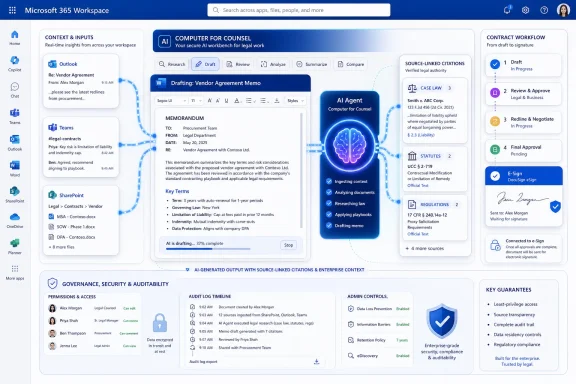 Perplexity Is Selling an AI Workbench, Not a Legal Search Box
The legal technology market has no shortage of AI research tools, drafting assistants, and contract-review products. What Perplexity is pitching with Computer for Counsel is broader: a system that can move across research databases, document repositories, contract platforms, e-signature tools, and communications apps, then assemble work product from that context.That distinction matters. Lawyers do not usually lose time because one database is slow. They lose time because the facts of a matter are scattered across Outlook threads, Teams messages, SharePoint folders, NetDocuments workspaces, DocuSign envelopes, contract lifecycle systems, and paid research platforms that do not naturally talk to each other.
Perplexity’s answer is to make its Computer agent the layer above those systems. The company says Computer for Counsel can handle research, document collection, contract triage, regulatory monitoring, citation review, and intake processing. In other words, it is positioning the product at the messy middle of legal work: not the final judgment, but the gathering, formatting, checking, routing, and summarizing that consumes so much attorney and paralegal time.
That is also where the risk lives. A legal AI tool that merely summarizes a public case has one failure mode. A tool that can read internal documents, draft a memo, route an NDA, cite regulatory materials, and act inside Microsoft 365 has many more. Perplexity is betting that source-linked outputs, enterprise controls, and attorney verification will be enough to make that power acceptable.
The Real Platform Battle Runs Through Word, Outlook, SharePoint, and Teams
For Windows and Microsoft 365 shops, the most consequential part of the launch is that Computer for Counsel is available inside Microsoft 365. Perplexity says it can draft documents in Word, retrieve files from SharePoint, and reference context from Outlook or Microsoft Teams conversations. That puts the agent directly inside the software stack that most legal departments already live in.This is the same battleground Microsoft has been trying to own with Copilot. The theory is simple: if the AI assistant is available inside Word, Outlook, Excel, PowerPoint, Teams, and SharePoint, the user does not need to leave the workflow. The assistant becomes less like a website and more like an ambient layer of the desktop.
Perplexity’s move is therefore both complementary and confrontational. It rides on Microsoft’s productivity estate, but it also competes for the role of trusted AI intermediary. A lawyer asking an assistant to summarize deal history from email, pull the latest draft from SharePoint, compare it against a third-party NDA, and prepare a clean version for DocuSign is not just using an app. They are delegating coordination across the office stack.
That is why Computer for Counsel should be read as part of a larger enterprise AI pattern. The winning product is not necessarily the model with the flashiest benchmark score. It is the one that gets permissions, identity, file access, auditability, and workflow placement right enough that users actually invoke it during the workday.
Legal AI Has Moved From Answers to Actions
The first wave of generative AI in law was obsessed with answers. Could a model summarize a case? Could it draft a clause? Could it explain a statute? Those were useful questions, but they also kept AI in the role of an unusually confident intern.Computer for Counsel points to the next phase: action. Perplexity describes workflows such as third-party NDA intake, regulatory monitoring, and case research with citation review. In the NDA example, the system can review incoming agreements for red flags, complete entity and signatory information, prepare clean copies, and route documents for approval and signature through DocuSign.
That is more ambitious than “write me a summary.” It touches business process, not just text generation. If it works well, it compresses the administrative loop between receiving a document, identifying what matters, filling in routine details, and moving the item to the next responsible person.
The same logic applies to regulatory monitoring. A dashboard for state privacy and adtech laws is not simply a research memo; it is a living operational artifact. Legal teams need to know what changed, where it changed, whether it affects current products, and which source supports the conclusion. The value is not the paragraph. The value is the maintained context.
Perplexity’s Multi-Model Pitch Is Clever, but Verification Is Still the Product
Perplexity says Computer for Counsel is powered by more than 20 frontier AI models and selects the best model for the task at hand. That is a sensible architecture for legal workflows, where research, reasoning, drafting, classification, retrieval, and document comparison may benefit from different model strengths.It is also a useful hedge. If one model family is better at long-context analysis and another is better at structured extraction, a routing layer can theoretically produce better results than a single-model system. For enterprises, it also reduces dependence on one provider’s model roadmap.
But legal users will not judge the product by the elegance of model orchestration. They will judge it by whether the answer can be verified quickly. Perplexity has leaned heavily into source-linked output, saying results link back to cases, statutes, regulations, filings, and internal documents so attorneys can inspect the basis before using material in a brief, memo, or client communication.
That is the right emphasis. The legal AI scandals of the past few years have mostly revolved around hallucinated authority, careless verification, or overreliance on fluent output. In law, a beautiful paragraph with a broken citation is not a productivity gain. It is a liability dressed as efficiency.
Midpage Gives the Launch a Legal Spine
The inclusion of Midpage is one of the more important details in the announcement. Midpage is an AI legal research and drafting platform for litigators that includes U.S. federal and state appellate case law, statutes, regulations, a proprietary citator, and source-linked answers. That gives Computer for Counsel a more credible legal-research foundation than a general web index alone.Legal research is unforgiving because authority has hierarchy, jurisdiction, procedural posture, and history. A case can be real and still be bad law. A statute can be current in one context and irrelevant in another. A model that cannot distinguish between persuasive authority and controlling authority is not ready to be treated as a legal research partner.
A proprietary citator is therefore not a decorative feature. It is part of the trust mechanism. Lawyers need to know not only what a case said, but whether it remains good law, how it has been treated, and whether relying on it would create professional embarrassment or worse.
Perplexity’s challenge is to blend that specialist capability with its broader agentic interface without flattening legal nuance into generic answer-engine prose. The more the product looks like a normal AI assistant, the more important it becomes that the underlying legal signals are preserved and visible.
Compliance Data Turns the Product Toward In-House Counsel
Computer for Counsel also includes access to Deel’s compliance data, covering employment law, worker classification, employer-of-record rules, contractor compliance, immigration, and cross-border payroll obligations. That points the product beyond litigation and into the daily grind of corporate legal departments.In-house teams face a different kind of information problem from litigators. They are often asked for fast, practical guidance across jurisdictions, business units, and employment arrangements. The question is less “what is the best case on this point?” and more “can we hire this person this way in this country without creating tax, immigration, or employment-law exposure?”
That is exactly the sort of question where AI can be useful and dangerous at the same time. The factual matrix changes quickly. The answer may depend on local counsel, company policy, contract structure, payroll setup, and the worker’s actual duties. An AI-generated answer can accelerate issue spotting, but it cannot safely become the final compliance determination.
Perplexity appears to understand that positioning. Its public framing says attorneys remain in control of judgment and strategy while Computer handles lower-value administrative work. That is the line every serious legal AI vendor now has to walk: powerful enough to be useful, constrained enough to avoid pretending it is counsel.
LegalZoom Brings Templates, but Also a Boundary Problem
The planned inclusion of LegalZoom’s custom contract template flow adds another dimension. Users are expected to be able to create customer agreements, employment contracts, and NDAs through the platform. For small businesses and lean legal teams, that could be attractive: research, template generation, review, routing, and execution all near the same interface.But contract templates are where product positioning becomes delicate. LegalZoom has long operated at the boundary between legal self-service and attorney-delivered legal advice. Perplexity is now bringing that boundary into an AI workflow that may also be used by enterprises and legal departments.
For lawyers, templates are not merely forms. They embody risk allocation, negotiation strategy, jurisdictional assumptions, and commercial leverage. A template that is fine for one customer agreement may be unacceptable for another. A generated NDA may look standard while quietly failing to reflect a company’s preferred confidentiality term, residuals position, injunctive-relief language, or data-security obligations.
That does not make the integration a mistake. It makes governance essential. Legal departments adopting Computer for Counsel will need to decide which templates are approved, who can generate them, whether generated documents must use firm or company playbooks, and how exceptions are escalated.
Connectors Are the Feature and the Attack Surface
Perplexity says Computer for Counsel can connect to Google Drive, Google Calendar, Gmail, and more than 400 other files and tools through App Connectors. Named legal and business connectors include Box, Carta, Clio, DeepJudge, DocuSign, Ironclad, and NetDocuments.That breadth is the product’s strongest selling point. It is also the reason sysadmins and security teams will want to slow the celebration. A legal AI agent connected to document repositories, contract systems, email, calendars, matter-management tools, and signature platforms is only as safe as its permission model, logging, retention settings, and administrative controls.
The old SaaS question was, “Can this app access our files?” The new agentic AI question is, “Can this app read, reason across, transform, and initiate workflow actions based on our files?” That is a different order of operational risk.
Perplexity says Enterprise does not train on company data and that internal files accessed through App Connectors remain under the firm’s control. Those are necessary claims, but they are not the end of due diligence. Legal teams will still need to examine tenant isolation, data residency, audit logs, identity integration, connector scopes, retention behavior, admin controls, and whether sensitive matters can be excluded from AI access.
The Windows Admin’s Problem Is No Longer Shadow AI, but Sanctioned AI
For years, IT departments worried that employees were pasting confidential material into consumer AI tools. That problem has not vanished, but the more complicated version is now arriving through sanctioned enterprise products. Computer for Counsel is designed to be adopted, connected, and placed inside the workflow.That changes the administrative posture. Blocking AI at the firewall is a blunt instrument when the general counsel’s office wants an approved tool inside Word and Outlook. The job becomes policy design: which data sources are connected, which users receive access, what actions the agent can take, what logs are retained, and how output is reviewed.
For Microsoft 365 administrators, SharePoint and Teams governance become especially important. Many organizations already have over-permissive SharePoint sites, stale Teams channels, and document libraries whose access rules reflect organizational history rather than current need. An AI agent does not create those permission problems, but it can make them visible at machine speed.
This is one of the least glamorous but most important realities of enterprise AI. Before an organization connects an agent to its knowledge base, it has to be honest about whether that knowledge base is cleanly permissioned. If the wrong people can already access a document, an AI assistant may simply make that mistake easier to exploit.
The Legal Profession Will Not Automate the Work It Values Most
Perplexity’s stated goal is to help lawyers spend less time on administrative work and more time on judgment, strategy, and client counsel. That is the right aspiration, and it is also a carefully chosen message. No credible vendor wants to tell lawyers that the machine is here to practice law.The likely near-term impact is narrower and more practical. AI will absorb more intake, triage, summarization, first-pass drafting, research organization, and status reporting. It will make junior work more review-heavy and less blank-page-heavy. It will also put pressure on the billable-hour economics of tasks that clients already suspected were inefficient.
That does not mean lawyers disappear from the loop. It means the loop changes shape. The attorney may spend less time finding ten documents and more time deciding which of the ten matter. The paralegal may spend less time assembling a chronology and more time checking whether the chronology omits a key email. The associate may spend less time generating a first draft and more time making sure the draft survives contact with precedent and client facts.
The firms and legal departments that benefit most will not be the ones that simply buy the product. They will be the ones that redesign workflows around verification, privilege, accountability, and escalation.
The Citation Link Is the New Save Button
Perplexity’s brand has always leaned on answers with citations. In consumer search, that is a differentiator. In legal work, it is table stakes. Computer for Counsel’s promise that outputs link back to cases, statutes, regulations, filings, and internal documents is therefore central to whether the product is taken seriously.A citation-backed PDF export for case research sounds mundane, but it reflects a deeper requirement. Legal work must be reviewable. A partner, client, judge, regulator, or opposing counsel may ask where a claim came from. “The AI said so” is not an answer; it is an admission.
The same standard should apply to internal documents. If Computer for Counsel summarizes a matter based on SharePoint files and Outlook messages, the user needs to know which files and messages informed the summary. Otherwise, the output becomes an attractive black box, and legal teams are professionally allergic to black boxes when stakes are high.
This is where Perplexity’s answer-engine heritage may help. The company has spent its existence training users to expect links back to source material. The legal market will test whether that habit can survive more complex, multi-source, permissioned enterprise workflows.
The Race Is Really About Trust Infrastructure
Perplexity is not alone in chasing legal AI. Microsoft, OpenAI, Anthropic, Harvey, Thomson Reuters, LexisNexis, Litera, and a growing field of specialist vendors are all competing for pieces of the legal workflow. What makes Computer for Counsel notable is the breadth of Perplexity’s integration strategy and its attempt to combine open-web reasoning, premium sources, internal documents, and productivity-suite action.That breadth could be a strength if it reduces tool switching and creates a coherent research-to-draft-to-route workflow. It could also become a weakness if legal teams decide that too much responsibility is being concentrated in one agentic layer. The same product that promises convenience may raise procurement questions about vendor lock-in, model routing opacity, and cross-system access.
The deciding factor will be trust infrastructure, not marketing language. Does the system respect permissions? Does it log what matters? Can admins restrict connectors? Can lawyers see sources? Can outputs be reproduced? Can firms prevent sensitive client data from leaking into unintended contexts? Can the vendor explain which model touched which data under which retention terms?
Those questions sound bureaucratic, but they are the architecture of adoption. Legal departments are conservative not because they dislike technology, but because mistakes carry duties, sanctions, reputational damage, privilege risk, and client consequences.
The Practical Read for WindowsForum Readers
Computer for Counsel is not just a legal-industry announcement; it is another signal that AI agents are moving into the Windows productivity layer through Microsoft 365 add-ins, enterprise connectors, and document-centric workflows. The legal angle makes the stakes unusually clear because lawyers are paid to care about sources, permissions, and consequences.- Perplexity is positioning Computer for Counsel as an agentic workflow layer across legal research, contracts, documents, email, calendars, and matter systems.
- The Microsoft 365 integration matters because Word, Outlook, SharePoint, and Teams are already the daily workspace for many legal teams.
- Source-linked answers are not a luxury in legal work; they are the minimum requirement for professional verification.
- Connectors to systems such as DocuSign, NetDocuments, Box, Ironclad, Clio, Carta, and Google Workspace make the product useful, but they also raise access-control and audit questions.
- The strongest early use cases are likely to be intake, triage, monitoring, first-pass research, citation review, and document assembly rather than final legal judgment.
- Administrators should treat legal AI deployment as an identity, permissions, logging, and data-governance project, not merely as another productivity add-in.
References
- Primary source: Pulse 2.0
Published: 2026-06-24T20:25:07.392854
Perplexity Launches Computer For Counsel For Legal Teams
Perplexity announced the launch of Computer for Counsel, a new AI product designed for lawyers and legal teams. Computer for Counsel connects the research databases, document repositories, contract tools, and matter-management systems lawyers use every day to Perplexity Computer. pulse2.com
- Related coverage: legalzoom.com
- Related coverage: perplexity.ai
- Official source: learn.microsoft.com
Application Information for Perplexity Computer for Outlook by Perplexity - Microsoft 365 App Certification | Microsoft Learn
All available security and compliance information information for Perplexity Computer for Outlook, its data handling policies, its Microsoft Cloud App Security app catalog information, and security/compliance information in the CSA STAR registry.learn.microsoft.com - Related coverage: artificiallawyer.com
Perplexity Gets Serious About Legal – Artificial Lawyer
We’ve had OpenAI, Anthropic, Microsoft and Palantir enter the legal vertical. Perplexity – which has dabbled in our field before – is going into legal for real, Artificial Lawyer can now share. So,…www.artificiallawyer.com - Related coverage: businesswire.com

- Related coverage: venturebeat.com
Perplexity takes its ‘Computer’ AI agent into the enterprise, taking aim at Microsoft and Salesforce | VentureBeat
Perplexity announced Computer for Enterprise at its Ask 2026 developer conference, launching a multi-model AI agent with Slack integration, Snowflake connectors, and 20 orchestrated AI models to compete directly with Microsoft Copilot and Salesforce in the $139 billion agentic AI market.venturebeat.com - Related coverage: enterprisedna.co
Perplexity Computer Is Now Inside Microsoft Office — Enterprise DNA
Perplexity Computer is now a native add-in in Word, Excel, PowerPoint, and Outlook, bringing agentic AI directly into everyday business workflows.enterprisedna.co - Related coverage: legaltech-talk.com
LegalZoom Announces Strategic Partnership with Perplexity to Offer Legal Services to AI Search Customers - LegalTechTalk
Industry-first collaboration brings technology-enabled legal solutions to users of leading AI answer enginewww.legaltech-talk.com - Related coverage: therift.ai
