

LawVu launched LegalOS on June 2, 2026, from Tauranga, New Zealand, as an AI-powered operating system for in-house legal departments that connects LawVu Assistant, agentic workflows, LawVu Draft, and external AI tools including ChatGPT, Claude, and Microsoft Copilot. The announcement matters because it is not another lawyer chatbot pitched at BigLaw efficiency budgets. It is a bid to own the workflow layer where corporate legal work is requested, assigned, approved, tracked, and measured. If LawVu is right, the next legal AI battleground is not the prompt window; it is the system of record behind it.
The legal AI market has spent the past two years behaving as if the profession’s main problem is that lawyers type too much. That diagnosis is convenient for vendors selling drafting, summarization, research, and document review assistants to law firms. It is less convincing inside a corporate legal department, where the hard part is often not writing the clause but deciding who owns the request, whether it has enough context, whether it needs outside counsel, and how it fits into the business’s risk appetite.
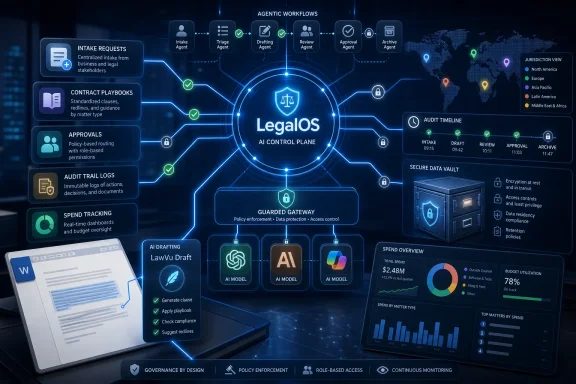
LawVu’s LegalOS pitch starts from that messier reality. The company is not presenting the product as a clever assistant that a lawyer opens in a separate tab when stuck. It is presenting LegalOS as the operating environment for in-house legal: intake, matters, contracts, approvals, spend, tasks, notes, documents, and institutional knowledge living in one governed place.
That distinction is not semantic. A chatbot without workflow context can answer a question; a system embedded in the work can route the request, create the matter, assemble the relevant contract history, trigger an approval, and leave an audit trail. The difference is the difference between Ask to Answer and Ask to Act.
For WindowsForum readers, the Microsoft angle is not incidental. LawVu Draft lives where many lawyers still live — Microsoft Word — while the platform’s MCP server is designed to connect tools such as Microsoft Copilot into LawVu’s governed legal data layer. The office suite remains the front end of legal work, but LawVu is trying to become the orchestration layer underneath it.
The important part is the way those pieces relate to one another. LawVu is not saying that every lawyer must use its own assistant instead of ChatGPT, Claude, or Copilot. It is saying that those tools become more useful when they can securely reach the legal department’s operational context instead of relying on pasted fragments and hope.
That is a shrewd position. The frontier model market is expensive, volatile, and dominated by companies with far deeper pockets than a New Zealand legal tech vendor. Rather than pretending it can out-model OpenAI, Anthropic, Microsoft, or Google, LawVu is trying to own the place where those models need permission, structure, and context.
This is where the Model Context Protocol becomes strategically useful. MCP is still early and still surrounded by the usual standards-war uncertainty, but the basic idea is straightforward: give AI systems a structured way to talk to external tools and data sources. In LawVu’s version, the AI tool does not become the legal operating system; it becomes a client of one.
That is also where the risk begins. Once AI tools can read from and write to legal systems, the stakes move beyond hallucinated summaries. The agent can potentially create, modify, route, or close work. A governed MCP layer is therefore not a feature flourish; it is the line between useful automation and an unmanageable compliance event.
Corporate legal departments have a different problem. They are not merely trying to produce more documents per lawyer. They are trying to absorb business demand without letting legal become either a bottleneck or a rubber stamp. That makes their work more operational and more dependent on context.
The CLOC numbers explain why the opportunity is suddenly more urgent. The 2025 State of the Industry report found that 30 percent of legal teams were already using AI and another 54 percent planned to adopt it within two years. That is not a fringe market experimenting with toys; it is a professional function moving from curiosity to procurement.
Yet in-house teams are often less well served by point AI tools than law firms are. A law firm can buy a research assistant and measure whether lawyers draft memos faster. A legal department needs to know whether the sales contract request has been triaged correctly, whether procurement has attached the right paper trail, whether outside counsel spend is justified, and whether the same risk position has been taken consistently across hundreds of matters.
That is why LawVu’s framing lands. The in-house legal department is not a smaller law firm trapped inside a corporation. It is a business function with legal judgment embedded in service delivery, governance, risk management, and spend control. AI that does not understand that operating model will remain impressive in demos and disappointing in production.
LegalOS makes the acquisition look more strategic. Drafting is not being treated as a separate AI island. It is one component inside the broader in-house workflow, which means drafting can be connected to intake, matters, approvals, obligations, spend, and legal knowledge.
That matters because contract work is where legal AI often collides with organizational reality. A model can propose language, but the business still needs to know which playbook applies, who approved the deviation, whether a fallback clause is allowed, and how the contract relates to prior negotiations. The value is not just generating text; it is ensuring the text belongs in that transaction.
The reported NZ$400 million valuation attached to LawVu’s late-2025 milestones also puts pressure on the company to tell a bigger story than “better contract drafting.” LegalOS is that story. It says LawVu is not merely adding AI features to a legal workspace; it is trying to define the enterprise category that in-house legal will standardize on.
That is ambitious, and ambition should invite skepticism. Enterprise software categories are not declared into existence by press releases. They are earned through integrations, uptime, permissions, migrations, governance, support, and the tedious politics of adoption.
But that same logic cuts both ways. Microsoft has every incentive to make Copilot better at domain workflows, and the company’s gravitational pull inside the enterprise is enormous. If LawVu becomes merely a data source that Copilot queries, it risks being valuable but invisible.
The company’s answer is governance. Legal departments do not just need AI access to documents; they need permissions, workflows, matter context, approvals, role boundaries, and auditability. Those are not generic productivity features. They are the difference between a useful enterprise assistant and a compliance nightmare with a friendly interface.
This is where smaller vertical software vendors can still win against platform giants. Microsoft can provide the substrate, identity layer, productivity suite, and AI assistant. A vertical vendor can provide the domain model: what a matter is, how intake should work, how legal spend is categorized, which contract deviation matters, and why a request from sales is not the same thing as a request from HR.
Still, the balance will be delicate. LawVu needs the frontier models and enterprise copilots to be close enough that customers can use them naturally, but not so dominant that LawVu becomes plumbing. The MCP server is a clever hedge because it positions LawVu as the governed hub rather than another AI destination.
LawVu’s Agentic Workflow Builder is compelling precisely because in-house legal work is full of repeatable, rules-based pathways. A nondisclosure agreement intake request may need a quick review, a playbook check, a business owner confirmation, and a record of approval. A privacy assessment may need to collect facts, route to the right specialist, and generate a matter record. A contract deviation may need escalation based on jurisdiction, value, or counterparty.
Those are plausible places for agents to help. They are also places where the agent must be constrained. Legal work is not just another ticket queue. Small changes in facts can alter risk, privilege, approval authority, and regulatory exposure.
That is why the audit trail may become more important than the assistant’s prose. If an AI agent triggers a workflow, changes a matter, drafts a clause, or routes an approval, the legal department needs to know what happened, why it happened, who authorized it, and whether a human reviewed the result. The more capable the agent, the more boring the controls must become.
This is the enterprise AI paradox. The flashy demo shows a lawyer asking a natural-language question and receiving a polished answer. The product that actually gets deployed must obsess over permissions, logging, exceptions, rollback, and administrative control.
Every enterprise function has lived through this consolidation cycle. Sales went from rolodexes, spreadsheets, and inboxes to CRM. Finance standardized around ERP. HR moved into HCM platforms. Legal has often lagged because its work is sensitive, varied, and culturally resistant to standardization.
AI changes the economics of that resistance. Fragmented data was always inefficient; now it actively limits what AI can do. If the matter history is in one place, the contract is in another, the spend data is somewhere else, and the approval happened in email, an assistant can only ever see a distorted version of reality.
LawVu’s thesis is that a decade of structured in-house workflow data gives it a defensible advantage. That claim deserves scrutiny, but the underlying idea is sound. AI systems are only as useful as the context they can safely access and the actions they are allowed to take.
The spreadsheet never had an audit strategy. The shared mailbox never had an agent governance model. The point tool never understood the whole legal lifecycle. LegalOS is LawVu’s attempt to make that fragmentation look obsolete.
That is unusual but not accidental. New Zealand software companies that break out globally often do so by avoiding the obvious local ceiling. They build for export from the start because the domestic market is too small to support category-scale ambition. LawVu’s customer references, which include global brands and sophisticated corporate legal buyers, suggest the company has been playing that game for some time.
For New Zealand’s legal market, the implications are sharper than national pride. Large firms can adopt Harvey, Copilot, or other AI tools to make their own lawyers faster, but their clients may be adopting platforms designed to reduce avoidable law firm spend. That is not an anti-law-firm story; complex work will still require external counsel. It is a utilization story.
When the client’s legal department has better intake, better matter context, better contract playbooks, and better spend analytics, it becomes a more intelligent buyer of legal services. It can decide what to keep in-house, what to automate, what to send out, and which firms are delivering value. That shifts leverage.
Law firms that see AI only as a way to preserve margins may miss the bigger movement. The client is not merely buying tools to do legal work faster. The client is buying tools to decide which legal work should exist at all.
LawVu’s MCP server is therefore the most strategically important and most scrutinizable part of the announcement. The promise is governed access: external tools such as Claude, ChatGPT, and Microsoft Copilot can interact with LawVu data and workflows without the legal department manually copying sensitive context into unmanaged prompts. That is the right direction.
But security-minded buyers will ask hard questions. How granular are the permissions? What can an external AI tool read? What can it write? How are actions logged? How are prompts, responses, and retrieved documents retained? Can administrators restrict particular workflows or data classes? What happens when a connected AI service changes its own policies or model behavior?
Those questions are not objections to the product. They are the buying process. In enterprise legal technology, the sale is not won when the assistant writes a decent summary; it is won when the CISO, general counsel, legal ops leader, and procurement team can all live with the control model.
The companies that succeed in legal AI will not be the ones with the most dramatic demos. They will be the ones that make risk boring enough for deployment.
Still, the metaphor has limits. Real operating systems win through ecosystems, developer gravity, compatibility, and ruthless reliability. LegalOS will need more than a good narrative to earn that role. It will need integrations that survive messy enterprise reality, migration paths from incumbent tools, administrative clarity, and enough flexibility for legal teams that do not all work the same way.
There is also the danger of over-centralization. In-house legal teams need a common layer, but they do not want a rigid bureaucracy disguised as software. The best legal operating system will standardize what should be standardized while leaving room for judgment, exception handling, and local practice.
LawVu’s advantage is that it appears to understand legal operations as an operating discipline, not just a document-production problem. Its risk is that the market may not yet agree on how much of that discipline belongs in one platform. The next two years of AI adoption will test that assumption.
If buyers decide that the right model is a loose federation of best-of-breed AI tools connected by Microsoft 365 and enterprise search, LawVu’s operating-system claim becomes harder to defend. If buyers decide that legal needs a governed domain layer before AI can scale safely, LawVu has chosen the right hill.
That is a much harder problem and a more valuable one. It requires structured data, trusted workflows, integrations, permissions, and a clear view of where human judgment remains mandatory. It also requires legal teams to confront their own process debt.
Many departments will discover that AI does not magically fix bad intake, unclear playbooks, inconsistent matter categorization, or undocumented approval norms. It exposes them. A legal operating system can help, but only if the department is willing to make its work legible.
This is why LawVu’s timing is interesting. The market has moved past pure experimentation, but it has not yet fully standardized. Legal leaders know they need AI, but many are still deciding whether to buy point tools, extend Microsoft, rely on law firms, build internally, or centralize around a specialist platform.
LegalOS is LawVu’s answer before the category hardens. It says the winning layer is not the model and not the document editor. It is the legal workflow system with enough context to let AI act safely.
If an AI-enabled legal operating system can triage requests, assemble context, automate routine workflows, draft first-pass documents, and identify when escalation is actually needed, the law firm invoice changes. Some work still goes out, but it goes out later, cleaner, and with a better-defined scope. Some work never goes out at all.
That is the quiet threat to private practice. The tools that make law firms more efficient may preserve their existing service model. The tools that make clients more operationally sophisticated may change the volume and shape of demand.
This does not mean the end of external counsel. It means the end of a certain kind of profitable ambiguity. A client with better data can ask why a matter cost what it cost, why a contract negotiation took so long, why similar work was handled differently, and whether the next iteration belongs inside the company.
LawVu’s customers are not buying AI because it is fashionable. They are buying leverage. The more legal work becomes measurable and routable, the more the client controls the economics.
For IT teams, the MCP and Copilot connections deserve careful evaluation rather than reflexive excitement. The architecture promises less copy-and-paste leakage and more governed access, but it also creates new pathways between sensitive legal data and AI tools. Those pathways need policy, monitoring, and ownership.
For legal operations leaders, the announcement is a reminder that AI readiness is mostly data and process readiness. If matters are inconsistently tagged, contracts are poorly organized, approvals live in email, and spend categories are unreliable, the assistant will inherit the mess. LegalOS may provide a structure, but the department still has to do the operational work.
For general counsel, the strategic question is whether AI should be layered onto existing fragmentation or used as the forcing function for consolidation. LawVu is betting that consolidation wins. The market has not yet delivered a final verdict, but the pressure is clearly moving in that direction.
 LawVu Is Selling the Place Where Legal Work Actually Happens
The legal AI market has spent the past two years behaving as if the profession’s main problem is that lawyers type too much. That diagnosis is convenient for vendors selling drafting, summarization, research, and document review assistants to law firms. It is less convincing inside a corporate legal department, where the hard part is often not writing the clause but deciding who owns the request, whether it has enough context, whether it needs outside counsel, and how it fits into the business’s risk appetite.LawVu’s LegalOS pitch starts from that messier reality. The company is not presenting the product as a clever assistant that a lawyer opens in a separate tab when stuck. It is presenting LegalOS as the operating environment for in-house legal: intake, matters, contracts, approvals, spend, tasks, notes, documents, and institutional knowledge living in one governed place.
That distinction is not semantic. A chatbot without workflow context can answer a question; a system embedded in the work can route the request, create the matter, assemble the relevant contract history, trigger an approval, and leave an audit trail. The difference is the difference between Ask to Answer and Ask to Act.
For WindowsForum readers, the Microsoft angle is not incidental. LawVu Draft lives where many lawyers still live — Microsoft Word — while the platform’s MCP server is designed to connect tools such as Microsoft Copilot into LawVu’s governed legal data layer. The office suite remains the front end of legal work, but LawVu is trying to become the orchestration layer underneath it.
The Product Is Less a Chatbot Than a Legal Control Plane
LegalOS combines several pieces that, taken separately, sound familiar. LawVu Assistant is the natural-language interface. The Agentic Workflow Builder is the mechanism for creating agents and automations. LawVu Draft, born from the company’s ClauseBase acquisition, handles AI-assisted drafting and contract review. The MCP server lets external AI tools connect to LawVu’s legal data and workflows under a governance model.The important part is the way those pieces relate to one another. LawVu is not saying that every lawyer must use its own assistant instead of ChatGPT, Claude, or Copilot. It is saying that those tools become more useful when they can securely reach the legal department’s operational context instead of relying on pasted fragments and hope.
That is a shrewd position. The frontier model market is expensive, volatile, and dominated by companies with far deeper pockets than a New Zealand legal tech vendor. Rather than pretending it can out-model OpenAI, Anthropic, Microsoft, or Google, LawVu is trying to own the place where those models need permission, structure, and context.
This is where the Model Context Protocol becomes strategically useful. MCP is still early and still surrounded by the usual standards-war uncertainty, but the basic idea is straightforward: give AI systems a structured way to talk to external tools and data sources. In LawVu’s version, the AI tool does not become the legal operating system; it becomes a client of one.
That is also where the risk begins. Once AI tools can read from and write to legal systems, the stakes move beyond hallucinated summaries. The agent can potentially create, modify, route, or close work. A governed MCP layer is therefore not a feature flourish; it is the line between useful automation and an unmanageable compliance event.
In-House Legal Was Always the Better AI Problem
The market obsession with private practice is understandable. Big law firms have money, prestige, and armies of associates doing document-heavy work that looks easy to automate from the outside. Harvey, Thomson Reuters CoCounsel, LexisNexis Protégé, and a growing list of specialist tools are all chasing variations of the same premise: make the lawyer faster and the firm more efficient.Corporate legal departments have a different problem. They are not merely trying to produce more documents per lawyer. They are trying to absorb business demand without letting legal become either a bottleneck or a rubber stamp. That makes their work more operational and more dependent on context.
The CLOC numbers explain why the opportunity is suddenly more urgent. The 2025 State of the Industry report found that 30 percent of legal teams were already using AI and another 54 percent planned to adopt it within two years. That is not a fringe market experimenting with toys; it is a professional function moving from curiosity to procurement.
Yet in-house teams are often less well served by point AI tools than law firms are. A law firm can buy a research assistant and measure whether lawyers draft memos faster. A legal department needs to know whether the sales contract request has been triaged correctly, whether procurement has attached the right paper trail, whether outside counsel spend is justified, and whether the same risk position has been taken consistently across hundreds of matters.
That is why LawVu’s framing lands. The in-house legal department is not a smaller law firm trapped inside a corporation. It is a business function with legal judgment embedded in service delivery, governance, risk management, and spend control. AI that does not understand that operating model will remain impressive in demos and disappointing in production.
The ClauseBase Deal Now Looks Like a Step, Not a Side Quest
LawVu’s December 2025 acquisition of ClauseBase was easy to understand as a product expansion. ClauseBase brought intelligent contract drafting, review, and automation into LawVu’s orbit, and the technology has been rebranded as LawVu Draft. That alone gave LawVu a stronger answer to the obvious question every legal AI buyer asks: can it help with contracts?LegalOS makes the acquisition look more strategic. Drafting is not being treated as a separate AI island. It is one component inside the broader in-house workflow, which means drafting can be connected to intake, matters, approvals, obligations, spend, and legal knowledge.
That matters because contract work is where legal AI often collides with organizational reality. A model can propose language, but the business still needs to know which playbook applies, who approved the deviation, whether a fallback clause is allowed, and how the contract relates to prior negotiations. The value is not just generating text; it is ensuring the text belongs in that transaction.
The reported NZ$400 million valuation attached to LawVu’s late-2025 milestones also puts pressure on the company to tell a bigger story than “better contract drafting.” LegalOS is that story. It says LawVu is not merely adding AI features to a legal workspace; it is trying to define the enterprise category that in-house legal will standardize on.
That is ambitious, and ambition should invite skepticism. Enterprise software categories are not declared into existence by press releases. They are earned through integrations, uptime, permissions, migrations, governance, support, and the tedious politics of adoption.
The Copilot Connection Is Both Opportunity and Warning
Microsoft Copilot’s presence in LawVu’s announcement is revealing. Many corporate legal departments already live inside Microsoft 365, and many IT leaders would prefer to extend an approved Microsoft environment rather than introduce another unmanaged AI surface. If LawVu can make Copilot more useful for legal work without forcing legal teams to abandon their system of record, it has a credible path into enterprises that are already standardizing around Microsoft’s AI stack.But that same logic cuts both ways. Microsoft has every incentive to make Copilot better at domain workflows, and the company’s gravitational pull inside the enterprise is enormous. If LawVu becomes merely a data source that Copilot queries, it risks being valuable but invisible.
The company’s answer is governance. Legal departments do not just need AI access to documents; they need permissions, workflows, matter context, approvals, role boundaries, and auditability. Those are not generic productivity features. They are the difference between a useful enterprise assistant and a compliance nightmare with a friendly interface.
This is where smaller vertical software vendors can still win against platform giants. Microsoft can provide the substrate, identity layer, productivity suite, and AI assistant. A vertical vendor can provide the domain model: what a matter is, how intake should work, how legal spend is categorized, which contract deviation matters, and why a request from sales is not the same thing as a request from HR.
Still, the balance will be delicate. LawVu needs the frontier models and enterprise copilots to be close enough that customers can use them naturally, but not so dominant that LawVu becomes plumbing. The MCP server is a clever hedge because it positions LawVu as the governed hub rather than another AI destination.
Agentic Workflows Are Where the Hype Meets the Audit Log
The phrase agentic AI is already approaching marketing exhaustion. In vendor language, it can mean anything from a script with better prompts to a multi-step autonomous system that can choose tools, call APIs, and complete work with limited human intervention. In legal operations, that ambiguity is dangerous.LawVu’s Agentic Workflow Builder is compelling precisely because in-house legal work is full of repeatable, rules-based pathways. A nondisclosure agreement intake request may need a quick review, a playbook check, a business owner confirmation, and a record of approval. A privacy assessment may need to collect facts, route to the right specialist, and generate a matter record. A contract deviation may need escalation based on jurisdiction, value, or counterparty.
Those are plausible places for agents to help. They are also places where the agent must be constrained. Legal work is not just another ticket queue. Small changes in facts can alter risk, privilege, approval authority, and regulatory exposure.
That is why the audit trail may become more important than the assistant’s prose. If an AI agent triggers a workflow, changes a matter, drafts a clause, or routes an approval, the legal department needs to know what happened, why it happened, who authorized it, and whether a human reviewed the result. The more capable the agent, the more boring the controls must become.
This is the enterprise AI paradox. The flashy demo shows a lawyer asking a natural-language question and receiving a polished answer. The product that actually gets deployed must obsess over permissions, logging, exceptions, rollback, and administrative control.
The Real Competitor Is the Spreadsheet, Not Harvey
It is tempting to frame LawVu against Harvey, CoCounsel, or Protégé because those are the visible names in legal AI. That comparison is only partly useful. LawVu is competing against them for attention, but its deeper enemy is the improvised legal department stack: email inboxes, shared drives, spreadsheets, contract repositories, e-billing tools, ticketing systems, and point solutions held together by legal operations teams.Every enterprise function has lived through this consolidation cycle. Sales went from rolodexes, spreadsheets, and inboxes to CRM. Finance standardized around ERP. HR moved into HCM platforms. Legal has often lagged because its work is sensitive, varied, and culturally resistant to standardization.
AI changes the economics of that resistance. Fragmented data was always inefficient; now it actively limits what AI can do. If the matter history is in one place, the contract is in another, the spend data is somewhere else, and the approval happened in email, an assistant can only ever see a distorted version of reality.
LawVu’s thesis is that a decade of structured in-house workflow data gives it a defensible advantage. That claim deserves scrutiny, but the underlying idea is sound. AI systems are only as useful as the context they can safely access and the actions they are allowed to take.
The spreadsheet never had an audit strategy. The shared mailbox never had an agent governance model. The point tool never understood the whole legal lifecycle. LegalOS is LawVu’s attempt to make that fragmentation look obsolete.
New Zealand’s Legal Tech Moment Is Quietly Global
There is a regional story here that should not be missed. LawVu is headquartered in Tauranga, not San Francisco, London, or New York. Yet it is trying to set terms in a global enterprise software category, selling to in-house legal teams that operate across jurisdictions, business units, and regulatory regimes.That is unusual but not accidental. New Zealand software companies that break out globally often do so by avoiding the obvious local ceiling. They build for export from the start because the domestic market is too small to support category-scale ambition. LawVu’s customer references, which include global brands and sophisticated corporate legal buyers, suggest the company has been playing that game for some time.
For New Zealand’s legal market, the implications are sharper than national pride. Large firms can adopt Harvey, Copilot, or other AI tools to make their own lawyers faster, but their clients may be adopting platforms designed to reduce avoidable law firm spend. That is not an anti-law-firm story; complex work will still require external counsel. It is a utilization story.
When the client’s legal department has better intake, better matter context, better contract playbooks, and better spend analytics, it becomes a more intelligent buyer of legal services. It can decide what to keep in-house, what to automate, what to send out, and which firms are delivering value. That shifts leverage.
Law firms that see AI only as a way to preserve margins may miss the bigger movement. The client is not merely buying tools to do legal work faster. The client is buying tools to decide which legal work should exist at all.
The Security Story Will Decide Whether LegalOS Scales
Legal data is not ordinary enterprise data. It can include privileged communications, sensitive commercial terms, regulatory investigations, employee disputes, board material, acquisition planning, and litigation strategy. Connecting that data to external AI systems is powerful, but it is also the kind of architecture that keeps security teams awake.LawVu’s MCP server is therefore the most strategically important and most scrutinizable part of the announcement. The promise is governed access: external tools such as Claude, ChatGPT, and Microsoft Copilot can interact with LawVu data and workflows without the legal department manually copying sensitive context into unmanaged prompts. That is the right direction.
But security-minded buyers will ask hard questions. How granular are the permissions? What can an external AI tool read? What can it write? How are actions logged? How are prompts, responses, and retrieved documents retained? Can administrators restrict particular workflows or data classes? What happens when a connected AI service changes its own policies or model behavior?
Those questions are not objections to the product. They are the buying process. In enterprise legal technology, the sale is not won when the assistant writes a decent summary; it is won when the CISO, general counsel, legal ops leader, and procurement team can all live with the control model.
The companies that succeed in legal AI will not be the ones with the most dramatic demos. They will be the ones that make risk boring enough for deployment.
The Operating-System Metaphor Is Useful Until It Becomes Overconfident
Calling something an operating system is a power move. It says the product is not an app in the stack but the environment in which the stack runs. In legal tech, that claim has intuitive appeal because in-house departments have lacked a single operational home for too long.Still, the metaphor has limits. Real operating systems win through ecosystems, developer gravity, compatibility, and ruthless reliability. LegalOS will need more than a good narrative to earn that role. It will need integrations that survive messy enterprise reality, migration paths from incumbent tools, administrative clarity, and enough flexibility for legal teams that do not all work the same way.
There is also the danger of over-centralization. In-house legal teams need a common layer, but they do not want a rigid bureaucracy disguised as software. The best legal operating system will standardize what should be standardized while leaving room for judgment, exception handling, and local practice.
LawVu’s advantage is that it appears to understand legal operations as an operating discipline, not just a document-production problem. Its risk is that the market may not yet agree on how much of that discipline belongs in one platform. The next two years of AI adoption will test that assumption.
If buyers decide that the right model is a loose federation of best-of-breed AI tools connected by Microsoft 365 and enterprise search, LawVu’s operating-system claim becomes harder to defend. If buyers decide that legal needs a governed domain layer before AI can scale safely, LawVu has chosen the right hill.
The Legal AI Race Is Moving From Prompts to Process
The most concrete read on LegalOS is that legal AI is maturing from individual productivity to departmental architecture. The early question was whether a lawyer could use AI to draft, summarize, or research faster. The next question is whether a legal department can redesign work around AI without losing control.That is a much harder problem and a more valuable one. It requires structured data, trusted workflows, integrations, permissions, and a clear view of where human judgment remains mandatory. It also requires legal teams to confront their own process debt.
Many departments will discover that AI does not magically fix bad intake, unclear playbooks, inconsistent matter categorization, or undocumented approval norms. It exposes them. A legal operating system can help, but only if the department is willing to make its work legible.
This is why LawVu’s timing is interesting. The market has moved past pure experimentation, but it has not yet fully standardized. Legal leaders know they need AI, but many are still deciding whether to buy point tools, extend Microsoft, rely on law firms, build internally, or centralize around a specialist platform.
LegalOS is LawVu’s answer before the category hardens. It says the winning layer is not the model and not the document editor. It is the legal workflow system with enough context to let AI act safely.
The Invoice Is Where This Gets Real
The most disruptive implication of LegalOS is not that in-house lawyers may write faster. It is that corporate legal departments may become more selective consumers of outside counsel. Better internal systems tend to make demand more visible, and visible demand is easier to manage.If an AI-enabled legal operating system can triage requests, assemble context, automate routine workflows, draft first-pass documents, and identify when escalation is actually needed, the law firm invoice changes. Some work still goes out, but it goes out later, cleaner, and with a better-defined scope. Some work never goes out at all.
That is the quiet threat to private practice. The tools that make law firms more efficient may preserve their existing service model. The tools that make clients more operationally sophisticated may change the volume and shape of demand.
This does not mean the end of external counsel. It means the end of a certain kind of profitable ambiguity. A client with better data can ask why a matter cost what it cost, why a contract negotiation took so long, why similar work was handled differently, and whether the next iteration belongs inside the company.
LawVu’s customers are not buying AI because it is fashionable. They are buying leverage. The more legal work becomes measurable and routable, the more the client controls the economics.
The Practical Read for IT, Legal Ops, and Windows Shops
The near-term significance of LegalOS is not that every in-house legal team should immediately rip out its current stack. The significance is that legal AI procurement is shifting from “which assistant gives the best answer?” to “which system governs the work?” That is a healthier question.For IT teams, the MCP and Copilot connections deserve careful evaluation rather than reflexive excitement. The architecture promises less copy-and-paste leakage and more governed access, but it also creates new pathways between sensitive legal data and AI tools. Those pathways need policy, monitoring, and ownership.
For legal operations leaders, the announcement is a reminder that AI readiness is mostly data and process readiness. If matters are inconsistently tagged, contracts are poorly organized, approvals live in email, and spend categories are unreliable, the assistant will inherit the mess. LegalOS may provide a structure, but the department still has to do the operational work.
For general counsel, the strategic question is whether AI should be layered onto existing fragmentation or used as the forcing function for consolidation. LawVu is betting that consolidation wins. The market has not yet delivered a final verdict, but the pressure is clearly moving in that direction.
The Part of LawVu’s Pitch Buyers Should Test First
LegalOS sounds expansive, but buyers should reduce the evaluation to specific claims that can be tested in real workflows. The strongest platforms in this category will prove themselves not in abstract AI benchmarks, but in the daily grind of legal service delivery.- LegalOS should be judged by whether it reduces intake friction without creating a new administrative burden for lawyers and business users.
- LawVu Assistant should be tested on real matter and contract context, not sanitized demo data that flatters the model.
- Agentic workflows should start with bounded, auditable processes where failure modes are understood and human review is explicit.
- MCP connections to ChatGPT, Claude, and Microsoft Copilot should be evaluated through permissions, logging, retention, and data-boundary controls before productivity claims.
- LawVu Draft should be measured against the department’s actual playbooks, fallback clauses, and approval rules rather than generic drafting quality.
- The platform’s value should ultimately appear in cycle time, outside counsel spend discipline, risk consistency, and business satisfaction, not merely in the number of AI features switched on.
References
- Primary source: LawFuel
Published: 2026-06-10T03:50:08.151800
New Zealand Legal Tech Company Just Launched An AI Workspace For In-House Teams Globally
Here's What LawVu's LegalOS Actually Does LawVu announced LegalOS on 2 June 2026 and the framing is the most interesting thing about it. Where Harvey, Thomson Rwww.lawfuel.com - Related coverage: lawvu.com
LawVu MCP Server: Connect AI Tools to Your Legal Operating System
LawVu's new MCP server connects AI tools like Claude and ChatGPT to your legal operating system — giving in-house teams governed access to matters, contracts, and workflows.lawvu.com - Related coverage: techcrunch.com
The AI legal services industry is heating up — Anthropic is getting in on the action | TechCrunch
Anthropic's new tools are designed to help law firms automate specific clerical functions — things like document search and review, case law resources, deposition prep, document drafting, and other related areas.techcrunch.com - Related coverage: deloitte.com
