
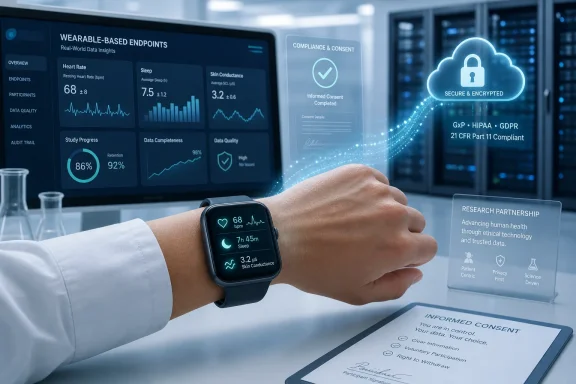
Samsung announced on June 24, 2026, that it is partnering with clinical research organization Alcedis to use biometric data from consenting Galaxy Watch users in medical research and drug-development studies, aiming to turn smartwatch signals into evidence usable by pharmaceutical companies and researchers. The announcement is less about a new watch feature than a new role for consumer hardware: the wrist as a low-friction clinical data pipeline. That makes the Galaxy Watch part fitness tracker, part research instrument, and part test case for how far Big Tech can move into healthcare without losing user trust.
The obvious comparison is Apple Watch, which has spent years teaching consumers to expect health claims from a device originally sold as an iPhone accessory. Samsung’s play is different in tone. Rather than leading with a dramatic consumer alert or a heartwarming rescue story, the company is pitching the Galaxy Watch as infrastructure for clinical trials — a quieter, more bureaucratic, and potentially more consequential business.
The central problem Samsung is trying to solve is not whether a smartwatch can collect data. That question has been answered by millions of wrists. The harder problem is whether those streams of heart rate, movement, sleep, body composition, skin temperature, and stress-adjacent signals can be translated into something researchers, regulators, and drug developers can actually use.
That is where Alcedis matters. Clinical research organizations live in the unglamorous middle layer between medical science, trial sponsors, data collection, compliance, and analysis. Samsung’s partnership with Alcedis is a recognition that raw wearable signals are not, by themselves, medical evidence. They need study design, validation, governance, and a workflow that can withstand scrutiny.
The language Samsung is using — “clinically meaningful evidence,” “wearable-based endpoints,” and “research lifecycle” — is not consumer-marketing fluff. It is the vocabulary of pharmaceutical trials, where an endpoint is not just a dashboard metric but a measurable outcome tied to whether a treatment works, helps, harms, or changes patient behavior. Samsung is trying to position Galaxy Watch data as something that can move beyond “your sleep score was 78” and into “this treatment changed a measurable physiological pattern in a real-world population.”
That is ambitious, and it should be treated as ambitious. Consumer wearables are excellent at collecting dense data in everyday settings, but they are also messy. People wear watches loosely, forget to charge them, switch wrists, ignore calibration instructions, sleep in strange positions, and take them off when they are sick — precisely when researchers might most want the data. The value proposition is not that the Galaxy Watch magically fixes that mess. It is that Samsung and Alcedis think they can build enough structure around the mess to make it useful.
Wearables promise a different kind of evidence: continuous, passive, real-world data. A smartwatch can observe patterns over days and weeks, not just during a clinic visit. It can capture whether a patient’s activity falls after starting a medication, whether sleep changes during treatment, or whether a physiological signal appears before a symptom is reported.
That is why drug developers are interested. If a wearable can detect changes earlier, more frequently, or with less burden on participants, it could make some trials faster and more efficient. It could also make trials more representative of daily life, especially for chronic conditions where the point is not what happens in a laboratory but what happens on a Tuesday afternoon when the patient is walking to the store.
Samsung is not alone in seeing this opening. Earlier this year, the company also announced work with Massachusetts General Hospital to study whether Galaxy Watch data can help monitor adults starting GLP-1 receptor agonist therapy, particularly around muscle loss and body composition. Samsung has also worked with Verily to bring Galaxy Watch data into clinical research platforms. The Alcedis partnership fits a pattern: Samsung is assembling the institutional plumbing around its hardware.
For WindowsForum readers, that should sound familiar. This is the same strategic move Microsoft has made repeatedly in enterprise software: the device or app is only the front door; the durable business is the platform, the compliance layer, and the data workflow that organizations build around it. Samsung’s smartwatch may sit on a wrist, but the bigger play is somewhere closer to the data center.
Bioelectrical impedance analysis, or BIA, estimates body composition by sending a small electrical signal through the body and measuring resistance. In consumer watches, it is typically used to estimate metrics such as body fat percentage, skeletal muscle mass, and body water. In a research context, those estimates could be interesting for studies involving weight-loss drugs, metabolic disease, frailty, aging, hydration, or treatment-related muscle loss.
Electrodermal activity, or EDA, measures changes in skin conductance linked to sweat gland activity. It is often associated with autonomic nervous system responses, which can reflect stress, arousal, thermoregulation, or other physiological changes. In the consumer world, that often gets compressed into “stress tracking,” a phrase that is both intuitive and dangerously vague. In research, the hope is that EDA can become one signal among many in understanding how the body responds to medication, disease, pain, anxiety, exertion, or sleep disruption.
The important word is among. No serious clinical researcher should treat a single smartwatch metric as an oracle. The power comes from combining streams: heart rate, motion, sleep timing, oxygen saturation, body composition estimates, temperature trends, user-reported symptoms, medication data, and clinical measurements. The Galaxy Watch becomes more interesting when it is not asked to be a doctor, but a persistent witness.
That framing also keeps the hype in check. A watch can collect more data than a clinic visit, but more data is not automatically better data. Wearable research has to separate signal from noise, physiology from behavior, and meaningful change from algorithmic decoration. Samsung’s announcement is best read not as proof that the Galaxy Watch is now a medical-grade instrument for every purpose, but as a bid to make it part of a validated research stack.
Consent in this context has to be more than a checkbox buried in an onboarding flow. Clinical research depends on informed participation, clear governance, and a meaningful explanation of what data is collected, how it is used, who can access it, how long it is retained, and whether it can be linked to other information. The more Samsung wants Galaxy Watch data to matter medically, the more serious the privacy obligations become.
This is where consumer tech culture and medical research culture can clash. Tech companies are used to optimizing for frictionless enrollment. Clinical research is supposed to slow things down enough that participants understand what they are joining. The business incentive is to make participation easy; the ethical requirement is to make participation informed.
Samsung’s partnership with a clinical research organization is therefore not just operationally useful. It is reputationally necessary. If the company wants pharmaceutical sponsors and researchers to trust Galaxy Watch data, it also needs users to believe the system is not simply laundering consumer health data into commercial research. Trust, not sensor density, may be the limiting factor.
The Alcedis announcement pushes that strategy into a different market. Consumers may buy a smartwatch for fitness goals, notifications, and battery life. Researchers and trial sponsors care about data continuity, validation, participant adherence, device management, and integration with study systems. A feature that looks modest on a product page can become valuable if it is reliable across thousands of participants.
This is why Samsung’s Android ecosystem position matters. Galaxy Watches run in a world of Android phones, Samsung accounts, Google services, regional health regulations, and varying device support. That makes the platform messier than Apple’s more tightly integrated system, but it also gives Samsung reach across a large global Android population. In clinical research, recruitment and diversity are not side issues. They are persistent pain points.
There is also a commercial logic. The premium smartwatch market is increasingly hard to differentiate on basic specs. Screens get brighter, chips get faster, batteries improve by increments, and health features become the main battleground. If Samsung can make Galaxy Watch hardware credible not only for consumers but for hospitals, researchers, and pharmaceutical companies, it gains a story Apple cannot simply neutralize with a new watch face.
If the watch feels unreliable to users, the research story becomes harder to sell. A person who sees inconsistent workout detection or questionable sleep staging may reasonably wonder how the same device can help drug development. The answer, of course, is that research studies can use controlled protocols, larger datasets, and statistical methods that differ from a single user staring at a daily score. But perception matters.
Samsung also has to avoid implying that every health-related metric is equally mature. ECG features, arrhythmia notifications, sleep apnea detection, BIA estimates, and EDA signals do not all sit at the same level of clinical validation. They vary by market, device, regulatory status, and intended use. A responsible platform strategy must make those distinctions clear.
The danger for Samsung is not that it is doing research. The danger is that the marketing gravity around wearables tends to pull every sensor toward a promise. “Wellness” language gives companies room to maneuver, but clinical research narrows that room. Once a device is used to support medical evidence, the burden of precision rises.
A smartwatch does not solve all of that, but it can reduce dependence on memory. It can capture activity trends after a treatment begins, monitor sleep disruption over time, and flag physiological changes that participants might not notice. For some conditions, those continuous patterns may be more useful than a clinic-only measurement.
That is especially relevant as healthcare moves toward decentralized and hybrid trials. If participants can be monitored remotely, studies can recruit more broadly and reduce the burden of repeated site visits. That may help older participants, people outside major medical centers, and patients with conditions that make travel difficult.
The economic incentive is just as important. Clinical trials are expensive, and anything that improves retention, reduces site burden, or finds meaningful signals earlier is attractive to sponsors. Samsung’s pitch is partly scientific, but it is also industrial. The company wants the Galaxy Watch to become a cost-and-time efficiency tool for research organizations.
For researchers, regulatory credibility matters. A trial sponsor does not want to build a study around a metric that later proves unstable, poorly validated, or unacceptable to regulators. If wearable-derived endpoints are going to influence drug development, they need defensible methods and transparent limitations.
This does not mean every Galaxy Watch signal must be individually cleared as a diagnostic tool before it can be useful in research. Exploratory endpoints, observational studies, and biomarker development often begin before full clinical adoption. But the closer a metric gets to influencing treatment claims, labeling, or approval decisions, the more scrutiny it will face.
That is the tension at the heart of this announcement. Consumer tech moves quickly; clinical evidence moves slowly. Samsung wants the scale and speed of consumer devices to help medical research, but it cannot simply import consumer-tech iteration into drug development. The watch may update every year. Evidence does not.
That effort is different from clinical trial data collection, but the timing is revealing. Samsung is testing healthcare roles for its devices beyond consumer entertainment and productivity. The headset can manage anxiety and comfort in a procedure setting; the watch can collect longitudinal physiological data; the phone and cloud services can connect the experience.
The XR example is also a useful caution. Making blood donation more comfortable is tangible and easy to understand. Using smartwatch data for drug development is more abstract and more sensitive. One improves an experience in the moment; the other asks users to contribute personal biological signals to a research pipeline.
Together, they show Samsung trying to make health a multi-device ecosystem rather than a watch-only category. That may be smart strategy, but it also raises the stakes. If Samsung Health becomes the connective tissue across watches, phones, headsets, and research partnerships, users will need clearer controls and more transparent explanations than they typically get from consumer electronics.
In the Windows world, IT pros learned long ago that endpoint devices are not just endpoints. They are identity surfaces, telemetry sources, security boundaries, update targets, and policy objects. Samsung is applying a similar logic to health wearables. The Galaxy Watch is the endpoint; the research platform is the enterprise story.
That matters because the healthcare version of endpoint management is far less forgiving. A broken driver or botched feature update can be painful. A flawed health data pipeline can distort evidence, mislead researchers, or erode trust in a study. The stakes are not only technical.
The analogy also helps explain why Samsung is partnering rather than going it alone. Enterprise buyers do not usually trust raw gadgets; they trust systems, support, integrations, auditability, and accountability. Clinical researchers are no different. Alcedis gives Samsung a bridge into a world where methodology is the product.
That distinction matters. Consumer wearables can be valuable without replacing clinical instruments. A home blood pressure cuff is useful even if it does not replace a cardiologist. A glucose monitor is useful even if it does not explain every metabolic pathway. A smartwatch can be useful if it adds context, continuity, and scale.
The challenge is resisting the temptation to overstate what the data can prove. Activity changes might reflect a drug effect, but they might also reflect weather, employment, injury, depression, caregiving duties, or a broken charger. Sleep changes might reflect treatment, but also travel, alcohol, stress, or a new baby. Wearable research must model life’s chaos rather than pretend it does not exist.
Samsung’s opportunity is to make that chaos measurable enough to matter. If the company and its partners can show that Galaxy Watch data improves trial design, monitoring, or endpoint development, the platform becomes more than a gadget ecosystem. It becomes part of the medical evidence supply chain.
That makes the practical questions sharper, not softer. Users should care about whether participation is opt-in, whether studies are clearly described, whether data is de-identified, whether withdrawal is possible, and whether commercial partners receive only what they need. Administrators and healthcare IT professionals should care about device governance, data provenance, interoperability, and auditability.
The most concrete implications are straightforward:
But messy truth needs discipline. Samsung’s move into wearable-based endpoints will succeed only if the company treats clinical evidence as something earned, not something inferred from sensor abundance. Alcedis can help with that, but partnerships do not automatically solve validation, privacy, bias, adherence, or regulatory acceptance.
The watch on the wrist is becoming a research instrument by inches, not by proclamation. If Samsung gets this right, Galaxy Watch data could help make some studies faster, broader, and more reflective of how people actually live with disease and treatment. If it gets it wrong, users will see yet another tech company asking for intimate data while promising benefits that arrive somewhere else, for someone else, later. The next phase of wearable health will be decided not by who has the most sensors, but by who can turn consented, continuous data into evidence people trust.
The obvious comparison is Apple Watch, which has spent years teaching consumers to expect health claims from a device originally sold as an iPhone accessory. Samsung’s play is different in tone. Rather than leading with a dramatic consumer alert or a heartwarming rescue story, the company is pitching the Galaxy Watch as infrastructure for clinical trials — a quieter, more bureaucratic, and potentially more consequential business.
 Samsung Wants the Watch to Graduate From Wellness Gadget to Trial Endpoint
The central problem Samsung is trying to solve is not whether a smartwatch can collect data. That question has been answered by millions of wrists. The harder problem is whether those streams of heart rate, movement, sleep, body composition, skin temperature, and stress-adjacent signals can be translated into something researchers, regulators, and drug developers can actually use.That is where Alcedis matters. Clinical research organizations live in the unglamorous middle layer between medical science, trial sponsors, data collection, compliance, and analysis. Samsung’s partnership with Alcedis is a recognition that raw wearable signals are not, by themselves, medical evidence. They need study design, validation, governance, and a workflow that can withstand scrutiny.
The language Samsung is using — “clinically meaningful evidence,” “wearable-based endpoints,” and “research lifecycle” — is not consumer-marketing fluff. It is the vocabulary of pharmaceutical trials, where an endpoint is not just a dashboard metric but a measurable outcome tied to whether a treatment works, helps, harms, or changes patient behavior. Samsung is trying to position Galaxy Watch data as something that can move beyond “your sleep score was 78” and into “this treatment changed a measurable physiological pattern in a real-world population.”
That is ambitious, and it should be treated as ambitious. Consumer wearables are excellent at collecting dense data in everyday settings, but they are also messy. People wear watches loosely, forget to charge them, switch wrists, ignore calibration instructions, sleep in strange positions, and take them off when they are sick — precisely when researchers might most want the data. The value proposition is not that the Galaxy Watch magically fixes that mess. It is that Samsung and Alcedis think they can build enough structure around the mess to make it useful.
The Wrist Is Where Clinical Trials Meet Real Life
Traditional clinical trials are powerful but constrained. Participants come to study sites, undergo tests, fill out diaries, and provide snapshots of their condition under controlled circumstances. That model can produce high-quality data, but it is expensive, slow, and incomplete. It often misses the ordinary fluctuations that happen between appointments.Wearables promise a different kind of evidence: continuous, passive, real-world data. A smartwatch can observe patterns over days and weeks, not just during a clinic visit. It can capture whether a patient’s activity falls after starting a medication, whether sleep changes during treatment, or whether a physiological signal appears before a symptom is reported.
That is why drug developers are interested. If a wearable can detect changes earlier, more frequently, or with less burden on participants, it could make some trials faster and more efficient. It could also make trials more representative of daily life, especially for chronic conditions where the point is not what happens in a laboratory but what happens on a Tuesday afternoon when the patient is walking to the store.
Samsung is not alone in seeing this opening. Earlier this year, the company also announced work with Massachusetts General Hospital to study whether Galaxy Watch data can help monitor adults starting GLP-1 receptor agonist therapy, particularly around muscle loss and body composition. Samsung has also worked with Verily to bring Galaxy Watch data into clinical research platforms. The Alcedis partnership fits a pattern: Samsung is assembling the institutional plumbing around its hardware.
For WindowsForum readers, that should sound familiar. This is the same strategic move Microsoft has made repeatedly in enterprise software: the device or app is only the front door; the durable business is the platform, the compliance layer, and the data workflow that organizations build around it. Samsung’s smartwatch may sit on a wrist, but the bigger play is somewhere closer to the data center.
Bioelectrical Impedance and Electrodermal Activity Are Not Just Fancy Sensor Names
Samsung specifically called out bioelectrical impedance analysis and electrodermal activity as part of the research toolkit. Those terms can sound like the kind of sensor jargon that fills launch events, but they matter because they hint at the types of questions researchers may want to ask.Bioelectrical impedance analysis, or BIA, estimates body composition by sending a small electrical signal through the body and measuring resistance. In consumer watches, it is typically used to estimate metrics such as body fat percentage, skeletal muscle mass, and body water. In a research context, those estimates could be interesting for studies involving weight-loss drugs, metabolic disease, frailty, aging, hydration, or treatment-related muscle loss.
Electrodermal activity, or EDA, measures changes in skin conductance linked to sweat gland activity. It is often associated with autonomic nervous system responses, which can reflect stress, arousal, thermoregulation, or other physiological changes. In the consumer world, that often gets compressed into “stress tracking,” a phrase that is both intuitive and dangerously vague. In research, the hope is that EDA can become one signal among many in understanding how the body responds to medication, disease, pain, anxiety, exertion, or sleep disruption.
The important word is among. No serious clinical researcher should treat a single smartwatch metric as an oracle. The power comes from combining streams: heart rate, motion, sleep timing, oxygen saturation, body composition estimates, temperature trends, user-reported symptoms, medication data, and clinical measurements. The Galaxy Watch becomes more interesting when it is not asked to be a doctor, but a persistent witness.
That framing also keeps the hype in check. A watch can collect more data than a clinic visit, but more data is not automatically better data. Wearable research has to separate signal from noise, physiology from behavior, and meaningful change from algorithmic decoration. Samsung’s announcement is best read not as proof that the Galaxy Watch is now a medical-grade instrument for every purpose, but as a bid to make it part of a validated research stack.
Consent Is the Word Doing the Most Work
Samsung says the research uses data from users who consent. That qualifier is essential, and it deserves more than a passing mention. Health data is intimate in a way that step counts and notification logs are not, even when the boundary between them is blurry. A smartwatch can reveal sleep patterns, exercise habits, resting heart rate, stress responses, possible arrhythmias, and behavioral routines.Consent in this context has to be more than a checkbox buried in an onboarding flow. Clinical research depends on informed participation, clear governance, and a meaningful explanation of what data is collected, how it is used, who can access it, how long it is retained, and whether it can be linked to other information. The more Samsung wants Galaxy Watch data to matter medically, the more serious the privacy obligations become.
This is where consumer tech culture and medical research culture can clash. Tech companies are used to optimizing for frictionless enrollment. Clinical research is supposed to slow things down enough that participants understand what they are joining. The business incentive is to make participation easy; the ethical requirement is to make participation informed.
Samsung’s partnership with a clinical research organization is therefore not just operationally useful. It is reputationally necessary. If the company wants pharmaceutical sponsors and researchers to trust Galaxy Watch data, it also needs users to believe the system is not simply laundering consumer health data into commercial research. Trust, not sensor density, may be the limiting factor.
The Galaxy Watch Is Becoming Samsung’s Health Platform Beachhead
Samsung has spent years building the Galaxy Watch into a more credible health device. Modern Galaxy Watch models include features such as ECG support, body composition measurement, sleep tracking, heart-rate monitoring, blood oxygen readings, and, in some markets and circumstances, sleep apnea and atrial fibrillation-related detection features. The company has also been investing in Samsung Health as the software layer that makes those readings legible to users.The Alcedis announcement pushes that strategy into a different market. Consumers may buy a smartwatch for fitness goals, notifications, and battery life. Researchers and trial sponsors care about data continuity, validation, participant adherence, device management, and integration with study systems. A feature that looks modest on a product page can become valuable if it is reliable across thousands of participants.
This is why Samsung’s Android ecosystem position matters. Galaxy Watches run in a world of Android phones, Samsung accounts, Google services, regional health regulations, and varying device support. That makes the platform messier than Apple’s more tightly integrated system, but it also gives Samsung reach across a large global Android population. In clinical research, recruitment and diversity are not side issues. They are persistent pain points.
There is also a commercial logic. The premium smartwatch market is increasingly hard to differentiate on basic specs. Screens get brighter, chips get faster, batteries improve by increments, and health features become the main battleground. If Samsung can make Galaxy Watch hardware credible not only for consumers but for hospitals, researchers, and pharmaceutical companies, it gains a story Apple cannot simply neutralize with a new watch face.
Medical Ambition Does Not Erase Consumer Skepticism
The average Galaxy Watch owner is not thinking about trial endpoints. They are thinking about whether sleep tracking makes sense, whether body composition readings are consistent, whether the battery lasts through the night, and whether Samsung Health nags too much. That gap between consumer experience and research ambition is where skepticism will live.If the watch feels unreliable to users, the research story becomes harder to sell. A person who sees inconsistent workout detection or questionable sleep staging may reasonably wonder how the same device can help drug development. The answer, of course, is that research studies can use controlled protocols, larger datasets, and statistical methods that differ from a single user staring at a daily score. But perception matters.
Samsung also has to avoid implying that every health-related metric is equally mature. ECG features, arrhythmia notifications, sleep apnea detection, BIA estimates, and EDA signals do not all sit at the same level of clinical validation. They vary by market, device, regulatory status, and intended use. A responsible platform strategy must make those distinctions clear.
The danger for Samsung is not that it is doing research. The danger is that the marketing gravity around wearables tends to pull every sensor toward a promise. “Wellness” language gives companies room to maneuver, but clinical research narrows that room. Once a device is used to support medical evidence, the burden of precision rises.
Drug Development Wants Passive Data Because Patients Are Bad Reporters
One reason wearables are attractive in drug studies is that patient-reported information is imperfect. People forget symptoms, round off dates, misjudge sleep, undercount missed doses, and change behavior when they know they are being observed. Diaries and surveys are still useful, but they are subjective and sporadic.A smartwatch does not solve all of that, but it can reduce dependence on memory. It can capture activity trends after a treatment begins, monitor sleep disruption over time, and flag physiological changes that participants might not notice. For some conditions, those continuous patterns may be more useful than a clinic-only measurement.
That is especially relevant as healthcare moves toward decentralized and hybrid trials. If participants can be monitored remotely, studies can recruit more broadly and reduce the burden of repeated site visits. That may help older participants, people outside major medical centers, and patients with conditions that make travel difficult.
The economic incentive is just as important. Clinical trials are expensive, and anything that improves retention, reduces site burden, or finds meaningful signals earlier is attractive to sponsors. Samsung’s pitch is partly scientific, but it is also industrial. The company wants the Galaxy Watch to become a cost-and-time efficiency tool for research organizations.
The Regulatory Shadow Is Longer Than the Press Release
Samsung’s announcement invokes Software as a Medical Device features such as obstructive sleep apnea and atrial fibrillation detection. That reference is important because it shows Samsung understands that not all health features can live forever in the soft-focus world of wellness. Some claims require regulatory pathways, clinical validation, and careful labeling.For researchers, regulatory credibility matters. A trial sponsor does not want to build a study around a metric that later proves unstable, poorly validated, or unacceptable to regulators. If wearable-derived endpoints are going to influence drug development, they need defensible methods and transparent limitations.
This does not mean every Galaxy Watch signal must be individually cleared as a diagnostic tool before it can be useful in research. Exploratory endpoints, observational studies, and biomarker development often begin before full clinical adoption. But the closer a metric gets to influencing treatment claims, labeling, or approval decisions, the more scrutiny it will face.
That is the tension at the heart of this announcement. Consumer tech moves quickly; clinical evidence moves slowly. Samsung wants the scale and speed of consumer devices to help medical research, but it cannot simply import consumer-tech iteration into drug development. The watch may update every year. Evidence does not.
The XR Blood Donation Experiment Shows Samsung’s Broader Healthcare Mood
Samsung’s smartwatch announcement arrived in the same month as another healthcare-adjacent initiative: using Galaxy XR technology to make blood donation more comfortable. In that project, Samsung and Abbott worked with the Korean Red Cross on an XR-powered blood donation drive at Samsung Digital City in Suwon, where donors could experience calming virtual environments while giving blood.That effort is different from clinical trial data collection, but the timing is revealing. Samsung is testing healthcare roles for its devices beyond consumer entertainment and productivity. The headset can manage anxiety and comfort in a procedure setting; the watch can collect longitudinal physiological data; the phone and cloud services can connect the experience.
The XR example is also a useful caution. Making blood donation more comfortable is tangible and easy to understand. Using smartwatch data for drug development is more abstract and more sensitive. One improves an experience in the moment; the other asks users to contribute personal biological signals to a research pipeline.
Together, they show Samsung trying to make health a multi-device ecosystem rather than a watch-only category. That may be smart strategy, but it also raises the stakes. If Samsung Health becomes the connective tissue across watches, phones, headsets, and research partnerships, users will need clearer controls and more transparent explanations than they typically get from consumer electronics.
Microsoft’s Audience Should Recognize the Platform Pattern
WindowsForum readers have seen this movie in other sectors. A consumer device becomes a data source. The data source becomes a platform. The platform becomes a compliance and analytics business. Eventually, the hardware is only one part of the value chain.In the Windows world, IT pros learned long ago that endpoint devices are not just endpoints. They are identity surfaces, telemetry sources, security boundaries, update targets, and policy objects. Samsung is applying a similar logic to health wearables. The Galaxy Watch is the endpoint; the research platform is the enterprise story.
That matters because the healthcare version of endpoint management is far less forgiving. A broken driver or botched feature update can be painful. A flawed health data pipeline can distort evidence, mislead researchers, or erode trust in a study. The stakes are not only technical.
The analogy also helps explain why Samsung is partnering rather than going it alone. Enterprise buyers do not usually trust raw gadgets; they trust systems, support, integrations, auditability, and accountability. Clinical researchers are no different. Alcedis gives Samsung a bridge into a world where methodology is the product.
The Watch Can Help Research Without Becoming a Doctor
The healthiest interpretation of Samsung’s announcement is also the least sensational. The Galaxy Watch is not being declared a diagnostic authority for all medicine. It is being positioned as a scalable tool for collecting wearable-derived data in studies where those signals may help researchers understand treatment effects, patient behavior, and real-world physiology.That distinction matters. Consumer wearables can be valuable without replacing clinical instruments. A home blood pressure cuff is useful even if it does not replace a cardiologist. A glucose monitor is useful even if it does not explain every metabolic pathway. A smartwatch can be useful if it adds context, continuity, and scale.
The challenge is resisting the temptation to overstate what the data can prove. Activity changes might reflect a drug effect, but they might also reflect weather, employment, injury, depression, caregiving duties, or a broken charger. Sleep changes might reflect treatment, but also travel, alcohol, stress, or a new baby. Wearable research must model life’s chaos rather than pretend it does not exist.
Samsung’s opportunity is to make that chaos measurable enough to matter. If the company and its partners can show that Galaxy Watch data improves trial design, monitoring, or endpoint development, the platform becomes more than a gadget ecosystem. It becomes part of the medical evidence supply chain.
The Practical Stakes Are Hiding in the Consent Screen
Samsung’s announcement will not change what most Galaxy Watch owners see tomorrow morning. There may be no dramatic new app tile, no new consumer-facing miracle metric, and no sudden reason for Windows users to rethink their device stack. The change is upstream, in how Samsung wants the data created by everyday wearables to be used.That makes the practical questions sharper, not softer. Users should care about whether participation is opt-in, whether studies are clearly described, whether data is de-identified, whether withdrawal is possible, and whether commercial partners receive only what they need. Administrators and healthcare IT professionals should care about device governance, data provenance, interoperability, and auditability.
The most concrete implications are straightforward:
- Samsung’s Alcedis partnership is aimed at clinical research and drug-development workflows, not merely at adding another consumer health dashboard to the Galaxy Watch.
- The initiative depends on consented user data, which makes transparency and withdrawal rights central to whether users will trust it.
- Bioelectrical impedance analysis and electrodermal activity could help researchers study body composition, autonomic responses, stress-related physiology, and treatment effects, but neither should be treated as a standalone medical verdict.
- The announcement fits Samsung’s broader 2026 healthcare push, including Galaxy Watch studies around GLP-1 treatment monitoring and Galaxy XR experiments in blood donation comfort.
- The long-term value will depend less on sensor marketing than on validation, study design, regulatory acceptance, and whether researchers can separate useful signals from everyday noise.
Samsung’s Bet Is That Healthcare Wants the Messy Truth
The appeal of the Galaxy Watch in medical research is not that it creates perfect data. It is that it creates data from real life, where patients forget diaries, skip appointments, sleep badly, recover unevenly, and respond to treatment in ways that clinical snapshots can miss. That messy truth is exactly what drug developers and researchers increasingly want.But messy truth needs discipline. Samsung’s move into wearable-based endpoints will succeed only if the company treats clinical evidence as something earned, not something inferred from sensor abundance. Alcedis can help with that, but partnerships do not automatically solve validation, privacy, bias, adherence, or regulatory acceptance.
The watch on the wrist is becoming a research instrument by inches, not by proclamation. If Samsung gets this right, Galaxy Watch data could help make some studies faster, broader, and more reflective of how people actually live with disease and treatment. If it gets it wrong, users will see yet another tech company asking for intimate data while promising benefits that arrive somewhere else, for someone else, later. The next phase of wearable health will be decided not by who has the most sensors, but by who can turn consented, continuous data into evidence people trust.
References
- Primary source: Android Headlines
Published: 2026-06-24T18:10:13.222913
Samsung is using its smartwatches to help medical research
Samsung has announced that it's using its Galaxy Watch smartwatches for medical research and drug development studies, in hopes of being able to "generate www.androidheadlines.com
- Related coverage: news.samsung.com
Samsung Partners With Alcedis To Advance Clinical Research Using Wearable-Based Endpoints – Samsung Global Newsroom
Combining the latest advancements in wearable technology and collected biometrics to generate clinically meaningful evidence for research and drug developmentnews.samsung.com
- Related coverage: sammobile.com
Samsung uses the Galaxy XR to make blood donation more comfortable - SamMobile - SamMobile
- SamMobilewww.sammobile.com - Related coverage: insights.samsung.com
Rethinking clinical research: The role of wearables in modern drug development - Samsung Business Insights
As regulatory expectations change and trial schedules move forward, life sciences leaders face fresh challenges in producing clean, defensible data while still managing costs.insights.samsung.com - Related coverage: samsung.com
Samsung predstavlja naslednjo generacijo funkcij Galaxy Watch za z umetno inteligenco podprtega vsakodnevnega spremljevalca zdravja | Samsung SI
Podjetje Samsung Electronics predstavlja pomembno posodobitev aplikacije Samsung Health, ki naslednjo generacijo ure Galaxy Watch spreminja v proaktivnega in inteligentnega partnerja za skrb za zdravje. Samsung bo 8. junija začel uvajati posodobitev aplikacije, s katero bo predstavil ključne...www.samsung.com - Related coverage: developer.samsung.com
Measure Electrodermal Activity on Galaxy Watch | Samsung Developer
Create a health app for Galaxy Watch, operating on Wear OS powered by Samsung, utilizing Samsung Health Sensor SDK to obtain Electrodermal Activity (EDA) measurement results.developer.samsung.com
- Related coverage: samsungmobilepress.com
Samsung and Massachusetts General Hospital Launch Joint Study To Investigate GLP-1 Treatment Monitoring With Galaxy Watch | Samsung Mobile Press
Samsung and Massachusetts General Hospital will jointly research the efficacy of Galaxy Watch in assisting adults to monitor body composition and potentially manage muscle loss while on GLP-1 therapy.www.samsungmobilepress.com - Related coverage: medcitynews.com
