

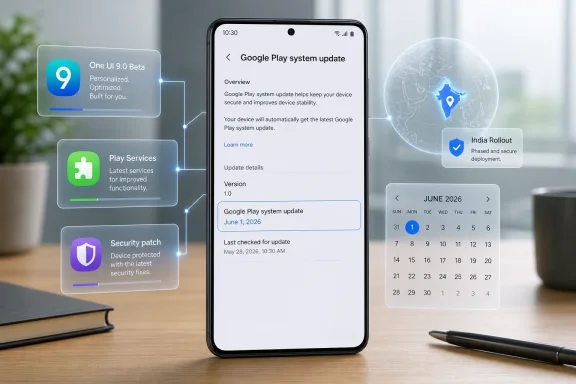
Samsung phones are now beginning to receive the June 2026 Google Play System update, with SamMobile reporting the date change from May 1 to June 1 on a Galaxy S26 Ultra running the One UI 9.0 beta in India. The update is small in appearance but revealing in timing: Google’s modular Android plumbing is moving ahead while Samsung’s own firmware ladder remains staggered by model, region, carrier, and beta eligibility. For Galaxy owners, the practical lesson is familiar but still underappreciated: the software that keeps a modern phone current no longer arrives through one front door.
There is no splashy feature list here, no One UI redesign to dissect, and no public package size from Google. The observable change is almost comically modest: after installation, the Google Play System update field advances from May 1, 2026, to June 1, 2026. Yet that tiny date stamp is one of Android’s most important pieces of modern infrastructure.
Google Play System updates are part of Android’s modular update machinery, the system born from Project Mainline and expanded over successive Android releases. Instead of waiting for a full operating-system image from Samsung, Google can update selected low-level components through Play infrastructure. That is not the same as a monthly Android security patch, not the same as a Samsung firmware build, and not the same as a Play Store app update — which is exactly why users so often misunderstand it.
SamMobile’s finding is especially interesting because availability appears uneven. The publication received the update on a Galaxy S26 Ultra running One UI 9.0 beta in India, but not on a Galaxy S25 running One UI 8.5. That does not prove the update is exclusive to One UI 9, but it does suggest the rollout is being gated, staged, or otherwise filtered by software branch.
This is Android in 2026: not a single update channel, but a stack of overlapping ones. Samsung controls the firmware experience, Google controls much of the services and modular system layer, carriers still influence deployment in some markets, and beta programs add yet another lane. The user sees only a date moving forward — if they know where to look.
A modern Galaxy device can be current in one sense and behind in another. It can have the latest Samsung security maintenance release while still showing an older Google Play System date. It can have an up-to-date Play Store and Play services build while waiting for a full One UI upgrade. It can be on a beta OS branch that receives some components earlier than a stable phone sitting beside it.
That layered model is a win for security architecture, but it is not a win for user comprehension. Samsung’s Software update screen tells one story. The Google Play System update menu tells another. The Play Store’s own update flow tells a third. None of them is wrong, but together they make “is my phone updated?” a surprisingly complicated question.
The June 2026 Play System update is therefore less notable as a feature drop than as a reminder of how Android maintenance actually works. The visible date is not decoration. It is the receipt for a class of system updates that can matter even when the phone’s headline Android version has not changed.
That does not mean every One UI 9 beta user will immediately see the June Play System update. Google frequently stages these releases, and Samsung devices do not all report availability at the same time. But when a beta build gets a Play System date advance before a stable build on a previous-generation flagship, it reinforces the sense that the beta channel is not merely cosmetic.
For enthusiasts, this can feel like a reward. Join the beta, tolerate the bugs, and you may see newer system components sooner. For administrators and cautious users, it is the opposite signal. The beta lane is useful evidence of what is coming, but it is not the branch you standardize on unless you enjoy turning your phone fleet into a moving experiment.
The Galaxy S25 running One UI 8.5 not receiving the update in SamMobile’s test is also a useful caution against overgeneralizing from one device. It may receive the June Play System update later. It may already be covered by some related Play services changes without the date advancing. Or Google and Samsung may be sequencing the package around Android 17 and One UI 9 readiness.
The frustrating answer is the accurate one: availability is not yet universal.
That approach has real benefits. Media frameworks, networking pieces, permission-related components, and other system modules can be updated without waiting for every OEM to build and certify a full software release. On paper, this narrows the gap between Pixel and non-Pixel devices. In practice, it narrows some gaps while leaving others intact.
Samsung remains one of the strongest Android OEMs on update policy and cadence, particularly for flagship devices. But even Samsung cannot make Android’s multiple update layers feel simple. The June 2026 Google Play System update arriving on one tested Galaxy configuration and not another is not a scandal; it is the expected behavior of a system built on staged rollouts and compatibility gates.
The tension is that Google markets Android as increasingly cohesive, while the lived experience remains conditional. Your model matters. Your region matters. Your carrier may matter. Your beta enrollment matters. Your installed Google components matter. Sometimes even the order in which you manually check updates appears to matter.
That does not make the system broken. It makes it opaque.
That is the strange state of Android maintenance. The platform increasingly relies on invisible modular updates, but one of the most reliable ways to confirm them is still a manual hunt through settings. If the update requires a restart, the phone will eventually nag or apply it depending on behavior and policy, but the user experience is not as clean as the theory.
This matters because Google Play System updates are not merely app refreshes. They can affect security posture, system behavior, and compatibility. When a phone is one month behind on that date field, panic is not warranted. When a fleet is consistently behind and administrators do not know why, the story changes.
For personal users, the manual check is a useful habit after major monthly Android news. For enterprise admins, it is another reminder that Android compliance cannot be reduced to “latest Samsung patch installed.” Mobile device management policies need to account for Google Play System levels, Play services versions, and OS builds as related but distinct facts.
The industry has spent years teaching users to look for the monthly security patch date. Now there is another date, and it may matter just as much in certain contexts.
That distinction explains why the dates may not line up. A Galaxy phone can show a June security patch while still displaying a May Google Play System date. Another device can receive a Play System update without a new Samsung firmware build. Both states can be legitimate.
It also explains why package sizes vary and are not always disclosed. Some Play System updates are tiny. Others arrive in multiple stages. A device may download one package, restart, then show another available update. The process is less like a classic firmware OTA and more like servicing a modular operating system whose components have their own release trains.
For WindowsForum readers, the rough analogy is not Windows Update as a single monthly ritual, but the combination of cumulative updates, Microsoft Store app updates, Defender intelligence updates, Edge updates, driver updates, and servicing stack updates. They all contribute to the health of the machine, but they are not the same thing. Android has been moving in a similar direction, only with OEM firmware still sitting heavily on top.
This is why a one-line SamMobile report deserves attention. It is a small window into the maintenance architecture that now defines mobile operating systems.
A user looking at a Galaxy S26 Ultra on One UI 9 beta may reasonably assume they are ahead of the curve. A Galaxy S25 owner on One UI 8.5 may reasonably assume a newer flagship from last year should not be behind in any meaningful way. Both assumptions run into the same wall: Android’s servicing model is not organized around simple consumer expectations.
Samsung could do more to expose update state cleanly. Google could do more to explain what each Play System release contains and which devices should expect it when. Instead, users often rely on community sightings, screenshots, regional reports, and outlets like SamMobile to infer rollout status.
That is not ideal for a platform that now wants to be taken seriously in enterprise, security-conscious consumer, and cross-device productivity contexts. Update opacity is tolerable when the stakes are emoji and wallpapers. It is less tolerable when the update channel touches system components and app trust mechanisms.
The irony is that modular updates were supposed to reduce anxiety. Technically, they do. Editorially and operationally, they have created a new class of uncertainty.
One UI 9 is the larger story behind the smaller update. It represents Samsung’s next adaptation layer over Android 17, and beta builds are where the company tests not only interface changes but also the interaction between Samsung services, Google services, security models, and third-party apps. A Play System update landing there first would fit that pattern.
The absence on a Galaxy S25 running One UI 8.5 is equally telling, but not damning. Stable branches often lag beta branches for good reasons. Samsung and Google may be avoiding a problematic component combination, staging by region, or simply rolling out in waves too narrow for broad conclusions.
Still, users notice these gaps. When the update screen says May on one premium phone and June on another, the nuance of staged infrastructure does not feel reassuring. It feels arbitrary.
That perception problem is now part of Android’s update burden.
If your device remains on May 1, 2026, that does not automatically mean something is wrong. It may mean the update has not reached your device class, region, account, or software branch. It may also mean Google is holding the rollout after seeing telemetry from early devices.
The temptation in enthusiast circles is always to turn rollout sightings into entitlement. Someone got the update in India on a Galaxy S26 Ultra beta build; therefore, everyone should have it now. That is not how Google’s Android servicing model works, and it is not how Samsung’s firmware ecosystem works either.
The healthier approach is boring but effective. Keep Samsung firmware current. Keep Google Play services and the Play Store updated. Check the Google Play System update page after monthly releases. Restart when prompted. For managed devices, record the Play System date as a separate compliance field rather than assuming it follows the OS patch level.
In other words, treat the phone like the layered computer it has become.
That narrow evidence supports a broader but careful conclusion: the rollout is underway, but not universal. It may be tied to newer software branches at the moment, or it may simply be early in a staged deployment. Either way, users should not read too much into a missing update on day one.
 Samsung’s Quiet Update Says More Than Its Changelog
There is no splashy feature list here, no One UI redesign to dissect, and no public package size from Google. The observable change is almost comically modest: after installation, the Google Play System update field advances from May 1, 2026, to June 1, 2026. Yet that tiny date stamp is one of Android’s most important pieces of modern infrastructure.Google Play System updates are part of Android’s modular update machinery, the system born from Project Mainline and expanded over successive Android releases. Instead of waiting for a full operating-system image from Samsung, Google can update selected low-level components through Play infrastructure. That is not the same as a monthly Android security patch, not the same as a Samsung firmware build, and not the same as a Play Store app update — which is exactly why users so often misunderstand it.
SamMobile’s finding is especially interesting because availability appears uneven. The publication received the update on a Galaxy S26 Ultra running One UI 9.0 beta in India, but not on a Galaxy S25 running One UI 8.5. That does not prove the update is exclusive to One UI 9, but it does suggest the rollout is being gated, staged, or otherwise filtered by software branch.
This is Android in 2026: not a single update channel, but a stack of overlapping ones. Samsung controls the firmware experience, Google controls much of the services and modular system layer, carriers still influence deployment in some markets, and beta programs add yet another lane. The user sees only a date moving forward — if they know where to look.
The Date Stamp Is the Product
For years, Android update coverage revolved around version numbers. Users asked when their phone would get Android 12, Android 13, Android 14, and so on. That framing still matters, but it no longer captures the real maintenance model.A modern Galaxy device can be current in one sense and behind in another. It can have the latest Samsung security maintenance release while still showing an older Google Play System date. It can have an up-to-date Play Store and Play services build while waiting for a full One UI upgrade. It can be on a beta OS branch that receives some components earlier than a stable phone sitting beside it.
That layered model is a win for security architecture, but it is not a win for user comprehension. Samsung’s Software update screen tells one story. The Google Play System update menu tells another. The Play Store’s own update flow tells a third. None of them is wrong, but together they make “is my phone updated?” a surprisingly complicated question.
The June 2026 Play System update is therefore less notable as a feature drop than as a reminder of how Android maintenance actually works. The visible date is not decoration. It is the receipt for a class of system updates that can matter even when the phone’s headline Android version has not changed.
One UI 9 Beta Becomes the Fast Lane, Whether Samsung Says So or Not
The fact that SamMobile saw the update on a Galaxy S26 Ultra running One UI 9.0 beta matters. Beta software is supposed to be a testing ground for Samsung’s next user-facing interface, but it also becomes a place where dependency chains shift earlier. New Android base, new framework behavior, new compatibility expectations — and sometimes, earlier access to Google’s modular payloads.That does not mean every One UI 9 beta user will immediately see the June Play System update. Google frequently stages these releases, and Samsung devices do not all report availability at the same time. But when a beta build gets a Play System date advance before a stable build on a previous-generation flagship, it reinforces the sense that the beta channel is not merely cosmetic.
For enthusiasts, this can feel like a reward. Join the beta, tolerate the bugs, and you may see newer system components sooner. For administrators and cautious users, it is the opposite signal. The beta lane is useful evidence of what is coming, but it is not the branch you standardize on unless you enjoy turning your phone fleet into a moving experiment.
The Galaxy S25 running One UI 8.5 not receiving the update in SamMobile’s test is also a useful caution against overgeneralizing from one device. It may receive the June Play System update later. It may already be covered by some related Play services changes without the date advancing. Or Google and Samsung may be sequencing the package around Android 17 and One UI 9 readiness.
The frustrating answer is the accurate one: availability is not yet universal.
Google’s Modular Android Dream Still Depends on OEM Reality
Project Mainline was never a magic wand. It was a structural compromise. Google could not fully solve Android fragmentation by decree, so it carved more of Android into components that could be serviced outside the traditional firmware path.That approach has real benefits. Media frameworks, networking pieces, permission-related components, and other system modules can be updated without waiting for every OEM to build and certify a full software release. On paper, this narrows the gap between Pixel and non-Pixel devices. In practice, it narrows some gaps while leaving others intact.
Samsung remains one of the strongest Android OEMs on update policy and cadence, particularly for flagship devices. But even Samsung cannot make Android’s multiple update layers feel simple. The June 2026 Google Play System update arriving on one tested Galaxy configuration and not another is not a scandal; it is the expected behavior of a system built on staged rollouts and compatibility gates.
The tension is that Google markets Android as increasingly cohesive, while the lived experience remains conditional. Your model matters. Your region matters. Your carrier may matter. Your beta enrollment matters. Your installed Google components matter. Sometimes even the order in which you manually check updates appears to matter.
That does not make the system broken. It makes it opaque.
Users Are Told to Check Manually Because Automation Is Not Trusted
SamMobile’s instructions are straightforward: open Settings, go to About phone, tap Software information, then choose Google Play System update. If an update is available, download it, install it, and restart. The path is easy enough for an enthusiast, but buried enough that many ordinary users will never find it.That is the strange state of Android maintenance. The platform increasingly relies on invisible modular updates, but one of the most reliable ways to confirm them is still a manual hunt through settings. If the update requires a restart, the phone will eventually nag or apply it depending on behavior and policy, but the user experience is not as clean as the theory.
This matters because Google Play System updates are not merely app refreshes. They can affect security posture, system behavior, and compatibility. When a phone is one month behind on that date field, panic is not warranted. When a fleet is consistently behind and administrators do not know why, the story changes.
For personal users, the manual check is a useful habit after major monthly Android news. For enterprise admins, it is another reminder that Android compliance cannot be reduced to “latest Samsung patch installed.” Mobile device management policies need to account for Google Play System levels, Play services versions, and OS builds as related but distinct facts.
The industry has spent years teaching users to look for the monthly security patch date. Now there is another date, and it may matter just as much in certain contexts.
The Security Patch and the Play System Update Are Not Twins
The most common mistake is to treat the Google Play System update as the same thing as the Android security patch. They are related in spirit, but not identical in mechanism or scope. Samsung’s monthly security maintenance release can include Android security bulletin fixes, Samsung-specific patches, modem updates, kernel changes, and device-specific adjustments. Google Play System updates target modular components serviced through Google’s infrastructure.That distinction explains why the dates may not line up. A Galaxy phone can show a June security patch while still displaying a May Google Play System date. Another device can receive a Play System update without a new Samsung firmware build. Both states can be legitimate.
It also explains why package sizes vary and are not always disclosed. Some Play System updates are tiny. Others arrive in multiple stages. A device may download one package, restart, then show another available update. The process is less like a classic firmware OTA and more like servicing a modular operating system whose components have their own release trains.
For WindowsForum readers, the rough analogy is not Windows Update as a single monthly ritual, but the combination of cumulative updates, Microsoft Store app updates, Defender intelligence updates, Edge updates, driver updates, and servicing stack updates. They all contribute to the health of the machine, but they are not the same thing. Android has been moving in a similar direction, only with OEM firmware still sitting heavily on top.
This is why a one-line SamMobile report deserves attention. It is a small window into the maintenance architecture that now defines mobile operating systems.
Samsung’s Update Leadership Comes With Communication Debt
Samsung has earned credit for improving Android updates. Its flagships receive long support windows, monthly patches arrive with impressive regularity, and the company has become much faster than it was in the TouchWiz-era wilderness. But speed does not erase the communication problem.A user looking at a Galaxy S26 Ultra on One UI 9 beta may reasonably assume they are ahead of the curve. A Galaxy S25 owner on One UI 8.5 may reasonably assume a newer flagship from last year should not be behind in any meaningful way. Both assumptions run into the same wall: Android’s servicing model is not organized around simple consumer expectations.
Samsung could do more to expose update state cleanly. Google could do more to explain what each Play System release contains and which devices should expect it when. Instead, users often rely on community sightings, screenshots, regional reports, and outlets like SamMobile to infer rollout status.
That is not ideal for a platform that now wants to be taken seriously in enterprise, security-conscious consumer, and cross-device productivity contexts. Update opacity is tolerable when the stakes are emoji and wallpapers. It is less tolerable when the update channel touches system components and app trust mechanisms.
The irony is that modular updates were supposed to reduce anxiety. Technically, they do. Editorially and operationally, they have created a new class of uncertainty.
The Galaxy S26 Ultra Is the Canary in Samsung’s Android 17 Mine
The Galaxy S26 Ultra’s appearance in this report is not incidental. Samsung’s current flagship and beta platform is where new Android behavior is most likely to surface first. If the June 2026 Google Play System update is showing there, it gives enthusiasts a practical signal about Samsung’s Android 17 branch.One UI 9 is the larger story behind the smaller update. It represents Samsung’s next adaptation layer over Android 17, and beta builds are where the company tests not only interface changes but also the interaction between Samsung services, Google services, security models, and third-party apps. A Play System update landing there first would fit that pattern.
The absence on a Galaxy S25 running One UI 8.5 is equally telling, but not damning. Stable branches often lag beta branches for good reasons. Samsung and Google may be avoiding a problematic component combination, staging by region, or simply rolling out in waves too narrow for broad conclusions.
Still, users notice these gaps. When the update screen says May on one premium phone and June on another, the nuance of staged infrastructure does not feel reassuring. It feels arbitrary.
That perception problem is now part of Android’s update burden.
The Right Move Is to Check, Not Chase
For Galaxy owners, the practical response is simple: check manually, install if offered, restart, and do not sideload random packages from the internet to force the date forward. Google Play System updates are staged for a reason, even if the reason is not visible from the Settings app.If your device remains on May 1, 2026, that does not automatically mean something is wrong. It may mean the update has not reached your device class, region, account, or software branch. It may also mean Google is holding the rollout after seeing telemetry from early devices.
The temptation in enthusiast circles is always to turn rollout sightings into entitlement. Someone got the update in India on a Galaxy S26 Ultra beta build; therefore, everyone should have it now. That is not how Google’s Android servicing model works, and it is not how Samsung’s firmware ecosystem works either.
The healthier approach is boring but effective. Keep Samsung firmware current. Keep Google Play services and the Play Store updated. Check the Google Play System update page after monthly releases. Restart when prompted. For managed devices, record the Play System date as a separate compliance field rather than assuming it follows the OS patch level.
In other words, treat the phone like the layered computer it has become.
The June Date Is Small, but the Maintenance Lesson Is Not
The concrete facts are limited, which is precisely why they are useful. A new Google Play System update is appearing on at least some Samsung phones. SamMobile confirmed it on a Galaxy S26 Ultra running One UI 9.0 beta in India. The visible result is a date change from May 1, 2026, to June 1, 2026. A Galaxy S25 on One UI 8.5 did not receive it in the same test.That narrow evidence supports a broader but careful conclusion: the rollout is underway, but not universal. It may be tied to newer software branches at the moment, or it may simply be early in a staged deployment. Either way, users should not read too much into a missing update on day one.
- The June 2026 Google Play System update is now appearing on some Samsung devices, but availability is not yet consistent across tested Galaxy models.
- The update advances the Google Play System date to June 1, 2026, which is separate from Samsung’s monthly firmware security patch level.
- The confirmed SamMobile device was a Galaxy S26 Ultra running the One UI 9.0 beta in India.
- A Galaxy S25 running One UI 8.5 did not receive the same update in SamMobile’s check, suggesting staged or branch-dependent availability.
- Galaxy users can check manually through Settings, About phone, Software information, and Google Play System update.
- Users should install the update if offered, restart when prompted, and avoid treating a missing rollout as evidence that their device is unsupported.
References
- Primary source: SamMobile
Published: Mon, 22 Jun 2026 10:33:00 GMT
Samsung phones are now getting June 2026 Google Play System update - SamMobile
Google has released a new update for the Google Play System on Samsung's smartphones. It is dated for June 1, 2026. - SamMobilewww.sammobile.com - Related coverage: androidcentral.com
Samsung hits a triple: One UI 9 Beta 3 is here for enrolled Galaxy S26 phones | Android Central
Here's everything Samsung brought to the table in Beta 3.www.androidcentral.com - Related coverage: techradar.com
One UI 9 beta begins rolling out to Samsung Galaxy S26 users — here are the 5 biggest upgrades to Quick Panel, Notes, and more | TechRadar
One beta with five upgradeswww.techradar.com - Related coverage: gadgets360.com
- Related coverage: androidauthority.com
Breaking: Galaxy S26 series gets third One UI 9 beta release with major bug fixes
Samsung rolled out its third One UI 9 beta for the Galaxy S26, delivering key bug fixes alongside the June 2026 security patches.www.androidauthority.com - Related coverage: 91mobiles.com
Samsung announces One UI 9 beta for Galaxy S26 series; focuses on creativity, customisation, enhanced security | 91mobiles.com
Samsung has announced the One UI 9 beta program. Here's what the update offers.www.91mobiles.com
- Related coverage: cincodias.elpais.com
- Related coverage: tomsguide.com
One UI 9 beta just released for Galaxy S26 — here's how to sign up and all the upgrades | Tom's Guide
Samsung is releasing the One UI 9 beta later this week, giving Galaxy S26 owners the chance to sample Samsung's take on Android 17 ahead of the official release.www.tomsguide.com - Related coverage: source.android.com
- Official source: support.google.com

Google system services release notes - Help
Google system services updates make your Android devices more secure and reliable, and give you new and useful features. They include updates from Google to the Android operating system, Google Play S
support.google.com
- Official source: 9to5google.com
What’s new in Android's June 2026 Google System Updates: WhatsApp backups
The monthly “Google System Release Notes” primarily detail what’s new in Play services, Play Store, and Play system update across...9to5google.com - Related coverage: techrepublic.com
Google Adds New Android Controls for WhatsApp Backups, Password Transfers
Google’s June 2026 Android system updates add WhatsApp backup controls, Play Protect checks, passkey portability, and Play Store AI search.www.techrepublic.com
- Related coverage: technerdiness.com
Google System Updates for June 2026: Everything New on Android - Tech Nerdiness
Google’s June 2026 System Updates bring password and passkey portability, Play Store improvements, and critical Android security fixes. Here’s everything that’s new.www.technerdiness.com - Related coverage: bayton.org
Google Play System Updates (mainline) are no longer managed by Android Enterprise system update policies | Jason Bayton
The website of Jason Baytonbayton.org - Related coverage: androidnewswire.com
Android Monday: June 1, 2026 — System Updates, One UI 8.5 Expands and Pixel Glow Makes an Appearance | Android Newswire | Android Newswire
June 2026 opened with three meaningful Android stories. Google dropped its June system updates — headlined by the ability to import and export passwords and passkeys between Google Password Manager and any third-party manager, plus Theft Protection turning on by default across Android 17...androidnewswire.com - Related coverage: bgr.com
6 New Features Added To Your Android Phone With Google's June 2026 System Update
The June 2026 Google Play Services update adds six new features to Android. Most are focused on the Play Store, but one has real security implications.www.bgr.com - Related coverage: t3.com
Your Google Pixel phone could get another big software upgrade soon – Android 17 is just "around the corner" | T3
There's something new coming to Android phones and Pixel will be front of the queuewww.t3.com - Related coverage: ftc.gov
50 Shades of Support: A Device-Centric Analysis of Android Security Updates
</rdf:Alt> </dc:description> <dc:title> <rdf:Alt> <rdf:li xml:lang="x-default">50 Shades of Support: A Device-Centric Analysis of Android Security Updateswww.ftc.gov
