
Taiwan’s Industrial Development Administration is using AI-centered semiconductor training programs in 2026 to help international students and engineers from Southeast Asia move into local chipmaking roles, with participants such as Indonesia’s Wifal Inola and the Philippines’ Earon John Mendoza applying AI in research, process engineering, and factory maintenance. The program is a small story with a large implication: Taiwan is treating talent mobility as part of semiconductor strategy, not as a charitable add-on. In an industry where process knowledge, equipment uptime, and cultural fluency increasingly matter as much as raw compute, the pitch is clear. Taiwan does not merely want to manufacture the hardware of the AI age; it wants to train the people who know how to make that hardware better.
The semiconductor industry has always been a story about machines, but it has never been only a story about machines. Lithography scanners, deposition tools, inspection systems, and advanced packaging lines get the headlines because they are expensive, photogenic, and geopolitically important. Yet every one of those machines depends on engineers who understand not just the procedure, but the process physics, the failure modes, and the cost of being wrong.
That is why the DigiTimes account of Taiwan’s AI training programs for international semiconductor talent is more than a feel-good workforce feature. It points to a deeper industrial wager: as chipmaking becomes more automated and more data-intensive, the countries and companies that win will be the ones that turn international talent into domain specialists quickly, reliably, and with enough local context to survive the factory floor.
The Industrial Development Administration under Taiwan’s Ministry of Economic Affairs is positioning its training ecosystem around three linked needs. It wants international students and professionals to understand semiconductor technology, to acquire AI skills that map onto real manufacturing and research problems, and to adapt to Taiwan’s working culture well enough to remain in the industry. That third part is easy to overlook, but it may be the most practical.
A semiconductor fab is not a generic technology workplace with cleaner air. It is a high-pressure, high-capital environment where downtime is measured in lost output, yield excursions can cascade through an entire production plan, and junior engineers learn quickly that “almost right” is not good enough. Training international talent for that world requires more than English-language coursework and a badge.
That distinction matters because the semiconductor sector has little patience for AI theater. A tool that summarizes papers may be helpful to a graduate student, but a system that reduces inspection time, identifies abnormal equipment behavior, or helps correlate sensor signals with defects can change production economics. The closer AI gets to the line, the less forgiving the environment becomes.
Wifal Inola’s experience captures the research side of that shift. As a master’s student in semiconductor technology at National Yang Ming Chiao Tung University, he describes using AI to reduce the time spent on literature review and to assist with technical analysis such as X-ray Photoelectron Spectroscopy peak division and chemical bond identification. That is not the fantasy of AI replacing the researcher; it is the more plausible reality of AI compressing the repetitive parts of research so the human can spend more time on experimental design and interpretation.
Earon John Mendoza’s experience points in the other direction: the maintenance-heavy world of production equipment. At ASE, his AI exposure is framed around preventive maintenance, sensors, controllers, monitoring systems, and identifying non-good parts. In other words, AI is not an office productivity layer. It is becoming part of the nervous system of manufacturing.
This is where the semiconductor industry’s version of AI diverges from the consumer narrative. For most users, AI appears as a chatbot, a search assistant, or a writing tool. In a fab or packaging facility, the valuable AI system is often less glamorous: a classifier that catches defects earlier, a model that flags drift before a tool fails, or an analytics workflow that helps an engineer decide which variable deserves attention first.
Those comparisons should be handled carefully. Southeast Asia is not short on technical talent, and countries such as Indonesia and the Philippines have deep pools of ambitious engineers. The issue is not capability. It is whether training ecosystems are connected tightly enough to the specific industrial environments where semiconductor AI is now being deployed.
Taiwan’s advantage is proximity. Students can move between university labs, suppliers, fabs, packaging houses, and equipment-heavy workplaces in a way that turns AI from coursework into practice. That physical and institutional closeness is difficult to replicate from a distance.
The training model also addresses a problem that many workforce policies prefer to describe vaguely: employability is not the same as education. An engineer can understand machine learning theory and still struggle inside a fab if they do not know how process flows, maintenance protocols, shift communication, and escalation chains work. Conversely, a technician can know the equipment intimately but need structured AI training to move from reactive troubleshooting to predictive analysis.
Taiwan’s bet is that international talent can cross that gap faster if AI instruction, semiconductor process knowledge, and local workplace integration are packaged together. That is an industrial policy argument disguised as a student success story.
Taiwan understands this better than most because its own success has made it central to everyone else’s industrial ambitions. The United States, Japan, Europe, South Korea, and China all want more semiconductor capacity, and all of them need people who can operate and improve it. The result is a talent market in which training, immigration, retention, and career mobility become strategic tools.
That is why Taiwan’s outreach to international students and professionals is not merely about filling seats. It is about embedding people into an ecosystem before rival ecosystems can recruit them away. If an Indonesian or Filipino engineer studies in Taiwan, interns locally, learns the workflows of Taiwanese semiconductor companies, and builds a career path at a firm such as Micron or ASE, Taiwan has done more than educate a student. It has converted global talent into local industrial depth.
The harder question is whether Taiwan can keep that talent over time. International engineers need more than technical instruction; they need predictable visa pathways, fair promotion structures, language support, housing stability, and workplaces that treat cross-cultural communication as operational infrastructure rather than soft-skills decoration. A training program can open the door, but retention depends on what happens after the badge is issued.
This is where the initiative’s emphasis on mentorship and tailored support services becomes significant. In semiconductor manufacturing, the difference between staying and leaving may hinge on whether a foreign engineer can build trust with a shift team, understand unwritten workplace expectations, or see a credible route from assistant engineer to specialist. Talent policy fails when it assumes that hiring is the finish line.
Wifal and Mendoza both describe a future in which AI takes over more manual and time-consuming tasks, allowing engineers to focus on higher-level decisions. That is an optimistic view, but it is not naïve. In a factory where equipment data, defect maps, maintenance logs, and inspection images are already abundant, the bottleneck is often not whether data exists. The bottleneck is whether people can interpret it correctly and act before a small anomaly becomes a production problem.
AI can help identify patterns, but it does not absolve engineers from understanding causality. A model may flag a suspicious correlation between sensor readings and defective output, but someone still has to decide whether the issue is contamination, tool wear, calibration drift, operator procedure, material variation, or a false alarm. In semiconductors, confident nonsense is expensive.
That is why the emphasis on understanding “why each stage is necessary” is so important. If AI training becomes a shortcut around fundamentals, it will produce fragile operators who trust dashboards too much. If it reinforces process discipline, it can produce engineers who use AI as a second layer of attention.
The best semiconductor AI workers will not be generic prompt engineers. They will be process engineers who understand data, equipment engineers who understand models, and researchers who can move between literature, experimental results, and production constraints. Taiwan’s program is interesting because it recognizes that the hybrid professional is no longer optional.
TAIDE was developed to support traditional Chinese language use and Taiwanese cultural context. Sahabat AI is designed around Bahasa Indonesia and regional dialects. Neither project should be mistaken for a direct substitute for the giant frontier models that dominate global headlines, but both reflect the same concern: if AI systems mediate work, education, public services, and technical knowledge, countries will want models that understand their own languages and institutional contexts.
For semiconductor training, this matters in practical ways. International engineers are not simply moving between toolsets; they are moving between languages of instruction, workplace norms, documentation habits, and cultural assumptions about hierarchy and problem-solving. AI systems that can support translation, summarization, and technical communication in locally relevant forms may reduce friction.
There is also a sovereignty argument. Taiwan’s semiconductor strength has always depended on being indispensable to global supply chains while maintaining enough local capability to avoid becoming merely a production site for other people’s strategies. Local AI development fits that pattern. The goal is not isolation. It is leverage.
The risk, of course, is fragmentation. If every country builds its own AI layer without interoperability, talent mobility could become harder rather than easier. But in the near term, local models can make technical training more inclusive, especially for students and engineers who are highly capable but not equally fluent in every language used by multinational semiconductor firms.
Indonesia and the Philippines are often discussed in technology coverage as markets, labor pools, or outsourcing destinations. The DigiTimes article presents a more interesting version: engineers from those countries moving into specialized semiconductor roles, acquiring AI skills, and potentially carrying that expertise across borders over the course of their careers. That is how industrial ecosystems spread.
If these engineers stay in Taiwan, they strengthen Taiwan’s workforce. If they eventually return home, they bring back tacit knowledge that is difficult to acquire through textbooks or remote training. Either outcome can deepen regional capability, though the benefits will not be distributed evenly.
There is a strategic tension here. Taiwan wants to retain talent, while Southeast Asian countries want their best engineers to contribute to domestic industrial upgrading. The most productive version of this relationship is not a zero-sum extraction model but a circulation model, where training, employment, and later leadership roles connect Taiwan more deeply with the region.
That kind of circulation is especially important as advanced electronics manufacturing becomes more geographically complex. No single country can train every engineer it needs internally. The semiconductor workforce of the next decade will be shaped by cross-border education, internships, supplier networks, and multilingual professional communities as much as by national university systems.
That is a high bar. AI education often looks impressive in controlled settings but becomes messy in production environments where data quality varies, old equipment coexists with newer systems, and human procedures are not always captured neatly in databases. The fab is where AI ambition meets legacy reality.
The report’s examples are encouraging because they are grounded in plausible use cases. Literature review acceleration, spectroscopy analysis support, preventive maintenance, inspection systems, and equipment monitoring are all areas where AI can be helpful without requiring magical claims. They also give junior engineers a way to contribute early while still learning deeper process knowledge.
But there is a governance challenge. Semiconductor firms will need to decide which AI-assisted recommendations can be trusted, which require human verification, and how to document model-assisted decisions. In regulated or customer-sensitive environments, “the AI said so” will not survive an audit, a yield crisis, or a customer escalation.
Training programs should therefore teach not only how to use AI, but how to doubt it properly. The engineer of the AI-enabled fab must know when a model is useful, when it is overfitting noise, when data is incomplete, and when a human should slow the line rather than optimize blindly. That skeptical discipline may become one of the most valuable skills Taiwan can teach.
AI in semiconductors resembles AI in IT administration in one crucial respect: the tool is only as good as the operator’s domain knowledge. A Windows administrator using AI to draft PowerShell scripts still needs to understand permissions, logging, endpoint behavior, and rollback. A semiconductor engineer using AI to interpret equipment signals still needs to understand process dependencies and failure modes.
The same lesson applies to automation. Enterprises once imagined that cloud management, endpoint analytics, and scripting would eliminate much of the need for hands-on administrators. Instead, the work changed. The people who thrived were the ones who combined old operational knowledge with new automation fluency.
Semiconductor companies are going through a comparable transition, only with far more expensive consequences for mistakes. A bad script can break a fleet of endpoints; a bad process decision can affect wafers, tools, delivery schedules, and customer commitments. The stakes differ, but the shape of the change is familiar.
For IT pros, the Taiwan example is a reminder that AI training divorced from systems knowledge is thin gruel. The valuable worker is not the person who can recite AI terminology. It is the person who can apply AI inside a real operating environment, where uptime matters and ambiguity is normal.
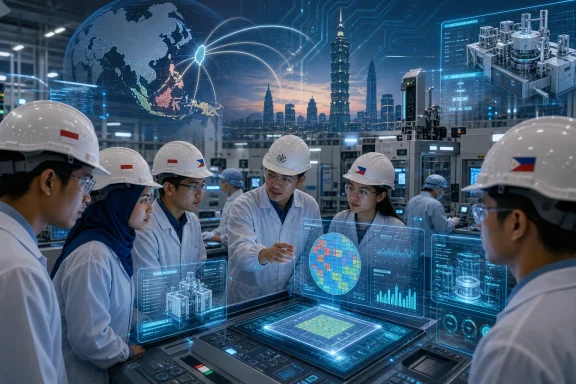 Taiwan Turns Talent Training Into Industrial Policy
The semiconductor industry has always been a story about machines, but it has never been only a story about machines. Lithography scanners, deposition tools, inspection systems, and advanced packaging lines get the headlines because they are expensive, photogenic, and geopolitically important. Yet every one of those machines depends on engineers who understand not just the procedure, but the process physics, the failure modes, and the cost of being wrong.That is why the DigiTimes account of Taiwan’s AI training programs for international semiconductor talent is more than a feel-good workforce feature. It points to a deeper industrial wager: as chipmaking becomes more automated and more data-intensive, the countries and companies that win will be the ones that turn international talent into domain specialists quickly, reliably, and with enough local context to survive the factory floor.
The Industrial Development Administration under Taiwan’s Ministry of Economic Affairs is positioning its training ecosystem around three linked needs. It wants international students and professionals to understand semiconductor technology, to acquire AI skills that map onto real manufacturing and research problems, and to adapt to Taiwan’s working culture well enough to remain in the industry. That third part is easy to overlook, but it may be the most practical.
A semiconductor fab is not a generic technology workplace with cleaner air. It is a high-pressure, high-capital environment where downtime is measured in lost output, yield excursions can cascade through an entire production plan, and junior engineers learn quickly that “almost right” is not good enough. Training international talent for that world requires more than English-language coursework and a badge.
AI Is Moving From Buzzword to Shop-Floor Discipline
The most useful detail in the DigiTimes report is not that AI is part of the curriculum. Everyone now says AI is part of the curriculum. The important point is that Taiwan’s version is described as tied to semiconductor applications, system integration, smart manufacturing, medical technology, and robotics rather than abstract model-building alone.That distinction matters because the semiconductor sector has little patience for AI theater. A tool that summarizes papers may be helpful to a graduate student, but a system that reduces inspection time, identifies abnormal equipment behavior, or helps correlate sensor signals with defects can change production economics. The closer AI gets to the line, the less forgiving the environment becomes.
Wifal Inola’s experience captures the research side of that shift. As a master’s student in semiconductor technology at National Yang Ming Chiao Tung University, he describes using AI to reduce the time spent on literature review and to assist with technical analysis such as X-ray Photoelectron Spectroscopy peak division and chemical bond identification. That is not the fantasy of AI replacing the researcher; it is the more plausible reality of AI compressing the repetitive parts of research so the human can spend more time on experimental design and interpretation.
Earon John Mendoza’s experience points in the other direction: the maintenance-heavy world of production equipment. At ASE, his AI exposure is framed around preventive maintenance, sensors, controllers, monitoring systems, and identifying non-good parts. In other words, AI is not an office productivity layer. It is becoming part of the nervous system of manufacturing.
This is where the semiconductor industry’s version of AI diverges from the consumer narrative. For most users, AI appears as a chatbot, a search assistant, or a writing tool. In a fab or packaging facility, the valuable AI system is often less glamorous: a classifier that catches defects earlier, a model that flags drift before a tool fails, or an analytics workflow that helps an engineer decide which variable deserves attention first.
The Gap Taiwan Is Trying to Close Is Not Just Technical
The report contrasts AI training in Taiwan with the educational experiences available in Indonesia and the Philippines. Wifal describes Indonesia’s AI emphasis as often connected to the digital economy, e-commerce, and financial technology. Mendoza contrasts Taiwan’s more structured, technically rigorous approach with a prior environment in the Philippines where final output and task completion under pressure received more emphasis.Those comparisons should be handled carefully. Southeast Asia is not short on technical talent, and countries such as Indonesia and the Philippines have deep pools of ambitious engineers. The issue is not capability. It is whether training ecosystems are connected tightly enough to the specific industrial environments where semiconductor AI is now being deployed.
Taiwan’s advantage is proximity. Students can move between university labs, suppliers, fabs, packaging houses, and equipment-heavy workplaces in a way that turns AI from coursework into practice. That physical and institutional closeness is difficult to replicate from a distance.
The training model also addresses a problem that many workforce policies prefer to describe vaguely: employability is not the same as education. An engineer can understand machine learning theory and still struggle inside a fab if they do not know how process flows, maintenance protocols, shift communication, and escalation chains work. Conversely, a technician can know the equipment intimately but need structured AI training to move from reactive troubleshooting to predictive analysis.
Taiwan’s bet is that international talent can cross that gap faster if AI instruction, semiconductor process knowledge, and local workplace integration are packaged together. That is an industrial policy argument disguised as a student success story.
The Semiconductor Talent War Is Becoming a Retention War
For years, the global semiconductor conversation has focused on capacity: new fabs, new subsidies, new packaging lines, new regional supply chains. But capacity without trained personnel is a spreadsheet fiction. The industry can announce fabs faster than it can produce experienced process engineers, equipment specialists, metrology experts, and yield analysts.Taiwan understands this better than most because its own success has made it central to everyone else’s industrial ambitions. The United States, Japan, Europe, South Korea, and China all want more semiconductor capacity, and all of them need people who can operate and improve it. The result is a talent market in which training, immigration, retention, and career mobility become strategic tools.
That is why Taiwan’s outreach to international students and professionals is not merely about filling seats. It is about embedding people into an ecosystem before rival ecosystems can recruit them away. If an Indonesian or Filipino engineer studies in Taiwan, interns locally, learns the workflows of Taiwanese semiconductor companies, and builds a career path at a firm such as Micron or ASE, Taiwan has done more than educate a student. It has converted global talent into local industrial depth.
The harder question is whether Taiwan can keep that talent over time. International engineers need more than technical instruction; they need predictable visa pathways, fair promotion structures, language support, housing stability, and workplaces that treat cross-cultural communication as operational infrastructure rather than soft-skills decoration. A training program can open the door, but retention depends on what happens after the badge is issued.
This is where the initiative’s emphasis on mentorship and tailored support services becomes significant. In semiconductor manufacturing, the difference between staying and leaving may hinge on whether a foreign engineer can build trust with a shift team, understand unwritten workplace expectations, or see a credible route from assistant engineer to specialist. Talent policy fails when it assumes that hiring is the finish line.
AI Makes the Engineer More Important, Not Less
The most tired claim in AI coverage is that automation simply replaces labor. The more interesting reality in semiconductors is that AI changes which parts of engineering work carry the most value. Repetitive work becomes more automatable; judgment becomes more important.Wifal and Mendoza both describe a future in which AI takes over more manual and time-consuming tasks, allowing engineers to focus on higher-level decisions. That is an optimistic view, but it is not naïve. In a factory where equipment data, defect maps, maintenance logs, and inspection images are already abundant, the bottleneck is often not whether data exists. The bottleneck is whether people can interpret it correctly and act before a small anomaly becomes a production problem.
AI can help identify patterns, but it does not absolve engineers from understanding causality. A model may flag a suspicious correlation between sensor readings and defective output, but someone still has to decide whether the issue is contamination, tool wear, calibration drift, operator procedure, material variation, or a false alarm. In semiconductors, confident nonsense is expensive.
That is why the emphasis on understanding “why each stage is necessary” is so important. If AI training becomes a shortcut around fundamentals, it will produce fragile operators who trust dashboards too much. If it reinforces process discipline, it can produce engineers who use AI as a second layer of attention.
The best semiconductor AI workers will not be generic prompt engineers. They will be process engineers who understand data, equipment engineers who understand models, and researchers who can move between literature, experimental results, and production constraints. Taiwan’s program is interesting because it recognizes that the hybrid professional is no longer optional.
Local AI Models Reveal the Cultural Side of Technical Sovereignty
The DigiTimes report briefly mentions TAIDE, Taiwan’s Trustworthy AI Dialogue Engine, alongside Indonesia’s Sahabat AI. That detail may look tangential to semiconductor manufacturing, but it belongs in the same story. AI capability is increasingly bound up with language, culture, governance, and national industrial strategy.TAIDE was developed to support traditional Chinese language use and Taiwanese cultural context. Sahabat AI is designed around Bahasa Indonesia and regional dialects. Neither project should be mistaken for a direct substitute for the giant frontier models that dominate global headlines, but both reflect the same concern: if AI systems mediate work, education, public services, and technical knowledge, countries will want models that understand their own languages and institutional contexts.
For semiconductor training, this matters in practical ways. International engineers are not simply moving between toolsets; they are moving between languages of instruction, workplace norms, documentation habits, and cultural assumptions about hierarchy and problem-solving. AI systems that can support translation, summarization, and technical communication in locally relevant forms may reduce friction.
There is also a sovereignty argument. Taiwan’s semiconductor strength has always depended on being indispensable to global supply chains while maintaining enough local capability to avoid becoming merely a production site for other people’s strategies. Local AI development fits that pattern. The goal is not isolation. It is leverage.
The risk, of course, is fragmentation. If every country builds its own AI layer without interoperability, talent mobility could become harder rather than easier. But in the near term, local models can make technical training more inclusive, especially for students and engineers who are highly capable but not equally fluent in every language used by multinational semiconductor firms.
Southeast Asian Engineers Are Not a Side Story
One of the lazy ways to read this development is as a Taiwan story with a few foreign participants. That misses the regional significance. Wifal Inola and Earon John Mendoza represent a broader Southeast Asian role in the semiconductor economy, one that is likely to grow as supply chains diversify and AI increases demand for advanced manufacturing.Indonesia and the Philippines are often discussed in technology coverage as markets, labor pools, or outsourcing destinations. The DigiTimes article presents a more interesting version: engineers from those countries moving into specialized semiconductor roles, acquiring AI skills, and potentially carrying that expertise across borders over the course of their careers. That is how industrial ecosystems spread.
If these engineers stay in Taiwan, they strengthen Taiwan’s workforce. If they eventually return home, they bring back tacit knowledge that is difficult to acquire through textbooks or remote training. Either outcome can deepen regional capability, though the benefits will not be distributed evenly.
There is a strategic tension here. Taiwan wants to retain talent, while Southeast Asian countries want their best engineers to contribute to domestic industrial upgrading. The most productive version of this relationship is not a zero-sum extraction model but a circulation model, where training, employment, and later leadership roles connect Taiwan more deeply with the region.
That kind of circulation is especially important as advanced electronics manufacturing becomes more geographically complex. No single country can train every engineer it needs internally. The semiconductor workforce of the next decade will be shaped by cross-border education, internships, supplier networks, and multilingual professional communities as much as by national university systems.
The Factory Floor Will Decide Whether the Training Worked
The ultimate test of Taiwan’s AI training push will not be graduate satisfaction or program branding. It will be whether participants can improve real workflows under real constraints. Semiconductor companies will judge the program by uptime, yield, cycle time, defect reduction, and the speed with which young engineers become trusted members of technical teams.That is a high bar. AI education often looks impressive in controlled settings but becomes messy in production environments where data quality varies, old equipment coexists with newer systems, and human procedures are not always captured neatly in databases. The fab is where AI ambition meets legacy reality.
The report’s examples are encouraging because they are grounded in plausible use cases. Literature review acceleration, spectroscopy analysis support, preventive maintenance, inspection systems, and equipment monitoring are all areas where AI can be helpful without requiring magical claims. They also give junior engineers a way to contribute early while still learning deeper process knowledge.
But there is a governance challenge. Semiconductor firms will need to decide which AI-assisted recommendations can be trusted, which require human verification, and how to document model-assisted decisions. In regulated or customer-sensitive environments, “the AI said so” will not survive an audit, a yield crisis, or a customer escalation.
Training programs should therefore teach not only how to use AI, but how to doubt it properly. The engineer of the AI-enabled fab must know when a model is useful, when it is overfitting noise, when data is incomplete, and when a human should slow the line rather than optimize blindly. That skeptical discipline may become one of the most valuable skills Taiwan can teach.
Windows IT Pros Should Recognize the Pattern
At first glance, this is a semiconductor industry story, not a Windows story. But WindowsForum readers will recognize the larger pattern immediately. Every enterprise technology shift eventually turns into a workforce and operations problem.AI in semiconductors resembles AI in IT administration in one crucial respect: the tool is only as good as the operator’s domain knowledge. A Windows administrator using AI to draft PowerShell scripts still needs to understand permissions, logging, endpoint behavior, and rollback. A semiconductor engineer using AI to interpret equipment signals still needs to understand process dependencies and failure modes.
The same lesson applies to automation. Enterprises once imagined that cloud management, endpoint analytics, and scripting would eliminate much of the need for hands-on administrators. Instead, the work changed. The people who thrived were the ones who combined old operational knowledge with new automation fluency.
Semiconductor companies are going through a comparable transition, only with far more expensive consequences for mistakes. A bad script can break a fleet of endpoints; a bad process decision can affect wafers, tools, delivery schedules, and customer commitments. The stakes differ, but the shape of the change is familiar.
For IT pros, the Taiwan example is a reminder that AI training divorced from systems knowledge is thin gruel. The valuable worker is not the person who can recite AI terminology. It is the person who can apply AI inside a real operating environment, where uptime matters and ambiguity is normal.
Taiwan’s AI Talent Bet Comes Down to These Practical Tests
The strongest case for Taiwan’s program is that it treats international semiconductor talent as a long-term systems problem, not a recruiting campaign. The weakest version would be a glossy pipeline that produces good press but leaves foreign engineers to navigate the hard parts alone. The difference will show up in retention, promotion, and measurable factory impact.- Taiwan is using AI training as a bridge between international engineering talent and the practical demands of semiconductor manufacturing.
- The most valuable training appears to be tied to concrete industrial workflows such as process analysis, preventive maintenance, inspection, and equipment monitoring.
- International students and engineers need cultural and workplace integration support as much as they need technical coursework.
- AI is likely to reduce repetitive engineering labor, but it will increase the premium on domain judgment and process discipline.
- Local AI efforts such as TAIDE and Sahabat AI show that language and cultural context are becoming part of technical competitiveness.
- The program’s success will depend on whether companies can retain trained engineers and give them credible paths into higher-responsibility roles.
