

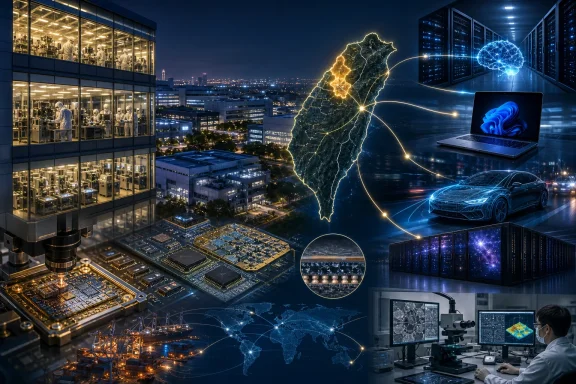
Taiwan’s semiconductor ecosystem has become the indispensable middle mile of modern computing, with the island controlling more than 60 percent of global foundry revenue and more than 90 percent of leading-edge chip production as of the latest trade and industry reporting. That is not merely a supply-chain statistic; it is the operating assumption behind AI servers, Windows PCs, cloud platforms, cars, defense systems, and the next wave of sovereign supercomputers. The EE Times dispatch from Hsinchu lands because it shows Taiwan no longer wants to be treated as the world’s silent fab floor. It wants to be recognized as the market, laboratory, and geopolitical partner that everyone else already depends on.
For decades, the technology industry trained itself to look through Taiwan rather than at it. The brand on the laptop lid mattered. The logo on the cloud GPU mattered. The processor architecture mattered. The foundry was treated as plumbing, and plumbing is usually noticed only when it breaks.
That mental model is now obsolete. Taiwan is not merely where chips are manufactured after the “real” innovation happens elsewhere. It is where the boundary between design ambition and physical reality is negotiated, repeatedly, at commercial scale.
The numbers make the point bluntly. Taiwan’s semiconductor industry generated more than $165 billion in revenue in 2024, a figure equal to roughly one-fifth of the country’s GDP. That is not a specialist export sector. It is a national economic architecture built around one of the hardest industrial capabilities humanity has ever developed.
The difference now is that Taiwan’s government and industry leaders are saying the quiet part aloud. Cheng-Wen Wu, Taiwan’s Minister of the National Science and Technology Council, framed the island not just as a manufacturing base but as a domestic market and innovation partner. The message to foreign chip designers, equipment vendors, AI firms, and systems companies is clear: if your roadmap depends on advanced silicon, Taiwan does not want to be your subcontractor. It wants a seat at the strategy table.
But Taiwan’s advantage was not created by a single appropriation bill. Hsinchu Science Park became powerful because it compressed companies, researchers, universities, suppliers, service labs, and technical talent into a mutually reinforcing loop. The park model did not simply provide land and tax incentives; it created proximity as infrastructure.
That matters because advanced chipmaking is no longer just about smaller transistors. It is about yield learning, defect analysis, packaging density, materials science, thermal limits, power delivery, and the messy, expensive process of turning a theoretical design into a reliable commercial part. The closer those feedback loops are, the faster the ecosystem learns.
Wu’s description of the model is revealing: Taiwan develops science parks, invites companies into them, asks them to conduct R&D, and pushes collaboration with academia. That sounds almost mundane until you compare it with the slower, more fragmented efforts underway elsewhere. A fab without surrounding expertise is an isolated asset. A fab inside a dense technical ecosystem is a learning machine.
Hsinchu’s real export, then, is not just wafers. It is accumulated manufacturing judgment. That kind of judgment is hard to copy because it resides across institutions, supplier relationships, engineering habits, and thousands of small decisions made under production pressure.
This shift strengthens Taiwan rather than weakening it. If the industry’s future were only about spreading basic fab capacity around the world, Taiwan’s dominance might gradually dilute. But the future is increasingly about integrating many pieces of silicon into power-hungry, thermally constrained, yield-sensitive packages. That is exactly the kind of work that rewards dense clusters of expertise.
QuantumDiamonds’ deployment of its QDm.1 failure-analysis system at Integrated Service Technology’s lab in Hsinchu Science Park is a small but telling example. The tool targets buried current-path failures in advanced packages, the kind of problem that becomes more important as chips stop being single monolithic slabs and start becoming tightly coupled assemblies.
Its CEO, Kevin Berghoff, reportedly described Hsinchu as the natural first deployment site outside Europe and the United States because the relevant customers and failure-analysis labs sit within a short radius. That phrase should make every semiconductor policymaker pause. The most valuable geography in chips may not be the place where one plant is built. It may be the place where all the hard problems arrive first.
For Windows users, this sounds remote until it becomes painfully concrete. The AI PC push depends on CPUs, GPUs, NPUs, memory, and packaging technologies converging at the right price and power envelope. Cloud gaming, Copilot-class workloads, workstation graphics, and enterprise inference all depend on the same supply chain. When packaging capacity tightens, product plans slip, prices rise, and hardware refresh cycles become less predictable.
That is not hypocrisy. It is the real world. Europe can design a sovereign processor, fund the ecosystem around it, and deploy it in a flagship supercomputer, but it still needs Taiwan to manufacture it at the required level. Sovereignty, in this case, does not mean autarky. It means knowing which dependencies are acceptable, which are dangerous, and which must be managed rather than wished away.
SiPearl CEO Philippe Notton’s reported framing of the issue as “derisking” is more honest than much of the political language around chips. Europe does not currently have a leading-edge foundry capable of producing a processor like Rhea1. Pretending otherwise would not make Europe more sovereign; it would make its industrial strategy less credible.
The more interesting change is political tone. Notton reportedly noted that French President Emmanuel Macron publicly acknowledged that Rhea1 was manufactured in Taiwan, something he suggested would have been far more sensitive a few years ago. That shift matters. Taiwan is becoming not just a quiet industrial partner but an acceptable public partner for democratic governments trying to reduce dependence on China without severing themselves from Asia.
The phrase “It’s Taiwan, not China,” attributed to Notton in the EE Times piece, is doing a lot of work. It is investment logic, geopolitical positioning, and supply-chain signaling packed into five words. European technology sovereignty may be sold to voters as a continental project, but in practice it increasingly depends on selective alignment with Taiwan, Japan, the United States, and other trusted partners.
What Taiwan is building now looks more like a silicon marketplace with strategic rules. The island still benefits from being indispensable, but it also wants to convert indispensability into investment, partnership, startup activity, and domestic application development. That is a more ambitious project than simply remaining difficult to replace.
Wu’s comments about AI, robotics, drones, electric and autonomous vehicles, and space technologies fit this larger shift. Taiwan wants to use its semiconductor base as a launchpad for higher-value systems and applications. That is the same ladder every advanced economy wants to climb: from components to platforms, from platforms to ecosystems, from ecosystems to standards and markets.
The challenge is that Taiwan’s very success makes every move politically charged. If TSMC expands abroad, some in Taiwan worry that the island’s strategic leverage could erode. If advanced manufacturing remains too concentrated on the island, foreign governments worry about systemic risk. If Taiwan pushes harder into applications, it may compete more directly with customers and partners that previously viewed it as neutral industrial infrastructure.
That tension is not going away. It is the defining feature of the next semiconductor decade. Everyone wants Taiwan close, but not too close; central, but not vulnerable; indispensable, but somehow replaceable enough to satisfy national security planners. No industrial policy can square that circle neatly.
AI has ended that abstraction. Nvidia’s data-center GPUs, AMD’s accelerators, Apple’s client silicon, Qualcomm’s PC ambitions, and the next generations of x86 and Arm server chips all depend on advanced manufacturing capacity that is scarce, expensive, and strategically exposed. Taiwan is where much of that scarcity is allocated.
This has practical consequences for WindowsForum readers. The Windows hardware roadmap now depends on bottlenecks that sit far upstream from OEM product launches. A new NPU requirement, a more capable integrated GPU, a workstation-class AI accelerator, or a server CPU refresh is only as real as its manufacturing and packaging allocation.
That does not mean every PC buyer needs to become a semiconductor analyst. It does mean the old rhythm of faster chips at predictable intervals can no longer be taken for granted. Supply shocks, geopolitical tensions, export controls, power constraints, and packaging capacity can all show up later as delayed laptops, expensive GPUs, limited server availability, or enterprise procurement headaches.
For sysadmins, the issue is not just price. Hardware planning now intersects with risk management. Organizations standardizing on AI-enabled PCs, GPU-backed virtual desktops, local inference boxes, or high-performance workstations need to think about lifecycle resilience. The question is not simply “Which CPU is fastest?” It is “Can we buy enough of this platform, support it for five years, and source compatible replacements if the supply chain tightens?”
Some will succeed partially. The United States will expand leading-edge capacity, especially through TSMC’s Arizona investments and Intel’s continuing attempt to rebuild foundry credibility. Japan is re-entering the advanced logic conversation with support for domestic projects and foreign partnerships. Europe will gain capacity in selected areas and may improve its position in equipment, automotive chips, power semiconductors, and specialized processors.
But catching up to Taiwan is not the same as building fabs. A leading-edge fab is one node in a network. Without materials suppliers, equipment maintenance expertise, packaging partners, test labs, process engineers, failure-analysis teams, and customers willing to co-develop at scale, the fab is less than the sum of its cleanrooms.
That is why the Hsinchu detail matters more than the usual macro statistics. QuantumDiamonds did not choose Taiwan simply because Taiwan has market share. It chose Hsinchu because the defects it wants to analyze are there, the customers are there, the labs are there, and the advanced packaging problems are there. In technology, the place where problems concentrate often becomes the place where solutions emerge first.
This is also why Taiwan’s domestic market pitch is savvy. If foreign firms come only to manufacture, Taiwan captures one layer of value. If they come to develop applications, test systems, raise capital, collaborate with universities, and sell into local industries, Taiwan captures more of the innovation cycle. The island is trying to make itself not only unavoidable but useful in more ways than one.
The more AI becomes normal infrastructure, the more Taiwan’s concentration looks risky. A disruption in advanced foundry or packaging capacity would not merely affect premium smartphones or high-end graphics cards. It could slow cloud expansion, enterprise AI deployments, scientific computing, defense modernization, and consumer hardware upgrades.
Yet AI also makes Taiwan harder to escape. The companies building the most advanced accelerators tend to gravitate toward the most capable manufacturing partner because performance per watt, yield, and time-to-market matter enormously. In a boom, customers do not voluntarily choose second-best process technology unless forced by cost, regulation, or lack of capacity.
This creates a feedback loop. More AI demand flows to the strongest manufacturing ecosystem. That ecosystem gains more experience with the hardest products. More experience improves execution. Better execution attracts more demand. Industrial policy elsewhere can interrupt the loop at the margins, but it cannot repeal it overnight.
The result is a strange dual mandate for the global chip industry: diversify away from Taiwan while deepening collaboration with Taiwan. Governments may dislike that contradiction, but companies live inside it. The rational move is not to pretend Taiwan can be replaced quickly. It is to build redundancy where possible while preserving access to the place where the leading edge actually works.
Microsoft’s own AI ambitions depend on chips that are either manufactured in Taiwan, packaged through Taiwan-linked capacity, or shaped by supply dynamics that Taiwan heavily influences. The same is true for the broader ecosystem of OEMs, GPU vendors, silicon designers, and enterprise hardware suppliers that Windows users rely on.
This does not mean Taiwan controls Windows. It means Taiwan controls many of the physical constraints under which the Windows ecosystem evolves. If advanced packaging capacity is tight, AI accelerator availability becomes tight. If leading-edge wafers are allocated toward hyperscale GPUs, client silicon roadmaps may feel pressure. If geopolitical risk raises costs, enterprise refresh budgets absorb the impact.
Windows enthusiasts often experience these macro forces as forum arguments over GPU pricing, laptop availability, CPU platform value, or whether AI PCs are being pushed too hard before the software is ready. Those arguments are real, but they are symptoms. The upstream story is that compute is becoming more capital-intensive, more geographically concentrated, and more politically visible.
That visibility will shape product strategy. Vendors will increasingly market not only performance but supply-chain resilience, regional manufacturing, trusted packaging, secure provenance, and compliance with export-control regimes. The spec sheet will not disappear, but it will sit beside a new set of procurement questions that used to belong mostly to defense contractors and hyperscalers.
The Netherlands matters because of lithography. Japan matters because of materials and equipment. The United States matters because of EDA tools, chip design, cloud demand, and capital markets. South Korea matters because of memory and advanced manufacturing. Europe matters in research, equipment niches, automotive, and HPC ambitions. Taiwan matters because it has turned advanced manufacturing into a repeatable national capability.
The winners will be the countries and companies that understand interdependence without becoming naïve about it. Democratic technology blocs are not supply-chain fairy tales; they are attempts to decide which dependencies can be trusted, monitored, diversified, and defended. Taiwan is central to that project because it is both indispensable and exposed.
There is a risk, however, that “trusted partnership” becomes a polite phrase for everyone demanding more from Taiwan than Taiwan can reasonably provide. The island is expected to maintain the world’s leading semiconductor base, support foreign reshoring efforts, preserve its own strategic leverage, withstand Chinese pressure, power energy-intensive fabs, and open new innovation markets. That is a heavy load for a small democracy.
The better approach is to treat Taiwan not as a magic shock absorber but as a core partner whose resilience requires investment on both sides. That means research collaboration, talent exchange, energy planning, cybersecurity cooperation, startup capital, and realistic diversification. It also means being honest that some forms of redundancy will cost more and deliver less efficiency than the hyper-optimized supply chain that preceded them.
For buyers, builders, and administrators, that changes how technology risk should be understood. The chip inside a future Windows workstation or AI server is not simply the output of one vendor’s roadmap. It is the result of foundry capacity, packaging maturity, test infrastructure, export rules, customer prioritization, and political trust.
 Taiwan Is No Longer the Place Behind the Product
For decades, the technology industry trained itself to look through Taiwan rather than at it. The brand on the laptop lid mattered. The logo on the cloud GPU mattered. The processor architecture mattered. The foundry was treated as plumbing, and plumbing is usually noticed only when it breaks.That mental model is now obsolete. Taiwan is not merely where chips are manufactured after the “real” innovation happens elsewhere. It is where the boundary between design ambition and physical reality is negotiated, repeatedly, at commercial scale.
The numbers make the point bluntly. Taiwan’s semiconductor industry generated more than $165 billion in revenue in 2024, a figure equal to roughly one-fifth of the country’s GDP. That is not a specialist export sector. It is a national economic architecture built around one of the hardest industrial capabilities humanity has ever developed.
The difference now is that Taiwan’s government and industry leaders are saying the quiet part aloud. Cheng-Wen Wu, Taiwan’s Minister of the National Science and Technology Council, framed the island not just as a manufacturing base but as a domestic market and innovation partner. The message to foreign chip designers, equipment vendors, AI firms, and systems companies is clear: if your roadmap depends on advanced silicon, Taiwan does not want to be your subcontractor. It wants a seat at the strategy table.
Hsinchu Shows Why Industrial Policy Still Has a Zip Code
The modern semiconductor story is often told as a contest of subsidies. Washington has the CHIPS Act. Brussels has the European Chips Act. Japan is rebuilding a domestic manufacturing base. China continues to pour state resources into its semiconductor program. Every government now wants a fab, a supply chain, and a press conference.But Taiwan’s advantage was not created by a single appropriation bill. Hsinchu Science Park became powerful because it compressed companies, researchers, universities, suppliers, service labs, and technical talent into a mutually reinforcing loop. The park model did not simply provide land and tax incentives; it created proximity as infrastructure.
That matters because advanced chipmaking is no longer just about smaller transistors. It is about yield learning, defect analysis, packaging density, materials science, thermal limits, power delivery, and the messy, expensive process of turning a theoretical design into a reliable commercial part. The closer those feedback loops are, the faster the ecosystem learns.
Wu’s description of the model is revealing: Taiwan develops science parks, invites companies into them, asks them to conduct R&D, and pushes collaboration with academia. That sounds almost mundane until you compare it with the slower, more fragmented efforts underway elsewhere. A fab without surrounding expertise is an isolated asset. A fab inside a dense technical ecosystem is a learning machine.
Hsinchu’s real export, then, is not just wafers. It is accumulated manufacturing judgment. That kind of judgment is hard to copy because it resides across institutions, supplier relationships, engineering habits, and thousands of small decisions made under production pressure.
Advanced Packaging Moves the Center of Gravity Even Closer to Taiwan
The old semiconductor race was easy to describe: smaller nodes won. The new race is stranger and more three-dimensional. Advanced packaging, chiplets, 2.5D interposers, 3D stacking, through-silicon vias, hybrid bonding, and high-bandwidth memory integration are now central to AI accelerators and high-performance computing.This shift strengthens Taiwan rather than weakening it. If the industry’s future were only about spreading basic fab capacity around the world, Taiwan’s dominance might gradually dilute. But the future is increasingly about integrating many pieces of silicon into power-hungry, thermally constrained, yield-sensitive packages. That is exactly the kind of work that rewards dense clusters of expertise.
QuantumDiamonds’ deployment of its QDm.1 failure-analysis system at Integrated Service Technology’s lab in Hsinchu Science Park is a small but telling example. The tool targets buried current-path failures in advanced packages, the kind of problem that becomes more important as chips stop being single monolithic slabs and start becoming tightly coupled assemblies.
Its CEO, Kevin Berghoff, reportedly described Hsinchu as the natural first deployment site outside Europe and the United States because the relevant customers and failure-analysis labs sit within a short radius. That phrase should make every semiconductor policymaker pause. The most valuable geography in chips may not be the place where one plant is built. It may be the place where all the hard problems arrive first.
For Windows users, this sounds remote until it becomes painfully concrete. The AI PC push depends on CPUs, GPUs, NPUs, memory, and packaging technologies converging at the right price and power envelope. Cloud gaming, Copilot-class workloads, workstation graphics, and enterprise inference all depend on the same supply chain. When packaging capacity tightens, product plans slip, prices rise, and hardware refresh cycles become less predictable.
Europe’s Sovereignty Runs Through a Taiwanese Foundry
SiPearl’s Rhea1 processor captures the paradox of modern technological sovereignty. The chip is a European project for high-performance computing and AI inference, destined for the CPU cluster module of JUPITER, Europe’s first exascale supercomputer. It is also built on TSMC’s 6-nm process.That is not hypocrisy. It is the real world. Europe can design a sovereign processor, fund the ecosystem around it, and deploy it in a flagship supercomputer, but it still needs Taiwan to manufacture it at the required level. Sovereignty, in this case, does not mean autarky. It means knowing which dependencies are acceptable, which are dangerous, and which must be managed rather than wished away.
SiPearl CEO Philippe Notton’s reported framing of the issue as “derisking” is more honest than much of the political language around chips. Europe does not currently have a leading-edge foundry capable of producing a processor like Rhea1. Pretending otherwise would not make Europe more sovereign; it would make its industrial strategy less credible.
The more interesting change is political tone. Notton reportedly noted that French President Emmanuel Macron publicly acknowledged that Rhea1 was manufactured in Taiwan, something he suggested would have been far more sensitive a few years ago. That shift matters. Taiwan is becoming not just a quiet industrial partner but an acceptable public partner for democratic governments trying to reduce dependence on China without severing themselves from Asia.
The phrase “It’s Taiwan, not China,” attributed to Notton in the EE Times piece, is doing a lot of work. It is investment logic, geopolitical positioning, and supply-chain signaling packed into five words. European technology sovereignty may be sold to voters as a continental project, but in practice it increasingly depends on selective alignment with Taiwan, Japan, the United States, and other trusted partners.
The Silicon Shield Is Becoming a Silicon Marketplace
The old shorthand for Taiwan’s semiconductor position was the silicon shield: the idea that the world’s dependence on Taiwanese chips would deter conflict or guarantee outside support in a crisis. It is a powerful concept, but it can also be misleading. A shield implies something static, defensive, and mostly geopolitical.What Taiwan is building now looks more like a silicon marketplace with strategic rules. The island still benefits from being indispensable, but it also wants to convert indispensability into investment, partnership, startup activity, and domestic application development. That is a more ambitious project than simply remaining difficult to replace.
Wu’s comments about AI, robotics, drones, electric and autonomous vehicles, and space technologies fit this larger shift. Taiwan wants to use its semiconductor base as a launchpad for higher-value systems and applications. That is the same ladder every advanced economy wants to climb: from components to platforms, from platforms to ecosystems, from ecosystems to standards and markets.
The challenge is that Taiwan’s very success makes every move politically charged. If TSMC expands abroad, some in Taiwan worry that the island’s strategic leverage could erode. If advanced manufacturing remains too concentrated on the island, foreign governments worry about systemic risk. If Taiwan pushes harder into applications, it may compete more directly with customers and partners that previously viewed it as neutral industrial infrastructure.
That tension is not going away. It is the defining feature of the next semiconductor decade. Everyone wants Taiwan close, but not too close; central, but not vulnerable; indispensable, but somehow replaceable enough to satisfy national security planners. No industrial policy can square that circle neatly.
The Foundry Map Is Also a Power Map
The PC industry has always been global, but the Windows ecosystem made that globalization feel frictionless. A Dell laptop, a Lenovo workstation, an HP desktop, an Azure server, and a custom gaming rig could all emerge from sprawling networks of suppliers while the user mostly thought in terms of specs and price. Semiconductor concentration was abstracted away by branding and retail.AI has ended that abstraction. Nvidia’s data-center GPUs, AMD’s accelerators, Apple’s client silicon, Qualcomm’s PC ambitions, and the next generations of x86 and Arm server chips all depend on advanced manufacturing capacity that is scarce, expensive, and strategically exposed. Taiwan is where much of that scarcity is allocated.
This has practical consequences for WindowsForum readers. The Windows hardware roadmap now depends on bottlenecks that sit far upstream from OEM product launches. A new NPU requirement, a more capable integrated GPU, a workstation-class AI accelerator, or a server CPU refresh is only as real as its manufacturing and packaging allocation.
That does not mean every PC buyer needs to become a semiconductor analyst. It does mean the old rhythm of faster chips at predictable intervals can no longer be taken for granted. Supply shocks, geopolitical tensions, export controls, power constraints, and packaging capacity can all show up later as delayed laptops, expensive GPUs, limited server availability, or enterprise procurement headaches.
For sysadmins, the issue is not just price. Hardware planning now intersects with risk management. Organizations standardizing on AI-enabled PCs, GPU-backed virtual desktops, local inference boxes, or high-performance workstations need to think about lifecycle resilience. The question is not simply “Which CPU is fastest?” It is “Can we buy enough of this platform, support it for five years, and source compatible replacements if the supply chain tightens?”
Taiwan’s Strength Exposes Everyone Else’s Weakness
The uncomfortable truth in the EE Times piece is that many countries talk about semiconductor resilience because Taiwan has already achieved what they have not. The island built an ecosystem that links government policy, private capital, technical education, industrial clustering, and relentless manufacturing execution. Its competitors are now trying to buy, legislate, or accelerate their way into similar capability.Some will succeed partially. The United States will expand leading-edge capacity, especially through TSMC’s Arizona investments and Intel’s continuing attempt to rebuild foundry credibility. Japan is re-entering the advanced logic conversation with support for domestic projects and foreign partnerships. Europe will gain capacity in selected areas and may improve its position in equipment, automotive chips, power semiconductors, and specialized processors.
But catching up to Taiwan is not the same as building fabs. A leading-edge fab is one node in a network. Without materials suppliers, equipment maintenance expertise, packaging partners, test labs, process engineers, failure-analysis teams, and customers willing to co-develop at scale, the fab is less than the sum of its cleanrooms.
That is why the Hsinchu detail matters more than the usual macro statistics. QuantumDiamonds did not choose Taiwan simply because Taiwan has market share. It chose Hsinchu because the defects it wants to analyze are there, the customers are there, the labs are there, and the advanced packaging problems are there. In technology, the place where problems concentrate often becomes the place where solutions emerge first.
This is also why Taiwan’s domestic market pitch is savvy. If foreign firms come only to manufacture, Taiwan captures one layer of value. If they come to develop applications, test systems, raise capital, collaborate with universities, and sell into local industries, Taiwan captures more of the innovation cycle. The island is trying to make itself not only unavoidable but useful in more ways than one.
The AI Boom Makes Concentration Harder to Defend and Harder to Escape
AI has turned Taiwan’s semiconductor role from a strategic concern into an everyday business dependency. Training clusters need cutting-edge GPUs and accelerators. Inference services need efficient silicon at scale. AI PCs need local processing engines that fit inside thin-and-light thermal envelopes. Networking gear, memory stacks, and advanced packaging all become part of the same demand surge.The more AI becomes normal infrastructure, the more Taiwan’s concentration looks risky. A disruption in advanced foundry or packaging capacity would not merely affect premium smartphones or high-end graphics cards. It could slow cloud expansion, enterprise AI deployments, scientific computing, defense modernization, and consumer hardware upgrades.
Yet AI also makes Taiwan harder to escape. The companies building the most advanced accelerators tend to gravitate toward the most capable manufacturing partner because performance per watt, yield, and time-to-market matter enormously. In a boom, customers do not voluntarily choose second-best process technology unless forced by cost, regulation, or lack of capacity.
This creates a feedback loop. More AI demand flows to the strongest manufacturing ecosystem. That ecosystem gains more experience with the hardest products. More experience improves execution. Better execution attracts more demand. Industrial policy elsewhere can interrupt the loop at the margins, but it cannot repeal it overnight.
The result is a strange dual mandate for the global chip industry: diversify away from Taiwan while deepening collaboration with Taiwan. Governments may dislike that contradiction, but companies live inside it. The rational move is not to pretend Taiwan can be replaced quickly. It is to build redundancy where possible while preserving access to the place where the leading edge actually works.
Windows Hardware Is Now Downstream of Geopolitics
The Windows ecosystem has a particular stake in this story because it sits at the messy intersection of consumer devices, enterprise fleets, cloud services, gaming hardware, developer workstations, and AI infrastructure. Windows is no longer just an operating system installed on commodity x86 machines. It is part of a compute stack that stretches from local NPUs to Azure data centers.Microsoft’s own AI ambitions depend on chips that are either manufactured in Taiwan, packaged through Taiwan-linked capacity, or shaped by supply dynamics that Taiwan heavily influences. The same is true for the broader ecosystem of OEMs, GPU vendors, silicon designers, and enterprise hardware suppliers that Windows users rely on.
This does not mean Taiwan controls Windows. It means Taiwan controls many of the physical constraints under which the Windows ecosystem evolves. If advanced packaging capacity is tight, AI accelerator availability becomes tight. If leading-edge wafers are allocated toward hyperscale GPUs, client silicon roadmaps may feel pressure. If geopolitical risk raises costs, enterprise refresh budgets absorb the impact.
Windows enthusiasts often experience these macro forces as forum arguments over GPU pricing, laptop availability, CPU platform value, or whether AI PCs are being pushed too hard before the software is ready. Those arguments are real, but they are symptoms. The upstream story is that compute is becoming more capital-intensive, more geographically concentrated, and more politically visible.
That visibility will shape product strategy. Vendors will increasingly market not only performance but supply-chain resilience, regional manufacturing, trusted packaging, secure provenance, and compliance with export-control regimes. The spec sheet will not disappear, but it will sit beside a new set of procurement questions that used to belong mostly to defense contractors and hyperscalers.
Partnership Is Replacing the Fantasy of Independence
The most mature line in Wu’s remarks is his admission that Taiwan cannot maintain its lead by doing research alone. That is not weakness. It is the modern semiconductor industry stated plainly. No country, not even the United States or China, owns the entire stack in a clean, self-sufficient way.The Netherlands matters because of lithography. Japan matters because of materials and equipment. The United States matters because of EDA tools, chip design, cloud demand, and capital markets. South Korea matters because of memory and advanced manufacturing. Europe matters in research, equipment niches, automotive, and HPC ambitions. Taiwan matters because it has turned advanced manufacturing into a repeatable national capability.
The winners will be the countries and companies that understand interdependence without becoming naïve about it. Democratic technology blocs are not supply-chain fairy tales; they are attempts to decide which dependencies can be trusted, monitored, diversified, and defended. Taiwan is central to that project because it is both indispensable and exposed.
There is a risk, however, that “trusted partnership” becomes a polite phrase for everyone demanding more from Taiwan than Taiwan can reasonably provide. The island is expected to maintain the world’s leading semiconductor base, support foreign reshoring efforts, preserve its own strategic leverage, withstand Chinese pressure, power energy-intensive fabs, and open new innovation markets. That is a heavy load for a small democracy.
The better approach is to treat Taiwan not as a magic shock absorber but as a core partner whose resilience requires investment on both sides. That means research collaboration, talent exchange, energy planning, cybersecurity cooperation, startup capital, and realistic diversification. It also means being honest that some forms of redundancy will cost more and deliver less efficiency than the hyper-optimized supply chain that preceded them.
The Hsinchu Lesson for Anyone Buying the Next Generation of Compute
The most important lesson from Taiwan’s semiconductor rise is not that every country needs its own Hsinchu. Most cannot build one, and pretending otherwise leads to wasteful industrial theater. The lesson is that advanced computing now depends on ecosystems, not isolated trophies.For buyers, builders, and administrators, that changes how technology risk should be understood. The chip inside a future Windows workstation or AI server is not simply the output of one vendor’s roadmap. It is the result of foundry capacity, packaging maturity, test infrastructure, export rules, customer prioritization, and political trust.
- Taiwan’s dominance is not limited to wafer fabrication; it increasingly extends into the advanced packaging and failure-analysis workflows that make AI-era chips commercially viable.
- Europe’s Rhea1 processor shows that technological sovereignty can still depend on Taiwanese manufacturing when leading-edge production is required.
- Hsinchu Science Park demonstrates that semiconductor advantage comes from dense industrial ecosystems, not from fabs standing alone.
- Windows PCs, servers, and AI hardware are downstream of Taiwan-linked capacity decisions that can affect pricing, availability, and refresh planning.
- Diversification away from Taiwan will be slow, expensive, and incomplete, which makes deeper partnership with Taiwan more important rather than less.
- The next semiconductor competition will be fought over collaboration, packaging, talent, energy, and trust as much as over nanometer labels.
References
- Primary source: EE Times
Published: Fri, 19 Jun 2026 07:46:12 GMT
- Related coverage: trade.gov
Taiwan - Semiconductors including chip design for AI
This is a best prospect industry sector for this country. Includes a market overview and trade data.www.trade.gov
- Related coverage: commerce.gov
Fact Sheet: Restoring American Semiconductor Manufacturing Leadership Through an Agreement on Trade & Investment with Taiwan
ADVANCING AMERICA FIRST TRADE AND INVESTMENT: Today, the American Institute in Taiwan and the Taipei Economic and Cultural Representative Office in the United States signed a historic trade deal that will drive a massive reshoring of America’s semiconductor sector. This unprecedented commitment... www.commerce.gov
- Related coverage: tomshardware.com
Global semiconductor foundry market hit a record $320 billion in 2025 as TSMC pulled further ahead | Tom's Hardware
TSMC grew 36% while most of the foundry market managed 8%.www.tomshardware.com - Related coverage: thehilltoponline.com
Taiwan Strait Tensions Push Countries to Diversify Semiconductor Supply Chains - The Hilltop
Taiwan produces roughly 90 percent of the world’s advanced chip production as the U.S., South Korea and India invest billions to build fabrication capacity domestically.thehilltoponline.com - Related coverage: eetimes.itmedia.co.jp
�v���Z�X�Z�p - EE Times Japan
�u���[�A�̖@���v��ǂ������H�Z�p�Ȃǃv���Z�X�Z�p�Ɋւ���������͂��Beetimes.itmedia.co.jp
- Related coverage: stimson.org
- Related coverage: institutmontaigne.org
- Related coverage: usitc.gov
