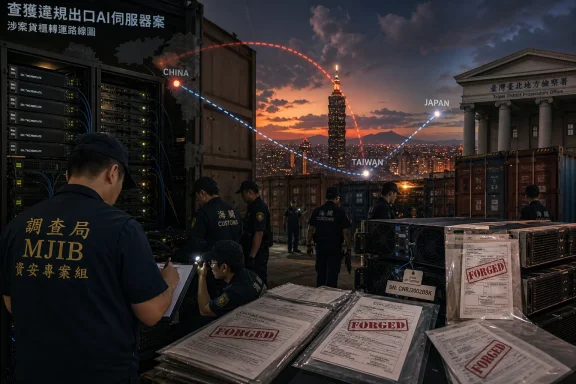
Super Micro Computer’s Taiwan offices were raided on June 29, 2026, as prosecutors in Keelung expanded an investigation into alleged smuggling of Nvidia-powered AI servers into China through falsified export routes and affiliated distributors. The company says it is cooperating with authorities, and that distinction matters. But it does not end the story. The raid turns Supermicro from a named supplier in someone else’s alleged scheme into a test case for whether the AI hardware boom can survive the geopolitical controls now being wrapped around it.
The uncomfortable lesson is that export controls are no longer a Washington policy abstraction. They are becoming a supply-chain operating system, enforced through prosecutors, customs agents, distributors, logistics firms, and server makers that built the AI era’s physical plumbing. Supermicro’s public line is simple: its products are being targeted, and it is helping law enforcement ensure lawful distribution. The market’s harder question is whether any company selling high-end AI infrastructure can truly know where its machines land once demand, scarcity, and geopolitics all point in the same forbidden direction.
The latest Taiwan action reportedly involved searches at Supermicro-linked offices, residences, and affiliated companies as prosecutors widened a probe into exports of AI servers containing restricted Nvidia chips. Earlier reporting from Bloomberg, the Financial Times, and other outlets described the investigation as focused on whether systems were routed into China despite U.S. restrictions on advanced AI accelerators. Taiwan’s Keelung District Prosecutors Office had already been pursuing suspects accused of using false documents and fraudulent declarations to move Supermicro servers abroad.
Supermicro’s response has been careful rather than combative. The company has said its products continue to be targeted in these matters, and that it is cooperating with law enforcement and government officials in Taiwan and other jurisdictions. That sentence is doing a lot of work. It frames Supermicro as a victim of diversion rather than an architect of it, while acknowledging the obvious: its hardware sits at the center of the alleged pipeline.
For years, server vendors competed on density, cooling, procurement speed, and how quickly they could turn Nvidia GPUs into deployable racks. That is still the business. But in 2026, the sales pitch now has another layer: can the vendor prove that the customer, reseller, freight forwarder, ultimate end user, and final destination are who they claim to be?
That is a profound change for an industry accustomed to treating servers as movable assets. A rack can be ordered in California, assembled in Taiwan, financed through an intermediary, warehoused in Singapore, declared for one market, and quietly redirected to another. In ordinary trade, that complexity is friction. In the AI chip war, it is the terrain on which enforcement now operates.
That role made Supermicro one of the great beneficiaries of the AI infrastructure surge. It also made the company a convenient focal point for investigators. When the most valuable export-controlled technology is shipped not as loose GPUs but as dense server systems, the server vendor’s name appears on invoices, chassis, labels, declarations, and support chains.
The alleged smuggling cases do not necessarily prove institutional wrongdoing by Supermicro. The company has said conduct attributed to individuals would violate its policies and compliance controls. It reportedly placed employees on leave and ended its relationship with a contractor after U.S. charges emerged earlier this year. Those are not cosmetic moves; they are the moves of a company trying to draw a line between corporate policy and individual conduct.
But export-control risk is not limited to whether headquarters approved a shipment. The more painful question is whether the company’s controls were strong enough to detect, stop, or deter diversion when the economic incentive to evade them became enormous. In the current AI market, that is not a theoretical compliance problem. It is a board-level business risk.
That mismatch creates the enforcement dilemma now visible in Taiwan. Re-exporting certain products from Taiwan to China may not, by itself, be a Taiwan criminal offense in the same way it is treated under U.S. export-control law. Local prosecutors may therefore lean on fraud, document forgery, false declarations, customs violations, or related offenses rather than a mirror image of Washington’s semiconductor rules.
This is why the Supermicro raid matters beyond one company’s stock price. It shows the U.S. export-control regime being translated into local legal systems that were not necessarily built for the same strategic purpose. The result is messier than a clean sanctions wall. It is a patchwork of national laws, commercial compliance obligations, and law-enforcement cooperation.
The practical consequence is that companies cannot treat U.S. export law as something that ends at the U.S. border. If a product contains controlled U.S. technology, and if the vendor depends on U.S. capital markets, U.S. customers, U.S. suppliers, or U.S. regulators, the compliance perimeter follows the product. That perimeter now appears to run through Taiwan’s prosecutors, Asian distributors, and logistics routes that once attracted far less public attention.
That is the genius and danger of modern smuggling. It does not always require hiding chips in suitcases. It can exploit the fact that servers are high-value, modular, globally traded assets whose paperwork may be more important than their physical concealment.
A fully built AI server is both a product and a disguise. It can be described as enterprise hardware, routed as data-center equipment, and embedded in a transaction chain with plausible commercial actors. If a declaration says the system is destined for one jurisdiction and the actual buyer is elsewhere, the problem may not be visible unless a regulator follows the paperwork through multiple layers.
The reported allegations involving Supermicro-linked products therefore expose a weak point in the export-control model. Washington can restrict direct sales. Nvidia can screen customers. Server vendors can publish compliance policies. But if downstream buyers can use false declarations and friendly intermediaries to redirect systems, enforcement becomes a constant chase rather than a static barrier.
Reports from the Chinese market have described surging prices for older Nvidia A100 systems, improvised use of gaming GPUs for AI workloads, and a black-market premium for restricted accelerators. That is exactly what export controls are meant to cause in one sense: friction, scarcity, and degraded access. But scarcity also creates profit opportunities for anyone willing to move product through unofficial channels.
This is where the policy becomes self-reinforcing. The more valuable the restricted chips become, the more energy flows into evasion. The more evasion is discovered, the more governments tighten enforcement. The more enforcement tightens, the more legitimate buyers, resellers, and distributors face delays, audits, and scrutiny.
For the WindowsForum audience, this may sound distant from the PC desktop. It is not. The same GPU supply chain that feeds hyperscale AI also shapes workstation availability, enterprise server refresh cycles, cloud pricing, and developer access to compute. When the most powerful accelerators become geopolitical contraband, the secondary effects eventually reach everyone building, renting, or administering compute.
That packaging matters. Export controls are not only about chips crossing borders; they are about systems, assemblies, technical support, firmware, interconnects, and usable AI infrastructure. A GPU locked in a warehouse is one thing. A tested, integrated server system ready for a data center is far more valuable.
Supermicro’s business model is built around speed and configuration flexibility. That has been a strength in the AI buildout, where customers want systems adapted to power, cooling, networking, and deployment constraints. But flexibility also expands the surface area for compliance mistakes or abuse. More configurations, more channels, more distributors, and more geographies mean more points at which an apparently lawful sale can become a problem.
The industry has often talked about AI infrastructure as though the only bottlenecks were wafers, packaging capacity, high-bandwidth memory, power, and data-center construction. The Supermicro case adds a different bottleneck: trust. If governments cannot trust the destination paperwork, they will make everyone prove more, wait longer, and disclose deeper into the sales chain.
But cooperation is not the same as exoneration. It is a process position, not a final verdict. The fact that authorities reportedly searched offices connected to the company’s Taiwan presence means investigators believed those locations might contain information relevant to the probe. It does not mean prosecutors have proved corporate culpability, but it does mean the investigation has moved close enough to the company’s operations to matter.
Investors tend to translate that ambiguity into volatility. Customers translate it into procurement risk. Governments translate it into a reason to demand better controls. Employees translate it into internal reviews, training, audits, and perhaps a more cautious sales culture.
The best outcome for Supermicro would be to demonstrate that alleged diversion occurred despite strong controls, that suspect personnel or contractors acted outside policy, and that the company materially assisted in stopping further illegal shipments. The harder outcome would be a finding that compliance systems failed at scale. The difference between those outcomes is not public-relations language; it is evidence.
Export controls introduce a different logic. They reward hesitation, verification, documentation, and refusal. A salesperson sees an order; a compliance officer sees a possible diversion path. A customer sees a deployment timeline; a government sees national security exposure.
This conflict is now structural. The same business processes that made AI hardware move quickly across borders are being retrofitted for a world where the identity of the final user may be more important than the technical specification. That retrofit will not be painless. It will slow deals, complicate distributor relationships, and force companies to build compliance tooling that looks more like financial anti-money-laundering systems than traditional hardware sales operations.
The phrase know your customer is no longer just banking jargon. In AI infrastructure, it is becoming a strategic requirement. Know your reseller. Know your logistics provider. Know your customer’s customer. Know whether a shipment that appears bound for one friendly jurisdiction is likely to be re-exported into a restricted one.
That makes Taiwan both indispensable and exposed. If advanced AI hardware is built, assembled, tested, or distributed through Taiwan, then Taiwan becomes a natural place for diversion attempts and enforcement actions. The Keelung prosecutors’ role shows how local authorities are being drawn into disputes that originate in U.S.-China strategic competition but play out through Taiwanese companies and ports.
For Taipei, the calculus is delicate. Align too loosely with U.S. controls, and Taiwan risks being seen as a weak link in the AI hardware embargo. Align too aggressively, and it must absorb enforcement burdens, commercial disruptions, and potential retaliation from China. Either path reinforces Taiwan’s central role in a technology conflict that is no longer only about fabrication plants and lithography machines.
The Supermicro raid therefore belongs in the same broad category as export-license debates, chip-tool restrictions, and pressure on cloud providers. It is another sign that the AI hardware stack is being securitized. Chips are not merely products; they are governed capabilities.
Vendors facing heightened scrutiny will ask more questions. Distributors will require more documentation. Delivery timelines may become more uncertain for high-end systems. Some customers may face additional checks if their ownership structure, geography, or intended use raises red flags.
That will be especially true for multinational organizations with operations in both permitted and restricted markets. A U.S. or European parent company ordering AI servers for a regional subsidiary may need to provide tighter assurances about deployment location, access controls, and resale restrictions. Procurement departments that once treated servers as commodities may have to treat them as controlled assets.
This is not necessarily bad. Better chain-of-custody controls can reduce legal risk and protect vendors from being used by bad actors. But it will make infrastructure planning more bureaucratic. The era of casually shifting the most advanced AI gear between business units, geographies, and partners is ending.
Microsoft’s AI strategy depends heavily on access to massive GPU clusters. So do the developers building on Windows, the enterprises deploying AI assistants, and the software vendors adding local or hybrid inference features. When export controls reshape GPU availability and pricing, they influence the cloud economics behind everyday services.
There is also a hardware-adjacent lesson for Windows admins. Compliance obligations are moving deeper into infrastructure operations. Asset tracking, endpoint telemetry, licensing, identity, and data governance already sit inside the admin’s domain. High-end compute may now join that list as a regulated asset class requiring auditability from purchase to deployment.
In practical terms, the sysadmin of the future may need to know not just which GPU is installed in which server, but who is authorized to use the cluster, where the workload runs, whether remote access crosses jurisdictions, and whether a system can be transferred between subsidiaries. That is not science fiction. It is the natural endpoint of treating compute as strategic capacity.
A modern AI server is movable, rentable, remotely accessible, and rapidly depreciating. Its value is not only in ownership but in access. A restricted user may not need to own the box if they can rent time on it, colocate near it, or reach it through a front company. Hardware controls therefore bleed into cloud controls, identity controls, and service controls.
This is why enforcement is expanding beyond the initial sale. If a server is shipped legally to one country and then illicitly re-exported, the original control has failed. If a system remains physically in a permitted country but is made available to restricted users remotely, the problem becomes even harder. The law is trying to follow capability, not just cargo.
Supermicro’s case is about physical servers, but the broader conflict is about access to compute. The policy question is whether governments can meaningfully deny strategic AI capacity to adversaries when hardware, services, and intermediaries are all global. The answer so far is: partially, expensively, and with constant leakage.
The uncertainty spans several categories. There is legal exposure if prosecutors uncover evidence of broader misconduct. There is revenue exposure if customers or governments slow purchases pending clarity. There is compliance-cost exposure if the company must overhaul controls. There is reputational exposure if Supermicro becomes shorthand for export-control leakage, even if the company argues it was targeted by smugglers rather than complicit in smuggling.
That last risk is particularly hard to manage. In high-growth markets, reputation can be an accelerator. In regulated markets, reputation can become a checkpoint. Customers buying mission-critical AI infrastructure want speed, but they also want vendors that will not drag them into investigations, delayed shipments, or political scrutiny.
Supermicro’s challenge is therefore not only to satisfy prosecutors. It must persuade customers, suppliers, and investors that it can remain fast while becoming more controlled. That is a difficult balancing act for any company built to exploit a demand boom.
Expect more pressure on licensing, distributor vetting, end-use checks, and penalties for false declarations. Expect more scrutiny of Southeast Asian transit hubs and jurisdictions that can serve as plausible waypoints for restricted technology. Expect lawmakers to ask whether current rules are too dependent on voluntary compliance by companies whose incentives are shaped by enormous sales opportunities.
There will also be pressure on Nvidia, though the company can reasonably argue that it does not control every downstream system built with its chips. Still, when Nvidia accelerators are the strategic prize, regulators will ask what more the company, its partners, and its approved server vendors can do to prevent diversion. In the AI era, “we sold to an authorized customer” may no longer be the end of the inquiry.
The risk is that policy overcorrects. If enforcement becomes too blunt, legitimate customers in friendly markets may face delays and uncertainty that undermine U.S. technology leadership. If enforcement remains too loose, restricted buyers will exploit the gaps. The next phase will be an attempt to find a middle ground, and companies like Supermicro will live inside that tension.
The uncomfortable lesson is that export controls are no longer a Washington policy abstraction. They are becoming a supply-chain operating system, enforced through prosecutors, customs agents, distributors, logistics firms, and server makers that built the AI era’s physical plumbing. Supermicro’s public line is simple: its products are being targeted, and it is helping law enforcement ensure lawful distribution. The market’s harder question is whether any company selling high-end AI infrastructure can truly know where its machines land once demand, scarcity, and geopolitics all point in the same forbidden direction.
 The Raid Makes Compliance a Product Feature
The latest Taiwan action reportedly involved searches at Supermicro-linked offices, residences, and affiliated companies as prosecutors widened a probe into exports of AI servers containing restricted Nvidia chips. Earlier reporting from Bloomberg, the Financial Times, and other outlets described the investigation as focused on whether systems were routed into China despite U.S. restrictions on advanced AI accelerators. Taiwan’s Keelung District Prosecutors Office had already been pursuing suspects accused of using false documents and fraudulent declarations to move Supermicro servers abroad.Supermicro’s response has been careful rather than combative. The company has said its products continue to be targeted in these matters, and that it is cooperating with law enforcement and government officials in Taiwan and other jurisdictions. That sentence is doing a lot of work. It frames Supermicro as a victim of diversion rather than an architect of it, while acknowledging the obvious: its hardware sits at the center of the alleged pipeline.
For years, server vendors competed on density, cooling, procurement speed, and how quickly they could turn Nvidia GPUs into deployable racks. That is still the business. But in 2026, the sales pitch now has another layer: can the vendor prove that the customer, reseller, freight forwarder, ultimate end user, and final destination are who they claim to be?
That is a profound change for an industry accustomed to treating servers as movable assets. A rack can be ordered in California, assembled in Taiwan, financed through an intermediary, warehoused in Singapore, declared for one market, and quietly redirected to another. In ordinary trade, that complexity is friction. In the AI chip war, it is the terrain on which enforcement now operates.
Supermicro Is Not Just Another Box Maker
The reason this story has weight is that Supermicro is not a boutique reseller caught near the edge of the market. It is one of the companies that turns scarce Nvidia accelerators into the physical systems that hyperscalers, AI labs, national cloud projects, and enterprise customers actually deploy. Nvidia sells the silicon and reference platforms, but companies like Supermicro industrialize the demand.That role made Supermicro one of the great beneficiaries of the AI infrastructure surge. It also made the company a convenient focal point for investigators. When the most valuable export-controlled technology is shipped not as loose GPUs but as dense server systems, the server vendor’s name appears on invoices, chassis, labels, declarations, and support chains.
The alleged smuggling cases do not necessarily prove institutional wrongdoing by Supermicro. The company has said conduct attributed to individuals would violate its policies and compliance controls. It reportedly placed employees on leave and ended its relationship with a contractor after U.S. charges emerged earlier this year. Those are not cosmetic moves; they are the moves of a company trying to draw a line between corporate policy and individual conduct.
But export-control risk is not limited to whether headquarters approved a shipment. The more painful question is whether the company’s controls were strong enough to detect, stop, or deter diversion when the economic incentive to evade them became enormous. In the current AI market, that is not a theoretical compliance problem. It is a board-level business risk.
Washington’s Rules Are Being Tested in Taiwan’s Ports
The United States has spent years tightening restrictions on China’s access to advanced AI chips, particularly Nvidia accelerators capable of training and running frontier-scale models. Those restrictions are designed to slow China’s military and strategic AI capabilities by limiting access to the computational hardware that makes large-scale systems possible. The controls apply most directly through U.S. law, but the hardware supply chain is not contained neatly inside U.S. borders.That mismatch creates the enforcement dilemma now visible in Taiwan. Re-exporting certain products from Taiwan to China may not, by itself, be a Taiwan criminal offense in the same way it is treated under U.S. export-control law. Local prosecutors may therefore lean on fraud, document forgery, false declarations, customs violations, or related offenses rather than a mirror image of Washington’s semiconductor rules.
This is why the Supermicro raid matters beyond one company’s stock price. It shows the U.S. export-control regime being translated into local legal systems that were not necessarily built for the same strategic purpose. The result is messier than a clean sanctions wall. It is a patchwork of national laws, commercial compliance obligations, and law-enforcement cooperation.
The practical consequence is that companies cannot treat U.S. export law as something that ends at the U.S. border. If a product contains controlled U.S. technology, and if the vendor depends on U.S. capital markets, U.S. customers, U.S. suppliers, or U.S. regulators, the compliance perimeter follows the product. That perimeter now appears to run through Taiwan’s prosecutors, Asian distributors, and logistics routes that once attracted far less public attention.
The Alleged Route Is the Story
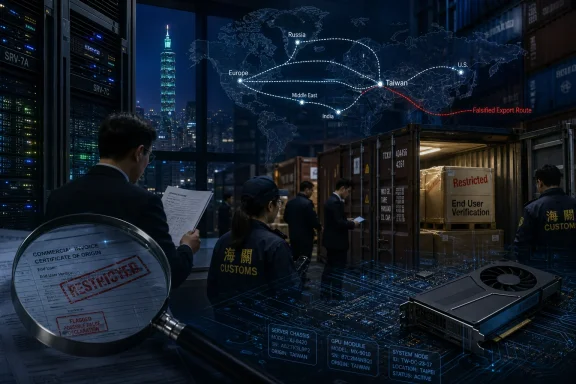
The details reported in earlier cases are striking because they sound less like a spy novel than like ordinary enterprise procurement with a few carefully placed lies. Suspects have been accused of falsifying export documents, using intermediaries, and routing servers through third countries to disguise their final destination. Japan, Southeast Asia, Hong Kong, and other transit points have all appeared in reporting around alleged diversion networks.That is the genius and danger of modern smuggling. It does not always require hiding chips in suitcases. It can exploit the fact that servers are high-value, modular, globally traded assets whose paperwork may be more important than their physical concealment.
A fully built AI server is both a product and a disguise. It can be described as enterprise hardware, routed as data-center equipment, and embedded in a transaction chain with plausible commercial actors. If a declaration says the system is destined for one jurisdiction and the actual buyer is elsewhere, the problem may not be visible unless a regulator follows the paperwork through multiple layers.
The reported allegations involving Supermicro-linked products therefore expose a weak point in the export-control model. Washington can restrict direct sales. Nvidia can screen customers. Server vendors can publish compliance policies. But if downstream buyers can use false declarations and friendly intermediaries to redirect systems, enforcement becomes a constant chase rather than a static barrier.
The AI Boom Has Created Its Own Gray Market
Scarcity is the fuel underneath the smuggling story. Nvidia’s high-end AI accelerators are not ordinary chips; they are rationed strategic assets in a market where demand from cloud providers, AI companies, governments, and enterprises has outstripped supply. When legal access is restricted for an entire national market as large as China, prices and incentives move accordingly.Reports from the Chinese market have described surging prices for older Nvidia A100 systems, improvised use of gaming GPUs for AI workloads, and a black-market premium for restricted accelerators. That is exactly what export controls are meant to cause in one sense: friction, scarcity, and degraded access. But scarcity also creates profit opportunities for anyone willing to move product through unofficial channels.
This is where the policy becomes self-reinforcing. The more valuable the restricted chips become, the more energy flows into evasion. The more evasion is discovered, the more governments tighten enforcement. The more enforcement tightens, the more legitimate buyers, resellers, and distributors face delays, audits, and scrutiny.
For the WindowsForum audience, this may sound distant from the PC desktop. It is not. The same GPU supply chain that feeds hyperscale AI also shapes workstation availability, enterprise server refresh cycles, cloud pricing, and developer access to compute. When the most powerful accelerators become geopolitical contraband, the secondary effects eventually reach everyone building, renting, or administering compute.
Nvidia’s Chips Are the Prize, but Server Makers Carry the Paper Trail
Nvidia is the obvious name in every version of this story because its GPUs are the object of desire. But the enforcement spotlight often lands on server makers because they package the accelerators into saleable infrastructure. A single rack of Nvidia-powered systems can represent millions of dollars in compute and a substantial chunk of strategic capability.That packaging matters. Export controls are not only about chips crossing borders; they are about systems, assemblies, technical support, firmware, interconnects, and usable AI infrastructure. A GPU locked in a warehouse is one thing. A tested, integrated server system ready for a data center is far more valuable.
Supermicro’s business model is built around speed and configuration flexibility. That has been a strength in the AI buildout, where customers want systems adapted to power, cooling, networking, and deployment constraints. But flexibility also expands the surface area for compliance mistakes or abuse. More configurations, more channels, more distributors, and more geographies mean more points at which an apparently lawful sale can become a problem.
The industry has often talked about AI infrastructure as though the only bottlenecks were wafers, packaging capacity, high-bandwidth memory, power, and data-center construction. The Supermicro case adds a different bottleneck: trust. If governments cannot trust the destination paperwork, they will make everyone prove more, wait longer, and disclose deeper into the sales chain.
“Cooperating” Is Necessary, Not Sufficient
Supermicro’s insistence that it is cooperating with Taiwan authorities is important, and there is no reason to dismiss it. Companies caught in sprawling investigations routinely assist prosecutors while also protecting their legal position. Cooperation can mean providing documents, explaining distribution channels, identifying suspect counterparties, and helping authorities understand how products move.But cooperation is not the same as exoneration. It is a process position, not a final verdict. The fact that authorities reportedly searched offices connected to the company’s Taiwan presence means investigators believed those locations might contain information relevant to the probe. It does not mean prosecutors have proved corporate culpability, but it does mean the investigation has moved close enough to the company’s operations to matter.
Investors tend to translate that ambiguity into volatility. Customers translate it into procurement risk. Governments translate it into a reason to demand better controls. Employees translate it into internal reviews, training, audits, and perhaps a more cautious sales culture.
The best outcome for Supermicro would be to demonstrate that alleged diversion occurred despite strong controls, that suspect personnel or contractors acted outside policy, and that the company materially assisted in stopping further illegal shipments. The harder outcome would be a finding that compliance systems failed at scale. The difference between those outcomes is not public-relations language; it is evidence.
The Industry Wanted Frictionless AI Hardware. Governments Want Chain of Custody.
The AI infrastructure market grew up around speed. Every quarter mattered. Every cluster delay meant lost model-training time, missed cloud revenue, and competitive disadvantage. Vendors that could deliver complete systems quickly gained share because the market rewarded availability almost as much as performance.Export controls introduce a different logic. They reward hesitation, verification, documentation, and refusal. A salesperson sees an order; a compliance officer sees a possible diversion path. A customer sees a deployment timeline; a government sees national security exposure.
This conflict is now structural. The same business processes that made AI hardware move quickly across borders are being retrofitted for a world where the identity of the final user may be more important than the technical specification. That retrofit will not be painless. It will slow deals, complicate distributor relationships, and force companies to build compliance tooling that looks more like financial anti-money-laundering systems than traditional hardware sales operations.
The phrase know your customer is no longer just banking jargon. In AI infrastructure, it is becoming a strategic requirement. Know your reseller. Know your logistics provider. Know your customer’s customer. Know whether a shipment that appears bound for one friendly jurisdiction is likely to be re-exported into a restricted one.
Taiwan Is Being Pulled Into the Enforcement Center
Taiwan’s position is uniquely complicated. It is central to the semiconductor supply chain, home to manufacturing and assembly capacity that the world cannot easily replace. It is also a democracy under constant pressure from Beijing, a crucial U.S. partner, and a jurisdiction whose trade rules do not automatically duplicate Washington’s export-control architecture.That makes Taiwan both indispensable and exposed. If advanced AI hardware is built, assembled, tested, or distributed through Taiwan, then Taiwan becomes a natural place for diversion attempts and enforcement actions. The Keelung prosecutors’ role shows how local authorities are being drawn into disputes that originate in U.S.-China strategic competition but play out through Taiwanese companies and ports.
For Taipei, the calculus is delicate. Align too loosely with U.S. controls, and Taiwan risks being seen as a weak link in the AI hardware embargo. Align too aggressively, and it must absorb enforcement burdens, commercial disruptions, and potential retaliation from China. Either path reinforces Taiwan’s central role in a technology conflict that is no longer only about fabrication plants and lithography machines.
The Supermicro raid therefore belongs in the same broad category as export-license debates, chip-tool restrictions, and pressure on cloud providers. It is another sign that the AI hardware stack is being securitized. Chips are not merely products; they are governed capabilities.
Enterprise Buyers Will Pay for the New Suspicion
Most enterprise IT teams are not trying to smuggle GPUs into sanctioned destinations. They are trying to build private AI clusters, expand VDI capacity, run inference workloads, modernize data centers, and keep budgets from exploding. Yet they will still feel the downstream effects of this enforcement environment.Vendors facing heightened scrutiny will ask more questions. Distributors will require more documentation. Delivery timelines may become more uncertain for high-end systems. Some customers may face additional checks if their ownership structure, geography, or intended use raises red flags.
That will be especially true for multinational organizations with operations in both permitted and restricted markets. A U.S. or European parent company ordering AI servers for a regional subsidiary may need to provide tighter assurances about deployment location, access controls, and resale restrictions. Procurement departments that once treated servers as commodities may have to treat them as controlled assets.
This is not necessarily bad. Better chain-of-custody controls can reduce legal risk and protect vendors from being used by bad actors. But it will make infrastructure planning more bureaucratic. The era of casually shifting the most advanced AI gear between business units, geographies, and partners is ending.
The Windows Angle Is the Compute Angle
Windows enthusiasts may wonder why a Taiwan raid involving Nvidia AI servers belongs on a Windows community site. The answer is that the Windows ecosystem increasingly depends on the same compute politics. Azure, Windows developer tooling, Copilot-era workloads, local AI PCs, enterprise inference, and GPU-accelerated applications all sit downstream of the AI hardware market.Microsoft’s AI strategy depends heavily on access to massive GPU clusters. So do the developers building on Windows, the enterprises deploying AI assistants, and the software vendors adding local or hybrid inference features. When export controls reshape GPU availability and pricing, they influence the cloud economics behind everyday services.
There is also a hardware-adjacent lesson for Windows admins. Compliance obligations are moving deeper into infrastructure operations. Asset tracking, endpoint telemetry, licensing, identity, and data governance already sit inside the admin’s domain. High-end compute may now join that list as a regulated asset class requiring auditability from purchase to deployment.
In practical terms, the sysadmin of the future may need to know not just which GPU is installed in which server, but who is authorized to use the cluster, where the workload runs, whether remote access crosses jurisdictions, and whether a system can be transferred between subsidiaries. That is not science fiction. It is the natural endpoint of treating compute as strategic capacity.
The Old Export-Control Model Was Built for Boxes That Stayed Put
Traditional export controls imagined a world of identifiable goods moving from one country to another. A machine tool, a radar component, a missile part, or a specialized chip could be licensed, denied, inspected, and tracked at the border. That model still exists, but AI compute complicates it.A modern AI server is movable, rentable, remotely accessible, and rapidly depreciating. Its value is not only in ownership but in access. A restricted user may not need to own the box if they can rent time on it, colocate near it, or reach it through a front company. Hardware controls therefore bleed into cloud controls, identity controls, and service controls.
This is why enforcement is expanding beyond the initial sale. If a server is shipped legally to one country and then illicitly re-exported, the original control has failed. If a system remains physically in a permitted country but is made available to restricted users remotely, the problem becomes even harder. The law is trying to follow capability, not just cargo.
Supermicro’s case is about physical servers, but the broader conflict is about access to compute. The policy question is whether governments can meaningfully deny strategic AI capacity to adversaries when hardware, services, and intermediaries are all global. The answer so far is: partially, expensively, and with constant leakage.
Investors Are Right to Fear the Unknowns
Supermicro shares have been sensitive to each new enforcement headline because the market is trying to price risks that are inherently hard to quantify. A raid does not equal a conviction. A co-founder’s indictment does not automatically equal corporate liability. A company’s cooperation does not guarantee a clean outcome.The uncertainty spans several categories. There is legal exposure if prosecutors uncover evidence of broader misconduct. There is revenue exposure if customers or governments slow purchases pending clarity. There is compliance-cost exposure if the company must overhaul controls. There is reputational exposure if Supermicro becomes shorthand for export-control leakage, even if the company argues it was targeted by smugglers rather than complicit in smuggling.
That last risk is particularly hard to manage. In high-growth markets, reputation can be an accelerator. In regulated markets, reputation can become a checkpoint. Customers buying mission-critical AI infrastructure want speed, but they also want vendors that will not drag them into investigations, delayed shipments, or political scrutiny.
Supermicro’s challenge is therefore not only to satisfy prosecutors. It must persuade customers, suppliers, and investors that it can remain fast while becoming more controlled. That is a difficult balancing act for any company built to exploit a demand boom.
The Policy Hawks Got Their Exhibit
For policymakers who have argued that AI chip controls need stronger enforcement, the Supermicro-linked cases are a gift. They provide a concrete answer to skeptics who said large-scale smuggling was too hard, too visible, or too marginal to matter. If billions of dollars’ worth of AI servers were allegedly diverted through intermediaries, then the enforcement debate changes.Expect more pressure on licensing, distributor vetting, end-use checks, and penalties for false declarations. Expect more scrutiny of Southeast Asian transit hubs and jurisdictions that can serve as plausible waypoints for restricted technology. Expect lawmakers to ask whether current rules are too dependent on voluntary compliance by companies whose incentives are shaped by enormous sales opportunities.
There will also be pressure on Nvidia, though the company can reasonably argue that it does not control every downstream system built with its chips. Still, when Nvidia accelerators are the strategic prize, regulators will ask what more the company, its partners, and its approved server vendors can do to prevent diversion. In the AI era, “we sold to an authorized customer” may no longer be the end of the inquiry.
The risk is that policy overcorrects. If enforcement becomes too blunt, legitimate customers in friendly markets may face delays and uncertainty that undermine U.S. technology leadership. If enforcement remains too loose, restricted buyers will exploit the gaps. The next phase will be an attempt to find a middle ground, and companies like Supermicro will live inside that tension.
The Server Rack Becomes a Border Checkpoint
The concrete lessons from the raid are less about drama and more about infrastructure discipline. AI hardware has crossed the line from expensive IT equipment into controlled strategic capacity, and the companies that sell it are being forced to act accordingly.- Supermicro says it is cooperating with Taiwan and other authorities, but cooperation does not settle the legal or operational questions raised by the raid.
- The investigation underscores that AI server diversion can happen through paperwork, intermediaries, and re-export routes rather than through crude physical concealment.
- Taiwan’s role in the case shows how U.S. export controls increasingly depend on local enforcement in supply-chain jurisdictions.
- Enterprise buyers should expect more documentation, longer checks, and tighter controls around high-end GPU server procurement.
- The AI hardware market is likely to become slower, more audited, and more politically exposed as governments treat compute as a strategic resource.
- The long-term winner will not simply be the vendor that ships the fastest, but the one that can prove where its systems go and who ultimately uses them.
References
- Primary source: Wccftech
Published: Mon, 29 Jun 2026 21:30:00 GMT
Super Micro Insists Cooperation as Taiwan Authorities Storm Offices in NVIDIA GPU Smuggling Crackdown on China Exports
Re-exporting chips to China isn't a crime under Taiwanese law, complicating a probe rooted in US export restrictions.wccftech.com
- Related coverage: tomshardware.com
China black market Nvidia prices rocket in wake of smuggling crackdown and customs freeze — five-year-old A100 servers triple in price, now fetching up to $82,000 | Tom's Hardware
Buyers are repurposing gaming GPUs and bidding up older Ampere hardware.www.tomshardware.com - Related coverage: bloomberg.com
- Related coverage: supermicro.com
- Related coverage: news.bloomberglaw.com
Super Micro Raided as Taiwan Expands Chip Smuggling Probe (1)
Super Micro Computer Inc.’s offices in Taiwan were raided by government authorities on Monday, widening an investigation into the alleged smuggling of Nvidia Corp. chips into China using the company’s servers, according to a person familiar with the situation. Super Micro’s shares fell as much...news.bloomberglaw.com
- Related coverage: gigazine.net
Three people attempting to smuggle NVIDIA GPUs into China via Japan have been arrested by Taiwanese authorities. - GIGAZINE
The news blog specialized in Japanese culture, odd news, gadgets and all other funny stuffs. Updated everyday.gigazine.net
- Related coverage: shacknews.com
- Related coverage: techspot.com
Taiwan just busted an alleged Nvidia GPU smuggling ring using Japan as a cover | TechSpot
Taiwanese prosecutors detained three individuals last week for allegedly falsifying export documents for Super Micro Computer servers. Investigators also seized about 50 servers they believe were being...www.techspot.com - Related coverage: techradar.com
Biggest heist of the US-China Chip War: 3 charged in $2.5bn scheme | TechRadar
Three men are facing charges of conspiracy to smuggle restricted GPUs to Chinawww.techradar.com - Related coverage: pcgamer.com
Financial Times report suggests chip smugglers shifted an alleged $1 billion worth of Nvidia's AI chips to China over the course of 3 months while stricter US export controls were in effect | PC Gamer
There is no evidence that [Nvidia] is involved in, or has knowledge of, its restricted products being sold to China.www.pcgamer.com - Related coverage: axios.com
AI chip smuggling signals strong Chinese demand
A new AI chip smuggling case is challenging industry claims that smuggling to China isn't happening on a massive scale.www.axios.com