

The United States is moving to require location-verification technology for export-controlled artificial intelligence chips through the Chip Security Act, a bipartisan proposal backed by six shipment-tracking companies and aimed at stopping advanced American accelerators from being routed to China through third countries. The bill is not just another export-control tweak; it is an attempt to turn the chip itself into a compliance witness. That changes the argument from paperwork and licensing to telemetry, attestation, and trust in the physical supply chain. For WindowsForum readers who live in the world of hardware platforms, cloud capacity, and enterprise risk, the fight is really about whether AI infrastructure can remain globally tradable without becoming globally trackable.
Export controls used to be an exercise in documents: purchase orders, end-user certificates, shipping manifests, audits, and the occasional inspection. That model works best when the controlled item is large, slow-moving, and difficult to hide. Advanced AI chips are none of those things once they are assembled into servers and pushed through a global web of brokers, distributors, subsidiaries, and data-center operators.
The Chip Security Act is Washington’s answer to a simple enforcement problem: a seller can know where a chip was supposed to go without knowing where it ended up. The proposed law would require standards for chip security mechanisms that can verify the location of covered integrated-circuit products, including advanced AI accelerators and systems containing them. In plain English, the government wants exporters to prove that powerful AI hardware is operating where the license says it should be operating.
That ambition has gained fresh industry support from six companies that specialize in tracking international shipments of sensitive technology. According to reporting on their letter to congressional leaders, the companies argue that location verification would close major gaps in the export-control system while helping American chipmakers sell more confidently into legitimate markets. Their pitch is striking because it flips the industry’s usual complaint: tracking is not a drag on commerce, they say, but a way to make commerce safer.
The opposition is equally predictable. Major semiconductor and technology trade groups have warned that mandatory tracking risks making American chips look less trustworthy, less private, and more politically entangled than foreign alternatives. The uncomfortable truth is that both sides have a point. If advanced chips can be smuggled at scale, paper controls are too weak; if every high-end chip ships with government-mandated location logic, the American AI stack starts to look like a controlled service rather than a product.
That case matters because it gives policymakers a concrete story to tell. Export-control debates can otherwise sound abstract, full of acronyms and threshold tables. A $2.5 billion alleged diversion scheme, complete with staged warehouse inspections and manipulated labels, is the kind of narrative Congress understands instantly.
It also shows why the weak point is not simply the first sale. A chipmaker can refuse direct shipments to a restricted buyer, and the Commerce Department can block exports to named Chinese entities, but neither measure fully solves the transshipment problem. If a third-country company buys servers for an apparently legitimate data center and then forwards them, leases them, repackages them, or provides remote access to a restricted customer, the compliance chain starts to fray.
This is where the proposed location-verification mandate becomes politically attractive. Instead of asking the government to trust every intermediary in Malaysia, Indonesia, Singapore, Taiwan, the Gulf, or Europe, the law would push verification down into the product or system. The chip, server, or associated management stack would become part of the enforcement perimeter.
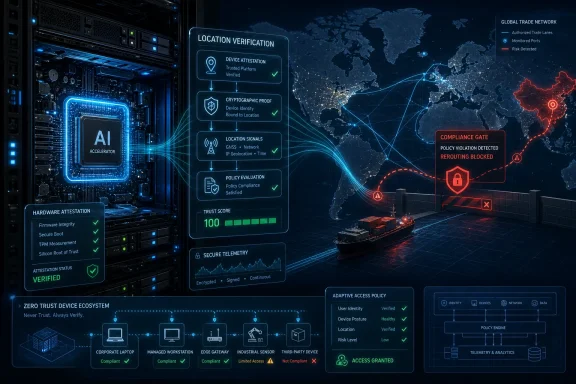
For administrators, that sounds familiar. Enterprise IT has spent years moving from perimeter trust to device posture, endpoint attestation, conditional access, and zero-trust claims. The Chip Security Act applies a similar logic to geopolitics: do not merely trust the reseller, the invoice, or the hosting claim; verify the device’s state and location continuously or periodically.
A software-based approach could use signals such as IP geography, latency patterns, data-center inventory systems, secure boot attestations, confidential-computing features, and vendor management services. A firmware or hardware approach could rely on secure enclaves, cryptographic roots of trust, or board-level mechanisms that report location or operational state to a trusted service. None of these paths is simple, and none is immune to spoofing, but they are not science fiction.
Nvidia has already been pulled into this debate. The company has rejected the idea that it installs secret backdoors, spyware, or kill switches in its products, while also reportedly developing software that can help data-center operators monitor the location and inventory of GPU fleets. That is the narrow corridor American chipmakers are trying to walk: offer enough verification to reassure Washington without creating the impression that their products are remotely controlled by Washington.
This distinction will matter in procurement. A hyperscaler may accept telemetry as part of fleet management; it already lives in a universe of remote attestation, hardware inventory, and compliance reporting. A sovereign cloud customer or foreign government may hear the same pitch and ask whether American hardware can be politically disabled, surveilled, or second-guessed after purchase.
The more powerful the chip, the more this anxiety grows. A mainstream laptop NPU is not the target of the current export-control fight. Frontier AI accelerators, high-density server boards, and systems designed for massive training or inference clusters are. But technology mandates have a way of expanding over time, and the industry will be watching closely to see where Commerce draws the line.
Their case is that stronger verification can increase, rather than decrease, sales. If chipmakers can prove that exported systems remain in approved jurisdictions, they may be able to win faster approvals, support larger orders, and serve countries that might otherwise be treated as diversion risks. That is a meaningful argument for markets in Southeast Asia, the Middle East, and other regions where legitimate AI demand is rising but Washington worries about rerouting to China.
This is the least appreciated part of the bill. The Chip Security Act is not only a restriction; it is also a possible licensing lubricant. A government that trusts the verification layer may become more comfortable approving exports to data centers in countries that sit between the United States and China commercially, geographically, or politically.
But that only works if the verification system is credible to all parties. It must be hard enough to spoof that regulators trust it, narrow enough that customers do not see it as surveillance, and operationally boring enough that cloud providers can integrate it without turning every GPU deployment into a compliance fire drill. That is a much harder problem than writing “location tracking” into a statute.
The tracking companies’ support also exposes a divide inside the broader technology industry. Chipmakers, cloud providers, logistics firms, security vendors, and compliance specialists do not all make money from the same friction. One company’s mandate is another company’s market.
This is the nightmare scenario for American semiconductor firms. The United States wants to keep China from obtaining the most advanced accelerators while preserving American dominance in the global AI stack. A tracking mandate could support the first goal while undermining the second if it makes U.S. hardware politically toxic in neutral or allied markets.
The language used by opponents is therefore deliberately stark. They warn about backdoors, kill switches, hacker incentives, privacy risks, and loss of customer confidence. Some of that rhetoric is defensive lobbying, but it lands because the technical concern is real: any mechanism that can report location, attest state, or enforce policy becomes a new part of the attack surface.
Security-minded readers should resist the easy version of the debate. A well-designed attestation system is not automatically a backdoor. A poorly designed one absolutely can become one. The difference lies in architecture, transparency, scope, auditability, and whether the system reports limited compliance claims or creates broad remote-control capability.
The bill’s supporters have tried to emphasize verification rather than disabling. That is a critical boundary. Location proof is one thing; a remote kill switch is another. If Congress blurs that line, it will hand Chinese regulators and domestic critics the argument they need.
This is the awkward reality of AI infrastructure. The asset is physical, but the service is virtual. A GPU cluster in one jurisdiction can train or serve models for customers in another. Traditional export controls were designed around objects crossing borders; AI compute lets the value of the object cross borders without the object moving at all.
Location verification does not solve the remote-access problem by itself. A chip can remain in an approved country while serving a restricted customer over the network. That is why cloud identity, customer due diligence, workload monitoring, and legal controls over compute access are moving into the same policy conversation as chip tracking.
For enterprise IT, this sounds like the next compliance headache. Cloud providers may be asked to prove not only where their accelerators sit, but who is using them, for what class of workload, and under what jurisdictional controls. That begins to merge export compliance with cloud governance, identity management, and AI safety policy.
The likely result is a more tiered AI cloud market. Some regions and customers will get access to the highest-performance accelerators with fewer restrictions. Others will receive downgraded chips, capped clusters, monitored services, or longer approval cycles. The hardware business becomes a policy-distribution business.
That sounds optimistic, but it is not absurd. Southeast Asia is absorbing huge amounts of data-center investment as companies seek power, land, fiber, and geopolitical diversification. If every large AI deployment in the region is treated as a possible diversion risk, U.S. exporters lose business and local operators lose access to the best hardware.
A credible verification regime could give these markets a cleaner path. Instead of broad suspicion, regulators could impose specific controls: registered facilities, auditable inventory, secure telemetry, customer screening, and re-export restrictions. That would not eliminate risk, but it could make risk measurable enough for licensing officers to tolerate.
The danger is that verification becomes a tax on everyone except the biggest players. Hyperscalers and major server operators can absorb compliance systems, legal reviews, and technical reporting. Smaller data-center firms, regional cloud providers, universities, and research labs may struggle. Export controls often claim to target adversaries, but the administrative burden lands first on legitimate customers.
This is where policymakers need to be precise. If the United States wants allies and swing states to build on American AI infrastructure, the compliance path must be usable. A regime that only Microsoft, Amazon, Google, Oracle, and a handful of national champions can navigate will consolidate the AI market further while claiming to protect it.
That said, Windows users are not spectators. The same AI hardware supply chain feeds cloud services, developer platforms, enterprise inference, model training, and the back-end systems that increasingly shape Microsoft’s products. If high-end accelerators become harder to export, more tightly monitored, or more expensive to deploy, the effects ripple into Azure capacity, AI service pricing, regional availability, and procurement timelines.
Microsoft and other cloud providers are already living in the world this bill anticipates. They run global fleets of accelerators, sell AI capacity across borders, and must comply with shifting national-security rules. Their customers may never touch an Nvidia H100, H200, B200, or successor chip, but they will feel the policy through service availability and contractual restrictions.
The local AI trend complicates the picture. As more developers and power users run models on workstations, gaming GPUs, and AI PCs, the boundary between “strategic accelerator” and “high-performance consumer hardware” will be politically contested. Today’s bill may focus on the data center. Tomorrow’s threshold debate could decide which chips are ordinary commerce and which are strategic goods.
That does not mean consumer PCs are about to become export-policed appliances. It does mean the old assumption that compute hardware is politically neutral is gone. High-end compute is now treated like a strategic resource, and the Windows ecosystem sits on top of that resource whether users notice or not.
But location verification cannot answer every policy question. It cannot decide which countries should receive advanced chips. It cannot determine whether remote access is equivalent to export. It cannot prevent an approved operator from serving a prohibited end user unless paired with customer controls. It cannot stop China from investing in domestic alternatives, stockpiling older hardware, or exploiting allied disagreements.
There is also a deeper strategic tension. The United States wants to slow Chinese AI capabilities without slowing the global adoption of American AI platforms. That requires a policy architecture that is restrictive enough to matter and open enough to preserve market leadership. A blunt tracking mandate may help enforcement while making the platform less attractive.
The best version of the Chip Security Act would be narrow, auditable, and technically humble. It would require verifiable compliance claims for the most sensitive chips without mandating secret control channels. It would make room for independent security review and clear limits on what data is collected. It would treat location verification as one layer in a broader export-control system, not as a magic answer.
The worst version would become a sprawling hardware surveillance mandate wrapped in national-security language. That would invite technical workarounds, foreign backlash, and a new round of distrust in American silicon. In chip policy, as in endpoint security, overreach can create the very threat model it claims to solve.
 Washington Has Decided the Invoice Is Not Enough
Export controls used to be an exercise in documents: purchase orders, end-user certificates, shipping manifests, audits, and the occasional inspection. That model works best when the controlled item is large, slow-moving, and difficult to hide. Advanced AI chips are none of those things once they are assembled into servers and pushed through a global web of brokers, distributors, subsidiaries, and data-center operators.The Chip Security Act is Washington’s answer to a simple enforcement problem: a seller can know where a chip was supposed to go without knowing where it ended up. The proposed law would require standards for chip security mechanisms that can verify the location of covered integrated-circuit products, including advanced AI accelerators and systems containing them. In plain English, the government wants exporters to prove that powerful AI hardware is operating where the license says it should be operating.
That ambition has gained fresh industry support from six companies that specialize in tracking international shipments of sensitive technology. According to reporting on their letter to congressional leaders, the companies argue that location verification would close major gaps in the export-control system while helping American chipmakers sell more confidently into legitimate markets. Their pitch is striking because it flips the industry’s usual complaint: tracking is not a drag on commerce, they say, but a way to make commerce safer.
The opposition is equally predictable. Major semiconductor and technology trade groups have warned that mandatory tracking risks making American chips look less trustworthy, less private, and more politically entangled than foreign alternatives. The uncomfortable truth is that both sides have a point. If advanced chips can be smuggled at scale, paper controls are too weak; if every high-end chip ships with government-mandated location logic, the American AI stack starts to look like a controlled service rather than a product.
The China Loophole Is Not Theoretical Anymore
The political momentum behind the bill sharpened after federal prosecutors alleged a massive diversion scheme involving AI servers routed to China. In March 2026, the Justice Department charged three people with conspiring to divert roughly $2.5 billion worth of high-performance AI servers assembled in the United States and containing controlled American technology. Prosecutors alleged that the scheme relied on intermediaries, false documentation, staged inspections, and dummy servers.That case matters because it gives policymakers a concrete story to tell. Export-control debates can otherwise sound abstract, full of acronyms and threshold tables. A $2.5 billion alleged diversion scheme, complete with staged warehouse inspections and manipulated labels, is the kind of narrative Congress understands instantly.
It also shows why the weak point is not simply the first sale. A chipmaker can refuse direct shipments to a restricted buyer, and the Commerce Department can block exports to named Chinese entities, but neither measure fully solves the transshipment problem. If a third-country company buys servers for an apparently legitimate data center and then forwards them, leases them, repackages them, or provides remote access to a restricted customer, the compliance chain starts to fray.
This is where the proposed location-verification mandate becomes politically attractive. Instead of asking the government to trust every intermediary in Malaysia, Indonesia, Singapore, Taiwan, the Gulf, or Europe, the law would push verification down into the product or system. The chip, server, or associated management stack would become part of the enforcement perimeter.
For administrators, that sounds familiar. Enterprise IT has spent years moving from perimeter trust to device posture, endpoint attestation, conditional access, and zero-trust claims. The Chip Security Act applies a similar logic to geopolitics: do not merely trust the reseller, the invoice, or the hosting claim; verify the device’s state and location continuously or periodically.
The Bill Turns Compliance Into a Hardware Platform Feature
The most important phrase in the debate is not “tracking device.” It is location verification mechanism. The bill language and its supporters have generally described a mechanism that could be software-based, firmware-based, hardware-based, or some combination of those approaches. That distinction matters because it separates a crude mental image of GPS tags glued to GPUs from a more plausible system built around secure telemetry, attestation, networking signals, and platform management.A software-based approach could use signals such as IP geography, latency patterns, data-center inventory systems, secure boot attestations, confidential-computing features, and vendor management services. A firmware or hardware approach could rely on secure enclaves, cryptographic roots of trust, or board-level mechanisms that report location or operational state to a trusted service. None of these paths is simple, and none is immune to spoofing, but they are not science fiction.
Nvidia has already been pulled into this debate. The company has rejected the idea that it installs secret backdoors, spyware, or kill switches in its products, while also reportedly developing software that can help data-center operators monitor the location and inventory of GPU fleets. That is the narrow corridor American chipmakers are trying to walk: offer enough verification to reassure Washington without creating the impression that their products are remotely controlled by Washington.
This distinction will matter in procurement. A hyperscaler may accept telemetry as part of fleet management; it already lives in a universe of remote attestation, hardware inventory, and compliance reporting. A sovereign cloud customer or foreign government may hear the same pitch and ask whether American hardware can be politically disabled, surveilled, or second-guessed after purchase.
The more powerful the chip, the more this anxiety grows. A mainstream laptop NPU is not the target of the current export-control fight. Frontier AI accelerators, high-density server boards, and systems designed for massive training or inference clusters are. But technology mandates have a way of expanding over time, and the industry will be watching closely to see where Commerce draws the line.
The Shipment Trackers Are Selling Certainty, Not Just Sensors
The six tracking companies backing the bill have an obvious commercial interest, but that does not make their argument irrelevant. Export controls are only useful if they are enforceable, and enforceability increasingly depends on knowing what happens after the box leaves the factory. In a world where a single rack can represent a strategic asset, logistics intelligence becomes part of national-security policy.Their case is that stronger verification can increase, rather than decrease, sales. If chipmakers can prove that exported systems remain in approved jurisdictions, they may be able to win faster approvals, support larger orders, and serve countries that might otherwise be treated as diversion risks. That is a meaningful argument for markets in Southeast Asia, the Middle East, and other regions where legitimate AI demand is rising but Washington worries about rerouting to China.
This is the least appreciated part of the bill. The Chip Security Act is not only a restriction; it is also a possible licensing lubricant. A government that trusts the verification layer may become more comfortable approving exports to data centers in countries that sit between the United States and China commercially, geographically, or politically.
But that only works if the verification system is credible to all parties. It must be hard enough to spoof that regulators trust it, narrow enough that customers do not see it as surveillance, and operationally boring enough that cloud providers can integrate it without turning every GPU deployment into a compliance fire drill. That is a much harder problem than writing “location tracking” into a statute.
The tracking companies’ support also exposes a divide inside the broader technology industry. Chipmakers, cloud providers, logistics firms, security vendors, and compliance specialists do not all make money from the same friction. One company’s mandate is another company’s market.
Silicon Valley Fears the Cure Could Poison the Brand
The strongest argument against mandatory chip tracking is not that diversion is imaginary. It is that trust in American hardware is itself a strategic asset. If foreign customers begin to believe that U.S.-designed AI chips include government-directed tracking, control, or reporting features, they may accelerate efforts to buy non-U.S. alternatives even when those alternatives are slower, less mature, or more expensive.This is the nightmare scenario for American semiconductor firms. The United States wants to keep China from obtaining the most advanced accelerators while preserving American dominance in the global AI stack. A tracking mandate could support the first goal while undermining the second if it makes U.S. hardware politically toxic in neutral or allied markets.
The language used by opponents is therefore deliberately stark. They warn about backdoors, kill switches, hacker incentives, privacy risks, and loss of customer confidence. Some of that rhetoric is defensive lobbying, but it lands because the technical concern is real: any mechanism that can report location, attest state, or enforce policy becomes a new part of the attack surface.
Security-minded readers should resist the easy version of the debate. A well-designed attestation system is not automatically a backdoor. A poorly designed one absolutely can become one. The difference lies in architecture, transparency, scope, auditability, and whether the system reports limited compliance claims or creates broad remote-control capability.
The bill’s supporters have tried to emphasize verification rather than disabling. That is a critical boundary. Location proof is one thing; a remote kill switch is another. If Congress blurs that line, it will hand Chinese regulators and domestic critics the argument they need.
Export Controls Are Becoming Cloud Controls
The Chip Security Act sits inside a broader shift in U.S. policy: Washington is no longer focused only on where chips are shipped, but also on where compute is consumed. That is why recent legislative efforts have targeted remote access to controlled AI chips through offshore data centers. If a Chinese company cannot import a restricted accelerator but can rent its capacity in another country, the strategic effect may be similar.This is the awkward reality of AI infrastructure. The asset is physical, but the service is virtual. A GPU cluster in one jurisdiction can train or serve models for customers in another. Traditional export controls were designed around objects crossing borders; AI compute lets the value of the object cross borders without the object moving at all.
Location verification does not solve the remote-access problem by itself. A chip can remain in an approved country while serving a restricted customer over the network. That is why cloud identity, customer due diligence, workload monitoring, and legal controls over compute access are moving into the same policy conversation as chip tracking.
For enterprise IT, this sounds like the next compliance headache. Cloud providers may be asked to prove not only where their accelerators sit, but who is using them, for what class of workload, and under what jurisdictional controls. That begins to merge export compliance with cloud governance, identity management, and AI safety policy.
The likely result is a more tiered AI cloud market. Some regions and customers will get access to the highest-performance accelerators with fewer restrictions. Others will receive downgraded chips, capped clusters, monitored services, or longer approval cycles. The hardware business becomes a policy-distribution business.
Southeast Asia Becomes the Test Case
Supporters of the Chip Security Act frequently point to countries such as Malaysia and Indonesia as examples of markets that could benefit from better verification. The argument is straightforward: these countries have legitimate AI and data-center demand, but they also sit in trade routes that Washington worries could be used to redirect advanced technology to China. Verification could reduce suspicion and unlock more lawful commerce.That sounds optimistic, but it is not absurd. Southeast Asia is absorbing huge amounts of data-center investment as companies seek power, land, fiber, and geopolitical diversification. If every large AI deployment in the region is treated as a possible diversion risk, U.S. exporters lose business and local operators lose access to the best hardware.
A credible verification regime could give these markets a cleaner path. Instead of broad suspicion, regulators could impose specific controls: registered facilities, auditable inventory, secure telemetry, customer screening, and re-export restrictions. That would not eliminate risk, but it could make risk measurable enough for licensing officers to tolerate.
The danger is that verification becomes a tax on everyone except the biggest players. Hyperscalers and major server operators can absorb compliance systems, legal reviews, and technical reporting. Smaller data-center firms, regional cloud providers, universities, and research labs may struggle. Export controls often claim to target adversaries, but the administrative burden lands first on legitimate customers.
This is where policymakers need to be precise. If the United States wants allies and swing states to build on American AI infrastructure, the compliance path must be usable. A regime that only Microsoft, Amazon, Google, Oracle, and a handful of national champions can navigate will consolidate the AI market further while claiming to protect it.
The Windows Angle Is Infrastructure, Not Consumer PCs
For Windows enthusiasts, the phrase “tracking AI chips” can sound like the beginning of a consumer-hardware panic. It is worth drawing a firm line. The immediate target is not the NPU in a Copilot+ PC, the GPU in a gaming desktop, or the workstation card used by a developer building local models. The policy fight is about export-controlled advanced chips and systems powerful enough to matter for frontier AI.That said, Windows users are not spectators. The same AI hardware supply chain feeds cloud services, developer platforms, enterprise inference, model training, and the back-end systems that increasingly shape Microsoft’s products. If high-end accelerators become harder to export, more tightly monitored, or more expensive to deploy, the effects ripple into Azure capacity, AI service pricing, regional availability, and procurement timelines.
Microsoft and other cloud providers are already living in the world this bill anticipates. They run global fleets of accelerators, sell AI capacity across borders, and must comply with shifting national-security rules. Their customers may never touch an Nvidia H100, H200, B200, or successor chip, but they will feel the policy through service availability and contractual restrictions.
The local AI trend complicates the picture. As more developers and power users run models on workstations, gaming GPUs, and AI PCs, the boundary between “strategic accelerator” and “high-performance consumer hardware” will be politically contested. Today’s bill may focus on the data center. Tomorrow’s threshold debate could decide which chips are ordinary commerce and which are strategic goods.
That does not mean consumer PCs are about to become export-policed appliances. It does mean the old assumption that compute hardware is politically neutral is gone. High-end compute is now treated like a strategic resource, and the Windows ecosystem sits on top of that resource whether users notice or not.
Verification Will Not Save a Broken Policy
The Chip Security Act rests on a seductive belief: if only the government could see where chips are, export controls would finally work. That is partly true. Better visibility would make some diversion schemes harder, raise the cost of smuggling, and give exporters more confidence in legitimate deals.But location verification cannot answer every policy question. It cannot decide which countries should receive advanced chips. It cannot determine whether remote access is equivalent to export. It cannot prevent an approved operator from serving a prohibited end user unless paired with customer controls. It cannot stop China from investing in domestic alternatives, stockpiling older hardware, or exploiting allied disagreements.
There is also a deeper strategic tension. The United States wants to slow Chinese AI capabilities without slowing the global adoption of American AI platforms. That requires a policy architecture that is restrictive enough to matter and open enough to preserve market leadership. A blunt tracking mandate may help enforcement while making the platform less attractive.
The best version of the Chip Security Act would be narrow, auditable, and technically humble. It would require verifiable compliance claims for the most sensitive chips without mandating secret control channels. It would make room for independent security review and clear limits on what data is collected. It would treat location verification as one layer in a broader export-control system, not as a magic answer.
The worst version would become a sprawling hardware surveillance mandate wrapped in national-security language. That would invite technical workarounds, foreign backlash, and a new round of distrust in American silicon. In chip policy, as in endpoint security, overreach can create the very threat model it claims to solve.
The New Rule of AI Hardware Is Trust but Attest
The clearest lesson from the Chip Security Act fight is that advanced AI chips are no longer ordinary components in the eyes of governments. They are strategic infrastructure, and strategic infrastructure attracts verification demands. The practical question is whether the United States can impose those demands without damaging the trust that made its hardware dominant.- The Chip Security Act would require location-verification standards for export-controlled advanced chips and systems containing them.
- The bill is gaining support from shipment-tracking companies that argue verification could make lawful exports easier, not harder.
- The March 2026 Justice Department diversion case gave Congress a concrete example of why paper-based controls may be insufficient.
- Semiconductor and technology groups worry that mandatory tracking could make U.S. chips look like instruments of government control.
- The most likely near-term impact would fall on data-center AI accelerators, cloud providers, exporters, and foreign operators seeking access to high-end American hardware.
- The policy will only work if it distinguishes limited compliance attestation from backdoors, kill switches, or broad surveillance.
References
- Primary source: ProPakistani
Published: 2026-06-22T11:52:07.052562
US to Location Track AI Chips to Prevent China Exports
Six companies that track international shipments of sensitive technologies are supporting a US bill that would introduce stronger security measures forpropakistani.pk - Related coverage: justice.gov
- Related coverage: tomshardware.com
Supermicro employees accused of smuggling $2.5 billion worth of Nvidia hardware to China — perps used a hairdryer to move serial numbers between real hardware and thousands of dummy servers | Tom's Hardware
Trio of suspects could be in line for decades behind bars, fines, and asset forfeiture.www.tomshardware.com - Related coverage: techradar.com
Biggest heist of the US-China Chip War: 3 charged in $2.5bn scheme | TechRadar
Three men are facing charges of conspiracy to smuggle restricted GPUs to Chinawww.techradar.com - Related coverage: 1m-reviews.com
- Related coverage: kelo.com
US charges 3 tied to Super Micro Computer with helping smuggle billions of dollars of AI chips to China | KELO-AM
By Kanishka Singh, Karen Freifeld and Stephen Nellis WASHINGTON, March 19 (Reuters) - Three people associated with artificial intelligence server maker Super Micro Computer Inc, including its co-founder, were charged with helping smuggle at least $2.5 ...kelo.com
- Related coverage: law360.com
Supermicro Co-Founder Exported AI Tech To China, Feds Say - Law360
A founder of Super Micro Computer Inc. and two others associated with the information technology company were charged Thursday with conspiring to divert $2.5 billion worth of servers that use Nvidia's artificial intelligence technology to China, in violation of U.S. export controls, New York...www.law360.com - Related coverage: theinformation.com
Supermicro Employees Charged Over Alleged Billion-Dollar AI Chips Smuggling — The Information
The U.S. Justice Department has charged three Super Micro Computer employees with illegally shipping at least $2.5 billion worth of advanced AI servers to China, violating U.S. export controls. U.S. officials didn’t name the specific chips involved, though Nvidia commands a dominant share of...www.theinformation.com - Related coverage: fortune.com
Supermicro’s cofounder was just arrested for allegedly smuggling $2.5 billion in GPUs to China | Fortune
The arrest of board member Yih-Shyan “Wally” Liaw—who previously resigned following an accounting scandal in 2018—led an after-hours trading drop of 12% in the Nvidia-linked server manufacturer's stock.fortune.com
- Related coverage: pcgamer.com
The co-founder of a major datacenter company has been charged with smuggling $2.5 billion in AI chips to China | PC Gamer
Supermicro has put them on administrative leave with another employee also charged, and a third has been fired.www.pcgamer.com - Related coverage: cointelegraph.com
Super Micro Cofounder Charged for Allegedly Funnelling AI Servers to China
A co-founder of Super Micro was arrested over an alleged scheme using fake documents and shell companies to smuggle $2.5 billion worth of advanced AI chips to China. cointelegraph.com
- Related coverage: gizmodo.com
Super Micro Co-Founder Charged With Smuggling $2.5 Billion of AI Tech Into China
Co-Founder and Vice President Yih-Shyan Liaw could face up to 30 years in prison. gizmodo.com
- Related coverage: indux.vozpopuli.com
Three people have been charged in a scheme to divert AI servers toward China, and the case is exposing a hidden route in one of the world’s most sensitive technology wars
Three charged in $2.5B AI server smuggling scheme to China, exposing gaps in export controls and tech supply chainsindux.vozpopuli.com - Related coverage: axios.com
AI chip smuggling signals strong Chinese demand
A new AI chip smuggling case is challenging industry claims that smuggling to China isn't happening on a massive scale.www.axios.com
- Related coverage: geocomply.com
The Chip Security Act: Location Verification for the AI Age | GeoComply
 www.geocomply.com
- Related coverage: aljazeera.com
US says ban on AI chip shipments applies to Chinese firms outside China | Technology News | Al Jazeera
Department of Commerce issues guidance on chip restrictions amid concerns about loopholes in export control regime.www.aljazeera.com
- Related coverage: investing.com
US takes step to halt Nvidia AI chip shipments to Chinese firms outside China By Reuters
US takes step to halt Nvidia AI chip shipments to Chinese firms outside Chinawww.investing.com - Related coverage: trendforce.com
[News] U.S. Moves to Block AI Chip Exports to Overseas Chinese Units as Loophole May Have Fueled Large Shipments
The U.S. has moved to halt shipments of advanced AI chips to Chinese firms operating outside China. According to Reuters, the Department of Commerce’s...www.trendforce.com
