

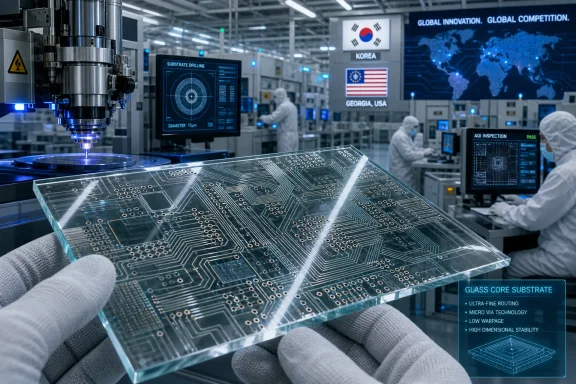
South Korea’s Samsung Electro-Mechanics, LG Innotek and SKC are racing to commercialize glass substrates for AI chip packages, with SKC’s Absolics plant in Georgia positioned as the most aggressive bet while broader industry volume production remains unlikely before 2027 or 2028. The reason this obscure component suddenly matters is that AI hardware is running into limits below the chip, not only inside it. The risk is that investors have started pricing tomorrow’s packaging breakthrough before factories have proved they can make it today.
The first phase of the AI hardware trade was easy to understand: buy the companies that make GPUs, HBM memory, advanced foundry capacity and the networking gear that keeps data centers fed. The second phase is less glamorous but just as important. Once Nvidia-class accelerators became scarce, the market began hunting through the rest of the stack for the next bottleneck.
That is where Korea’s substrate makers entered the story. Samsung Electro-Mechanics and LG Innotek are not the names most consumers associate with artificial intelligence, but they sit close to a chokepoint every AI accelerator must cross. Their products help connect advanced chips to the larger systems that power them, and shortages in high-end package substrates have turned previously sleepy component businesses into market darlings.
Glass substrates are the next extrapolation of that trade. If AI chips keep getting larger, hotter and more densely connected, the platform underneath them has to improve too. The market is betting that the old plastic-resin foundation will eventually give way to engineered glass, a flatter and more dimensionally stable material that promises cleaner signals and denser routing.
The catch is that “eventually” is doing a lot of work. Development samples are not mass production. A pilot line is not a reliable supply chain. And in semiconductor packaging, the distance between a beautiful lab result and a bankable factory can be measured in broken panels, missed yield targets and delayed customer approvals.
AI accelerators have changed the geometry of the problem. Modern high-performance packages are larger, more power-hungry and more dependent on fast communication between multiple dies, memory stacks and supporting components. As packages grow, resin materials are more vulnerable to warpage, signal loss and dimensional instability.
Glass offers a seductive answer. It is flatter, stiffer and better suited to fine-pitch wiring over larger areas. In theory, that allows chipmakers to place more logic, memory and power-delivery structures into a package without suffering the same degree of distortion.
That “in theory” matters. Semiconductor history is full of materials that solved one problem while creating three more. Glass may reduce warpage, but it introduces brittleness. It may allow denser interconnects, but only if manufacturers can drill, plate, stack, cut and inspect it at scale without microscopic cracks destroying yields later in the process.
Taiwan’s position in that world is formidable. TSMC’s advanced packaging ecosystem has become a strategic asset, not an afterthought, because the highest-end AI chips depend on sophisticated integration as much as raw wafer manufacturing. Korea’s memory champions dominate HBM, but the surrounding packaging stack is where national industrial anxiety starts to show.
That is why Korean companies are treating glass substrates as both a commercial opportunity and a strategic wedge. If the next packaging transition is still unsettled, early investment can reshape the supply map. The moment a new substrate material becomes unavoidable, the companies that learned how to make it before everyone else gain pricing power and customer leverage.
But there is a difference between entering a race early and winning it. Intel has spent years promoting glass substrates as a long-term packaging technology. Japanese materials firms, Chinese display and PCB players, and American glass specialists are also circling the opportunity. Korea is not alone; it is trying to turn urgency into manufacturing advantage before the window closes.
That makes SKC fascinating and vulnerable. Samsung Electro-Mechanics and LG Innotek can describe glass as the next chapter in an existing substrate business. If commercialization slips, they still have customers, cash flow and credibility from the current FC-BGA cycle. SKC has made a far more concentrated wager.
Over the past several years, SKC has sold off major businesses and redirected capital toward the glass opportunity. Its shareholder raise this spring, with a large portion reportedly bound for Absolics, only sharpened the point. The company is not merely participating in a technology transition; it is asking investors to believe that the transition will arrive in time to justify a corporate transformation.
That is a bold strategic move, but it also narrows the margin for error. If Absolics proves out mass production ahead of rivals, SKC becomes a key supplier to the next AI packaging wave. If the process remains stubbornly immature, the company risks being remembered as the first mover that arrived before the market was ready.
A glass substrate is not simply a sheet of glass with holes in it. Manufacturers must form extremely fine through-glass vias, metallize them reliably, build routing layers, manage thermal and mechanical stress, and inspect the part without damaging it. Each step has to preserve the integrity of a brittle material that may not reveal fatal defects until much later.
That delayed failure mode is what makes investors’ impatience dangerous. A panel can appear successful early in the line and still crack during later packaging or reliability testing. In a high-volume semiconductor supply chain, “mostly works” is not a business model. Customers need repeatable yields, predictable quality and confidence that failures will not appear after expensive chips are attached.
The problem is compounded by ambition. Absolics is not only chasing a glass replacement for existing substrates. Its flagship vision involves embedding small passive components inside the glass structure, reducing package height and freeing surface area for compute dies. That is the version with the most upside, and naturally it is also the version most likely to slip.
That conservatism is not timidity. It is portfolio logic. Samsung can use its customer relationships, substrate process knowledge and group-level semiconductor proximity to learn what AI chipmakers will actually buy. If the market moves quickly, it can accelerate. If qualification takes longer, it has not mortgaged the whole business on one material.
LG Innotek is taking a similar route, even as its public messaging has sometimes sounded more enthusiastic than its timeline. Management has described glass substrates as a game-changing packaging technology while also pointing toward commercialization later in the decade. That combination reflects the awkward truth of the market: everyone wants to be seen as ready, but nobody wants to overbuild before customers commit.
For IT pros and systems buyers, this matters because the timing of packaging transitions eventually shows up in product availability. If glass substrates mature, they may enable larger, denser and more efficient AI accelerators. If they remain difficult, the industry will keep leaning harder on existing organic substrates, silicon interposers and other packaging workarounds, with cost and supply constraints passed downstream.
The danger for Korean suppliers is not that Chinese firms instantly solve every hard technical problem. It is that China can attack the market with scale, subsidy and iteration. If the technology becomes “good enough” for certain tiers of packaging before it becomes perfect for the highest-end AI accelerators, Chinese suppliers could gain experience and cost advantage from below.
Korea’s advantage is its proximity to high-end semiconductor customers and memory ecosystems. Samsung, SK hynix and the surrounding materials base give Korean suppliers a powerful reference market. But glass substrates will not be won by national branding. They will be won by yield curves, qualification cycles and the ability to deliver consistent panels when demand arrives.
That is why the race is more fragile than the stock charts imply. A supplier can look strategically indispensable while still being commercially premature. In semiconductors, the market often discovers the difference only after the first wave of capital has been spent.
That is not necessarily evidence that the technology is failing. It is evidence that qualification is hard. AI chip customers do not adopt a new package foundation because suppliers need a growth story. They adopt it when the performance benefit outweighs the manufacturing, reliability and supply-chain risks.
The most important phrase in this market is not “pilot line.” It is customer approval. A substrate must survive thermal cycling, mechanical stress, electrical testing and integration into real package flows. It must also fit the customer’s roadmap, not merely the supplier’s capex plan.
This is why industry analysts remain cautious about meaningful volume before around 2028. The technology may be real, but the commercialization curve is still being negotiated between suppliers who want to move fast and customers who cannot afford hidden reliability problems in multi-thousand-dollar AI packages.
If advanced packaging remains constrained, AI accelerators stay expensive and scarce. That affects cloud pricing, enterprise AI adoption timelines, workstation availability and the economics of local inference. When Microsoft, OEMs and silicon vendors talk about AI PCs and AI servers, they are ultimately depending on a supply chain that includes materials as obscure as substrates and capacitors.
The lesson from the past few years is that bottlenecks migrate. One year it is leading-edge foundry capacity. The next it is HBM. Then it is CoWoS-like packaging, high-end substrates, power components or networking optics. AI has made the semiconductor supply chain behave less like a linear pipeline and more like a pressure system: fix one constraint, and stress appears somewhere else.
Glass substrates matter because they are a candidate solution to one of those future stresses. They are not a magic unlock for AI. They are a reminder that software ambition is increasingly limited by physical integration, and physical integration is governed by the unromantic realities of materials engineering.
But the trade has a familiar risk. Investors often compress the distance between “technically promising” and “commercially inevitable.” In semiconductor materials, that distance can be enormous. The harder the process, the more dangerous it is to treat each customer sample or pilot-line milestone as proof of a finished business.
The best argument for glass substrates is structural. AI packages are likely to keep growing in size and complexity, and existing organic substrates face real physical limits. The best argument against near-term euphoria is operational. Someone still has to produce glass substrates at volume, with acceptable yield, cost and reliability, for customers who have alternatives.
That tension is why SKC’s bet is so compelling as a business story. It is either visionary industrial repositioning or a case study in how the AI boom tempts companies to sprint ahead of manufacturability. The answer will not come from conference-stage optimism. It will come from factory data.
 The AI Boom Has Moved Beneath the Silicon
The first phase of the AI hardware trade was easy to understand: buy the companies that make GPUs, HBM memory, advanced foundry capacity and the networking gear that keeps data centers fed. The second phase is less glamorous but just as important. Once Nvidia-class accelerators became scarce, the market began hunting through the rest of the stack for the next bottleneck.That is where Korea’s substrate makers entered the story. Samsung Electro-Mechanics and LG Innotek are not the names most consumers associate with artificial intelligence, but they sit close to a chokepoint every AI accelerator must cross. Their products help connect advanced chips to the larger systems that power them, and shortages in high-end package substrates have turned previously sleepy component businesses into market darlings.
Glass substrates are the next extrapolation of that trade. If AI chips keep getting larger, hotter and more densely connected, the platform underneath them has to improve too. The market is betting that the old plastic-resin foundation will eventually give way to engineered glass, a flatter and more dimensionally stable material that promises cleaner signals and denser routing.
The catch is that “eventually” is doing a lot of work. Development samples are not mass production. A pilot line is not a reliable supply chain. And in semiconductor packaging, the distance between a beautiful lab result and a bankable factory can be measured in broken panels, missed yield targets and delayed customer approvals.
Plastic Was Good Enough Until AI Made It Look Small
A package substrate is not the chip, but it is the floor the chip stands on. It translates the microscopic wiring of advanced silicon into connections that a circuit board can actually use. For years, resin-based substrates did that job well enough, even as processors and memory became more complex.AI accelerators have changed the geometry of the problem. Modern high-performance packages are larger, more power-hungry and more dependent on fast communication between multiple dies, memory stacks and supporting components. As packages grow, resin materials are more vulnerable to warpage, signal loss and dimensional instability.
Glass offers a seductive answer. It is flatter, stiffer and better suited to fine-pitch wiring over larger areas. In theory, that allows chipmakers to place more logic, memory and power-delivery structures into a package without suffering the same degree of distortion.
That “in theory” matters. Semiconductor history is full of materials that solved one problem while creating three more. Glass may reduce warpage, but it introduces brittleness. It may allow denser interconnects, but only if manufacturers can drill, plate, stack, cut and inspect it at scale without microscopic cracks destroying yields later in the process.
Korea’s Packaging Ambition Is a Response to Taiwan’s Advantage
Korea’s interest in glass substrates is not happening in isolation. It is part of a broader recognition that the AI chip race is no longer just about who fabricates transistors. Advanced packaging has become the arena where performance, power delivery and memory bandwidth are increasingly decided.Taiwan’s position in that world is formidable. TSMC’s advanced packaging ecosystem has become a strategic asset, not an afterthought, because the highest-end AI chips depend on sophisticated integration as much as raw wafer manufacturing. Korea’s memory champions dominate HBM, but the surrounding packaging stack is where national industrial anxiety starts to show.
That is why Korean companies are treating glass substrates as both a commercial opportunity and a strategic wedge. If the next packaging transition is still unsettled, early investment can reshape the supply map. The moment a new substrate material becomes unavoidable, the companies that learned how to make it before everyone else gain pricing power and customer leverage.
But there is a difference between entering a race early and winning it. Intel has spent years promoting glass substrates as a long-term packaging technology. Japanese materials firms, Chinese display and PCB players, and American glass specialists are also circling the opportunity. Korea is not alone; it is trying to turn urgency into manufacturing advantage before the window closes.
SKC Has Turned a Component Bet Into a Corporate Identity
The most dramatic Korean player is not Samsung or LG. It is SKC, a company that has effectively rewritten its own story around glass substrates. Through Absolics, its US subsidiary, SKC built a factory in Covington, Georgia, designed to commercialize a technology much of the industry still treats as exploratory.That makes SKC fascinating and vulnerable. Samsung Electro-Mechanics and LG Innotek can describe glass as the next chapter in an existing substrate business. If commercialization slips, they still have customers, cash flow and credibility from the current FC-BGA cycle. SKC has made a far more concentrated wager.
Over the past several years, SKC has sold off major businesses and redirected capital toward the glass opportunity. Its shareholder raise this spring, with a large portion reportedly bound for Absolics, only sharpened the point. The company is not merely participating in a technology transition; it is asking investors to believe that the transition will arrive in time to justify a corporate transformation.
That is a bold strategic move, but it also narrows the margin for error. If Absolics proves out mass production ahead of rivals, SKC becomes a key supplier to the next AI packaging wave. If the process remains stubbornly immature, the company risks being remembered as the first mover that arrived before the market was ready.
The Factory Is Where the Story Gets Less Magical
The appeal of glass substrates is easy to explain in a slide deck. The production flow is not. Analysts who have toured or studied Absolics’ line describe a hybrid process that borrows from substrate manufacturing, display production and semiconductor techniques. That industrial mash-up is precisely why the technology is hard to scale.A glass substrate is not simply a sheet of glass with holes in it. Manufacturers must form extremely fine through-glass vias, metallize them reliably, build routing layers, manage thermal and mechanical stress, and inspect the part without damaging it. Each step has to preserve the integrity of a brittle material that may not reveal fatal defects until much later.
That delayed failure mode is what makes investors’ impatience dangerous. A panel can appear successful early in the line and still crack during later packaging or reliability testing. In a high-volume semiconductor supply chain, “mostly works” is not a business model. Customers need repeatable yields, predictable quality and confidence that failures will not appear after expensive chips are attached.
The problem is compounded by ambition. Absolics is not only chasing a glass replacement for existing substrates. Its flagship vision involves embedding small passive components inside the glass structure, reducing package height and freeing surface area for compute dies. That is the version with the most upside, and naturally it is also the version most likely to slip.
Samsung and LG Are Playing the Optionality Game
Samsung Electro-Mechanics has approached glass with the posture of a company that knows it already has a seat at the table. Its existing strength in package substrates and multilayer ceramic capacitors gives it leverage in the current AI cycle. The Sumitomo Chemical glass-core venture adds a credible path into next-generation materials without forcing Samsung to declare that the old world is over.That conservatism is not timidity. It is portfolio logic. Samsung can use its customer relationships, substrate process knowledge and group-level semiconductor proximity to learn what AI chipmakers will actually buy. If the market moves quickly, it can accelerate. If qualification takes longer, it has not mortgaged the whole business on one material.
LG Innotek is taking a similar route, even as its public messaging has sometimes sounded more enthusiastic than its timeline. Management has described glass substrates as a game-changing packaging technology while also pointing toward commercialization later in the decade. That combination reflects the awkward truth of the market: everyone wants to be seen as ready, but nobody wants to overbuild before customers commit.
For IT pros and systems buyers, this matters because the timing of packaging transitions eventually shows up in product availability. If glass substrates mature, they may enable larger, denser and more efficient AI accelerators. If they remain difficult, the industry will keep leaning harder on existing organic substrates, silicon interposers and other packaging workarounds, with cost and supply constraints passed downstream.
China’s Entry Turns a Technical Race Into a Supply-Chain Race
China’s push into glass substrates adds another layer to the story. Companies with display and PCB expertise are reportedly moving into pilot lines and related process development. That makes sense: glass handling is already central to display manufacturing, and PCB makers understand large-area panel processes.The danger for Korean suppliers is not that Chinese firms instantly solve every hard technical problem. It is that China can attack the market with scale, subsidy and iteration. If the technology becomes “good enough” for certain tiers of packaging before it becomes perfect for the highest-end AI accelerators, Chinese suppliers could gain experience and cost advantage from below.
Korea’s advantage is its proximity to high-end semiconductor customers and memory ecosystems. Samsung, SK hynix and the surrounding materials base give Korean suppliers a powerful reference market. But glass substrates will not be won by national branding. They will be won by yield curves, qualification cycles and the ability to deliver consistent panels when demand arrives.
That is why the race is more fragile than the stock charts imply. A supplier can look strategically indispensable while still being commercially premature. In semiconductors, the market often discovers the difference only after the first wave of capital has been spent.
The Timeline Keeps Slipping Because Customers Are the Real Gatekeepers
The public timeline for glass substrates has been remarkably elastic. SKC’s commercial output expectations have moved from 2024 to 2025 and then toward customer approval in 2026. Samsung’s volume ambitions are generally framed around the post-2027 period. LG Innotek has pointed toward 2028, while some reports suggest demand uncertainty could push broader commercialization later.That is not necessarily evidence that the technology is failing. It is evidence that qualification is hard. AI chip customers do not adopt a new package foundation because suppliers need a growth story. They adopt it when the performance benefit outweighs the manufacturing, reliability and supply-chain risks.
The most important phrase in this market is not “pilot line.” It is customer approval. A substrate must survive thermal cycling, mechanical stress, electrical testing and integration into real package flows. It must also fit the customer’s roadmap, not merely the supplier’s capex plan.
This is why industry analysts remain cautious about meaningful volume before around 2028. The technology may be real, but the commercialization curve is still being negotiated between suppliers who want to move fast and customers who cannot afford hidden reliability problems in multi-thousand-dollar AI packages.
For WindowsForum Readers, This Is the Hardware Story Behind the AI Software Story
At first glance, glass substrates may seem remote from the world of Windows PCs, servers and enterprise administration. They are buried inside semiconductor packages that most users will never see. But the AI infrastructure wave is already shaping the hardware market that Windows professionals buy, deploy and support.If advanced packaging remains constrained, AI accelerators stay expensive and scarce. That affects cloud pricing, enterprise AI adoption timelines, workstation availability and the economics of local inference. When Microsoft, OEMs and silicon vendors talk about AI PCs and AI servers, they are ultimately depending on a supply chain that includes materials as obscure as substrates and capacitors.
The lesson from the past few years is that bottlenecks migrate. One year it is leading-edge foundry capacity. The next it is HBM. Then it is CoWoS-like packaging, high-end substrates, power components or networking optics. AI has made the semiconductor supply chain behave less like a linear pipeline and more like a pressure system: fix one constraint, and stress appears somewhere else.
Glass substrates matter because they are a candidate solution to one of those future stresses. They are not a magic unlock for AI. They are a reminder that software ambition is increasingly limited by physical integration, and physical integration is governed by the unromantic realities of materials engineering.
Investors Are Pricing a Breakthrough Before the Yield Curve Has Spoken
The equity-market excitement around Korean AI parts suppliers is understandable. Samsung Electro-Mechanics and LG Innotek benefited from substrate shortages and pricing power. SKC offers a more dramatic story: a transformed company tied to a potentially foundational technology. In a market hungry for the next AI derivative, that is a powerful pitch.But the trade has a familiar risk. Investors often compress the distance between “technically promising” and “commercially inevitable.” In semiconductor materials, that distance can be enormous. The harder the process, the more dangerous it is to treat each customer sample or pilot-line milestone as proof of a finished business.
The best argument for glass substrates is structural. AI packages are likely to keep growing in size and complexity, and existing organic substrates face real physical limits. The best argument against near-term euphoria is operational. Someone still has to produce glass substrates at volume, with acceptable yield, cost and reliability, for customers who have alternatives.
That tension is why SKC’s bet is so compelling as a business story. It is either visionary industrial repositioning or a case study in how the AI boom tempts companies to sprint ahead of manufacturability. The answer will not come from conference-stage optimism. It will come from factory data.
The Glass Trade Has a Few Hard Truths
The glass substrate race is best understood as a manufacturing contest disguised as an AI theme. The upside is real, but so are the reasons timelines keep moving. For now, the most useful way to read the market is to separate credible progress from premature victory laps.- Glass substrates promise flatter, denser and more stable foundations for future AI chip packages, but they remain difficult to manufacture reliably at scale.
- SKC’s Absolics has made the most concentrated corporate bet, while Samsung Electro-Mechanics and LG Innotek can treat glass as an extension of existing substrate businesses.
- Meaningful industry volume is more likely a late-decade story than a 2026 revenue inflection, unless customer qualification and yield improvement accelerate sharply.
- China’s entry through display and PCB-adjacent manufacturing could pressure Korean suppliers if the market develops in tiers rather than through one premium AI application.
- Windows users and IT buyers will feel this indirectly through AI hardware pricing, cloud capacity, workstation availability and the pace at which advanced accelerators become mainstream.
References
- Primary source: The Korea Herald
Published: Sun, 14 Jun 2026 01:59:27 GMT
- Related coverage: prnewswire.com
Samsung Electro-Mechanics Signs MOU with Sumitomo Chemical Group to Establish a Joint Venture for 'Glass Core' Used in Package Substrates
/PRNewswire/ -- Samsung Electro-Mechanics announced on the 5th that it has signed a memorandum of understanding (MOU) with Sumitomo Chemical Group to establish... www.prnewswire.com
- Related coverage: trendforce.com
[News] Korea Challenges Intel on Glass Substrate Standards as Absolics, Samsung Accelerate Commercialization
Commercialization of glass substrates is accelerating, with South Korean players and Intel increasingly competing head-on for leadership. According to...www.trendforce.com - Related coverage: ibselectronics.in
