

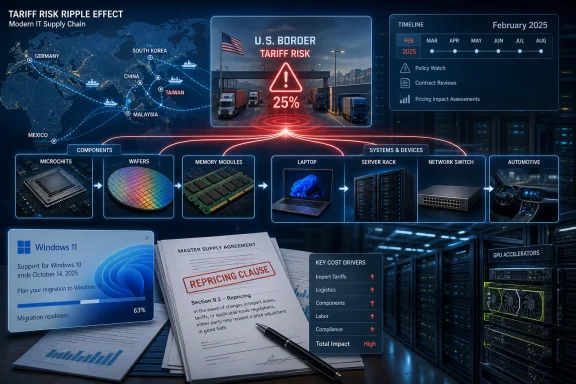
President Trump’s proposed semiconductor tariffs began as a February 2025 threat to impose duties of roughly 25 percent on imported chips, but the larger impact was immediate: they turned supply-chain planning for electronics, PCs, servers, cars, industrial gear, and data-center hardware into a tariff-risk exercise months before any broad chip levy arrived.
That is the real story. A semiconductor tariff is not a neat border tax on a discrete product; it is a tax on the nervous system of the modern economy. For Windows users and IT buyers, the question was never simply whether a chip made in Taiwan, South Korea, China, Malaysia, Mexico, or Germany would cost more. It was whether every device that depends on chips would become harder to price, harder to source, and harder to refresh on schedule.
The administration’s early-2025 trade calendar moved with deliberate velocity. On February 1, it announced tariffs on China, Canada, and Mexico. Within days, the Canada and Mexico measures were delayed, the China tariff took effect, and steel and aluminum duties were put on the calendar for March.
That rhythm mattered. Semiconductor firms, device makers, distributors, and enterprise procurement teams do not wait for a Federal Register notice before reacting. They model exposure, renegotiate delivery dates, pull forward orders, and start asking suppliers where every meaningful component crosses a border.
By February 18, when Trump said semiconductor imports could face tariffs “in the neighborhood of 25 percent,” chips were folded into a broader industrial-nationalist agenda that also targeted autos and pharmaceuticals. The statement did not provide a clean product list, exemption framework, or country-by-country structure. That ambiguity was not a side effect; it was part of the pressure mechanism.
For companies that live on long lead times, uncertainty can be nearly as expensive as policy. A server OEM deciding where to place motherboard assembly, a systems integrator quoting a fleet refresh, or a cloud provider planning accelerator procurement cannot treat “maybe 25 percent, maybe higher” as background noise. It becomes a pricing variable.
A chip may be designed in California, fabricated in Taiwan, packaged in Malaysia, tested in Singapore, placed on a board in Mexico, and shipped inside a laptop assembled in China or Vietnam. A tariff on “semiconductors” therefore raises immediate questions that sound technical but have enormous commercial consequences. Does the duty apply to bare integrated circuits, finished electronics, semiconductor manufacturing equipment, wafers, chiplets, advanced packages, or downstream products containing chips?
That distinction is everything. A narrow tariff on imported discrete chips hits component importers and some manufacturers directly. A broad tariff on derivative products can reach laptops, servers, smartphones, routers, cars, medical equipment, factory controllers, gaming consoles, and almost every device WindowsForum readers care about.
The administration later moved toward the national-security machinery of Section 232 investigations, a process that gives the government a framework for examining whether imports threaten national security. That path made the policy more formal, but not necessarily more predictable for buyers. Section 232 can produce tariffs, quotas, negotiated arrangements, exemptions, or a mix of all of them.
Tariffs operate on a different clock. They can be announced in weeks and priced into contracts overnight. That mismatch is the central weakness of the proposal: a tariff can raise the cost of imports long before domestic alternatives exist at scale.
For leading-edge logic, the United States remains deeply dependent on overseas production. For memory, packaging, passive components, specialty chips, power management, and embedded controllers, the supply map is even more fragmented. A tariff can tell companies to buy American; it cannot instantly create enough American supply to meet demand.
This is where the politics and the physics diverge. The political message says tariffs will force production home. The manufacturing reality says that unless the tariff is carefully staged and paired with capacity that actually exists, it mainly raises costs for firms that still have to buy from the global market.
The honest answer is messier. Tariffs rarely pass through in a clean one-to-one line from duty rate to retail price. Vendors absorb some costs, suppliers eat some margin, distributors adjust incentives, and retailers play timing games with inventory. But the pressure shows up somewhere.
In the PC market, the first signs would likely be less dramatic than a sudden across-the-board price shock. Promotions would get worse. Entry-level configurations would quietly lose RAM, storage, display quality, or bundled accessories. Business SKUs would be quoted with shorter validity windows. Replacement parts would become more expensive, and vendors would lean harder on “while supplies last” inventory positioning.
That is especially relevant for Windows users because the PC market is already in a forced transition. Windows 10 support ends in October 2025 for most mainstream users, pushing households, schools, small businesses, and enterprises toward hardware refresh decisions. A chip tariff inserted into that cycle does not merely tax electronics; it complicates one of the largest Windows migration waves in years.
A tariff threat turns every quote into a perishable document. Procurement teams begin asking whether a vendor’s price is tariff-inclusive, whether orders shipped after a certain date will be repriced, whether backordered units are protected, and whether substitutions will be permitted. Legal teams scrutinize force majeure and change-in-law clauses that few people cared about when trade policy was quiet.
Large enterprises can sometimes blunt the impact by forward-buying inventory, negotiating with multiple OEMs, or shifting delivery schedules. Smaller organizations usually cannot. They buy when budgets open, when machines fail, or when compliance deadlines arrive.
That asymmetry is one of the least discussed effects of tariff policy. The companies with the most sophisticated procurement operations often manage around the shock. The businesses with the least leverage pay closer to the full cost.
A broad semiconductor tariff would collide with a market already strained by accelerator demand. Hyperscalers, cloud providers, universities, startups, government labs, and enterprise AI teams are competing for many of the same parts. Add tariff risk, and capacity planning becomes a geopolitical spreadsheet.
The effect would not stop at companies buying Nvidia, AMD, Intel, or custom silicon. It would filter into cloud pricing, reserved-instance planning, managed AI service margins, and the availability of specialized compute. If providers cannot fully absorb higher hardware costs, they eventually pass some of that pressure into service pricing or capacity constraints.
For WindowsForum’s audience, this is not an abstract Wall Street story. Windows Server estates, Azure migrations, private-cloud builds, virtualization refreshes, backup appliances, endpoint management infrastructure, and security analytics platforms all depend on hardware economics. When chips get more expensive or harder to source, IT architecture bends around the cost.
But a semiconductor tariff that is too broad can end up hitting allies and partners as much as adversaries. Taiwan, South Korea, Japan, the Netherlands, Germany, Malaysia, Singapore, Mexico, Canada, and the European Union all play important roles in the semiconductor or electronics supply chain. A tariff that fails to distinguish between strategic risk and ordinary allied production can weaken the very network the United States needs.
That is the uncomfortable policy trade-off. Washington wants more domestic capability, but it also depends on allied capacity to reduce reliance on China. Penalizing imported chips from allies before domestic alternatives are ready may create leverage in negotiations, but it can also create resentment, retaliation, and investment hesitation.
Retaliation matters because technology supply chains are reciprocal. U.S. companies export semiconductor equipment, design tools, IP, components, and finished systems. If other governments respond with their own restrictions or incentives against U.S. firms, the cost of the original tariff spreads beyond the import ledger.
The auto sector is the clearest example. Cars are now rolling networks of microcontrollers, sensors, power electronics, memory, connectivity modules, and compute platforms. A tariff on chips could layer on top of tariffs on autos, steel, aluminum, or country-specific imports, creating a stack of trade costs inside one final product.
Industrial equipment faces the same problem in quieter form. A programmable logic controller, an industrial PC, a robotic arm, or a smart meter may contain relatively inexpensive chips, but the availability of those parts determines whether the finished product ships. Tariff friction at the component level can delay high-value goods far downstream.
That is why the “25 percent on semiconductors” framing undersells the stakes. The tariff may be assessed at a border line, but the disruption travels through production lines, maintenance contracts, spare-parts inventories, and capital expenditure plans.
But a strong security argument does not automatically validate a broad tariff. Security policy works best when it distinguishes between critical dependencies, commodity flows, trusted partners, adversarial leverage, and domestic bottlenecks. A tariff that treats too many of those categories alike can become a blunt instrument where a scalpel is needed.
The smarter version of the policy would target specific vulnerabilities: advanced AI accelerators, defense-relevant chips, supply chains tied to sanctioned entities, single-source components, and areas where domestic production can realistically scale. The riskier version taxes everything because everything contains silicon.
This is where implementation becomes ideology’s stress test. A tariff designed to trigger negotiation may be defensible as leverage. A tariff designed as a permanent substitute for industrial capacity is less convincing.
That drift is politically harder to measure but economically meaningful. It punishes users at the edge of affordability first: students, families, gamers on tight budgets, independent repair shops, nonprofits, and small businesses trying to stretch old hardware through one more budget cycle.
The timing around Windows 10’s end of support made that drift more sensitive. Many perfectly functional older PCs do not officially meet Windows 11 requirements, especially because of TPM, CPU generation, and security baseline rules. If tariff pressure made new Windows 11-capable systems more expensive, Microsoft’s platform transition became more painful for the very users least able to absorb it.
There is an irony here. A tariff meant to strengthen America’s technology base could, if mishandled, slow the adoption of newer, more secure hardware. That would be a strange outcome for a policy often justified in the language of national resilience.
Companies can shift final assembly, change customs classifications, alter sourcing, move inventory through different jurisdictions, redesign boards around alternative components, or renegotiate supplier terms. None of those steps necessarily creates a U.S. fab job. Some merely move complexity around the map.
That does not mean tariffs have no effect. They can accelerate investment, especially when combined with subsidies and procurement guarantees. But semiconductor manufacturing is capital-intensive enough that executives do not build fabs solely because of one tariff threat. They look for durable demand, stable regulation, skilled labor, energy availability, water access, equipment supply, and predictable policy.
Policy whiplash undermines that predictability. If tariffs are announced, delayed, exempted, narrowed, broadened, litigated, and renegotiated in rapid succession, companies hedge rather than commit. The result can be less investment discipline, not more.
Those costs are invisible in campaign rhetoric but visible in corporate behavior. A hardware vendor that once optimized for efficiency now pays for redundancy. A distributor that once stocked leanly now holds buffer inventory. An enterprise buyer that once standardized on one device family now keeps alternatives warm in case supply shifts.
Some of that resilience is healthy. The pandemic proved that ultra-lean global supply chains were brittle. But resilience built through panic and tariff ambiguity is more expensive than resilience built through deliberate planning.
In semiconductors, optionality is particularly precious because substitution is hard. You cannot always swap one chip for another without board redesign, firmware changes, validation, certification, and software testing. That is why even a small component can stall a large product.
OEMs such as Dell, HP, Lenovo, Acer, Asus, Microsoft’s Surface group, and countless white-box vendors depend on intricate global component flows. So do the firms that make motherboards, SSDs, DRAM modules, Wi-Fi adapters, docks, monitors, and peripherals. A semiconductor tariff that reaches downstream electronics would ripple through the entire PC bill of materials.
Enterprise administrators would then be forced into trade-offs that have nothing to do with IT strategy. Do they refresh before tariffs hit, potentially buying too early? Do they wait and risk higher prices? Do they extend Windows 10 systems with paid support? Do they accept mixed fleets that complicate management?
Security teams would not be spared. Hardware refreshes are often tied to encryption standards, firmware protections, virtualization-based security, identity hardware, and endpoint detection performance. If tariffs slow refreshes, they can indirectly prolong risk.
That behavior can create a self-fulfilling squeeze. If everyone rushes to import before a tariff deadline, logistics costs rise and inventory becomes uneven. If everyone pauses orders waiting for clarity, factories face demand distortion. Either way, the supply chain becomes less stable.
The administration may view that instability as useful leverage. Trading partners and corporations are more likely to negotiate when uncertainty is expensive. But leverage is not free. Domestic buyers pay some of the carrying cost while the negotiation plays out.
This is the central political gamble of semiconductor tariffs. The administration wants to impose pain on foreign producers and governments. In a deeply integrated supply chain, the pain does not respect borders.
The most constructive version would be phased, targeted, and integrated with domestic capacity milestones. It would protect genuinely strategic segments without punishing allied supply chains indiscriminately. It would give companies predictable rules, transparent exclusions, and enough time to adjust without hoarding or panic-buying.
The most disruptive version would stack duties across chips, electronics, steel, aluminum, autos, and country-of-origin categories while leaving derivative-product definitions vague. That would invite litigation, compliance confusion, and quiet price increases across the hardware economy.
The difference between those versions is not academic. It is the difference between a policy that pressures supply chains to become more resilient and one that simply makes technology more expensive.
If the administration wants tariffs to become more than a headline weapon, it will have to prove that they can accelerate domestic capacity without taxing the transition so heavily that users delay the very modernization the country needs. The United States can make a serious case for rebuilding semiconductor strength, but in 2026 that case will be judged less by the toughness of the tariff threat than by whether the next generation of PCs, servers, and secure infrastructure becomes easier to buy, not harder.
That is the real story. A semiconductor tariff is not a neat border tax on a discrete product; it is a tax on the nervous system of the modern economy. For Windows users and IT buyers, the question was never simply whether a chip made in Taiwan, South Korea, China, Malaysia, Mexico, or Germany would cost more. It was whether every device that depends on chips would become harder to price, harder to source, and harder to refresh on schedule.
 The Tariff Threat Landed Before the Tariff Did
The administration’s early-2025 trade calendar moved with deliberate velocity. On February 1, it announced tariffs on China, Canada, and Mexico. Within days, the Canada and Mexico measures were delayed, the China tariff took effect, and steel and aluminum duties were put on the calendar for March.That rhythm mattered. Semiconductor firms, device makers, distributors, and enterprise procurement teams do not wait for a Federal Register notice before reacting. They model exposure, renegotiate delivery dates, pull forward orders, and start asking suppliers where every meaningful component crosses a border.
By February 18, when Trump said semiconductor imports could face tariffs “in the neighborhood of 25 percent,” chips were folded into a broader industrial-nationalist agenda that also targeted autos and pharmaceuticals. The statement did not provide a clean product list, exemption framework, or country-by-country structure. That ambiguity was not a side effect; it was part of the pressure mechanism.
For companies that live on long lead times, uncertainty can be nearly as expensive as policy. A server OEM deciding where to place motherboard assembly, a systems integrator quoting a fleet refresh, or a cloud provider planning accelerator procurement cannot treat “maybe 25 percent, maybe higher” as background noise. It becomes a pricing variable.
Semiconductors Are a Bad Place to Draw a Simple Border
The political appeal of a semiconductor tariff is obvious. Chips are strategic, the United States wants more domestic manufacturing, and the pandemic-era shortages exposed just how fragile global electronics supply chains can be. The problem is that semiconductors are among the least tariff-friendly products in the world.A chip may be designed in California, fabricated in Taiwan, packaged in Malaysia, tested in Singapore, placed on a board in Mexico, and shipped inside a laptop assembled in China or Vietnam. A tariff on “semiconductors” therefore raises immediate questions that sound technical but have enormous commercial consequences. Does the duty apply to bare integrated circuits, finished electronics, semiconductor manufacturing equipment, wafers, chiplets, advanced packages, or downstream products containing chips?
That distinction is everything. A narrow tariff on imported discrete chips hits component importers and some manufacturers directly. A broad tariff on derivative products can reach laptops, servers, smartphones, routers, cars, medical equipment, factory controllers, gaming consoles, and almost every device WindowsForum readers care about.
The administration later moved toward the national-security machinery of Section 232 investigations, a process that gives the government a framework for examining whether imports threaten national security. That path made the policy more formal, but not necessarily more predictable for buyers. Section 232 can produce tariffs, quotas, negotiated arrangements, exemptions, or a mix of all of them.
The CHIPS Act Built a Carrot; Tariffs Bring the Stick
The United States has already chosen one path for reshoring semiconductor capacity: subsidies, tax credits, and industrial coordination through the CHIPS and Science Act. That approach was slow, expensive, and bureaucratic, but it at least acknowledged the basic reality of chipmaking. Fabs take years to build, billions to equip, and entire ecosystems to staff.Tariffs operate on a different clock. They can be announced in weeks and priced into contracts overnight. That mismatch is the central weakness of the proposal: a tariff can raise the cost of imports long before domestic alternatives exist at scale.
For leading-edge logic, the United States remains deeply dependent on overseas production. For memory, packaging, passive components, specialty chips, power management, and embedded controllers, the supply map is even more fragmented. A tariff can tell companies to buy American; it cannot instantly create enough American supply to meet demand.
This is where the politics and the physics diverge. The political message says tariffs will force production home. The manufacturing reality says that unless the tariff is carefully staged and paired with capacity that actually exists, it mainly raises costs for firms that still have to buy from the global market.
The PC Market Would Feel It in the Boring Places First
For consumers, the instinct is to look at sticker prices. Would a laptop cost 25 percent more? Would a desktop GPU spike overnight? Would mini PCs, gaming rigs, and business notebooks jump by hundreds of dollars?The honest answer is messier. Tariffs rarely pass through in a clean one-to-one line from duty rate to retail price. Vendors absorb some costs, suppliers eat some margin, distributors adjust incentives, and retailers play timing games with inventory. But the pressure shows up somewhere.
In the PC market, the first signs would likely be less dramatic than a sudden across-the-board price shock. Promotions would get worse. Entry-level configurations would quietly lose RAM, storage, display quality, or bundled accessories. Business SKUs would be quoted with shorter validity windows. Replacement parts would become more expensive, and vendors would lean harder on “while supplies last” inventory positioning.
That is especially relevant for Windows users because the PC market is already in a forced transition. Windows 10 support ends in October 2025 for most mainstream users, pushing households, schools, small businesses, and enterprises toward hardware refresh decisions. A chip tariff inserted into that cycle does not merely tax electronics; it complicates one of the largest Windows migration waves in years.
Enterprise IT Hates Nothing More Than a Moving Cost Basis
For IT departments, the tariff problem is not just price. It is timing. Corporate refresh cycles, data-center upgrades, endpoint standardization, and network modernization are budgeted months or years in advance.A tariff threat turns every quote into a perishable document. Procurement teams begin asking whether a vendor’s price is tariff-inclusive, whether orders shipped after a certain date will be repriced, whether backordered units are protected, and whether substitutions will be permitted. Legal teams scrutinize force majeure and change-in-law clauses that few people cared about when trade policy was quiet.
Large enterprises can sometimes blunt the impact by forward-buying inventory, negotiating with multiple OEMs, or shifting delivery schedules. Smaller organizations usually cannot. They buy when budgets open, when machines fail, or when compliance deadlines arrive.
That asymmetry is one of the least discussed effects of tariff policy. The companies with the most sophisticated procurement operations often manage around the shock. The businesses with the least leverage pay closer to the full cost.
Data Centers Sit at the Center of the Blast Radius
The tariff debate becomes even more consequential in data centers. AI servers, GPU clusters, networking switches, SSDs, power systems, and high-speed interconnects are dense bundles of imported semiconductor value. Even when final assembly happens in the United States or Mexico, the bill of materials is global.A broad semiconductor tariff would collide with a market already strained by accelerator demand. Hyperscalers, cloud providers, universities, startups, government labs, and enterprise AI teams are competing for many of the same parts. Add tariff risk, and capacity planning becomes a geopolitical spreadsheet.
The effect would not stop at companies buying Nvidia, AMD, Intel, or custom silicon. It would filter into cloud pricing, reserved-instance planning, managed AI service margins, and the availability of specialized compute. If providers cannot fully absorb higher hardware costs, they eventually pass some of that pressure into service pricing or capacity constraints.
For WindowsForum’s audience, this is not an abstract Wall Street story. Windows Server estates, Azure migrations, private-cloud builds, virtualization refreshes, backup appliances, endpoint management infrastructure, and security analytics platforms all depend on hardware economics. When chips get more expensive or harder to source, IT architecture bends around the cost.
China Is the Obvious Target, but Not the Only Problem
The administration’s tariff sequence began with China, and semiconductors inevitably sit inside the U.S.-China technology contest. Export controls, advanced-node restrictions, AI accelerator policy, and China’s own industrial subsidies have already made chips a central front in strategic competition.But a semiconductor tariff that is too broad can end up hitting allies and partners as much as adversaries. Taiwan, South Korea, Japan, the Netherlands, Germany, Malaysia, Singapore, Mexico, Canada, and the European Union all play important roles in the semiconductor or electronics supply chain. A tariff that fails to distinguish between strategic risk and ordinary allied production can weaken the very network the United States needs.
That is the uncomfortable policy trade-off. Washington wants more domestic capability, but it also depends on allied capacity to reduce reliance on China. Penalizing imported chips from allies before domestic alternatives are ready may create leverage in negotiations, but it can also create resentment, retaliation, and investment hesitation.
Retaliation matters because technology supply chains are reciprocal. U.S. companies export semiconductor equipment, design tools, IP, components, and finished systems. If other governments respond with their own restrictions or incentives against U.S. firms, the cost of the original tariff spreads beyond the import ledger.
The Auto and Industrial Sectors Show Why Chips Cannot Be Isolated
Semiconductors are not just a tech-sector input. They are everywhere in modern vehicles, appliances, medical devices, power systems, telecommunications equipment, and factory automation. That makes a chip tariff a manufacturing tariff by another name.The auto sector is the clearest example. Cars are now rolling networks of microcontrollers, sensors, power electronics, memory, connectivity modules, and compute platforms. A tariff on chips could layer on top of tariffs on autos, steel, aluminum, or country-specific imports, creating a stack of trade costs inside one final product.
Industrial equipment faces the same problem in quieter form. A programmable logic controller, an industrial PC, a robotic arm, or a smart meter may contain relatively inexpensive chips, but the availability of those parts determines whether the finished product ships. Tariff friction at the component level can delay high-value goods far downstream.
That is why the “25 percent on semiconductors” framing undersells the stakes. The tariff may be assessed at a border line, but the disruption travels through production lines, maintenance contracts, spare-parts inventories, and capital expenditure plans.
The Security Argument Is Stronger Than the Tariff Design
The national-security case for semiconductor resilience is real. No serious observer thinks the United States should be indifferent to where advanced logic, memory, packaging, and chipmaking equipment are produced. The concentration of leading-edge fabrication in Taiwan alone would justify a national strategy.But a strong security argument does not automatically validate a broad tariff. Security policy works best when it distinguishes between critical dependencies, commodity flows, trusted partners, adversarial leverage, and domestic bottlenecks. A tariff that treats too many of those categories alike can become a blunt instrument where a scalpel is needed.
The smarter version of the policy would target specific vulnerabilities: advanced AI accelerators, defense-relevant chips, supply chains tied to sanctioned entities, single-source components, and areas where domestic production can realistically scale. The riskier version taxes everything because everything contains silicon.
This is where implementation becomes ideology’s stress test. A tariff designed to trigger negotiation may be defensible as leverage. A tariff designed as a permanent substitute for industrial capacity is less convincing.
Consumers Will Notice the Drift, Not Just the Shock
Households rarely experience tariff policy as a line item. They experience it as a market mood. A laptop that used to go on sale for $699 now bottoms out at $779. A GPU stays stubbornly above MSRP. A repair part takes three weeks. A small business delays replacing five aging desktops because the quote changed twice.That drift is politically harder to measure but economically meaningful. It punishes users at the edge of affordability first: students, families, gamers on tight budgets, independent repair shops, nonprofits, and small businesses trying to stretch old hardware through one more budget cycle.
The timing around Windows 10’s end of support made that drift more sensitive. Many perfectly functional older PCs do not officially meet Windows 11 requirements, especially because of TPM, CPU generation, and security baseline rules. If tariff pressure made new Windows 11-capable systems more expensive, Microsoft’s platform transition became more painful for the very users least able to absorb it.
There is an irony here. A tariff meant to strengthen America’s technology base could, if mishandled, slow the adoption of newer, more secure hardware. That would be a strange outcome for a policy often justified in the language of national resilience.
Vendors Will Re-Route Before They Rebuild
One assumption behind tariffs is that companies will respond by moving production to the United States. Some will, especially where subsidies, government contracts, or strategic importance make the math work. But the faster response is usually not reshoring. It is rerouting.Companies can shift final assembly, change customs classifications, alter sourcing, move inventory through different jurisdictions, redesign boards around alternative components, or renegotiate supplier terms. None of those steps necessarily creates a U.S. fab job. Some merely move complexity around the map.
That does not mean tariffs have no effect. They can accelerate investment, especially when combined with subsidies and procurement guarantees. But semiconductor manufacturing is capital-intensive enough that executives do not build fabs solely because of one tariff threat. They look for durable demand, stable regulation, skilled labor, energy availability, water access, equipment supply, and predictable policy.
Policy whiplash undermines that predictability. If tariffs are announced, delayed, exempted, narrowed, broadened, litigated, and renegotiated in rapid succession, companies hedge rather than commit. The result can be less investment discipline, not more.
The Real Cost Is Optionality
The most important economic effect of the proposed tariffs may be the loss of optionality. When trade policy becomes volatile, companies pay to preserve choices. They carry more inventory, qualify more suppliers, duplicate compliance work, and shorten planning horizons.Those costs are invisible in campaign rhetoric but visible in corporate behavior. A hardware vendor that once optimized for efficiency now pays for redundancy. A distributor that once stocked leanly now holds buffer inventory. An enterprise buyer that once standardized on one device family now keeps alternatives warm in case supply shifts.
Some of that resilience is healthy. The pandemic proved that ultra-lean global supply chains were brittle. But resilience built through panic and tariff ambiguity is more expensive than resilience built through deliberate planning.
In semiconductors, optionality is particularly precious because substitution is hard. You cannot always swap one chip for another without board redesign, firmware changes, validation, certification, and software testing. That is why even a small component can stall a large product.
Windows Hardware Sits in the Middle of the Policy Collision
The Windows ecosystem is uniquely exposed because it spans consumer devices, enterprise endpoints, servers, embedded systems, gaming rigs, and industrial PCs. Apple controls a tighter hardware stack. Cloud-native startups can sometimes avoid endpoint complexity. Windows lives everywhere tariffs would land.OEMs such as Dell, HP, Lenovo, Acer, Asus, Microsoft’s Surface group, and countless white-box vendors depend on intricate global component flows. So do the firms that make motherboards, SSDs, DRAM modules, Wi-Fi adapters, docks, monitors, and peripherals. A semiconductor tariff that reaches downstream electronics would ripple through the entire PC bill of materials.
Enterprise administrators would then be forced into trade-offs that have nothing to do with IT strategy. Do they refresh before tariffs hit, potentially buying too early? Do they wait and risk higher prices? Do they extend Windows 10 systems with paid support? Do they accept mixed fleets that complicate management?
Security teams would not be spared. Hardware refreshes are often tied to encryption standards, firmware protections, virtualization-based security, identity hardware, and endpoint detection performance. If tariffs slow refreshes, they can indirectly prolong risk.
The Market Already Knows How to Price Fear
Even before formal tariff action, markets tend to respond to tariff threats. Equity analysts revise margin assumptions. Importers front-load shipments. Suppliers adjust payment terms. Customers ask for price locks.That behavior can create a self-fulfilling squeeze. If everyone rushes to import before a tariff deadline, logistics costs rise and inventory becomes uneven. If everyone pauses orders waiting for clarity, factories face demand distortion. Either way, the supply chain becomes less stable.
The administration may view that instability as useful leverage. Trading partners and corporations are more likely to negotiate when uncertainty is expensive. But leverage is not free. Domestic buyers pay some of the carrying cost while the negotiation plays out.
This is the central political gamble of semiconductor tariffs. The administration wants to impose pain on foreign producers and governments. In a deeply integrated supply chain, the pain does not respect borders.
The Fine Print Will Decide Whether This Is Strategy or Shock Therapy
A semiconductor tariff can be designed in many ways. It can be broad or narrow, immediate or phased, country-specific or global, temporary or permanent, stackable or offset by exemptions. Each choice determines whether the policy nudges investment or detonates procurement plans.The most constructive version would be phased, targeted, and integrated with domestic capacity milestones. It would protect genuinely strategic segments without punishing allied supply chains indiscriminately. It would give companies predictable rules, transparent exclusions, and enough time to adjust without hoarding or panic-buying.
The most disruptive version would stack duties across chips, electronics, steel, aluminum, autos, and country-of-origin categories while leaving derivative-product definitions vague. That would invite litigation, compliance confusion, and quiet price increases across the hardware economy.
The difference between those versions is not academic. It is the difference between a policy that pressures supply chains to become more resilient and one that simply makes technology more expensive.
The Silicon Tax Comes Due in Places Washington Rarely Watches
The practical lessons for Windows buyers, IT departments, and hardware vendors are less dramatic than the political speeches but more useful. The proposed tariffs turned semiconductor sourcing into a boardroom issue, and that will remain true even when individual measures are delayed, narrowed, or replaced by new investigations.- Organizations planning Windows 11 migrations should treat hardware quotes as time-sensitive and ask vendors whether tariff-related repricing clauses apply.
- Enterprises with 2025 and 2026 refresh cycles should model multiple price scenarios rather than assuming historical PC cost curves will hold.
- Smaller businesses should consider whether extended support, staged refreshes, or refurbished Windows 11-capable hardware reduce exposure to sudden price changes.
- Data-center buyers should separate accelerator availability, server lead times, and network hardware risk instead of treating “compute” as one procurement category.
- Vendors that can document supply-chain origin, tariff exposure, and substitution options will have a real advantage over those selling only on sticker price.
If the administration wants tariffs to become more than a headline weapon, it will have to prove that they can accelerate domestic capacity without taxing the transition so heavily that users delay the very modernization the country needs. The United States can make a serious case for rebuilding semiconductor strength, but in 2026 that case will be judged less by the toughness of the tariff threat than by whether the next generation of PCs, servers, and secure infrastructure becomes easier to buy, not harder.
References
- Primary source: Z2Data
Published: 2026-06-30T15:10:13.054996
Impact Report: Trump’s Proposed Tariffs on Semiconductors | Z2Data
A 25% tariff on semiconductor imports could touch 2.8 million parts and add billions in costs. A Z2 analysis breaks down the timeline, the most exposed commodity types, and what manufacturers can do.www.z2data.com - Related coverage: fenwick.com
- Related coverage: tomshardware.com
Trump to introduce 25% and 'higher' tariff on imported semiconductors, timing unclear | Tom's Hardware
Timelines remain uncertain.www.tomshardware.com - Related coverage: orrick.com
Tariffs Loom for Imports of Semiconductor and Pharmaceutical Products and Critical Minerals as Trump Administration Initiates National Security Probes
The administration launched national security investigations into semiconductors, pharmaceuticals, and critical minerals that could lead to tariffs.www.orrick.com - Related coverage: kvia.com
Trump plans to impose 25% tariffs on autos, chips and pharmaceuticals - KVIA
By John Liu and Elisabeth Buchwald, CNN (CNN) — President Donald Trump said on Tuesday that he plans to impose tariffs of around 25% on auto imports as well as semiconductors and pharmaceuticals shipped to the United States as early as April 2. Trump recently enacted a 10%...kvia.com
- Related coverage: investing.com
Trump says he will introduce 25% tariffs on autos, pharmaceuticals and chips By Reuters
Trump says he will introduce 25% tariffs on autos, pharmaceuticals and chipswww.investing.com
- Related coverage: kelleydrye.com
- Related coverage: forbes.com
Deciphering Trump’s Semiconductor Tariff Threat
President Donald Trump's threat of tariffs on semiconductors seems serious and may hurt Taiwan, but an emerging deal between TSMC and Intel could open a path for relief.www.forbes.com - Related coverage: cassidylevy.com
“Semiconductor” Exclusion from IEEPA Reciprocal Tariffs Expanded; Section 232 Investigation Announced - Cassidy Levy Kent
The weekend saw significant shifts in U.S. semiconductor tariff policy. First, late Friday, the list of products excluded from “reciprocal” […] www.cassidylevy.com
- Related coverage: semiconductors.org
- Related coverage: axios.com
Trump's tariff exemption for electronics is temporary, Lutnick says
White House officials said Sunday that semiconductor and pharmaceutical levies are imminent.www.axios.com
- Related coverage: industry.gov.au
- Related coverage: troutman.com
From Chips to Minerals: New Section 232 Tariff Actions Target Semiconductors and Critical Minerals
PDF documentwww.troutman.com
