

VanEck launched the VanEck China Semiconductor ETF, ticker SMHC, in late June 2026 on Nasdaq, giving U.S. investors a new fund tracking 25 large Chinese semiconductor companies through the MarketVector China Semiconductor 25 Index. The fund is not just another AI trade in ETF clothing. It is a tradable bet that the world’s most important technology supply chain is splitting into rival ecosystems. For Windows users, PC buyers, sysadmins, and enterprise IT shops, that matters because chips are no longer just components; they are policy, platform strategy, cloud capacity, security risk, and procurement politics rolled into silicon.
The pitch for SMHC is easy to understand because it borrows from a familiar playbook. VanEck already has a giant semiconductor franchise in SMH, the U.S.-listed semiconductor ETF that became one of the cleanest ways for retail and institutional investors to ride the Nvidia-led AI boom. SMHC takes that same thematic machinery and points it at China’s attempt to build a self-sufficient chip stack.
That timing is not accidental. China is reportedly preparing a roughly 2 trillion yuan, or about $295 billion, five-year AI infrastructure push, centered on data centers, domestic compute, and a national buildout that would reduce dependence on U.S. technology. Private Chinese giants such as Alibaba and Tencent are also spending heavily on AI infrastructure, though their plans sit inside a political economy very different from Microsoft, Amazon, Meta, or Google.
The ETF therefore arrives at a moment when investors have become conditioned to think of chips as the scarce resource behind everything else. AI models may get the headlines, but GPUs, networking gear, advanced packaging, memory bandwidth, lithography, fabs, and energy access decide who can train and deploy those models at scale. If the first phase of the AI trade was “buy Nvidia,” SMHC asks whether the next trade is “buy the workaround.”
But that word, workaround, is doing a lot of work. China is not merely trying to grow a domestic semiconductor sector in the ordinary industrial-policy sense. It is trying to rebuild, under pressure, a stack that the U.S. and its allies can partially deny it: advanced AI accelerators, leading-edge foundry capacity, electronic design automation, memory, lithography, packaging, and the software layers that make the hardware useful.
That distinction is the entire point. A conventional semiconductor ETF is likely to be dominated by U.S., Taiwanese, Dutch, Korean, and Japanese names: Nvidia, Broadcom, AMD, TSMC, ASML, Applied Materials, Lam Research, Tokyo Electron, Samsung, SK hynix, and others depending on the index. Those companies are deeply embedded in the globalized chip order that China is trying to escape or duplicate.
SMHC points instead at the companies Beijing needs if it wants a domestic alternative. That includes chip design, manufacturing-related suppliers, equipment, materials, packaging, and other pieces of the Chinese semiconductor chain. It is less a fund built around today’s undisputed winners than one built around the possibility that geopolitical pressure will create tomorrow’s protected national champions.
This is why the product is interesting even to people who never buy ETFs. Financial products often lag reality, but sometimes they reveal what the market has decided is real enough to package. A China semiconductor ETF says the decoupling story has matured from think-tank slide decks and sanctions memos into an investable category.
China has shown in solar panels, batteries, telecom equipment, electric vehicles, and industrial automation that state-backed scale can change global cost curves. If Beijing decides that domestic AI compute is a strategic necessity, capital will flow. Local governments will compete. State funds will support favored players. Customers will be nudged, or pushed, toward domestic alternatives.
But money does not automatically buy the leading edge. The semiconductor industry is not one industry; it is a stack of brutally specialized monopolies and oligopolies. The most advanced chips depend on years of process knowledge, materials science, lithography, metrology, software tools, packaging know-how, and supply-chain coordination that cannot be conjured by appropriations alone.
That is the problem facing China’s AI ambitions. The country can build data centers, subsidize domestic chipmakers, and direct demand toward local suppliers. It cannot easily replace Nvidia’s software ecosystem, TSMC’s process maturity, ASML’s EUV lithography dominance, or the decades of accumulated tooling and IP that sit behind the most advanced nodes.
That has forced Nvidia and other chip companies into an awkward middle ground. They want access to China, one of the world’s largest technology markets, but they must design around shifting U.S. performance thresholds and licensing rules. China, meanwhile, has every incentive to treat export-compliant foreign chips as a temporary bridge rather than a foundation.
The lithography bottleneck is even harder. ASML’s most advanced EUV machines remain effectively off-limits to China, and recent reporting has shown how sensitive the topic remains in Washington and The Hague. ASML has denied claims that EUV systems or EUV-specific components were shipped to China, but the controversy itself shows how central a single class of machines has become to the geopolitical order.
The result is not a clean blockade. China still has access to older tools, domestic workarounds, mature-node manufacturing, chiplet strategies, packaging improvements, and some foreign equipment under constraints. But the ceiling matters. In AI, being one or two generations behind is not fatal for every workload, yet it changes economics, power consumption, model scale, and deployment efficiency.
That exclusion makes sense legally and operationally. A fund sold to U.S. investors cannot simply ignore sanctions and investment restrictions. But it also means SMHC is not a pure map of China’s semiconductor ambition. It is a map of the part of that ambition U.S. investors are still allowed to own.
That is a strange product-design problem. The more strategically important a Chinese chip company becomes, the more likely it is to attract U.S. scrutiny. The more it attracts U.S. scrutiny, the harder it may be for a U.S.-listed ETF to hold it. In other words, success inside China’s national semiconductor strategy can become an eligibility problem inside an American financial product.
This does not make the ETF useless. It does, however, make it different from buying a broad U.S. semiconductor ETF, where the biggest winners tend to become larger weights rather than forbidden assets. Investors are not simply taking technology risk or valuation risk. They are taking index survivability risk in a sanctions-driven market.
That can be bullish for revenue and bearish for returns at the same time. Subsidies can create demand, but they can also create overcapacity. National mandates can produce customers, but they can also force companies into uneconomic projects. A protected market can lift domestic players, but it can also dull the discipline that normally separates durable winners from capital-burning participants.
Investors in Chinese technology learned this lesson the hard way during the 2021 regulatory crackdown. Internet platforms that once looked like unstoppable compounding machines suddenly found themselves subordinate to social, political, and regulatory priorities. The semiconductor sector is different because Beijing wants it to grow, not shrink, but the hierarchy is the same: national priorities come first.
That difference matters for anyone tempted to treat SMHC as simply “China’s SMH.” The U.S. semiconductor trade is also shaped by policy, subsidies, defense priorities, and export controls, but the shareholder bargain is still more legible. In China, the bargain is more conditional. You may be investing alongside the state, but you are not necessarily investing for the same reasons as the state.
Microsoft’s Copilot+ PC push, neural processing units in client devices, local AI inference, and cloud-connected AI features all depend on a semiconductor supply chain that is becoming more politicized. The first wave of AI PCs has leaned on Qualcomm, AMD, Intel, and their partners. The cloud side leans heavily on Nvidia and custom accelerators from hyperscalers.
A parallel Chinese chip ecosystem could eventually mean parallel AI PC ecosystems, parallel developer targets, and parallel optimization paths. Domestic Chinese silicon may first matter most inside Chinese cloud and government deployments, but software gravity tends to follow hardware availability. If enough compute runs on domestic accelerators, frameworks, compilers, drivers, and model tooling will adapt.
That has implications for cross-platform developers and enterprise vendors. A Windows application with AI features may not care much about Chinese AI accelerators today. A cloud service trying to sell into China might care a great deal tomorrow. The more AI inference moves from generic CPU code to accelerator-specific paths, the more fragmented the hardware world becomes.
Enterprise technology buyers already learned during the pandemic that supply chains are not abstractions. Lead times, component shortages, shipping disruptions, and regional concentration can delay laptop refreshes, server deployments, networking upgrades, and security projects. The AI era adds a new dependency: access to accelerator capacity, whether in the cloud or on premises.
If the U.S. and China continue building separate AI hardware stacks, multinational organizations will face messier choices. A workload deployed in Azure, AWS, or Google Cloud in one region may have very different hardware assumptions from a workload deployed through a Chinese cloud provider. Security reviews may need to account not only for software provenance but also for chip provenance, firmware update channels, and management tooling.
This will be especially uncomfortable for companies that want global AI features with local compliance. Data residency was already hard. AI model governance made it harder. Hardware geopolitics adds another layer: the same service may not run on the same class of silicon everywhere, and the optimization gap may widen over time.
AI acceleration challenges that model. Traditional Windows compatibility is built around CPU instruction sets, drivers, APIs, and certification. AI performance increasingly depends on NPUs, GPUs, tensor cores, memory bandwidth, model formats, quantization methods, and runtime support. Compatibility is no longer just “does it run?” but “does it run fast enough, privately enough, and cheaply enough to matter?”
A Chinese semiconductor stack will likely optimize first for Chinese platforms, Chinese cloud workloads, and Chinese regulatory requirements. That does not mean it will be irrelevant to Windows. Windows remains widely used in business environments, and Microsoft has long had to navigate China as both a market and a regulatory challenge. But AI may make the old balancing act harder.
The risk is not that Windows suddenly splits into two incompatible worlds. The risk is subtler: features, performance, cloud integrations, developer tools, and enterprise support matrices may become increasingly region-specific. The AI PC could remain a global product category while the AI infrastructure behind it becomes more regional, more political, and less interchangeable.
Yet a true macro thesis can still be a disappointing investment. The world can need more chips while a chip stock underperforms. A government can support an industry while shareholders absorb dilution, bad capital allocation, or regulatory shocks. A country can make technological progress while public-market investors fail to capture the best part of the value chain.
The exclusion of sanctioned companies compounds that problem. If the most critical firms are unavailable, the ETF may tilt toward second-order beneficiaries rather than the central engines of China’s semiconductor strategy. Some of those beneficiaries may do well. Others may be policy passengers rather than durable compounders.
There is also the valuation trap. Chinese equities have often looked cheap relative to U.S. peers, but cheapness has not been enough to overcome geopolitical distrust. Investors assign lower multiples because they fear sanctions, delistings, capital controls, state intervention, accounting opacity, and conflict risk. SMHC does not remove those risks; it concentrates them in one of the most politically sensitive sectors on earth.
Chinese firms can and will produce AI accelerators. Some will be good enough for many domestic workloads, especially where buyers are required or encouraged to use them. But catching up to Nvidia’s full-stack advantage is not the same as producing a benchmark slide that looks competitive under selected conditions.
This matters because AI infrastructure economics are unforgiving. If a domestic accelerator needs more chips, more power, more engineering effort, or more time to produce the same result, the cost gap shows up somewhere. It may show up in electricity demand, data-center footprints, model capability, cloud margins, or slower deployment.
China can absorb some inefficiency for strategic reasons. The U.S. has done the same in defense and other critical industries. But investors should not confuse strategic necessity with economic superiority. Sometimes a country builds a domestic alternative because it is cheaper and better. Sometimes it builds one because the better option is unavailable.
If U.S.-China tensions ease, export controls loosen, and Chinese buyers regain greater access to global best-in-class hardware, the urgency behind domestic substitution could soften. If tensions worsen, domestic substitution becomes more urgent, but the ETF could face higher sanctions risk, lower foreign investor appetite, and more exclusions. The fund benefits from a narrow corridor: enough conflict to drive Chinese semiconductor investment, not so much conflict that U.S. investors cannot comfortably own the beneficiaries.
That corridor may exist for years. Washington is unlikely to abandon technology controls entirely, and Beijing is unlikely to abandon chip self-sufficiency. Both parties now treat AI compute as strategically important. Once a sector is reclassified from commerce to national power, it rarely returns to being just another product market.
For investors, that means SMHC is not a casual thematic sleeve. It is a geopolitical instrument with an expense ratio. It may rise because Chinese chip firms improve, because Beijing spends, because domestic customers shift, or because global investors warm to China. It may fall because Washington tightens rules, Beijing intervenes, Chinese equities derate, or the technology gap proves more stubborn than the subsidy cycle.
China is trying to answer a brutal question: can a country that lacks unrestricted access to the leading global chip stack still build enough domestic capability to power frontier-adjacent AI, modern cloud services, advanced manufacturing, and military-relevant compute? The answer does not have to be a clean yes for SMHC to work. It only has to be yes enough for domestic firms to grow into the demand Beijing creates.
But “yes enough” is an ambiguous threshold. For government workloads, sanctioned environments, and domestic platforms, good-enough chips may be perfectly viable. For frontier model training, hyperscale efficiency, and global cloud competition, the gap may remain painful. The ETF lives in that ambiguity.
That ambiguity is also why the fund deserves attention from technologists. It is easy to mock state-backed semiconductor campaigns when they lag the cutting edge. It is also easy to overhype them because the spending numbers are enormous. The harder and more useful view is that China may build a parallel stack that is inferior in some ways, superior in none at first, but still strategically sufficient to change global technology markets.
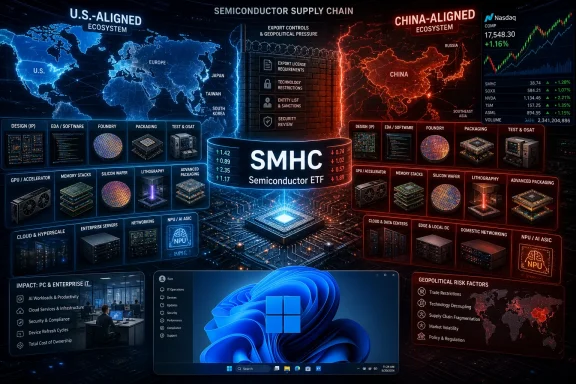 Wall Street Has Found a Ticker for the Chip Cold War
The pitch for SMHC is easy to understand because it borrows from a familiar playbook. VanEck already has a giant semiconductor franchise in SMH, the U.S.-listed semiconductor ETF that became one of the cleanest ways for retail and institutional investors to ride the Nvidia-led AI boom. SMHC takes that same thematic machinery and points it at China’s attempt to build a self-sufficient chip stack.That timing is not accidental. China is reportedly preparing a roughly 2 trillion yuan, or about $295 billion, five-year AI infrastructure push, centered on data centers, domestic compute, and a national buildout that would reduce dependence on U.S. technology. Private Chinese giants such as Alibaba and Tencent are also spending heavily on AI infrastructure, though their plans sit inside a political economy very different from Microsoft, Amazon, Meta, or Google.
The ETF therefore arrives at a moment when investors have become conditioned to think of chips as the scarce resource behind everything else. AI models may get the headlines, but GPUs, networking gear, advanced packaging, memory bandwidth, lithography, fabs, and energy access decide who can train and deploy those models at scale. If the first phase of the AI trade was “buy Nvidia,” SMHC asks whether the next trade is “buy the workaround.”
But that word, workaround, is doing a lot of work. China is not merely trying to grow a domestic semiconductor sector in the ordinary industrial-policy sense. It is trying to rebuild, under pressure, a stack that the U.S. and its allies can partially deny it: advanced AI accelerators, leading-edge foundry capacity, electronic design automation, memory, lithography, packaging, and the software layers that make the hardware useful.
The Fund Sells Exposure to an Ecosystem That Is Being Forced Into Existence
The fund tracks 25 large and liquid Chinese semiconductor companies, with an expense ratio of 0.65 percent. That makes it relatively expensive compared with older, broader semiconductor ETFs, but not unusual for a narrow thematic product focused on a hard-to-access market. It is designed to give U.S. investors exposure to domestic Chinese chipmakers across parts of the value chain rather than the global champions that dominate familiar chip baskets.That distinction is the entire point. A conventional semiconductor ETF is likely to be dominated by U.S., Taiwanese, Dutch, Korean, and Japanese names: Nvidia, Broadcom, AMD, TSMC, ASML, Applied Materials, Lam Research, Tokyo Electron, Samsung, SK hynix, and others depending on the index. Those companies are deeply embedded in the globalized chip order that China is trying to escape or duplicate.
SMHC points instead at the companies Beijing needs if it wants a domestic alternative. That includes chip design, manufacturing-related suppliers, equipment, materials, packaging, and other pieces of the Chinese semiconductor chain. It is less a fund built around today’s undisputed winners than one built around the possibility that geopolitical pressure will create tomorrow’s protected national champions.
This is why the product is interesting even to people who never buy ETFs. Financial products often lag reality, but sometimes they reveal what the market has decided is real enough to package. A China semiconductor ETF says the decoupling story has matured from think-tank slide decks and sanctions memos into an investable category.
Money Is the Easy Part of China’s Semiconductor Problem
The simplest bullish case for SMHC is that China has money, scale, engineering talent, and political will. That combination should not be dismissed. Semiconductor history is full of governments shaping markets: the U.S. defense establishment, Japan’s industrial ministries, South Korea’s chaebol model, Taiwan’s foundry strategy, Europe’s lithography ecosystem, and now the U.S. CHIPS Act.China has shown in solar panels, batteries, telecom equipment, electric vehicles, and industrial automation that state-backed scale can change global cost curves. If Beijing decides that domestic AI compute is a strategic necessity, capital will flow. Local governments will compete. State funds will support favored players. Customers will be nudged, or pushed, toward domestic alternatives.
But money does not automatically buy the leading edge. The semiconductor industry is not one industry; it is a stack of brutally specialized monopolies and oligopolies. The most advanced chips depend on years of process knowledge, materials science, lithography, metrology, software tools, packaging know-how, and supply-chain coordination that cannot be conjured by appropriations alone.
That is the problem facing China’s AI ambitions. The country can build data centers, subsidize domestic chipmakers, and direct demand toward local suppliers. It cannot easily replace Nvidia’s software ecosystem, TSMC’s process maturity, ASML’s EUV lithography dominance, or the decades of accumulated tooling and IP that sit behind the most advanced nodes.
Export Controls Have Turned AI Hardware Into a Strategic Border
The U.S. export-control regime has steadily narrowed China’s access to cutting-edge AI chips and the tools needed to make them. Washington’s logic is blunt: if AI accelerators are strategically important, then allowing a rival power unlimited access to the best accelerators is not ordinary commerce. It is a national-security decision.That has forced Nvidia and other chip companies into an awkward middle ground. They want access to China, one of the world’s largest technology markets, but they must design around shifting U.S. performance thresholds and licensing rules. China, meanwhile, has every incentive to treat export-compliant foreign chips as a temporary bridge rather than a foundation.
The lithography bottleneck is even harder. ASML’s most advanced EUV machines remain effectively off-limits to China, and recent reporting has shown how sensitive the topic remains in Washington and The Hague. ASML has denied claims that EUV systems or EUV-specific components were shipped to China, but the controversy itself shows how central a single class of machines has become to the geopolitical order.
The result is not a clean blockade. China still has access to older tools, domestic workarounds, mature-node manufacturing, chiplet strategies, packaging improvements, and some foreign equipment under constraints. But the ceiling matters. In AI, being one or two generations behind is not fatal for every workload, yet it changes economics, power consumption, model scale, and deployment efficiency.
The Missing Giant Is the First Warning Label
The most important caveat in SMHC is not hidden in a footnote. A U.S.-listed China semiconductor ETF must avoid sanctioned companies, and that means some of the most strategically significant names in Chinese chips may be absent. The obvious example is SMIC, China’s largest foundry and the closest thing the country has to a domestic answer to TSMC.That exclusion makes sense legally and operationally. A fund sold to U.S. investors cannot simply ignore sanctions and investment restrictions. But it also means SMHC is not a pure map of China’s semiconductor ambition. It is a map of the part of that ambition U.S. investors are still allowed to own.
That is a strange product-design problem. The more strategically important a Chinese chip company becomes, the more likely it is to attract U.S. scrutiny. The more it attracts U.S. scrutiny, the harder it may be for a U.S.-listed ETF to hold it. In other words, success inside China’s national semiconductor strategy can become an eligibility problem inside an American financial product.
This does not make the ETF useless. It does, however, make it different from buying a broad U.S. semiconductor ETF, where the biggest winners tend to become larger weights rather than forbidden assets. Investors are not simply taking technology risk or valuation risk. They are taking index survivability risk in a sanctions-driven market.
China’s State Capitalism Changes the Meaning of Shareholder Upside
The second warning label is political. China’s semiconductor push is not happening in a market where shareholder returns are the only, or even always the primary, objective. The state’s goals include technological sovereignty, military resilience, domestic employment, supply-chain control, and reduced exposure to foreign pressure.That can be bullish for revenue and bearish for returns at the same time. Subsidies can create demand, but they can also create overcapacity. National mandates can produce customers, but they can also force companies into uneconomic projects. A protected market can lift domestic players, but it can also dull the discipline that normally separates durable winners from capital-burning participants.
Investors in Chinese technology learned this lesson the hard way during the 2021 regulatory crackdown. Internet platforms that once looked like unstoppable compounding machines suddenly found themselves subordinate to social, political, and regulatory priorities. The semiconductor sector is different because Beijing wants it to grow, not shrink, but the hierarchy is the same: national priorities come first.
That difference matters for anyone tempted to treat SMHC as simply “China’s SMH.” The U.S. semiconductor trade is also shaped by policy, subsidies, defense priorities, and export controls, but the shareholder bargain is still more legible. In China, the bargain is more conditional. You may be investing alongside the state, but you are not necessarily investing for the same reasons as the state.
The AI PC Makes This More Than a Data-Center Story
For WindowsForum readers, the temptation is to see all of this as far away: Chinese fabs, Wall Street ETFs, Washington export controls, Beijing industrial policy. But the consequences will eventually show up in the devices and services people actually use. AI infrastructure is already reshaping Windows PCs, cloud services, developer tools, endpoint management, and procurement assumptions.Microsoft’s Copilot+ PC push, neural processing units in client devices, local AI inference, and cloud-connected AI features all depend on a semiconductor supply chain that is becoming more politicized. The first wave of AI PCs has leaned on Qualcomm, AMD, Intel, and their partners. The cloud side leans heavily on Nvidia and custom accelerators from hyperscalers.
A parallel Chinese chip ecosystem could eventually mean parallel AI PC ecosystems, parallel developer targets, and parallel optimization paths. Domestic Chinese silicon may first matter most inside Chinese cloud and government deployments, but software gravity tends to follow hardware availability. If enough compute runs on domestic accelerators, frameworks, compilers, drivers, and model tooling will adapt.
That has implications for cross-platform developers and enterprise vendors. A Windows application with AI features may not care much about Chinese AI accelerators today. A cloud service trying to sell into China might care a great deal tomorrow. The more AI inference moves from generic CPU code to accelerator-specific paths, the more fragmented the hardware world becomes.
Enterprise IT Should Read the ETF as a Supply-Chain Signal
IT departments do not need to buy SMHC to learn from it. The fund is a signal that semiconductor bifurcation is no longer a theoretical concern. It is an allocation category, a procurement issue, and a long-term architecture risk.Enterprise technology buyers already learned during the pandemic that supply chains are not abstractions. Lead times, component shortages, shipping disruptions, and regional concentration can delay laptop refreshes, server deployments, networking upgrades, and security projects. The AI era adds a new dependency: access to accelerator capacity, whether in the cloud or on premises.
If the U.S. and China continue building separate AI hardware stacks, multinational organizations will face messier choices. A workload deployed in Azure, AWS, or Google Cloud in one region may have very different hardware assumptions from a workload deployed through a Chinese cloud provider. Security reviews may need to account not only for software provenance but also for chip provenance, firmware update channels, and management tooling.
This will be especially uncomfortable for companies that want global AI features with local compliance. Data residency was already hard. AI model governance made it harder. Hardware geopolitics adds another layer: the same service may not run on the same class of silicon everywhere, and the optimization gap may widen over time.
The Windows Ecosystem Has Seen Fragmentation Before, but This One Is Different
Windows has always lived across hardware diversity. x86 desktops, Arm laptops, workstation GPUs, integrated graphics, enterprise thin clients, gaming rigs, rugged tablets, and virtual desktops all coexist under the same broad platform umbrella. Microsoft’s genius has often been making that diversity feel less chaotic than it really is.AI acceleration challenges that model. Traditional Windows compatibility is built around CPU instruction sets, drivers, APIs, and certification. AI performance increasingly depends on NPUs, GPUs, tensor cores, memory bandwidth, model formats, quantization methods, and runtime support. Compatibility is no longer just “does it run?” but “does it run fast enough, privately enough, and cheaply enough to matter?”
A Chinese semiconductor stack will likely optimize first for Chinese platforms, Chinese cloud workloads, and Chinese regulatory requirements. That does not mean it will be irrelevant to Windows. Windows remains widely used in business environments, and Microsoft has long had to navigate China as both a market and a regulatory challenge. But AI may make the old balancing act harder.
The risk is not that Windows suddenly splits into two incompatible worlds. The risk is subtler: features, performance, cloud integrations, developer tools, and enterprise support matrices may become increasingly region-specific. The AI PC could remain a global product category while the AI infrastructure behind it becomes more regional, more political, and less interchangeable.
Investors Are Buying a Story That May Be True and Still Disappoint
The bullish SMHC story has real substance. China wants domestic chips. Export controls make that desire more urgent. AI infrastructure requires enormous semiconductor investment. A protected national market can create winners. U.S. investors have few simple ways to express that view.Yet a true macro thesis can still be a disappointing investment. The world can need more chips while a chip stock underperforms. A government can support an industry while shareholders absorb dilution, bad capital allocation, or regulatory shocks. A country can make technological progress while public-market investors fail to capture the best part of the value chain.
The exclusion of sanctioned companies compounds that problem. If the most critical firms are unavailable, the ETF may tilt toward second-order beneficiaries rather than the central engines of China’s semiconductor strategy. Some of those beneficiaries may do well. Others may be policy passengers rather than durable compounders.
There is also the valuation trap. Chinese equities have often looked cheap relative to U.S. peers, but cheapness has not been enough to overcome geopolitical distrust. Investors assign lower multiples because they fear sanctions, delistings, capital controls, state intervention, accounting opacity, and conflict risk. SMHC does not remove those risks; it concentrates them in one of the most politically sensitive sectors on earth.
The Nvidia Shadow Still Falls Over the Whole Trade
No discussion of China’s chip ambitions can avoid Nvidia. The company’s dominance is not just about fast silicon. It is about CUDA, libraries, developer familiarity, model optimization, networking, systems integration, and a decade-plus of software ecosystem investment. That moat is why export controls hurt China and why replacing Nvidia is so hard.Chinese firms can and will produce AI accelerators. Some will be good enough for many domestic workloads, especially where buyers are required or encouraged to use them. But catching up to Nvidia’s full-stack advantage is not the same as producing a benchmark slide that looks competitive under selected conditions.
This matters because AI infrastructure economics are unforgiving. If a domestic accelerator needs more chips, more power, more engineering effort, or more time to produce the same result, the cost gap shows up somewhere. It may show up in electricity demand, data-center footprints, model capability, cloud margins, or slower deployment.
China can absorb some inefficiency for strategic reasons. The U.S. has done the same in defense and other critical industries. But investors should not confuse strategic necessity with economic superiority. Sometimes a country builds a domestic alternative because it is cheaper and better. Sometimes it builds one because the better option is unavailable.
The ETF Is a Bet on Decoupling, Not Just Growth
SMHC’s most honest framing is not “China AI growth.” It is “semiconductor decoupling.” That is a more powerful thesis and a more dangerous one.If U.S.-China tensions ease, export controls loosen, and Chinese buyers regain greater access to global best-in-class hardware, the urgency behind domestic substitution could soften. If tensions worsen, domestic substitution becomes more urgent, but the ETF could face higher sanctions risk, lower foreign investor appetite, and more exclusions. The fund benefits from a narrow corridor: enough conflict to drive Chinese semiconductor investment, not so much conflict that U.S. investors cannot comfortably own the beneficiaries.
That corridor may exist for years. Washington is unlikely to abandon technology controls entirely, and Beijing is unlikely to abandon chip self-sufficiency. Both parties now treat AI compute as strategically important. Once a sector is reclassified from commerce to national power, it rarely returns to being just another product market.
For investors, that means SMHC is not a casual thematic sleeve. It is a geopolitical instrument with an expense ratio. It may rise because Chinese chip firms improve, because Beijing spends, because domestic customers shift, or because global investors warm to China. It may fall because Washington tightens rules, Beijing intervenes, Chinese equities derate, or the technology gap proves more stubborn than the subsidy cycle.
The Real Product Is Optionality on a Parallel Stack
The most interesting thing about SMHC is that it offers exposure not to the current center of semiconductor gravity, but to the possibility of a second one. That is rare. Most ETFs package yesterday’s winners or today’s consensus. This one packages a forced experiment.China is trying to answer a brutal question: can a country that lacks unrestricted access to the leading global chip stack still build enough domestic capability to power frontier-adjacent AI, modern cloud services, advanced manufacturing, and military-relevant compute? The answer does not have to be a clean yes for SMHC to work. It only has to be yes enough for domestic firms to grow into the demand Beijing creates.
But “yes enough” is an ambiguous threshold. For government workloads, sanctioned environments, and domestic platforms, good-enough chips may be perfectly viable. For frontier model training, hyperscale efficiency, and global cloud competition, the gap may remain painful. The ETF lives in that ambiguity.
That ambiguity is also why the fund deserves attention from technologists. It is easy to mock state-backed semiconductor campaigns when they lag the cutting edge. It is also easy to overhype them because the spending numbers are enormous. The harder and more useful view is that China may build a parallel stack that is inferior in some ways, superior in none at first, but still strategically sufficient to change global technology markets.
The Ticker Tape Now Reflects the Supply Chain Split
SMHC will not decide the future of semiconductors, AI, or U.S.-China technology competition. But it captures a shift that Windows users and IT pros should not ignore: the chip supply chain is becoming a contested map rather than a neutral background layer.- SMHC gives U.S. investors targeted exposure to large Chinese semiconductor companies, but it cannot hold some sanctioned firms that may be central to China’s chip strategy.
- China’s reported AI infrastructure plans strengthen the demand story, but funding alone cannot replace restricted access to Nvidia-class accelerators, TSMC-class manufacturing, or ASML EUV lithography.
- The fund is best understood as a decoupling trade, not a simple AI growth trade, because its upside and downside both depend heavily on geopolitical pressure.
- Enterprise IT should expect AI hardware assumptions to become more regional, especially for cloud deployments, regulated workloads, and services operating inside China.
- Windows developers and administrators should watch the rise of parallel AI stacks because accelerator-specific optimization will increasingly shape performance, compatibility, and procurement decisions.
References
- Primary source: etf.com
Published: Tue, 30 Jun 2026 20:15:00 GMT
China Wants Its Own Chips. Now There's an ETF for It
The VanEck China Semiconductor ETF (SMHC) gives U.S. investors exposure to China's chip companies. Just don't expect to find the country's biggest chipmaker inside.www.etf.com - Related coverage: vaneck.com
SMHC-VanEck China Semiconductor ETF (US) | Holdings & Performance | VanEck
Invest in China's domestic chip boom. VanEck China Semiconductor U.S. ETF (SMHC) tracks the 25 largest Chinese semiconductor companies - with sanctioned companies excluded by design.www.vaneck.com - Related coverage: tomshardware.com
China drafts $295 billion plan to build national AI data center grid running on 80% homemade silicon — projected 2028 timeline could run into limits of local chip production | Tom's Hardware
Beijing's spending ambitions run into the reality of limited chip output.www.tomshardware.com - Related coverage: techtimes.com
China AI Data Center Grid Locks Out Nvidia With $295 Billion Domestic Chip Mandate
China AI data center buildout: Beijing is drafting a $295 billion plan to build a nationwide AI computing grid run on 80% domestic chips, structurally excluding Nvidia and AMD. Huawei Ascend chipswww.techtimes.com - Related coverage: techradar.com
China’s $295 billion AI data center plan could reshape computing power, with a massive domestic chip reliance strategy underway | TechRadar
China wants full AI data center dominance with a $295 billion planwww.techradar.com - Related coverage: chinaindustryintel.com
- Related coverage: techcrunch.com
The US says ASML's top chip tool may be in China, but how? | TechCrunch
There's a commercial logic that cuts against the idea that ASML would risk its export license to arm a Chinese customer.techcrunch.com - Related coverage: igorslab.de
ASML Denies EUV Allegations: No Systems Delivered to China
ASML clarifies it has not delivered any EUV lithography systems or components to China, countering US government concerns about export violations.www.igorslab.de - Related coverage: theeditorial.news
ASML EUV Export Ban: China Received Zero Machines in Q1 2026 | The Editorial
ASML shipped 42 EUV lithography machines in Q1 2026, none to China. The Dutch export ban is holding. Beijing's DUV workaround cannot scale below 7nm.theeditorial.news - Related coverage: insiderfinance.io
ASML EUV China Allegation Prompts Denial | InsiderFinance
ASML EUV China allegation raised regulatory risk and dented shares as U.S. officials flagged a possible EUV, ASML denied shipments and circulated inventorywww.insiderfinance.io - Related coverage: ioplus.nl
ASML denies selling advanced chip machine to China
US tells ASML it's concerned an advanced chip machine may have reached China, the company denies.ioplus.nl
- Related coverage: abhs.in
ASML Export Ban: How Close China's SMEE EUV Machine Is in 2026 | Abhishek Gautam
China's SMEE has a working DUV prototype and active EUV program. If it ships by 2027, US export controls on China's chip industry effectively fail.abhs.in
- Related coverage: digitalmarketreports.com
ASML Denies US Concerns That EUV Chipmaking Equipment Reached China
ASML has denied claims that one of its extreme ultraviolet lithography systems, or any component specifically designed for those machines, was shipped todigitalmarketreports.com - Related coverage: ts2.tech
Dispute over ASML China EUV orders puts U.S. export rules to the test
ASML shares fell up to 2.7% after reports that U.S.ts2.tech - Related coverage: pcgamer.com
The US is worried China could have a top-spec chipmaking machine despite export restrictions, but the machine maker ASML denies it | PC Gamer
All I know is you can't hide a 150+ ton EUV machine in MY house.www.pcgamer.com - Related coverage: axios.com
Nvidia restarting production for H200 chips for sales in China
CEO Jensen Huang said the company has received purchase orders "from many customers."www.axios.com
