

On June 18, 2026, the District Court of Munich ruled for Infineon in two additional German patent infringement cases against China’s Innoscience, barring the manufacture, sale, and marketing of more disputed gallium nitride products in Germany and ordering damages. The ruling does not end the fight; it confirms that the fight has become a multi-front war over who gets to set the commercial terms for next-generation power electronics. For Windows users and IT buyers, that may sound remote until the same GaN components start shaping the power bricks, servers, AI racks, chargers, and edge devices sitting behind everyday computing. This is not merely a patent spat between two chipmakers; it is a preview of how the energy architecture of modern computing will be litigated.
Gallium nitride, or GaN, has spent years being described as the technology that makes chargers smaller and power conversion more efficient. That description is accurate, but it undersells the strategic point. GaN is not just a nicer way to build a USB-C wall adapter; it is one of the materials that lets the power layer of computing keep up with the compute layer.
The pressure is obvious everywhere in the Windows ecosystem. Laptops are thinner, docks are hungrier, GPUs are hotter, data centers are denser, and AI workloads are pushing power delivery into places where old silicon power components look increasingly stretched. Every watt lost as heat is now a design problem, an operating-cost problem, and in large fleets, a procurement problem.
That is why the Infineon-Innoscience dispute matters beyond the semiconductor bar. The fight is about patents, but the market beneath it is about control over a faster-growing slice of the electronics stack. If GaN becomes ordinary in PC chargers, workstation power supplies, server power shelves, electric vehicles, industrial automation, and renewable energy systems, then the companies that own defensible GaN intellectual property own more than legal leverage. They own tollbooths.
Infineon’s latest win in Munich lands at exactly the moment when those tollbooths are being mapped. The court’s decision covers two further infringement cases, one based on a patent and one based on a utility model, and it adds another German ruling to Infineon’s side of the ledger. In practical terms, Innoscience faces a broader prohibition in Germany against manufacturing, selling, and marketing additional accused products.
But the broader signal is more important than the immediate injunction. Munich has now become one of the places where Infineon can say its GaN portfolio has teeth. In a market where suppliers sell not just parts but confidence, that matters.
The complexity is that this dispute is not being fought in one courtroom. It is being fought across jurisdictions, each with its own remedies, timelines, standards, and commercial consequences. A win in Germany does not erase a loss in China, and a win at the U.S. International Trade Commission does not automatically translate into global control.
That is the uncomfortable reality of modern semiconductor patent warfare. A chipmaker can be an infringer in one market, a victim in another, and a negotiating counterparty everywhere else. The legal map begins to look less like a scoreboard and more like a set of pressure points.
In Germany, Infineon has a strong recent narrative. The Munich District Court previously ruled in Infineon’s favor in an initial German proceeding, and the newest decisions extend that line. In the United States, the ITC’s Full Commission found in May that Innoscience infringed an Infineon patent in the field of GaN technology and ordered import and sales restrictions, subject to the usual procedural path.
Yet Innoscience has its own narrative, and it is not trivial. China’s Supreme People’s Court recently upheld a sales injunction against certain Infineon GaN products, following a May 27, 2026 judgment from the Intermediate People’s Court of Suzhou. That Chinese ruling found specified Infineon products infringed Innoscience patent rights and left Infineon facing restrictions in a major electronics market.
The result is a split-screen patent war. Infineon can point to Germany and the United States. Innoscience can point to China. Both can claim validation. Neither can credibly claim final global victory.
That distinction matters because GaN is still in the phase where design wins can harden into long-term positions. Once an OEM qualifies a power component, integrates it into a design, tests it, certifies it, and builds a supply plan around it, switching is not frictionless. Patent pressure at this stage can shape the supplier list before the market fully matures.
Infineon is not a startup trying to prove it belongs. It is one of the world’s major power semiconductor companies, with deep relationships in automotive, industrial, energy, and computing-adjacent markets. Its argument is not only that Innoscience infringed particular rights, but that Infineon’s decades of power-electronics investment should not be undercut by products it says rely on protected technology.
Innoscience, meanwhile, represents a different kind of pressure. The company has become one of the most visible Chinese GaN players, with manufacturing scale and ambitions that extend well beyond its home market. Its emergence has sharpened the pricing, capacity, and geopolitical dimensions of the GaN business.
That is why this dispute has the feel of a larger industrial contest. Europe wants defensible semiconductor champions. China wants more domestic strength in strategically important components. The United States, through tools like the ITC, remains a critical enforcement venue for companies trying to block imports that allegedly violate intellectual property rights. GaN sits neatly at the intersection of all three.
A German injunction may not decide the global market, but it can make Germany and, by extension, European access more complicated for Innoscience. A Chinese injunction may not decide Europe or the United States, but it can constrain Infineon in a market no global semiconductor supplier wants to lose. Each ruling becomes both legal remedy and bargaining chip.
In May 2026, the ITC’s Full Commission found that Innoscience infringed an Infineon patent in the GaN field. That followed an earlier determination and added U.S. institutional weight to Infineon’s claim that Innoscience’s technology crosses protected lines. For Infineon, the ITC result is especially useful because it speaks to import and sales restrictions in one of the world’s most important electronics markets.
The ITC also changes the tempo of negotiations. Patent litigation can drag, but an exclusion order can force companies to move quickly. Suppliers may need to redesign parts, negotiate licenses, reroute inventory, or reassure customers that existing products will remain available.
For WindowsForum readers, this is where an abstract semiconductor dispute begins to connect with practical computing. Power electronics are buried inside the products people rarely think about until they fail: laptop chargers, docking stations, mini PCs, monitor power supplies, server power systems, and networking gear. A component-level injunction does not mean your laptop suddenly stops working, but it can affect what OEMs choose for future designs.
That effect is rarely visible at retail. A charger that might have used one GaN supplier quietly uses another. A power board gets revised. A data-center supply contract changes. A product launch slips by a quarter because qualification has to be repeated.
The consumer sees a price, a wattage rating, a warranty period, and maybe a logo. The legal fight behind the power stage remains invisible. But invisible is not the same as irrelevant.
According to Innoscience’s announcement and subsequent reporting, China’s Supreme People’s Court upheld a sales injunction against certain Infineon GaN products after the Suzhou court found infringement of Innoscience patents. The ruling reportedly restricts Infineon from selling, offering, or importing specified products in China and includes damages. Infineon has disputed the broader framing of Innoscience’s “final victory” language, but the existence of a Chinese injunction is now part of the landscape.
That matters because China is not a side market for power electronics. It is a manufacturing base, a consumption market, and a strategic theater for semiconductor self-sufficiency. A supplier constrained there faces not just lost sales, but potential complications with customers that build globally.
The dueling rulings also reveal a broader truth about patent portfolios. In mature technology fights, the parties rarely arrive empty-handed. Each side may hold patents that read on the other’s products, and each side may seek injunctions not only to stop infringement but to improve licensing leverage.
This does not mean all claims are equal or that every court ruling should be treated as symmetrical. It means the commercial outcome will likely be shaped by cumulative pressure rather than one dramatic knockout. Infineon’s Munich win strengthens its position, but Innoscience’s China win prevents the dispute from becoming a one-way enforcement campaign.
The most likely destination is not a world where one company disappears from GaN. It is a world of carve-outs, redesigns, appeals, licensing talks, regional restrictions, and customer reassurances. Semiconductor patent wars tend to end less like courtroom dramas and more like supply-chain spreadsheets.
A utility model, in jurisdictions that recognize it, is often associated with practical technical inventions and can be faster or narrower than a conventional patent. It can still be a meaningful enforcement tool. For a company trying to protect a product architecture, process detail, or device structure, the distinction may matter less commercially than the fact that a court can use it to restrict a rival’s products.
That is especially important in GaN because the competitive advantage may live in details that never appear on a product box. Device structures, layers, manufacturing methods, thermal behavior, reliability improvements, and packaging choices can all become patent terrain. The customer sees a compact charger or efficient power stage; the courtroom sees claim language.
Infineon’s use of both patents and utility models suggests a portfolio strategy rather than a single-asset bet. The company is not merely asserting one crown-jewel patent and hoping it holds. It is using multiple rights across multiple venues to constrain Innoscience’s room to maneuver.
That approach is common in high-value semiconductor fights because redesign is always a possible escape route. If a defendant can change one feature and avoid one patent, the plaintiff wants other claims waiting. A portfolio creates a maze; a single patent creates a door.
For Innoscience, the problem is not just losing one German case. It is the accumulation of adverse rulings that may narrow the set of products it can confidently sell into certain markets without modification or licensing. Even if appeals or parallel actions change the picture, uncertainty itself becomes a cost.
That shift pulls GaN deeper into the strategic conversation. Silicon carbide gets much of the attention in electric vehicles and high-voltage applications, but GaN is attractive in fast-switching, compact, efficient power conversion. The more computing becomes a power-management problem, the more valuable GaN know-how becomes.
This is not just a cloud hyperscaler issue. Enterprise IT teams are already being asked to support AI pilots, local inference boxes, denser edge deployments, and workstation-class hardware with serious power demands. Even where GaN is not directly visible, the pressure for smaller, cooler, more efficient power systems flows through the supply chain.
For Windows users, the near-term impact is more likely to show up in accessories and systems than in headlines. Higher-wattage USB-C chargers, compact docking stations, efficient mini PCs, and workstation adapters all benefit from better power electronics. The Windows PC market is famously cost-sensitive, and a shift in component availability or licensing costs can affect design choices.
For data centers, the issue is less about elegance and more about economics. Power conversion losses scale brutally. A small efficiency gain in a single device can become meaningful across thousands of servers, and a small supply disruption can become painful when tied to qualified hardware platforms.
That is why patent certainty matters. Buyers do not need to know every claim in every GaN patent, but OEMs and infrastructure suppliers do need predictable access to components. When major suppliers are fighting injunctions across continents, procurement teams notice.
Infineon is one of Europe’s most important semiconductor companies, particularly in power electronics. When it says the ruling demonstrates the value of its GaN portfolio, that is both a legal statement and an industrial-policy statement. The message is that European chip innovation can be defended in European courts.
That is not a small thing. If Europe wants to remain relevant in semiconductors, it cannot rely only on public funding and patriotic procurement. It needs companies whose intellectual property is valuable enough to enforce and courts capable of delivering remedies that competitors take seriously.
The Munich court’s role is therefore larger than a local venue. Germany is a major automotive and industrial economy, and power semiconductors sit directly inside those sectors’ future. A ruling that restricts infringing GaN products in Germany has implications for how suppliers think about European market entry.
There is a risk, of course, that aggressive patent enforcement can shade into market protectionism. Customers benefit from competition, and Innoscience’s rise has likely increased pressure on incumbents to move faster and price more sharply. A market dominated by a few heavily protected suppliers would not automatically serve OEMs or end users.
But that is the balance patent systems are meant to strike. They reward invention with temporary exclusionary rights while eventually allowing broader diffusion. The hard part is making that balance work in a global market where national courts can produce different answers at nearly the same time.
A supplier under injunction pressure may still be able to serve some markets while blocked in others. A product may be legal to sell in one region and risky in another. A redesign may solve the legal problem but require requalification, firmware changes, new thermal testing, or customer notification.
That is why OEMs care about indemnity and supplier assurances. If a component becomes legally problematic, who pays? Who replaces inventory? Who handles customer claims? Who certifies that the redesigned part behaves identically under load, heat, and aging?
In consumer electronics, these questions can hide behind brand names. A Windows laptop buyer usually does not know who supplied the power stage inside the charger or dock. But the OEM absolutely knows, and so does the contract manufacturer responsible for shipping compliant products into multiple jurisdictions.
For enterprise IT, the lesson is not to panic over GaN availability. It is to understand that component-level legal fights can affect product roadmaps in subtle ways. A charger generation may change supplier. A server platform may get a revised power shelf. A vendor may qualify a second source earlier than planned.
The companies that manage this well will not necessarily be the ones with the loudest press releases. They will be the ones with redundant designs, flexible sourcing, and lawyers who talk to engineers before products are frozen. In a patent-heavy field, supply-chain resilience is partly a legal discipline.
GaN is now deep into that third stage. The technology is commercially important enough for companies to fight in Germany, the United States, and China. The remedies are serious enough to affect sales and imports. The rhetoric is sharp enough that both sides are trying to define the public meaning of each ruling.
That public meaning matters because customers do not like uncertainty. If Infineon can present Innoscience as a repeat infringer in Western venues, it may reassure customers choosing Infineon for long-lifecycle products. If Innoscience can present itself as vindicated in China and resilient abroad, it can argue that it is not merely a low-cost challenger but an IP-bearing competitor in its own right.
Neither message should be accepted uncritically. Litigation communications are designed to create commercial pressure. Every “victory” is selected, framed, and distributed to influence customers, investors, and counterparties.
The more useful reading is structural. Infineon appears to have meaningful enforcement momentum against Innoscience in Germany and the United States. Innoscience has achieved a meaningful counterstrike against Infineon in China. Both companies remain important to a market that is growing because computing needs better power electronics.
That combination points toward continued litigation rather than peace. Additional proceedings are pending in the United States and Germany, and even decided cases may leave room for appeals, redesigns, or licensing maneuvers. The latest Munich ruling is a milestone, not an ending.
A laptop charger on a store shelf is unlikely to become a consumer’s legal problem. The burden falls on manufacturers, distributors, and suppliers. If a product contains restricted components in a market where an injunction applies, companies upstream must deal with it.
The more realistic effect is supplier selection. OEMs may prefer components from vendors with less legal exposure in target regions, or they may demand stronger contractual protection from suppliers involved in disputes. That can alter cost, availability, and design timing.
There is also a standards-adjacent dimension. USB-C power delivery, high-wattage charging, and compact adapters have trained users to expect small, efficient bricks that work across devices. GaN helped make that expectation practical. If patent constraints slow some suppliers or raise licensing costs, the market will absorb it, but not evenly.
Premium devices are better positioned to swallow higher component costs. Low-margin accessories are less forgiving. If legal risk concentrates among lower-cost suppliers, the cheapest end of the market could see more churn than the flagship tier.
For enterprise buyers, the advice is familiar but newly relevant: buy from vendors with clear support channels, documented certifications, and credible supply continuity. The patent fight is not a reason to avoid GaN. It is a reason to avoid mystery hardware from suppliers that cannot explain what happens if their component source changes.
The concrete points are less dramatic than the corporate language, but more useful.
Infineon’s latest win in Munich strengthens its campaign to defend a GaN portfolio it sees as central to the next era of efficient power electronics, but Innoscience’s success in China ensures this remains a global contest rather than a European enforcement story. The companies will keep arguing over patents, utility models, injunctions, damages, and jurisdictional victories; the rest of the industry will watch for the quieter consequences in licensing terms, second-source strategies, and product designs. As computing grows more power-hungry and more geographically fragmented, the chips that manage electricity may become as strategically contested as the processors that consume it.
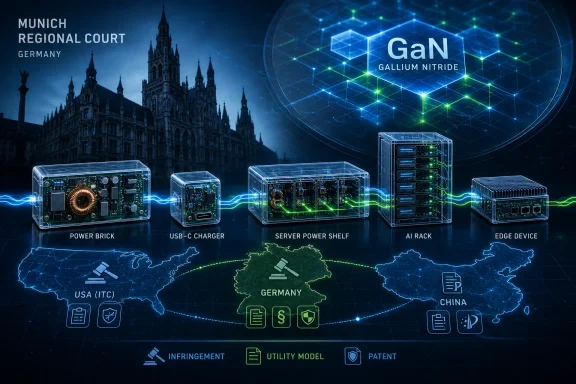 GaN Has Become Too Important to Stay Quiet
Gallium nitride, or GaN, has spent years being described as the technology that makes chargers smaller and power conversion more efficient. That description is accurate, but it undersells the strategic point. GaN is not just a nicer way to build a USB-C wall adapter; it is one of the materials that lets the power layer of computing keep up with the compute layer.The pressure is obvious everywhere in the Windows ecosystem. Laptops are thinner, docks are hungrier, GPUs are hotter, data centers are denser, and AI workloads are pushing power delivery into places where old silicon power components look increasingly stretched. Every watt lost as heat is now a design problem, an operating-cost problem, and in large fleets, a procurement problem.
That is why the Infineon-Innoscience dispute matters beyond the semiconductor bar. The fight is about patents, but the market beneath it is about control over a faster-growing slice of the electronics stack. If GaN becomes ordinary in PC chargers, workstation power supplies, server power shelves, electric vehicles, industrial automation, and renewable energy systems, then the companies that own defensible GaN intellectual property own more than legal leverage. They own tollbooths.
Infineon’s latest win in Munich lands at exactly the moment when those tollbooths are being mapped. The court’s decision covers two further infringement cases, one based on a patent and one based on a utility model, and it adds another German ruling to Infineon’s side of the ledger. In practical terms, Innoscience faces a broader prohibition in Germany against manufacturing, selling, and marketing additional accused products.
But the broader signal is more important than the immediate injunction. Munich has now become one of the places where Infineon can say its GaN portfolio has teeth. In a market where suppliers sell not just parts but confidence, that matters.
Infineon Wins in Munich, but Not the Whole Map
Infineon’s public framing is straightforward: German courts and U.S. authorities have repeatedly found that Innoscience products infringe Infineon’s intellectual property. The company says the latest Munich decisions represent Innoscience’s third and fourth legal defeats in the series. That is the kind of phrase companies use when they want the market to see momentum rather than complexity.The complexity is that this dispute is not being fought in one courtroom. It is being fought across jurisdictions, each with its own remedies, timelines, standards, and commercial consequences. A win in Germany does not erase a loss in China, and a win at the U.S. International Trade Commission does not automatically translate into global control.
That is the uncomfortable reality of modern semiconductor patent warfare. A chipmaker can be an infringer in one market, a victim in another, and a negotiating counterparty everywhere else. The legal map begins to look less like a scoreboard and more like a set of pressure points.
In Germany, Infineon has a strong recent narrative. The Munich District Court previously ruled in Infineon’s favor in an initial German proceeding, and the newest decisions extend that line. In the United States, the ITC’s Full Commission found in May that Innoscience infringed an Infineon patent in the field of GaN technology and ordered import and sales restrictions, subject to the usual procedural path.
Yet Innoscience has its own narrative, and it is not trivial. China’s Supreme People’s Court recently upheld a sales injunction against certain Infineon GaN products, following a May 27, 2026 judgment from the Intermediate People’s Court of Suzhou. That Chinese ruling found specified Infineon products infringed Innoscience patent rights and left Infineon facing restrictions in a major electronics market.
The result is a split-screen patent war. Infineon can point to Germany and the United States. Innoscience can point to China. Both can claim validation. Neither can credibly claim final global victory.
The Patent Fight Is Really a Market Access Fight
Patent disputes in semiconductors often sound like they are about invention, but they are just as often about market access. A successful injunction changes who can ship, where they can ship, and how urgently they must redesign. For customers, the legal language eventually becomes a supply-chain question.That distinction matters because GaN is still in the phase where design wins can harden into long-term positions. Once an OEM qualifies a power component, integrates it into a design, tests it, certifies it, and builds a supply plan around it, switching is not frictionless. Patent pressure at this stage can shape the supplier list before the market fully matures.
Infineon is not a startup trying to prove it belongs. It is one of the world’s major power semiconductor companies, with deep relationships in automotive, industrial, energy, and computing-adjacent markets. Its argument is not only that Innoscience infringed particular rights, but that Infineon’s decades of power-electronics investment should not be undercut by products it says rely on protected technology.
Innoscience, meanwhile, represents a different kind of pressure. The company has become one of the most visible Chinese GaN players, with manufacturing scale and ambitions that extend well beyond its home market. Its emergence has sharpened the pricing, capacity, and geopolitical dimensions of the GaN business.
That is why this dispute has the feel of a larger industrial contest. Europe wants defensible semiconductor champions. China wants more domestic strength in strategically important components. The United States, through tools like the ITC, remains a critical enforcement venue for companies trying to block imports that allegedly violate intellectual property rights. GaN sits neatly at the intersection of all three.
A German injunction may not decide the global market, but it can make Germany and, by extension, European access more complicated for Innoscience. A Chinese injunction may not decide Europe or the United States, but it can constrain Infineon in a market no global semiconductor supplier wants to lose. Each ruling becomes both legal remedy and bargaining chip.
The ITC Ruling Adds an American Lever
The U.S. International Trade Commission matters because it does not operate like an ordinary damages court. Its most potent remedy is exclusion: keeping infringing goods out of the U.S. market. For semiconductor companies, that can be more urgent than a damages award because it threatens live customer relationships and active distribution channels.In May 2026, the ITC’s Full Commission found that Innoscience infringed an Infineon patent in the GaN field. That followed an earlier determination and added U.S. institutional weight to Infineon’s claim that Innoscience’s technology crosses protected lines. For Infineon, the ITC result is especially useful because it speaks to import and sales restrictions in one of the world’s most important electronics markets.
The ITC also changes the tempo of negotiations. Patent litigation can drag, but an exclusion order can force companies to move quickly. Suppliers may need to redesign parts, negotiate licenses, reroute inventory, or reassure customers that existing products will remain available.
For WindowsForum readers, this is where an abstract semiconductor dispute begins to connect with practical computing. Power electronics are buried inside the products people rarely think about until they fail: laptop chargers, docking stations, mini PCs, monitor power supplies, server power systems, and networking gear. A component-level injunction does not mean your laptop suddenly stops working, but it can affect what OEMs choose for future designs.
That effect is rarely visible at retail. A charger that might have used one GaN supplier quietly uses another. A power board gets revised. A data-center supply contract changes. A product launch slips by a quarter because qualification has to be repeated.
The consumer sees a price, a wattage rating, a warranty period, and maybe a logo. The legal fight behind the power stage remains invisible. But invisible is not the same as irrelevant.
China’s Counterpunch Prevents a Simple Story
If the story ended with Germany and the United States, Infineon could present a clean enforcement arc. It does not. Innoscience’s win in China complicates any simple tale of original inventor versus alleged copyist.According to Innoscience’s announcement and subsequent reporting, China’s Supreme People’s Court upheld a sales injunction against certain Infineon GaN products after the Suzhou court found infringement of Innoscience patents. The ruling reportedly restricts Infineon from selling, offering, or importing specified products in China and includes damages. Infineon has disputed the broader framing of Innoscience’s “final victory” language, but the existence of a Chinese injunction is now part of the landscape.
That matters because China is not a side market for power electronics. It is a manufacturing base, a consumption market, and a strategic theater for semiconductor self-sufficiency. A supplier constrained there faces not just lost sales, but potential complications with customers that build globally.
The dueling rulings also reveal a broader truth about patent portfolios. In mature technology fights, the parties rarely arrive empty-handed. Each side may hold patents that read on the other’s products, and each side may seek injunctions not only to stop infringement but to improve licensing leverage.
This does not mean all claims are equal or that every court ruling should be treated as symmetrical. It means the commercial outcome will likely be shaped by cumulative pressure rather than one dramatic knockout. Infineon’s Munich win strengthens its position, but Innoscience’s China win prevents the dispute from becoming a one-way enforcement campaign.
The most likely destination is not a world where one company disappears from GaN. It is a world of carve-outs, redesigns, appeals, licensing talks, regional restrictions, and customer reassurances. Semiconductor patent wars tend to end less like courtroom dramas and more like supply-chain spreadsheets.
The Utility Model Detail Is Not a Footnote
One of the two latest Munich cases was based on a patent; the other was based on a utility model. That may sound like legal trivia, but it is worth pausing on because it shows how aggressively companies protect incremental technical territory in fast-moving hardware markets.A utility model, in jurisdictions that recognize it, is often associated with practical technical inventions and can be faster or narrower than a conventional patent. It can still be a meaningful enforcement tool. For a company trying to protect a product architecture, process detail, or device structure, the distinction may matter less commercially than the fact that a court can use it to restrict a rival’s products.
That is especially important in GaN because the competitive advantage may live in details that never appear on a product box. Device structures, layers, manufacturing methods, thermal behavior, reliability improvements, and packaging choices can all become patent terrain. The customer sees a compact charger or efficient power stage; the courtroom sees claim language.
Infineon’s use of both patents and utility models suggests a portfolio strategy rather than a single-asset bet. The company is not merely asserting one crown-jewel patent and hoping it holds. It is using multiple rights across multiple venues to constrain Innoscience’s room to maneuver.
That approach is common in high-value semiconductor fights because redesign is always a possible escape route. If a defendant can change one feature and avoid one patent, the plaintiff wants other claims waiting. A portfolio creates a maze; a single patent creates a door.
For Innoscience, the problem is not just losing one German case. It is the accumulation of adverse rulings that may narrow the set of products it can confidently sell into certain markets without modification or licensing. Even if appeals or parallel actions change the picture, uncertainty itself becomes a cost.
The AI Power Boom Raises the Stakes
The timing of the dispute is impossible to ignore. AI infrastructure has turned power delivery from a background engineering discipline into a front-line constraint. GPU clusters, accelerated servers, and high-density racks are forcing companies to rethink how electricity moves through data centers.That shift pulls GaN deeper into the strategic conversation. Silicon carbide gets much of the attention in electric vehicles and high-voltage applications, but GaN is attractive in fast-switching, compact, efficient power conversion. The more computing becomes a power-management problem, the more valuable GaN know-how becomes.
This is not just a cloud hyperscaler issue. Enterprise IT teams are already being asked to support AI pilots, local inference boxes, denser edge deployments, and workstation-class hardware with serious power demands. Even where GaN is not directly visible, the pressure for smaller, cooler, more efficient power systems flows through the supply chain.
For Windows users, the near-term impact is more likely to show up in accessories and systems than in headlines. Higher-wattage USB-C chargers, compact docking stations, efficient mini PCs, and workstation adapters all benefit from better power electronics. The Windows PC market is famously cost-sensitive, and a shift in component availability or licensing costs can affect design choices.
For data centers, the issue is less about elegance and more about economics. Power conversion losses scale brutally. A small efficiency gain in a single device can become meaningful across thousands of servers, and a small supply disruption can become painful when tied to qualified hardware platforms.
That is why patent certainty matters. Buyers do not need to know every claim in every GaN patent, but OEMs and infrastructure suppliers do need predictable access to components. When major suppliers are fighting injunctions across continents, procurement teams notice.
Europe’s Semiconductor Ambitions Need Enforceable IP
Infineon’s Munich victory also fits into Europe’s broader semiconductor posture. The European conversation around chips often centers on fabrication capacity, subsidies, and strategic autonomy. But a semiconductor industry is not built on fabs alone; it is built on the ability to protect process knowledge, device design, customer trust, and long-term R&D investments.Infineon is one of Europe’s most important semiconductor companies, particularly in power electronics. When it says the ruling demonstrates the value of its GaN portfolio, that is both a legal statement and an industrial-policy statement. The message is that European chip innovation can be defended in European courts.
That is not a small thing. If Europe wants to remain relevant in semiconductors, it cannot rely only on public funding and patriotic procurement. It needs companies whose intellectual property is valuable enough to enforce and courts capable of delivering remedies that competitors take seriously.
The Munich court’s role is therefore larger than a local venue. Germany is a major automotive and industrial economy, and power semiconductors sit directly inside those sectors’ future. A ruling that restricts infringing GaN products in Germany has implications for how suppliers think about European market entry.
There is a risk, of course, that aggressive patent enforcement can shade into market protectionism. Customers benefit from competition, and Innoscience’s rise has likely increased pressure on incumbents to move faster and price more sharply. A market dominated by a few heavily protected suppliers would not automatically serve OEMs or end users.
But that is the balance patent systems are meant to strike. They reward invention with temporary exclusionary rights while eventually allowing broader diffusion. The hard part is making that balance work in a global market where national courts can produce different answers at nearly the same time.
The Supply Chain Learns to Price Legal Uncertainty
Hardware buyers are used to pricing shortages, tariffs, currency shifts, and logistics delays. Patent risk is harder to model. It does not always appear in a bill of materials, but it can force sudden substitutions or limit where a finished product can be sold.A supplier under injunction pressure may still be able to serve some markets while blocked in others. A product may be legal to sell in one region and risky in another. A redesign may solve the legal problem but require requalification, firmware changes, new thermal testing, or customer notification.
That is why OEMs care about indemnity and supplier assurances. If a component becomes legally problematic, who pays? Who replaces inventory? Who handles customer claims? Who certifies that the redesigned part behaves identically under load, heat, and aging?
In consumer electronics, these questions can hide behind brand names. A Windows laptop buyer usually does not know who supplied the power stage inside the charger or dock. But the OEM absolutely knows, and so does the contract manufacturer responsible for shipping compliant products into multiple jurisdictions.
For enterprise IT, the lesson is not to panic over GaN availability. It is to understand that component-level legal fights can affect product roadmaps in subtle ways. A charger generation may change supplier. A server platform may get a revised power shelf. A vendor may qualify a second source earlier than planned.
The companies that manage this well will not necessarily be the ones with the loudest press releases. They will be the ones with redundant designs, flexible sourcing, and lawyers who talk to engineers before products are frozen. In a patent-heavy field, supply-chain resilience is partly a legal discipline.
The Courts Are Defining the Shape of the GaN Market
The Infineon-Innoscience battle shows how emerging hardware markets become structured. First comes the technical race. Then come the design wins. Then come the patent suits, as incumbents and challengers test where the legal walls actually stand.GaN is now deep into that third stage. The technology is commercially important enough for companies to fight in Germany, the United States, and China. The remedies are serious enough to affect sales and imports. The rhetoric is sharp enough that both sides are trying to define the public meaning of each ruling.
That public meaning matters because customers do not like uncertainty. If Infineon can present Innoscience as a repeat infringer in Western venues, it may reassure customers choosing Infineon for long-lifecycle products. If Innoscience can present itself as vindicated in China and resilient abroad, it can argue that it is not merely a low-cost challenger but an IP-bearing competitor in its own right.
Neither message should be accepted uncritically. Litigation communications are designed to create commercial pressure. Every “victory” is selected, framed, and distributed to influence customers, investors, and counterparties.
The more useful reading is structural. Infineon appears to have meaningful enforcement momentum against Innoscience in Germany and the United States. Innoscience has achieved a meaningful counterstrike against Infineon in China. Both companies remain important to a market that is growing because computing needs better power electronics.
That combination points toward continued litigation rather than peace. Additional proceedings are pending in the United States and Germany, and even decided cases may leave room for appeals, redesigns, or licensing maneuvers. The latest Munich ruling is a milestone, not an ending.
The Fine Print That Will Matter to Buyers
For IT pros and Windows enthusiasts, the immediate temptation is to ask whether this affects the next laptop, charger, or mini PC purchase. The honest answer is: probably not directly tomorrow, but possibly over the next design cycles. Patent rulings at the component level tend to ripple rather than explode.A laptop charger on a store shelf is unlikely to become a consumer’s legal problem. The burden falls on manufacturers, distributors, and suppliers. If a product contains restricted components in a market where an injunction applies, companies upstream must deal with it.
The more realistic effect is supplier selection. OEMs may prefer components from vendors with less legal exposure in target regions, or they may demand stronger contractual protection from suppliers involved in disputes. That can alter cost, availability, and design timing.
There is also a standards-adjacent dimension. USB-C power delivery, high-wattage charging, and compact adapters have trained users to expect small, efficient bricks that work across devices. GaN helped make that expectation practical. If patent constraints slow some suppliers or raise licensing costs, the market will absorb it, but not evenly.
Premium devices are better positioned to swallow higher component costs. Low-margin accessories are less forgiving. If legal risk concentrates among lower-cost suppliers, the cheapest end of the market could see more churn than the flagship tier.
For enterprise buyers, the advice is familiar but newly relevant: buy from vendors with clear support channels, documented certifications, and credible supply continuity. The patent fight is not a reason to avoid GaN. It is a reason to avoid mystery hardware from suppliers that cannot explain what happens if their component source changes.
The Real Scorecard Is Written in Injunctions, Not Press Releases
The latest Munich decisions give Infineon a stronger hand in Europe and reinforce its argument that Innoscience has crossed protected lines in GaN technology. They also arrive days after Innoscience highlighted a Chinese high-court outcome against Infineon. The result is a dispute in which both companies can issue triumphant statements and both still face meaningful constraints.The concrete points are less dramatic than the corporate language, but more useful.
- The Munich District Court ruled for Infineon on June 18, 2026 in two additional German cases involving GaN technology, one based on a patent and one based on a utility model.
- The German rulings prohibit Innoscience from manufacturing, selling, and marketing additional infringing products in Germany and require damages to Infineon.
- The U.S. International Trade Commission’s Full Commission found in May 2026 that Innoscience infringed an Infineon GaN patent, adding American import-and-sales pressure to the dispute.
- China’s Supreme People’s Court recently upheld an injunction against certain Infineon GaN products, giving Innoscience a significant counterweight in its home market.
- The fight is likely to influence supplier qualification, licensing negotiations, redesign plans, and regional market access before it visibly changes consumer hardware shelves.
- The broader significance is that GaN power technology has become strategically valuable enough for global chipmakers to litigate it across the world’s major commercial jurisdictions.
Infineon’s latest win in Munich strengthens its campaign to defend a GaN portfolio it sees as central to the next era of efficient power electronics, but Innoscience’s success in China ensures this remains a global contest rather than a European enforcement story. The companies will keep arguing over patents, utility models, injunctions, damages, and jurisdictional victories; the rest of the industry will watch for the quieter consequences in licensing terms, second-source strategies, and product designs. As computing grows more power-hungry and more geographically fragmented, the chips that manage electricity may become as strategically contested as the processors that consume it.
References
- Primary source: Compound Semiconductor
Published: 2026-06-19T10:50:14.112822
Infineon-Innoscience patent battle continues - Compound Semiconductor News
Our selection of industry specific magazines cover a large range of topics.compoundsemiconductor.net - Related coverage: tomshardware.com
China's supreme court bans Infineon from selling GaN power chips in China — market-leader Innoscience secures major victory in multi-region patent war | Tom's Hardware
Two suppliers building Nvidia's 800V AI-rack power chips now block each other from key markets.www.tomshardware.com - Related coverage: trendforce.com
[News] Infineon Found to Infringe Innoscience GaN Patent, Barred from Selling Certain Products in China
Innoscience announced that China’s Supreme People’s Court has upheld a sales injunction against certain gallium nitride (GaN) products manufactured by...www.trendforce.com - Related coverage: infineon.com
Court rules in favor of Infineon in patent infringement | Infineon Technologies
Court rules in favor of Infineon in patent infringement | Infineon Technologieswww.infineon.com
- Related coverage: semiconductor-today.com
China’s Supreme Court upholds injunction against Infineon, says Innoscience
Infineon prohibited from selling GaN products in mainland Chinawww.semiconductor-today.com - Related coverage: newswire.ca

Infineon wins patent infringement case against Innoscience
/CNW/ -- The District Court Munich, Germany (Landgericht München I) today ruled in favor of Infineon Technologies in two further of the patent infringement...
www.newswire.ca
- Related coverage: evertiq.com
ITC rules in favour of Infineon in GaN patent case against Innoscience
The Full Commission of the US International Trade Commission has affirmed an earlier ruling that Chinese GaN manufacturer Innoscience infringed an Infineon patent, and has ordered import and sales bans for Innoscience's gallium nitride products in the United States.evertiq.com - Related coverage: streetinsider.com
Innoscience Secures Final Victory in Patent Lawsuit as China's Supreme Court Upholds Injunction Against Infineon GaN Products
SUZHOU, China, June 13, 2026 /PRNewswire/ -- In a landmark decision for...www.streetinsider.com - Related coverage: ipfray.com
- Related coverage: abit.ee
China Bans Infineon's GaN Chip Sales: Court Rules in Favour of Innoscience
China's Supreme Court has banned Infineon Technologies from selling GaN chips in China. Chinese firm Innoscience won the patent dispute over gallium nitride semiconductors.abit.ee
- Related coverage: au.investing.com
Infineon wins two patent cases against Innoscience in Germany By Investing.com
Infineon wins two patent cases against Innoscience in Germanyau.investing.com

