

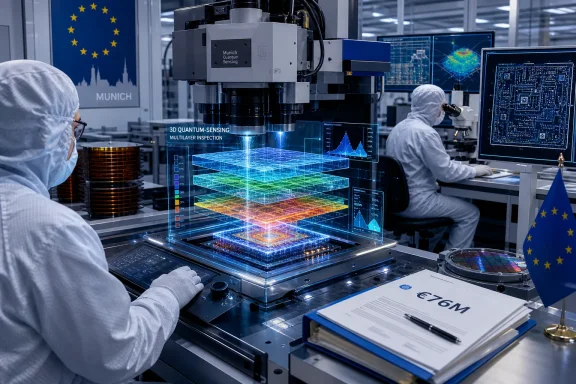
The European Commission approved €76 million in German state aid on June 23, 2026, for Munich-based QuantumDiamonds GmbH to build what Brussels describes as the EU’s first production facility for semiconductor metrology and inspection systems based on quantum sensing. The money is not going to a giant fab or a headline-grabbing AI accelerator project. It is going to the machinery that helps prove whether increasingly complex chips actually work. That makes the decision less spectacular than Europe’s biggest chip subsidies, but arguably more revealing about where the continent now thinks semiconductor sovereignty has to be won.
For years, the public shorthand for semiconductor strategy has been simple: build more fabs. That made political sense after the pandemic-era supply shock, when auto plants idled for want of relatively ordinary chips and governments discovered that supply chains they had treated as background infrastructure were, in fact, strategic terrain.
But a semiconductor ecosystem is not a row of cleanrooms alone. It is lithography, chemicals, substrates, gases, packaging, design software, process control, testing, inspection, and a brutally specialized workforce. If any one layer is missing, the industrial sovereignty slogan starts to wobble.
That is why the QuantumDiamonds grant matters. The Commission’s approval puts public money behind metrology and inspection — the discipline of measuring, imaging, and verifying chips during and after production. In plain English: this is the boring-but-essential layer that tells manufacturers whether the marvels coming off a wafer line are usable, failing, marginal, contaminated, or drifting out of spec.
Europe already has one globally indispensable semiconductor equipment champion in ASML, whose lithography machines sit at the center of advanced chipmaking. But ASML’s success can obscure a harder truth: dominance in one essential tool category does not equal control of the whole manufacturing stack. If Europe wants more than symbolic chip capacity, it has to thicken the supply chain around the fab.
That distinction matters because “quantum” has become one of the tech industry’s most abused adjectives. It can mean foundational science, speculative computing architectures, national security research, communications, sensing, or simply a venture-backed startup trying to survive the hype cycle. Here, the application is narrower and more industrial: use quantum sensor technology to see inside or characterize chips in ways conventional tools may struggle to handle.
Modern chips are becoming harder to inspect because they are becoming more three-dimensional. Advanced packaging, stacked memory, backside power delivery, through-silicon vias, chiplets, and dense interconnect structures all complicate the old mental model of a flat piece of silicon with features visible from the top down. As designs become more vertically integrated, testing must follow them into the third dimension.
That is the quiet logic behind this grant. The EU is not just trying to subsidize production volume. It is trying to seed toolmaking capacity for the era in which the complexity of the package may matter as much as the node printed on the wafer.
The Commission described the Munich site as the first EU production facility for this class of quantum-sensing-based semiconductor metrology and inspection systems. That “first” is the political payload. Brussels and Berlin are not merely helping a company buy equipment; they are trying to establish a domestic foothold in a specialized tool category before it becomes another imported dependency.
Germany’s role is unsurprising. The country has been one of Europe’s most aggressive semiconductor-policy actors, partly because its industrial base — especially autos, machinery, chemicals, and advanced manufacturing — has direct exposure to chip shortages. German leaders do not need a geopolitical white paper to understand what happens when microelectronics supply gets tight; the lesson was visible in factories and order books.
But Germany’s strategy has also been uneven. Big-ticket fab plans have collided with market cycles, corporate retrenchment, and the awkward reality that state aid cannot force global chip companies to invest on Europe’s preferred timetable. Against that background, equipment and supply-chain projects look less like side quests and more like insurance.
The EU’s single market is built on suspicion of national subsidy races. If Germany can throw money at domestic champions without restraint, smaller member states rightly worry that the single market becomes a contest of fiscal muscle. State aid control is supposed to prevent that.
The semiconductor shock changed the politics without eliminating the law. Brussels now has to perform a balancing act: allow member states to subsidize strategic capacity while preventing the wealthiest governments from hollowing out the common market. The result is industrial policy by exception, condition, and case number.
That is why the conditions attached to QuantumDiamonds matter. The company has agreed to collaborate with universities and research institutions, make part of the facility available to early-stage high-tech companies, start-ups, and academic labs, and prioritize orders if shortages occur. Those obligations are not decorative. They are the Commission’s way of arguing that the grant produces benefits beyond one firm’s balance sheet.
Making part of the facility available to start-ups and academic labs is an attempt to spread the benefits of a specialized manufacturing asset across the ecosystem. In deep tech, access to expensive tools and production-grade environments can be the difference between a clever lab result and a credible industrial product. Europe has many excellent research institutions; what it often lacks is the connective tissue that turns research into scaled hardware businesses.
The priority-order commitment is also revealing. It reflects one of the lessons of the chip shortage: in a crisis, market allocation alone may not satisfy public-policy goals. If key testing equipment becomes scarce, Brussels wants leverage to ensure that supply serves strategic needs rather than only the highest-margin customer.
There is a tension here, of course. Companies thrive by selling to customers, not by becoming quasi-public utilities. But the whole premise of state aid is that public money buys more than private expansion. If taxpayers underwrite the risk, governments will increasingly demand resilience, access, workforce development, and shortage-management commitments in return.
The problem is that chipmaking is not a spreadsheet target. Capacity takes years to build, global rivals are also subsidizing aggressively, and the most profitable leading-edge segments are tied to ecosystems Europe does not fully control. The US has scale in design and cloud demand; Taiwan has unmatched foundry execution; South Korea dominates memory; Japan remains critical in materials and equipment; the Netherlands owns the most strategic lithography niche through ASML. Europe’s position is real but fragmented.
That reality is forcing a more mature conversation. Instead of asking only how many wafers can be produced on European soil, policymakers are asking which parts of the chain Europe must control, which it can influence, and which dependencies are tolerable. Metrology and inspection fit neatly into that second-generation strategy.
The tool layer is especially attractive because it can create leverage beyond domestic chip output. A European company that sells indispensable inspection systems into global fabs has influence even if those fabs are in Taiwan, Korea, Japan, or the United States. Sovereignty, in that model, is not autarky. It is bargaining power.
As chips become more advanced, failures become harder to diagnose. A defect buried in a 3D package may not announce itself as a simple surface flaw. It may appear as intermittent behavior, thermal instability, degraded yield, or a reliability problem that only emerges under specific workloads. The more complex the device, the more valuable the ability to see, measure, and localize problems without destroying the sample.
That matters for the hardware beneath Windows systems in several ways. AI PCs, discrete GPUs, server accelerators, high-bandwidth memory stacks, advanced SSD controllers, and networking silicon all rely on dense integration. The consumer rarely sees the inspection layer, but the inspection layer helps determine availability, cost, reliability, and time to market.
This is also where the old distinction between “chip manufacturing” and “system manufacturing” starts to blur. A modern AI server is not just a CPU on a board. It is a stack of accelerators, memory, power delivery, firmware, interconnects, thermals, and packaging constraints. Testing has to keep pace with the system-level complexity that modern computing now demands.
That is a more credible approach than treating semiconductor sovereignty as a single heroic factory announcement. Fabs are necessary, but they do not automatically create domestic capability in tools, materials, packaging, design, or failure analysis. A country that hosts a fab but imports most of its enabling technology remains exposed.
Germany has reasons to think in systems. Its industrial champions depend on semiconductors but are not, for the most part, leading-edge chip designers. The German economy needs reliable access to automotive, industrial, power, sensor, and increasingly AI-related chips. It also needs the equipment and process expertise that can be exported into other regions’ fabs.
The QuantumDiamonds grant therefore sits in a familiar German industrial tradition: support a specialized, high-precision manufacturing niche that can become indispensable inside a larger global machine. That is less glamorous than building Europe’s answer to TSMC. It may also be more realistic.
But Europe lacks the hyperscale AI platform giants that are currently driving the most explosive chip demand. It does not have a domestic equivalent of Nvidia at the center of the accelerator boom, nor does it have the same concentration of cloud capital expenditure as the United States. That makes a pure leading-edge volume strategy harder.
Europe’s more plausible route is to own essential niches: lithography, power electronics, sensors, automotive and industrial semiconductors, advanced materials, packaging research, and specialized equipment. Quantum-sensing inspection belongs to that universe. It is a deep-tech niche with potential relevance across many manufacturing environments.
The risk is that Europe mistakes niche strength for full-stack autonomy. The opportunity is that it stops chasing every layer equally and focuses on the layers where it can plausibly become hard to replace.
Advanced manufacturing requires engineers, technicians, process specialists, software developers, materials scientists, equipment maintainers, and production managers. These are not roles that can be conjured overnight by a subsidy award. They require universities, apprenticeships, immigration pathways, industry training, and enough long-term demand to convince people that the career path is stable.
Germany has advantages here: a strong technical education tradition, a dense manufacturing base, and a cluster of research institutions and industrial firms. But Europe’s broader challenge remains acute. If every major economy is subsidizing semiconductor capacity at once, they are also competing for the same scarce talent.
QuantumDiamonds’ collaboration commitments with universities and research organizations are therefore more than good optics. They are part of the workforce pipeline. If the facility becomes a place where researchers, start-ups, and technicians learn production-grade metrology, its value could exceed the output of the company itself.
Semiconductor manufacturers are conservative buyers for good reason. Their production lines are expensive, tightly optimized, and intolerant of tools that introduce uncertainty. A startup selling into that world must prove not just that its technology works, but that it is reliable, serviceable, integrable, and economically superior to alternatives.
Public funding can help bridge the brutal gap between prototype and production. It can finance facilities, hiring, qualification work, and the long sales cycles that deep-tech startups often struggle to survive. But it cannot guarantee adoption.
The Commission’s approval should therefore be read as a wager, not a victory lap. Europe is betting that quantum sensing can become an industrially relevant inspection technology, and that a Munich-based company can scale early enough to matter. If the bet pays off, the EU gains a new toolmaking foothold. If it does not, critics will cite it as another subsidy chasing strategic fashion.
The Netherlands’ ASML is the canonical example. Extreme ultraviolet lithography has become a chokepoint technology, and export-control decisions around advanced tools have turned equipment into geopolitical policy. That lesson has not been lost on Brussels.
Metrology and inspection are not lithography, but they belong to the same strategic family: enabling tools without which manufacturing quality suffers. As devices become more complex, inspection technologies can become bottlenecks. If a particular tool is necessary to diagnose failures in advanced packaging or 3D structures, access to that tool becomes strategically meaningful.
This is why Europe’s semiconductor policy increasingly looks like a search for chokepoints it can own. Not every chokepoint needs to be as dominant as EUV lithography. A portfolio of specialized advantages can still improve Europe’s resilience and bargaining position.
When inspection improves, yield can improve. When yield improves, supply can become less constrained. When defects are caught earlier, fewer marginal parts make their way into systems where they become someone else’s intermittent crash, thermal issue, or unexplained failure under load.
This is not to say a €76 million grant in Munich will noticeably change PC prices next quarter. It will not. Semiconductor tool projects operate on long timelines and indirect effects. But for IT professionals, the lesson is still practical: the reliability of the systems they manage depends on obscure upstream technologies that rarely appear in procurement spreadsheets.
The AI PC cycle makes this even more relevant. As more devices integrate NPUs, advanced memory subsystems, new packaging approaches, and tighter power constraints, the quality-control burden increases. The more intelligence moves into silicon, the more invisible testing infrastructure matters.
That is why the facility-access condition is so important. If early-stage companies and academic labs can use part of the Munich site, the project becomes a node in a wider ecosystem. It could help researchers validate ideas, help startups industrialize prototypes, and give European chip firms access to measurement capabilities closer to home.
The profit-sharing element reported in Commission summaries also fits this logic. If public money absorbs some risk, the public sector wants a mechanism to share unexpectedly strong upside. That is politically sensible, even if execution details will matter.
The challenge will be enforcement and follow-through. Europe is good at designing frameworks. It is less consistently good at making them fast, simple, and commercially decisive. If access obligations become paperwork theatre, the ecosystem benefit will shrink.
QuantumDiamonds will need to turn grant-backed plans into manufacturing capability. It will need to hire, build, validate, and support equipment in a market where customers demand performance and reliability. Germany and the Commission will need to ensure that the public-interest commitments remain meaningful once the ribbon-cutting phase passes.
There is also a timing problem. Semiconductor markets move in cycles, but equipment bets require long horizons. A technology that looks perfectly aligned with today’s packaging and inspection needs must still be relevant when the facility reaches maturity. That requires both technical flexibility and close contact with manufacturers’ real roadmaps.
Still, the direction is rational. Europe cannot subsidy-shop its way into semiconductor leadership by copying everyone else’s strategy. It has to build around its own strengths, fill specific gaps, and create capabilities that global chipmakers cannot ignore.
 Europe Is Learning That Chip Sovereignty Is Not Just About Fabs
For years, the public shorthand for semiconductor strategy has been simple: build more fabs. That made political sense after the pandemic-era supply shock, when auto plants idled for want of relatively ordinary chips and governments discovered that supply chains they had treated as background infrastructure were, in fact, strategic terrain.But a semiconductor ecosystem is not a row of cleanrooms alone. It is lithography, chemicals, substrates, gases, packaging, design software, process control, testing, inspection, and a brutally specialized workforce. If any one layer is missing, the industrial sovereignty slogan starts to wobble.
That is why the QuantumDiamonds grant matters. The Commission’s approval puts public money behind metrology and inspection — the discipline of measuring, imaging, and verifying chips during and after production. In plain English: this is the boring-but-essential layer that tells manufacturers whether the marvels coming off a wafer line are usable, failing, marginal, contaminated, or drifting out of spec.
Europe already has one globally indispensable semiconductor equipment champion in ASML, whose lithography machines sit at the center of advanced chipmaking. But ASML’s success can obscure a harder truth: dominance in one essential tool category does not equal control of the whole manufacturing stack. If Europe wants more than symbolic chip capacity, it has to thicken the supply chain around the fab.
The Quantum Bet Is Really a Testing Bet
QuantumDiamonds’ project, called IPF-ATEST, is not a quantum computer play in the usual press-release sense. It is a quantum sensing play applied to semiconductor inspection. The company intends to develop and manufacture systems that use quantum sensors to perform high-resolution, three-dimensional testing of modern chips.That distinction matters because “quantum” has become one of the tech industry’s most abused adjectives. It can mean foundational science, speculative computing architectures, national security research, communications, sensing, or simply a venture-backed startup trying to survive the hype cycle. Here, the application is narrower and more industrial: use quantum sensor technology to see inside or characterize chips in ways conventional tools may struggle to handle.
Modern chips are becoming harder to inspect because they are becoming more three-dimensional. Advanced packaging, stacked memory, backside power delivery, through-silicon vias, chiplets, and dense interconnect structures all complicate the old mental model of a flat piece of silicon with features visible from the top down. As designs become more vertically integrated, testing must follow them into the third dimension.
That is the quiet logic behind this grant. The EU is not just trying to subsidize production volume. It is trying to seed toolmaking capacity for the era in which the complexity of the package may matter as much as the node printed on the wafer.
Munich Gets a Small Grant With Large Strategic Signaling
At €76 million, this is not a mega-subsidy by semiconductor standards. The large fab projects that dominate chip-policy headlines run into the billions, and Europe’s wider Chips Act ambitions are attached to tens of billions in public and private investment. Yet smaller grants can sometimes say more about strategy than bigger ones.The Commission described the Munich site as the first EU production facility for this class of quantum-sensing-based semiconductor metrology and inspection systems. That “first” is the political payload. Brussels and Berlin are not merely helping a company buy equipment; they are trying to establish a domestic foothold in a specialized tool category before it becomes another imported dependency.
Germany’s role is unsurprising. The country has been one of Europe’s most aggressive semiconductor-policy actors, partly because its industrial base — especially autos, machinery, chemicals, and advanced manufacturing — has direct exposure to chip shortages. German leaders do not need a geopolitical white paper to understand what happens when microelectronics supply gets tight; the lesson was visible in factories and order books.
But Germany’s strategy has also been uneven. Big-ticket fab plans have collided with market cycles, corporate retrenchment, and the awkward reality that state aid cannot force global chip companies to invest on Europe’s preferred timetable. Against that background, equipment and supply-chain projects look less like side quests and more like insurance.
Brussels Has Found a Legal Route for Industrial Policy
The approval was made under EU state aid rules, specifically the treaty provision that allows support for certain economic activities under defined conditions. That sounds like procedural boilerplate, but it is one of the main reasons European industrial policy often looks slower and more legalistic than its American or Asian counterparts.The EU’s single market is built on suspicion of national subsidy races. If Germany can throw money at domestic champions without restraint, smaller member states rightly worry that the single market becomes a contest of fiscal muscle. State aid control is supposed to prevent that.
The semiconductor shock changed the politics without eliminating the law. Brussels now has to perform a balancing act: allow member states to subsidize strategic capacity while preventing the wealthiest governments from hollowing out the common market. The result is industrial policy by exception, condition, and case number.
That is why the conditions attached to QuantumDiamonds matter. The company has agreed to collaborate with universities and research institutions, make part of the facility available to early-stage high-tech companies, start-ups, and academic labs, and prioritize orders if shortages occur. Those obligations are not decorative. They are the Commission’s way of arguing that the grant produces benefits beyond one firm’s balance sheet.
The Strings Attached Are the Point
The most interesting part of this decision may be the public-interest bargain embedded in it. QuantumDiamonds is not simply receiving a direct grant to scale a private facility. It is being asked to act, at least partially, like infrastructure.Making part of the facility available to start-ups and academic labs is an attempt to spread the benefits of a specialized manufacturing asset across the ecosystem. In deep tech, access to expensive tools and production-grade environments can be the difference between a clever lab result and a credible industrial product. Europe has many excellent research institutions; what it often lacks is the connective tissue that turns research into scaled hardware businesses.
The priority-order commitment is also revealing. It reflects one of the lessons of the chip shortage: in a crisis, market allocation alone may not satisfy public-policy goals. If key testing equipment becomes scarce, Brussels wants leverage to ensure that supply serves strategic needs rather than only the highest-margin customer.
There is a tension here, of course. Companies thrive by selling to customers, not by becoming quasi-public utilities. But the whole premise of state aid is that public money buys more than private expansion. If taxpayers underwrite the risk, governments will increasingly demand resilience, access, workforce development, and shortage-management commitments in return.
The EU’s Chip Strategy Is Moving Down the Stack
The original political promise of the European Chips Act was bold: double Europe’s global semiconductor market share to 20 percent by 2030. That target has always been part aspiration, part provocation. It was meant to shock Europe out of complacency and signal to global investors that the continent was prepared to compete.The problem is that chipmaking is not a spreadsheet target. Capacity takes years to build, global rivals are also subsidizing aggressively, and the most profitable leading-edge segments are tied to ecosystems Europe does not fully control. The US has scale in design and cloud demand; Taiwan has unmatched foundry execution; South Korea dominates memory; Japan remains critical in materials and equipment; the Netherlands owns the most strategic lithography niche through ASML. Europe’s position is real but fragmented.
That reality is forcing a more mature conversation. Instead of asking only how many wafers can be produced on European soil, policymakers are asking which parts of the chain Europe must control, which it can influence, and which dependencies are tolerable. Metrology and inspection fit neatly into that second-generation strategy.
The tool layer is especially attractive because it can create leverage beyond domestic chip output. A European company that sells indispensable inspection systems into global fabs has influence even if those fabs are in Taiwan, Korea, Japan, or the United States. Sovereignty, in that model, is not autarky. It is bargaining power.
Inspection Becomes More Important as Chips Become Less Visible
For WindowsForum readers, semiconductor inspection can feel distant from the everyday world of PCs, servers, GPUs, and Windows devices. It should not. Every laptop, workstation, AI server, SSD, network card, and embedded controller depends on manufacturing processes that must be measured and verified at absurd levels of precision.As chips become more advanced, failures become harder to diagnose. A defect buried in a 3D package may not announce itself as a simple surface flaw. It may appear as intermittent behavior, thermal instability, degraded yield, or a reliability problem that only emerges under specific workloads. The more complex the device, the more valuable the ability to see, measure, and localize problems without destroying the sample.
That matters for the hardware beneath Windows systems in several ways. AI PCs, discrete GPUs, server accelerators, high-bandwidth memory stacks, advanced SSD controllers, and networking silicon all rely on dense integration. The consumer rarely sees the inspection layer, but the inspection layer helps determine availability, cost, reliability, and time to market.
This is also where the old distinction between “chip manufacturing” and “system manufacturing” starts to blur. A modern AI server is not just a CPU on a board. It is a stack of accelerators, memory, power delivery, firmware, interconnects, thermals, and packaging constraints. Testing has to keep pace with the system-level complexity that modern computing now demands.
Germany’s Semiconductor Playbook Is Becoming More Granular
Germany’s November 2024 funding call for innovative investment projects across the European semiconductor value chain is the immediate policy context for this approval. The QuantumDiamonds decision is reportedly the fifth project pre-selected under that process. That sequencing is important because it shows Germany is not only chasing giant fabs; it is distributing bets across enabling technologies.That is a more credible approach than treating semiconductor sovereignty as a single heroic factory announcement. Fabs are necessary, but they do not automatically create domestic capability in tools, materials, packaging, design, or failure analysis. A country that hosts a fab but imports most of its enabling technology remains exposed.
Germany has reasons to think in systems. Its industrial champions depend on semiconductors but are not, for the most part, leading-edge chip designers. The German economy needs reliable access to automotive, industrial, power, sensor, and increasingly AI-related chips. It also needs the equipment and process expertise that can be exported into other regions’ fabs.
The QuantumDiamonds grant therefore sits in a familiar German industrial tradition: support a specialized, high-precision manufacturing niche that can become indispensable inside a larger global machine. That is less glamorous than building Europe’s answer to TSMC. It may also be more realistic.
Europe’s Strengths Are Not the Same as America’s
The US semiconductor strategy is heavily shaped by advanced logic, defense needs, cloud-scale AI, and the reshoring of manufacturing capacity tied to companies such as Intel, TSMC, Samsung, Micron, and GlobalFoundries. Europe’s position is different. It has deep research institutions, key equipment capabilities, strong industrial chipmakers, world-class automotive and manufacturing customers, and a regulatory system that can coordinate subsidy conditions across member states.But Europe lacks the hyperscale AI platform giants that are currently driving the most explosive chip demand. It does not have a domestic equivalent of Nvidia at the center of the accelerator boom, nor does it have the same concentration of cloud capital expenditure as the United States. That makes a pure leading-edge volume strategy harder.
Europe’s more plausible route is to own essential niches: lithography, power electronics, sensors, automotive and industrial semiconductors, advanced materials, packaging research, and specialized equipment. Quantum-sensing inspection belongs to that universe. It is a deep-tech niche with potential relevance across many manufacturing environments.
The risk is that Europe mistakes niche strength for full-stack autonomy. The opportunity is that it stops chasing every layer equally and focuses on the layers where it can plausibly become hard to replace.
State Aid Cannot Fix the Talent Problem by Itself
One of the Commission’s stated expectations is that the project will help increase the qualified workforce. That phrase appears often in industrial-policy documents because it is both essential and difficult. Semiconductor strategy runs into a labor problem almost immediately.Advanced manufacturing requires engineers, technicians, process specialists, software developers, materials scientists, equipment maintainers, and production managers. These are not roles that can be conjured overnight by a subsidy award. They require universities, apprenticeships, immigration pathways, industry training, and enough long-term demand to convince people that the career path is stable.
Germany has advantages here: a strong technical education tradition, a dense manufacturing base, and a cluster of research institutions and industrial firms. But Europe’s broader challenge remains acute. If every major economy is subsidizing semiconductor capacity at once, they are also competing for the same scarce talent.
QuantumDiamonds’ collaboration commitments with universities and research organizations are therefore more than good optics. They are part of the workforce pipeline. If the facility becomes a place where researchers, start-ups, and technicians learn production-grade metrology, its value could exceed the output of the company itself.
The Startup Angle Is Both Promise and Vulnerability
QuantumDiamonds is not a legacy industrial conglomerate with a century of manufacturing muscle. It is a young deep-tech company trying to scale into a demanding semiconductor equipment market. That is precisely why the grant is intriguing — and why it carries risk.Semiconductor manufacturers are conservative buyers for good reason. Their production lines are expensive, tightly optimized, and intolerant of tools that introduce uncertainty. A startup selling into that world must prove not just that its technology works, but that it is reliable, serviceable, integrable, and economically superior to alternatives.
Public funding can help bridge the brutal gap between prototype and production. It can finance facilities, hiring, qualification work, and the long sales cycles that deep-tech startups often struggle to survive. But it cannot guarantee adoption.
The Commission’s approval should therefore be read as a wager, not a victory lap. Europe is betting that quantum sensing can become an industrially relevant inspection technology, and that a Munich-based company can scale early enough to matter. If the bet pays off, the EU gains a new toolmaking foothold. If it does not, critics will cite it as another subsidy chasing strategic fashion.
The Semiconductor Cold War Is Also a Tool War
The geopolitics of chips is usually told through fabs, export controls, and Taiwan risk. But toolmaking is one of the most powerful forms of leverage in the semiconductor world. Countries that control critical equipment can shape who manufactures what, where, and at which level of sophistication.The Netherlands’ ASML is the canonical example. Extreme ultraviolet lithography has become a chokepoint technology, and export-control decisions around advanced tools have turned equipment into geopolitical policy. That lesson has not been lost on Brussels.
Metrology and inspection are not lithography, but they belong to the same strategic family: enabling tools without which manufacturing quality suffers. As devices become more complex, inspection technologies can become bottlenecks. If a particular tool is necessary to diagnose failures in advanced packaging or 3D structures, access to that tool becomes strategically meaningful.
This is why Europe’s semiconductor policy increasingly looks like a search for chokepoints it can own. Not every chokepoint needs to be as dominant as EUV lithography. A portfolio of specialized advantages can still improve Europe’s resilience and bargaining position.
The Windows Connection Is Hardware Reliability, Not Brussels Bureaucracy
At first glance, this story may look like Brussels state-aid minutiae with little relevance to Windows users. But Windows has always lived on the consequences of hardware supply chains. Driver stability, firmware bugs, storage reliability, GPU availability, enterprise refresh cycles, and server procurement all sit downstream from semiconductor manufacturing quality.When inspection improves, yield can improve. When yield improves, supply can become less constrained. When defects are caught earlier, fewer marginal parts make their way into systems where they become someone else’s intermittent crash, thermal issue, or unexplained failure under load.
This is not to say a €76 million grant in Munich will noticeably change PC prices next quarter. It will not. Semiconductor tool projects operate on long timelines and indirect effects. But for IT professionals, the lesson is still practical: the reliability of the systems they manage depends on obscure upstream technologies that rarely appear in procurement spreadsheets.
The AI PC cycle makes this even more relevant. As more devices integrate NPUs, advanced memory subsystems, new packaging approaches, and tighter power constraints, the quality-control burden increases. The more intelligence moves into silicon, the more invisible testing infrastructure matters.
Brussels Is Trying to Turn Subsidy Into Ecosystem
The most constructive reading of the QuantumDiamonds decision is that Brussels is learning from earlier industrial-policy mistakes. A subsidy that merely attracts one plant can become a press release with depreciation attached. A subsidy that builds shared capability, trains workers, supports start-ups, and creates supply-chain leverage has a better chance of compounding.That is why the facility-access condition is so important. If early-stage companies and academic labs can use part of the Munich site, the project becomes a node in a wider ecosystem. It could help researchers validate ideas, help startups industrialize prototypes, and give European chip firms access to measurement capabilities closer to home.
The profit-sharing element reported in Commission summaries also fits this logic. If public money absorbs some risk, the public sector wants a mechanism to share unexpectedly strong upside. That is politically sensible, even if execution details will matter.
The challenge will be enforcement and follow-through. Europe is good at designing frameworks. It is less consistently good at making them fast, simple, and commercially decisive. If access obligations become paperwork theatre, the ecosystem benefit will shrink.
The Real Test Comes After Approval
State-aid approval is not construction, production, qualification, customer adoption, or global competitiveness. It is permission. The hard part begins now.QuantumDiamonds will need to turn grant-backed plans into manufacturing capability. It will need to hire, build, validate, and support equipment in a market where customers demand performance and reliability. Germany and the Commission will need to ensure that the public-interest commitments remain meaningful once the ribbon-cutting phase passes.
There is also a timing problem. Semiconductor markets move in cycles, but equipment bets require long horizons. A technology that looks perfectly aligned with today’s packaging and inspection needs must still be relevant when the facility reaches maturity. That requires both technical flexibility and close contact with manufacturers’ real roadmaps.
Still, the direction is rational. Europe cannot subsidy-shop its way into semiconductor leadership by copying everyone else’s strategy. It has to build around its own strengths, fill specific gaps, and create capabilities that global chipmakers cannot ignore.
Munich’s €76 Million Signal Is Small Enough to Miss and Strategic Enough to Matter
The QuantumDiamonds decision is not the biggest semiconductor subsidy in Europe, but it captures the direction of travel: away from fab-only symbolism and toward the machinery, skills, and niche capabilities that make fabs useful. The most concrete implications are easy to state.- Germany is using state aid to back a Munich production facility for quantum-sensing-based semiconductor metrology and inspection equipment.
- The European Commission has framed the project as the first EU production site of its kind, giving it strategic significance beyond its headline cost.
- The grant comes with ecosystem obligations, including collaboration with universities and research institutions and access for start-ups and academic laboratories.
- The project reflects Europe’s broader shift from chasing chip volume alone toward securing critical points in the semiconductor value chain.
- For Windows users and IT departments, the practical relevance lies upstream in chip quality, yield, reliability, and the hardware supply that eventually shapes PCs, servers, and devices.
References
- Primary source: The Brussels Times
Published: Tue, 23 Jun 2026 23:08:49 GMT
The Brussels Times
 www.brusselstimes.com
- Related coverage: europeansting.com
Commission approves €76 million German State aid for first-of-a-kind semiconductor testing equipment facility - The European Sting - Critical News & Insights on European Politics, Economy, Foreign Affairs, Business & Technology - europeanstin
Commission approves €76 million German State aid for first-of-a-kind semiconductor testing equipment facility The European Sting - Critical News & Insights on European Politics, Economy, Foreign Affairs, Business & Technology - europeansting.com European Union News -europeansting.com - Related coverage: mlex.com
QuantumDiamonds gets EU approval for chips facility state aid | MLex | Specialist news and analysis on legal risk and regulation
MLex Summary: The European Commission has approved a German state aid program worth €76 million, intended to help QuantumDiamonds build a plant to make semiconductor-testing equipment. This will be the EU’s first production site for novel semiconductor metrology and inspection systems based on...www.mlex.com - Related coverage: ireland.representation.ec.europa.eu
European Commission proposes Chips Act to confront semiconductor shortages and strengthen Europe's technological leadership
To ensure the EU's security of supply, resilience and technological leadership in semi-conductor technologies and applications, the European Commission has proposed an EU Chips Act.ireland.representation.ec.europa.eu - Related coverage: tomshardware.com
EU pushes for Chips Act 2.0 investment as it looks set to miss global silicon production targets by a wide margin — seeks quadrupling of semiconductor investment as $50 billion initiative flounders | Tom's Hardware
A group of countries pressed the EU to quadruple spending on semiconductors.www.tomshardware.com - Related coverage: lemonde.fr
Europe's relentless semiconductor decline
'Microchips: The Oil of the 21st Century' (3/5). When the Chips Act, the plan by the 27 European Union member states to reduce their dependence on the US and China for semiconductors, came into force in 2023, the goal initially appeared 'out of reach.'www.lemonde.fr
