
On June 25, 2026, Microsoft Research said a collaboration with UC Berkeley, UCSF, and Columbia University has developed generative causal testing, a method that turns LLM-based brain-prediction models into short, experimentally testable explanations of what specific cortical regions respond to during language processing. The claim is not that AI has “decoded the brain,” a phrase that deserves retirement from every research headline. The more interesting claim is narrower and stronger: Microsoft’s team is trying to turn black-box prediction into something science can argue with. In a field increasingly tempted to treat high accuracy as understanding, that distinction matters.
The immediate subject here is language neuroscience, but the deeper subject is the same one haunting AI deployment everywhere: models can predict things that humans cannot explain. In this case, large language models can be fed the same stories a person hears in an fMRI scanner, and their internal representations can be used to predict which patches of cortex will become active. That is impressive, but it is not yet an explanation.
A predictive model can say, in effect, “this brain region will respond here.” What it cannot automatically say is whether the region is tracking food, places, dialogue, numbers, time, measurements, social interaction, narrative structure, or some other feature buried in the input. The map is accurate enough to be useful, but the legend is missing.
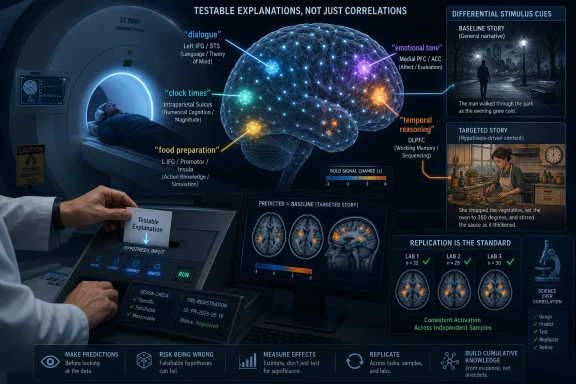
That missing legend is the heart of the Microsoft Research work. Generative causal testing, or GCT, tries to translate a model’s hidden machinery into compact phrases a scientist can read: “food preparation,” “location names,” “dialogue,” “clock times,” and so on. It then does the crucial thing that too many AI explainability systems do not: it tests whether the explanation actually causes the predicted effect.
That is why the work deserves attention beyond neuroscience. Microsoft is not merely showing another demo in which an LLM labels a pattern. It is proposing a workflow in which AI-generated explanations are forced back through the grinder of experiment.
That tradeoff is now familiar to anyone who has watched deep learning absorb one technical field after another. Accuracy improves first. Interpretability is promised later. In science, however, “later” is not a minor inconvenience; it is the difference between a model being a measuring instrument and a theory being a theory.
Brain-prediction models built on LLM representations have become powerful precisely because they capture rich statistical structure in language. They encode relationships between words, phrases, context, syntax, meaning, and discourse in ways that align surprisingly well with neural responses. But when those representations are spread across millions or billions of learned parameters, the model’s success does not directly tell a neuroscientist what a patch of cortex is doing.
That is the debt GCT is trying to pay down. It accepts that modern models may remain too complex to inspect directly, but it refuses to stop at correlation. Instead, it asks whether the behavior of a predictive model can be distilled into a hypothesis precise enough to generate a new stimulus and risky enough to fail.
This is an important move. A black box that predicts well can become a black box that suggests experiments. The experiment, not the model’s confidence, becomes the arbiter.
An LLM then summarizes those highly activating phrases into a short verbal explanation. The result is not a sprawling mechanistic theory, but a compressed label: perhaps “food preparation” or “location names.” That label is deliberately simple because it has to be testable.
The second stage is where the method becomes more than interpretability theater. An LLM writes new stories designed to match the explanation and activate the target region. Human subjects then hear or read those synthetic passages while being scanned. If the targeted region responds more strongly to those passages than to baseline material, the explanation earns experimental support.
This closed loop is the key innovation. The system does not merely ask an LLM to narrate what another model is doing. It asks the LLM to produce a stimulus that should have a measurable effect in the brain if the explanation is correct. That is a much higher bar.
The distinction matters because many AI explanations are only persuasive after the fact. They make a model’s behavior sound reasonable without proving that the stated reason is what drives the result. GCT, by contrast, takes a phrase like “location names” and puts it under the scanner. If the region does not light up, the phrase is not good enough.
That dual use will make some readers uneasy, and rightly so. If an LLM both writes the explanation and writes the test material, there is a risk of building an elegant loop that confirms its own linguistic habits. A story engineered to contain “clock times” may differ from a baseline story in all sorts of uncontrolled ways, from rhythm and concreteness to narrative setting and emotional tone.
The Microsoft-led team appears aware of that problem, which is why the work emphasizes differential stimuli and comparisons against baselines rather than simple activation maps alone. The point is not that a generated paragraph is perfectly controlled in the old laboratory sense. The point is that generative models make it possible to create and iterate stimuli quickly enough to turn vague model behavior into targeted experiments.
That is both the promise and the danger. The generate-and-test loop can accelerate discovery, but it can also accelerate the production of plausible-sounding explanations if researchers are not ruthless about controls. In science, speed is useful only when it increases contact with reality rather than merely increasing narrative output.
This is where GCT is more serious than the average AI-for-science pitch. It does not claim that a verbal explanation is true because a model produced it. It claims the explanation becomes scientifically interesting only when a scanner has a chance to disagree.
The Microsoft Research account describes experiments in which synthetic stories reliably drove their targeted regions above baseline across three subjects. That is a small number of people by population-science standards, but this kind of fMRI mapping often operates at the level of detailed individual-subject models. The important question for the method is whether a region-specific explanation can produce a region-specific response.
Some of the resulting maps lined up with established findings. Stories associated with locations produced responses in known place-processing regions, including retrosplenial cortex, parahippocampal place area, and occipital place area. A “food preparation” explanation activated a ventral occipital region near the fusiform face area, aligning with newer hypotheses about category selectivity in visual and semantic processing.
This is the unglamorous part of the story, but it is necessary. A method that cannot rediscover the obvious should not be trusted with the obscure. GCT’s credibility begins with its ability to hit known targets before it claims new ones.
The more interesting result is that not every generated explanation mapped cleanly onto an established area. Microsoft’s own summary mentions “birthdays” as one such case. That ambiguity should be read as a strength rather than an embarrassment: a serious method should produce loose ends, not just a parade of tidy confirmations.
At first, Microsoft says, stories written for one of these areas also activated the others. That is not surprising. If a passage is full of location-rich language, it may drive multiple parts of the place-processing network. A coarse stimulus can make neighboring regions look more interchangeable than they really are.
GCT’s answer was to generate differential stimuli: stories designed to activate one region while keeping nearby regions quieter. That is where the method moves from labeling to discrimination. Instead of asking whether a region likes “places,” it asks what kind of place-related information separates one area from another.
The reported example is telling. Retrosplenial cortex responded more strongly to proper-noun location names, such as Tokyo or Connecticut, than to general location language. That is a much more specific hypothesis than “this region processes places,” and it is the kind of distinction a raw predictive model would not hand to a scientist in plain English.
This is where GCT starts to look less like a clever AI wrapper and more like a tool for theory refinement. Scientific progress often comes not from discovering a new category, but from splitting an old category at the joint. “Places” becomes “proper-noun locations versus general spatial context,” and a blurry map becomes a set of sharper claims.
If the results hold up, they suggest that parts of cortex may be organized around more fine-grained semantic distinctions than researchers had previously mapped. That does not mean the brain contains a “one o’clock module” in the cartoonish sense. It means that in a particular person, under a particular modeling and scanning setup, a stable patch of cortex may respond reliably to a surprisingly specific kind of linguistic information.
This is exactly the kind of finding that needs both excitement and restraint. The excitement is obvious: a method that can discover micro-regions no one explicitly went looking for could expand the map of language-selective cortex. The restraint is equally important: small regions, small samples, and synthetic stimuli require replication before they become durable neuroscience.
Still, the methodological point is powerful. Traditional hypothesis-driven experiments depend on researchers knowing what to look for. GCT changes the search process by allowing the model to propose candidate selectivities that may not have occurred to the experimenter. The scientist’s job then shifts from inventing every hypothesis manually to auditing, testing, and refining machine-generated candidates.
That shift is familiar in other domains of AI-assisted science. In drug discovery, materials research, and protein modeling, machine learning systems increasingly propose possibilities humans then test. GCT brings that same pattern into cognitive neuroscience, with language as both the probe and the object of study.
That positioning does not make the research invalid. It does, however, explain why Microsoft is eager to frame GCT as a generalizable approach. The company’s blog explicitly points beyond neuroscience to other fields where predictive models have outrun human understanding. That is a compelling idea, and also a convenient one for a vendor whose business increasingly depends on organizations trusting opaque models.
The phrase testable explanations is doing a lot of work here. In enterprise AI, explainability often means dashboards, feature attributions, summaries, or compliance artifacts. In science, an explanation has to survive intervention. GCT’s value lies in importing that stricter scientific expectation into an AI-heavy workflow.
For WindowsForum readers, this may seem far afield from the usual concerns of Windows updates, Copilot licensing, endpoint security, and hardware compatibility. But it belongs in the same conversation because it shows the direction of Microsoft’s AI argument. The company is no longer merely saying AI can assist users. It is saying AI can help generate the hypotheses by which reality is investigated.
That is an ambitious claim. If Microsoft wants enterprises, universities, hospitals, and governments to trust AI systems in complex domains, “the model predicts well” will not be enough. GCT is a research-stage example of a more mature pitch: the model proposes, the world disposes.
The second caveat is stimulus control. LLM-generated stories can be targeted, fluent, and diverse, but they are not magically clean experimental instruments. A paragraph designed to evoke “food preparation” may also differ in objects, actions, smells, social settings, verbs, and sensory imagery. Disentangling those factors remains hard.
The third caveat is model dependence. Microsoft notes that explanations were most trustworthy where the underlying brain-prediction models were strongest and most stable. That is sensible, but it also means GCT inherits the weaknesses of the predictive model beneath it. A bad map can still generate a crisp-sounding label.
The fourth caveat is anthropomorphic temptation. Short explanations make neuroscience readable, but they can also make it too easy. A label like “dialogue” or “measurements” should be treated as a provisional compression of evidence, not as the final name of a mental faculty.
These caveats do not undermine the work. They define the territory in which it should be judged. GCT is not a finished atlas of the language brain; it is a method for making the next atlas more arguable.
But GCT’s causal claim is more modest than the word may initially suggest. The generated stimulus is an intervention. If a story designed around a hypothesized feature reliably increases activity in a target region compared with baseline, that supports the claim that the feature can drive the response. It does not prove that the region is necessary for understanding that feature, nor that the label exhausts the region’s function.
That distinction is important because the work sits between correlation and mechanistic intervention. It is stronger than simply observing that a model’s internal states correlate with brain activity. It is weaker than lesion, stimulation, or perturbation evidence showing that a region is required for a cognitive operation. Its proper role is to generate and test functional selectivity claims.
Seen that way, the method’s name is defensible if read carefully. The causal test is about whether the generated linguistic feature can drive the measured response. It is not a final theory of how language comprehension is implemented in neural circuits.
This kind of methodological precision will matter as AI-generated science becomes more common. The risk is not that models will be useless. The risk is that their outputs will arrive wrapped in language stronger than the evidence supports. GCT is interesting because it tries to discipline that language with experiment.
The GCT paper is not an enterprise observability product, and nobody should pretend it is. But the philosophy travels. If an AI system claims a server outage was caused by a certificate expiration, the operational equivalent of GCT would be a testable intervention: renew the certificate in a controlled environment, replay the failure condition, and see whether the issue disappears. Explanation becomes useful when it can be checked.
That is where the neuroscience work intersects with the practical world of systems management. Predictive accuracy is valuable, but administrators live in a world of root cause, remediation, reproducibility, and audit trails. A model that can rank likely causes is helpful. A model that can propose a verifiable test is far more valuable.
Microsoft’s research story also hints at how Copilot-like systems may evolve. Today’s AI assistants often summarize, suggest, and automate. Tomorrow’s better ones may generate experiments: test cases, synthetic workloads, adversarial prompts, controlled configuration changes, and differential diagnostics designed to isolate one explanation from another.
That future will require guardrails. In a lab, a bad generated story wastes scanner time. In production infrastructure, a bad generated test can take down a service or corrupt data. The lesson is not “let the model experiment freely.” The lesson is make the model’s explanations earn trust under controlled conditions.
In this frame, the LLM is not the scientist. It is not even the theory. It is a generator of candidate explanations and candidate tests. The scientific burden remains with experimental design, measurement, replication, and interpretation.
That division of labor is worth preserving. The current AI market often blurs it, presenting generated text as though fluency were evidence. GCT points in the opposite direction: fluency is only the beginning, and the generated phrase must face empirical risk.
The same logic could apply well beyond neuroscience. Climate models, genomics systems, recommendation engines, financial risk models, medical imaging classifiers, and security analytics all face versions of the same interpretability gap. A model can be accurate enough to influence decisions while remaining too opaque to explain itself in terms humans can debate.
The most useful AI systems in those domains may not be the ones that merely produce confident answers. They may be the ones that propose the next discriminating test. That is a less glamorous vision of AI, but a more durable one.
That loop restores an old scientific discipline inside a new computational workflow. It says an explanation should expose itself to failure. It says the value of a readable label is not how intuitive it feels, but whether it predicts what will happen under a new condition.
The scanner, in this story, is not a stage prop for AI theater. It is the judge. The LLM may write “food preparation,” but the brain response gets a vote. The model may propose that a place area cares about proper-noun locations, but a differential stimulus has to separate that claim from neighboring alternatives.
This is the part of the work that AI vendors should take seriously in their product claims. If a model-generated explanation cannot be tested, it may still be useful as a hint, but it should not be sold as understanding. The difference between a hint and an explanation is operational: what would change your mind?
GCT offers one answer. Generate a stimulus that should work if the explanation is true, and then measure whether it does. That is not the whole philosophy of science, but it is a better philosophy than “the chatbot said so.”
 Microsoft’s Brain Story Is Really an Explainability Story
The immediate subject here is language neuroscience, but the deeper subject is the same one haunting AI deployment everywhere: models can predict things that humans cannot explain. In this case, large language models can be fed the same stories a person hears in an fMRI scanner, and their internal representations can be used to predict which patches of cortex will become active. That is impressive, but it is not yet an explanation.A predictive model can say, in effect, “this brain region will respond here.” What it cannot automatically say is whether the region is tracking food, places, dialogue, numbers, time, measurements, social interaction, narrative structure, or some other feature buried in the input. The map is accurate enough to be useful, but the legend is missing.
That missing legend is the heart of the Microsoft Research work. Generative causal testing, or GCT, tries to translate a model’s hidden machinery into compact phrases a scientist can read: “food preparation,” “location names,” “dialogue,” “clock times,” and so on. It then does the crucial thing that too many AI explainability systems do not: it tests whether the explanation actually causes the predicted effect.
That is why the work deserves attention beyond neuroscience. Microsoft is not merely showing another demo in which an LLM labels a pattern. It is proposing a workflow in which AI-generated explanations are forced back through the grinder of experiment.
Prediction Was the Easy Part, Understanding Was the Debt
Over the last decade, the relationship between AI and neuroscience has changed shape. Earlier computational models of language often came with human-readable assumptions baked in. They were limited, but they were legible. Modern LLM-based models are the opposite: they work remarkably well, and then dare researchers to explain why.That tradeoff is now familiar to anyone who has watched deep learning absorb one technical field after another. Accuracy improves first. Interpretability is promised later. In science, however, “later” is not a minor inconvenience; it is the difference between a model being a measuring instrument and a theory being a theory.
Brain-prediction models built on LLM representations have become powerful precisely because they capture rich statistical structure in language. They encode relationships between words, phrases, context, syntax, meaning, and discourse in ways that align surprisingly well with neural responses. But when those representations are spread across millions or billions of learned parameters, the model’s success does not directly tell a neuroscientist what a patch of cortex is doing.
That is the debt GCT is trying to pay down. It accepts that modern models may remain too complex to inspect directly, but it refuses to stop at correlation. Instead, it asks whether the behavior of a predictive model can be distilled into a hypothesis precise enough to generate a new stimulus and risky enough to fail.
This is an important move. A black box that predicts well can become a black box that suggests experiments. The experiment, not the model’s confidence, becomes the arbiter.
GCT Turns the Model Into a Hypothesis Generator
The GCT pipeline has two major stages: explanation and verification. First, researchers start with a predictive model for a voxel or region of interest. They identify short phrases that most strongly drive the model’s predicted response for that brain location.An LLM then summarizes those highly activating phrases into a short verbal explanation. The result is not a sprawling mechanistic theory, but a compressed label: perhaps “food preparation” or “location names.” That label is deliberately simple because it has to be testable.
The second stage is where the method becomes more than interpretability theater. An LLM writes new stories designed to match the explanation and activate the target region. Human subjects then hear or read those synthetic passages while being scanned. If the targeted region responds more strongly to those passages than to baseline material, the explanation earns experimental support.
This closed loop is the key innovation. The system does not merely ask an LLM to narrate what another model is doing. It asks the LLM to produce a stimulus that should have a measurable effect in the brain if the explanation is correct. That is a much higher bar.
The distinction matters because many AI explanations are only persuasive after the fact. They make a model’s behavior sound reasonable without proving that the stated reason is what drives the result. GCT, by contrast, takes a phrase like “location names” and puts it under the scanner. If the region does not light up, the phrase is not good enough.
The LLM Is Both Microscope and Lab Assistant
There is a subtle but important dual role for the LLM in this research. In the first stage, it helps summarize model-driving language features into human-readable hypotheses. In the second, it generates new experimental stimuli to test those hypotheses.That dual use will make some readers uneasy, and rightly so. If an LLM both writes the explanation and writes the test material, there is a risk of building an elegant loop that confirms its own linguistic habits. A story engineered to contain “clock times” may differ from a baseline story in all sorts of uncontrolled ways, from rhythm and concreteness to narrative setting and emotional tone.
The Microsoft-led team appears aware of that problem, which is why the work emphasizes differential stimuli and comparisons against baselines rather than simple activation maps alone. The point is not that a generated paragraph is perfectly controlled in the old laboratory sense. The point is that generative models make it possible to create and iterate stimuli quickly enough to turn vague model behavior into targeted experiments.
That is both the promise and the danger. The generate-and-test loop can accelerate discovery, but it can also accelerate the production of plausible-sounding explanations if researchers are not ruthless about controls. In science, speed is useful only when it increases contact with reality rather than merely increasing narrative output.
This is where GCT is more serious than the average AI-for-science pitch. It does not claim that a verbal explanation is true because a model produced it. It claims the explanation becomes scientifically interesting only when a scanner has a chance to disagree.
Known Brain Regions Give the Method Its First Trial
A new interpretability method has to begin by proving it can recover things researchers already know. Otherwise, every “discovery” is just a fresh label over uncertainty. GCT’s validation step therefore matters as much as its more novel findings.The Microsoft Research account describes experiments in which synthetic stories reliably drove their targeted regions above baseline across three subjects. That is a small number of people by population-science standards, but this kind of fMRI mapping often operates at the level of detailed individual-subject models. The important question for the method is whether a region-specific explanation can produce a region-specific response.
Some of the resulting maps lined up with established findings. Stories associated with locations produced responses in known place-processing regions, including retrosplenial cortex, parahippocampal place area, and occipital place area. A “food preparation” explanation activated a ventral occipital region near the fusiform face area, aligning with newer hypotheses about category selectivity in visual and semantic processing.
This is the unglamorous part of the story, but it is necessary. A method that cannot rediscover the obvious should not be trusted with the obscure. GCT’s credibility begins with its ability to hit known targets before it claims new ones.
The more interesting result is that not every generated explanation mapped cleanly onto an established area. Microsoft’s own summary mentions “birthdays” as one such case. That ambiguity should be read as a strength rather than an embarrassment: a serious method should produce loose ends, not just a parade of tidy confirmations.
Place Areas Were Similar Until the Stories Got Sharper
One of the strongest examples in the work involves three neighboring brain regions associated with place processing: retrosplenial cortex, parahippocampal place area, and occipital place area. These regions have often been discussed together because they all respond to places in some form. The practical problem is that “places” is a broad category, and broad categories blur neural differences.At first, Microsoft says, stories written for one of these areas also activated the others. That is not surprising. If a passage is full of location-rich language, it may drive multiple parts of the place-processing network. A coarse stimulus can make neighboring regions look more interchangeable than they really are.
GCT’s answer was to generate differential stimuli: stories designed to activate one region while keeping nearby regions quieter. That is where the method moves from labeling to discrimination. Instead of asking whether a region likes “places,” it asks what kind of place-related information separates one area from another.
The reported example is telling. Retrosplenial cortex responded more strongly to proper-noun location names, such as Tokyo or Connecticut, than to general location language. That is a much more specific hypothesis than “this region processes places,” and it is the kind of distinction a raw predictive model would not hand to a scientist in plain English.
This is where GCT starts to look less like a clever AI wrapper and more like a tool for theory refinement. Scientific progress often comes not from discovering a new category, but from splitting an old category at the joint. “Places” becomes “proper-noun locations versus general spatial context,” and a blurry map becomes a set of sharper claims.
The Prefrontal Micro-Regions Are the Provocation
The most provocative part of the work is the reported discovery of small prefrontal “micro-regions” tuned to specific language concepts. Microsoft describes regions selective for dialogue between people, mentions of clock times, and numeric measurements. These are not grand categories like vision, language, or memory. They are tiny conceptual hooks embedded in ordinary discourse.If the results hold up, they suggest that parts of cortex may be organized around more fine-grained semantic distinctions than researchers had previously mapped. That does not mean the brain contains a “one o’clock module” in the cartoonish sense. It means that in a particular person, under a particular modeling and scanning setup, a stable patch of cortex may respond reliably to a surprisingly specific kind of linguistic information.
This is exactly the kind of finding that needs both excitement and restraint. The excitement is obvious: a method that can discover micro-regions no one explicitly went looking for could expand the map of language-selective cortex. The restraint is equally important: small regions, small samples, and synthetic stimuli require replication before they become durable neuroscience.
Still, the methodological point is powerful. Traditional hypothesis-driven experiments depend on researchers knowing what to look for. GCT changes the search process by allowing the model to propose candidate selectivities that may not have occurred to the experimenter. The scientist’s job then shifts from inventing every hypothesis manually to auditing, testing, and refining machine-generated candidates.
That shift is familiar in other domains of AI-assisted science. In drug discovery, materials research, and protein modeling, machine learning systems increasingly propose possibilities humans then test. GCT brings that same pattern into cognitive neuroscience, with language as both the probe and the object of study.
Microsoft Is Selling a Philosophy, Not Just a Paper
It is impossible to separate this work from Microsoft’s broader AI strategy. The company has spent the last several years embedding generative AI into products, developer platforms, cloud services, search, security workflows, and research tooling. A paper about LLMs helping explain brain models fits neatly into that larger story: AI is not only a product layer, but a method for doing knowledge work.That positioning does not make the research invalid. It does, however, explain why Microsoft is eager to frame GCT as a generalizable approach. The company’s blog explicitly points beyond neuroscience to other fields where predictive models have outrun human understanding. That is a compelling idea, and also a convenient one for a vendor whose business increasingly depends on organizations trusting opaque models.
The phrase testable explanations is doing a lot of work here. In enterprise AI, explainability often means dashboards, feature attributions, summaries, or compliance artifacts. In science, an explanation has to survive intervention. GCT’s value lies in importing that stricter scientific expectation into an AI-heavy workflow.
For WindowsForum readers, this may seem far afield from the usual concerns of Windows updates, Copilot licensing, endpoint security, and hardware compatibility. But it belongs in the same conversation because it shows the direction of Microsoft’s AI argument. The company is no longer merely saying AI can assist users. It is saying AI can help generate the hypotheses by which reality is investigated.
That is an ambitious claim. If Microsoft wants enterprises, universities, hospitals, and governments to trust AI systems in complex domains, “the model predicts well” will not be enough. GCT is a research-stage example of a more mature pitch: the model proposes, the world disposes.
The Caveats Are Not Footnotes
The first caveat is scale. The Microsoft summary says three subjects returned to the scanner for synthetic-story testing. That may be appropriate for intensive individual-level fMRI studies, but it limits how broadly any specific cortical selectivity claim should be generalized. The method may be more important than any one discovered micro-region.The second caveat is stimulus control. LLM-generated stories can be targeted, fluent, and diverse, but they are not magically clean experimental instruments. A paragraph designed to evoke “food preparation” may also differ in objects, actions, smells, social settings, verbs, and sensory imagery. Disentangling those factors remains hard.
The third caveat is model dependence. Microsoft notes that explanations were most trustworthy where the underlying brain-prediction models were strongest and most stable. That is sensible, but it also means GCT inherits the weaknesses of the predictive model beneath it. A bad map can still generate a crisp-sounding label.
The fourth caveat is anthropomorphic temptation. Short explanations make neuroscience readable, but they can also make it too easy. A label like “dialogue” or “measurements” should be treated as a provisional compression of evidence, not as the final name of a mental faculty.
These caveats do not undermine the work. They define the territory in which it should be judged. GCT is not a finished atlas of the language brain; it is a method for making the next atlas more arguable.
The Real Advance Is the Refusal to Stop at Correlation
The phrase “causal” in generative causal testing is likely to draw scrutiny, as it should. In neuroscience, causality is a high bar. fMRI measures blood-oxygen-level-dependent responses, not neurons directly, and increased activity in a region does not by itself prove a full causal mechanism of cognition.But GCT’s causal claim is more modest than the word may initially suggest. The generated stimulus is an intervention. If a story designed around a hypothesized feature reliably increases activity in a target region compared with baseline, that supports the claim that the feature can drive the response. It does not prove that the region is necessary for understanding that feature, nor that the label exhausts the region’s function.
That distinction is important because the work sits between correlation and mechanistic intervention. It is stronger than simply observing that a model’s internal states correlate with brain activity. It is weaker than lesion, stimulation, or perturbation evidence showing that a region is required for a cognitive operation. Its proper role is to generate and test functional selectivity claims.
Seen that way, the method’s name is defensible if read carefully. The causal test is about whether the generated linguistic feature can drive the measured response. It is not a final theory of how language comprehension is implemented in neural circuits.
This kind of methodological precision will matter as AI-generated science becomes more common. The risk is not that models will be useless. The risk is that their outputs will arrive wrapped in language stronger than the evidence supports. GCT is interesting because it tries to discipline that language with experiment.
Why IT Pros Should Care About a Brain-Mapping Paper
A Windows administrator does not need to know the difference between RSC and PPA to see the larger pattern. Modern AI systems are increasingly used to interpret logs, detect threats, triage support tickets, summarize incidents, generate code, and recommend actions. In each case, the same question appears: is the model giving you an explanation, or merely a plausible sentence?The GCT paper is not an enterprise observability product, and nobody should pretend it is. But the philosophy travels. If an AI system claims a server outage was caused by a certificate expiration, the operational equivalent of GCT would be a testable intervention: renew the certificate in a controlled environment, replay the failure condition, and see whether the issue disappears. Explanation becomes useful when it can be checked.
That is where the neuroscience work intersects with the practical world of systems management. Predictive accuracy is valuable, but administrators live in a world of root cause, remediation, reproducibility, and audit trails. A model that can rank likely causes is helpful. A model that can propose a verifiable test is far more valuable.
Microsoft’s research story also hints at how Copilot-like systems may evolve. Today’s AI assistants often summarize, suggest, and automate. Tomorrow’s better ones may generate experiments: test cases, synthetic workloads, adversarial prompts, controlled configuration changes, and differential diagnostics designed to isolate one explanation from another.
That future will require guardrails. In a lab, a bad generated story wastes scanner time. In production infrastructure, a bad generated test can take down a service or corrupt data. The lesson is not “let the model experiment freely.” The lesson is make the model’s explanations earn trust under controlled conditions.
The Map Microsoft Wants to Draw Is Bigger Than the Cortex
The broader importance of GCT is that it reframes LLMs as instruments for theory-building rather than merely answer engines. That is a healthier role for them. An answer engine invites passive trust. A theory-building instrument invites skepticism, iteration, and measurement.In this frame, the LLM is not the scientist. It is not even the theory. It is a generator of candidate explanations and candidate tests. The scientific burden remains with experimental design, measurement, replication, and interpretation.
That division of labor is worth preserving. The current AI market often blurs it, presenting generated text as though fluency were evidence. GCT points in the opposite direction: fluency is only the beginning, and the generated phrase must face empirical risk.
The same logic could apply well beyond neuroscience. Climate models, genomics systems, recommendation engines, financial risk models, medical imaging classifiers, and security analytics all face versions of the same interpretability gap. A model can be accurate enough to influence decisions while remaining too opaque to explain itself in terms humans can debate.
The most useful AI systems in those domains may not be the ones that merely produce confident answers. They may be the ones that propose the next discriminating test. That is a less glamorous vision of AI, but a more durable one.
The Scanner Becomes a Judge, Not a Stage Prop
What makes the Microsoft-led work persuasive is not that it uses fMRI, LLMs, or synthetic stories individually. All of those ingredients can be overhyped. The persuasive part is the loop: model, explanation, generated stimulus, measured response, revision.That loop restores an old scientific discipline inside a new computational workflow. It says an explanation should expose itself to failure. It says the value of a readable label is not how intuitive it feels, but whether it predicts what will happen under a new condition.
The scanner, in this story, is not a stage prop for AI theater. It is the judge. The LLM may write “food preparation,” but the brain response gets a vote. The model may propose that a place area cares about proper-noun locations, but a differential stimulus has to separate that claim from neighboring alternatives.
This is the part of the work that AI vendors should take seriously in their product claims. If a model-generated explanation cannot be tested, it may still be useful as a hint, but it should not be sold as understanding. The difference between a hint and an explanation is operational: what would change your mind?
GCT offers one answer. Generate a stimulus that should work if the explanation is true, and then measure whether it does. That is not the whole philosophy of science, but it is a better philosophy than “the chatbot said so.”
The Brain Paper’s Practical Lesson Is That Explanations Need Stress Tests
Microsoft’s GCT work is still research, and its most specific neuroscience claims will need the usual cycle of replication, criticism, and refinement. But the structure of the work is concrete enough to extract a few lessons now.- LLM-based models can predict brain responses to language, but prediction alone does not reveal what a brain region is responding to.
- Generative causal testing turns model-driving phrases into short explanations and then uses generated stories to test those explanations in the scanner.
- The method appears strongest where the underlying predictive brain models are stable and accurate.
- GCT reproduced known selectivity in place-processing regions and helped separate neighboring regions that broad “place” stimuli can blur together.
- The reported prefrontal micro-regions for dialogue, clock times, and measurements are intriguing, but they should be treated as early scientific claims rather than settled anatomy.
- The larger lesson for AI is that explanations become more trustworthy when they generate risky, measurable tests.
References
- Primary source: Microsoft
Published: Thu, 25 Jun 2026 16:00:00 GMT
Understanding the brain with AI-driven explanations and experiments - Microsoft Research
Researchers introduce generative causal testing, which translates black box models into clear hypotheses and verifies them in the scanner, revealing what specific brain regions respond to in language.www.microsoft.com
