
CISA on June 25, 2026, published an industrial control systems advisory for Daktronics Controller Firmware, warning that vulnerable DMP-5000, VFC-DMP-5000, and DMP-8000 devices could allow unauthenticated attackers to gain root-level control if left exposed. The advisory is not just another entry in the weekly vulnerability stream; it is a reminder that public-facing “appliances” in stadiums, venues, hospitals, and emergency environments are still computers with firmware, credentials, and attack surfaces. The uncomfortable part is that these systems often sit outside the normal mental model of enterprise patching. They are operational technology wearing the friendly face of a display controller.
The phrase “controller firmware” has a way of lowering the room temperature in IT discussions. It sounds specific, embedded, maybe even obscure enough to ignore until the next maintenance window. But CISA’s Daktronics advisory lands in a category where obscure does not mean harmless.
Daktronics is best known for digital displays, scoreboards, message boards, and venue systems. That makes the affected firmware interesting in a way a generic server flaw is not: these devices can bridge the physical and public worlds. A compromised display controller may not sound like the first domino in a catastrophic breach, but root-level control of any device on a production network is never just about the device itself.
CISA says successful exploitation could give an unauthenticated user complete root-level access and control of the system. That is the line administrators should not skim past. “Unauthenticated” means the attacker does not need a legitimate account; “root-level” means the attacker is not merely changing a setting but potentially owning the operating environment beneath the application.
The vulnerabilities called out include path traversal, unrestricted upload of dangerous file types, and hard-coded credentials. Those are not exotic cryptographic side channels or academic edge cases. They are the kind of practical, composable flaws that can turn a network-reachable embedded system into a foothold.
Path traversal vulnerabilities typically allow an attacker to access files outside the directory the application intended to expose. In an embedded controller, that can mean reading sensitive configuration, overwriting files, or manipulating application behavior depending on implementation. It is not glamorous, but it is one of the oldest ways web-exposed services lose control of their own filesystem.
Unrestricted upload of dangerous file types is worse when paired with weak authentication or credential problems. If an attacker can place executable content where the device will run or process it, the attack shifts from “I can read something I should not” to “I can make the system do something it should not.” On a general-purpose server, defenders at least expect to hunt this kind of behavior. On a display controller, it may go unnoticed because nobody bought the device thinking of it as a server.
Hard-coded credentials are the oldest embedded-systems sin because they collapse the distinction between “my device” and “every device like mine.” If credentials are shared, recoverable, or baked into firmware, defenders cannot simply rotate passwords in the usual enterprise sense. The fix has to come from firmware, compensating controls, or removing exposure.
That combination explains why CISA’s language is direct. This is not merely a risk of defacement or nuisance disruption. Root-level control turns the controller into a platform from which an attacker can persist, pivot, sniff, relay, or simply disrupt operations at a politically or commercially sensitive moment.
That phrasing matters because it suggests organizations should not treat “v10” as automatically safe, or “v8” as merely old and unsupported. The advisory is branch-aware. If your environment standardized on one major firmware family and assumed that was enough, the relevant question is whether the device is at or beyond the fixed point for that branch.
This is a familiar frustration in operational technology. Firmware lifecycles do not always map cleanly to enterprise software lifecycles. Devices are installed, commissioned, integrated into venue workflows, and then left alone because downtime is visible and patching feels risky.
That risk calculation is increasingly backwards. Leaving a controller unpatched because it is operationally important is exactly why an attacker may find it attractive. The more awkward a device is to patch, the more defenders are tempted to grant it informal immunity.
Internet exposure is especially dangerous for systems that were deployed for availability and convenience rather than hostile-network resilience. Remote access often creeps in through vendor support needs, venue operations, integrator shortcuts, or emergency maintenance requirements. Over time, exceptions become architecture.
CISA also recommends placing control system networks and remote devices behind firewalls and isolating them from business networks. That isolation is not just to protect the controller from the enterprise; it is also to protect the enterprise from the controller. Once a device can be rooted, every trust relationship around it becomes suspect.
Remote access should use more secure methods, such as VPNs, but CISA correctly notes that VPNs themselves must be current and that a VPN is only as secure as the devices connected through it. That caveat deserves more attention than it usually receives. A VPN wrapped around poor segmentation can turn remote access into a private highway to fragile systems.
A compromised controller could be used for obvious mischief, such as unauthorized messages on a public display. That scenario is easy to imagine and easy to trivialize. But focusing only on defacement misses the deeper operational concern.
Digital display controllers may sit near scheduling systems, media servers, building networks, point-of-sale environments, or maintenance workstations. Even when they do not have direct access to sensitive data, they may share management paths or administrative habits with systems that do. Attackers do not need every foothold to contain the crown jewels; they need footholds that make the next step easier.
Healthcare and emergency services raise the stakes further. A display controller in those environments may not be life-critical in the way a clinical system or dispatch platform is, but disruption and confusion matter. The security posture of “secondary” systems becomes part of organizational resilience.
The governance problem is that buyers often do not know how to evaluate credential architecture before procurement. A product can look mature, reliable, and industry-standard while still relying on credential practices that would be rejected in a modern enterprise application. By the time the issue appears in an advisory, customers are stuck balancing firmware updates, compensating controls, vendor support, and operational downtime.
This is where IT and OT teams frequently talk past each other. IT sees hard-coded credentials and thinks “unacceptable.” OT sees firmware replacement and thinks “outage, compatibility, rollback plan, vendor coordination.” Both are right, and the result is delay unless leadership forces a risk-based path.
The right lesson is not that embedded vendors are uniquely negligent. The lesson is that embedded products need the same procurement pressure now applied to SaaS platforms and endpoint agents. Customers should ask about unique credentials, password rotation, signed updates, vulnerability disclosure, and remote-access assumptions before a device is purchased, not after CISA publishes an advisory.
That is why firmware advisories belong in the same operational rhythm as OS and application vulnerabilities. A domain-joined Windows workstation used to administer an OT device can become the bridge in either direction. If the workstation is compromised, the controller may be reachable; if the controller is compromised, the workstation may be targeted.
Modern enterprise security is full of these asymmetric dependencies. The device with the weakest update story may be protected by the team with the strongest endpoint discipline, or it may sit in a shadow network maintained by a vendor account nobody has reviewed in years. Neither model works if asset inventory is incomplete.
The practical move is to treat these controllers as managed assets even if they do not run familiar software. They need owners, network diagrams, firmware baselines, access-control reviews, and maintenance windows. If an organization can tell you the exact build number of every Windows Server but not the firmware branch of the display controller in a public venue, its asset discipline has a blind spot.
The advisory itself changes the risk landscape. Once details are public enough to identify affected products and bug classes, defenders and attackers are both on the clock. Even without proof-of-concept code, the existence of path traversal, dangerous upload handling, and credential weaknesses gives skilled actors a map of where to look.
Industrial environments also suffer from detection gaps. A compromised controller may not generate the kind of telemetry a security operations center expects. Logs may be sparse, retained locally, or never forwarded. Alerts may focus on availability rather than command execution or file integrity.
That means “no known exploitation” should trigger urgency, not complacency. The best time to find exposed controllers is before opportunistic scanning turns the advisory into a target list. The best time to test segmentation is before an incident response team discovers that the display network can see more than anyone intended.
The process is imperfect. Customers often want more technical detail than advisories provide, while vendors may prefer less. Researchers may wait months for fixes. Defenders are left to act on summaries that say enough to establish urgency but not always enough to validate exposure with precision.
Still, the alternative is worse. Quietly exploitable firmware bugs in widely deployed devices are exactly the kind of risk that benefits from public coordination. The publication date, affected versions, severity, and mitigations give defenders a common language for change management.
There is also a broader cultural point. Academic and independent research into operational technology can feel uncomfortable for vendors, but it is necessary. The attack surface is too large, too specialized, and too unevenly monitored to depend only on internal testing.
The goal is not to build a decorative firewall rule and declare victory. The goal is to make exploitation materially harder. Controllers should not accept management traffic from broad corporate networks, guest networks, vendor laptops, or the internet. Administrative access should originate from controlled jump hosts or management segments with logging and strong authentication.
Outbound traffic deserves the same scrutiny. A rooted device that can freely reach the internet is easier to turn into a persistent implant or command-and-control node. If a controller needs specific vendor update or support connectivity, define and monitor that path rather than allowing default egress.
Segmentation also helps incident response. If a controller behaves strangely, defenders should be able to isolate it without taking down unrelated business systems. That kind of containment is only possible when the network was designed with failure in mind.
Active Directory groups may govern access to management workstations. VPN policies may determine who can reach the controller network. Firewall teams may own the rules that separate venue systems from business systems. Endpoint management may decide whether the laptop used by an integrator is trusted, monitored, or blocked.
That means the response should be cross-functional. Facilities can identify the device and operational constraints. The vendor can confirm firmware paths. Network teams can validate exposure. Security teams can review logs and detection. Windows admins can secure the management plane that humans actually use.
The worst response is to assume this is “not our system.” Attackers do not respect org charts, and root access on a neglected embedded device has a way of becoming everyone’s problem.
A serious inventory should include model, firmware branch, management interface, IP address, physical location, business owner, vendor contact, support status, and network path. It should also capture whether the device is internet-accessible directly or indirectly through remote access tooling. If that information is unavailable, the advisory has already done its job by revealing a governance gap.
Version mapping is especially important here because the affected branches are explicit. Teams should confirm whether VFC-DMP-5000, DMP-5000, or DMP-8000 firmware is present and whether it falls below the relevant v8.117.x.x, v9.43.x.x, or v10.34.x.x thresholds. Guessing by purchase date is not a substitute for checking the device.
Once inventory exists, the remediation conversation becomes less emotional. Instead of arguing about whether “the scoreboard” is vulnerable, teams can discuss a known device, known firmware, known exposure, and known compensating controls. That is how operational security becomes manageable.
Organizations should resist the temptation to choose between patching and compensating controls as if they are mutually exclusive. For high-impact embedded vulnerabilities, both tracks should run at once. Network exposure can often be reduced faster than firmware can be validated, while firmware remediation closes the underlying defect rather than relying indefinitely on perimeter assumptions.
Change management should include a rollback plan and coordination with anyone who depends on the display system. That may include venue operations, public safety, communications teams, facilities, or clinical operations depending on deployment. Security teams sometimes underestimate how visible these systems are when they fail.
But visibility cuts both ways. A public display incident is reputationally loud, and leadership understands reputational risk. Framing the advisory as a resilience issue rather than a niche firmware issue may help teams get the maintenance windows they need.
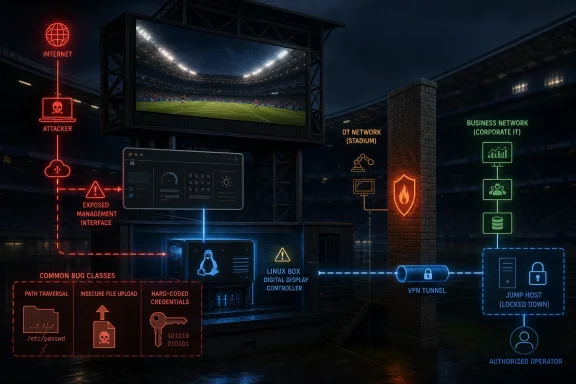 A Scoreboard Controller Is Still a Linux Box With Consequences
The phrase “controller firmware” has a way of lowering the room temperature in IT discussions. It sounds specific, embedded, maybe even obscure enough to ignore until the next maintenance window. But CISA’s Daktronics advisory lands in a category where obscure does not mean harmless.Daktronics is best known for digital displays, scoreboards, message boards, and venue systems. That makes the affected firmware interesting in a way a generic server flaw is not: these devices can bridge the physical and public worlds. A compromised display controller may not sound like the first domino in a catastrophic breach, but root-level control of any device on a production network is never just about the device itself.
CISA says successful exploitation could give an unauthenticated user complete root-level access and control of the system. That is the line administrators should not skim past. “Unauthenticated” means the attacker does not need a legitimate account; “root-level” means the attacker is not merely changing a setting but potentially owning the operating environment beneath the application.
The vulnerabilities called out include path traversal, unrestricted upload of dangerous file types, and hard-coded credentials. Those are not exotic cryptographic side channels or academic edge cases. They are the kind of practical, composable flaws that can turn a network-reachable embedded system into a foothold.
The Bug Classes Tell a Bigger Story Than the CVSS Number
The vendor-assigned CVSS v3 score is 8.1, which places the issue in high-severity territory. That number is useful, but it undersells the practical anxiety here because the vulnerability mix matters more than the decimal. Path traversal, arbitrary dangerous uploads, and hard-coded credentials are three different ways of saying the same thing: the device boundary is too porous.Path traversal vulnerabilities typically allow an attacker to access files outside the directory the application intended to expose. In an embedded controller, that can mean reading sensitive configuration, overwriting files, or manipulating application behavior depending on implementation. It is not glamorous, but it is one of the oldest ways web-exposed services lose control of their own filesystem.
Unrestricted upload of dangerous file types is worse when paired with weak authentication or credential problems. If an attacker can place executable content where the device will run or process it, the attack shifts from “I can read something I should not” to “I can make the system do something it should not.” On a general-purpose server, defenders at least expect to hunt this kind of behavior. On a display controller, it may go unnoticed because nobody bought the device thinking of it as a server.
Hard-coded credentials are the oldest embedded-systems sin because they collapse the distinction between “my device” and “every device like mine.” If credentials are shared, recoverable, or baked into firmware, defenders cannot simply rotate passwords in the usual enterprise sense. The fix has to come from firmware, compensating controls, or removing exposure.
That combination explains why CISA’s language is direct. This is not merely a risk of defacement or nuisance disruption. Root-level control turns the controller into a platform from which an attacker can persist, pivot, sniff, relay, or simply disrupt operations at a politically or commercially sensitive moment.
The Affected Versions Span Several Firmware Branches
The affected products include VFC-DMP-5000, DMP-5000, and DMP-8000 controller firmware across multiple version branches. CISA lists affected VFC-DMP-5000 firmware below v8.117.x.x, below v9.43.x.x, and below v10.34.x.x. It lists the same branch thresholds for DMP-5000 and DMP-8000: versions below v8.117.x.x, below v9.43.x.x, and below v10.34.x.x are affected.That phrasing matters because it suggests organizations should not treat “v10” as automatically safe, or “v8” as merely old and unsupported. The advisory is branch-aware. If your environment standardized on one major firmware family and assumed that was enough, the relevant question is whether the device is at or beyond the fixed point for that branch.
This is a familiar frustration in operational technology. Firmware lifecycles do not always map cleanly to enterprise software lifecycles. Devices are installed, commissioned, integrated into venue workflows, and then left alone because downtime is visible and patching feels risky.
That risk calculation is increasingly backwards. Leaving a controller unpatched because it is operationally important is exactly why an attacker may find it attractive. The more awkward a device is to patch, the more defenders are tempted to grant it informal immunity.
The Real Exposure Is Network Reachability
CISA’s recommended mitigations are conventional because the first principle remains stubbornly effective: minimize network exposure for control systems and make sure they are not accessible from the internet. That advice can sound boilerplate, but in this case it is the center of the story. The difference between a vulnerable embedded controller on a segmented management network and the same controller reachable from the public internet is the difference between a scheduled remediation task and an incident waiting for a scan.Internet exposure is especially dangerous for systems that were deployed for availability and convenience rather than hostile-network resilience. Remote access often creeps in through vendor support needs, venue operations, integrator shortcuts, or emergency maintenance requirements. Over time, exceptions become architecture.
CISA also recommends placing control system networks and remote devices behind firewalls and isolating them from business networks. That isolation is not just to protect the controller from the enterprise; it is also to protect the enterprise from the controller. Once a device can be rooted, every trust relationship around it becomes suspect.
Remote access should use more secure methods, such as VPNs, but CISA correctly notes that VPNs themselves must be current and that a VPN is only as secure as the devices connected through it. That caveat deserves more attention than it usually receives. A VPN wrapped around poor segmentation can turn remote access into a private highway to fragile systems.
Public Venues Make Low-Level Firmware Bugs Very Public
The sectors listed for this advisory include commercial facilities, information technology, emergency services, and healthcare and public health, with worldwide deployment. That is a broad footprint, but the commercial facilities angle is particularly important because display systems live in places where failures are visible. Stadiums, arenas, campuses, hospitals, transportation-adjacent spaces, and public venues all depend on signage and display infrastructure for information, operations, and credibility.A compromised controller could be used for obvious mischief, such as unauthorized messages on a public display. That scenario is easy to imagine and easy to trivialize. But focusing only on defacement misses the deeper operational concern.
Digital display controllers may sit near scheduling systems, media servers, building networks, point-of-sale environments, or maintenance workstations. Even when they do not have direct access to sensitive data, they may share management paths or administrative habits with systems that do. Attackers do not need every foothold to contain the crown jewels; they need footholds that make the next step easier.
Healthcare and emergency services raise the stakes further. A display controller in those environments may not be life-critical in the way a clinical system or dispatch platform is, but disruption and confusion matter. The security posture of “secondary” systems becomes part of organizational resilience.
Hard-Coded Credentials Are a Governance Failure, Not Just a Coding Error
Hard-coded credentials keep appearing in industrial advisories because embedded products have historically prioritized controlled deployment assumptions over hostile-environment assumptions. Vendors built systems for integrators, installers, and predictable field maintenance. Attackers built search queries.The governance problem is that buyers often do not know how to evaluate credential architecture before procurement. A product can look mature, reliable, and industry-standard while still relying on credential practices that would be rejected in a modern enterprise application. By the time the issue appears in an advisory, customers are stuck balancing firmware updates, compensating controls, vendor support, and operational downtime.
This is where IT and OT teams frequently talk past each other. IT sees hard-coded credentials and thinks “unacceptable.” OT sees firmware replacement and thinks “outage, compatibility, rollback plan, vendor coordination.” Both are right, and the result is delay unless leadership forces a risk-based path.
The right lesson is not that embedded vendors are uniquely negligent. The lesson is that embedded products need the same procurement pressure now applied to SaaS platforms and endpoint agents. Customers should ask about unique credentials, password rotation, signed updates, vulnerability disclosure, and remote-access assumptions before a device is purchased, not after CISA publishes an advisory.
Patch Management Cannot Stop at Windows Update
For a WindowsForum audience, the immediate relevance may not seem obvious. Daktronics controller firmware is not Windows, and this is not a Patch Tuesday story. But Windows administrators increasingly own the connective tissue around these systems: management workstations, firewall rules, remote-access tooling, identity policy, logging pipelines, and incident response.That is why firmware advisories belong in the same operational rhythm as OS and application vulnerabilities. A domain-joined Windows workstation used to administer an OT device can become the bridge in either direction. If the workstation is compromised, the controller may be reachable; if the controller is compromised, the workstation may be targeted.
Modern enterprise security is full of these asymmetric dependencies. The device with the weakest update story may be protected by the team with the strongest endpoint discipline, or it may sit in a shadow network maintained by a vendor account nobody has reviewed in years. Neither model works if asset inventory is incomplete.
The practical move is to treat these controllers as managed assets even if they do not run familiar software. They need owners, network diagrams, firmware baselines, access-control reviews, and maintenance windows. If an organization can tell you the exact build number of every Windows Server but not the firmware branch of the display controller in a public venue, its asset discipline has a blind spot.
No Known Exploitation Is Not a Comfort Blanket
CISA says it has no known reports of public exploitation specifically targeting these vulnerabilities at the time of publication. That is useful, but it should not be misread as safety. “No known exploitation” is a statement about visibility, reporting, and timing, not a guarantee about attacker interest.The advisory itself changes the risk landscape. Once details are public enough to identify affected products and bug classes, defenders and attackers are both on the clock. Even without proof-of-concept code, the existence of path traversal, dangerous upload handling, and credential weaknesses gives skilled actors a map of where to look.
Industrial environments also suffer from detection gaps. A compromised controller may not generate the kind of telemetry a security operations center expects. Logs may be sparse, retained locally, or never forwarded. Alerts may focus on availability rather than command execution or file integrity.
That means “no known exploitation” should trigger urgency, not complacency. The best time to find exposed controllers is before opportunistic scanning turns the advisory into a target list. The best time to test segmentation is before an incident response team discovers that the display network can see more than anyone intended.
The Research Credit Is a Quiet Win for Coordinated Disclosure
The advisory credits Thomas Jou of Princeton University with reporting the vulnerabilities to CISA. That detail matters because coordinated disclosure remains one of the few mechanisms that scales across embedded ecosystems. Researchers find flaws, vendors and agencies coordinate, and customers get a documented remediation path rather than a surprise exploit dump.The process is imperfect. Customers often want more technical detail than advisories provide, while vendors may prefer less. Researchers may wait months for fixes. Defenders are left to act on summaries that say enough to establish urgency but not always enough to validate exposure with precision.
Still, the alternative is worse. Quietly exploitable firmware bugs in widely deployed devices are exactly the kind of risk that benefits from public coordination. The publication date, affected versions, severity, and mitigations give defenders a common language for change management.
There is also a broader cultural point. Academic and independent research into operational technology can feel uncomfortable for vendors, but it is necessary. The attack surface is too large, too specialized, and too unevenly monitored to depend only on internal testing.
Segmentation Is the Control That Buys Time
Firmware updates are the cleanest long-term answer, but segmentation is the control that buys time when patching takes planning. In operational environments, immediate patching may require vendor coordination, physical access, validation against dependent systems, or scheduled downtime. Network controls can reduce exposure while that process runs.The goal is not to build a decorative firewall rule and declare victory. The goal is to make exploitation materially harder. Controllers should not accept management traffic from broad corporate networks, guest networks, vendor laptops, or the internet. Administrative access should originate from controlled jump hosts or management segments with logging and strong authentication.
Outbound traffic deserves the same scrutiny. A rooted device that can freely reach the internet is easier to turn into a persistent implant or command-and-control node. If a controller needs specific vendor update or support connectivity, define and monitor that path rather than allowing default egress.
Segmentation also helps incident response. If a controller behaves strangely, defenders should be able to isolate it without taking down unrelated business systems. That kind of containment is only possible when the network was designed with failure in mind.
The Windows Admin’s Role Is Bigger Than the Device
Many organizations will assign this advisory to facilities, AV, or an OT vendor. That may be reasonable for firmware execution, but it is not enough for risk ownership. The Windows and infrastructure teams often control the systems around the controller, and those systems determine whether the vulnerability is reachable, exploitable, or contained.Active Directory groups may govern access to management workstations. VPN policies may determine who can reach the controller network. Firewall teams may own the rules that separate venue systems from business systems. Endpoint management may decide whether the laptop used by an integrator is trusted, monitored, or blocked.
That means the response should be cross-functional. Facilities can identify the device and operational constraints. The vendor can confirm firmware paths. Network teams can validate exposure. Security teams can review logs and detection. Windows admins can secure the management plane that humans actually use.
The worst response is to assume this is “not our system.” Attackers do not respect org charts, and root access on a neglected embedded device has a way of becoming everyone’s problem.
Inventory Is Where the Incident Is Won or Lost
The first practical challenge is knowing whether the organization has affected devices at all. That sounds trivial until the asset lives under a scoreboard contract, a facilities budget, an AV integrator’s documentation, or a building project that closed five years ago. Many OT incidents begin with the sentence nobody wants to say: “We did not know that was on the network.”A serious inventory should include model, firmware branch, management interface, IP address, physical location, business owner, vendor contact, support status, and network path. It should also capture whether the device is internet-accessible directly or indirectly through remote access tooling. If that information is unavailable, the advisory has already done its job by revealing a governance gap.
Version mapping is especially important here because the affected branches are explicit. Teams should confirm whether VFC-DMP-5000, DMP-5000, or DMP-8000 firmware is present and whether it falls below the relevant v8.117.x.x, v9.43.x.x, or v10.34.x.x thresholds. Guessing by purchase date is not a substitute for checking the device.
Once inventory exists, the remediation conversation becomes less emotional. Instead of arguing about whether “the scoreboard” is vulnerable, teams can discuss a known device, known firmware, known exposure, and known compensating controls. That is how operational security becomes manageable.
The Fix Is Technical, but the Deadline Is Operational
The advisory does not change the basic remediation playbook: update affected firmware where possible, reduce exposure, isolate control systems, secure remote access, and perform impact analysis before defensive changes. The hard part is not knowing what to do. The hard part is doing it without breaking a production environment that may have narrow maintenance windows.Organizations should resist the temptation to choose between patching and compensating controls as if they are mutually exclusive. For high-impact embedded vulnerabilities, both tracks should run at once. Network exposure can often be reduced faster than firmware can be validated, while firmware remediation closes the underlying defect rather than relying indefinitely on perimeter assumptions.
Change management should include a rollback plan and coordination with anyone who depends on the display system. That may include venue operations, public safety, communications teams, facilities, or clinical operations depending on deployment. Security teams sometimes underestimate how visible these systems are when they fail.
But visibility cuts both ways. A public display incident is reputationally loud, and leadership understands reputational risk. Framing the advisory as a resilience issue rather than a niche firmware issue may help teams get the maintenance windows they need.
The Advisory Turns a Display Controller Into a Boardroom Risk
The most concrete lesson from this advisory is that embedded systems attached to public operations deserve first-class security treatment. They do not need to store customer databases to create risk. They only need to be reachable, vulnerable, and operationally awkward.- Organizations should identify whether they run VFC-DMP-5000, DMP-5000, or DMP-8000 firmware and verify the exact branch and version rather than relying on purchase records or assumptions.
- Devices below the listed v8.117.x.x, v9.43.x.x, or v10.34.x.x thresholds should be treated as exposed risk until patched or otherwise mitigated.
- Any internet-facing management interface for these controllers should be removed from direct exposure and placed behind tightly controlled access paths.
- Network segmentation should prevent compromised display controllers from reaching business systems, management workstations, or unrelated operational networks.
- Remote access should be reviewed for VPN currency, authentication strength, vendor account hygiene, and logging.
- Security teams should not interpret the lack of known exploitation as proof that vulnerable devices are safe.
References
- Primary source: CISA
Published: 2026-06-25T12:00:00+00:00

Daktronics Controller Firmware | CISA
www.cisa.gov
- Related coverage: cyber.gc.ca
[Control systems] CISA ICS security advisories (AV26–506) - Canadian Centre for Cyber Security
[Control systems] CISA ICS security advisories (AV26–506)www.cyber.gc.ca - Related coverage: cyberpress.org
- Related coverage: vulners.com
Siemens Teamcenter - vulnerability database | Vulners.com
1. SUMMARY Siemens Teamcenter is affected by multiple vulnerabilities which could potentially lead to a compromise in availability, integrity and confidentiality. Siemens has released new versions for the affected products and recommends to update...vulners.com - Related coverage: bleepingcomputer.com
CISA orders feds to patch actively exploited Ivanti flaw by Sunday
The U.S. Cybersecurity and Infrastructure Security Agency (CISA) ordered government agencies to patch an actively exploited Ivanti Sentry flaw within three days, as mandated by the newly issued Binding Operational Directive (BOD) 26-04.www.bleepingcomputer.com - Related coverage: cybersecuritynews.com
- Related coverage: malware.news
[Control systems] CISA ICS security advisories (AV26–506) - Malware News - Malware Analysis, News and Indicators
Introduction to Malware Binary Triage (IMBT) Course Looking to level up your skills? Get 10% off using coupon code: MWNEWS10 for any flavor. Enroll Now and Save 10%: Coupon Code MWNEWS10 Note: Affiliate link – your e… malware.news
- Related coverage: infocean.com
CISA Releases Eight Industrial Control Systems Advisories - Infocean Technology Co. Ltd.
CISA released eight Industrial Control Systems (ICS) advisories on June 24, 2025. These advisories […] www.infocean.com
- Related coverage: johnsoncontrols.com
