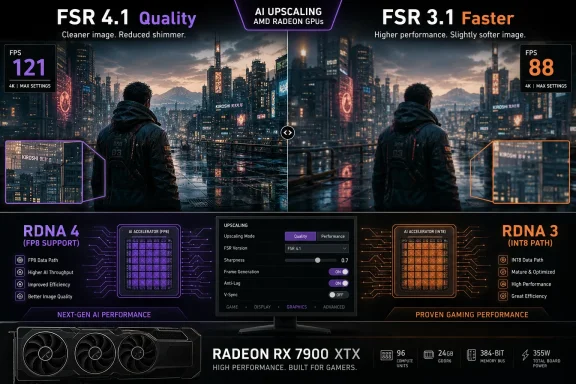
AMD officially released FSR Upscaling 4.1 for Radeon RX 7000-series graphics cards on June 22, 2026, bringing its newer machine-learning upscaler to RDNA 3 desktop GPUs through the latest Adrenalin driver ahead of the July window AMD had previously promised. The move is more than a driver footnote: it is AMD admitting that software longevity has become part of GPU value. For Windows gamers and PC builders, the question is no longer only how fast a card was at launch, but how much intelligence the vendor can bolt onto it years later. AMD has just made the RX 7000 family feel less like yesterday’s compromise and more like a still-active platform.
The obvious headline is that Radeon RX 7000 owners get access to FSR Upscaling 4.1 today, rather than waiting until July. That matters because RDNA 3 was the awkward middle child in AMD’s recent graphics stack: modern enough to include AI-oriented hardware, old enough to have missed the first wave of AMD’s machine-learning FSR push on RX 9000 cards.
For anyone who bought a Radeon RX 7900 XTX, RX 7900 XT, RX 7800 XT, RX 7700 XT, or RX 7600-class card, the update changes the aftertaste of that purchase. These cards were never slow in conventional rasterized games, but they have spent the last year watching the industry’s image reconstruction arms race move faster than raw shader gains. Upscaling quality, frame generation, ray reconstruction, and latency mitigation have become part of the performance story.
That is why FSR 4.1 reaching RX 7000 is not just AMD “supporting older GPUs.” It is AMD trying to prove that Radeon buyers are not locked into the feature set their cards shipped with. Nvidia has trained the market to expect software features to stretch hardware life; AMD’s burden is proving it can do the same without turning every generational leap into a hard product wall.
The timing helps. AMD had said in May that RX 7000 support would arrive in July 2026, with RX 6000 support planned for early 2027. Landing the first phase in late June is a small scheduling win, but in a hardware market where delayed promises age badly, even a modest early delivery buys credibility.
FSR 4 changed the premise by leaning into machine learning. That made AMD more competitive on quality, but it also introduced the same strategic problem Nvidia has lived with for years: machine-learning features are only as universal as the hardware and driver paths that can run them well. The first FSR 4 wave focused on RDNA 4 and Radeon RX 9000-series cards, where AMD could rely on newer AI acceleration and FP8 support.
The RX 7000 rollout is therefore a technical and political compromise. AMD has reportedly optimized the model path for RDNA 3’s INT8 capabilities rather than simply dumping the RDNA 4 path onto older silicon and hoping for the best. That distinction matters because bad backports can be worse than no backport at all; if the feature tanks performance or looks worse than community workarounds, the brand damage lands immediately.
It also places AMD in direct comparison with Nvidia’s “older RTX cards still get new DLSS tricks” narrative. Radeon owners have watched DLSS evolve from a niche RTX 20-series feature into a sprawling software ecosystem. AMD does not need to match Nvidia feature-for-feature overnight, but it does need to show that buying Radeon is not a vote for shorter software life.
FSR 4.1 on RX 7000 is AMD’s best answer so far. It says the company can take a machine-learning upscaler designed around newer hardware and make it useful on a previous architecture. That is exactly the kind of post-sale engineering PC gamers have started to expect from GPU vendors.
FSR 4.1 gives those cards a second chance to be judged on a more modern software stack. That does not rewrite benchmark history, and it does not turn an RX 7600 into a high-end 4K monster. But it can materially affect the lived experience of playing newer games that lean heavily on upscaling to reach high resolutions and frame rates.
AMD says FSR 4.1 is available in more than 300 games, which is the kind of number that finally sounds like an ecosystem rather than a tech demo. The more important detail is how those games expose the feature. In many modern titles, upscaling is no longer a toggle for low-end systems; it is part of the intended rendering pipeline, especially once ray tracing, high-resolution textures, or dense open worlds enter the picture.
That is why RX 7000 owners should treat this as more than a quality preset upgrade. It may determine whether a card remains comfortable at 1440p or 4K in the next wave of games. When the difference between “playable” and “compromised” is often an upscaler’s ability to preserve motion clarity, a better reconstruction model can feel like a hardware upgrade.
AMD says it is developing lightweight machine-learning models to bring FSR 4.1 to more devices, including RDNA 3 and RDNA 3.5 integrated graphics. That points toward laptops, mini PCs, handhelds, and the messy category of console-like Windows machines that increasingly define PC gaming’s growth edge. It also includes hardware where every watt and every millisecond of GPU time matters.
This is where AMD’s statement becomes strategically rich. A discrete RX 7900 XTX has enough headroom to absorb some upscaling overhead and still deliver a strong result. An integrated GPU in a handheld does not. If FSR 4.1’s machine-learning path consumes too much of the very performance it is supposed to recover, the feature becomes a spec-sheet victory rather than a gaming improvement.
That explains the “lightweight model” language. AMD appears to understand that one model cannot serve every architecture and power envelope equally well. The model that makes sense on RDNA 4 may not make sense on RDNA 3; the model that works on a desktop RX 7800 XT may be too heavy for a handheld APU with shared memory and tight thermal limits.
For Windows handhelds, this could be a pivotal development. Devices built around AMD silicon already dominate much of the category, from ROG Ally-style machines to Legion Go-class systems and the broader wave of Ryzen-powered portable PCs. If AMD can deliver FSR 4.1-class image quality in a model tuned for these chips, it gives handheld makers a powerful answer to the uncomfortable truth that many modern games are being asked to run on laptop-class integrated graphics.
It also has implications for SteamOS and Valve’s next living-room push. Reports around Valve testing FSR 4 for the upcoming Steam Machine suggest that AMD’s upscaling roadmap is no longer only a Windows driver story. A better FSR path across Proton, SteamOS, and Windows would make AMD’s technology a common denominator across PC form factors rather than a Radeon Control Panel curiosity.
On handhelds, upscaling is survival. Small devices are asked to run games designed for consoles and desktop GPUs, often while staying under strict power budgets. A handheld can brute-force older titles, but new AAA games increasingly need reconstruction to hit acceptable frame rates without destroying battery life or image quality.
That is why AMD’s APU work may become the most consequential part of the FSR 4.1 rollout. If lightweight models bring visibly better reconstruction to integrated GPUs, the benefit is not theoretical. It could mean sharper text, less shimmering, cleaner motion, and fewer compromises in the games that make handheld PCs feel like small miracles one moment and thermal math problems the next.
The risk is fragmentation. If RX 9000 gets the best FP8 path, RX 7000 gets an INT8 path, RDNA 3.5 APUs get a lightweight model, and RDNA 2 arrives later with another compromise, then FSR 4.1 becomes less a single product than a family of related behaviors. That may be technically necessary, but it makes messaging harder and testing more important.
Reviewers will need to treat “FSR 4.1” as a claim that depends on hardware. Users should do the same. A feature with the same name may not deliver identical performance, latency, or image quality across a desktop RDNA 4 card, a previous-generation RDNA 3 GPU, and a power-limited integrated GPU.
There is a technical reason for the delay. RDNA 2 lacks the same AI acceleration profile as newer architectures, so AMD has more work to do if it wants to avoid shipping a feature that runs poorly. That is a reasonable engineering constraint, but it does not erase the customer perception problem. RX 6000 owners are being told that the train is coming; they are also being told to watch RX 7000 owners board first.
The delay lands differently depending on the card. A Radeon RX 6950 XT or RX 6800 XT still has enough brute force to play many modern games well, but those cards also target resolutions where upscaling quality matters. Lower-end RX 6000 cards would benefit from better reconstruction even more, because they are more likely to lean on aggressive upscaling modes.
AMD has to be careful here. If RDNA 2 support arrives as a diminished, slow, or game-limited implementation, the goodwill from promising support could evaporate. If it arrives polished, AMD can claim a genuinely impressive backward-support story stretching across three GPU generations.
The lesson for IT pros and system builders is familiar: roadmap promises are not deployable features. If you manage shared gaming labs, esports spaces, workstation fleets with mixed Radeon hardware, or BYOD environments where driver behavior matters, RX 7000 support is real now. RDNA 2 support remains a planning assumption until AMD ships it.
AMD is not merely competing against Nvidia here. It is competing against the expectations created by its own enthusiast base. If unofficial methods delivered tantalizing image-quality gains with rough edges, AMD’s version needs to deliver the same promise with less overhead, more stability, and fewer per-game hacks.
That is where a driver-level implementation matters. Official support can be validated across more configurations, exposed through normal software controls, and integrated into game profiles without users swapping DLLs or following forum recipes. For mainstream users, that difference is enormous. For enthusiasts, it is the difference between a science project and a feature they can recommend to friends.
This is also a reminder of how much PC gaming innovation now happens in the gray zone between vendor roadmaps and community impatience. OptiScaler-style tools, Proton experiments, driver toggles, and game-specific workarounds all pressure vendors to move faster. AMD benefits from that energy, but it also has to live up to it.
The healthier version of this dynamic is not vendors locking everything down. It is vendors watching what enthusiasts prove valuable, then turning the best ideas into supported software. FSR 4.1 on RX 7000 looks like one of those moments: the community demonstrated demand, and AMD finally put engineering weight behind an official path.
The upcoming game mentions are also telling. AMD is already tying FSR 4.1 to high-profile releases and updates, including new entries and remasters that will be used as comparison fodder across Radeon and GeForce systems. That is the right battlefield. Upscaling quality is most visible in the games people are actually buying now, not in a vendor showcase from two years ago.
For Windows users, the practical point is that this is a driver-and-game interaction, not just a driver download. Users will need compatible games, current Adrenalin software, and in many cases the correct in-game FSR setting or AMD software toggle. The industry has not made this simple; depending on the title, FSR 4.1 may appear as a native option, an upgrade path from FSR 3.1, or a driver-mediated replacement.
That complexity has consequences for support. Expect forum threads where one user sees FSR 4.1, another sees only FSR 3, and a third has the right driver but the wrong game version. AMD’s ecosystem has improved, but the PC remains the PC: feature availability is a matrix, not a light switch.
The upside is that once the machinery works, the benefit is broad. A single driver update enabling better upscaling across hundreds of titles is exactly the kind of software leverage the GPU industry has been chasing. It turns compatibility into compounding value.
A new driver can add FSR 4.1 and also introduce a regression in a VR headset, a capture workflow, a multi-monitor setup, or a specific game. AMD’s recent driver notes have included the usual mixture of new support, known issues, and fixes, and serious users should read them before updating a machine they rely on. Gaming rigs can be experimental; production-adjacent systems should be treated with more discipline.
For most single-user gaming PCs, the calculus favors updating. The RX 7000 series is exactly the target hardware, and FSR 4.1 is a major enough feature that staying behind indefinitely makes little sense. If you play supported games at 1440p or 4K, the update is likely worth testing immediately.
For managed environments, the better path is staged deployment. Test the driver on representative RX 7000 systems, confirm the games or applications that matter, and watch for issues with overlays, recording tools, anti-cheat, VR, and multi-display configurations. Upscaling features may be consumer-facing, but driver stability remains an IT concern.
The most interesting group may be users who had considered replacing an RX 7000 card soon. FSR 4.1 should not stop anyone from upgrading if they need more raw performance, better ray tracing, or newer media features. But it may extend the point at which an RX 7000 card feels obsolete, and that is precisely the point.
Nvidia understood this early because DLSS made RTX hardware feel like a platform. AMD resisted parts of that model by emphasizing openness and broad compatibility, but the market has moved. Gamers now expect reconstruction, generation, latency tools, and ray-enhancement features to improve throughout a card’s life.
FSR 4.1 on RX 7000 is AMD adapting to that reality. It is not a subscription in the billing sense, but it is subscription-like in expectation: buyers assume the vendor will keep delivering meaningful software improvements. If those improvements stop too soon, the hardware feels abandoned even if it still runs games well.
That creates pressure inside AMD. Every new architecture now carries not only a launch-performance target but a support obligation. If RDNA 4 features can be backported to RDNA 3, customers will ask which RDNA 5 features can be backported to RDNA 4. The better AMD gets at software longevity, the more users will expect it.
This is a good problem to have. It forces GPU vendors to compete on engineering follow-through rather than only launch-day spectacle. It also rewards buyers who keep hardware longer, which is healthier for wallets and less absurd than treating a two-year-old high-end GPU as disposable.
This is not unique to AMD. Nvidia’s DLSS family also varies by GPU generation and feature type, and Intel’s XeSS has different paths depending on hardware. The entire industry has trained consumers to learn acronyms first and discover caveats later.
The danger for AMD is that Radeon already fights a perception battle around drivers and feature parity. If FSR 4.1 behaves inconsistently across supported hardware, critics will seize on it. If AMD clearly documents the expected differences and reviewers find the RX 7000 version genuinely strong, the company can turn a potential weakness into a maturity signal.
Transparency matters because upscaling is visual and subjective. Two users can look at the same scene and disagree about shimmer, softness, or ghosting. The only way to keep that debate productive is to be specific about hardware, driver version, game version, preset, resolution, and frame generation state.
For WindowsForum readers testing the feature, screenshots are not enough. Motion is the test. Watch foliage, fences, particle effects, hair, thin wires, reflections, and UI elements during camera movement. That is where reconstruction algorithms either earn trust or lose it.
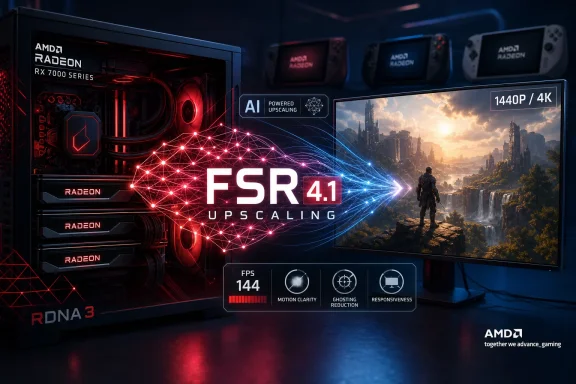 AMD Turns a Driver Update Into a Warranty on Relevance
The obvious headline is that Radeon RX 7000 owners get access to FSR Upscaling 4.1 today, rather than waiting until July. That matters because RDNA 3 was the awkward middle child in AMD’s recent graphics stack: modern enough to include AI-oriented hardware, old enough to have missed the first wave of AMD’s machine-learning FSR push on RX 9000 cards.For anyone who bought a Radeon RX 7900 XTX, RX 7900 XT, RX 7800 XT, RX 7700 XT, or RX 7600-class card, the update changes the aftertaste of that purchase. These cards were never slow in conventional rasterized games, but they have spent the last year watching the industry’s image reconstruction arms race move faster than raw shader gains. Upscaling quality, frame generation, ray reconstruction, and latency mitigation have become part of the performance story.
That is why FSR 4.1 reaching RX 7000 is not just AMD “supporting older GPUs.” It is AMD trying to prove that Radeon buyers are not locked into the feature set their cards shipped with. Nvidia has trained the market to expect software features to stretch hardware life; AMD’s burden is proving it can do the same without turning every generational leap into a hard product wall.
The timing helps. AMD had said in May that RX 7000 support would arrive in July 2026, with RX 6000 support planned for early 2027. Landing the first phase in late June is a small scheduling win, but in a hardware market where delayed promises age badly, even a modest early delivery buys credibility.
The Real Competition Is Not Native 4K, It Is Nvidia’s Upgrade Story
AMD’s pitch around FSR has always been broader than Nvidia’s DLSS pitch. FSR began as a more open, less hardware-dependent technology that could run across a wide range of GPUs, including competitors’ cards. That openness helped AMD win developer mindshare and community goodwill, but it also created a ceiling: earlier FSR versions often struggled to match DLSS in image stability, fine detail, and motion handling.FSR 4 changed the premise by leaning into machine learning. That made AMD more competitive on quality, but it also introduced the same strategic problem Nvidia has lived with for years: machine-learning features are only as universal as the hardware and driver paths that can run them well. The first FSR 4 wave focused on RDNA 4 and Radeon RX 9000-series cards, where AMD could rely on newer AI acceleration and FP8 support.
The RX 7000 rollout is therefore a technical and political compromise. AMD has reportedly optimized the model path for RDNA 3’s INT8 capabilities rather than simply dumping the RDNA 4 path onto older silicon and hoping for the best. That distinction matters because bad backports can be worse than no backport at all; if the feature tanks performance or looks worse than community workarounds, the brand damage lands immediately.
It also places AMD in direct comparison with Nvidia’s “older RTX cards still get new DLSS tricks” narrative. Radeon owners have watched DLSS evolve from a niche RTX 20-series feature into a sprawling software ecosystem. AMD does not need to match Nvidia feature-for-feature overnight, but it does need to show that buying Radeon is not a vote for shorter software life.
FSR 4.1 on RX 7000 is AMD’s best answer so far. It says the company can take a machine-learning upscaler designed around newer hardware and make it useful on a previous architecture. That is exactly the kind of post-sale engineering PC gamers have started to expect from GPU vendors.
The RX 7000 Family Gets a Second Marketing Moment
The Radeon RX 7000 series arrived into a difficult market. It competed against Nvidia’s RTX 40 generation during a period when power efficiency, ray tracing, DLSS, and creator workloads all mattered alongside traditional frames per dollar. AMD often had strong raster performance and aggressive pricing, but the software-feature gap kept appearing in reviews, forum debates, and purchase recommendations.FSR 4.1 gives those cards a second chance to be judged on a more modern software stack. That does not rewrite benchmark history, and it does not turn an RX 7600 into a high-end 4K monster. But it can materially affect the lived experience of playing newer games that lean heavily on upscaling to reach high resolutions and frame rates.
AMD says FSR 4.1 is available in more than 300 games, which is the kind of number that finally sounds like an ecosystem rather than a tech demo. The more important detail is how those games expose the feature. In many modern titles, upscaling is no longer a toggle for low-end systems; it is part of the intended rendering pipeline, especially once ray tracing, high-resolution textures, or dense open worlds enter the picture.
That is why RX 7000 owners should treat this as more than a quality preset upgrade. It may determine whether a card remains comfortable at 1440p or 4K in the next wave of games. When the difference between “playable” and “compromised” is often an upscaler’s ability to preserve motion clarity, a better reconstruction model can feel like a hardware upgrade.
AMD’s APU Promise Is the More Interesting Gamble
The RX 7000 desktop rollout is concrete. The APU story is more conditional, and arguably more important.AMD says it is developing lightweight machine-learning models to bring FSR 4.1 to more devices, including RDNA 3 and RDNA 3.5 integrated graphics. That points toward laptops, mini PCs, handhelds, and the messy category of console-like Windows machines that increasingly define PC gaming’s growth edge. It also includes hardware where every watt and every millisecond of GPU time matters.
This is where AMD’s statement becomes strategically rich. A discrete RX 7900 XTX has enough headroom to absorb some upscaling overhead and still deliver a strong result. An integrated GPU in a handheld does not. If FSR 4.1’s machine-learning path consumes too much of the very performance it is supposed to recover, the feature becomes a spec-sheet victory rather than a gaming improvement.
That explains the “lightweight model” language. AMD appears to understand that one model cannot serve every architecture and power envelope equally well. The model that makes sense on RDNA 4 may not make sense on RDNA 3; the model that works on a desktop RX 7800 XT may be too heavy for a handheld APU with shared memory and tight thermal limits.
For Windows handhelds, this could be a pivotal development. Devices built around AMD silicon already dominate much of the category, from ROG Ally-style machines to Legion Go-class systems and the broader wave of Ryzen-powered portable PCs. If AMD can deliver FSR 4.1-class image quality in a model tuned for these chips, it gives handheld makers a powerful answer to the uncomfortable truth that many modern games are being asked to run on laptop-class integrated graphics.
It also has implications for SteamOS and Valve’s next living-room push. Reports around Valve testing FSR 4 for the upcoming Steam Machine suggest that AMD’s upscaling roadmap is no longer only a Windows driver story. A better FSR path across Proton, SteamOS, and Windows would make AMD’s technology a common denominator across PC form factors rather than a Radeon Control Panel curiosity.
The Handheld PC Is Where Upscaling Stops Being Optional
On a desktop, upscaling can be a preference. Some players chase native resolution, some use Quality mode, some toggle frame generation only in single-player games, and some simply lower settings. The desktop has enough variables that no single technology owns the experience.On handhelds, upscaling is survival. Small devices are asked to run games designed for consoles and desktop GPUs, often while staying under strict power budgets. A handheld can brute-force older titles, but new AAA games increasingly need reconstruction to hit acceptable frame rates without destroying battery life or image quality.
That is why AMD’s APU work may become the most consequential part of the FSR 4.1 rollout. If lightweight models bring visibly better reconstruction to integrated GPUs, the benefit is not theoretical. It could mean sharper text, less shimmering, cleaner motion, and fewer compromises in the games that make handheld PCs feel like small miracles one moment and thermal math problems the next.
The risk is fragmentation. If RX 9000 gets the best FP8 path, RX 7000 gets an INT8 path, RDNA 3.5 APUs get a lightweight model, and RDNA 2 arrives later with another compromise, then FSR 4.1 becomes less a single product than a family of related behaviors. That may be technically necessary, but it makes messaging harder and testing more important.
Reviewers will need to treat “FSR 4.1” as a claim that depends on hardware. Users should do the same. A feature with the same name may not deliver identical performance, latency, or image quality across a desktop RDNA 4 card, a previous-generation RDNA 3 GPU, and a power-limited integrated GPU.
RDNA 2 Owners Are Still Waiting Outside the Club
AMD’s plan to bring FSR 4.1 to RDNA 2 in early 2027 is both welcome and slightly awkward. The Radeon RX 6000 series was one of AMD’s strongest competitive generations in years, and many of those cards remain perfectly capable gaming GPUs. But early 2027 is a long time to wait in a graphics market that now treats software features as headline capabilities.There is a technical reason for the delay. RDNA 2 lacks the same AI acceleration profile as newer architectures, so AMD has more work to do if it wants to avoid shipping a feature that runs poorly. That is a reasonable engineering constraint, but it does not erase the customer perception problem. RX 6000 owners are being told that the train is coming; they are also being told to watch RX 7000 owners board first.
The delay lands differently depending on the card. A Radeon RX 6950 XT or RX 6800 XT still has enough brute force to play many modern games well, but those cards also target resolutions where upscaling quality matters. Lower-end RX 6000 cards would benefit from better reconstruction even more, because they are more likely to lean on aggressive upscaling modes.
AMD has to be careful here. If RDNA 2 support arrives as a diminished, slow, or game-limited implementation, the goodwill from promising support could evaporate. If it arrives polished, AMD can claim a genuinely impressive backward-support story stretching across three GPU generations.
The lesson for IT pros and system builders is familiar: roadmap promises are not deployable features. If you manage shared gaming labs, esports spaces, workstation fleets with mixed Radeon hardware, or BYOD environments where driver behavior matters, RX 7000 support is real now. RDNA 2 support remains a planning assumption until AMD ships it.
The Modding Community Forced the Issue Before AMD Did
One of the more revealing details around this rollout is that some Radeon users had already been experimenting with community methods to force newer FSR paths onto unsupported hardware. That is not unusual in PC gaming; modders often expose vendor hesitation by proving that something is at least partially possible before it is officially blessed. But it changes how AMD’s official release will be judged.AMD is not merely competing against Nvidia here. It is competing against the expectations created by its own enthusiast base. If unofficial methods delivered tantalizing image-quality gains with rough edges, AMD’s version needs to deliver the same promise with less overhead, more stability, and fewer per-game hacks.
That is where a driver-level implementation matters. Official support can be validated across more configurations, exposed through normal software controls, and integrated into game profiles without users swapping DLLs or following forum recipes. For mainstream users, that difference is enormous. For enthusiasts, it is the difference between a science project and a feature they can recommend to friends.
This is also a reminder of how much PC gaming innovation now happens in the gray zone between vendor roadmaps and community impatience. OptiScaler-style tools, Proton experiments, driver toggles, and game-specific workarounds all pressure vendors to move faster. AMD benefits from that energy, but it also has to live up to it.
The healthier version of this dynamic is not vendors locking everything down. It is vendors watching what enthusiasts prove valuable, then turning the best ideas into supported software. FSR 4.1 on RX 7000 looks like one of those moments: the community demonstrated demand, and AMD finally put engineering weight behind an official path.
Game Support Is Big Enough That Quality Now Matters More Than Count
AMD’s “more than 300 games” figure is important, but it should not end the discussion. Upscaling technologies live or die by implementation quality, motion behavior, UI handling, transparency effects, ghosting, and how well they survive the pathological scenes reviewers love to test. A large compatibility list gets users in the door; image quality keeps them there.The upcoming game mentions are also telling. AMD is already tying FSR 4.1 to high-profile releases and updates, including new entries and remasters that will be used as comparison fodder across Radeon and GeForce systems. That is the right battlefield. Upscaling quality is most visible in the games people are actually buying now, not in a vendor showcase from two years ago.
For Windows users, the practical point is that this is a driver-and-game interaction, not just a driver download. Users will need compatible games, current Adrenalin software, and in many cases the correct in-game FSR setting or AMD software toggle. The industry has not made this simple; depending on the title, FSR 4.1 may appear as a native option, an upgrade path from FSR 3.1, or a driver-mediated replacement.
That complexity has consequences for support. Expect forum threads where one user sees FSR 4.1, another sees only FSR 3, and a third has the right driver but the wrong game version. AMD’s ecosystem has improved, but the PC remains the PC: feature availability is a matrix, not a light switch.
The upside is that once the machinery works, the benefit is broad. A single driver update enabling better upscaling across hundreds of titles is exactly the kind of software leverage the GPU industry has been chasing. It turns compatibility into compounding value.
Windows Gamers Should Update, But Not Blindly
The natural advice is to install the latest Adrenalin driver if you own an RX 7000 card and play FSR-supported games. That advice is mostly right. But WindowsForum readers know that GPU drivers are not moral goods; they are trade-offs packaged as installers.A new driver can add FSR 4.1 and also introduce a regression in a VR headset, a capture workflow, a multi-monitor setup, or a specific game. AMD’s recent driver notes have included the usual mixture of new support, known issues, and fixes, and serious users should read them before updating a machine they rely on. Gaming rigs can be experimental; production-adjacent systems should be treated with more discipline.
For most single-user gaming PCs, the calculus favors updating. The RX 7000 series is exactly the target hardware, and FSR 4.1 is a major enough feature that staying behind indefinitely makes little sense. If you play supported games at 1440p or 4K, the update is likely worth testing immediately.
For managed environments, the better path is staged deployment. Test the driver on representative RX 7000 systems, confirm the games or applications that matter, and watch for issues with overlays, recording tools, anti-cheat, VR, and multi-display configurations. Upscaling features may be consumer-facing, but driver stability remains an IT concern.
The most interesting group may be users who had considered replacing an RX 7000 card soon. FSR 4.1 should not stop anyone from upgrading if they need more raw performance, better ray tracing, or newer media features. But it may extend the point at which an RX 7000 card feels obsolete, and that is precisely the point.
AMD Is Learning That Graphics Cards Are Now Software Subscriptions Without the Fee
The GPU market used to be easier to explain. A card shipped, reviewers benchmarked it, drivers improved performance over time, and eventually the card aged out. That world still exists, but it is being absorbed by a new model where major features arrive after launch and reshape the value of old hardware.Nvidia understood this early because DLSS made RTX hardware feel like a platform. AMD resisted parts of that model by emphasizing openness and broad compatibility, but the market has moved. Gamers now expect reconstruction, generation, latency tools, and ray-enhancement features to improve throughout a card’s life.
FSR 4.1 on RX 7000 is AMD adapting to that reality. It is not a subscription in the billing sense, but it is subscription-like in expectation: buyers assume the vendor will keep delivering meaningful software improvements. If those improvements stop too soon, the hardware feels abandoned even if it still runs games well.
That creates pressure inside AMD. Every new architecture now carries not only a launch-performance target but a support obligation. If RDNA 4 features can be backported to RDNA 3, customers will ask which RDNA 5 features can be backported to RDNA 4. The better AMD gets at software longevity, the more users will expect it.
This is a good problem to have. It forces GPU vendors to compete on engineering follow-through rather than only launch-day spectacle. It also rewards buyers who keep hardware longer, which is healthier for wallets and less absurd than treating a two-year-old high-end GPU as disposable.
The Catch Is That Names Can Hide Unequal Experiences
AMD should get credit for bringing FSR 4.1 to RX 7000, but the branding still deserves scrutiny. A single version number can imply sameness where none exists. If RDNA 4 runs a higher-quality or lower-overhead model than RDNA 3, and future APU support uses a lighter model again, users need plain language about the differences.This is not unique to AMD. Nvidia’s DLSS family also varies by GPU generation and feature type, and Intel’s XeSS has different paths depending on hardware. The entire industry has trained consumers to learn acronyms first and discover caveats later.
The danger for AMD is that Radeon already fights a perception battle around drivers and feature parity. If FSR 4.1 behaves inconsistently across supported hardware, critics will seize on it. If AMD clearly documents the expected differences and reviewers find the RX 7000 version genuinely strong, the company can turn a potential weakness into a maturity signal.
Transparency matters because upscaling is visual and subjective. Two users can look at the same scene and disagree about shimmer, softness, or ghosting. The only way to keep that debate productive is to be specific about hardware, driver version, game version, preset, resolution, and frame generation state.
For WindowsForum readers testing the feature, screenshots are not enough. Motion is the test. Watch foliage, fences, particle effects, hair, thin wires, reflections, and UI elements during camera movement. That is where reconstruction algorithms either earn trust or lose it.
The RX 7000 Update Gives Radeon Owners a Short, Practical Checklist
This release is easy to overstate and easy to understate. It is not magic, and it will not make every game look better by default. But it is one of the most meaningful post-launch software upgrades AMD has delivered to RDNA 3 owners, and it deserves a practical read rather than a tribal one.- Radeon RX 7000 owners should install the latest supported Adrenalin driver if they want official FSR Upscaling 4.1 support on RDNA 3 hardware.
- The feature is most relevant in games that already support AMD’s modern FSR path, especially at 1440p and 4K where reconstruction quality is easier to see.
- Radeon RX 6000 owners are still waiting for AMD’s promised early-2027 support, so they should not make purchasing or deployment decisions as if the feature has already shipped.
- Integrated GPU and handheld users should watch AMD’s lightweight-model work closely, because that version may matter more for battery-limited devices than the desktop release does.
- Reviewers and enthusiasts should compare FSR 4.1 separately on RDNA 4, RDNA 3, and future APU implementations rather than assuming the same version number means the same experience.
- IT admins and power users should stage the driver like any major graphics update, particularly on systems involving VR, capture software, multi-monitor setups, or production workloads.
References
- Primary source: The Verge
Published: 2026-06-22T17:20:19.591202
AMD releases FSR 4.1 upscaling for older graphics cards | The Verge
AMD is launching FSR Upscaling 4.1 for Radeon RX 7000-series GPUs, which use the RDNA 3 graphics architecture. FSR 4.1 is also in the works for RDNA 3 APUs.www.theverge.com
- Independent coverage: GameSpot
Published: Mon, 22 Jun 2026 20:43:54 GMT
AMD's FSR Upscaling 4.1 Comes To Older GPUs, Steam Machine And Xbox ROG Ally Support On The Way - GameSpot
The AI-powered upscaling behind PSSR is now available to even more PC gamers.www.gamespot.com - Independent coverage: TechSpot
Published: Mon, 22 Jun 2026 19:34:00 GMT
Valve confirms FSR 4 for Steam Machine, AMD releases FSR 4.1 for RDNA 3 GPUs | TechSpot
Screenshots posted on X by YouTuber and XR analyst Brad Lynch appear to show that Valve is already testing support for FSR 4.1 upscaling in the Proton...www.techspot.com - Independent coverage: TechPowerUp
Published: Mon, 22 Jun 2026 16:37:26 GMT
AMD FSR Upscaling 4.1 Officially Released for Radeon RX 7000 GPUs | TechPowerUp
AMD has officially released the RDNA 3-focused FSR Upscaling 4.1 model for the Radeon RX 7000 series of graphics cards. This marks the first step towards deploying the FSR 4 technology across all RDNA gaming GPUs. According to a post on X by AMD's Jack Huynh, Senior Vice President and...www.techpowerup.com - Independent coverage: Wccftech
Published: 2026-06-22T15:20:19.603529
AMD Rolls Out FSR 4.1 For RX 7000 GPUs, Builds a Lightweight ML Model for RDNA 3.5 and RDNA 3 iGPUs
AMD has officially launched FSR 4.1 for Radeon RX 7000 GPUs while confirming support for RDNA 3.5 & RDNA 3 GPUs coming soon.wccftech.com
- Independent coverage: GamingOnLinux
Published: Mon, 22 Jun 2026 14:45:07 GMT
AMD release FSR Upscaling 4.1 for Radeon RX 7000 series / RDNA 3 | GamingOnLinux
A little earlier than expected, AMD today officially announced that FSR Upscaling 4.1 is now available for the Radeon RX 7000 series.www.gamingonlinux.com
- Independent coverage: videocardz.com
Published: Mon, 22 Jun 2026 14:23:12 GMT
- Related coverage: tomshardware.com
AMD makes FSR 4 upscaling official for Radeon RX 7000- and 6000-series cards — RDNA 3 and RDNA 2 chips will soon enjoy improved visuals | Tom's Hardware
Welcome news for owners of older hardware, especially in the current GPU landscapewww.tomshardware.com - Related coverage: arstechnica.com
Over a year later, AMD is bringing improved FSR 4 upscaling to its older GPUs - Ars Technica
FSR 4.1 running on RDNA3 or RDNA2 GPUs may take a bigger performance hit.arstechnica.com - Related coverage: gamestar.de
FSR 4.1: Ältere Radeon-GPUs werden bald mit der aktuellen Upscaling-Generation versorgt
AMD-Vizepräsident Jack Huynh bestätigt offiziell: FSR Upscaling 4.1 erreicht im Juli die Radeon RX 7000. Anfang 2027 folgen die RX-6000-Karten.www.gamestar.de
- Related coverage: gizchina.com
AMD Confirms FSR 4.1 Support for Radeon RX 7000 and RX 6000 GPUs
AMD confirms FSR 4.1 support for Radeon RX 7000 in July and RX 6000 in 2027, bringing improved upscaling performance to older GPUs.www.gizchina.com - Related coverage: dlcompare.com
AMD confirms FSR 4.1 is officially coming to Radeon RX 7000 and 6000 GPUs
AMD will extend FSR 4.1 to RX 7000 GPUs in July 2026 and RX 6000 series in early 2027 following backlash over initial RDNA 4 exclusivity.www.dlcompare.com - Related coverage: pcgamer.com
AMD bringing FSR 4.1 ML-powered upscaling to RX 7000 series in July, RX 6000 series in 2027 | PC Gamer
Modders and Sony proved it possible. Now AMD is making good with official support.www.pcgamer.com - Related coverage: ixbt.com
Радость для владельцев старых Radeon: AMD расширит поддержку FSR 4.1 на Radeon RX 7000 и RX 6000
AMD добавит FSR 4.1 для RX 7000 в июле 2026 года, а для RX 6000 — в 2027 году www.ixbt.com
- Related coverage: thekonnetwork.com
FSR 4.1 Previous-gen Support Confirmed For RX 7000 And 6000
AMD confirms FSR 4.1 previous-gen support for RDNA 3 and RDNA 2 GPUs. Learn about the July launch and the 2027 roadmap.thekonnetwork.com - Related coverage: pcworld.com
AMD is bringing FSR 4 to older Radeon cards, but you'll have to wait | PCWorld
AMD confirms FSR 4 upscaling for RDNA 3 in July 2026 and RDNA 2 in early 2027. That includes RX 7000 and RX 6000 series, respectively.www.pcworld.com - Related coverage: tomsguide.com
AMD is bringing FSR 4.1 upscaling to older Radeon RX GPUs — this is huge | Tom's Guide
AMD just revealed its plan to bring FSR Upscaling 4.1 to its Radeon RX 7000 in July and to RX 6000 early in 2027. Here's why this is a big deal for gamers.www.tomsguide.com - Related coverage: windowscentral.com
AMD isn't ruling out FSR Redstone on RDNA 3 GPUs | Windows Central
FSR Redstone is officially exclusive to RDNA 4 GPUs, but it might not always be that way.www.windowscentral.com - Related coverage: amd.com
- Related coverage: tweakers.net
AMD maakt upscalingtechnologie FSR4 beschikbaar voor RX 7000-gpu's
AMD heeft FSR 4.1 uitgebracht voor RX 7000-gpu's. Daardoor kunnen deze RDNA 3-kaarten gebruikmaken van de FSR4-upscalingtechnologie. De fabrikant belooft dat FSR 4.1 later ook beschikbaar komt voor apu's op basis van de RDNA 3-architectuur.tweakers.net
- Related coverage: technopat.net
RX 7000 serisine FSR 4.1 desteği getiren AMD Radeon 26.6.2 WHQL Sürücüsü Yayınlandı | Technopat Sosyal
Öne Çıkanlar Yeni Özellikler AMD Radeon™ RX 7000 Serisi ekran kartları için AMD FSR Upscaling 4.1 desteği. Yeni Oyun Desteği Assassin's Creed Black Flag...www.technopat.net - Related coverage: tweaktown.com
AMD Radeon Software Adrenalin 25.6.2 adds FSR 4 to more games, fixes 9060 XT issues
AMD Radeon Software Adrenalin 25.6.2 is a new optional driver that also adds day one support to two new games - The Alters and FBC: Firebreak. www.tweaktown.com
- Related coverage: adrenaline.com.br
AMD Radeon Software Adrenalin 25.6.2 chega otimizado para novos games - Adrenaline
Veja as correções de bugs, novo suporte FSR 4 a mais games e melhorias de desempenho da nova atualização. Baixe agora o driver mais recente da AMD.www.adrenaline.com.br - Related coverage: windowsreport.com
AMD's Adrenalin Edition 25.6.2 Driver Brings Day-One Support for Firebreak, Expands FSR 4
AMD Adrenalin 25.6.2 adds FSR 4 support for new games and fixes major crashes in Spider-Man 2 and Darktide. windowsreport.com