
Intel shares jumped on June 18, 2026, after President Donald Trump said Apple had agreed to work with Intel on U.S. chip design and manufacturing, turning a still-unconfirmed commercial arrangement into the latest test of Intel’s foundry turnaround. The market heard “Apple” and immediately repriced Intel as if a strategic customer had arrived. That may prove right eventually, but the harder story is not the headline; it is whether Intel can convert political momentum, process-node progress, and packaging demand into durable external foundry revenue. For long-term investors and Windows-world IT buyers alike, this is less a victory lap than a credibility exam.
Intel’s foundry plan has always needed a marquee proof point. The company could talk about process roadmaps, EUV learning curves, advanced packaging capacity, government support, and national-security relevance, but none of that fully answered the question Wall Street kept asking: who outside Intel will trust Intel Foundry with serious volume?
That is why the Apple news landed with such force. Apple is not just another chip customer. It is one of the few companies whose silicon decisions reshape supplier economics, validate process technologies, and send a signal to every other systems vendor watching from the sidelines.
But the signal is not the same as signed, ramped, profitable revenue. As of the announcement, the public details remained thin, and neither Apple nor Intel had laid out a conventional customer win with product names, wafer starts, timing, pricing, or capacity commitments. That matters because semiconductor investors have been burned before by roadmap optimism that took years longer than promised to become gross margin.
The most plausible near-term interpretation is not that Apple is preparing to reverse its post-Intel Mac strategy. Apple already designs its own processors and has spent years reducing dependence on Intel CPUs in Macs. The more credible reading is that Apple wants additional U.S.-based manufacturing and packaging optionality, while Intel wants the validation that comes from being seen as capable of serving the world’s most demanding consumer-device silicon company.
If Apple works with Intel, the first practical use case may be narrower than the stock reaction implied. It could involve advanced packaging, back-end manufacturing steps, lower-risk components, or future products where Apple wants geographic diversification without immediately betting a flagship iPhone or Mac processor on Intel’s most ambitious node.
That would still matter. In semiconductors, supply-chain optionality is not a consolation prize. It is leverage, insurance, and policy compliance wrapped into one operating decision.
Apple has been diversifying assembly and component sourcing for years, with India becoming a larger iPhone manufacturing base and U.S. political pressure intensifying around domestic production. A partnership with Intel fits that arc. It gives Apple another answer when Washington asks what it is doing to bring more of the silicon stack closer to home.
For Intel, however, “optionality” cuts both ways. It can open the door, but it does not guarantee that Apple will hand over high-volume, leading-edge production. The difference between being an option and being the default supplier is the difference between a useful press cycle and a multi-year earnings engine.
The 18A process is the centerpiece of that story. Intel has pitched 18A as the node that restores its manufacturing credibility after years in which the company lost its aura of inevitability. Better-than-expected yields, early production milestones, and management confidence have given investors a reason to believe Intel is no longer merely promising a comeback from the next node out.
That matters because Intel’s lost decade was not caused by one bad product cycle. It was a compounding failure of manufacturing delays, competitive pressure from AMD, Apple’s move away from Intel CPUs, and the broader industry’s shift toward foundry ecosystems where TSMC became the trusted execution machine. Rebuilding from that requires more than a good benchmark slide.
CEO Lip-Bu Tan inherited a company with valuable assets and a brutal credibility problem. Intel still has engineering depth, strategic manufacturing sites, x86 incumbency in PCs and servers, and a foundry story aligned with U.S. industrial policy. What it has lacked is proof that these pieces can be made to work together at commercial scale.
The Apple announcement strengthens the perception that Intel is once again strategically relevant. That is not nothing. In the chip business, perception can influence customer conversations, investor patience, recruiting, and government support. But perception has to be converted into wafers, packages, delivery schedules, and margins.
That split is the heart of the issue. Intel can report large foundry revenue because its manufacturing arm serves Intel’s own product groups. But the strategic prize is external foundry revenue: chips designed by customers who choose Intel over TSMC, Samsung, or another manufacturing path.
Those customers are difficult to win because leading-edge foundry decisions are conservative by necessity. A chip design can take years and hundreds of millions of dollars to bring to market. If a foundry slips, the customer misses product windows, loses share, and absorbs cascading costs across hardware, software, and supply-chain planning.
Apple understands that risk better than almost anyone. Its product cadence depends on tightly managed silicon schedules. A MacBook Air processor, an iPad chip, or an AI infrastructure component cannot be treated like an experimental trophy if it underpins a global product launch.
That is why the Apple relationship, if it becomes substantive, is more likely to build in stages. Intel may get packaging work first, then lower-risk silicon, then potentially a more ambitious role if execution holds. The market’s temptation is to value the end state immediately; the business reality is that the middle steps determine whether that end state ever arrives.
Advanced packaging has become one of the defining constraints of the AI hardware era. As chip designers combine compute tiles, memory, accelerators, and specialized dies into increasingly complex systems, the ability to assemble those components efficiently becomes a strategic capability rather than a back-end afterthought.
Intel has been pushing this point for years through technologies such as EMIB and Foveros. The argument is straightforward: even if a customer does not immediately move all leading-edge logic production to Intel, it may still need Intel’s packaging capacity and know-how to build complex multi-die systems.
That could be especially relevant for Apple. The company’s consumer silicon is already highly integrated, and its AI ambitions increasingly require powerful on-device and cloud-side compute. Apple’s “Private Cloud Compute” strategy, for example, depends on trusted infrastructure that aligns with its privacy and vertical-integration narrative.
If Intel can support Apple in advanced packaging, it would give the foundry business a commercially meaningful foothold without requiring Apple to abandon TSMC for every leading-edge die. That kind of hybrid relationship is exactly how Intel could rebuild trust: not by demanding a wholesale leap of faith, but by proving reliability in parts of the stack where capacity and integration matter.
The catch is that packaging is becoming more competitive too. TSMC has its own formidable packaging ecosystem, and customers do not separate front-end and back-end decisions casually. Intel’s opportunity is real, but it has to be won against entrenched alternatives.
That creates advantages for Intel. It remains the most politically obvious U.S.-based candidate for leading-edge domestic semiconductor manufacturing at scale. Government support can lower capital pressure, improve customer confidence, and make Intel’s fabs part of a broader resilience strategy.
But political sponsorship can also distort investor thinking. A government-backed strategic asset is not automatically a great stock at any price. Industrial policy can help build capacity, but it cannot repeal yield curves, depreciation, customer qualification cycles, or competitive pricing.
There is also a governance question hanging over the whole story. When politicians announce or amplify commercial arrangements involving public companies, markets may move before companies disclose the details investors would normally need. That is especially delicate when the government itself has a financial or strategic interest in the outcome.
For Intel, the best way to reduce that ambiguity is simple: publish results that do not need political translation. If external foundry revenue grows, if operating losses narrow, if 18A and 14A milestones hold, and if customers commit to volume, the story becomes less dependent on who posted what and more dependent on execution.
It is also dangerous when it outruns the income statement. A high sales multiple can make sense for a company with rapid growth, high gross margins, and operating leverage already visible. Intel is still trying to prove all three in the businesses investors are most excited about.
The foundry segment’s losses are not merely an accounting nuisance. They reflect the cost of building and qualifying a business that must compete with the best manufacturer in the semiconductor world. Until external customers produce meaningful revenue, Intel’s valuation rests heavily on future trust.
That does not mean the stock is doomed or that the market is irrational. Turnarounds often re-rate before the numbers fully recover. If investors waited for every metric to look safe, the upside would already be gone.
But there is a difference between paying for early evidence and paying for inevitability. Intel has earned a better hearing than it had two years ago. It has not yet earned the assumption that Apple-scale foundry success is guaranteed.
A healthier Intel could mean stronger client CPUs, more competitive server chips, better supply resilience, and a more diverse advanced-manufacturing base for the broader industry. That matters for OEM roadmaps, enterprise procurement, workstation availability, and cloud infrastructure planning.
The Windows ecosystem has lived through the consequences of Intel’s stumbles. AMD’s resurgence improved competition and gave buyers better options, but it also exposed how dependent the PC industry had been on one supplier’s cadence. Apple’s shift to its own silicon added another psychological blow by demonstrating what vertical integration could achieve when paired with world-class manufacturing.
If Intel regains manufacturing credibility, the PC market benefits from a more competitive foundation. That does not mean every Windows machine becomes an Intel machine again, nor should it. The best outcome for users is not Intel dominance; it is sustained competition among Intel, AMD, Arm vendors, and foundry partners.
For sysadmins, the practical implication is to watch product availability and platform stability rather than stock-market enthusiasm. Better Intel execution could improve refresh-cycle confidence, especially in enterprise fleets where support timelines, driver maturity, manageability, and predictable supply matter more than peak benchmark performance.
But Apple’s involvement should be treated as a catalyst until the commercial scope becomes clearer. A catalyst changes the probability distribution; it does not complete the turnaround by itself.
The best case is powerful. Apple begins with U.S.-based packaging or selective chip production, Intel executes cleanly, and other customers view the relationship as evidence that Intel Foundry is safe enough to consider for their own roadmaps. Over time, Intel’s external foundry revenue rises, losses narrow, and the company becomes a credible second source for advanced silicon.
The less heroic case is also plausible. Apple uses Intel selectively for political and supply-chain optionality, while keeping its most important leading-edge production anchored elsewhere. Intel gets a valuable endorsement, but not enough volume to transform foundry economics quickly.
The bear case is that the market has mistaken a politically useful announcement for a material customer win. In that version, Intel’s stock has priced in a level of foundry success that remains years away, while the business continues to absorb enormous capital costs.
None of these scenarios can be dismissed yet. That uncertainty is exactly why the next few quarters matter more than the one-day stock reaction.
The first is external foundry revenue. If the number remains tiny relative to total foundry revenue, Intel’s manufacturing business is still mostly serving itself. A real foundry turnaround requires outside customers to show up in the financials.
The second is foundry operating loss. Intel can justify losses during a buildout phase, but investors need evidence that scale and yield improvements are bending the curve. A permanently loss-making foundry is not strategic leverage; it is a capital sink.
The third is 18A execution. Yield commentary is encouraging, but production ramps are where optimism meets physics. If Intel delivers on 18A products and customer timelines, the credibility gap narrows.
The fourth is 14A customer engagement. Intel has positioned 14A as the follow-on proof that its roadmap is not a one-node recovery. Early customer evaluations are useful, but they need to become commitments.
The fifth is packaging backlog and capacity utilization. If advanced packaging is the bridge into customer relationships, Intel should eventually be able to show that demand in revenue, margins, and facility loading.
That changes the burden of proof. A year ago, any sign of improved execution could look like upside. After a massive share-price run, the same sign may only be enough to defend the valuation.
This is where long-term investors need to separate company quality from stock attractiveness. Intel may be improving. Intel may be strategically important. Intel may even be on the right side of U.S. industrial policy and AI-era packaging demand. None of that automatically means the shares offer a sufficient margin of safety after a dramatic re-rating.
For Apple, the calculus is different. It can explore Intel as a supplier without betting the company. For Washington, the calculus is different again. It wants domestic capacity, jobs, and strategic resilience. For Intel shareholders, however, the question is brutally financial: how much future success is already priced in?
That is why neutrality is a defensible stance. The story is better than it was, but the stock has already moved as though a large part of the turnaround has been achieved.
That may frustrate investors who want the Apple headline to simplify the case. It should not. The semiconductor industry is too capital-intensive and too execution-sensitive for shortcuts.
Intel’s opportunity is unusually large because the industry genuinely wants more resilient supply chains and more advanced manufacturing capacity outside Taiwan. That need gives Intel a strategic opening it did not have during the worst years of its manufacturing delays.
But customers do not buy national strategy. They buy yield, cost, performance, capacity, ecosystem maturity, and delivery confidence. Intel has to win on those terms, not merely on geography.
If it does, the Apple announcement may be remembered as the moment the foundry flywheel began to spin. If it does not, it will be remembered as another rally built on the hope that Intel’s next act would finally arrive.
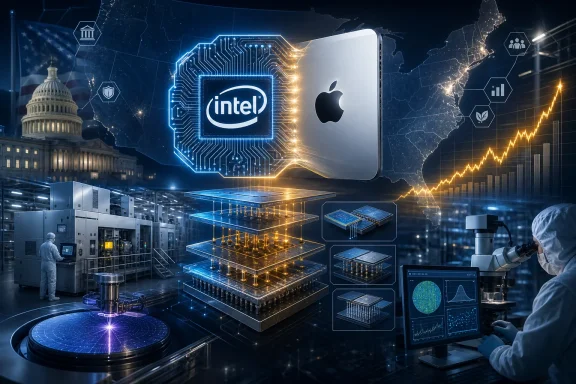 Apple Gives Intel the One Thing Its Foundry Story Has Lacked
Intel’s foundry plan has always needed a marquee proof point. The company could talk about process roadmaps, EUV learning curves, advanced packaging capacity, government support, and national-security relevance, but none of that fully answered the question Wall Street kept asking: who outside Intel will trust Intel Foundry with serious volume?That is why the Apple news landed with such force. Apple is not just another chip customer. It is one of the few companies whose silicon decisions reshape supplier economics, validate process technologies, and send a signal to every other systems vendor watching from the sidelines.
But the signal is not the same as signed, ramped, profitable revenue. As of the announcement, the public details remained thin, and neither Apple nor Intel had laid out a conventional customer win with product names, wafer starts, timing, pricing, or capacity commitments. That matters because semiconductor investors have been burned before by roadmap optimism that took years longer than promised to become gross margin.
The most plausible near-term interpretation is not that Apple is preparing to reverse its post-Intel Mac strategy. Apple already designs its own processors and has spent years reducing dependence on Intel CPUs in Macs. The more credible reading is that Apple wants additional U.S.-based manufacturing and packaging optionality, while Intel wants the validation that comes from being seen as capable of serving the world’s most demanding consumer-device silicon company.
This Is a Supply-Chain Story Before It Is a Silicon Story
Apple’s chip supply chain is already global, sophisticated, and deeply tied to Taiwan Semiconductor Manufacturing Company. The company’s in-house silicon strategy did not make Apple vertically integrated in fabrication; it made Apple a high-end chip designer dependent on elite manufacturing partners. That distinction is crucial.If Apple works with Intel, the first practical use case may be narrower than the stock reaction implied. It could involve advanced packaging, back-end manufacturing steps, lower-risk components, or future products where Apple wants geographic diversification without immediately betting a flagship iPhone or Mac processor on Intel’s most ambitious node.
That would still matter. In semiconductors, supply-chain optionality is not a consolation prize. It is leverage, insurance, and policy compliance wrapped into one operating decision.
Apple has been diversifying assembly and component sourcing for years, with India becoming a larger iPhone manufacturing base and U.S. political pressure intensifying around domestic production. A partnership with Intel fits that arc. It gives Apple another answer when Washington asks what it is doing to bring more of the silicon stack closer to home.
For Intel, however, “optionality” cuts both ways. It can open the door, but it does not guarantee that Apple will hand over high-volume, leading-edge production. The difference between being an option and being the default supplier is the difference between a useful press cycle and a multi-year earnings engine.
Intel’s Turnaround Is Real Enough to Be Taken Seriously
The easy skeptical take is that Intel is riding a political headline. That is too simple. Intel’s recovery over the past year has not been built only on patriotic chipmaking rhetoric; it has also rested on signs that the company’s manufacturing execution is improving.The 18A process is the centerpiece of that story. Intel has pitched 18A as the node that restores its manufacturing credibility after years in which the company lost its aura of inevitability. Better-than-expected yields, early production milestones, and management confidence have given investors a reason to believe Intel is no longer merely promising a comeback from the next node out.
That matters because Intel’s lost decade was not caused by one bad product cycle. It was a compounding failure of manufacturing delays, competitive pressure from AMD, Apple’s move away from Intel CPUs, and the broader industry’s shift toward foundry ecosystems where TSMC became the trusted execution machine. Rebuilding from that requires more than a good benchmark slide.
CEO Lip-Bu Tan inherited a company with valuable assets and a brutal credibility problem. Intel still has engineering depth, strategic manufacturing sites, x86 incumbency in PCs and servers, and a foundry story aligned with U.S. industrial policy. What it has lacked is proof that these pieces can be made to work together at commercial scale.
The Apple announcement strengthens the perception that Intel is once again strategically relevant. That is not nothing. In the chip business, perception can influence customer conversations, investor patience, recruiting, and government support. But perception has to be converted into wafers, packages, delivery schedules, and margins.
The Foundry Numbers Still Tell a Colder Story
The reason investors should stay disciplined is that Intel Foundry remains a financial drag. In the first quarter of 2026, Intel’s foundry segment generated billions of dollars in revenue, but only a small fraction came from external customers. The business also posted a multibillion-dollar operating loss.That split is the heart of the issue. Intel can report large foundry revenue because its manufacturing arm serves Intel’s own product groups. But the strategic prize is external foundry revenue: chips designed by customers who choose Intel over TSMC, Samsung, or another manufacturing path.
Those customers are difficult to win because leading-edge foundry decisions are conservative by necessity. A chip design can take years and hundreds of millions of dollars to bring to market. If a foundry slips, the customer misses product windows, loses share, and absorbs cascading costs across hardware, software, and supply-chain planning.
Apple understands that risk better than almost anyone. Its product cadence depends on tightly managed silicon schedules. A MacBook Air processor, an iPad chip, or an AI infrastructure component cannot be treated like an experimental trophy if it underpins a global product launch.
That is why the Apple relationship, if it becomes substantive, is more likely to build in stages. Intel may get packaging work first, then lower-risk silicon, then potentially a more ambitious role if execution holds. The market’s temptation is to value the end state immediately; the business reality is that the middle steps determine whether that end state ever arrives.
Advanced Packaging Is the Underappreciated Battlefield
The most interesting part of the Apple-Intel story may not be wafer fabrication at all. It may be packaging.Advanced packaging has become one of the defining constraints of the AI hardware era. As chip designers combine compute tiles, memory, accelerators, and specialized dies into increasingly complex systems, the ability to assemble those components efficiently becomes a strategic capability rather than a back-end afterthought.
Intel has been pushing this point for years through technologies such as EMIB and Foveros. The argument is straightforward: even if a customer does not immediately move all leading-edge logic production to Intel, it may still need Intel’s packaging capacity and know-how to build complex multi-die systems.
That could be especially relevant for Apple. The company’s consumer silicon is already highly integrated, and its AI ambitions increasingly require powerful on-device and cloud-side compute. Apple’s “Private Cloud Compute” strategy, for example, depends on trusted infrastructure that aligns with its privacy and vertical-integration narrative.
If Intel can support Apple in advanced packaging, it would give the foundry business a commercially meaningful foothold without requiring Apple to abandon TSMC for every leading-edge die. That kind of hybrid relationship is exactly how Intel could rebuild trust: not by demanding a wholesale leap of faith, but by proving reliability in parts of the stack where capacity and integration matter.
The catch is that packaging is becoming more competitive too. TSMC has its own formidable packaging ecosystem, and customers do not separate front-end and back-end decisions casually. Intel’s opportunity is real, but it has to be won against entrenched alternatives.
Washington Has Become Part of Intel’s Cap Table Story
Intel’s turnaround is also inseparable from U.S. industrial policy. The Trump administration’s public role in the Apple announcement was not incidental; it was the point. The message was that domestic chipmaking is no longer just a corporate strategy but a national project.That creates advantages for Intel. It remains the most politically obvious U.S.-based candidate for leading-edge domestic semiconductor manufacturing at scale. Government support can lower capital pressure, improve customer confidence, and make Intel’s fabs part of a broader resilience strategy.
But political sponsorship can also distort investor thinking. A government-backed strategic asset is not automatically a great stock at any price. Industrial policy can help build capacity, but it cannot repeal yield curves, depreciation, customer qualification cycles, or competitive pricing.
There is also a governance question hanging over the whole story. When politicians announce or amplify commercial arrangements involving public companies, markets may move before companies disclose the details investors would normally need. That is especially delicate when the government itself has a financial or strategic interest in the outcome.
For Intel, the best way to reduce that ambiguity is simple: publish results that do not need political translation. If external foundry revenue grows, if operating losses narrow, if 18A and 14A milestones hold, and if customers commit to volume, the story becomes less dependent on who posted what and more dependent on execution.
Valuation Has Started Pricing In the Comeback Before the Comeback Arrives
The market has rewarded Intel aggressively. The stock’s huge run over the past year reflects a belief that the company is no longer a melting ice cube but a leveraged recovery play tied to AI infrastructure, U.S. manufacturing, and foundry optionality. That belief is understandable.It is also dangerous when it outruns the income statement. A high sales multiple can make sense for a company with rapid growth, high gross margins, and operating leverage already visible. Intel is still trying to prove all three in the businesses investors are most excited about.
The foundry segment’s losses are not merely an accounting nuisance. They reflect the cost of building and qualifying a business that must compete with the best manufacturer in the semiconductor world. Until external customers produce meaningful revenue, Intel’s valuation rests heavily on future trust.
That does not mean the stock is doomed or that the market is irrational. Turnarounds often re-rate before the numbers fully recover. If investors waited for every metric to look safe, the upside would already be gone.
But there is a difference between paying for early evidence and paying for inevitability. Intel has earned a better hearing than it had two years ago. It has not yet earned the assumption that Apple-scale foundry success is guaranteed.
Windows Users Should Care Even If They Never Buy the Stock
This story is not only for investors. Windows users, PC enthusiasts, developers, and IT administrators all have a stake in whether Intel’s manufacturing comeback succeeds.A healthier Intel could mean stronger client CPUs, more competitive server chips, better supply resilience, and a more diverse advanced-manufacturing base for the broader industry. That matters for OEM roadmaps, enterprise procurement, workstation availability, and cloud infrastructure planning.
The Windows ecosystem has lived through the consequences of Intel’s stumbles. AMD’s resurgence improved competition and gave buyers better options, but it also exposed how dependent the PC industry had been on one supplier’s cadence. Apple’s shift to its own silicon added another psychological blow by demonstrating what vertical integration could achieve when paired with world-class manufacturing.
If Intel regains manufacturing credibility, the PC market benefits from a more competitive foundation. That does not mean every Windows machine becomes an Intel machine again, nor should it. The best outcome for users is not Intel dominance; it is sustained competition among Intel, AMD, Arm vendors, and foundry partners.
For sysadmins, the practical implication is to watch product availability and platform stability rather than stock-market enthusiasm. Better Intel execution could improve refresh-cycle confidence, especially in enterprise fleets where support timelines, driver maturity, manageability, and predictable supply matter more than peak benchmark performance.
Apple Is a Catalyst, Not a Customer Base
The Apple name creates an emotional shortcut. Investors hear it and imagine volume. Competitors hear it and imagine validation. Politicians hear it and imagine domestic manufacturing wins.But Apple’s involvement should be treated as a catalyst until the commercial scope becomes clearer. A catalyst changes the probability distribution; it does not complete the turnaround by itself.
The best case is powerful. Apple begins with U.S.-based packaging or selective chip production, Intel executes cleanly, and other customers view the relationship as evidence that Intel Foundry is safe enough to consider for their own roadmaps. Over time, Intel’s external foundry revenue rises, losses narrow, and the company becomes a credible second source for advanced silicon.
The less heroic case is also plausible. Apple uses Intel selectively for political and supply-chain optionality, while keeping its most important leading-edge production anchored elsewhere. Intel gets a valuable endorsement, but not enough volume to transform foundry economics quickly.
The bear case is that the market has mistaken a politically useful announcement for a material customer win. In that version, Intel’s stock has priced in a level of foundry success that remains years away, while the business continues to absorb enormous capital costs.
None of these scenarios can be dismissed yet. That uncertainty is exactly why the next few quarters matter more than the one-day stock reaction.
The Metrics That Will Separate a Turnaround From a Trade
Investors do not need to guess solely from headlines. Intel’s progress can be judged by a handful of concrete indicators, and those indicators are more useful than debating whether the Apple announcement was overhyped.The first is external foundry revenue. If the number remains tiny relative to total foundry revenue, Intel’s manufacturing business is still mostly serving itself. A real foundry turnaround requires outside customers to show up in the financials.
The second is foundry operating loss. Intel can justify losses during a buildout phase, but investors need evidence that scale and yield improvements are bending the curve. A permanently loss-making foundry is not strategic leverage; it is a capital sink.
The third is 18A execution. Yield commentary is encouraging, but production ramps are where optimism meets physics. If Intel delivers on 18A products and customer timelines, the credibility gap narrows.
The fourth is 14A customer engagement. Intel has positioned 14A as the follow-on proof that its roadmap is not a one-node recovery. Early customer evaluations are useful, but they need to become commitments.
The fifth is packaging backlog and capacity utilization. If advanced packaging is the bridge into customer relationships, Intel should eventually be able to show that demand in revenue, margins, and facility loading.
The Apple Bounce Leaves Intel With Less Room for Error
The danger of a successful narrative is that it raises the cost of disappointment. Intel is no longer trading like a company nobody believes in. It is trading like a company expected to pull off one of the most important semiconductor turnarounds of the decade.That changes the burden of proof. A year ago, any sign of improved execution could look like upside. After a massive share-price run, the same sign may only be enough to defend the valuation.
This is where long-term investors need to separate company quality from stock attractiveness. Intel may be improving. Intel may be strategically important. Intel may even be on the right side of U.S. industrial policy and AI-era packaging demand. None of that automatically means the shares offer a sufficient margin of safety after a dramatic re-rating.
For Apple, the calculus is different. It can explore Intel as a supplier without betting the company. For Washington, the calculus is different again. It wants domestic capacity, jobs, and strategic resilience. For Intel shareholders, however, the question is brutally financial: how much future success is already priced in?
That is why neutrality is a defensible stance. The story is better than it was, but the stock has already moved as though a large part of the turnaround has been achieved.
The Real Readout Will Come From Boring Numbers, Not Grand Announcements
The next stage of the Intel story will not be settled by another political post or another premarket rally. It will be settled in the dullest parts of corporate reporting: segment revenue, operating losses, gross margins, capital expenditures, customer disclosures, and production timelines.That may frustrate investors who want the Apple headline to simplify the case. It should not. The semiconductor industry is too capital-intensive and too execution-sensitive for shortcuts.
Intel’s opportunity is unusually large because the industry genuinely wants more resilient supply chains and more advanced manufacturing capacity outside Taiwan. That need gives Intel a strategic opening it did not have during the worst years of its manufacturing delays.
But customers do not buy national strategy. They buy yield, cost, performance, capacity, ecosystem maturity, and delivery confidence. Intel has to win on those terms, not merely on geography.
If it does, the Apple announcement may be remembered as the moment the foundry flywheel began to spin. If it does not, it will be remembered as another rally built on the hope that Intel’s next act would finally arrive.
The Signal Inside the Silicon Noise
The Apple-Intel news is important, but not because it instantly transforms Intel into Apple’s next TSMC. It matters because it gives Intel a higher-profile lane to prove that its manufacturing comeback is more than an internal recovery plan.- Intel’s stock reaction reflects renewed confidence in the foundry turnaround, but public details of the Apple arrangement remain too limited to treat it as guaranteed high-volume revenue.
- Apple’s most likely near-term motivation is supply-chain diversification and U.S. manufacturing optionality, not a wholesale return to Intel-designed processors.
- Intel’s 18A progress has improved the company’s credibility, but customer ramps and sustained yields will matter more than management commentary.
- Advanced packaging may be the most realistic first bridge between Apple and Intel, especially as AI systems become more dependent on complex multi-die integration.
- Intel Foundry’s external revenue and operating losses remain the cleanest tests of whether the turnaround is becoming a business rather than a narrative.
- After the stock’s huge run, Intel may be a stronger company without necessarily being a cheap stock.
References
- Primary source: TipRanks
Published: 2026-06-25T14:10:12.395569
Loading…
www.tipranks.com - Related coverage: macrumors.com
Loading…
www.macrumors.com - Related coverage: investing.com
Loading…
www.investing.com - Related coverage: techspot.com
Loading…
www.techspot.com - Related coverage: spokesman.com
Loading…
www.spokesman.com - Related coverage: axios.com
Loading…
www.axios.com
- Related coverage: ndtv.com
Loading…
www.ndtv.com - Related coverage: 247wallst.com
Loading…
247wallst.com - Related coverage: tomshardware.com
Loading…
www.tomshardware.com - Related coverage: quiverquant.com
Loading…
www.quiverquant.com - Related coverage: the-independent.com
Loading…
www.the-independent.com - Related coverage: elpais.com
Loading…
elpais.com - Related coverage: omni.se
Loading…
omni.se - Related coverage: pcgamer.com
Loading…
www.pcgamer.com - Related coverage: download.intel.com
Loading…
download.intel.com - Related coverage: intc.com
Loading…
www.intc.com