
Microsoft Copilot Cowork is Microsoft’s new agentic Microsoft 365 capability, broadly available in June 2026, that lets business users delegate multi-step work across Outlook, Teams, Word, Excel, PowerPoint, and SharePoint while retaining review and approval checkpoints. The important word is not Copilot but delegate. Microsoft and partners such as BDO USA are now selling a version of enterprise AI that is less about answering prompts and more about reorganizing how work moves through a company. That makes Copilot Cowork less like a feature launch and more like a test of whether enterprises are ready to manage digital labor with the same seriousness they apply to human labor.
For the first phase of generative AI in the enterprise, the dominant metaphor was the assistant. A user asked for a draft, a summary, a formula, a slide outline, or a meeting recap, and the AI responded inside the boundaries of that request. It could accelerate a task, but it rarely owned a workflow.
Copilot Cowork changes that framing. The user gives it a goal, and the system is designed to break that goal into a plan, gather context from Microsoft 365, perform intermediate steps, and produce a deliverable that can be reviewed or adjusted along the way. That sounds like an incremental improvement until you translate it into the daily life of an organization: the AI is no longer just helping someone write the email; it may be assembling the status report, finding the supporting documents, creating the meeting brief, proposing follow-ups, and preparing the deck.
This is why BDO’s framing matters. The consultancy is not treating Cowork as another productivity add-on. It is treating it as a signal that the center of gravity has moved from isolated AI use cases to operating model redesign.
That is the right read. A chat window can be piloted by a department. An execution layer that touches identity, data access, workflow, approvals, and business process requires the whole company to participate.
That distinction matters because assistance and execution have different risk profiles. Assistance can be absorbed into existing review habits: a worker drafts with AI, then edits before sending. Execution requires a more explicit contract: which systems can the AI touch, which actions can it take, where must a human approve, and who is accountable if the output is wrong?
Cowork’s pitch is that Microsoft 365 already contains the context of work. Email, meetings, chat, documents, spreadsheets, calendars, and SharePoint sites are not merely storage locations; they are the operational memory of the modern office. If an AI system can reason across that memory and act within it, Microsoft has a natural advantage over AI tools that live outside the tenant.
But that advantage also creates the uncomfortable part of the story. Microsoft 365 is often where years of permission sprawl, stale SharePoint sites, overshared files, and informal business processes go to hide. Copilot Cowork does not invent those problems. It makes them newly operational.
Still, “digital labor” is a loaded phrase. It implies that AI systems are not merely software tools but participants in work allocation. That does not mean they become employees, and it certainly does not mean they deserve the legal or moral status of employees. It means they create management questions that resemble labor questions: capacity, supervision, quality control, escalation, training, cost accounting, and performance measurement.
The first mistake enterprises will make is to treat Cowork as a premium feature to be distributed broadly because people are curious. The second mistake will be to lock it down so aggressively that the organization learns nothing. BDO’s useful contribution is to argue for a middle path: start with defined workflows where value can be measured, risk can be bounded, and governance can mature with evidence.
That may sound like consulting language, because it is. But it is also the only plausible way to prevent agentic AI from becoming either shelfware or shadow IT with a nicer user interface.
That is a meaningful baseline. For heavily regulated organizations, it is the difference between experimenting with a consumer AI service and considering a deployment inside an enterprise governance perimeter. Microsoft has spent years making the case that the safest AI tool is the one embedded in the productivity stack companies already govern.
But “the AI only sees what the user can see” is not the end of the security discussion. In many Microsoft 365 tenants, users can see too much. The problem is not that Copilot breaks permissions; the problem is that it can make poorly maintained permissions far more visible and useful.
A worker may technically have access to an old SharePoint folder, a sensitive spreadsheet, or a Teams channel that no one has cleaned up in years. Before AI, finding and synthesizing that material required effort. With Copilot-style systems, discovery becomes easier, faster, and more natural. That changes the practical exposure of existing data access, even if the formal access model has not changed.
Copilot Cowork raises the stakes because it is designed to execute across systems. An AI that summarizes a document can reveal data. An AI that acts on a workflow can propagate, repackage, or operationalize that data. For admins, the deployment checklist cannot stop at licensing and enablement. It has to include permission hygiene, sensitivity labeling, data lifecycle management, audit logging, and clear human approval rules.
That is the right design principle, but enterprises should be careful about accepting the phrase human in the loop as a magic spell. A human who rubber-stamps AI output under time pressure is not exercising meaningful judgment. A human who cannot understand how a task was completed is not really supervising it. A human who is accountable for an AI-generated deliverable but lacks authority over the workflow has been handed liability, not control.
The practical question is where human review is placed. Reviewing a final report is different from approving source selection, data extraction, recipient lists, calendar changes, or external communications. The more consequential the workflow, the more organizations will need checkpoints that happen before the damage can be done.
This is where Cowork forces process design into the open. Many organizations do not have crisp definitions of who approves what in ordinary human workflows. AI does not remove that ambiguity. It punishes it.
The best first deployments are likely to be boring, repetitive, and bounded. Internal status reporting, recurring finance packs, service operations summaries, sales account preparation, policy comparison, and controlled document generation all have something in common: the organization can define the inputs, outputs, reviewers, and success metrics.
That is not glamorous, but it is where enterprise AI becomes measurable. If Cowork reduces the cycle time for a monthly reporting process, improves consistency across client briefings, or lowers the effort required to prepare service reviews, executives can compare results against a baseline. If the only evidence is that employees “feel more productive,” the program will eventually struggle when budgets tighten.
This is one of the quiet tensions in the Copilot era. Microsoft sells horizontal productivity because Microsoft 365 is horizontal. Buyers need vertical evidence because budgets are allocated to business outcomes. Cowork will succeed in the enterprise only where those two worlds meet.
Microsoft’s move toward usage-based billing through Copilot Credits makes economic sense for the vendor and may make adoption more flexible for customers. It also introduces a new management burden. If a digital coworker can run multiple tasks, call high-end models, and operate across large bodies of content, the cost of “just try it” can become nontrivial.
That will push AI governance beyond security and compliance into financial operations. Enterprises will need to know who can launch Cowork tasks, which models are being used, which workflows consume the most credits, and whether the output justifies the spend. FinOps habits that cloud teams learned over the past decade are coming to AI.
This is another reason BDO’s value-measurement emphasis is not optional. Once AI execution has a meter attached to it, vague productivity narratives will not be enough. Business leaders will ask whether the monthly budget review, client briefing, or sales opportunity analysis is actually faster, better, or cheaper than before.
Admins will be asked to make Cowork available without letting it become a governance blind spot. They will need to explain why some users can use it and others cannot, why certain files appear in AI-generated outputs, why a workflow failed, why a generated deliverable referenced stale information, or why a task consumed more credits than expected. They will also need to manage the gap between what Microsoft’s marketing implies and what a messy tenant can safely support.
The uncomfortable truth is that many organizations are still catching up from the first Copilot wave. They are reviewing oversharing in SharePoint, rationalizing Teams sprawl, tightening guest access, improving labeling, and educating users on prompt hygiene. Cowork does not wait for that work to be finished. It makes the backlog more urgent.
This may ultimately be good for Microsoft 365 hygiene. Agentic AI gives executives a reason to fund cleanup work that admins have been requesting for years. But that cleanup must happen before broad deployment, not after the first incident.
But the sales pitch is attached to a real market problem. Microsoft is moving quickly because the platform opportunity is enormous. If Copilot becomes the execution layer for Microsoft 365, Microsoft strengthens its hold on the daily workflow of the enterprise. If Cowork normalizes the idea that AI can plan and act across Office apps, then every business process inside the tenant becomes a candidate for AI mediation.
Enterprises, by contrast, cannot move at keynote speed. They have regulators, unions, contracts, data classification schemes, legacy workflows, risk committees, and employees who still need to understand what is happening to their jobs. That mismatch between vendor momentum and organizational readiness is where many AI programs will wobble.
The better enterprises will not resist agentic AI on principle. They will slow it down just enough to make it usable. That means defining where AI execution is appropriate, where it is prohibited, and where it requires human approval with evidence.
BDO’s operating model language points toward a more significant possibility. If AI can assemble context, draft deliverables, coordinate handoffs, and maintain continuity across applications, then some workflows can be redesigned around outcomes rather than tasks. The human role shifts from doing every step to defining the goal, supervising the path, applying judgment, and handling exceptions.
That can be empowering or alienating depending on how it is implemented. Workers may welcome relief from administrative drag, status-chasing, document assembly, and repetitive coordination. They may also worry that the organization is using AI to intensify work, reduce headcount, or turn professional judgment into a thin approval layer over machine-generated output.
Executives should take that concern seriously. Adoption will not scale if employees see Cowork as surveillance-adjacent automation imposed from above. It has a better chance if workers see it removing low-value coordination while preserving human authority over decisions that matter.
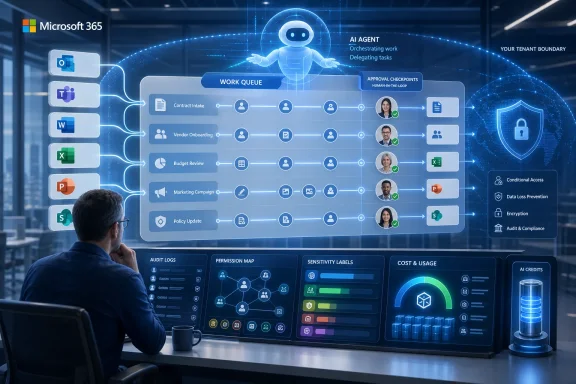 Microsoft Moves Copilot From the Text Box to the Work Queue
For the first phase of generative AI in the enterprise, the dominant metaphor was the assistant. A user asked for a draft, a summary, a formula, a slide outline, or a meeting recap, and the AI responded inside the boundaries of that request. It could accelerate a task, but it rarely owned a workflow.Copilot Cowork changes that framing. The user gives it a goal, and the system is designed to break that goal into a plan, gather context from Microsoft 365, perform intermediate steps, and produce a deliverable that can be reviewed or adjusted along the way. That sounds like an incremental improvement until you translate it into the daily life of an organization: the AI is no longer just helping someone write the email; it may be assembling the status report, finding the supporting documents, creating the meeting brief, proposing follow-ups, and preparing the deck.
This is why BDO’s framing matters. The consultancy is not treating Cowork as another productivity add-on. It is treating it as a signal that the center of gravity has moved from isolated AI use cases to operating model redesign.
That is the right read. A chat window can be piloted by a department. An execution layer that touches identity, data access, workflow, approvals, and business process requires the whole company to participate.
The BDO Argument Is Really an Operating Model Argument
BDO’s piece is nominally about Copilot Cowork, but its deeper argument is that enterprise AI has crossed an organizational threshold. The question is no longer whether generative AI can summarize a meeting or draft a document. The question is where a company is willing to let AI participate in execution.That distinction matters because assistance and execution have different risk profiles. Assistance can be absorbed into existing review habits: a worker drafts with AI, then edits before sending. Execution requires a more explicit contract: which systems can the AI touch, which actions can it take, where must a human approve, and who is accountable if the output is wrong?
Cowork’s pitch is that Microsoft 365 already contains the context of work. Email, meetings, chat, documents, spreadsheets, calendars, and SharePoint sites are not merely storage locations; they are the operational memory of the modern office. If an AI system can reason across that memory and act within it, Microsoft has a natural advantage over AI tools that live outside the tenant.
But that advantage also creates the uncomfortable part of the story. Microsoft 365 is often where years of permission sprawl, stale SharePoint sites, overshared files, and informal business processes go to hide. Copilot Cowork does not invent those problems. It makes them newly operational.
Digital Labor Is a Management Problem Before It Is a Licensing Problem
Microsoft’s Work Trend Index has been pushing the language of “digital labor,” and BDO echoes it because it is useful shorthand for the next phase of adoption. Executives are under pressure to increase productivity, employees report that they lack the time and energy to keep up, and AI adoption has moved quickly from experiments to business planning. Stanford HAI’s AI Index has similarly shown a sharp rise in organizational AI use, making the market context hard to dismiss as hype alone.Still, “digital labor” is a loaded phrase. It implies that AI systems are not merely software tools but participants in work allocation. That does not mean they become employees, and it certainly does not mean they deserve the legal or moral status of employees. It means they create management questions that resemble labor questions: capacity, supervision, quality control, escalation, training, cost accounting, and performance measurement.
The first mistake enterprises will make is to treat Cowork as a premium feature to be distributed broadly because people are curious. The second mistake will be to lock it down so aggressively that the organization learns nothing. BDO’s useful contribution is to argue for a middle path: start with defined workflows where value can be measured, risk can be bounded, and governance can mature with evidence.
That may sound like consulting language, because it is. But it is also the only plausible way to prevent agentic AI from becoming either shelfware or shadow IT with a nicer user interface.
Microsoft’s Security Story Is Necessary, Not Sufficient
Microsoft’s strongest enterprise argument remains the tenant boundary. Microsoft says Microsoft 365 Copilot honors existing permissions, uses Microsoft Graph to ground responses in the user’s authorized context, and does not use prompts, responses, or Graph-accessed customer data to train foundation models. Conditional Access, multifactor authentication, compliance controls, and identity policy are part of the pitch.That is a meaningful baseline. For heavily regulated organizations, it is the difference between experimenting with a consumer AI service and considering a deployment inside an enterprise governance perimeter. Microsoft has spent years making the case that the safest AI tool is the one embedded in the productivity stack companies already govern.
But “the AI only sees what the user can see” is not the end of the security discussion. In many Microsoft 365 tenants, users can see too much. The problem is not that Copilot breaks permissions; the problem is that it can make poorly maintained permissions far more visible and useful.
A worker may technically have access to an old SharePoint folder, a sensitive spreadsheet, or a Teams channel that no one has cleaned up in years. Before AI, finding and synthesizing that material required effort. With Copilot-style systems, discovery becomes easier, faster, and more natural. That changes the practical exposure of existing data access, even if the formal access model has not changed.
Copilot Cowork raises the stakes because it is designed to execute across systems. An AI that summarizes a document can reveal data. An AI that acts on a workflow can propagate, repackage, or operationalize that data. For admins, the deployment checklist cannot stop at licensing and enablement. It has to include permission hygiene, sensitivity labeling, data lifecycle management, audit logging, and clear human approval rules.
The Human-in-the-Loop Promise Needs Real Teeth
Every agentic AI launch leans on a version of the same reassurance: humans remain in control. Cowork is no exception. The system is positioned as one that plans and executes while keeping progress visible and requiring approval for sensitive actions.That is the right design principle, but enterprises should be careful about accepting the phrase human in the loop as a magic spell. A human who rubber-stamps AI output under time pressure is not exercising meaningful judgment. A human who cannot understand how a task was completed is not really supervising it. A human who is accountable for an AI-generated deliverable but lacks authority over the workflow has been handed liability, not control.
The practical question is where human review is placed. Reviewing a final report is different from approving source selection, data extraction, recipient lists, calendar changes, or external communications. The more consequential the workflow, the more organizations will need checkpoints that happen before the damage can be done.
This is where Cowork forces process design into the open. Many organizations do not have crisp definitions of who approves what in ordinary human workflows. AI does not remove that ambiguity. It punishes it.
The First Use Cases Should Be Boring on Purpose
The most seductive demos for Cowork will be the most expansive ones: prepare for a client meeting, produce a product launch plan, analyze a portfolio, compare documents, coordinate schedules, or assemble a board pack. These scenarios are compelling because they resemble actual knowledge work rather than toy prompts. They are also risky if adopted without narrowing the scope.The best first deployments are likely to be boring, repetitive, and bounded. Internal status reporting, recurring finance packs, service operations summaries, sales account preparation, policy comparison, and controlled document generation all have something in common: the organization can define the inputs, outputs, reviewers, and success metrics.
That is not glamorous, but it is where enterprise AI becomes measurable. If Cowork reduces the cycle time for a monthly reporting process, improves consistency across client briefings, or lowers the effort required to prepare service reviews, executives can compare results against a baseline. If the only evidence is that employees “feel more productive,” the program will eventually struggle when budgets tighten.
This is one of the quiet tensions in the Copilot era. Microsoft sells horizontal productivity because Microsoft 365 is horizontal. Buyers need vertical evidence because budgets are allocated to business outcomes. Cowork will succeed in the enterprise only where those two worlds meet.
Usage-Based AI Brings Finance Into the Conversation
One reason Copilot Cowork is arriving with more executive attention than earlier AI assistants is that agentic work can be expensive in ways that are difficult to predict. A simple prompt has a relatively understandable cost profile. A multi-step agent that reasons, searches, generates, revises, invokes tools, and runs in the background can consume far more compute.Microsoft’s move toward usage-based billing through Copilot Credits makes economic sense for the vendor and may make adoption more flexible for customers. It also introduces a new management burden. If a digital coworker can run multiple tasks, call high-end models, and operate across large bodies of content, the cost of “just try it” can become nontrivial.
That will push AI governance beyond security and compliance into financial operations. Enterprises will need to know who can launch Cowork tasks, which models are being used, which workflows consume the most credits, and whether the output justifies the spend. FinOps habits that cloud teams learned over the past decade are coming to AI.
This is another reason BDO’s value-measurement emphasis is not optional. Once AI execution has a meter attached to it, vague productivity narratives will not be enough. Business leaders will ask whether the monthly budget review, client briefing, or sales opportunity analysis is actually faster, better, or cheaper than before.
The WindowsForum Angle Is the Admin Burden Behind the Executive Pitch
For WindowsForum readers, the executive narrative is only half the story. The other half is the operational burden that lands on IT, security, compliance, and platform teams. Every “AI coworker” story eventually becomes an identity, data, endpoint, audit, and support story.Admins will be asked to make Cowork available without letting it become a governance blind spot. They will need to explain why some users can use it and others cannot, why certain files appear in AI-generated outputs, why a workflow failed, why a generated deliverable referenced stale information, or why a task consumed more credits than expected. They will also need to manage the gap between what Microsoft’s marketing implies and what a messy tenant can safely support.
The uncomfortable truth is that many organizations are still catching up from the first Copilot wave. They are reviewing oversharing in SharePoint, rationalizing Teams sprawl, tightening guest access, improving labeling, and educating users on prompt hygiene. Cowork does not wait for that work to be finished. It makes the backlog more urgent.
This may ultimately be good for Microsoft 365 hygiene. Agentic AI gives executives a reason to fund cleanup work that admins have been requesting for years. But that cleanup must happen before broad deployment, not after the first incident.
BDO Is Selling Discipline Because Microsoft Is Selling Momentum
BDO’s article ends, unsurprisingly, with a consulting proposition. The firm argues that organizations need help translating experimentation into scalable approaches aligned with strategy, governance, operating design, and measurable value. Readers can be forgiven for hearing the sales pitch.But the sales pitch is attached to a real market problem. Microsoft is moving quickly because the platform opportunity is enormous. If Copilot becomes the execution layer for Microsoft 365, Microsoft strengthens its hold on the daily workflow of the enterprise. If Cowork normalizes the idea that AI can plan and act across Office apps, then every business process inside the tenant becomes a candidate for AI mediation.
Enterprises, by contrast, cannot move at keynote speed. They have regulators, unions, contracts, data classification schemes, legacy workflows, risk committees, and employees who still need to understand what is happening to their jobs. That mismatch between vendor momentum and organizational readiness is where many AI programs will wobble.
The better enterprises will not resist agentic AI on principle. They will slow it down just enough to make it usable. That means defining where AI execution is appropriate, where it is prohibited, and where it requires human approval with evidence.
The Real Productivity Gain May Come From Redesign, Not Automation
The biggest mistake in the Copilot Cowork conversation is assuming that the value lies in automating existing work exactly as it is done today. That is the easiest way to demo the technology and the weakest way to transform a business. If a broken process is handed to an AI agent, the company may simply get a faster broken process.BDO’s operating model language points toward a more significant possibility. If AI can assemble context, draft deliverables, coordinate handoffs, and maintain continuity across applications, then some workflows can be redesigned around outcomes rather than tasks. The human role shifts from doing every step to defining the goal, supervising the path, applying judgment, and handling exceptions.
That can be empowering or alienating depending on how it is implemented. Workers may welcome relief from administrative drag, status-chasing, document assembly, and repetitive coordination. They may also worry that the organization is using AI to intensify work, reduce headcount, or turn professional judgment into a thin approval layer over machine-generated output.
Executives should take that concern seriously. Adoption will not scale if employees see Cowork as surveillance-adjacent automation imposed from above. It has a better chance if workers see it removing low-value coordination while preserving human authority over decisions that matter.
The Cowork Era Rewards the Enterprises That Clean Their House First
The practical lessons from Copilot Cowork are already visible, even before every organization has touched the product. This is not a normal feature rollout, and treating it like one is the fastest path to disappointment. It belongs in the same conversation as data governance, workflow redesign, cost management, and change leadership.- Copilot Cowork marks a shift from AI assistance to AI execution inside Microsoft 365, which means deployment decisions should be tied to workflows rather than curiosity.
- Microsoft’s security boundary is an important starting point, but it does not replace tenant cleanup, permission reviews, sensitivity labeling, and audit planning.
- The best first use cases are bounded, repetitive workflows where inputs, outputs, reviewers, and business metrics can be clearly defined.
- Human approval must be designed into the workflow before sensitive actions occur, not reduced to a final glance at an AI-produced deliverable.
- Usage-based AI economics will force organizations to measure value with more discipline than the first wave of Copilot experimentation required.
- The companies that benefit most will be the ones that redesign work around human judgment and AI execution instead of merely accelerating old processes.
References
- Primary source: BDO USA
Published: Fri, 26 Jun 2026 15:36:02 GMT
Loading…
www.bdo.com - Related coverage: itpro.com
Copilot Cowork is now generally available: Everything you need to know, including pricing, usage limits, and new features | IT Pro
Microsoft has announced that Copilot Cowork is now generally available for users globally, following a beta period via the tech giant’s Frontier program.www.itpro.com - Official source: support.microsoft.com
- Official source: learn.microsoft.com
Use Copilot Cowork | Microsoft Learn
Learn how to have conversations, manage files, approve actions, and organize projects with Microsoft 365 Copilot Cowork.learn.microsoft.com - Related coverage: productionai.institute
Microsoft 365 Copilot AI Data Use: Training & Privacy | Production AI Institute
Microsoft says files, communications, prompts, responses, and Microsoft Graph data used with Microsoft 365 Copilot are not used to train foundation models. www.productionai.institute
- Official source: techcommunity.microsoft.com
Loading…
techcommunity.microsoft.com
- Official source: microsoft.com
Loading…
www.microsoft.com - Official source: enablement.microsoft.com
Microsoft 365 Copilot Cowork – Microsoft Adoption
Copilot Cowork is an agentic system that plans, executes, and delivers work. It coordinates long-running, multi-step workflows across your apps, files, and data. Powered by Work IQ, it integrates signals from your work graph and applies task-appropriate models to produce context-aware results.enablement.microsoft.com - Official source: news.microsoft.com
Copilot Cowork ya está disponible de forma general - Source EMEA
 news.microsoft.com
- Related coverage: kurtsh.com
INFO: Microsoft 365 Copilot & Azure OpenAI Service do not train Microsoft’s or OpenAI’s LLMs… or other AI models
Organizations that trust Microsoft 365 Copilot & Azure OpenAI Service can depend on Microsoft to not train any AI models with their data. The following are excerpts from Microsoft’s Data …kurtsh.com
- Related coverage: computerworld.com
Microsoft launches Copilot Cowork with usage-based pricing – Computerworld
Copilot Cowork customers can choose from Anthropic and OpenAI models to run the AI agent, while Microsoft reportedly plans to offer an open source model from DeepSeek to lower costs. www.computerworld.com
- Related coverage: windowscentral.com
This is Microsoft's new "Copilot Cowork": An experiment with Anthropic's Claude AI models that plans and delegates your work | Windows Central
Microsoft ships Copilot Cowork to its Frontier program.www.windowscentral.com - Related coverage: techradar.com
Microsoft makes Copilot Cowork open to everyone, and wants to help you tackle even the trickiest work tasks | TechRadar
Copilot Cowork gets an upgrade as it opens to all userswww.techradar.com - Related coverage: axios.com
Microsoft explores DeepSeek for Copilot Cowork
Microsoft will also shift to usage-based pricing for the enterprise agent.www.axios.com
- Official source: cdn-dynmedia-1.microsoft.com
- Official source: download.microsoft.com
- Related coverage: jmu.edu
Loading…
www.jmu.edu