

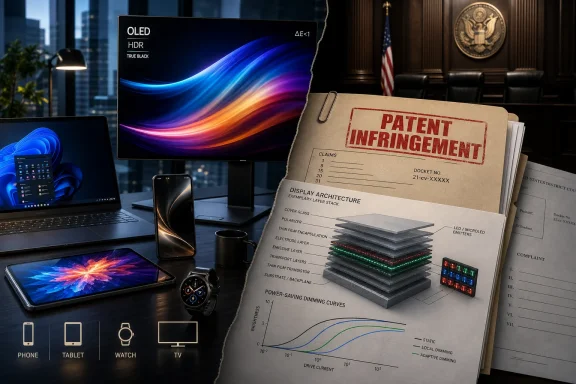
Tau Ceti Ventures LLC filed a patent-infringement lawsuit against Samsung Electronics and Samsung Electronics America on June 23, 2026, in the U.S. District Court for the Eastern District of Texas, accusing Samsung products across phones, tablets, watches, laptops, monitors, and TVs of using patented display technologies without a license. The case is early, the allegations are untested, and Samsung has not yet had its courtroom turn. But the lawsuit matters because it shows how the modern display stack — once a clean consumer-spec race over brightness, burn-in, and battery life — has become a sprawling legal attack surface. For WindowsForum readers, the interesting part is not whether a Galaxy phone survives another patent complaint; it is how patents over LEDs, MicroLEDs, substrates, and power-saving display behavior can reach the PCs and monitors sitting on corporate desks.
Samsung is accustomed to fighting on the front end of the technology market. It sells premium phones, OLED-heavy tablets, Galaxy Book laptops, smartwatches, monitors, and televisions into categories where display quality is one of the first things buyers notice. Brightness, viewing angles, energy efficiency, and burn-in resistance are not marketing garnish; they are part of why a user chooses one device over another.
Tau Ceti Ventures is attacking that same value chain from the back end. According to the reporting that surfaced the complaint, the company claims Samsung infringed ten display-related patents covering technologies meant to make displays brighter, reduce burn-in, extend battery life, and lower manufacturing costs. That is a broad set of claims, and breadth is the point. If a patent owner can credibly map claims onto common display architectures, it does not need to pick one hero product. It can name the ecosystem.
The product list reportedly includes the Galaxy S25, Galaxy Z Flip 7, Galaxy Watch 8, Galaxy Tab A9+, Galaxy Book 4, recent Samsung monitors, and recent Samsung TVs. That is a consumer-electronics bingo card, but it also crosses into the Windows world through laptops and desktop displays. A patent complaint that looks like “phone news” at first glance may still land in the procurement channel, especially when the accused technologies are embedded in screens rather than apps.
That distinction matters because displays are no longer passive panels attached to smarter devices. Modern screens are assemblies of emitters, films, substrates, controllers, compensation techniques, power-management tricks, and manufacturing processes. A laptop panel is not merely a rectangle that Windows paints pixels onto; it is a stack of engineering decisions that can become the basis for litigation years after the device ships.
A practicing competitor sues for reasons that can include market share, injunction leverage, licensing royalties, and strategic pressure. An NPE usually has a narrower commercial objective: extract value from a patent portfolio through settlements, judgments, or licenses. That business model is legal, but it is also controversial because it can turn old technical claims into recurring toll booths across entire industries.
The lawsuit reportedly seeks financial damages and enhanced damages based on alleged willful infringement. Enhanced damages are where the rhetoric becomes expensive. If a plaintiff can convince a court that infringement was not accidental but knowing or reckless, damages can potentially grow beyond a simple reasonable royalty theory. That is one reason even a lawsuit filed by an NPE cannot be dismissed as mere noise.
Samsung, for its part, is not a helpless target wandering into patent law for the first time. The company is one of the world’s most experienced patent litigants, both as a plaintiff and defendant. It has the legal machinery, prior-art hunting capability, and Patent Trial and Appeal Board playbook to fight these claims aggressively. The opening complaint is only the plaintiff’s version of reality.
For defendants, that venue choice often shapes the entire litigation strategy. A company like Samsung may challenge the patents at the Patent Trial and Appeal Board, seek transfer, narrow accused products, contest claim construction, and attack damages theories. The goal is not merely to win at trial; it is to collapse the plaintiff’s leverage before trial becomes a serious risk.
The Eastern District’s importance also explains why so many patent complaints sound similar at the start. They allege jurisdiction, identify accused products, list asserted patents, claim infringement, and ask for damages. The real fight comes later, when the court interprets patent claims and the parties argue whether the accused devices actually practice the claimed inventions.
That is where press coverage can get ahead of itself. A complaint is not a finding. It is a claim for relief. The fact that Samsung has been sued does not mean Samsung has infringed anything, and the fact that an NPE filed the case does not mean the patents are invalid. The legal system now has to do the slow, expensive thing it was built to do.
What the case appears to target is not one visible user feature, such as a setting in One UI or a display profile in Windows. It is the technology underneath the visible feature. Brighter LEDs, improved emitter structures, quantum-dot-related components, reflective layers, textured films, burn-in mitigation, and power-saving techniques can be buried so deep in the device stack that even technically literate buyers never see them described clearly.
That invisibility is one reason display patents are powerful litigation assets. A smartphone buyer may know the panel is bright outdoors. An IT admin may know a monitor supports high refresh rates or HDR. Neither knows which layer, film, emitter package, compensation routine, or substrate geometry made the result possible.
The same problem affects OEMs and enterprise buyers in a different way. A finished product contains components and subcomponents from suppliers, partners, foundries, panel makers, materials companies, and internal divisions. When a patent complaint lands, the accused brand name gets the headline, but the disputed invention may sit several layers down the supply chain.
A Windows laptop’s display is now central to the device’s value. OLED and high-brightness panels are moving from luxury extras into mainstream premium machines. Battery life claims increasingly depend on panel efficiency. Eye-comfort modes, adaptive refresh, HDR, and color-accurate workflows all assume a display subsystem that is far more advanced than the commodity LCDs of the past.
If display patents become a more aggressive litigation frontier, Windows OEMs and monitor vendors will face pressure that is not limited to Samsung. HP has reportedly already been sued by Tau Ceti over related patents, and LG was reportedly targeted earlier this year as well. That pattern suggests Tau Ceti is not pursuing a single Samsung-specific theory. It is probing a display-industry portfolio against multiple major hardware makers.
For enterprise buyers, the immediate practical effect is probably minimal. Lawsuits like this rarely lead to sudden device recalls or support disruptions. The more plausible effect is background cost: legal exposure priced into licensing deals, supplier contracts, component sourcing, and eventually product margins. Patent litigation is one of those forces users do not see until it has already been absorbed into the price of the next refresh cycle.
That breadth can be a strength in product strategy and a weakness in patent litigation. A plaintiff can point to a common display technology allegedly used across many categories and turn Samsung’s scale into a damages narrative. The more units sold, the more attractive the royalty base becomes.
There is also a signaling effect. Suing Samsung tells other vendors that the patent owner is willing to take on a heavyweight. If the case survives early challenges, smaller companies may be more inclined to settle rather than fund a prolonged fight. That does not mean Tau Ceti will win. It means the first big defendant can become the proof-of-pressure case.
Samsung’s counterargument will likely be equally structural. It can challenge whether the patents are valid, whether the claims read on the accused devices, whether Tau Ceti’s damages model is inflated, and whether any alleged infringement was willful. In patent litigation, scale cuts both ways: the target is large, but so is the defense budget.
That is the uncomfortable part of the patent system. Some NPE cases are weak monetization campaigns built around vague claims and settlement pressure. Others involve patents that may have real technical substance but are owned by entities that do not practice them. The public debate tends to flatten those differences because the business model feels parasitic even when the underlying property right is enforceable.
Samsung and its peers have also helped create the conditions for this world. The tech industry files enormous numbers of patents, buys and sells portfolios, cross-licenses aggressively, and uses intellectual property as both shield and weapon. When patents are strategic assets, they do not disappear just because the original inventor, startup, or operating company leaves the market.
The result is a secondary market where portfolios move into the hands of enforcement entities. Those entities may not build products, but they can still build legal campaigns. Tau Ceti’s reported suits against LG, HP, and now Samsung fit that pattern.
That time lag creates a strange public reaction. Users see a modern Galaxy Book, Galaxy Watch, or Samsung monitor and wonder how a company they have never heard of can claim ownership over some part of it. Patent law answers that inventions are protected for a fixed term, and infringement can occur long after the original filing. The market answers with annoyance, because by the time the lawsuit arrives, the technology may feel obvious.
This is especially true in displays. The industry has spent years chasing predictable goals: brighter panels, lower power, better durability, thinner assemblies, richer color, and lower cost. Many companies worked on similar problems at similar times. The courtroom task is to decide whether a patent claims a specific invention or merely occupies territory that later became inevitable.
That distinction is hard, technical, and often unsatisfying. It depends on claim language, prior art, expert testimony, and the court’s interpretation of terms that most consumers will never read. Yet those decisions can shape what companies pay to ship everyday hardware.
Premium Windows laptops are already leaning into OLED panels, high refresh rates, improved HDR, and better battery behavior. Those are not isolated luxuries; they are part of the perceived jump from an old laptop to a new one. If the panel is dim, power-hungry, or prone to burn-in, no NPU TOPS number will rescue the experience.
That makes display supply chains strategically important again. Microsoft can define Windows features, Qualcomm can push Arm performance, Intel and AMD can improve silicon, and OEMs can redesign chassis — but the screen remains the daily interface. Patent assertions around display efficiency and brightness therefore touch a core part of PC modernization.
For sysadmins, this is not a reason to panic or pause purchasing. It is a reason to understand that hardware risk is not limited to firmware bugs, driver regressions, or supply shortages. Intellectual-property disputes can influence availability, cost, and vendor roadmaps in ways that rarely appear in a spec sheet.
For Samsung, the best outcome is probably a boring one: the claims are narrowed, the patents are challenged, the damages theory weakens, and the case disappears into a confidential settlement or defense win. For Tau Ceti, the best outcome is also probably boring: enough pressure to secure licensing revenue without having to prove every allegation to a jury.
The public rarely gets the clean answer it wants. A settlement does not prove infringement. A dismissal may not prove the patents were worthless. A licensing deal may reflect risk management more than technical guilt. Patent litigation is often less about moral clarity than about pricing uncertainty.
That is why coverage should resist two easy narratives. The first is that Samsung is automatically a victim of legal extortion. The second is that a patent owner must have uncovered theft simply because a complaint names famous products. Neither assumption is journalism. The real story is the pressure patent portfolios can apply to mature technology markets.
The more relevant lesson is procurement literacy. Enterprises already ask vendors about lifecycle support, firmware updates, repairability, driver packages, and security commitments. They should also understand which technologies are differentiated enough to create licensing exposure. That does not mean asking every reseller for a patent indemnity dissertation, but it does mean recognizing that “display quality” can carry legal baggage.
Large organizations often receive indemnification protections through purchasing agreements, especially when buying through major OEM channels. Smaller businesses and individual users generally do not think in those terms. They buy what looks good, works well, and fits the budget. That is rational, but it leaves the broader costs hidden.
If patent enforcement raises costs across display categories, users will see it only indirectly. A model gets more expensive. A feature moves upmarket. A vendor changes suppliers. A panel option disappears from a configuration page. The lawsuit itself may be forgotten by then.
 The Display War Has Moved From Spec Sheets to Court Filings
Samsung is accustomed to fighting on the front end of the technology market. It sells premium phones, OLED-heavy tablets, Galaxy Book laptops, smartwatches, monitors, and televisions into categories where display quality is one of the first things buyers notice. Brightness, viewing angles, energy efficiency, and burn-in resistance are not marketing garnish; they are part of why a user chooses one device over another.Tau Ceti Ventures is attacking that same value chain from the back end. According to the reporting that surfaced the complaint, the company claims Samsung infringed ten display-related patents covering technologies meant to make displays brighter, reduce burn-in, extend battery life, and lower manufacturing costs. That is a broad set of claims, and breadth is the point. If a patent owner can credibly map claims onto common display architectures, it does not need to pick one hero product. It can name the ecosystem.
The product list reportedly includes the Galaxy S25, Galaxy Z Flip 7, Galaxy Watch 8, Galaxy Tab A9+, Galaxy Book 4, recent Samsung monitors, and recent Samsung TVs. That is a consumer-electronics bingo card, but it also crosses into the Windows world through laptops and desktop displays. A patent complaint that looks like “phone news” at first glance may still land in the procurement channel, especially when the accused technologies are embedded in screens rather than apps.
That distinction matters because displays are no longer passive panels attached to smarter devices. Modern screens are assemblies of emitters, films, substrates, controllers, compensation techniques, power-management tricks, and manufacturing processes. A laptop panel is not merely a rectangle that Windows paints pixels onto; it is a stack of engineering decisions that can become the basis for litigation years after the device ships.
Tau Ceti Is Not Selling a Rival Galaxy Book
The phrase patent troll gets thrown around easily, sometimes too easily. In this case, the label being used by GSMArena and SamMobile is attached to Tau Ceti Ventures because it is described as a non-practicing entity, or NPE — a company that owns and enforces patents rather than making products that compete in the accused market. That does not automatically make its patents worthless, nor does it automatically make Samsung innocent. It does, however, change the economics of the fight.A practicing competitor sues for reasons that can include market share, injunction leverage, licensing royalties, and strategic pressure. An NPE usually has a narrower commercial objective: extract value from a patent portfolio through settlements, judgments, or licenses. That business model is legal, but it is also controversial because it can turn old technical claims into recurring toll booths across entire industries.
The lawsuit reportedly seeks financial damages and enhanced damages based on alleged willful infringement. Enhanced damages are where the rhetoric becomes expensive. If a plaintiff can convince a court that infringement was not accidental but knowing or reckless, damages can potentially grow beyond a simple reasonable royalty theory. That is one reason even a lawsuit filed by an NPE cannot be dismissed as mere noise.
Samsung, for its part, is not a helpless target wandering into patent law for the first time. The company is one of the world’s most experienced patent litigants, both as a plaintiff and defendant. It has the legal machinery, prior-art hunting capability, and Patent Trial and Appeal Board playbook to fight these claims aggressively. The opening complaint is only the plaintiff’s version of reality.
East Texas Remains the Patent Plaintiff’s Favorite Stage
The venue is not incidental. The case was filed in the Eastern District of Texas, a court with a long history as a major forum for patent litigation. Patent plaintiffs have favored it for reasons that include local rules, scheduling practices, experienced judges, and a reputation — fair or not — for being a venue where patent cases move with seriousness.For defendants, that venue choice often shapes the entire litigation strategy. A company like Samsung may challenge the patents at the Patent Trial and Appeal Board, seek transfer, narrow accused products, contest claim construction, and attack damages theories. The goal is not merely to win at trial; it is to collapse the plaintiff’s leverage before trial becomes a serious risk.
The Eastern District’s importance also explains why so many patent complaints sound similar at the start. They allege jurisdiction, identify accused products, list asserted patents, claim infringement, and ask for damages. The real fight comes later, when the court interprets patent claims and the parties argue whether the accused devices actually practice the claimed inventions.
That is where press coverage can get ahead of itself. A complaint is not a finding. It is a claim for relief. The fact that Samsung has been sued does not mean Samsung has infringed anything, and the fact that an NPE filed the case does not mean the patents are invalid. The legal system now has to do the slow, expensive thing it was built to do.
The Patent List Points to the Hidden Complexity of “Better Screens”
The ten patent numbers reported in the SamMobile story — including 8,089,218, 8,101,959, 8,492,780, 8,552,460, 8,766,309, 9,257,604, 9,847,460, 10,038,116, 10,439,108, and 10,566,509 — are the most concrete part of the allegation. Patent numbers are dry, but they are also the map. They tell Samsung what it must invalidate, design around, license, or distinguish from its products.What the case appears to target is not one visible user feature, such as a setting in One UI or a display profile in Windows. It is the technology underneath the visible feature. Brighter LEDs, improved emitter structures, quantum-dot-related components, reflective layers, textured films, burn-in mitigation, and power-saving techniques can be buried so deep in the device stack that even technically literate buyers never see them described clearly.
That invisibility is one reason display patents are powerful litigation assets. A smartphone buyer may know the panel is bright outdoors. An IT admin may know a monitor supports high refresh rates or HDR. Neither knows which layer, film, emitter package, compensation routine, or substrate geometry made the result possible.
The same problem affects OEMs and enterprise buyers in a different way. A finished product contains components and subcomponents from suppliers, partners, foundries, panel makers, materials companies, and internal divisions. When a patent complaint lands, the accused brand name gets the headline, but the disputed invention may sit several layers down the supply chain.
The Windows Angle Is Bigger Than Galaxy Phones
The obvious Samsung headline is mobile. Galaxy S25 and Galaxy Z Flip 7 devices are consumer flagships, and patent lawsuits involving smartphones tend to attract the most attention. But the inclusion of Galaxy Book laptops and recent Samsung monitors is what should make Windows users pay closer attention.A Windows laptop’s display is now central to the device’s value. OLED and high-brightness panels are moving from luxury extras into mainstream premium machines. Battery life claims increasingly depend on panel efficiency. Eye-comfort modes, adaptive refresh, HDR, and color-accurate workflows all assume a display subsystem that is far more advanced than the commodity LCDs of the past.
If display patents become a more aggressive litigation frontier, Windows OEMs and monitor vendors will face pressure that is not limited to Samsung. HP has reportedly already been sued by Tau Ceti over related patents, and LG was reportedly targeted earlier this year as well. That pattern suggests Tau Ceti is not pursuing a single Samsung-specific theory. It is probing a display-industry portfolio against multiple major hardware makers.
For enterprise buyers, the immediate practical effect is probably minimal. Lawsuits like this rarely lead to sudden device recalls or support disruptions. The more plausible effect is background cost: legal exposure priced into licensing deals, supplier contracts, component sourcing, and eventually product margins. Patent litigation is one of those forces users do not see until it has already been absorbed into the price of the next refresh cycle.
Samsung’s Product Breadth Makes It an Efficient Target
Samsung is unusually exposed to this kind of broad display lawsuit because it sells almost everything with a screen. It is not just a phone company, not just a TV company, and not just a PC-adjacent vendor. It spans consumer, enterprise, mobile, wearable, home entertainment, and component-adjacent markets.That breadth can be a strength in product strategy and a weakness in patent litigation. A plaintiff can point to a common display technology allegedly used across many categories and turn Samsung’s scale into a damages narrative. The more units sold, the more attractive the royalty base becomes.
There is also a signaling effect. Suing Samsung tells other vendors that the patent owner is willing to take on a heavyweight. If the case survives early challenges, smaller companies may be more inclined to settle rather than fund a prolonged fight. That does not mean Tau Ceti will win. It means the first big defendant can become the proof-of-pressure case.
Samsung’s counterargument will likely be equally structural. It can challenge whether the patents are valid, whether the claims read on the accused devices, whether Tau Ceti’s damages model is inflated, and whether any alleged infringement was willful. In patent litigation, scale cuts both ways: the target is large, but so is the defense budget.
Patent Troll Is a Moral Judgment, Not a Legal Defense
Calling Tau Ceti a patent troll may be emotionally satisfying, especially for readers tired of seeing innovation taxed by litigation. But “troll” is not a defense in court. The relevant questions are whether the patents are valid, whether Samsung infringed them, and what damages, if any, follow from that infringement.That is the uncomfortable part of the patent system. Some NPE cases are weak monetization campaigns built around vague claims and settlement pressure. Others involve patents that may have real technical substance but are owned by entities that do not practice them. The public debate tends to flatten those differences because the business model feels parasitic even when the underlying property right is enforceable.
Samsung and its peers have also helped create the conditions for this world. The tech industry files enormous numbers of patents, buys and sells portfolios, cross-licenses aggressively, and uses intellectual property as both shield and weapon. When patents are strategic assets, they do not disappear just because the original inventor, startup, or operating company leaves the market.
The result is a secondary market where portfolios move into the hands of enforcement entities. Those entities may not build products, but they can still build legal campaigns. Tau Ceti’s reported suits against LG, HP, and now Samsung fit that pattern.
The Complaint Is Also a Reminder That Hardware Innovation Ages Strangely
Software disputes often feel immediate. A feature ships, a competitor complains, and the market can see the overlap. Hardware patent disputes can feel like messages from another era. Patents granted in the 2010s can surface against devices sold in the mid-2020s, long after the underlying technology has become normal.That time lag creates a strange public reaction. Users see a modern Galaxy Book, Galaxy Watch, or Samsung monitor and wonder how a company they have never heard of can claim ownership over some part of it. Patent law answers that inventions are protected for a fixed term, and infringement can occur long after the original filing. The market answers with annoyance, because by the time the lawsuit arrives, the technology may feel obvious.
This is especially true in displays. The industry has spent years chasing predictable goals: brighter panels, lower power, better durability, thinner assemblies, richer color, and lower cost. Many companies worked on similar problems at similar times. The courtroom task is to decide whether a patent claims a specific invention or merely occupies territory that later became inevitable.
That distinction is hard, technical, and often unsatisfying. It depends on claim language, prior art, expert testimony, and the court’s interpretation of terms that most consumers will never read. Yet those decisions can shape what companies pay to ship everyday hardware.
The AI PC Era Makes Display Litigation More Relevant, Not Less
It may seem odd to dwell on display patents at a moment when the PC industry is obsessed with NPUs, Copilot branding, and on-device AI. But the AI PC pitch only increases the importance of the rest of the machine. If vendors want users to replace perfectly serviceable laptops, they need visible improvements. The display is one of the few upgrades a user can appreciate instantly.Premium Windows laptops are already leaning into OLED panels, high refresh rates, improved HDR, and better battery behavior. Those are not isolated luxuries; they are part of the perceived jump from an old laptop to a new one. If the panel is dim, power-hungry, or prone to burn-in, no NPU TOPS number will rescue the experience.
That makes display supply chains strategically important again. Microsoft can define Windows features, Qualcomm can push Arm performance, Intel and AMD can improve silicon, and OEMs can redesign chassis — but the screen remains the daily interface. Patent assertions around display efficiency and brightness therefore touch a core part of PC modernization.
For sysadmins, this is not a reason to panic or pause purchasing. It is a reason to understand that hardware risk is not limited to firmware bugs, driver regressions, or supply shortages. Intellectual-property disputes can influence availability, cost, and vendor roadmaps in ways that rarely appear in a spec sheet.
The Lawsuit’s Best Outcome May Be Boring
Most patent cases do not end with cinematic courtroom vindication. They end through settlement, licensing, dismissal, invalidation, narrowed claims, or quiet procedural exhaustion. That is especially true when large defendants and monetization-focused plaintiffs face each other across a portfolio.For Samsung, the best outcome is probably a boring one: the claims are narrowed, the patents are challenged, the damages theory weakens, and the case disappears into a confidential settlement or defense win. For Tau Ceti, the best outcome is also probably boring: enough pressure to secure licensing revenue without having to prove every allegation to a jury.
The public rarely gets the clean answer it wants. A settlement does not prove infringement. A dismissal may not prove the patents were worthless. A licensing deal may reflect risk management more than technical guilt. Patent litigation is often less about moral clarity than about pricing uncertainty.
That is why coverage should resist two easy narratives. The first is that Samsung is automatically a victim of legal extortion. The second is that a patent owner must have uncovered theft simply because a complaint names famous products. Neither assumption is journalism. The real story is the pressure patent portfolios can apply to mature technology markets.
The Practical Read for Windows Buyers Is Caution, Not Alarm
For anyone buying Samsung monitors or Galaxy Book laptops, there is no immediate reason to treat this complaint as a product warning. Patent lawsuits generally do not affect warranty coverage, device security, Windows compatibility, or day-to-day support. Your display will not become dimmer because a complaint was filed in Texas.The more relevant lesson is procurement literacy. Enterprises already ask vendors about lifecycle support, firmware updates, repairability, driver packages, and security commitments. They should also understand which technologies are differentiated enough to create licensing exposure. That does not mean asking every reseller for a patent indemnity dissertation, but it does mean recognizing that “display quality” can carry legal baggage.
Large organizations often receive indemnification protections through purchasing agreements, especially when buying through major OEM channels. Smaller businesses and individual users generally do not think in those terms. They buy what looks good, works well, and fits the budget. That is rational, but it leaves the broader costs hidden.
If patent enforcement raises costs across display categories, users will see it only indirectly. A model gets more expensive. A feature moves upmarket. A vendor changes suppliers. A panel option disappears from a configuration page. The lawsuit itself may be forgotten by then.
The Texas Filing Turns Screen Specs Into Supply-Chain Risk
The concrete takeaways are less dramatic than the headlines, but they are more useful. This is not a consumer panic story. It is a reminder that the technologies making modern devices look better and last longer are also valuable enough to fight over.- Tau Ceti Ventures filed its Samsung patent-infringement complaint on June 23, 2026, in the Eastern District of Texas.
- The lawsuit reportedly asserts ten display-related patents and targets Samsung products across smartphones, watches, tablets, laptops, monitors, and televisions.
- The inclusion of Galaxy Book laptops and Samsung monitors makes the case relevant to Windows users, not just Android phone buyers.
- The allegations remain unproven, and Samsung is likely to challenge the patents, infringement theories, venue strategy, damages model, or all of the above.
- Similar reported actions against LG and HP suggest Tau Ceti is pursuing a broader display-industry licensing campaign rather than a one-off fight with Samsung.
- The most likely user-facing impact, if any, would be indirect pressure on licensing costs, component sourcing, and future product pricing rather than disruption to existing devices.
References
- Primary source: gsmarena.com
Published: Fri, 26 Jun 2026 21:47:03 GMT
- Independent coverage: SamMobile
Published: 2026-06-26T12:30:19.482367
Samsung hit with another lawsuit from a patent troll claiming 10 display patents - SamMobile
Samsung Electronics is facing a patent infringement lawsuit related to display technologies. it has been filed a patent troll firm in the US. - SamMobilewww.sammobile.com - Related coverage: ipfray.com
- Related coverage: patsnap.com
- Related coverage: news.bloomberglaw.com
Samsung Persuades Magistrate Judge on Bid to Invalidate Patent
Samsung Electronics Co. convinced a Texas federal magistrate judge that an inventor’s patents should be invalidated in a dispute concerning location and mapping features.news.bloomberglaw.com
- Related coverage: ihatepatenttrolls.com
Lepton Computing LLC v. Samsung Electronics America Inc et al. — IHatePatentTrolls
Lepton Computing LLC v. Samsung Electronics America Inc et al. — 2:26-cv-00338 · Texas Eastern District Court · filed 2026-04-23 · Open. Patent infringement litigation case detail: parties, court, accused products, status.ihatepatenttrolls.com


