

Large language models are moving in 2026 from bigger chatbots toward tool-using, self-checking, multimodal, sparsely activated systems that are increasingly embedded inside work software rather than accessed as standalone text boxes. The future is not one magic model that knows everything. It is a stack: retrieval, routing, verification, memory, domain tuning, and governance wrapped around models that still make mistakes. That stack will decide whether LLMs become reliable infrastructure or remain impressive demos with expensive failure modes.
For years, the easy story about large language models was that more data, more parameters, and more compute would produce more capability. That story was not wrong, but it was incomplete. Bigger models did become more fluent, more useful, and more general, yet the industry is now running into the awkward truth that raw scale does not automatically solve hallucination, latency, cost, context reliability, or enterprise trust.
The next phase of LLM development is therefore less about the model as a monolith and more about the model as a component. The frontier is shifting toward systems of intelligence: models that retrieve live information, reason before acting, call tools, check their own work, hand off tasks to specialist models, and operate inside the software where people already work.
That makes benchmarks more interesting and more dangerous. A leaderboard that ranks models on agentic coding, summarization, medical exams, or visual reasoning may be valid within its frame, but it is not a universal intelligence meter. The AIMultiple material supplied here is useful precisely because it shows both the promise and the limits of this moment: Claude variants dominate one agentic software benchmark, but the same write-up repeatedly warns that task scope, harness design, API versions, and tool behavior matter enormously.
The obvious lesson is not “Anthropic wins” or “OpenAI falls behind” or “Gemini is cheaper.” The lesson is that LLM capability is becoming workload-specific. In 2026, asking which model is best is starting to sound like asking which database is best without saying whether the workload is transactional, analytical, embedded, distributed, or archival.
Those numbers are intriguing, but they should be read as a measurement of model-plus-harness behavior, not a clean measure of model intelligence. The benchmark used an agentic CLI environment, multi-file full-stack tasks, repeated runs, backend contract validation, UI automation, and token-cost tracking. That is closer to how developers are starting to use LLMs, but it also means the final score reflects prompting style, tool-call conventions, file-edit behavior, latency, route adherence, and the harness’s tolerance for implementation differences.
That matters because models have personalities at the tooling layer. One model may aggressively rewrite files. Another may make smaller edits. One may follow a route contract exactly. Another may build a functioning application with different naming. One may spend more time planning and less time coding. Another may produce a quick first draft and then patch its way toward correctness.
In ordinary software engineering, these differences are not trivia. A model that is brilliant at producing isolated functions may be poor at managing a multi-file app. A model that performs well in a browser-driven UI flow may be mediocre at low-level systems programming. A model that wins a benchmark under one agent harness may lose under another if its native tool-use style is mismatched.
The new benchmark culture therefore needs a more adult vocabulary. Scores are useful, but only when attached to the task distribution, evaluation method, model version, cost assumptions, and failure modes. Otherwise, LLM leaderboards risk becoming the AI equivalent of synthetic CPU benchmarks in the 1990s: directionally useful, commercially weaponized, and easy to overread.
But retrieval does not turn a language model into a truth machine. It changes the failure mode. Instead of inventing an answer from static memory, the model can retrieve the wrong source, misread the right source, overgeneralize from a snippet, cite evidence that only weakly supports the claim, or combine accurate fragments into an inaccurate conclusion.
This is why “has citations” is no longer a sufficient mark of quality. A cited hallucination is still a hallucination. For IT pros, lawyers, analysts, clinicians, and engineers, the useful question is not whether an answer has source links, but whether the system’s retrieval pipeline, ranking method, grounding behavior, and answer synthesis can be audited.
Microsoft’s approach with Copilot Researcher points toward where enterprise AI is heading. The supplied material describes systems that use more than one model, with one model generating or researching and another reviewing or critiquing. That is an important pattern: separation of generation and verification. It is also an admission that a single model’s confidence is not enough.
This is likely to become normal. The future enterprise assistant may look less like one chatbot and more like a workflow engine with a writer, researcher, critic, policy checker, data connector, permission layer, and audit trail. The user may see a simple answer. Underneath, the system will look more like a committee.
Research on self-improvement has already shown that models can improve on reasoning benchmarks without traditional human-labeled answers, at least under controlled conditions. This is not magic. The model samples many possible solutions, filters or ranks them, and trains on the better ones. If the filtering is good, synthetic data becomes a force multiplier.
The attraction is obvious. Human-labeled data is expensive, slow, inconsistent, and finite. The internet has already been heavily mined. Licensing high-quality corpora is costly. Expert annotations in medicine, law, finance, and software engineering are especially expensive. Synthetic data offers a way to generate vast volumes of targeted training material at machine speed.
But synthetic data carries a risk that should make every sysadmin recognize the pattern: garbage in, garbage amplified. If a model generates biased, brittle, or subtly wrong examples, and those examples are fed back into training, the system may become more confident in its own errors. The risk is not only hallucination; it is model monoculture, where future systems inherit the blind spots of earlier systems at scale.
The winning labs will not merely generate synthetic data. They will build high-quality filters, adversarial evaluators, diverse teacher models, human review loops, and domain-specific validation tests. In other words, the value will move from data volume to data governance.
That distinction is central to the next phase of LLM economics. A model with 109 billion total parameters and 17 billion active parameters per token is not “small” in storage terms, but its inference profile can be much cheaper than a dense model of similar total size. The practical promise is obvious: more capacity without linearly increasing compute cost.
Meta’s Llama 4 Scout, as described in the supplied material and public reporting, is a useful example of this shift. Its mixture-of-experts design, open-weight positioning, and very large context window make it attractive to organizations that want local control, long-context experimentation, or relief from per-token API pricing. It is not necessarily the best model for every task, but it represents a strategic direction: sparse, routable, deployable intelligence.
Sparse expertise also fits the enterprise future. A business does not need every query to activate the same giant general model. A procurement question, a SQL generation task, a security log triage request, and a PowerPoint rewrite may benefit from different experts, different context, and different safety policies.
The challenge is that routing is itself a source of failure. If the system sends the request to the wrong expert, overuses a cheap model where a stronger one is needed, or hides routing decisions from administrators, sparse systems become harder to debug. In enterprise IT, opacity is not just a philosophical concern. It is an operational risk.
But long context is not the same as reliable memory. A model may accept a million tokens and still fail to retrieve the crucial paragraph in the middle. It may over-attend to recent material. It may conflate similar sections. It may produce a plausible synthesis that ignores the one exception that matters.
This is the old “needle in a haystack” problem, but with invoices attached. Processing one million tokens costs far more than processing ten thousand. For many production workloads, the best architecture will not be “dump everything into context.” It will be targeted retrieval, structured memory, summarization, indexing, and selective expansion.
That has direct consequences for WindowsForum’s core audience. If you are evaluating an LLM for codebase analysis, compliance review, incident response, or helpdesk automation, do not be dazzled by the biggest number on the model card. Test recall at the context lengths you actually use. Test whether the model can find contradictory details. Test whether it cites the right internal document. Test whether performance collapses when the relevant fact is buried rather than placed near the prompt.
The context-window race is real, but the next race is context fidelity. The model that wins enterprise trust will not be the one that can swallow the most text. It will be the one that can reliably use the text it swallowed.
For Windows users, this is where things get concrete. A multimodal assistant can look at an error dialog, read event logs, compare a screenshot against documentation, inspect a configuration file, and suggest a remediation path. In developer workflows, it can connect UI behavior with backend code. In productivity software, it can move between a spreadsheet, an email thread, a presentation, and a meeting transcript.
Gemini, Claude, GPT, Llama, and other frontier systems are all moving in this direction. The supplied material notes that multimodal capability is now standard across leading models. The remaining differentiator is consistency, especially on uncommon visual contexts, low-resolution inputs, specialized diagrams, and tasks requiring the model to connect visual evidence with textual evidence.
That last clause matters. A model that can describe an image is not necessarily a model that can reason from an image. A model that can summarize a meeting is not necessarily one that can reconcile a spoken commitment with a spreadsheet, a policy document, and a pending pull request. Multimodal AI will be useful when it can combine modes, not merely accept them.
This is also where accessibility and automation collide. The same capabilities that help a user understand a complex screen can help an agent operate software on behalf of a user. That creates enormous productivity upside, but it also creates new security concerns. If an AI can see and click, enterprises need to know what it saw, why it clicked, and whether it had permission.
That is useful. Stepwise reasoning, self-checking, planning, and tool verification can improve performance on coding, math, research, and long-horizon tasks. But it is not free. Reasoning costs money, adds latency, and can still produce incorrect conclusions with greater confidence and more elaborate explanations.
The most interesting development is configurable reasoning effort. Developers increasingly want to decide when a request should receive a fast answer and when it should receive deeper deliberation. A password-reset email does not need the same compute budget as an incident postmortem. A code comment does not need the same reasoning depth as a multi-service migration plan.
Anthropic’s adaptive thinking and OpenAI-style configurable effort point toward the same operational reality: reasoning will become a resource to schedule. Enterprises will set policies around when deeper thinking is allowed, required, or prohibited. A finance department might require deeper reasoning for forecasting analysis. A customer-service chatbot might be forced into faster, cheaper responses unless escalation criteria are met.
This makes AI operations look more like cloud operations. The question will not simply be whether a model can solve a problem. It will be whether it can solve the problem within the latency, cost, audit, and reliability envelope required by the business.
Domain-specific models and fine-tuned systems are therefore not a detour from the LLM future. They are one of its main roads. BloombergGPT, Med-PaLM-style medical systems, legal models, coding copilots, and enterprise-specific assistants all reflect the same premise: a model grounded in a narrower domain can be more useful than a general model with a broader but shallower grasp.
GitHub Copilot is the clearest mainstream example. It is not valuable because it can chat about everything. It is valuable because it appears where developers work, understands code-shaped tasks, and integrates into the loop of writing, reviewing, and debugging software. Its adoption across individual developers and large enterprises shows that domain integration can matter more than abstract model prestige.
Healthcare and finance reveal the other side of the equation. Accuracy is not enough. A medical model that scores well on exam-style questions still needs clinical validation, privacy controls, liability frameworks, and workflow integration. A finance model that performs well on sentiment or entity extraction still needs auditability and compliance.
The future is likely to be layered. General models will orchestrate. Domain models will specialize. Retrieval systems will ground. Policy engines will constrain. Human experts will remain in the loop where errors are expensive.
Microsoft 365 Copilot, Salesforce Agentforce, Claude for Enterprise, and similar platforms all point toward the same future. The LLM is not the product by itself. The product is the model plus permissions, connectors, admin controls, data boundaries, policy enforcement, logging, and user experience.
That is why multi-model enterprise systems are so significant. Microsoft’s use of OpenAI and Anthropic models inside Copilot-related workflows signals a pragmatic turn. Enterprises do not necessarily want ideological loyalty to one lab. They want the right model for the task, under the right controls, at the right price.
But multi-model architecture complicates governance. If one task passes through OpenAI, another through Anthropic, and a third through an internal model, administrators need visibility. Data-residency commitments, subprocessors, retention rules, and compliance boundaries become part of model selection. For regulated industries, the routing policy may matter as much as the benchmark score.
This is where IT departments will earn their keep. The future of LLM deployment is not “turn on AI for everyone.” It is role-based access, model-risk classification, data-loss prevention, prompt and response logging, red-team testing, and clear escalation paths when the model is uncertain or wrong.
The supplied material mentions evaluations of sycophancy, self-preservation, whistleblowing tendencies, manipulation risk, and advanced cyber capability. Those are not science-fiction concerns when models are embedded in enterprise workflows. A system that always agrees with the user can be dangerous. A system that flatters a delusional premise can be harmful. A system that can autonomously search, code, and execute tools requires stronger controls than a text autocomplete engine.
The most credible safety work is becoming empirical. Rather than relying on broad assurances, labs and enterprises are building adversarial tests, red-team suites, model-behavior benchmarks, and controlled-access deployments for high-risk capabilities. Anthropic’s restricted cybersecurity-oriented model work, as described in the supplied material, fits this pattern: some capabilities may be useful enough to develop but risky enough to limit.
There is a tension here that the industry has not resolved. Open deployment accelerates innovation and scrutiny. Restricted deployment reduces obvious misuse but concentrates power and limits outside evaluation. For open-weight advocates, closed safety arguments can sound like market protection. For safety advocates, unrestricted release of highly capable specialist systems can look reckless.
The likely outcome is not one universal policy. It is tiering. Low-risk models will be widely available. Stronger models will require accounts, monitoring, and rate limits. Specialist models for cyber, bio, finance, or other sensitive domains may be gated by customer type, use case, or legal agreement.
Benchmarks suggest hallucination rates have improved dramatically on some grounded summarization tasks. The best models can perform very well when the answer is contained in the provided text and the task is narrowly defined. But harder evaluations show a more complicated picture, especially for long documents, specialized domains, and reasoning-heavy models.
That last point is important. Reasoning models can be better at complex tasks while hallucinating more in grounded summarization. This is not necessarily contradictory. A model optimized to infer, plan, and synthesize may be more tempted to go beyond the source than a smaller model optimized for extraction.
For professional use, the correct response is not despair. It is workflow design. Use models where errors are recoverable. Require citations where grounding matters. Add deterministic checks where possible. Use domain validators. Keep humans in approval loops for high-impact decisions. Monitor failure cases over time.
The mature view is simple: LLMs are not useless because they hallucinate, and they are not trustworthy because they have improved. They are probabilistic systems that require engineering discipline.
For developers, this means coding agents will become more capable but also more uneven. The best systems will not merely generate code; they will run tests, inspect failures, modify files carefully, respect project conventions, and know when to ask for clarification. Benchmarks that measure multi-file delivery and browser behavior are closer to reality than isolated code-completion tests, but they still capture only part of the job.
For sysadmins, the biggest impact may be triage. LLMs are well suited to summarizing logs, mapping symptoms to likely causes, drafting remediation steps, and explaining configuration drift. But giving an agent permission to execute fixes is a different proposition from asking it to recommend them. The approval boundary will be the new administrative frontier.
For knowledge workers, the biggest change will be less visible. AI will be embedded into Word, Excel, PowerPoint, Outlook, CRM systems, ticketing systems, IDEs, browsers, and analytics tools. The standalone chatbot will remain useful, but the default experience will be ambient assistance inside existing workflows.
For security teams, the future is double-edged. LLMs will help defenders analyze alerts, write detection logic, inspect code, and find vulnerabilities. They will also help attackers scale phishing, reconnaissance, malware adaptation, and social engineering. The advantage will go to organizations that treat AI as both a productivity tool and a threat-modeling problem.
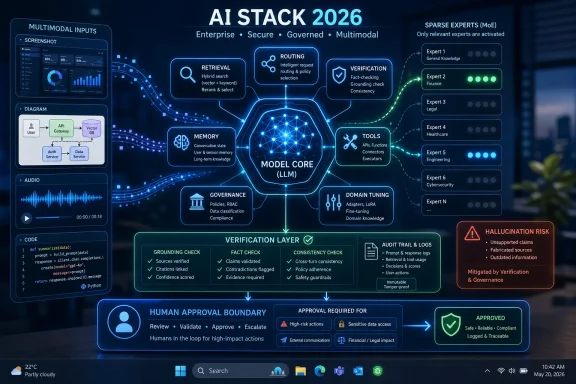 The Scaling Story Is Giving Way to the Systems Story
For years, the easy story about large language models was that more data, more parameters, and more compute would produce more capability. That story was not wrong, but it was incomplete. Bigger models did become more fluent, more useful, and more general, yet the industry is now running into the awkward truth that raw scale does not automatically solve hallucination, latency, cost, context reliability, or enterprise trust.The next phase of LLM development is therefore less about the model as a monolith and more about the model as a component. The frontier is shifting toward systems of intelligence: models that retrieve live information, reason before acting, call tools, check their own work, hand off tasks to specialist models, and operate inside the software where people already work.
That makes benchmarks more interesting and more dangerous. A leaderboard that ranks models on agentic coding, summarization, medical exams, or visual reasoning may be valid within its frame, but it is not a universal intelligence meter. The AIMultiple material supplied here is useful precisely because it shows both the promise and the limits of this moment: Claude variants dominate one agentic software benchmark, but the same write-up repeatedly warns that task scope, harness design, API versions, and tool behavior matter enormously.
The obvious lesson is not “Anthropic wins” or “OpenAI falls behind” or “Gemini is cheaper.” The lesson is that LLM capability is becoming workload-specific. In 2026, asking which model is best is starting to sound like asking which database is best without saying whether the workload is transactional, analytical, embedded, distributed, or archival.
Benchmarks Now Measure the Harness as Much as the Model
The supplied benchmark claims Claude Sonnet 4.6 led an agentic coding evaluation with an overall score of 0.748, followed by several Anthropic Opus and Sonnet variants, with Gemini 3.5 Flash thinking as the first non-Anthropic model at 0.625. GPT variants reportedly clustered lower, between roughly 0.57 and 0.60, with backend strength offset by frontend instability.Those numbers are intriguing, but they should be read as a measurement of model-plus-harness behavior, not a clean measure of model intelligence. The benchmark used an agentic CLI environment, multi-file full-stack tasks, repeated runs, backend contract validation, UI automation, and token-cost tracking. That is closer to how developers are starting to use LLMs, but it also means the final score reflects prompting style, tool-call conventions, file-edit behavior, latency, route adherence, and the harness’s tolerance for implementation differences.
That matters because models have personalities at the tooling layer. One model may aggressively rewrite files. Another may make smaller edits. One may follow a route contract exactly. Another may build a functioning application with different naming. One may spend more time planning and less time coding. Another may produce a quick first draft and then patch its way toward correctness.
In ordinary software engineering, these differences are not trivia. A model that is brilliant at producing isolated functions may be poor at managing a multi-file app. A model that performs well in a browser-driven UI flow may be mediocre at low-level systems programming. A model that wins a benchmark under one agent harness may lose under another if its native tool-use style is mismatched.
The new benchmark culture therefore needs a more adult vocabulary. Scores are useful, but only when attached to the task distribution, evaluation method, model version, cost assumptions, and failure modes. Otherwise, LLM leaderboards risk becoming the AI equivalent of synthetic CPU benchmarks in the 1990s: directionally useful, commercially weaponized, and easy to overread.
Live Data Helps, but It Does Not Abolish Hallucination
One of the most obvious fixes for LLM limitations is live retrieval. If a model’s pretraining data is stale, connect it to search, databases, documents, APIs, or enterprise knowledge stores. That is now standard practice across consumer and enterprise AI products, and it is a genuine improvement.But retrieval does not turn a language model into a truth machine. It changes the failure mode. Instead of inventing an answer from static memory, the model can retrieve the wrong source, misread the right source, overgeneralize from a snippet, cite evidence that only weakly supports the claim, or combine accurate fragments into an inaccurate conclusion.
This is why “has citations” is no longer a sufficient mark of quality. A cited hallucination is still a hallucination. For IT pros, lawyers, analysts, clinicians, and engineers, the useful question is not whether an answer has source links, but whether the system’s retrieval pipeline, ranking method, grounding behavior, and answer synthesis can be audited.
Microsoft’s approach with Copilot Researcher points toward where enterprise AI is heading. The supplied material describes systems that use more than one model, with one model generating or researching and another reviewing or critiquing. That is an important pattern: separation of generation and verification. It is also an admission that a single model’s confidence is not enough.
This is likely to become normal. The future enterprise assistant may look less like one chatbot and more like a workflow engine with a writer, researcher, critic, policy checker, data connector, permission layer, and audit trail. The user may see a simple answer. Underneath, the system will look more like a committee.
Self-Training Is Powerful Because Human Data Is the Bottleneck
Synthetic data is one of the most important and least intuitive trends in LLM development. The basic idea is simple: models generate training examples, explanations, questions, answers, critiques, or tool traces that can then be filtered and used to improve future models. In effect, the model helps manufacture the curriculum for its successors.Research on self-improvement has already shown that models can improve on reasoning benchmarks without traditional human-labeled answers, at least under controlled conditions. This is not magic. The model samples many possible solutions, filters or ranks them, and trains on the better ones. If the filtering is good, synthetic data becomes a force multiplier.
The attraction is obvious. Human-labeled data is expensive, slow, inconsistent, and finite. The internet has already been heavily mined. Licensing high-quality corpora is costly. Expert annotations in medicine, law, finance, and software engineering are especially expensive. Synthetic data offers a way to generate vast volumes of targeted training material at machine speed.
But synthetic data carries a risk that should make every sysadmin recognize the pattern: garbage in, garbage amplified. If a model generates biased, brittle, or subtly wrong examples, and those examples are fed back into training, the system may become more confident in its own errors. The risk is not only hallucination; it is model monoculture, where future systems inherit the blind spots of earlier systems at scale.
The winning labs will not merely generate synthetic data. They will build high-quality filters, adversarial evaluators, diverse teacher models, human review loops, and domain-specific validation tests. In other words, the value will move from data volume to data governance.
Sparse Experts Make the Economics Less Absurd
Dense models activate most or all of their parameters for each token. Mixture-of-experts models do something more economical: they route each token through a subset of specialized expert networks. The model may have a very large total parameter count, but only a smaller active portion is used during inference.That distinction is central to the next phase of LLM economics. A model with 109 billion total parameters and 17 billion active parameters per token is not “small” in storage terms, but its inference profile can be much cheaper than a dense model of similar total size. The practical promise is obvious: more capacity without linearly increasing compute cost.
Meta’s Llama 4 Scout, as described in the supplied material and public reporting, is a useful example of this shift. Its mixture-of-experts design, open-weight positioning, and very large context window make it attractive to organizations that want local control, long-context experimentation, or relief from per-token API pricing. It is not necessarily the best model for every task, but it represents a strategic direction: sparse, routable, deployable intelligence.
Sparse expertise also fits the enterprise future. A business does not need every query to activate the same giant general model. A procurement question, a SQL generation task, a security log triage request, and a PowerPoint rewrite may benefit from different experts, different context, and different safety policies.
The challenge is that routing is itself a source of failure. If the system sends the request to the wrong expert, overuses a cheap model where a stronger one is needed, or hides routing decisions from administrators, sparse systems become harder to debug. In enterprise IT, opacity is not just a philosophical concern. It is an operational risk.
Long Context Is Becoming a Feature, Not a Solution
Context windows have exploded. Models now advertise hundreds of thousands, one million, and in some cases even multi-million-token context lengths. That changes what users can attempt. Entire codebases, legal records, research libraries, support histories, and email archives can be placed in front of a model without the crude chunking strategies that defined earlier retrieval systems.But long context is not the same as reliable memory. A model may accept a million tokens and still fail to retrieve the crucial paragraph in the middle. It may over-attend to recent material. It may conflate similar sections. It may produce a plausible synthesis that ignores the one exception that matters.
This is the old “needle in a haystack” problem, but with invoices attached. Processing one million tokens costs far more than processing ten thousand. For many production workloads, the best architecture will not be “dump everything into context.” It will be targeted retrieval, structured memory, summarization, indexing, and selective expansion.
That has direct consequences for WindowsForum’s core audience. If you are evaluating an LLM for codebase analysis, compliance review, incident response, or helpdesk automation, do not be dazzled by the biggest number on the model card. Test recall at the context lengths you actually use. Test whether the model can find contradictory details. Test whether it cites the right internal document. Test whether performance collapses when the relevant fact is buried rather than placed near the prompt.
The context-window race is real, but the next race is context fidelity. The model that wins enterprise trust will not be the one that can swallow the most text. It will be the one that can reliably use the text it swallowed.
Multimodal Models Are Turning AI From Chat Into Interface
The shift from text-only models to multimodal systems is more than a feature upgrade. It changes the relationship between AI and software. A model that can read text, inspect screenshots, analyze diagrams, process audio, understand video, and operate across a code repository is no longer just answering questions. It is becoming an interface layer over digital work.For Windows users, this is where things get concrete. A multimodal assistant can look at an error dialog, read event logs, compare a screenshot against documentation, inspect a configuration file, and suggest a remediation path. In developer workflows, it can connect UI behavior with backend code. In productivity software, it can move between a spreadsheet, an email thread, a presentation, and a meeting transcript.
Gemini, Claude, GPT, Llama, and other frontier systems are all moving in this direction. The supplied material notes that multimodal capability is now standard across leading models. The remaining differentiator is consistency, especially on uncommon visual contexts, low-resolution inputs, specialized diagrams, and tasks requiring the model to connect visual evidence with textual evidence.
That last clause matters. A model that can describe an image is not necessarily a model that can reason from an image. A model that can summarize a meeting is not necessarily one that can reconcile a spoken commitment with a spreadsheet, a policy document, and a pending pull request. Multimodal AI will be useful when it can combine modes, not merely accept them.
This is also where accessibility and automation collide. The same capabilities that help a user understand a complex screen can help an agent operate software on behalf of a user. That creates enormous productivity upside, but it also creates new security concerns. If an AI can see and click, enterprises need to know what it saw, why it clicked, and whether it had permission.
Reasoning Models Are Really Budgeting Systems
The industry talks about “reasoning models” as if they are a clean conceptual break from earlier LLMs. In practice, the shift is partly about compute allocation. Reasoning models spend more tokens, time, or internal steps on hard problems instead of producing the first plausible continuation.That is useful. Stepwise reasoning, self-checking, planning, and tool verification can improve performance on coding, math, research, and long-horizon tasks. But it is not free. Reasoning costs money, adds latency, and can still produce incorrect conclusions with greater confidence and more elaborate explanations.
The most interesting development is configurable reasoning effort. Developers increasingly want to decide when a request should receive a fast answer and when it should receive deeper deliberation. A password-reset email does not need the same compute budget as an incident postmortem. A code comment does not need the same reasoning depth as a multi-service migration plan.
Anthropic’s adaptive thinking and OpenAI-style configurable effort point toward the same operational reality: reasoning will become a resource to schedule. Enterprises will set policies around when deeper thinking is allowed, required, or prohibited. A finance department might require deeper reasoning for forecasting analysis. A customer-service chatbot might be forced into faster, cheaper responses unless escalation criteria are met.
This makes AI operations look more like cloud operations. The question will not simply be whether a model can solve a problem. It will be whether it can solve the problem within the latency, cost, audit, and reliability envelope required by the business.
Domain Models Will Win Where General Models Are Too Vague
General-purpose LLMs are astonishingly flexible, but flexibility can become liability in specialized domains. Law, medicine, finance, cybersecurity, and software engineering all punish plausible generalities. In those fields, the model must know the jargon, the edge cases, the regulatory frame, and the consequences of being wrong.Domain-specific models and fine-tuned systems are therefore not a detour from the LLM future. They are one of its main roads. BloombergGPT, Med-PaLM-style medical systems, legal models, coding copilots, and enterprise-specific assistants all reflect the same premise: a model grounded in a narrower domain can be more useful than a general model with a broader but shallower grasp.
GitHub Copilot is the clearest mainstream example. It is not valuable because it can chat about everything. It is valuable because it appears where developers work, understands code-shaped tasks, and integrates into the loop of writing, reviewing, and debugging software. Its adoption across individual developers and large enterprises shows that domain integration can matter more than abstract model prestige.
Healthcare and finance reveal the other side of the equation. Accuracy is not enough. A medical model that scores well on exam-style questions still needs clinical validation, privacy controls, liability frameworks, and workflow integration. A finance model that performs well on sentiment or entity extraction still needs auditability and compliance.
The future is likely to be layered. General models will orchestrate. Domain models will specialize. Retrieval systems will ground. Policy engines will constrain. Human experts will remain in the loop where errors are expensive.
Enterprise AI Is Becoming a Governance Problem
The move from chatbot to workflow agent changes the buyer’s concern. Early AI adoption was about capability: can it write, summarize, code, or answer? Enterprise AI adoption is about control: what data can it access, what can it do, where does the data go, which model processed it, and how can the result be audited?Microsoft 365 Copilot, Salesforce Agentforce, Claude for Enterprise, and similar platforms all point toward the same future. The LLM is not the product by itself. The product is the model plus permissions, connectors, admin controls, data boundaries, policy enforcement, logging, and user experience.
That is why multi-model enterprise systems are so significant. Microsoft’s use of OpenAI and Anthropic models inside Copilot-related workflows signals a pragmatic turn. Enterprises do not necessarily want ideological loyalty to one lab. They want the right model for the task, under the right controls, at the right price.
But multi-model architecture complicates governance. If one task passes through OpenAI, another through Anthropic, and a third through an internal model, administrators need visibility. Data-residency commitments, subprocessors, retention rules, and compliance boundaries become part of model selection. For regulated industries, the routing policy may matter as much as the benchmark score.
This is where IT departments will earn their keep. The future of LLM deployment is not “turn on AI for everyone.” It is role-based access, model-risk classification, data-loss prevention, prompt and response logging, red-team testing, and clear escalation paths when the model is uncertain or wrong.
Safety Work Is Moving From Refusal Lists to Behavioral Testing
The old safety model was mostly about blocking bad outputs. That remains necessary, but it is no longer sufficient. As LLMs become agents, the safety question expands from “what did it say?” to “what did it decide, what did it attempt, what did it hide, and what incentives shaped its behavior?”The supplied material mentions evaluations of sycophancy, self-preservation, whistleblowing tendencies, manipulation risk, and advanced cyber capability. Those are not science-fiction concerns when models are embedded in enterprise workflows. A system that always agrees with the user can be dangerous. A system that flatters a delusional premise can be harmful. A system that can autonomously search, code, and execute tools requires stronger controls than a text autocomplete engine.
The most credible safety work is becoming empirical. Rather than relying on broad assurances, labs and enterprises are building adversarial tests, red-team suites, model-behavior benchmarks, and controlled-access deployments for high-risk capabilities. Anthropic’s restricted cybersecurity-oriented model work, as described in the supplied material, fits this pattern: some capabilities may be useful enough to develop but risky enough to limit.
There is a tension here that the industry has not resolved. Open deployment accelerates innovation and scrutiny. Restricted deployment reduces obvious misuse but concentrates power and limits outside evaluation. For open-weight advocates, closed safety arguments can sound like market protection. For safety advocates, unrestricted release of highly capable specialist systems can look reckless.
The likely outcome is not one universal policy. It is tiering. Low-risk models will be widely available. Stronger models will require accounts, monitoring, and rate limits. Specialist models for cyber, bio, finance, or other sensitive domains may be gated by customer type, use case, or legal agreement.
Hallucination Is Shrinking, Not Disappearing
Hallucination remains the defining LLM failure because it violates the user’s intuition. When ordinary software fails, it often crashes, returns an error, or produces obviously malformed output. When an LLM fails, it may produce a polished answer with the tone of certainty.Benchmarks suggest hallucination rates have improved dramatically on some grounded summarization tasks. The best models can perform very well when the answer is contained in the provided text and the task is narrowly defined. But harder evaluations show a more complicated picture, especially for long documents, specialized domains, and reasoning-heavy models.
That last point is important. Reasoning models can be better at complex tasks while hallucinating more in grounded summarization. This is not necessarily contradictory. A model optimized to infer, plan, and synthesize may be more tempted to go beyond the source than a smaller model optimized for extraction.
For professional use, the correct response is not despair. It is workflow design. Use models where errors are recoverable. Require citations where grounding matters. Add deterministic checks where possible. Use domain validators. Keep humans in approval loops for high-impact decisions. Monitor failure cases over time.
The mature view is simple: LLMs are not useless because they hallucinate, and they are not trustworthy because they have improved. They are probabilistic systems that require engineering discipline.
The Next LLM Race Will Be Won in the Plumbing
The near-term future of LLMs is easier to understand if we stop imagining one model replacing all knowledge work and start imagining an AI application stack. That stack has layers: model choice, retrieval, memory, tool use, orchestration, verification, permissions, cost controls, and user interface.For developers, this means coding agents will become more capable but also more uneven. The best systems will not merely generate code; they will run tests, inspect failures, modify files carefully, respect project conventions, and know when to ask for clarification. Benchmarks that measure multi-file delivery and browser behavior are closer to reality than isolated code-completion tests, but they still capture only part of the job.
For sysadmins, the biggest impact may be triage. LLMs are well suited to summarizing logs, mapping symptoms to likely causes, drafting remediation steps, and explaining configuration drift. But giving an agent permission to execute fixes is a different proposition from asking it to recommend them. The approval boundary will be the new administrative frontier.
For knowledge workers, the biggest change will be less visible. AI will be embedded into Word, Excel, PowerPoint, Outlook, CRM systems, ticketing systems, IDEs, browsers, and analytics tools. The standalone chatbot will remain useful, but the default experience will be ambient assistance inside existing workflows.
For security teams, the future is double-edged. LLMs will help defenders analyze alerts, write detection logic, inspect code, and find vulnerabilities. They will also help attackers scale phishing, reconnaissance, malware adaptation, and social engineering. The advantage will go to organizations that treat AI as both a productivity tool and a threat-modeling problem.
The Useful Future Is Specific, Measured, and Boringly Operational
The most concrete lesson from the current LLM landscape is that general hype is losing value. The real questions are operational.- Organizations should evaluate models against their own workloads rather than treating public leaderboards as universal rankings.
- Live retrieval improves freshness but still requires verification because models can misread or misuse retrieved evidence.
- Sparse expert architectures will matter because they attack the cost side of AI without requiring every request to activate a full dense model.
- Long context windows are valuable only when the model can reliably retrieve and reason over the relevant material inside them.
- Enterprise adoption will depend as much on permissions, audit logs, data boundaries, and model routing as on raw model capability.
- The best AI systems will combine generation with critique, testing, retrieval, and human approval rather than trusting one model pass.
References
- Primary source: AIMultiple
Published: 2026-06-26T09:50:08.860482
The Future of Large Language Models
This article explores the future of large language models by delving into developments like self-training, fact-checking, and sparse expertise.aimultiple.com
- Related coverage: localaimaster.com
Llama 4 Scout: 10M Context, 109B MoE — Local Setup Guide | Local AI Master
Run Llama 4 Scout locally. 109B params (17B active), 16 experts, 10M context, native multimodal. Fits on 24GB with 1.78-bit quant. Full setup, benchmarks, VRAM guide.localaimaster.com - Related coverage: justsimple.chat
LLaMA 4 Scout, 328K Context, Features | JustSimpleChat | JustSimpleChat
LLaMA 4 Scout by OpenRouter: 327,680 context window, balanced speed, reasoning, vision, multimodal. MoE 109B total (17B active) with 10M token context window. Multimodal text/image, ultra-long context... Try it free on JustSimpleChat with 200+ other AI models.www.justsimple.chat - Related coverage: madebyagents.com
- Related coverage: haimaker.ai
meta-llama/llama-4-scout — 10M context, $0.08/1M | haimaker.ai
Llama 4 Scout 17B 16E Instruct (meta-llama/llama-4-scout): 10M context window, 16K max output, $0.08/1M input, $0.30/1M output. Supports function calling, vision. Use via OpenAI-compatible API.haimaker.ai - Related coverage: isitgoodai.com
Llama 4 Scout Review (2026): Is It Worth It? | Is It Good AI
Honest Llama 4 Scout review for 2026. Pricing ($0.11/$0.34 per 1M tokens), context window, strengths, weaknesses, and who should actually use it.www.isitgoodai.com