

CVE-2026-53080 is a newly published Linux kernel vulnerability, added to the NVD dataset on June 24, 2026, in which the
The vulnerability sits in the Linux networking scheduler, under
The affected classifier,
The core problem is a lifetime and ordering issue. A previous kernel change protected the filter-chain list with a mutex and, as part of that behavior, allowed filters to be added to a shared block and made visible to the datapath before the classifier’s
That small window is enough. With a carefully repeated sequence using a dummy interface, a shared egress block, a
But Linux kernel CVEs should not be judged only by whether they hand an attacker root in three commands. The kernel is a shared fault domain. If a privileged network-management service, container host, router appliance, or orchestration agent can trigger a kernel crash through valid administrative interfaces, that is operationally meaningful even when the attacker model is constrained.
The reproducer in the disclosure uses tools and permissions that imply local administrative capability. Creating dummy network devices, adding qdiscs, attaching blocks, and manipulating traffic-control filters are not operations ordinary users can typically perform on hardened systems. That limits the blast radius, but it does not make the bug irrelevant.
Modern infrastructure is full of software that runs with exactly those capabilities. Kubernetes networking components, CNI plugins, observability agents, virtual router stacks, SD-WAN appliances, firewalls, lab automation, and CI systems can all touch kernel networking internals. A flaw that looks academic on a laptop can become a real availability problem when it sits under a fleet service that assumes
That indirection is part of the risk. An administrator may never type
The
That is the kind of fix kernel maintainers make when they must preserve compatibility without pretending all compatibility modes are equally valid everywhere. The old path is not removed wholesale. Instead, it is fenced off from the context where its assumptions are wrong.
The relevant sequence is subtle. Filters are placed into a shared block and published to the datapath before
That distinction matters because it separates this CVE from a simple missing
The fix described in the record skips old-style classification on shared blocks, preventing the classifier from walking into a context where the queue pointer is not valid. That is a targeted repair. It does not redesign traffic control, and it does not claim that shared blocks are broken. It recognizes that one classifier path made an assumption the newer shared-block model could no longer satisfy.
But sharing changes object relationships. Code that once assumed a classifier had a direct queueing discipline context may now find itself operating in a more abstract block context. The NULL dereference in
This is a recurring story in mature kernels. A subsystem evolves to support scale, offload, namespaces, virtualization, or more flexible policy, and older modules remain present because real users still depend on them. The friction appears not in the headline feature but in the seams between the old and the new.
For administrators, that is why minor-seeming net/sched CVEs deserve attention even when they are not internet-facing vulnerabilities. They often expose assumptions inside foundational code paths. If your infrastructure depends on traffic control, bridge filtering, virtual interfaces, qdiscs, or packet marking, those assumptions are part of your production platform whether you think about them or not.
That distribution caveat is not a formality. Enterprise Linux vendors routinely backport fixes without changing the upstream version number in the way users expect. A system advertising a familiar long-term kernel version may already contain the fix, while a custom-built or vendor appliance kernel may not. The upstream semver line is a map, not a substitute for checking your vendor advisory or package changelog.
The practical first step is to determine whether your systems use kernels in the affected range and whether your vendor has shipped the corresponding net/sched fix. For self-built kernels, that means checking for the relevant stable commit in your tree. For distribution kernels, it means checking the security errata rather than assuming that the visible kernel version tells the whole story.
There is also a difference between theoretical exposure and likely triggerability. Systems that never allow privileged actors or services to create shared traffic-control blocks with old-style
Windows environments now routinely contain Linux at the edges and in the middle. Developers run Linux containers on Windows workstations. Security teams test appliances in Hyper-V. Azure-heavy shops run Linux network virtual appliances. Build farms, observability pipelines, Kubernetes clusters, storage gateways, and security sandboxes all mix Windows administration with Linux kernels.
Even WSL has changed expectations, though this CVE should not be lazily turned into a WSL scare. The vulnerable code lives in the Linux kernel networking stack, and exposure depends on kernel version, enabled modules, privileges, and whether the relevant traffic-control paths can be reached. The right takeaway for Windows administrators is not “WSL users are doomed.” It is that Linux kernel patch posture is now part of many Windows estates.
That is especially true for small IT teams. A Windows admin may own the Hyper-V hosts, the firewall appliance VM, the Linux-based backup repository, the container runner, and the monitoring stack by default. Vulnerabilities like CVE-2026-53080 are reminders that “not a Windows CVE” does not mean “not our problem.”
The public description points to a crash in
That distinction should shape response. Internet-wide scanning panic would be misplaced. So would ignoring the patch because “only root can do it.” Many production outages are caused by privileged automation faithfully doing the wrong thing at machine speed.
The more mature reading is that CVE-2026-53080 is an availability flaw in a privileged configuration path, with special relevance to systems where traffic control is automated or exposed through higher-level management planes. It should be patched through normal kernel update channels and prioritized higher on hosts that run advanced Linux networking.
Yet the architectural lesson is wider. Kernel subsystems increasingly rely on staging, validation, reference counting, RCU, locks, and carefully defined object lifetimes to safely update live datapaths. When a configuration object becomes visible before it is fully validated, the system is betting that every consumer can tolerate that intermediate state. CVE-2026-53080 shows how one legacy consumer could not.
There is a governance angle here as well. The Linux kernel’s modern CVE process has been assigning identifiers to many resolved flaws that previously might have been treated as ordinary bug fixes. That can inflate vulnerability feeds with issues that vary widely in exploitability, but it also improves traceability. Administrators get a named handle for a real crash condition and can tie it to patches, advisories, and asset inventory.
The downside is fatigue. If every kernel oops becomes another CVE row with no CVSS score at publication, security teams must do more interpretation themselves. The answer is not to dismiss the feed; it is to triage based on subsystem, reachable configuration, privilege requirements, and business role.
A vendor may backport the fix into a kernel whose base version still appears affected by upstream semver. Conversely, a custom kernel built from a stable branch before the fix may remain vulnerable even if the distribution on the box looks modern. In security operations, “uname says X” is a clue, not a verdict.
Administrators should also remember that kernel modules complicate exposure. The trace in the report shows
For high-confidence assessment, inventory needs to answer three questions. Is the kernel code present and unfixed? Can privileged local users or services configure traffic-control shared blocks and
Containers also complicate the meaning of “local.” A container that receives elevated networking capabilities is not just another process; it may be able to influence kernel networking state on the host. If a cluster permits privileged containers or grants broad
That does not mean CVE-2026-53080 is automatically exploitable from any container. Capability boundaries, namespace setup, module availability, LSM policy, and distribution patches all matter. But it does mean the right place to look is not the average user’s shell; it is the exception list of workloads allowed to manage networking.
Network appliances are another natural concern. Many vendor devices run Linux kernels with custom traffic shaping and firewall policy layers. Customers may not see
A NULL pointer dereference in a privileged kernel network path can be low priority on a single-user workstation and high priority on a multi-tenant network node. It can be irrelevant on a locked-down appliance that never exposes the path and important on a lab automation server that continuously creates and destroys virtual interfaces. CVSS is not designed to understand your topology.
The better triage model starts with reachability. If no actor or service can create the relevant traffic-control objects, urgency drops. If privileged automation can create them, and if crashing the host would interrupt customer traffic or security enforcement, urgency rises.
This is where Windows-centric operations teams sometimes have an advantage. Years of Patch Tuesday discipline have trained many admins to separate vendor severity from business impact. The same muscle applies here: identify affected assets, map exposure, test the patch, roll it through rings, and watch for regressions in the networking stack.
cls_fw traffic-control classifier can dereference a NULL pointer after malformed old-style filters are briefly exposed to the packet datapath. The bug is narrow, technical, and unlikely to become the next headline-grabbing remote exploit. But it is exactly the kind of kernel flaw that matters in real systems because it lives where administrative configuration, packet flow, and kernel concurrency meet. For WindowsForum readers running Linux in WSL-adjacent labs, Hyper-V fleets, containers, appliances, routers, or mixed-platform infrastructure, the lesson is not panic; it is that traffic-control plumbing deserves the same patch discipline as flashier security components.
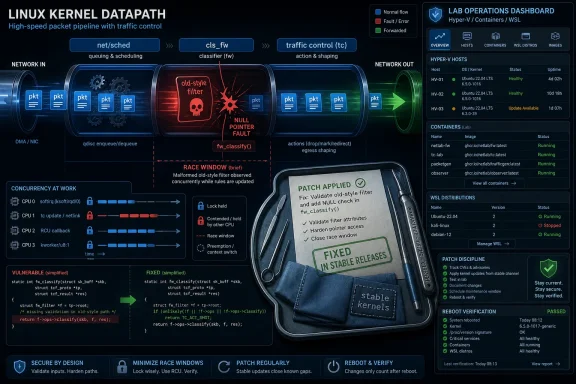 A Small Race in a Deep Subsystem Becomes a CVE
The vulnerability sits in the Linux networking scheduler, under net/sched/cls_fw.c, a part of the kernel that most desktop users will never knowingly touch. It is used by Linux traffic control, the sprawling tc framework that lets administrators classify packets, attach actions, shape queues, mirror traffic, set marks, and build surprisingly complex network policy directly inside the kernel.The affected classifier,
cls_fw, is old machinery. Its job is to classify packets based on firewall marks, a mechanism familiar to anyone who has combined netfilter, routing policy, and tc for QoS or service steering. That age matters, because this bug is not a brand-new feature collapsing under novelty; it is an older interface colliding with newer assumptions about how filters are installed and shared.The core problem is a lifetime and ordering issue. A previous kernel change protected the filter-chain list with a mutex and, as part of that behavior, allowed filters to be added to a shared block and made visible to the datapath before the classifier’s
change() function completed validation. For most classifiers, that ordering may be tolerable. For cls_fw, an invalid old-style filter could briefly exist in a state where packets were still able to reach it.That small window is enough. With a carefully repeated sequence using a dummy interface, a shared egress block, a
matchall filter setting a packet mark, and an old-style fw filter, the kernel can first hit a warning in fw_classify() and then dereference a NULL pointer through the classifier’s expected queue state. In plainer English: the kernel briefly lets an object be used before it has been proven safe to use.The Exploit Story Is Less Dramatic Than the Engineering Story
There is no NVD CVSS score yet, and that absence is worth respecting rather than filling with invented certainty. The public record describes a NULL pointer dereference and a kernel crash path, not a demonstrated privilege escalation, data leak, or remote code execution chain. That generally puts the practical security concern closer to denial of service than full compromise, at least based on the information currently available.But Linux kernel CVEs should not be judged only by whether they hand an attacker root in three commands. The kernel is a shared fault domain. If a privileged network-management service, container host, router appliance, or orchestration agent can trigger a kernel crash through valid administrative interfaces, that is operationally meaningful even when the attacker model is constrained.
The reproducer in the disclosure uses tools and permissions that imply local administrative capability. Creating dummy network devices, adding qdiscs, attaching blocks, and manipulating traffic-control filters are not operations ordinary users can typically perform on hardened systems. That limits the blast radius, but it does not make the bug irrelevant.
Modern infrastructure is full of software that runs with exactly those capabilities. Kubernetes networking components, CNI plugins, observability agents, virtual router stacks, SD-WAN appliances, firewalls, lab automation, and CI systems can all touch kernel networking internals. A flaw that looks academic on a laptop can become a real availability problem when it sits under a fleet service that assumes
tc is safe, deterministic plumbing.Traffic Control Is Linux’s Power Tool, and Power Tools Bite
Linuxtc has always occupied an odd place in the platform. It is powerful enough to build production-grade packet classification and shaping, but it exposes administrators to an API surface that feels more like kernel surgery than ordinary system configuration. The feature is indispensable in data centers and edge devices, yet many teams interact with it indirectly through higher-level tooling.That indirection is part of the risk. An administrator may never type
tc filter add block 1 protocol ip prio 2 fw, but some service may generate equivalent state on their behalf. When that service is a container networking layer or a traffic-shaping daemon, the kernel does not care whether the command came from a human, a script, or a controller reconciling desired state.The
cls_fw bug also highlights how old compatibility paths linger in critical systems. The phrase “old-style” in the vulnerability description is doing a lot of work. It refers to a legacy way of creating filters without the newer options structure, and the fix effectively says that this old classification path should be skipped on shared blocks because it cannot safely assume the queue context it wants to dereference.That is the kind of fix kernel maintainers make when they must preserve compatibility without pretending all compatibility modes are equally valid everywhere. The old path is not removed wholesale. Instead, it is fenced off from the context where its assumptions are wrong.
The Datapath Saw the Filter Too Soon
The bug’s most interesting detail is not that a pointer was NULL. NULL pointer dereferences are a familiar class of kernel failure, and they often read like boilerplate in vulnerability databases. What matters here is why the pointer could be reached.The relevant sequence is subtle. Filters are placed into a shared block and published to the datapath before
change() finishes. The validation logic later rejects the invalid old-style filter, but there is a short lifetime during which packets can be classified through it. If packets are moving fast enough and the test is repeated enough, that invalid transient state becomes observable.That distinction matters because it separates this CVE from a simple missing
if (!ptr) check. The bug is about publication ordering, validation timing, and concurrent packet processing. Kernel networking code is especially exposed to this class of mistake because configuration happens in process context while classification happens along hot packet paths that are optimized for speed.The fix described in the record skips old-style classification on shared blocks, preventing the classifier from walking into a context where the queue pointer is not valid. That is a targeted repair. It does not redesign traffic control, and it does not claim that shared blocks are broken. It recognizes that one classifier path made an assumption the newer shared-block model could no longer satisfy.
Shared Blocks Were Built for Scale, Not for Legacy Assumptions
Shared blocks are one of those Linux networking features that make perfect sense once you run large or complex systems. Instead of attaching duplicate filter chains to individual qdiscs or devices, administrators can attach classifiers to a block and share that policy across multiple attachment points. That makes configuration more reusable and, in many cases, more efficient.But sharing changes object relationships. Code that once assumed a classifier had a direct queueing discipline context may now find itself operating in a more abstract block context. The NULL dereference in
cls_fw is a symptom of that shift. The old classifier path expected something the shared-block world did not promise.This is a recurring story in mature kernels. A subsystem evolves to support scale, offload, namespaces, virtualization, or more flexible policy, and older modules remain present because real users still depend on them. The friction appears not in the headline feature but in the seams between the old and the new.
For administrators, that is why minor-seeming net/sched CVEs deserve attention even when they are not internet-facing vulnerabilities. They often expose assumptions inside foundational code paths. If your infrastructure depends on traffic control, bridge filtering, virtual interfaces, qdiscs, or packet marking, those assumptions are part of your production platform whether you think about them or not.
The Version Matrix Tells Administrators Where to Look
The affected record identifies Linux as affected starting with the relevant 5.1-era lineage and marks older versions below 5.1 as unaffected for this issue. It also lists fixed stable-line versions including 5.10.259, 5.15.210, 6.1.176, 6.6.143, 6.12.93, 6.18.35, 7.0.10, and the 7.1 fix lineage. The exact package names and backport status will vary by distribution, which is the part administrators actually have to care about.That distribution caveat is not a formality. Enterprise Linux vendors routinely backport fixes without changing the upstream version number in the way users expect. A system advertising a familiar long-term kernel version may already contain the fix, while a custom-built or vendor appliance kernel may not. The upstream semver line is a map, not a substitute for checking your vendor advisory or package changelog.
The practical first step is to determine whether your systems use kernels in the affected range and whether your vendor has shipped the corresponding net/sched fix. For self-built kernels, that means checking for the relevant stable commit in your tree. For distribution kernels, it means checking the security errata rather than assuming that the visible kernel version tells the whole story.
There is also a difference between theoretical exposure and likely triggerability. Systems that never allow privileged actors or services to create shared traffic-control blocks with old-style
cls_fw filters have a much smaller operational risk. Systems that run network policy automation, packet-marking pipelines, or custom traffic-control scripts should treat this as more than database noise.Windows Shops Should Not Dismiss a Linux Kernel Bug
At first glance, this looks like a Linux-only issue with little relevance to a Windows-focused community. That would have been a reasonable instinct in 2006. It is much less reasonable in 2026.Windows environments now routinely contain Linux at the edges and in the middle. Developers run Linux containers on Windows workstations. Security teams test appliances in Hyper-V. Azure-heavy shops run Linux network virtual appliances. Build farms, observability pipelines, Kubernetes clusters, storage gateways, and security sandboxes all mix Windows administration with Linux kernels.
Even WSL has changed expectations, though this CVE should not be lazily turned into a WSL scare. The vulnerable code lives in the Linux kernel networking stack, and exposure depends on kernel version, enabled modules, privileges, and whether the relevant traffic-control paths can be reached. The right takeaway for Windows administrators is not “WSL users are doomed.” It is that Linux kernel patch posture is now part of many Windows estates.
That is especially true for small IT teams. A Windows admin may own the Hyper-V hosts, the firewall appliance VM, the Linux-based backup repository, the container runner, and the monitoring stack by default. Vulnerabilities like CVE-2026-53080 are reminders that “not a Windows CVE” does not mean “not our problem.”
NULL Dereference Does Not Mean Low Consequence
Security teams sometimes underweight NULL dereferences because they are often denial-of-service bugs. That instinct is understandable, but it can become sloppy. A kernel crash is not a harmless event when it takes down a node carrying production traffic, a firewall, a storage path, or a multi-tenant workload host.The public description points to a crash in
fw_classify() after a warning path and then a dereference involving q->handle when q is NULL. The repro context includes generated UDP traffic and repeated setup-teardown of a dummy device and traffic-control state. This is not a passive network packet sent from the internet to every Linux server. It is a kernel state manipulation that depends on local control of networking configuration.That distinction should shape response. Internet-wide scanning panic would be misplaced. So would ignoring the patch because “only root can do it.” Many production outages are caused by privileged automation faithfully doing the wrong thing at machine speed.
The more mature reading is that CVE-2026-53080 is an availability flaw in a privileged configuration path, with special relevance to systems where traffic control is automated or exposed through higher-level management planes. It should be patched through normal kernel update channels and prioritized higher on hosts that run advanced Linux networking.
The Fix Is Surgical, but the Lesson Is Architectural
The patch strategy is narrow: prevent old-stylecls_fw classification from operating on shared blocks in the invalid short-lived state. That is good engineering. Broad rewrites create regression risk, especially in kernel networking, where tiny behavioral changes can break obscure but legitimate deployments.Yet the architectural lesson is wider. Kernel subsystems increasingly rely on staging, validation, reference counting, RCU, locks, and carefully defined object lifetimes to safely update live datapaths. When a configuration object becomes visible before it is fully validated, the system is betting that every consumer can tolerate that intermediate state. CVE-2026-53080 shows how one legacy consumer could not.
There is a governance angle here as well. The Linux kernel’s modern CVE process has been assigning identifiers to many resolved flaws that previously might have been treated as ordinary bug fixes. That can inflate vulnerability feeds with issues that vary widely in exploitability, but it also improves traceability. Administrators get a named handle for a real crash condition and can tie it to patches, advisories, and asset inventory.
The downside is fatigue. If every kernel oops becomes another CVE row with no CVSS score at publication, security teams must do more interpretation themselves. The answer is not to dismiss the feed; it is to triage based on subsystem, reachable configuration, privilege requirements, and business role.
Patch Management Has to Understand the Kernel You Actually Run
The biggest operational trap is assuming that upstream kernel version numbers translate cleanly into distribution risk. They often do not. Red Hat, Canonical, SUSE, Debian, appliance vendors, Android-derived platforms, cloud kernels, and embedded distributions all carry patches differently.A vendor may backport the fix into a kernel whose base version still appears affected by upstream semver. Conversely, a custom kernel built from a stable branch before the fix may remain vulnerable even if the distribution on the box looks modern. In security operations, “uname says X” is a clue, not a verdict.
Administrators should also remember that kernel modules complicate exposure. The trace in the report shows
cls_fw and act_skbedit as modules in the reproducer environment. If a system never loads the relevant classifier and has no tooling that would load it, practical exposure is reduced. But module autoloading and orchestration can turn “not loaded now” into “loaded during incident response” faster than change boards would like.For high-confidence assessment, inventory needs to answer three questions. Is the kernel code present and unfixed? Can privileged local users or services configure traffic-control shared blocks and
cls_fw filters? Does the system’s business role make a kernel crash materially damaging? That last question is often the one vulnerability scanners cannot answer.Container Hosts Deserve a Closer Look Than Laptops
For ordinary Linux desktops, this CVE is unlikely to be urgent unless the user runs custom network labs or untrusted privileged workloads. For container hosts, routers, and network appliances, the calculus changes. These are precisely the environments wheretc, packet marks, classifiers, and actions may be used as part of normal control-plane behavior.Containers also complicate the meaning of “local.” A container that receives elevated networking capabilities is not just another process; it may be able to influence kernel networking state on the host. If a cluster permits privileged containers or grants broad
CAP_NET_ADMIN, a bug in traffic-control code becomes more relevant to tenant isolation and node availability.That does not mean CVE-2026-53080 is automatically exploitable from any container. Capability boundaries, namespace setup, module availability, LSM policy, and distribution patches all matter. But it does mean the right place to look is not the average user’s shell; it is the exception list of workloads allowed to manage networking.
Network appliances are another natural concern. Many vendor devices run Linux kernels with custom traffic shaping and firewall policy layers. Customers may not see
tc, but the vendor’s control plane may rely on it. In those cases, the actionable patch may arrive as firmware, not as a package manager update.Security Feeds Need Context, Not Theater
CVE-2026-53080 arrived in NVD without an NVD-provided CVSS score at publication. That will frustrate dashboards built around severity colors. It should also remind us that severity scoring is a convenience layer, not the vulnerability itself.A NULL pointer dereference in a privileged kernel network path can be low priority on a single-user workstation and high priority on a multi-tenant network node. It can be irrelevant on a locked-down appliance that never exposes the path and important on a lab automation server that continuously creates and destroys virtual interfaces. CVSS is not designed to understand your topology.
The better triage model starts with reachability. If no actor or service can create the relevant traffic-control objects, urgency drops. If privileged automation can create them, and if crashing the host would interrupt customer traffic or security enforcement, urgency rises.
This is where Windows-centric operations teams sometimes have an advantage. Years of Patch Tuesday discipline have trained many admins to separate vendor severity from business impact. The same muscle applies here: identify affected assets, map exposure, test the patch, roll it through rings, and watch for regressions in the networking stack.
The Crash Window Leaves a Clear Admin Playbook
CVE-2026-53080 is not a reason to rip out Linux traffic control or disable every advanced networking feature in sight. It is a reason to treat kernel networking updates as reliability updates as well as security updates. The machines most worth attention are the ones where a crash is expensive andtc is part of the normal operating model.- Systems running fixed vendor kernels or upstream stable releases at 5.10.259, 5.15.210, 6.1.176, 6.6.143, 6.12.93, 6.18.35, 7.0.10, or newer fixed lineages should already contain the upstream repair for this issue.
- Systems using custom kernels should be checked for the
cls_fwfix rather than judged only by the version string printed byuname. - Hosts that grant
CAP_NET_ADMINto containers, agents, or automation deserve closer review because traffic-control configuration may be reachable through those delegated privileges. - Network appliances, virtual routers, Kubernetes nodes, and traffic-shaping hosts should be prioritized above ordinary desktops because a kernel crash on those systems has wider operational impact.
- Teams should avoid treating the lack of an NVD CVSS score as evidence of harmlessness, because the absence of a score says more about enrichment status than about local business risk.
- The safest mitigation is to apply the appropriate kernel or vendor firmware update, then reboot into the fixed kernel and verify that the running kernel, not merely the installed package, has changed.
References
- Primary source: NVD / Linux Kernel
Published: 2026-06-28T01:42:19-07:00
NVD - CVE-2026-53080
 nvd.nist.gov
- Security advisory: MSRC
Published: 2026-06-28T01:42:19-07:00
Original feed URL
Security Update Guide - Microsoft Security Response Center
 msrc.microsoft.com
- Official source: nist.gov
National Vulnerability Database
NIST maintains the National Vulnerability Database (NVD), a repository of information on software and hardware flaws that can compromise computer security. This is a key piece of the nation’s cybersecurity infrastructure.www.nist.gov - Related coverage: windowsforum.com
CVE-2026-31421 NULL Pointer Dereference in Linux tc cls_fw: Shared Block Crash Fix | Windows Forum
Overview A newly assigned Linux kernel CVE, CVE-2026-31421, highlights a small but very real class of bug that security teams have learned to take...windowsforum.com - Related coverage: security.snyk.io
CVE-2023-53080 in kernel | CVE-2023-53080 | Snyk
Medium severity (4.1) CVE-2023-53080 in kernel | CVE-2023-53080security.snyk.io - Related coverage: static.sched.com
Slide 1: Breaking and Fixing the Kernel: Crashes, Debugging & Performance tuning
PDF documentstatic.sched.com
