

Linux kernel maintainers assigned CVE-2026-45845 on May 27, 2026, to a TAPRIO traffic-control flaw that can let a local user crash affected systems through a NULL pointer dereference in the class-dump path. The bug is not a remote network break-in, and it is not a privilege-escalation story on the evidence available so far. It is, instead, a reminder that the Linux networking stack’s most specialized machinery often becomes security-relevant once namespaces, capabilities, and diagnostic interfaces meet. For WindowsForum readers running Linux hosts, WSL-adjacent lab systems, container platforms, routers, appliances, or mixed Windows/Linux infrastructure, the practical question is less “Is TAPRIO common?” than “Where have we allowed local namespace control to become a denial-of-service lever?”
CVE-2026-45845 sits in
That description sounds exotic, and for many desktop Linux users it is. But the modern Linux kernel is a general-purpose substrate: the same source tree runs laptops, cloud hosts, industrial gateways, hypervisors, container nodes, and embedded network equipment. A flaw in a specialized qdisc can therefore matter even when most administrators have never typed
The vulnerability description is unusually clear. A TAPRIO child qdisc can be deleted through
That is the classic shape of a kernel denial-of-service bug: a control path assumes an object exists because the data structure normally contains one, but a legal sequence of configuration operations leaves a hole. When the diagnostic or dump path walks the structure, the kernel touches memory through a NULL pointer and falls over.
The bug is reachable with namespace-scoped
That detail is the pivot. Linux capabilities are not global in the old root-or-not-root sense once user namespaces enter the picture. A process that is not privileged on the host can be privileged inside a namespace, and kernel attack surface exposed to that namespace becomes a possible route to host-wide failure.
The described outcome is a kernel panic, not data theft or arbitrary code execution. But for production systems, a reliable panic is still a serious security event. It can take down a container host, interrupt workloads, reset networking, trigger failover, and turn a low-privilege local foothold into a service outage.
The security tradeoff is that specialized kernel features are still kernel features. They share the same privilege boundary as the rest of the networking stack. If a feature can be configured from a namespace, and if unprivileged users can create that namespace, the feature becomes reachable in places far beyond its intended industrial or embedded deployments.
This is not unique to TAPRIO. Over the past decade, Linux hardening work has repeatedly run into the same pattern: namespaces make containerization practical, but they also expose more kernel code to users who would not otherwise reach it. A bug that once required root on a host can become reachable by an ordinary user if the right namespace configuration grants scoped authority.
The Windows comparison is imperfect but useful. Windows administrators are used to thinking in terms of local privilege boundaries, driver attack surface, and whether a feature is merely installed or actually accessible. Linux administrators have to apply the same discipline to kernel subsystems that may be compiled in, module-loadable, or reachable through namespace-mediated interfaces.
This is the kind of fix kernel developers like because it repairs the invariant rather than sprinkling defensive checks through every caller. If class-dump paths can assume a child pointer is never NULL, they become simpler and safer. The control plane stops needing to rediscover that a deleted child left behind a trap.
There was also a subtle accounting wrinkle. The data-plane paths previously guarded against NULL children, dropping or skipping packets cleanly. Once the slot contains
That detail is easy to miss, but it is the difference between a crash-only fix and a correct fix. Kernel networking code is full of these hidden contracts: pointers, reference counts, queue lengths, backlog accounting, and dump paths all need to agree on what an “absent” qdisc looks like. A sentinel object solves one class of bug only if every path treats it consistently.
On many developer workstations, unprivileged user namespaces are enabled because they make rootless containers, sandboxing, and modern development workflows easier. On container hosts, namespace features are the foundation of the platform. On multi-user servers, HPC clusters, and shared lab systems, the same feature can convert a seemingly narrow kernel bug into a local denial-of-service path.
That does not mean administrators should reflexively disable user namespaces everywhere. They are not a gimmick; they are part of how contemporary Linux systems isolate software. But security teams should stop treating them as a pure reduction in risk. Namespaces move privilege around, and every kernel subsystem reachable from that moved privilege becomes part of the exposed surface.
For enterprises with Linux under Windows-heavy management, this is where asset inventory tends to fail. The vulnerable machine may not be a flagship Linux server. It may be a build runner, a Kubernetes node, a network appliance, a lab box under a desk, a WSL-related test environment, or a vendor-supplied VM. The systems most likely to be overlooked are often the ones most permissive about local experimentation.
The impact is local denial of service. The preconditions include a kernel with TAPRIO enabled and a route to namespace-scoped
That makes it less urgent than a remote unauthenticated code-execution flaw and more urgent than a purely theoretical edge case requiring host root. If a platform permits unprivileged namespace creation, the privilege barrier is lower than a casual reading of
Administrators should also remember that Linux distribution kernels differ. Some features are built in, some are modules, and some are disabled by configuration. Vendor kernels may backport the fix without changing the visible upstream version number. The answer is not simply “upgrade to kernel X”; it is “check your vendor’s fixed package or stable backport for the kernel line you actually run.”
That is why local denial-of-service CVEs can matter more in container fleets than on single-user desktops. A developer crashing their own laptop is annoying. A tenant, compromised web app, or malicious CI job crashing a shared worker node is an incident.
The exact exploitability depends on runtime policy. Seccomp filters, capability drops, network namespace restrictions,
In Kubernetes environments, the obvious red flag is any workload granted excessive networking capability. Privileged containers, containers with
Microsoft’s own ecosystem has made that more true, not less. Windows developers routinely build Linux containers, deploy to Linux-based cloud services, and run mixed environments where identity, endpoint management, and patch governance cross OS boundaries. A Linux kernel panic on a build host can delay Windows software delivery just as surely as a Windows Update regression can.
The right mental model is not “Linux vulnerability versus Windows vulnerability.” It is “shared infrastructure fragility.” CVE-2026-45845 is a host-kernel reliability bug with a security trigger. If the affected host provides services that Windows users depend on, the business impact lands in the same ticket queues.
This is also why vulnerability scoring alone cannot decide priority. A local DoS on a forgotten lab machine is low drama. The same bug on a dense container host, remote development platform, or industrial gateway may be a real availability risk.
Distribution kernels are not plain upstream kernels. Red Hat, Canonical, SUSE, Debian, Oracle, cloud vendors, and appliance makers backport fixes into their own maintained branches. The version string may not obviously show the upstream commit, and a system can be fixed while still reporting an older-looking kernel version.
For unmanaged systems, the simplest path is to install current kernel security updates from the distribution and reboot into the fixed kernel. For managed fleets, the better path is to query vendor advisories, package changelogs, and fleet inventory to confirm which kernel builds include the TAPRIO fix. A staged rollout should still move quickly where multi-user or containerized workloads are exposed.
Reboots are the unglamorous part. Kernel fixes do not protect a running host until the fixed kernel is active, unless a live-patching vendor has explicitly shipped and applied a live patch for this issue. A dashboard showing “package installed” is not enough if the machine is still booted into the vulnerable kernel.
Administrators can also examine whether TAPRIO is present or loadable on their systems. But feature-level mitigation is often messy in real fleets, especially where kernels are vendor-managed or modules are shared across use cases. Configuration hardening should not become a substitute for applying the kernel fix.
For container platforms, the practical review starts with capability grants and privileged workloads. If a workload does not need traffic-control manipulation, it should not have the authority to perform it. If a CI job needs root-like behavior only because the pipeline is old and convenient, CVEs like this are an argument for tightening that design.
Monitoring is less satisfying here. A successful trigger may simply crash the machine. Logs from a prior oops, panic, or KASAN-like trace can help confirm what happened after the fact, but they do not prevent the outage. Prevention lives in patching and reachability reduction.
A kernel NULL pointer dereference is not merely an application crash. It can be a host crash, a service outage, and a tenant-impacting event. The severity depends on who can trigger it and where the affected host sits in the architecture.
CVE-2026-45845 also illustrates why control-plane code deserves the same paranoia as packet fast paths. The panic happens in a dump path, not in the dramatic act of forwarding hostile traffic at line rate. Introspection and configuration interfaces are attack surface too, especially when exposed through generic netlink and rtnetlink plumbing.
The fix’s reliance on
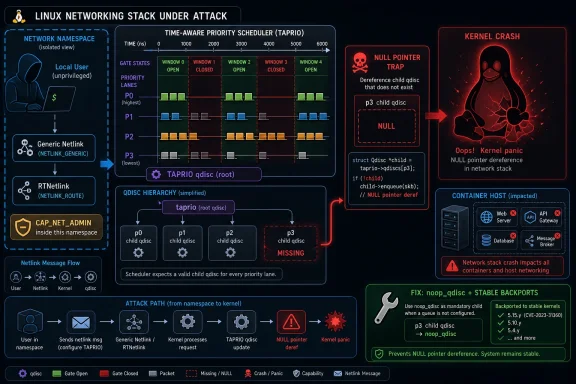 A Small Traffic-Control Bug Lands in a Large Attack Surface
CVE-2026-45845 sits in net/sched, the part of the Linux kernel that implements traffic control queueing disciplines, or qdiscs. The affected component is TAPRIO, short for Time-Aware Priority Scheduler, a scheduler used in time-sensitive networking scenarios where packet transmission is coordinated by traffic classes and time windows.That description sounds exotic, and for many desktop Linux users it is. But the modern Linux kernel is a general-purpose substrate: the same source tree runs laptops, cloud hosts, industrial gateways, hypervisors, container nodes, and embedded network equipment. A flaw in a specialized qdisc can therefore matter even when most administrators have never typed
tc qdisc add ... taprio by hand.The vulnerability description is unusually clear. A TAPRIO child qdisc can be deleted through
RTM_DELQDISC, causing taprio_graft() to store NULL into an internal array slot. Later, a class-dump operation through RTM_GETTCLASS walks those classes, calls into taprio_dump_class(), retrieves that NULL child through taprio_leaf(), and then dereferences it while trying to read the child handle.That is the classic shape of a kernel denial-of-service bug: a control path assumes an object exists because the data structure normally contains one, but a legal sequence of configuration operations leaves a hole. When the diagnostic or dump path walks the structure, the kernel touches memory through a NULL pointer and falls over.
The Exploit Chain Is Local, but the Blast Radius Is the Host
The NVD entry was still awaiting enrichment when published, with no NIST CVSS score assigned. That matters because a mature vulnerability-management pipeline should not treat “N/A” as “safe”; it should treat it as “not yet scored.” The technical description already tells administrators enough to triage exposure.The bug is reachable with namespace-scoped
CAP_NET_ADMIN on kernels built with CONFIG_NET_SCH_TAPRIO. On systems where unprivileged user namespaces are enabled, an unprivileged local user can reportedly create a new network namespace, gain the relevant capability inside that namespace, configure TAPRIO, delete a child qdisc, and then request a class dump. The dump request itself does not require capability.That detail is the pivot. Linux capabilities are not global in the old root-or-not-root sense once user namespaces enter the picture. A process that is not privileged on the host can be privileged inside a namespace, and kernel attack surface exposed to that namespace becomes a possible route to host-wide failure.
The described outcome is a kernel panic, not data theft or arbitrary code execution. But for production systems, a reliable panic is still a serious security event. It can take down a container host, interrupt workloads, reset networking, trigger failover, and turn a low-privilege local foothold into a service outage.
TAPRIO Shows How “Specialized” Kernel Code Becomes Everyone’s Problem
TAPRIO exists for a real reason. Time-sensitive networking and deterministic packet scheduling are important in industrial control, audio/video bridging, automotive systems, telecom, and other domains where traffic timing matters. Linux has spent years becoming credible in those spaces, and sophisticated queueing disciplines are part of that story.The security tradeoff is that specialized kernel features are still kernel features. They share the same privilege boundary as the rest of the networking stack. If a feature can be configured from a namespace, and if unprivileged users can create that namespace, the feature becomes reachable in places far beyond its intended industrial or embedded deployments.
This is not unique to TAPRIO. Over the past decade, Linux hardening work has repeatedly run into the same pattern: namespaces make containerization practical, but they also expose more kernel code to users who would not otherwise reach it. A bug that once required root on a host can become reachable by an ordinary user if the right namespace configuration grants scoped authority.
The Windows comparison is imperfect but useful. Windows administrators are used to thinking in terms of local privilege boundaries, driver attack surface, and whether a feature is merely installed or actually accessible. Linux administrators have to apply the same discipline to kernel subsystems that may be compiled in, module-loadable, or reachable through namespace-mediated interfaces.
The Fix Is Boring in the Best Possible Way
The upstream fix usesnoop_qdisc as a placeholder when a TAPRIO child qdisc is removed. Instead of leaving an internal slot as NULL, taprio_graft() substitutes the kernel’s no-op qdisc. That follows an established pattern used elsewhere in traffic control, including qdiscs that avoid NULL slots by replacing absent children with a safe sentinel object.This is the kind of fix kernel developers like because it repairs the invariant rather than sprinkling defensive checks through every caller. If class-dump paths can assume a child pointer is never NULL, they become simpler and safer. The control plane stops needing to rediscover that a deleted child left behind a trap.
There was also a subtle accounting wrinkle. The data-plane paths previously guarded against NULL children, dropping or skipping packets cleanly. Once the slot contains
noop_qdisc instead of NULL, those checks have to change. If packets were allowed to flow into the no-op qdisc through the wrong path, root qdisc counters could be incremented without being rolled back, permanently inflating queue length and backlog statistics.That detail is easy to miss, but it is the difference between a crash-only fix and a correct fix. Kernel networking code is full of these hidden contracts: pointers, reference counts, queue lengths, backlog accounting, and dump paths all need to agree on what an “absent” qdisc looks like. A sentinel object solves one class of bug only if every path treats it consistently.
The Risk Is Highest Where User Namespaces Are Treated as Free Isolation
The most important operational variable is not whether an administrator deliberately uses TAPRIO. It is whether local users, containers, build jobs, CI workers, or sandboxed applications can create user and network namespaces on a kernel where TAPRIO is available.On many developer workstations, unprivileged user namespaces are enabled because they make rootless containers, sandboxing, and modern development workflows easier. On container hosts, namespace features are the foundation of the platform. On multi-user servers, HPC clusters, and shared lab systems, the same feature can convert a seemingly narrow kernel bug into a local denial-of-service path.
That does not mean administrators should reflexively disable user namespaces everywhere. They are not a gimmick; they are part of how contemporary Linux systems isolate software. But security teams should stop treating them as a pure reduction in risk. Namespaces move privilege around, and every kernel subsystem reachable from that moved privilege becomes part of the exposed surface.
For enterprises with Linux under Windows-heavy management, this is where asset inventory tends to fail. The vulnerable machine may not be a flagship Linux server. It may be a build runner, a Kubernetes node, a network appliance, a lab box under a desk, a WSL-related test environment, or a vendor-supplied VM. The systems most likely to be overlooked are often the ones most permissive about local experimentation.
“No CVSS Yet” Is Not the Same as “No Triage Needed”
Because NVD enrichment had not yet supplied CVSS vectors at publication, security dashboards may initially show CVE-2026-45845 in an ambiguous state. That is uncomfortable for teams that rely on severity scores to drive patching. But this is one of those cases where the prose beats the number.The impact is local denial of service. The preconditions include a kernel with TAPRIO enabled and a route to namespace-scoped
CAP_NET_ADMIN. The trigger sequence is specific but not fanciful: create or manipulate a TAPRIO qdisc, delete a child, then dump traffic-control classes.That makes it less urgent than a remote unauthenticated code-execution flaw and more urgent than a purely theoretical edge case requiring host root. If a platform permits unprivileged namespace creation, the privilege barrier is lower than a casual reading of
CAP_NET_ADMIN might suggest. If it does not, exposure narrows sharply.Administrators should also remember that Linux distribution kernels differ. Some features are built in, some are modules, and some are disabled by configuration. Vendor kernels may backport the fix without changing the visible upstream version number. The answer is not simply “upgrade to kernel X”; it is “check your vendor’s fixed package or stable backport for the kernel line you actually run.”
Containers Turn Kernel Panics into Platform Incidents
The container angle deserves special attention because it is where local kernel vulnerabilities routinely become operational outages. Containers do not have their own kernels. A process inside a container that can reach a host kernel bug can crash the host kernel, taking sibling workloads down with it.That is why local denial-of-service CVEs can matter more in container fleets than on single-user desktops. A developer crashing their own laptop is annoying. A tenant, compromised web app, or malicious CI job crashing a shared worker node is an incident.
The exact exploitability depends on runtime policy. Seccomp filters, capability drops, network namespace restrictions,
tc availability, module loading policy, and user-namespace settings all shape the practical path. But the vulnerability description’s emphasis on namespace-scoped CAP_NET_ADMIN should immediately send platform teams to their container profiles.In Kubernetes environments, the obvious red flag is any workload granted excessive networking capability. Privileged containers, containers with
NET_ADMIN, and containers allowed to manipulate traffic control deserve scrutiny. Even if unprivileged user namespaces are constrained, over-broad container permissions can recreate the reachability condition.Windows Shops Should Read This as a Linux Host Reliability Story
A WindowsForum audience may reasonably ask why a Linux TAPRIO bug belongs in their daily threat model. The answer is that few Windows environments are purely Windows anymore. Linux sits under container platforms, network appliances, security tools, storage gateways, CI pipelines, cloud images, and developer infrastructure.Microsoft’s own ecosystem has made that more true, not less. Windows developers routinely build Linux containers, deploy to Linux-based cloud services, and run mixed environments where identity, endpoint management, and patch governance cross OS boundaries. A Linux kernel panic on a build host can delay Windows software delivery just as surely as a Windows Update regression can.
The right mental model is not “Linux vulnerability versus Windows vulnerability.” It is “shared infrastructure fragility.” CVE-2026-45845 is a host-kernel reliability bug with a security trigger. If the affected host provides services that Windows users depend on, the business impact lands in the same ticket queues.
This is also why vulnerability scoring alone cannot decide priority. A local DoS on a forgotten lab machine is low drama. The same bug on a dense container host, remote development platform, or industrial gateway may be a real availability risk.
Patch Management Has to Follow the Stable Trees, Not the Headline
The CVE record lists multiple stable kernel references, indicating that fixes are being carried across supported kernel branches rather than living only in mainline. That is normal for Linux kernel security work. It is also where many administrators get tripped up.Distribution kernels are not plain upstream kernels. Red Hat, Canonical, SUSE, Debian, Oracle, cloud vendors, and appliance makers backport fixes into their own maintained branches. The version string may not obviously show the upstream commit, and a system can be fixed while still reporting an older-looking kernel version.
For unmanaged systems, the simplest path is to install current kernel security updates from the distribution and reboot into the fixed kernel. For managed fleets, the better path is to query vendor advisories, package changelogs, and fleet inventory to confirm which kernel builds include the TAPRIO fix. A staged rollout should still move quickly where multi-user or containerized workloads are exposed.
Reboots are the unglamorous part. Kernel fixes do not protect a running host until the fixed kernel is active, unless a live-patching vendor has explicitly shipped and applied a live patch for this issue. A dashboard showing “package installed” is not enough if the machine is still booted into the vulnerable kernel.
Mitigation Is About Reducing Reachability Until the Kernel Is Fixed
If patching cannot happen immediately, mitigation should focus on whether untrusted local users can reach the vulnerable path. Disabling or restricting unprivileged user namespaces can reduce exposure, though it may break rootless container workflows and application sandboxes. Removing unnecessaryCAP_NET_ADMIN from containers and services is a lower-regret move in most environments.Administrators can also examine whether TAPRIO is present or loadable on their systems. But feature-level mitigation is often messy in real fleets, especially where kernels are vendor-managed or modules are shared across use cases. Configuration hardening should not become a substitute for applying the kernel fix.
For container platforms, the practical review starts with capability grants and privileged workloads. If a workload does not need traffic-control manipulation, it should not have the authority to perform it. If a CI job needs root-like behavior only because the pipeline is old and convenient, CVEs like this are an argument for tightening that design.
Monitoring is less satisfying here. A successful trigger may simply crash the machine. Logs from a prior oops, panic, or KASAN-like trace can help confirm what happened after the fact, but they do not prevent the outage. Prevention lives in patching and reachability reduction.
The Lesson Hidden in the NULL Pointer
NULL pointer dereferences are sometimes dismissed as low-grade bugs because they often produce crashes rather than compromise. In user space, that instinct is frequently reasonable. In kernel space, the calculus changes because the kernel is the shared execution base for the whole system.A kernel NULL pointer dereference is not merely an application crash. It can be a host crash, a service outage, and a tenant-impacting event. The severity depends on who can trigger it and where the affected host sits in the architecture.
CVE-2026-45845 also illustrates why control-plane code deserves the same paranoia as packet fast paths. The panic happens in a dump path, not in the dramatic act of forwarding hostile traffic at line rate. Introspection and configuration interfaces are attack surface too, especially when exposed through generic netlink and rtnetlink plumbing.
The fix’s reliance on
noop_qdisc is a useful design lesson. Robust kernel code often depends on maintaining invariants at structure boundaries. If an array of child qdiscs is supposed to contain qdisc pointers, letting a NULL sneak in is not just one missing check; it is a broken contract.The Admin’s Reading of CVE-2026-45845 Should Be Concrete
This is not a panic-everywhere emergency, but it is also not background noise. Treat it as a local host denial-of-service issue whose importance rises with namespace availability, container density, and shared-user exposure.- Systems running kernels with
CONFIG_NET_SCH_TAPRIOenabled should be checked against distribution or vendor updates that include the TAPRIO class-dump fix. - Hosts that allow unprivileged user namespaces deserve higher priority because the bug can reportedly be reached without ordinary host-level administrative rights.
- Container platforms should review privileged workloads and unnecessary
CAP_NET_ADMINgrants, especially where untrusted or semi-trusted jobs run. - Applying the fixed kernel package is not sufficient until the machine is booted into that fixed kernel or an applicable live patch is confirmed active.
- NVD’s missing CVSS score at initial publication should not delay triage, because the vulnerability description already identifies the affected subsystem, trigger conditions, and likely impact.
References
- Primary source: NVD / Linux Kernel
Published: 2026-05-28T01:09:34-07:00
NVD - CVE-2026-45845
 nvd.nist.gov
- Security advisory: MSRC
Published: 2026-05-28T01:09:34-07:00
Original feed URL
Security Update Guide - Microsoft Security Response Center
 msrc.microsoft.com
- Related coverage: spinics.net
Re: [PATCH net v2] net/sched: taprio: fix NULL pointer dereference in class dump — Linux Kernel
Linux Kernel: Re: [PATCH net v2] net/sched: taprio: fix NULL pointer dereference in class dump www.spinics.net
- Related coverage: mail-archive.com
[PATCH net v5 1/2] net/sched: taprio: fix NULL pointer dereference in class dump
www.mail-archive.com
- Related coverage: cve.imfht.com
CVE-2026-23309: tracing: Add NULL pointer check to trigger_data_free() - Vulnerability Platform
[中危] Overview There is a null pointer dereference vulnerability in the Linux kernel tracing subsystem. When fails to allocate memory and returns NULL, the cve.imfht.com
