

CVE-2026-31540 is a Linux kernel i915 graphics-driver NULL pointer dereference, published on April 24, 2026, affecting Intel GPU systems where required i915 firmware is missing and suspend triggers an unchecked function-pointer call. It is not a Windows vulnerability in the usual Patch Tuesday sense, but Microsoft’s Security Update Guide entry matters because Windows estates increasingly contain Linux guests, WSL-adjacent tooling, Azure Linux images, developer workstations, and dual-boot hardware. The flaw’s CVSS 3.1 score of 5.5 says “medium”; the operational lesson says something sharper. A laptop that crashes when it sleeps is still a security and reliability incident if it sits in the middle of an enterprise fleet.
The bug itself is almost embarrassingly simple: the i915 driver expects a
That simplicity is why CVE-2026-31540 is more interesting than its score. This is not a speculative execution apocalypse, a remote worm, or a privilege-escalation bug with exploit code bouncing around GitHub. It is a local availability problem in the graphics stack, triggered by a hardware-and-firmware condition that many desktop Linux users and fleet administrators could plausibly create without trying.
The call trace tells the story more clearly than the advisory prose. The system is entering deep suspend, user space is frozen, storage is being synchronized, devices are being powered down, and then the Intel GT suspend path stumbles into
That matters because suspend is no longer a cosmetic desktop feature. Modern endpoint management assumes devices can be closed, docked, undocked, transported, resumed, encrypted, inventoried, patched, and monitored across unreliable power states. A kernel crash at suspend is a denial-of-service flaw wearing the clothes of a driver bug.
For Intel graphics on Linux, firmware is not an afterthought. The i915 driver has spent years absorbing more responsibility for GPU scheduling, power management, display handling, and GuC/HuC-assisted execution. That evolution has improved performance and enabled modern platforms, but it has also made the boundary between “kernel driver” and “external firmware payload” more operationally fragile.
CVE-2026-31540 appears in exactly that seam. The driver’s internal submission machinery expects to reset to a default mode, but the function pointer that should perform the reset is not initialized when the firmware-dependent path is unavailable. The fix is not glamorous: check the pointer before dereferencing it. But the bug exposes a larger design hazard in which a missing optional dependency can turn into a kernel-mode crash during a routine power transition.
That is the kind of failure sysadmins hate because it resists clean categorization. Is it a security vulnerability, a packaging bug, a kernel regression, a bad image build, or a firmware deployment problem? The answer is yes enough to keep everyone in the incident channel.
A local authenticated user causing a system crash is not the same category of emergency as a remote code execution flaw in an exposed service. But the word local has become less comforting in an era of shared developer workstations, lab benches, kiosk-style Linux deployments, classroom machines, GPU-enabled CI runners, and laptops that move between trusted and semi-trusted contexts. Local access is often the first thing an attacker gets after phishing, credential theft, or lateral movement.
The availability impact also deserves a less dismissive reading. A crash during suspend can corrupt workflows, interrupt encryption and backup routines, strand remote users, and produce a machine that looks “off” to management tools until it is physically recovered. In some environments, a repeatable local crash is a nuisance. In others, it is a cheap way to knock endpoint capacity sideways.
There is another subtlety: the trigger condition may not require a sophisticated exploit chain. If a system is already misconfigured or deliberately stripped of firmware, normal suspend behavior can do the rest. The vulnerability is less about a clever attacker constructing a payload and more about the kernel failing to tolerate a plausible degraded state.
CVE-2026-31540 belongs to that new, noisier world. It is a one-line class of bug in spirit, backported across several stable branches, and published with enough metadata to trip scanners. To a patch manager already buried under browser zero-days, Exchange ghosts, VPN appliances, and identity-provider advisories, it is tempting to treat this as background radiation.
That would be a mistake, not because this CVE is catastrophic, but because the accumulation of “medium” kernel flaws is now a core maintenance reality. Linux sits under containers, hypervisors, appliances, developer desktops, Android-adjacent hardware labs, network functions, cloud images, and embedded systems. A medium kernel availability bug in the wrong system can matter more than a high-scoring application flaw in a boxed-off service.
The practical challenge is prioritization. Security teams should not page the on-call engineer for every i915 suspend crash. They should, however, know which assets have Intel graphics, which kernel branches they run, whether firmware packages are complete, and whether suspend states are used in production. That is asset management, not panic.
That does not mean CVE-2026-31540 is patched through Windows Update. It means Microsoft is part of the vulnerability-routing infrastructure for organizations whose exposure does not stop at the Windows kernel. The modern Microsoft estate includes Defender telemetry, Azure images, WSL workflows, GitHub-hosted development, AKS nodes, and hybrid fleets where Linux vulnerabilities show up in the same dashboards as Windows ones.
For WindowsForum readers, this is the important pivot. A Linux i915 bug may not affect your Windows 11 installation, but it can affect the Linux partition on the same laptop, the Fedora or Ubuntu image used by your developers, the lab machine running GPU tests, or a fleet of Intel-based Linux desktops managed by the same IT team that handles Windows endpoints. Platform boundaries are still technically real, but operationally porous.
MSRC listing a Linux CVE is therefore not an error in the matrix. It is a sign that the vulnerability-management map now follows the customer environment rather than the old operating-system tribes. The patch path remains Linux kernel updates and distribution packages, but the alerting path may pass through Microsoft-controlled tooling.
But CPE listings are not the same as confirmed fleet exposure. A vulnerable kernel version matters most when paired with affected Intel graphics hardware, the i915 driver path, missing firmware binaries, and suspend activity. A headless server with no Intel GPU in use is not operationally equivalent to a developer laptop that suspends ten times a day.
This is where vulnerability scanners can both help and mislead. They are good at identifying kernel package versions. They are worse at understanding whether i915 is loaded, whether the relevant firmware blobs are installed, whether GuC submission is in play, and whether suspend is part of the machine’s real use pattern. A scanner may correctly flag a package and still overstate the practical risk for a server.
The inverse is also true. A laptop fleet with incomplete firmware packaging may be more exposed than the raw CVSS score suggests. If machines are crashing on suspend and logs show an i915 NULL pointer dereference near
Power management is especially unforgiving because it crosses subsystem boundaries. The GPU driver is coordinating with PCI power states, device runtime PM, display handling, firmware loading, memory management, workqueues, and the kernel’s suspend ordering. Bugs that do not appear during boot or normal use can surface only when the system is halfway through freezing itself.
The supplied trace shows the crash occurring in an asynchronous suspend worker. That matters because asynchronous suspend improves latency but complicates the mental model. By the time the driver dereferences the NULL pointer, user space is frozen and the system is in a transitional state where recovery is unlikely to be graceful.
A pointer check is boring defensive programming. In kernel power-management paths, boring defensive programming is architecture. CVE-2026-31540 is a reminder that the Linux graphics stack’s sophistication depends not only on fast paths and new hardware enablement, but on tolerating absence: absent firmware, absent callbacks, absent assumptions that yesterday’s initialization path always ran.
The i915 driver has carried an enormous compatibility burden across generations of Intel integrated graphics. It has evolved from basic display and rendering support into a complex platform component responsible for scheduling, resets, firmware-assisted submission, power management, and increasingly subtle interactions with desktop compositors. That complexity creates bugs, but it also reflects the reality that GPUs are no longer simple framebuffer devices.
CVE-2026-31540 is not evidence that the whole stack is rotten. It is evidence that the stack has become deep enough that firmware absence must be treated as a first-class state. A modern driver cannot simply assume that because hardware exists, every supporting binary and callback has been wired up.
The coming transition toward newer Intel graphics paths, including the continued split between legacy i915 responsibilities and newer driver architecture for recent GPUs, will not eliminate this class of problem. It may even make it more visible for a while. New hardware enablement tends to move quickly; enterprise reliability depends on all the dull fallback paths moving with it.
If you build minimal Linux images, verify that Intel graphics firmware is intentionally included or intentionally irrelevant. If you maintain golden images for laptops, confirm that the firmware package set matches the hardware generations you deploy. If your security baseline strips “nonessential” binary blobs, make sure it is not accidentally creating a less stable machine.
The same scrutiny belongs in initramfs generation. Some systems may have firmware installed on disk but unavailable early enough for the relevant driver path. Others may boot fine until a suspend transition exercises a code path that was not touched during provisioning. A clean boot is not a complete validation test for mobile hardware.
For administrators, the fastest triage path is practical. Identify Linux systems with Intel graphics and affected kernels. Check whether i915 is loaded. Confirm firmware packages are present. Review recent kernel logs for i915 Oops traces during suspend or resume. Then patch according to your distribution’s kernel stream rather than hand-applying upstream commits unless you already operate at that level.
That is why version comparisons can be treacherous. A distribution may ship a kernel with a lower-looking version number that includes the backported patch. Another may carry a newer mainline-derived kernel that remains exposed until its package is rebuilt. The safe answer is to follow the distribution’s security tracker and changelog, not just the upstream version string.
The presence of multiple stable patch references is a sign that the kernel maintainers have done the expected backport work across supported branches. That is good news for administrators because it means the fix should flow into maintained kernels without requiring a jump to a bleeding-edge release. It is also a reminder that running abandoned kernels is not merely a compliance problem; it is how small fixes accumulate into avoidable instability.
For desktop Linux users, the remediation is less dramatic. Install the next kernel update from your distribution, reboot into it, and make sure firmware packages are not missing. If you have been working around Intel graphics problems by removing firmware blobs or pinning old kernels, this CVE is one more reason to revisit that decision.
It also shows why availability bugs can be more than theoretical. A system that dies while suspending may not leave an obvious user-facing explanation. To a nontechnical user, the laptop simply fails to sleep, reboots, or returns in a bad state. To IT, it may appear as random instability unless kernel logs are collected centrally.
The call trace narrows the fault domain:
There is a lesson here for telemetry. Endpoint management that ignores kernel logs will miss the difference between user complaints about “sleep being broken” and a reproducible driver vulnerability. Linux desktop fleets, especially developer fleets, need the same evidence discipline that Windows shops apply to blue screens and reliability monitor data.
CVE-2026-31540 makes the invisibility harder to defend. The vulnerable state is not merely “bad code exists in the kernel.” It is “the kernel reaches a code path where a firmware-dependent initialization did not establish the function pointer later assumed by suspend.” That is a dependency-management failure as much as a coding defect.
This is especially relevant to organizations that harden Linux images by removing firmware they believe they do not need. The instinct is understandable. Binary blobs complicate licensing, provenance, attestation, and supply-chain review. But removing firmware from general-purpose endpoint images can turn hardware support into a minefield of untested fallback paths.
A better policy is explicitness. Know which firmware packages are required for which hardware classes. Include them deliberately, exclude them deliberately, and test the power states you expect users to rely on. The worst option is accidental absence, where the system mostly works until a suspend worker discovers the missing piece.
That is why a Linux kernel CVE can be relevant to a Windows-centric audience without being a Windows flaw. The question is not “does this compromise Windows?” The question is whether the organizations that rely on Microsoft tooling will see, prioritize, and remediate Linux exposure correctly.
For WSL specifically, CVE-2026-31540 is not the kind of issue that maps neatly onto typical WSL usage, because the bug lives in the Linux kernel’s Intel i915 graphics driver and suspend path rather than ordinary Linux user space. But for Hyper-V Linux guests with GPU-related configurations, Linux desktop VMs, or dual-boot developer machines, administrators should avoid blanket assumptions. The determining factors are the kernel, driver, hardware exposure, firmware state, and suspend behavior.
This is the hybrid estate’s recurring headache. Security advisories arrive labeled by product, but risk arrives through use. A Windows team that owns the laptop lifecycle may also own the Linux risk on that laptop, whether or not the vulnerable code shipped from Redmond.
Source: NVD / Linux Kernel Security Update Guide - Microsoft Security Response Center
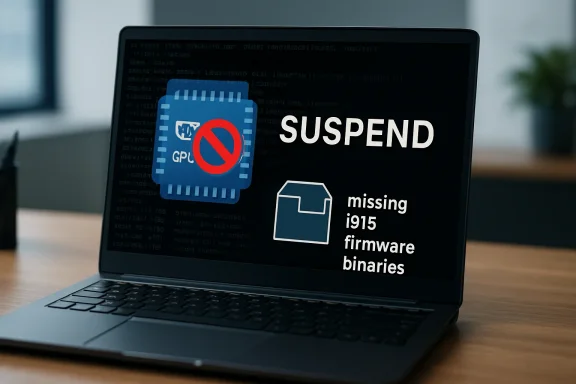 A Medium CVE That Fails at the Worst Possible Moment
The bug itself is almost embarrassingly simple: the i915 driver expects a set_default_submission callback to exist, but in one firmware-missing path it does not. During suspend, the driver still tries to call it. The kernel then jumps through a NULL pointer, lands at address zero, and falls over with the familiar ugly poetry of an Oops trace.That simplicity is why CVE-2026-31540 is more interesting than its score. This is not a speculative execution apocalypse, a remote worm, or a privilege-escalation bug with exploit code bouncing around GitHub. It is a local availability problem in the graphics stack, triggered by a hardware-and-firmware condition that many desktop Linux users and fleet administrators could plausibly create without trying.
The call trace tells the story more clearly than the advisory prose. The system is entering deep suspend, user space is frozen, storage is being synchronized, devices are being powered down, and then the Intel GT suspend path stumbles into
intel_engines_reset_default_submission. The bug is not in an exotic administrator-only interface; it is in the choreography of going to sleep.That matters because suspend is no longer a cosmetic desktop feature. Modern endpoint management assumes devices can be closed, docked, undocked, transported, resumed, encrypted, inventoried, patched, and monitored across unreliable power states. A kernel crash at suspend is a denial-of-service flaw wearing the clothes of a driver bug.
The Missing Firmware Path Is the Real Attack Surface
The official description hinges on a condition that sounds niche: “when the i915 driver firmware binaries are not present.” In practice, that phrase covers more ground than it first appears to. Firmware packaging, initramfs composition, minimal images, custom kernels, immutable distributions, lab builds, and aggressive compliance baselines can all create systems where a driver probes hardware but lacks the binary blobs it expects.For Intel graphics on Linux, firmware is not an afterthought. The i915 driver has spent years absorbing more responsibility for GPU scheduling, power management, display handling, and GuC/HuC-assisted execution. That evolution has improved performance and enabled modern platforms, but it has also made the boundary between “kernel driver” and “external firmware payload” more operationally fragile.
CVE-2026-31540 appears in exactly that seam. The driver’s internal submission machinery expects to reset to a default mode, but the function pointer that should perform the reset is not initialized when the firmware-dependent path is unavailable. The fix is not glamorous: check the pointer before dereferencing it. But the bug exposes a larger design hazard in which a missing optional dependency can turn into a kernel-mode crash during a routine power transition.
That is the kind of failure sysadmins hate because it resists clean categorization. Is it a security vulnerability, a packaging bug, a kernel regression, a bad image build, or a firmware deployment problem? The answer is yes enough to keep everyone in the incident channel.
The CVSS Score Undersells the Fleet Problem
NVD’s CVSS 3.1 vector for CVE-2026-31540 is local, low complexity, low privileges required, no user interaction, unchanged scope, and high availability impact. That lands at 5.5, squarely in medium territory. The score is defensible, but it is also a reminder that CVSS often describes exploit mechanics better than operational pain.A local authenticated user causing a system crash is not the same category of emergency as a remote code execution flaw in an exposed service. But the word local has become less comforting in an era of shared developer workstations, lab benches, kiosk-style Linux deployments, classroom machines, GPU-enabled CI runners, and laptops that move between trusted and semi-trusted contexts. Local access is often the first thing an attacker gets after phishing, credential theft, or lateral movement.
The availability impact also deserves a less dismissive reading. A crash during suspend can corrupt workflows, interrupt encryption and backup routines, strand remote users, and produce a machine that looks “off” to management tools until it is physically recovered. In some environments, a repeatable local crash is a nuisance. In others, it is a cheap way to knock endpoint capacity sideways.
There is another subtlety: the trigger condition may not require a sophisticated exploit chain. If a system is already misconfigured or deliberately stripped of firmware, normal suspend behavior can do the rest. The vulnerability is less about a clever attacker constructing a payload and more about the kernel failing to tolerate a plausible degraded state.
Linux Kernel CVEs Have Become Noisier, Not Less Important
The kernel project’s CVE process has made Linux vulnerability tracking more systematic, but it has also flooded enterprise dashboards with issues that look, at first glance, mundane. Many are small fixes wrapped in vulnerability identifiers. Many involve obscure subsystems. Many have no known exploitation and no dramatic public proof of concept.CVE-2026-31540 belongs to that new, noisier world. It is a one-line class of bug in spirit, backported across several stable branches, and published with enough metadata to trip scanners. To a patch manager already buried under browser zero-days, Exchange ghosts, VPN appliances, and identity-provider advisories, it is tempting to treat this as background radiation.
That would be a mistake, not because this CVE is catastrophic, but because the accumulation of “medium” kernel flaws is now a core maintenance reality. Linux sits under containers, hypervisors, appliances, developer desktops, Android-adjacent hardware labs, network functions, cloud images, and embedded systems. A medium kernel availability bug in the wrong system can matter more than a high-scoring application flaw in a boxed-off service.
The practical challenge is prioritization. Security teams should not page the on-call engineer for every i915 suspend crash. They should, however, know which assets have Intel graphics, which kernel branches they run, whether firmware packages are complete, and whether suspend states are used in production. That is asset management, not panic.
Microsoft’s Presence Is a Signal About Linux’s New Address Book
The user-supplied source points to Microsoft’s Security Update Guide, which may seem odd for a Linux kernel driver vulnerability. It is not odd anymore. Microsoft’s security ecosystem now has to track Linux because Microsoft’s customers run Linux everywhere: in Azure, in containers, in appliances, in developer environments, and alongside Windows on the same physical hardware.That does not mean CVE-2026-31540 is patched through Windows Update. It means Microsoft is part of the vulnerability-routing infrastructure for organizations whose exposure does not stop at the Windows kernel. The modern Microsoft estate includes Defender telemetry, Azure images, WSL workflows, GitHub-hosted development, AKS nodes, and hybrid fleets where Linux vulnerabilities show up in the same dashboards as Windows ones.
For WindowsForum readers, this is the important pivot. A Linux i915 bug may not affect your Windows 11 installation, but it can affect the Linux partition on the same laptop, the Fedora or Ubuntu image used by your developers, the lab machine running GPU tests, or a fleet of Intel-based Linux desktops managed by the same IT team that handles Windows endpoints. Platform boundaries are still technically real, but operationally porous.
MSRC listing a Linux CVE is therefore not an error in the matrix. It is a sign that the vulnerability-management map now follows the customer environment rather than the old operating-system tribes. The patch path remains Linux kernel updates and distribution packages, but the alerting path may pass through Microsoft-controlled tooling.
The Affected-Version List Is a Map, Not a Diagnosis
NVD’s configuration data lists affected Linux kernel ranges across long-term and newer branches, including branches beginning at 4.12, 5.16, 6.2, 6.7, 6.13, 6.19, and 7.0 release candidates, with fixed cutoffs such as 5.15.203, 6.1.167, 6.6.130, 6.12.78, 6.18.20, and 6.19.10. It also lists 7.0 release candidates before the fix appears in the subsequent release-candidate stream. That is a broad paper footprint.But CPE listings are not the same as confirmed fleet exposure. A vulnerable kernel version matters most when paired with affected Intel graphics hardware, the i915 driver path, missing firmware binaries, and suspend activity. A headless server with no Intel GPU in use is not operationally equivalent to a developer laptop that suspends ten times a day.
This is where vulnerability scanners can both help and mislead. They are good at identifying kernel package versions. They are worse at understanding whether i915 is loaded, whether the relevant firmware blobs are installed, whether GuC submission is in play, and whether suspend is part of the machine’s real use pattern. A scanner may correctly flag a package and still overstate the practical risk for a server.
The inverse is also true. A laptop fleet with incomplete firmware packaging may be more exposed than the raw CVSS score suggests. If machines are crashing on suspend and logs show an i915 NULL pointer dereference near
intel_engines_reset_default_submission, this CVE should move from dashboard noise to active remediation.The Patch Is Boring, Which Is Exactly the Point
The kernel-side remedy checks thatset_default_submission exists before the suspend path calls it. That is the kind of fix that makes non-developers wonder how the bug survived code review. Kernel developers know the answer: initialization paths multiply, hardware support evolves, firmware assumptions change, and power-management code is where happy-path logic goes to be humbled.Power management is especially unforgiving because it crosses subsystem boundaries. The GPU driver is coordinating with PCI power states, device runtime PM, display handling, firmware loading, memory management, workqueues, and the kernel’s suspend ordering. Bugs that do not appear during boot or normal use can surface only when the system is halfway through freezing itself.
The supplied trace shows the crash occurring in an asynchronous suspend worker. That matters because asynchronous suspend improves latency but complicates the mental model. By the time the driver dereferences the NULL pointer, user space is frozen and the system is in a transitional state where recovery is unlikely to be graceful.
A pointer check is boring defensive programming. In kernel power-management paths, boring defensive programming is architecture. CVE-2026-31540 is a reminder that the Linux graphics stack’s sophistication depends not only on fast paths and new hardware enablement, but on tolerating absence: absent firmware, absent callbacks, absent assumptions that yesterday’s initialization path always ran.
Intel Graphics on Linux Is Better Than Its Edge Cases Suggest
It would be easy to turn this CVE into another lazy story about Linux graphics being brittle. That would miss the larger arc. Intel’s Linux graphics support is one of the reasons modern Linux desktops, laptops, and developer machines work as well as they do out of the box.The i915 driver has carried an enormous compatibility burden across generations of Intel integrated graphics. It has evolved from basic display and rendering support into a complex platform component responsible for scheduling, resets, firmware-assisted submission, power management, and increasingly subtle interactions with desktop compositors. That complexity creates bugs, but it also reflects the reality that GPUs are no longer simple framebuffer devices.
CVE-2026-31540 is not evidence that the whole stack is rotten. It is evidence that the stack has become deep enough that firmware absence must be treated as a first-class state. A modern driver cannot simply assume that because hardware exists, every supporting binary and callback has been wired up.
The coming transition toward newer Intel graphics paths, including the continued split between legacy i915 responsibilities and newer driver architecture for recent GPUs, will not eliminate this class of problem. It may even make it more visible for a while. New hardware enablement tends to move quickly; enterprise reliability depends on all the dull fallback paths moving with it.
The Enterprise Fix Starts Before the Kernel Update
The obvious advice is to update to a kernel containing the fix. That is correct, but incomplete. For organizations, CVE-2026-31540 should also trigger a check of firmware packaging practices, image build pipelines, and endpoint suspend policies.If you build minimal Linux images, verify that Intel graphics firmware is intentionally included or intentionally irrelevant. If you maintain golden images for laptops, confirm that the firmware package set matches the hardware generations you deploy. If your security baseline strips “nonessential” binary blobs, make sure it is not accidentally creating a less stable machine.
The same scrutiny belongs in initramfs generation. Some systems may have firmware installed on disk but unavailable early enough for the relevant driver path. Others may boot fine until a suspend transition exercises a code path that was not touched during provisioning. A clean boot is not a complete validation test for mobile hardware.
For administrators, the fastest triage path is practical. Identify Linux systems with Intel graphics and affected kernels. Check whether i915 is loaded. Confirm firmware packages are present. Review recent kernel logs for i915 Oops traces during suspend or resume. Then patch according to your distribution’s kernel stream rather than hand-applying upstream commits unless you already operate at that level.
Distros Will Decide How Quickly This Becomes Boring
Upstream stable patches are only part of the story. Most users receive this fix through distribution kernels, vendor kernels, or appliance updates. Ubuntu, Fedora, Debian, Arch, SUSE, Red Hat-derived platforms, and specialized images will each surface the fix on their own cadence, with different kernel naming and backport practices.That is why version comparisons can be treacherous. A distribution may ship a kernel with a lower-looking version number that includes the backported patch. Another may carry a newer mainline-derived kernel that remains exposed until its package is rebuilt. The safe answer is to follow the distribution’s security tracker and changelog, not just the upstream version string.
The presence of multiple stable patch references is a sign that the kernel maintainers have done the expected backport work across supported branches. That is good news for administrators because it means the fix should flow into maintained kernels without requiring a jump to a bleeding-edge release. It is also a reminder that running abandoned kernels is not merely a compliance problem; it is how small fixes accumulate into avoidable instability.
For desktop Linux users, the remediation is less dramatic. Install the next kernel update from your distribution, reboot into it, and make sure firmware packages are not missing. If you have been working around Intel graphics problems by removing firmware blobs or pinning old kernels, this CVE is one more reason to revisit that decision.
The Crash Log Tells a Better Story Than the Scorecard
The most useful artifact in the advisory is the crash log. It shows a kernel entering suspend, freezing tasks, syncing filesystems, disabling devices, and then tripping over a NULL instruction pointer. For anyone who has debugged laptop sleep problems, it is instantly recognizable.It also shows why availability bugs can be more than theoretical. A system that dies while suspending may not leave an obvious user-facing explanation. To a nontechnical user, the laptop simply fails to sleep, reboots, or returns in a bad state. To IT, it may appear as random instability unless kernel logs are collected centrally.
The call trace narrows the fault domain:
intel_engines_reset_default_submission, __intel_gt_unset_wedged, gt_sanitize, and the i915 suspend-late path. That sequence is a breadcrumb trail through the GPU reset and sanitization machinery. The driver is trying to put the graphics engine into a known-good state as the system powers down, and the missing callback turns that cleanup into the crash itself.There is a lesson here for telemetry. Endpoint management that ignores kernel logs will miss the difference between user complaints about “sleep being broken” and a reproducible driver vulnerability. Linux desktop fleets, especially developer fleets, need the same evidence discipline that Windows shops apply to blue screens and reliability monitor data.
Security Teams Should Stop Treating Firmware as Inventory Dust
Firmware has long occupied an awkward place in vulnerability management. It is software, but it does not feel like software. It is packaged by distributions, sourced from hardware vendors, loaded by drivers, and often invisible to users until something fails.CVE-2026-31540 makes the invisibility harder to defend. The vulnerable state is not merely “bad code exists in the kernel.” It is “the kernel reaches a code path where a firmware-dependent initialization did not establish the function pointer later assumed by suspend.” That is a dependency-management failure as much as a coding defect.
This is especially relevant to organizations that harden Linux images by removing firmware they believe they do not need. The instinct is understandable. Binary blobs complicate licensing, provenance, attestation, and supply-chain review. But removing firmware from general-purpose endpoint images can turn hardware support into a minefield of untested fallback paths.
A better policy is explicitness. Know which firmware packages are required for which hardware classes. Include them deliberately, exclude them deliberately, and test the power states you expect users to rely on. The worst option is accidental absence, where the system mostly works until a suspend worker discovers the missing piece.
The Windows Angle Is Hybrid Reality, Not Brand Confusion
WindowsForum readers live in a world where the old boundary between Windows and Linux is still culturally vivid but operationally faded. A single developer laptop may run Windows 11, WSL, Hyper-V, Docker Desktop, a Linux VM, and a dual-boot partition. A single enterprise security console may report on Windows endpoints, Linux servers, Kubernetes nodes, and Azure marketplace images.That is why a Linux kernel CVE can be relevant to a Windows-centric audience without being a Windows flaw. The question is not “does this compromise Windows?” The question is whether the organizations that rely on Microsoft tooling will see, prioritize, and remediate Linux exposure correctly.
For WSL specifically, CVE-2026-31540 is not the kind of issue that maps neatly onto typical WSL usage, because the bug lives in the Linux kernel’s Intel i915 graphics driver and suspend path rather than ordinary Linux user space. But for Hyper-V Linux guests with GPU-related configurations, Linux desktop VMs, or dual-boot developer machines, administrators should avoid blanket assumptions. The determining factors are the kernel, driver, hardware exposure, firmware state, and suspend behavior.
This is the hybrid estate’s recurring headache. Security advisories arrive labeled by product, but risk arrives through use. A Windows team that owns the laptop lifecycle may also own the Linux risk on that laptop, whether or not the vulnerable code shipped from Redmond.
The Practical Read for Admins Holding the Patch Queue
CVE-2026-31540 does not deserve emergency theater, but it does deserve a clean operational response. Treat it as a targeted availability bug affecting Linux systems with Intel graphics and relevant kernel versions, especially where firmware packaging may be incomplete and suspend is used.- Systems running affected Linux kernel branches should receive distribution-provided kernel updates that include the i915
set_default_submissionNULL-check fix. - Administrators should prioritize laptops, workstations, lab machines, and developer endpoints with Intel graphics over headless servers where i915 is not loaded or relevant.
- Firmware package completeness should be verified on Linux images, especially minimal builds, custom golden images, and systems where binary firmware was removed for policy reasons.
- Kernel logs showing crashes in
intel_engines_reset_default_submissionor the i915 suspend-late path should be treated as strong indicators that this CVE is not merely theoretical in the environment. - Version strings alone are not enough, because distribution kernels may backport the fix without adopting the upstream version number that appears in generic vulnerability databases.
- Windows teams should care when they own Linux-bearing hardware, Azure Linux assets, or Microsoft security tooling that surfaces Linux kernel vulnerabilities alongside Windows findings.
Source: NVD / Linux Kernel Security Update Guide - Microsoft Security Response Center
