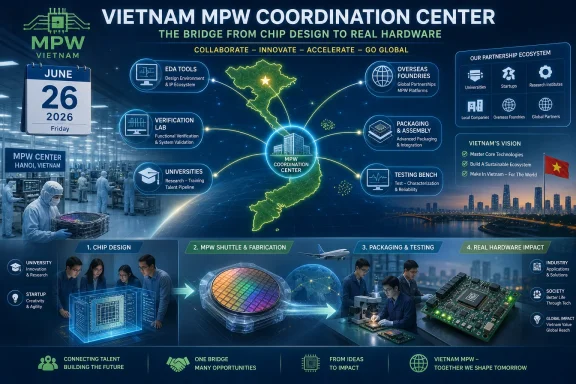
Vietnam launched the Vietnam National Multi-Project Wafer Coordination Center in Hanoi on June 26, 2026, creating its first national facility dedicated to helping domestic chip designers prototype semiconductor designs through shared multi-project wafer access. The move is not a factory ribbon-cutting in the old industrial-policy sense. It is Vietnam trying to buy down the most awkward gap between chip-design ambition and real silicon: the expensive, slow, failure-prone leap from design file to tested prototype.
That distinction matters. Countries do not become semiconductor powers merely by announcing fabs, training engineers, or hosting foreign assembly lines. They become credible when students, startups, research institutes, and domestic companies can afford to fail repeatedly on real wafers, learn from those failures, and iterate fast enough to build products that someone might actually buy.
The new center’s name is ungainly, but the policy logic is sharp. A multi-project wafer model lets many chip designs share space on a single wafer run, spreading the cost of fabrication across multiple teams. For early-stage design work, that can be the difference between a university lab producing a paper and producing a working chip.
Vietnam’s Ministry of Science and Technology is presenting the center as a bridge between domestic chip research and the global manufacturing ecosystem. That wording is doing real work. Vietnam is not claiming that it can suddenly replace TSMC, Samsung, Intel, or the dense web of suppliers around them. It is acknowledging that the country’s near-term leverage lies in coordination, design enablement, packaging, testing, talent, and foreign partnerships.
This is the less glamorous part of semiconductor strategy, and therefore probably the more serious one. Prototyping does not generate the political theater of a cutting-edge fab. It does not produce the same aerial renderings, the same concrete-and-steel symbolism, or the same promise of instant national self-reliance. But for a country trying to climb from outsourced manufacturing and assembly into higher-value silicon work, the prototyping layer is where credibility begins.
The center also gives Vietnam a practical answer to a familiar problem in emerging chip ecosystems: promising designs often leave the country at the moment they become expensive. If local teams must rely entirely on overseas prototyping channels, then cost, queue times, intellectual-property friction, and lack of hands-on feedback all work against commercialization. A national coordinator cannot eliminate those constraints, but it can make them less random.
Chip design is unforgiving. Simulations lie by omission, process rules constrain imagination, verification misses edge cases, and packaging can expose assumptions that looked fine in software. The only way to build an ecosystem that understands those realities is to put more engineers through the tapeout cycle.
For Vietnam, subsidizing prototypes is a way to turn policy ambition into muscle memory. A team that has taped out one flawed chip is usually more valuable than a team that has only completed coursework. A university that has watched several student designs fail in silicon understands curriculum gaps more clearly than one that has merely added a semiconductor module to an electrical-engineering program.
The danger, of course, is that subsidy can become theater if it is measured by participation rather than outcomes. A free prototype run is useful only if teams receive technical support before submission, testing infrastructure after fabrication, and a path toward revision. Otherwise, the government simply pays for artifacts that sit in display cases.
That is why the word “coordination” in the center’s title is important. Vietnam’s challenge is not just to fund isolated chip projects. It is to build repeatable workflows between design tools, foundry access, packaging partners, test labs, mentors, universities, and commercial customers. If the center becomes a booking desk for wafer slots, it will underperform. If it becomes a disciplined operating layer for the national chip ecosystem, it could matter.
Assembly and test operations can be built around disciplined execution and manufacturing scale. Design ecosystems require a different mix: experienced engineers, EDA access, IP libraries, verification culture, research depth, venture tolerance, and customers willing to take a chance on local silicon. The launch of a national prototyping center is a recognition that Vietnam cannot skip those layers.
The country’s semiconductor strategy through 2030 and its longer vision toward 2050 describe a phased climb through research, design, manufacturing, packaging, and testing. That phrasing is broad enough to flatter almost any initiative, but the new center gives the strategy a more concrete mechanism. It says, in effect: before Vietnam can claim a complete semiconductor ecosystem, Vietnamese teams need more shots on goal.
That matters because “semiconductor hub” has become one of the most overused phrases in economic policy. Every government wants the jobs, leverage, and national-security aura that chips now confer. But the global industry is not a blank map waiting for new flags. It is a brutally specialized network where the leaders have decades of tacit knowledge, supplier depth, and customer trust.
Vietnam’s plausible near-term path is therefore not to dethrone existing chip powers. It is to become more useful to them while retaining more value at home. A national MPW coordination center fits that path: it can train local teams on global workflows, help domestic designs reach manufacturable form, and make Vietnam a more credible location for foreign R&D partnerships.
EDA vendors matter because chips are not drawn so much as compiled, verified, constrained, simulated, and checked against foundry rule decks. Foundry and packaging partners matter because a design that cannot be manufactured or tested is not a product. University and research partners matter because the early pipeline is likely to be thin, uneven, and in need of patient technical coaching.
This is where Vietnam’s position is both promising and exposed. Its pitch to global chip companies is built on political stability, manufacturing momentum, a young technical workforce, and a desire by multinationals to diversify Asian supply chains. But dependence on foreign process technology, foreign EDA platforms, foreign IP, and foreign customers will remain substantial for years.
That is not a scandal. It is the structure of the semiconductor industry. Even the United States, with its deep chip history, remains dependent on global allies and suppliers for pieces of the stack. The relevant question for Vietnam is whether foreign partnerships become a ladder or a ceiling.
A ladder would transfer tacit knowledge, improve local engineering quality, and create Vietnamese firms capable of owning more design and product value. A ceiling would leave Vietnam as a convenient site for labor, services, and policy announcements while core technical and commercial decisions remain elsewhere. The prototyping center will not decide that outcome alone, but it will reveal which direction the ecosystem is moving.
The modern Windows device is a bundle of silicon bets. CPUs, NPUs, GPUs, Wi-Fi modules, security processors, storage controllers, power-management chips, and firmware all influence performance, manageability, battery life, privacy, and update reliability. As Microsoft pushes AI features deeper into Windows and OEMs differentiate around local acceleration, the semiconductor supply chain becomes part of the Windows experience.
Vietnam’s move will not suddenly produce a Vietnamese Copilot+ PC processor. That is not the point. The more realistic impact is downstream and gradual: more regional capacity, more engineering talent, more packaging and test maturity, more controller and edge-device design, and more competition in the less glamorous chips that make PCs and peripherals function.
For IT buyers, this matters because resilience is not only about having enough flagship CPUs. A laptop shipment can be delayed by a missing power IC, wireless module, embedded controller, or packaging bottleneck. The pandemic-era hardware crunch made that lesson painfully clear. A more distributed chip ecosystem does not guarantee stability, but it reduces the number of single points of failure.
There is also a security dimension. Firmware, hardware roots of trust, supply-chain provenance, and device integrity are increasingly central to enterprise Windows deployments. Countries that build deeper semiconductor competence are better positioned to audit, customize, and secure the devices they depend on. That does not automatically make hardware safer, but it increases the pool of engineers who understand where the risks live.
Microcontrollers, sensor interfaces, power-management chips, connectivity modules, industrial controllers, automotive components, security chips, and edge-AI accelerators may not command the same headlines as data-center GPUs. They are, however, areas where emerging design teams can learn, specialize, and find customers without competing directly against the most capital-intensive companies on earth.
Vietnam’s prototyping center is well suited to that kind of climb. MPW access is especially useful for education, research, and lower-volume design exploration. It allows teams to validate IP blocks, test analog and mixed-signal circuits, prototype application-specific chips, and build credibility before taking on more expensive production commitments.
The AI era also changes the demand profile. Not every AI workload belongs in a hyperscale data center. Factories, cameras, medical devices, logistics systems, agricultural sensors, and consumer electronics all create opportunities for specialized edge silicon. Vietnam’s existing manufacturing base could give local designers a nearby market for embedded and industrial chips if policy, procurement, and product development line up.
That is the more believable version of semiconductor ambition. The world does not need every country to build a leading-edge GPU. It does need more places capable of designing, validating, packaging, testing, and integrating useful chips into real products. Vietnam’s new center is a bet that the road to strategic relevance may run through practical, mid-stack competence rather than instant supremacy.
The first is talent depth. Training 50,000 semiconductor engineers, a target frequently associated with Vietnam’s national ambitions, is an attractive headline. But the industry does not run on headcount alone. It needs senior verification engineers, analog designers, physical-design specialists, packaging experts, process integration talent, test engineers, EDA support staff, and technical managers who have lived through product cycles.
The second is curriculum realism. Semiconductor education cannot simply be a repackaged electronics degree with more fashionable terminology. Students need access to tools, process design kits where possible, verification workflows, test equipment, and mentors who can explain why a clean simulation may still fail in silicon. The prototyping center can help here if it becomes part of the education loop rather than a separate government facility.
The third is commercialization. A prototype is not a business. The gap between “this chip works” and “this product ships” includes yield, packaging, reliability, certification, customer support, software integration, firmware maintenance, and pricing. Vietnam’s center can accelerate the first step, but the surrounding ecosystem must carry teams through the next ten.
The fourth is export-control reality. Semiconductor policy now lives under the shadow of U.S.-China technology controls, allied industrial policy, and increasingly sensitive rules around advanced manufacturing equipment, EDA access, AI accelerators, and strategic technologies. Vietnam’s diplomatic balancing act has served it well, but chips are an arena where neutrality is harder to operationalize than it is to declare.
The fifth is patience. The most damaging version of this project would be an expectation that subsidized prototypes must quickly produce national champions. Early MPW runs should produce errors, revisions, and modest designs. That is not failure; that is how the craft is learned. The policy danger is that politicians may demand triumph before the engineering system has had time to mature.
Which universities submit manufacturable designs? Which teams can pass design-rule checks? Which companies understand verification? Which projects fail because of tool access, which fail because of weak circuit design, and which fail because nobody knows how to test the packaged part? These are not abstract policy questions. They are operational signals.
If Vietnam uses the center well, it can identify where money should go next. Perhaps the bottleneck is not wafer access but test equipment. Perhaps it is not EDA licensing but senior mentors. Perhaps the country produces enough digital designers but lacks analog and mixed-signal talent. Perhaps startups need procurement channels more than grants.
That feedback loop is the real prize. Industrial policy often fails when it allocates money based on aspiration rather than observed constraint. A prototyping center can expose constraints quickly, sometimes embarrassingly. That is useful, provided the system is allowed to learn rather than hide its weak points.
For foreign partners, the same evidence matters. Companies considering deeper investment in Vietnam will watch whether local teams can execute. They will look for repeatable process discipline, not just enthusiasm. A national center that produces a steady stream of competent prototypes could make Vietnam a more persuasive place for R&D, design services, packaging innovation, and eventually higher-value product work.
That makes the new center both technical infrastructure and diplomatic signaling. Vietnam is telling multinational chip companies that it wants to be more than an assembly destination. It is telling domestic institutions that semiconductor policy is moving from strategy documents into operating programs. It is telling larger powers that Vietnam intends to occupy a more valuable position in the technology stack.
The difficulty is that every step upward brings more scrutiny. Advanced semiconductor work is no longer treated as ordinary commerce. Tool access, design IP, AI hardware, and manufacturing partnerships are all filtered through national-security assumptions. Vietnam’s ability to attract broad cooperation may depend on convincing partners that it can manage technology responsibly.
This is especially important for EDA and foundry-linked workflows. A prototyping program may involve design files, IP blocks, process rules, test data, and technical training that companies and governments treat as sensitive. Building trust around those workflows is as important as building labs.
Vietnam’s advantage is that it does not need to choose the most politically explosive starting point. By focusing on prototyping coordination, education, packaging-adjacent capability, and commercially useful but not necessarily bleeding-edge chips, it can accumulate competence without immediately colliding with the hardest export-control boundaries. That may be slower than nationalist rhetoric prefers, but it is more durable.
A stronger Vietnamese semiconductor ecosystem could eventually touch several layers of that coalition. It might contribute to embedded controllers, IoT modules, power components, industrial Windows devices, factory automation systems, test and packaging services, or edge-AI hardware used alongside Windows endpoints. None of that requires Vietnam to compete at the leading edge of CPU design.
This is where the practical consequences are most plausible. Enterprise IT departments care about procurement lead times, stable firmware, predictable device fleets, and vendor support. Regional diversification in the semiconductor supply chain can help OEMs manage those pressures, especially when combined with Vietnam’s existing strength in electronics manufacturing.
Developers may feel the effects more indirectly. As more countries build chip-design capacity, specialized hardware becomes less exotic. More devices gain accelerators, sensors, secure elements, and custom controllers. Windows software has to become more hardware-aware, not less, as AI and edge workloads push computation into increasingly varied silicon.
Security teams should also pay attention. Hardware provenance is becoming part of risk management. A world with more semiconductor-capable countries is not automatically safer; it may even become more complex. But it also gives enterprises and governments more options when they evaluate trusted supply chains, firmware transparency, and regional sourcing.
That makes the project more credible, not less. The most serious semiconductor strategies are the ones that understand where the country sits in the stack. Vietnam appears to be targeting the layer where policy money can remove a real barrier without pretending to conjure a leading-edge fab into existence.
The immediate test will be participation. If the 2026–2027 subsidy window produces a broad pipeline of serious projects from universities, research institutes, startups, and companies, the center will have justified its first phase. If it produces mostly ceremonial submissions and press-release partnerships, it will become another monument to tech-policy fashion.
The second test will be iteration. A healthy prototyping system should see teams return with revised designs, better verification discipline, clearer product goals, and stronger testing practices. The first chip from a young team is rarely the important one. The second and third reveal whether learning is taking place.
The third test will be whether the center can survive the transition from full state subsidy to partial support and more mature infrastructure. Free access can seed a market, but it can also mask weak demand. Vietnam’s challenge is to build enough value around the center that companies eventually see prototyping as a strategic investment rather than a government-sponsored experiment.
A failed tapeout can be a national asset if the lesson is captured. A late design can expose a training gap. A broken test plan can justify investment in labs. A university project that misses timing can teach an entire cohort what textbooks flatten. A startup prototype that barely works can still attract a customer, a mentor, or a better second attempt.
That is why the prototyping center deserves attention beyond Vietnam. It reflects a broader shift in semiconductor policy from pure attraction of foreign capital toward ecosystem building. Governments have learned that hosting someone else’s factory is useful, but not sufficient. The deeper value lies in the ability to design, validate, improve, and integrate technology locally.
For WindowsForum readers, the lesson is similarly grounded. The devices on desks, in server rooms, on factory floors, and at the network edge are products of an increasingly contested semiconductor world. A new MPW coordination center in Hanoi will not change your next Patch Tuesday. But it is part of the same long reshaping of hardware supply chains that will influence what devices are available, where they are built, how resilient they are, and who understands the silicon inside them.
That distinction matters. Countries do not become semiconductor powers merely by announcing fabs, training engineers, or hosting foreign assembly lines. They become credible when students, startups, research institutes, and domestic companies can afford to fail repeatedly on real wafers, learn from those failures, and iterate fast enough to build products that someone might actually buy.
 Vietnam Is Targeting the Bottleneck, Not the Billboard
The new center’s name is ungainly, but the policy logic is sharp. A multi-project wafer model lets many chip designs share space on a single wafer run, spreading the cost of fabrication across multiple teams. For early-stage design work, that can be the difference between a university lab producing a paper and producing a working chip.Vietnam’s Ministry of Science and Technology is presenting the center as a bridge between domestic chip research and the global manufacturing ecosystem. That wording is doing real work. Vietnam is not claiming that it can suddenly replace TSMC, Samsung, Intel, or the dense web of suppliers around them. It is acknowledging that the country’s near-term leverage lies in coordination, design enablement, packaging, testing, talent, and foreign partnerships.
This is the less glamorous part of semiconductor strategy, and therefore probably the more serious one. Prototyping does not generate the political theater of a cutting-edge fab. It does not produce the same aerial renderings, the same concrete-and-steel symbolism, or the same promise of instant national self-reliance. But for a country trying to climb from outsourced manufacturing and assembly into higher-value silicon work, the prototyping layer is where credibility begins.
The center also gives Vietnam a practical answer to a familiar problem in emerging chip ecosystems: promising designs often leave the country at the moment they become expensive. If local teams must rely entirely on overseas prototyping channels, then cost, queue times, intellectual-property friction, and lack of hands-on feedback all work against commercialization. A national coordinator cannot eliminate those constraints, but it can make them less random.
The First Subsidy Is a Bet on Learning by Doing
The most revealing part of the launch is the subsidy schedule. During the 2026–2027 phase, the Vietnamese state is expected to cover pilot prototyping costs in full for universities, research institutes, companies, and chip-design teams. That is not merely a handout; it is an attempt to create volume in a system where volume is itself a form of learning.Chip design is unforgiving. Simulations lie by omission, process rules constrain imagination, verification misses edge cases, and packaging can expose assumptions that looked fine in software. The only way to build an ecosystem that understands those realities is to put more engineers through the tapeout cycle.
For Vietnam, subsidizing prototypes is a way to turn policy ambition into muscle memory. A team that has taped out one flawed chip is usually more valuable than a team that has only completed coursework. A university that has watched several student designs fail in silicon understands curriculum gaps more clearly than one that has merely added a semiconductor module to an electrical-engineering program.
The danger, of course, is that subsidy can become theater if it is measured by participation rather than outcomes. A free prototype run is useful only if teams receive technical support before submission, testing infrastructure after fabrication, and a path toward revision. Otherwise, the government simply pays for artifacts that sit in display cases.
That is why the word “coordination” in the center’s title is important. Vietnam’s challenge is not just to fund isolated chip projects. It is to build repeatable workflows between design tools, foundry access, packaging partners, test labs, mentors, universities, and commercial customers. If the center becomes a booking desk for wafer slots, it will underperform. If it becomes a disciplined operating layer for the national chip ecosystem, it could matter.
The Semiconductor Race Has Moved Beyond Cheap Labor
Vietnam’s broader semiconductor push sits inside a larger geopolitical reordering. Supply chains that once optimized almost entirely for cost now also optimize for resilience, geography, export controls, political risk, and customer pressure. Vietnam has benefited from that shift in electronics manufacturing, but semiconductors demand a deeper stack.Assembly and test operations can be built around disciplined execution and manufacturing scale. Design ecosystems require a different mix: experienced engineers, EDA access, IP libraries, verification culture, research depth, venture tolerance, and customers willing to take a chance on local silicon. The launch of a national prototyping center is a recognition that Vietnam cannot skip those layers.
The country’s semiconductor strategy through 2030 and its longer vision toward 2050 describe a phased climb through research, design, manufacturing, packaging, and testing. That phrasing is broad enough to flatter almost any initiative, but the new center gives the strategy a more concrete mechanism. It says, in effect: before Vietnam can claim a complete semiconductor ecosystem, Vietnamese teams need more shots on goal.
That matters because “semiconductor hub” has become one of the most overused phrases in economic policy. Every government wants the jobs, leverage, and national-security aura that chips now confer. But the global industry is not a blank map waiting for new flags. It is a brutally specialized network where the leaders have decades of tacit knowledge, supplier depth, and customer trust.
Vietnam’s plausible near-term path is therefore not to dethrone existing chip powers. It is to become more useful to them while retaining more value at home. A national MPW coordination center fits that path: it can train local teams on global workflows, help domestic designs reach manufacturable form, and make Vietnam a more credible location for foreign R&D partnerships.
Foreign Partners Are the Feature, Not the Footnote
Reports around the launch describe memoranda of understanding with domestic and international partners, including names associated with fabrication, packaging, chip design, and electronic design automation. That partner list is politically useful, but it is also technically necessary. No national prototyping center can function in isolation from the companies that control the tools, process knowledge, and manufacturing pathways of modern silicon.EDA vendors matter because chips are not drawn so much as compiled, verified, constrained, simulated, and checked against foundry rule decks. Foundry and packaging partners matter because a design that cannot be manufactured or tested is not a product. University and research partners matter because the early pipeline is likely to be thin, uneven, and in need of patient technical coaching.
This is where Vietnam’s position is both promising and exposed. Its pitch to global chip companies is built on political stability, manufacturing momentum, a young technical workforce, and a desire by multinationals to diversify Asian supply chains. But dependence on foreign process technology, foreign EDA platforms, foreign IP, and foreign customers will remain substantial for years.
That is not a scandal. It is the structure of the semiconductor industry. Even the United States, with its deep chip history, remains dependent on global allies and suppliers for pieces of the stack. The relevant question for Vietnam is whether foreign partnerships become a ladder or a ceiling.
A ladder would transfer tacit knowledge, improve local engineering quality, and create Vietnamese firms capable of owning more design and product value. A ceiling would leave Vietnam as a convenient site for labor, services, and policy announcements while core technical and commercial decisions remain elsewhere. The prototyping center will not decide that outcome alone, but it will reveal which direction the ecosystem is moving.
Windows Users Should Care Because the PC Is Becoming a Geopolitical Object
At first glance, a chip prototyping center in Hanoi may seem remote from the concerns of Windows users, system builders, IT admins, and enterprise buyers. It is not. The Windows ecosystem is increasingly shaped by chip availability, chip specialization, supply-chain geography, and the uncomfortable fact that PCs are no longer generic boxes assembled from interchangeable global parts.The modern Windows device is a bundle of silicon bets. CPUs, NPUs, GPUs, Wi-Fi modules, security processors, storage controllers, power-management chips, and firmware all influence performance, manageability, battery life, privacy, and update reliability. As Microsoft pushes AI features deeper into Windows and OEMs differentiate around local acceleration, the semiconductor supply chain becomes part of the Windows experience.
Vietnam’s move will not suddenly produce a Vietnamese Copilot+ PC processor. That is not the point. The more realistic impact is downstream and gradual: more regional capacity, more engineering talent, more packaging and test maturity, more controller and edge-device design, and more competition in the less glamorous chips that make PCs and peripherals function.
For IT buyers, this matters because resilience is not only about having enough flagship CPUs. A laptop shipment can be delayed by a missing power IC, wireless module, embedded controller, or packaging bottleneck. The pandemic-era hardware crunch made that lesson painfully clear. A more distributed chip ecosystem does not guarantee stability, but it reduces the number of single points of failure.
There is also a security dimension. Firmware, hardware roots of trust, supply-chain provenance, and device integrity are increasingly central to enterprise Windows deployments. Countries that build deeper semiconductor competence are better positioned to audit, customize, and secure the devices they depend on. That does not automatically make hardware safer, but it increases the pool of engineers who understand where the risks live.
The AI Boom Makes Small Silicon More Strategic
The global semiconductor conversation is dominated by advanced GPUs, high-bandwidth memory, and cutting-edge foundry nodes. That is understandable; AI infrastructure has turned compute capacity into a boardroom obsession. But national ecosystems are often built first around less spectacular silicon.Microcontrollers, sensor interfaces, power-management chips, connectivity modules, industrial controllers, automotive components, security chips, and edge-AI accelerators may not command the same headlines as data-center GPUs. They are, however, areas where emerging design teams can learn, specialize, and find customers without competing directly against the most capital-intensive companies on earth.
Vietnam’s prototyping center is well suited to that kind of climb. MPW access is especially useful for education, research, and lower-volume design exploration. It allows teams to validate IP blocks, test analog and mixed-signal circuits, prototype application-specific chips, and build credibility before taking on more expensive production commitments.
The AI era also changes the demand profile. Not every AI workload belongs in a hyperscale data center. Factories, cameras, medical devices, logistics systems, agricultural sensors, and consumer electronics all create opportunities for specialized edge silicon. Vietnam’s existing manufacturing base could give local designers a nearby market for embedded and industrial chips if policy, procurement, and product development line up.
That is the more believable version of semiconductor ambition. The world does not need every country to build a leading-edge GPU. It does need more places capable of designing, validating, packaging, testing, and integrating useful chips into real products. Vietnam’s new center is a bet that the road to strategic relevance may run through practical, mid-stack competence rather than instant supremacy.
The Hard Part Begins After the Ceremony
Launch events are easy. Semiconductor ecosystems are not. Vietnam now has to solve several problems that do not yield to slogans.The first is talent depth. Training 50,000 semiconductor engineers, a target frequently associated with Vietnam’s national ambitions, is an attractive headline. But the industry does not run on headcount alone. It needs senior verification engineers, analog designers, physical-design specialists, packaging experts, process integration talent, test engineers, EDA support staff, and technical managers who have lived through product cycles.
The second is curriculum realism. Semiconductor education cannot simply be a repackaged electronics degree with more fashionable terminology. Students need access to tools, process design kits where possible, verification workflows, test equipment, and mentors who can explain why a clean simulation may still fail in silicon. The prototyping center can help here if it becomes part of the education loop rather than a separate government facility.
The third is commercialization. A prototype is not a business. The gap between “this chip works” and “this product ships” includes yield, packaging, reliability, certification, customer support, software integration, firmware maintenance, and pricing. Vietnam’s center can accelerate the first step, but the surrounding ecosystem must carry teams through the next ten.
The fourth is export-control reality. Semiconductor policy now lives under the shadow of U.S.-China technology controls, allied industrial policy, and increasingly sensitive rules around advanced manufacturing equipment, EDA access, AI accelerators, and strategic technologies. Vietnam’s diplomatic balancing act has served it well, but chips are an arena where neutrality is harder to operationalize than it is to declare.
The fifth is patience. The most damaging version of this project would be an expectation that subsidized prototypes must quickly produce national champions. Early MPW runs should produce errors, revisions, and modest designs. That is not failure; that is how the craft is learned. The policy danger is that politicians may demand triumph before the engineering system has had time to mature.
The Center Gives Vietnam a Place to Measure Reality
One underrated benefit of a national prototyping center is that it can make the ecosystem legible. Governments often struggle to distinguish genuine technical capacity from pitch-deck capacity. A functioning MPW program creates evidence.Which universities submit manufacturable designs? Which teams can pass design-rule checks? Which companies understand verification? Which projects fail because of tool access, which fail because of weak circuit design, and which fail because nobody knows how to test the packaged part? These are not abstract policy questions. They are operational signals.
If Vietnam uses the center well, it can identify where money should go next. Perhaps the bottleneck is not wafer access but test equipment. Perhaps it is not EDA licensing but senior mentors. Perhaps the country produces enough digital designers but lacks analog and mixed-signal talent. Perhaps startups need procurement channels more than grants.
That feedback loop is the real prize. Industrial policy often fails when it allocates money based on aspiration rather than observed constraint. A prototyping center can expose constraints quickly, sometimes embarrassingly. That is useful, provided the system is allowed to learn rather than hide its weak points.
For foreign partners, the same evidence matters. Companies considering deeper investment in Vietnam will watch whether local teams can execute. They will look for repeatable process discipline, not just enthusiasm. A national center that produces a steady stream of competent prototypes could make Vietnam a more persuasive place for R&D, design services, packaging innovation, and eventually higher-value product work.
Washington, Taipei, Seoul, and Beijing Are All in the Room
Vietnam’s semiconductor rise cannot be separated from geopolitics. The country sits in a region that already carries much of the world’s electronics and semiconductor production. It has deep trade ties with major powers, a growing role in manufacturing diversification, and an increasingly visible place in conversations about supply-chain resilience.That makes the new center both technical infrastructure and diplomatic signaling. Vietnam is telling multinational chip companies that it wants to be more than an assembly destination. It is telling domestic institutions that semiconductor policy is moving from strategy documents into operating programs. It is telling larger powers that Vietnam intends to occupy a more valuable position in the technology stack.
The difficulty is that every step upward brings more scrutiny. Advanced semiconductor work is no longer treated as ordinary commerce. Tool access, design IP, AI hardware, and manufacturing partnerships are all filtered through national-security assumptions. Vietnam’s ability to attract broad cooperation may depend on convincing partners that it can manage technology responsibly.
This is especially important for EDA and foundry-linked workflows. A prototyping program may involve design files, IP blocks, process rules, test data, and technical training that companies and governments treat as sensitive. Building trust around those workflows is as important as building labs.
Vietnam’s advantage is that it does not need to choose the most politically explosive starting point. By focusing on prototyping coordination, education, packaging-adjacent capability, and commercially useful but not necessarily bleeding-edge chips, it can accumulate competence without immediately colliding with the hardest export-control boundaries. That may be slower than nationalist rhetoric prefers, but it is more durable.
The Windows Hardware Chain Is Wider Than the CPU Roadmap
For the Windows ecosystem, the semiconductor map is often flattened into Intel, AMD, Qualcomm, Nvidia, and a handful of memory and storage vendors. That view misses how much hardware reliability depends on the wider supply chain. The Windows PC is a platform, but it is also a dense coalition of components.A stronger Vietnamese semiconductor ecosystem could eventually touch several layers of that coalition. It might contribute to embedded controllers, IoT modules, power components, industrial Windows devices, factory automation systems, test and packaging services, or edge-AI hardware used alongside Windows endpoints. None of that requires Vietnam to compete at the leading edge of CPU design.
This is where the practical consequences are most plausible. Enterprise IT departments care about procurement lead times, stable firmware, predictable device fleets, and vendor support. Regional diversification in the semiconductor supply chain can help OEMs manage those pressures, especially when combined with Vietnam’s existing strength in electronics manufacturing.
Developers may feel the effects more indirectly. As more countries build chip-design capacity, specialized hardware becomes less exotic. More devices gain accelerators, sensors, secure elements, and custom controllers. Windows software has to become more hardware-aware, not less, as AI and edge workloads push computation into increasingly varied silicon.
Security teams should also pay attention. Hardware provenance is becoming part of risk management. A world with more semiconductor-capable countries is not automatically safer; it may even become more complex. But it also gives enterprises and governments more options when they evaluate trusted supply chains, firmware transparency, and regional sourcing.
The Ceremony Was Small; the Signal Was Not
Vietnam’s new prototyping center should not be mistaken for a declaration of semiconductor independence. It is better understood as an admission that independence, if the word is useful at all, begins with dependence managed intelligently. Vietnam will still rely on global foundries, foreign tools, international partners, and imported expertise.That makes the project more credible, not less. The most serious semiconductor strategies are the ones that understand where the country sits in the stack. Vietnam appears to be targeting the layer where policy money can remove a real barrier without pretending to conjure a leading-edge fab into existence.
The immediate test will be participation. If the 2026–2027 subsidy window produces a broad pipeline of serious projects from universities, research institutes, startups, and companies, the center will have justified its first phase. If it produces mostly ceremonial submissions and press-release partnerships, it will become another monument to tech-policy fashion.
The second test will be iteration. A healthy prototyping system should see teams return with revised designs, better verification discipline, clearer product goals, and stronger testing practices. The first chip from a young team is rarely the important one. The second and third reveal whether learning is taking place.
The third test will be whether the center can survive the transition from full state subsidy to partial support and more mature infrastructure. Free access can seed a market, but it can also mask weak demand. Vietnam’s challenge is to build enough value around the center that companies eventually see prototyping as a strategic investment rather than a government-sponsored experiment.
The Real Scorecard Will Be Written in Failed Tapeouts
The useful way to judge Vietnam’s launch is not by asking whether it creates a chip superpower overnight. It will not. The better question is whether it gives Vietnamese engineers more chances to encounter reality.A failed tapeout can be a national asset if the lesson is captured. A late design can expose a training gap. A broken test plan can justify investment in labs. A university project that misses timing can teach an entire cohort what textbooks flatten. A startup prototype that barely works can still attract a customer, a mentor, or a better second attempt.
That is why the prototyping center deserves attention beyond Vietnam. It reflects a broader shift in semiconductor policy from pure attraction of foreign capital toward ecosystem building. Governments have learned that hosting someone else’s factory is useful, but not sufficient. The deeper value lies in the ability to design, validate, improve, and integrate technology locally.
For WindowsForum readers, the lesson is similarly grounded. The devices on desks, in server rooms, on factory floors, and at the network edge are products of an increasingly contested semiconductor world. A new MPW coordination center in Hanoi will not change your next Patch Tuesday. But it is part of the same long reshaping of hardware supply chains that will influence what devices are available, where they are built, how resilient they are, and who understands the silicon inside them.
The Wafer Shuttle Vietnam Is Trying to Catch
Vietnam’s move is concrete enough to matter and limited enough to be believable. The next few years will show whether the country can turn a subsidized prototyping window into durable engineering capacity.- Vietnam launched its first national semiconductor chip prototyping support center in Hanoi on June 26, 2026.
- The center is built around the multi-project wafer model, which lets multiple teams share fabrication runs and lower the cost of early chip validation.
- The Vietnamese state is expected to fully cover pilot prototyping costs during the 2026–2027 phase to encourage participation from universities, institutes, companies, and design teams.
- The project fits Vietnam’s broader semiconductor strategy through 2030 and its longer 2050 vision, but it does not by itself make the country a leading-edge manufacturing power.
- The center’s success will depend on technical support, testing capacity, repeat submissions, commercial pathways, and honest measurement of failed as well as successful designs.
- For Windows users and IT pros, the significance is indirect but real: more distributed semiconductor capacity can shape future device supply chains, embedded components, edge hardware, and enterprise sourcing options.
References
- Primary source: Myanmar International TV
Published: Sat, 27 Jun 2026 03:48:43 GMT

Viet Nam debuts semiconductor prototyping center | Myanmar International TV
Viet Nam on Friday launched its first national center for supporting semiconductor chip prototyping.
www.myanmaritv.com
- Independent coverage: Vietnam Economic Times
Published: Sat, 27 Jun 2026 02:00:00 GMT
Vietnam launches first national semiconductor chip prototyping center - VnEconomy
The center will serve as a national hub connecting domestic chip designers with the global semiconductor manufacturing ecosystem.en.vneconomy.vn - Independent coverage: VOV World
Published: Fri, 26 Jun 2026 15:05:00 GMT
Vietnam launches first national center for semiconductor chip prototyping support | VOV5.VN
[VOVWORLD] - The Ministry of Science and Technology on Friday launched the Vietnam National Multi-Project Wafer Coordination Centre (VNMPW/CC), the first national-level centre dedicated to supporting semiconductor chip prototyping in Vietnam.vovworld.vn - Related coverage: vietnamnews.vn
Việt Nam launches first national semiconductor chip prototyping support centre
Speaking at the launch ceremony in Hà Nội, Minister of Science and Technology Vũ Hải Quân said the centre was part of the Government’s strategy to build a complete semiconductor ecosystem, following recent legal and policy reforms to promote the industry.vietnamnews.vn - Related coverage: en.baochinhphu.vn
National semiconductor chip prototyping support center mades debut
VGP - The Ministry of Science and Technology launched the national semiconductor chip prototyping support center in Ha Noi on Jun 26.en.baochinhphu.vn - Related coverage: english.luatvietnam.vn
Decision 1018/QD-TTg 2024 Strategy for development of Vietnam’s semiconductor industry through 2030
Decision 1018/QD-TTg 2024 Strategy for development of Vietnam’s semiconductor industry through 2030english.luatvietnam.vn
- Related coverage: en.sggp.org.vn
Ministry launches Vietnam National Multi-Project Wafer Coordination Center | SGGP English Edition
The Ministry of Science and Technology has officially launched the Vietnam National Multi-Project Wafer Coordination Center.en.sggp.org.vn
- Related coverage: deloitte.com
Vietnam's semiconductor strategy: From vision to values | Deloitte Southeast Asia
According to Mr. Bui Tuan Minh, Country Tax & Legal Leader, Deloitte Vietnam, the global semiconductor industry is facing major changes. Geopolitical tensions, supply chain shifts, and the rising demand for AI and digital technologies have made semiconductors now seen as strategic national...www.deloitte.com - Related coverage: thuviennhadat.vn
Decision No. 1018/QD-TTg dated September 21, 2024 on promulgation of the strategy for development of Vietnam's semiconductor industry to 2030 and vision to 2050
Decision No. 1018/QD-TTg dated September 21, 2024 on promulgation of the strategy for development of Vietnam's semiconductor industry to 2030 and vision to 2050thuviennhadat.vn
- Related coverage: news.tuoitre.vn
Vietnam introduces national multi-project wafer coordination center
Vietnam's Ministry of Science and Technology on Friday officially launched the Vietnam National Multi-Project Wafer Coordination Center, the country's first national-level facility dedicated to supporting semiconductor chip prototyping.news.tuoitre.vn - Related coverage: vietnam.vn
Vietnam establishes a national center to support the prototyping of semiconductor chips.
(Dan Tri Newspaper) - The establishment of the center demonstrates Vietnam's determination to build a complete semiconductor ecosystem, from design and trial production to product commercialization.www.vietnam.vn - Related coverage: en.vietnamplus.vn
First national semiconductor chip prototyping support centre makes debut
The Ministry of Science and Technology (MoST) on June 26 unveiled the Vietnam National Multi-Project Wafer Coordination Centre (VNMPW/CC) - the first national centre dedicated to supporting semiconductor chip prototyping, marking a key step in connecting domestic chip research and design with...en.vietnamplus.vn
- Related coverage: gtjai.com.vn
- Related coverage: oecd.org
- Related coverage: assets.kpmg.com