

ServiceNow introduced EmployeeWorks on February 26, 2026, in Santa Clara, California, combining Moveworks conversational AI and enterprise search with ServiceNow workflows so employees can ask for help inside Teams, Slack, or a browser and trigger governed enterprise actions. The pitch is simple enough to fit in a product demo: stop making workers hunt through portals, policies, and ticket forms. The harder truth is that EmployeeWorks is not really a chatbot story. It is ServiceNow’s attempt to turn the messy front door of corporate work into a control point for the next era of enterprise software.
For years, the most common employee experience with enterprise software has been a scavenger hunt. A worker needs a VPN policy, a payslip, a laptop replacement, a parental leave form, or access to a finance system, and the answer is usually scattered across intranet pages, HR portals, service catalogs, email aliases, and tribal knowledge. ServiceNow built a large business by turning that chaos into tickets and workflows, but tickets still require employees to know where to start.
EmployeeWorks is designed to remove that first decision. Instead of asking whether a request belongs in HR, IT, facilities, procurement, or security, the employee starts with a sentence. The system is supposed to interpret the intent, search enterprise knowledge, understand context and permissions, and either provide the answer or initiate the right workflow.
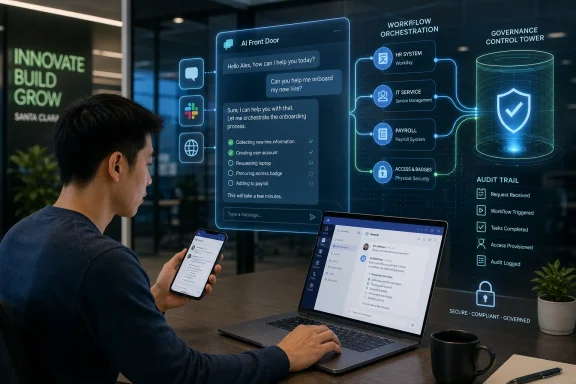
That is why ServiceNow’s language around EmployeeWorks matters. The company is not merely selling “AI search” or a prettier employee portal. It is selling an AI front door to the enterprise, where conversational interaction becomes the normal way work enters the system.
For WindowsForum readers, the most relevant comparison is not consumer ChatGPT. It is the long, uneven history of corporate self-service portals that promised to reduce ticket volume and ended up becoming another layer of navigation. EmployeeWorks is ServiceNow’s answer to that failure: do not make the user learn the portal; make the portal understand the user.
That combination is the strategic logic behind EmployeeWorks. Moveworks brings conversational AI chat and enterprise search; ServiceNow brings the unified portal, workflow engine, permissions model, approvals, audit trails, and integrations into business systems. The result is supposed to be more than a bot that retrieves documents. It is supposed to complete work.
This distinction is important because enterprise AI is crowded with products that can summarize policies or answer common questions. The real value comes when the assistant can safely act. A user asking “Can I get access to the payroll reporting dashboard?” is not merely asking for information. That request may require identity checks, manager approval, license validation, access provisioning, and an audit record.
ServiceNow is betting that the companies already using its platform will prefer to extend that existing governance layer rather than build a new assistant stack from scratch. That is a plausible bet. It is also a bet that assumes customers have already done the hard work of cleaning up workflows, permissions, service catalogs, and knowledge bases.
That experience sounds routine because consumer AI has made conversational interfaces feel ordinary. But inside a large company, every apparently simple request sits on top of policy, identity, role, geography, data classification, and compliance. The assistant must know not only what the employee wants, but what the employee is allowed to see and what systems are authoritative.
That is where ServiceNow’s product story becomes more credible than the usual AI wrapper. The company’s strength has always been in the plumbing of enterprise operations: incident management, request fulfillment, HR service delivery, service catalogs, asset records, approvals, and cross-functional workflows. EmployeeWorks turns that plumbing into something employees can reach without understanding the underlying map.
The risk is that the chat interface hides complexity without eliminating it. If the workflow underneath is broken, the assistant will expose the breakage faster. If the knowledge base is stale, the answer will be stale. If departments disagree about process ownership, the AI will inherit the ambiguity.
Most employees do not want another destination. They want fewer tabs, fewer bookmarks, and fewer “where do I go for this?” moments. By meeting users inside collaboration tools, EmployeeWorks treats Teams and Slack as the new front desks of the company.
For Microsoft-heavy enterprises, this matters. Teams has already become the daily operating layer for chat, meetings, file sharing, approvals, and app integrations. If EmployeeWorks can live naturally inside that environment, it has a better chance of becoming a habit rather than another icon in the app launcher.
But this also puts ServiceNow in a delicate position. Microsoft has its own AI ambitions through Copilot, Graph, Entra, SharePoint, Viva, and the Power Platform. Enterprises may not want every vendor to install its own assistant into Teams. The winner will not necessarily be the assistant with the best demo; it will be the assistant that reliably knows which system owns the work.
The old promise was that employees would search a knowledge article and solve the problem themselves. In practice, many users skipped the portal and filed a ticket, called the help desk, messaged a colleague, or created a shadow process in email. The cost of finding the official answer was often higher than the cost of asking a human.
EmployeeWorks tries to change that by lowering the effort required to use the official channel. If the sanctioned path feels as easy as messaging a coworker, employees may use it. If it feels like a chatbot standing between them and help, they will route around it.
That is why adoption numbers, while encouraging, should be read carefully. ServiceNow has reportedly pointed to strong early momentum, including fivefold year-over-year growth in the EmployeeWorks business in the first quarter of 2026 and several deals above $1 million in net new annual contract value. Those figures suggest enterprise buyers are interested. They do not yet prove that employees will love using it.
That is where the product becomes strategically important for ServiceNow investors and customers alike. A conversational employee interface can make the Now Platform more visible to ordinary workers, not just administrators and CIOs. If the employee front door becomes sticky, ServiceNow gains leverage over more business processes.
Governance is the key word. In consumer AI, the question is often whether the model gives a useful answer. In enterprise AI, the question is whether the system can act within policy, preserve an audit trail, respect authorization boundaries, and avoid making silent mistakes at scale. EmployeeWorks is being sold into organizations where a wrong answer about benefits, access, payroll, security procedure, or compliance policy can have real consequences.
That governance pitch is also ServiceNow’s defense against general-purpose AI tools. A custom bot may be cheaper to prototype, but a prototype is not the same as an enterprise operating layer. The more regulated or complex the company, the more ServiceNow can argue that workflow control matters more than model novelty.
This is not a flaw unique to ServiceNow. Every enterprise AI assistant faces the same problem. The model may be impressive, but the system of record still matters. Garbage in, polished garbage out remains the oldest law of business computing.
Early practitioner chatter around Moveworks-style deployments has often pointed to the same lesson. Companies with disciplined knowledge management and mature service processes tend to get better results. Companies with thin documentation and loosely governed catalogs can end up with partial answers, confusing handoffs, or a bot that confidently points employees toward the wrong door.
That means EmployeeWorks should not be treated as a plug-in productivity miracle. It is more like a diagnostic test for operational maturity. A successful deployment will likely require content cleanup, workflow mapping, integration work, permission review, change management, and ongoing tuning.
That does not mean the service desk goes away. More likely, the work shifts. Human agents become escalation handlers, process designers, knowledge stewards, and exception managers. The assistant absorbs the predictable front-line load, while humans deal with edge cases and emotionally sensitive interactions.
For employees, that can be an improvement if the AI is fast and accurate. Nobody misses waiting in a queue to ask where a form lives. But the experience can become alienating if the assistant blocks access to a human when the user’s problem does not fit the script.
This is where enterprise AI needs humility. The goal should not be to make every interaction conversational. The goal should be to make the right path obvious, fast, and accountable. Sometimes that path is an automated workflow. Sometimes it is a person.
For HR and IT leaders, the buying question is therefore not “What is the list price?” It is whether EmployeeWorks reduces ticket volume, improves first-contact resolution, shortens time-to-service, raises employee satisfaction, and avoids adding administrative overhead. If it becomes another system that needs constant grooming without meaningful deflection, the business case weakens quickly.
The strongest case will be in large organizations where the volume of routine requests is high and the underlying workflows are already mature. A company with tens of thousands of employees, multiple regions, and a sprawling service catalog has more to gain from a unified AI front door than a smaller firm with simpler support paths.
There is also a political dimension. EmployeeWorks can cut across HR, IT, facilities, security, procurement, and operations. That makes it powerful, but it also means ownership must be clear. If every department treats the assistant as someone else’s responsibility, quality will drift.
That matters because many enterprise software companies are now trying to convince Wall Street that AI is not just a feature tax. Investors want to see AI products that expand deal sizes, improve retention, and create new platform gravity. EmployeeWorks is attractive in that narrative because it sits at the intersection of user experience, workflow automation, and cross-sell potential.
But customers should separate the investment story from the deployment story. A product can be strategically important to ServiceNow and still require difficult implementation work inside the enterprise. The stock-market appeal of AI does not reduce the burden on administrators, process owners, security teams, and knowledge managers.
For WindowsForum’s IT pro audience, the practical question is not whether ServiceNow’s AI strategy sounds plausible. It is whether the product can be governed, measured, secured, and improved without becoming another expensive abstraction layer. The answer will vary sharply by organization.
That is exactly the kind of invisibility enterprise platforms want. The more ServiceNow fades into the background of everyday work, the harder it becomes to displace. The user interface becomes conversational, but the lock-in lives in workflows, approvals, data models, integrations, analytics, and governance.
This is also why ServiceNow’s competitors will not stand still. Microsoft can argue that Copilot, Graph, Teams, Entra, SharePoint, and Power Platform already sit closer to the daily flow of work. HR vendors can argue that employee experience begins with people data, not ITSM. AI platform vendors can argue that companies should build flexible assistants rather than buy another packaged layer.
ServiceNow’s counterargument is that enterprise work is not just content retrieval. It is coordinated action across systems. If EmployeeWorks proves that it can turn intent into completed, governed work, that argument becomes much stronger.
 ServiceNow Wants the Employee Help Desk to Become the AI Interface
For years, the most common employee experience with enterprise software has been a scavenger hunt. A worker needs a VPN policy, a payslip, a laptop replacement, a parental leave form, or access to a finance system, and the answer is usually scattered across intranet pages, HR portals, service catalogs, email aliases, and tribal knowledge. ServiceNow built a large business by turning that chaos into tickets and workflows, but tickets still require employees to know where to start.EmployeeWorks is designed to remove that first decision. Instead of asking whether a request belongs in HR, IT, facilities, procurement, or security, the employee starts with a sentence. The system is supposed to interpret the intent, search enterprise knowledge, understand context and permissions, and either provide the answer or initiate the right workflow.
That is why ServiceNow’s language around EmployeeWorks matters. The company is not merely selling “AI search” or a prettier employee portal. It is selling an AI front door to the enterprise, where conversational interaction becomes the normal way work enters the system.
For WindowsForum readers, the most relevant comparison is not consumer ChatGPT. It is the long, uneven history of corporate self-service portals that promised to reduce ticket volume and ended up becoming another layer of navigation. EmployeeWorks is ServiceNow’s answer to that failure: do not make the user learn the portal; make the portal understand the user.
The Moveworks Deal Gave ServiceNow a Missing Piece
EmployeeWorks arrived just two months after ServiceNow closed its acquisition of Moveworks, and the timing tells the story. Moveworks had built its reputation around conversational AI for employees, especially in IT and HR support scenarios. ServiceNow already had the workflow backbone, the service management footprint, and the enterprise customer base, but it needed a more natural interface for non-specialist users.That combination is the strategic logic behind EmployeeWorks. Moveworks brings conversational AI chat and enterprise search; ServiceNow brings the unified portal, workflow engine, permissions model, approvals, audit trails, and integrations into business systems. The result is supposed to be more than a bot that retrieves documents. It is supposed to complete work.
This distinction is important because enterprise AI is crowded with products that can summarize policies or answer common questions. The real value comes when the assistant can safely act. A user asking “Can I get access to the payroll reporting dashboard?” is not merely asking for information. That request may require identity checks, manager approval, license validation, access provisioning, and an audit record.
ServiceNow is betting that the companies already using its platform will prefer to extend that existing governance layer rather than build a new assistant stack from scratch. That is a plausible bet. It is also a bet that assumes customers have already done the hard work of cleaning up workflows, permissions, service catalogs, and knowledge bases.
A Chat Window Is Easy; Enterprise Action Is Hard
The seductive part of EmployeeWorks is the interface. A worker types “I need my last three payslips” into Microsoft Teams, and the system returns the relevant HR record or sends the request through the right channel. Another user asks for a password reset, a software install, or a badge replacement, and the assistant handles the first steps without dumping the user into a static portal.That experience sounds routine because consumer AI has made conversational interfaces feel ordinary. But inside a large company, every apparently simple request sits on top of policy, identity, role, geography, data classification, and compliance. The assistant must know not only what the employee wants, but what the employee is allowed to see and what systems are authoritative.
That is where ServiceNow’s product story becomes more credible than the usual AI wrapper. The company’s strength has always been in the plumbing of enterprise operations: incident management, request fulfillment, HR service delivery, service catalogs, asset records, approvals, and cross-functional workflows. EmployeeWorks turns that plumbing into something employees can reach without understanding the underlying map.
The risk is that the chat interface hides complexity without eliminating it. If the workflow underneath is broken, the assistant will expose the breakage faster. If the knowledge base is stale, the answer will be stale. If departments disagree about process ownership, the AI will inherit the ambiguity.
Microsoft Teams and Slack Are the New Corporate Front Desks
One of the smartest parts of the EmployeeWorks strategy is that ServiceNow is not insisting employees begin inside ServiceNow. The product is designed to surface where employees already work, including Microsoft Teams, Slack, and browser-based experiences. That is not a cosmetic deployment detail; it is central to whether the product can change behavior.Most employees do not want another destination. They want fewer tabs, fewer bookmarks, and fewer “where do I go for this?” moments. By meeting users inside collaboration tools, EmployeeWorks treats Teams and Slack as the new front desks of the company.
For Microsoft-heavy enterprises, this matters. Teams has already become the daily operating layer for chat, meetings, file sharing, approvals, and app integrations. If EmployeeWorks can live naturally inside that environment, it has a better chance of becoming a habit rather than another icon in the app launcher.
But this also puts ServiceNow in a delicate position. Microsoft has its own AI ambitions through Copilot, Graph, Entra, SharePoint, Viva, and the Power Platform. Enterprises may not want every vendor to install its own assistant into Teams. The winner will not necessarily be the assistant with the best demo; it will be the assistant that reliably knows which system owns the work.
The Real Competition Is Not Just Other Vendors
ServiceNow will compete with HR experience platforms, IT service desk automation tools, specialist AI assistants, and in-house bots built on general-purpose AI platforms. But the bigger competitor may be the enterprise’s own accumulated skepticism. IT departments have heard promises about self-service deflection for more than a decade.The old promise was that employees would search a knowledge article and solve the problem themselves. In practice, many users skipped the portal and filed a ticket, called the help desk, messaged a colleague, or created a shadow process in email. The cost of finding the official answer was often higher than the cost of asking a human.
EmployeeWorks tries to change that by lowering the effort required to use the official channel. If the sanctioned path feels as easy as messaging a coworker, employees may use it. If it feels like a chatbot standing between them and help, they will route around it.
That is why adoption numbers, while encouraging, should be read carefully. ServiceNow has reportedly pointed to strong early momentum, including fivefold year-over-year growth in the EmployeeWorks business in the first quarter of 2026 and several deals above $1 million in net new annual contract value. Those figures suggest enterprise buyers are interested. They do not yet prove that employees will love using it.
AI Control Tower Is the Governance Pitch Behind the Gloss
EmployeeWorks also fits into ServiceNow’s broader AI portfolio, including Now Assist and AI Control Tower. The commercial logic is obvious: once EmployeeWorks becomes the conversational front door, ServiceNow can cross-sell adjacent AI tools that help automate, govern, and monitor more of the enterprise workflow estate. The assistant is not the end of the sale; it is the beginning of the platform expansion.That is where the product becomes strategically important for ServiceNow investors and customers alike. A conversational employee interface can make the Now Platform more visible to ordinary workers, not just administrators and CIOs. If the employee front door becomes sticky, ServiceNow gains leverage over more business processes.
Governance is the key word. In consumer AI, the question is often whether the model gives a useful answer. In enterprise AI, the question is whether the system can act within policy, preserve an audit trail, respect authorization boundaries, and avoid making silent mistakes at scale. EmployeeWorks is being sold into organizations where a wrong answer about benefits, access, payroll, security procedure, or compliance policy can have real consequences.
That governance pitch is also ServiceNow’s defense against general-purpose AI tools. A custom bot may be cheaper to prototype, but a prototype is not the same as an enterprise operating layer. The more regulated or complex the company, the more ServiceNow can argue that workflow control matters more than model novelty.
The Product Works Only as Well as the Company It Serves
There is a brutally practical catch to EmployeeWorks: AI cannot magically organize a company that has not organized itself. If HR policies are duplicated across three repositories, if IT knowledge articles are stale, if service catalogs are incomplete, or if access workflows depend on undocumented exceptions, EmployeeWorks will surface those weaknesses.This is not a flaw unique to ServiceNow. Every enterprise AI assistant faces the same problem. The model may be impressive, but the system of record still matters. Garbage in, polished garbage out remains the oldest law of business computing.
Early practitioner chatter around Moveworks-style deployments has often pointed to the same lesson. Companies with disciplined knowledge management and mature service processes tend to get better results. Companies with thin documentation and loosely governed catalogs can end up with partial answers, confusing handoffs, or a bot that confidently points employees toward the wrong door.
That means EmployeeWorks should not be treated as a plug-in productivity miracle. It is more like a diagnostic test for operational maturity. A successful deployment will likely require content cleanup, workflow mapping, integration work, permission review, change management, and ongoing tuning.
The Help Desk Will Not Disappear, but Its Shape May Change
ServiceNow’s marketing naturally emphasizes the reduction of repetitive work. Password resets, address changes, policy lookups, equipment requests, payslip retrieval, onboarding tasks, and status checks are exactly the kinds of interactions that should not require a human agent every time. If EmployeeWorks handles those reliably, HR and IT teams can spend more time on exceptions and complex cases.That does not mean the service desk goes away. More likely, the work shifts. Human agents become escalation handlers, process designers, knowledge stewards, and exception managers. The assistant absorbs the predictable front-line load, while humans deal with edge cases and emotionally sensitive interactions.
For employees, that can be an improvement if the AI is fast and accurate. Nobody misses waiting in a queue to ask where a form lives. But the experience can become alienating if the assistant blocks access to a human when the user’s problem does not fit the script.
This is where enterprise AI needs humility. The goal should not be to make every interaction conversational. The goal should be to make the right path obvious, fast, and accountable. Sometimes that path is an automated workflow. Sometimes it is a person.
Pricing Will Be Judged by Deflection, Not Demos
ServiceNow typically sells products like EmployeeWorks as part of broader enterprise platform deals rather than as a simple shrink-wrapped app with a public price tag. That makes evaluation harder from the outside. The real price depends on the customer’s existing ServiceNow footprint, licensing structure, deployment scope, integrations, and negotiated contract.For HR and IT leaders, the buying question is therefore not “What is the list price?” It is whether EmployeeWorks reduces ticket volume, improves first-contact resolution, shortens time-to-service, raises employee satisfaction, and avoids adding administrative overhead. If it becomes another system that needs constant grooming without meaningful deflection, the business case weakens quickly.
The strongest case will be in large organizations where the volume of routine requests is high and the underlying workflows are already mature. A company with tens of thousands of employees, multiple regions, and a sprawling service catalog has more to gain from a unified AI front door than a smaller firm with simpler support paths.
There is also a political dimension. EmployeeWorks can cut across HR, IT, facilities, security, procurement, and operations. That makes it powerful, but it also means ownership must be clear. If every department treats the assistant as someone else’s responsibility, quality will drift.
Investors See a Platform Story, but Customers Need Operational Proof
The ad hoc financial framing around EmployeeWorks is not surprising. ServiceNow shares, traded on the New York Stock Exchange under the NOW ticker and associated with ISIN US81762P1021, remain closely watched by investors looking for durable enterprise AI revenue. ServiceNow has been positioning itself as an AI platform for business transformation, and EmployeeWorks gives that story a tangible employee-facing product.That matters because many enterprise software companies are now trying to convince Wall Street that AI is not just a feature tax. Investors want to see AI products that expand deal sizes, improve retention, and create new platform gravity. EmployeeWorks is attractive in that narrative because it sits at the intersection of user experience, workflow automation, and cross-sell potential.
But customers should separate the investment story from the deployment story. A product can be strategically important to ServiceNow and still require difficult implementation work inside the enterprise. The stock-market appeal of AI does not reduce the burden on administrators, process owners, security teams, and knowledge managers.
For WindowsForum’s IT pro audience, the practical question is not whether ServiceNow’s AI strategy sounds plausible. It is whether the product can be governed, measured, secured, and improved without becoming another expensive abstraction layer. The answer will vary sharply by organization.
EmployeeWorks Makes the Portal Less Visible and More Important
The irony of EmployeeWorks is that it may make ServiceNow’s portal less visible while making the platform more important. If users interact through Teams, Slack, or a browser assistant, they may not think of themselves as “using ServiceNow” at all. They will just ask for something and expect the company to respond.That is exactly the kind of invisibility enterprise platforms want. The more ServiceNow fades into the background of everyday work, the harder it becomes to displace. The user interface becomes conversational, but the lock-in lives in workflows, approvals, data models, integrations, analytics, and governance.
This is also why ServiceNow’s competitors will not stand still. Microsoft can argue that Copilot, Graph, Teams, Entra, SharePoint, and Power Platform already sit closer to the daily flow of work. HR vendors can argue that employee experience begins with people data, not ITSM. AI platform vendors can argue that companies should build flexible assistants rather than buy another packaged layer.
ServiceNow’s counterargument is that enterprise work is not just content retrieval. It is coordinated action across systems. If EmployeeWorks proves that it can turn intent into completed, governed work, that argument becomes much stronger.
The EmployeeWorks Bet Comes Down to Five Unfashionable Details
The near-term story around EmployeeWorks will be told through AI language, investor enthusiasm, and polished demos. The long-term result will depend on less glamorous implementation details that determine whether employees trust the assistant after the novelty fades.- EmployeeWorks was launched on February 26, 2026, shortly after ServiceNow completed its Moveworks acquisition, making it one of the clearest early signs of how ServiceNow plans to absorb Moveworks into the Now Platform.
- The product’s core promise is not merely conversational search, but the ability to connect natural-language requests to governed ServiceNow workflows across HR, IT, facilities, and other enterprise functions.
- The strongest deployments will likely come from organizations that already have clean knowledge bases, well-defined service catalogs, disciplined identity controls, and mature workflow ownership.
- Microsoft Teams and Slack integration may be decisive because employees are more likely to adopt an assistant that appears inside tools they already use every day.
- The business case will rise or fall on measurable operational outcomes such as reduced ticket volume, faster request fulfillment, higher satisfaction scores, and fewer manual handoffs.
- ServiceNow’s investor story around EmployeeWorks is compelling, but customers should judge the product by deployment reality rather than the broader market excitement around enterprise AI.
References
- Primary source: ad-hoc-news.de
Published: 2026-06-29T02:27:09.413766
Loading…
www.ad-hoc-news.de - Related coverage: newsroom.servicenow.com
Loading…
newsroom.servicenow.com - Related coverage: nasdaq.com
Loading…
www.nasdaq.com - Related coverage: constellationr.com
Loading…
www.constellationr.com - Related coverage: servicenow.com
Loading…
www.servicenow.com - Related coverage: investing.com
Loading…
www.investing.com