

AMD’s latest Radeon driver trouble on Windows 10 reportedly leaves Smart Access Memory disabled on some systems after clean driver recovery attempts, with affected users describing lower game performance, crashes, and repeated hardware-change prompts around late June 2026. The narrower official fact is that AMD has already shipped an Adrenalin 26.6.3 hotfix for an intermittent Windows 10 installation issue affecting Radeon RX 7000-series and newer graphics products. The wider story is messier: a driver stack meant to expose more GPU capability is instead reminding Windows holdouts that “supported” and “boring” are no longer the same thing. For gamers and admins alike, this is the kind of bug that hurts because it hides behind settings that appear correct everywhere except the software layer that actually decides whether the feature is usable.
The immediate spark was AMD Software: Adrenalin Edition 26.6.2, a driver branch that arrived with new-generation Radeon features but quickly ran into reports from Windows 10 users. The company’s follow-up, Adrenalin 26.6.3 Hotfix Preview, explicitly targets an intermittent install issue on Windows 10 systems using Radeon RX 7000-series and newer GPUs. That is the clean, official version of events.
The community version is less tidy. Users have described machines that stopped detecting Radeon graphics cards properly, Adrenalin installations that failed or disappeared, Device Manager warning states, and recovery sequences involving Display Driver Uninstaller in Safe Mode. Those are not exotic enthusiast rituals anymore; they have become the folk medicine of the PC gaming ecosystem.
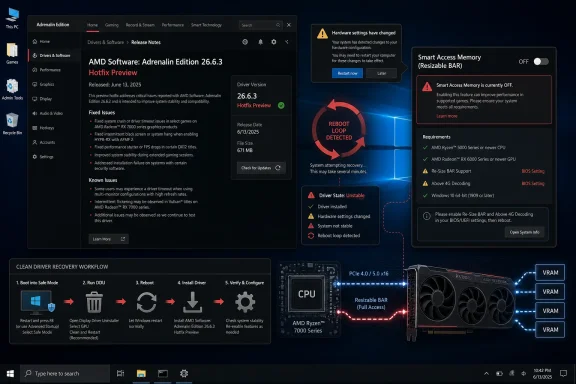
The reported Smart Access Memory breakage appears to sit adjacent to that recovery path. After removing the broken driver and reinstalling cleanly, some users say Adrenalin reports SAM or Resizable BAR as disabled even when firmware settings remain unchanged. That distinction matters because it shifts suspicion away from the motherboard and toward AMD’s Windows driver and control software.
This is not a minor checkbox for the people affected. Smart Access Memory is AMD’s branding for the Resizable BAR capability that lets the CPU address a much larger portion of GPU memory instead of working through smaller access windows. In the right games, with the right CPU, motherboard firmware, GPU, and driver support, it can produce measurable gains. In the wrong failure mode, it can become one more silent variable between a stable gaming PC and a weekend of reinstalling drivers.
That simplicity is also the trap. When a feature depends on the BIOS, PCIe topology, graphics driver, Windows device enumeration, and a vendor control panel, there are many places for state to disagree. A motherboard can advertise the right capability while the driver decides the platform is not eligible. A driver can report a feature as unsupported even though third-party tools see Resizable BAR as active. A clean install can fix one broken component and disturb another.
For Windows users, this is especially frustrating because the failure is not always visible in the way a bad driver usually is. A GPU that fails to enumerate properly throws an obvious warning. A game crash gets attention. But a performance feature that quietly turns itself off is more insidious. The machine still boots, the game still launches, and the frame-rate loss can look like shader compilation, a bad patch, a Windows update, or simple placebo until someone checks the right panel.
The reported behavior also cuts against the usual advice. Enthusiasts are told to keep firmware settings stable, remove bad drivers cleanly, reinstall the current package, and reboot. If the result is a system where SAM comes back temporarily and then disappears again after another restart, the normal troubleshooting ladder stops feeling like a ladder and starts feeling like a loop.
That conservatism is now colliding with new GPU feature development. AMD’s hotfix notes specifically name Windows 10 and Radeon RX 7000-series and newer products, which tells us the issue is not simply ancient hardware aging out of modern drivers. It is happening at the intersection of a still-common operating system and relatively modern GPUs.
This is where the burden on driver quality becomes heavier, not lighter. A Windows 10 user with a Radeon RX 7900 XT or RX 7900 XTX is not running some abandoned museum machine. They are running high-end, recent hardware on an OS that has been stable for years and remains present across gaming desktops, lab rigs, small offices, and specialist deployments. If a driver update strands that user in a broken install state, the problem is not merely that they failed to upgrade to Windows 11.
AMD has been trying to walk a narrow path here. It must deliver new features for RDNA 3 and newer cards, keep pace with game launches and upscaling technologies, and avoid letting Windows 10 become a second-class testing surface too abruptly. The 26.6.3 hotfix shows responsiveness, but it also shows that the original release path did not catch enough before users did.
Persistent notifications about hardware settings changing are a clue. If Adrenalin repeatedly tells a user to reboot because hardware settings changed, but rebooting does not settle the state, the software may be stuck reconciling conflicting information from Windows, firmware, and its own stored configuration. That is exactly the kind of bug that can survive a normal reinstall and only disappear after a more aggressive cleanup, a different driver branch, or sheer luck across multiple restarts.
The community workarounds being floated are telling because they do not all target SAM directly. Some users report success after checking monitor refresh-rate settings or re-enabling Variable Refresh Rate. Others say multiple reboots eventually restore expected behavior. Those fixes sound strange until one remembers that Adrenalin is not just a display driver control panel; it is a large settings manager that spans display timing, game profiles, performance telemetry, recording features, tuning, and platform capability flags.
This does not prove that VRR or refresh-rate handling causes the SAM failure. It does show that users are poking at nearby driver state in hopes of unsticking the software. That is a bad place for a vendor to leave customers, because it turns troubleshooting into superstition. Once the official guidance is incomplete, every anecdote becomes a possible cure.
But the bug’s practical damage does not depend on SAM being a magic performance switch. It depends on expectations. A user who bought into an all-AMD platform, enabled the right firmware settings, and previously saw SAM as active has a reasonable expectation that a driver reinstall will not silently remove that capability. If the same driver event also coincides with crashes or inconsistent behavior, trust erodes quickly.
Gaming performance troubleshooting is already noisy. Frame rates move with game patches, Windows updates, anti-cheat changes, overlay hooks, shader cache resets, BIOS updates, and background software. A driver bug that changes a platform capability without making the change obvious adds another hidden variable. That makes benchmarking harder, support threads longer, and vendor blame both easier and more chaotic.
The crash reports raise the stakes further, though they should be treated carefully until AMD documents a root cause. A disabled SAM state may correlate with instability without directly causing it. The same underlying driver conflict that breaks SAM reporting could also affect display initialization, shader compilation, power management, or game-specific profiles. In other words, SAM may be the visible symptom rather than the disease.
But relying on DDU as the de facto fix is an admission of ecosystem failure. Safe Mode removal, offline installation, Windows Update blocking, and repeated reboots are not reasonable expectations for a mainstream gaming product. They are acceptable emergency measures for enthusiasts who know the risks. They are not a quality bar.
The offline-installation advice is especially revealing. Users do it to prevent Windows Update from racing in with an older or mismatched display driver before AMD’s package finishes installing. That race has haunted both AMD and Nvidia users for years, and it is one of the places where Windows’ admirable plug-and-play instincts can work against precise driver recovery. A system that helpfully installs “a driver” may be less helpful when the user needs the right driver, in the right order, with the right control software.
For IT pros, the lesson is familiar. Configuration drift is not just for servers. A gaming desktop can drift too: firmware settings in one place, Windows device state in another, vendor software in a third, and a user profile full of per-game overrides in a fourth. When a driver package cannot reliably reconcile those layers, the machine becomes a tiny change-management problem with RGB lighting.
Still, the hotfix note is narrower than the community complaint. It addresses an intermittent install issue with 26.6.2 on Windows 10 systems. It does not, at least in the public language, fully explain why Adrenalin would continue reporting SAM as disabled after a clean install, or why users would see repeated hardware-change prompts. If those issues share the same cause, AMD should say so. If they do not, users need a separate acknowledgement and guidance path.
The danger for AMD is that a partial fix can look like a complete answer from the outside. News moves on, the hotfix headline lands, and the remaining users are left to argue in forums about whether their issue is real, cosmetic, firmware-related, or self-inflicted. That is how driver bugs become folklore. Years later, someone still warns a new Radeon owner not to update because of a half-remembered SAM problem from a driver branch long gone.
A better response would separate the confirmed from the suspected. AMD can say the installer issue is fixed in 26.6.3, while also investigating reports that SAM availability is misreported or disabled after driver recovery on Windows 10. That kind of framing does not require admitting a root cause prematurely. It does tell users they are not hallucinating.
This is part of a broader fatigue in PC gaming. GPU drivers now carry upscalers, frame generation, latency tools, streaming encoders, overlay capture, browser components, game launch integrations, AI features, performance tuning, and telemetry. That makes each driver more valuable when it works and more disruptive when it fails. The graphics driver is no longer a thin hardware shim; it is a platform layer.
AMD is not alone in this complexity. Nvidia and Intel have their own driver regressions, installer oddities, and game-specific headaches. But AMD’s position is more delicate because Radeon’s market narrative often leans on value, openness, and platform friendliness. When an all-AMD feature like Smart Access Memory breaks in AMD’s own software, the optics are worse than a random game profile bug.
The company also has less room for ambiguity. Nvidia users may grumble through a bad Game Ready release and wait for the next one. Radeon users, especially those who remember older driver reputation cycles, are quicker to see each regression as evidence of a pattern. Fair or not, AMD has to overperform on stability to escape that history.
The problem is sharper for Radeon RX 7000-series and newer cards. These are precisely the GPUs most likely to benefit from ongoing driver work, new FSR support, and game optimizations. A Windows 10 user with newer Radeon hardware is therefore pulled in two directions: stay conservative to preserve a stable machine, or update to receive the features the hardware was sold to support.
Windows 11 is the obvious vendor-preferred escape hatch, but it is not a universal answer. Some users cannot move easily because of hardware policy, software compatibility, licensing, workflow, or simple preference. Others reasonably object to solving a Windows 10 driver bug by changing operating systems. If AMD says a driver supports Windows 10, users are entitled to expect that support to survive ordinary installation and reboot cycles.
That said, the direction of travel is clear. Windows 10 is moving from default platform to legacy platform, even for gamers who still prefer it. Bugs like this are the practical texture of that transition. Support does not end all at once; it gets narrower, more conditional, and more likely to expose gaps in validation.
That makes community reports inherently noisy. Some systems will have a real driver bug. Some will have firmware settings that changed after a BIOS update. Some will have Windows installed in a mode that blocks the feature. Some will be reading one tool’s status as authoritative when another layer is telling a different story.
But the pattern described in the latest reports is specific enough to deserve attention: SAM working before the driver incident, BIOS settings unchanged, SAM returning after driver reinstall, then disappearing again after reboot or hardware-change prompts. That is not the classic “you forgot to enable ReBAR” scenario. It is a state persistence problem.
The right troubleshooting posture, then, is neither panic nor dismissal. Users should verify the firmware basics, check Device Manager for display-adapter warnings, confirm driver version, and avoid stacking multiple attempted fixes without notes. But AMD should not hide behind the fact that SAM has prerequisites. A feature with prerequisites can still be broken by the software responsible for validating them.
AMD should also improve the user-facing diagnostics around SAM. If Adrenalin says Smart Access Memory is disabled, it should distinguish between firmware disabled, unsupported platform, Windows device state mismatch, driver-profile block, and unknown detection failure. A single disabled message is convenient for UI design and terrible for troubleshooting.
There is an enterprise lesson here, even though SAM sounds like a gamer feature. Modern client PCs are increasingly composed of vendor-specific capability stacks: security processors, firmware switches, GPU scheduling features, memory access modes, virtualization-based security, AI accelerators, and power-management frameworks. When those stacks fail, Windows often remains functional while the promised capability silently disappears. That is harder to monitor than a blue screen.
For sysadmins managing creator workstations, lab PCs, esports rooms, or engineering desktops, silent capability loss is a real operational problem. A driver update that reduces render performance or destabilizes GPU-accelerated workloads can cost time even if it never triggers a classic outage. The lesson is to treat GPU driver updates on production-adjacent systems like any other change: test, stage, document, and keep a known-good rollback package available.
This bug lands in a particularly sensitive place because it touches a feature that symbolizes AMD platform synergy. Smart Access Memory was not just another setting; it was part of the argument for pairing Ryzen with Radeon. If that feature can vanish because a Windows 10 driver branch stumbles, the platform story looks less seamless.
The issue also blurs the line between official support and community support. AMD can publish a hotfix, but much of the lived troubleshooting still happens on Reddit, vendor forums, Discord servers, and enthusiast sites. That distributed support network is valuable, yet it also amplifies uncertainty. One user’s successful triple reboot becomes another user’s wasted evening.
The most useful thing AMD can do now is communicate with uncomfortable specificity. Which driver versions are affected? Which Windows 10 builds? Which GPU generations? Is SAM actually disabled, or is Adrenalin misreporting the status in some cases? Does the 26.6.3 hotfix address any SAM detection path, or only the installation failure? Those are the answers that turn a forum storm back into a support incident.
 AMD’s Windows 10 Problem Is No Longer Just an Installer Problem
The immediate spark was AMD Software: Adrenalin Edition 26.6.2, a driver branch that arrived with new-generation Radeon features but quickly ran into reports from Windows 10 users. The company’s follow-up, Adrenalin 26.6.3 Hotfix Preview, explicitly targets an intermittent install issue on Windows 10 systems using Radeon RX 7000-series and newer GPUs. That is the clean, official version of events.The community version is less tidy. Users have described machines that stopped detecting Radeon graphics cards properly, Adrenalin installations that failed or disappeared, Device Manager warning states, and recovery sequences involving Display Driver Uninstaller in Safe Mode. Those are not exotic enthusiast rituals anymore; they have become the folk medicine of the PC gaming ecosystem.
The reported Smart Access Memory breakage appears to sit adjacent to that recovery path. After removing the broken driver and reinstalling cleanly, some users say Adrenalin reports SAM or Resizable BAR as disabled even when firmware settings remain unchanged. That distinction matters because it shifts suspicion away from the motherboard and toward AMD’s Windows driver and control software.
This is not a minor checkbox for the people affected. Smart Access Memory is AMD’s branding for the Resizable BAR capability that lets the CPU address a much larger portion of GPU memory instead of working through smaller access windows. In the right games, with the right CPU, motherboard firmware, GPU, and driver support, it can produce measurable gains. In the wrong failure mode, it can become one more silent variable between a stable gaming PC and a weekend of reinstalling drivers.
Smart Access Memory Was Sold as Free Performance, Not Another Failure State
SAM’s appeal has always been that it looks almost too simple. Enable Above 4G Decoding, enable Resizable BAR, boot into Windows, confirm the driver sees it, and collect whatever performance uplift a given game can extract. It is the kind of platform feature that vendors love because it transforms coordination across CPU, GPU, chipset, firmware, and software into a single marketing-friendly toggle.That simplicity is also the trap. When a feature depends on the BIOS, PCIe topology, graphics driver, Windows device enumeration, and a vendor control panel, there are many places for state to disagree. A motherboard can advertise the right capability while the driver decides the platform is not eligible. A driver can report a feature as unsupported even though third-party tools see Resizable BAR as active. A clean install can fix one broken component and disturb another.
For Windows users, this is especially frustrating because the failure is not always visible in the way a bad driver usually is. A GPU that fails to enumerate properly throws an obvious warning. A game crash gets attention. But a performance feature that quietly turns itself off is more insidious. The machine still boots, the game still launches, and the frame-rate loss can look like shader compilation, a bad patch, a Windows update, or simple placebo until someone checks the right panel.
The reported behavior also cuts against the usual advice. Enthusiasts are told to keep firmware settings stable, remove bad drivers cleanly, reinstall the current package, and reboot. If the result is a system where SAM comes back temporarily and then disappears again after another restart, the normal troubleshooting ladder stops feeling like a ladder and starts feeling like a loop.
Windows 10 Is Becoming the Driver Branch Nobody Wants to Break but Everyone Can
The uncomfortable backdrop is Windows 10’s long goodbye. Microsoft’s mainstream consumer support timeline has pushed much of the PC ecosystem toward Windows 11, but a large installed base remains on Windows 10 for reasons that are not irrational. Some users prefer its interface, some machines fall outside Windows 11’s requirements, and plenty of gaming rigs are configured around a “do not touch what works” philosophy.That conservatism is now colliding with new GPU feature development. AMD’s hotfix notes specifically name Windows 10 and Radeon RX 7000-series and newer products, which tells us the issue is not simply ancient hardware aging out of modern drivers. It is happening at the intersection of a still-common operating system and relatively modern GPUs.
This is where the burden on driver quality becomes heavier, not lighter. A Windows 10 user with a Radeon RX 7900 XT or RX 7900 XTX is not running some abandoned museum machine. They are running high-end, recent hardware on an OS that has been stable for years and remains present across gaming desktops, lab rigs, small offices, and specialist deployments. If a driver update strands that user in a broken install state, the problem is not merely that they failed to upgrade to Windows 11.
AMD has been trying to walk a narrow path here. It must deliver new features for RDNA 3 and newer cards, keep pace with game launches and upscaling technologies, and avoid letting Windows 10 become a second-class testing surface too abruptly. The 26.6.3 hotfix shows responsiveness, but it also shows that the original release path did not catch enough before users did.
The SAM Reports Point to a Deeper State-Management Bug
The most interesting part of the current episode is not the driver installation issue AMD has acknowledged. It is the reported aftermath: Smart Access Memory becoming unavailable after users restore the driver stack. That suggests a possible state-management problem, where the software believes platform conditions have changed even when the firmware configuration has not.Persistent notifications about hardware settings changing are a clue. If Adrenalin repeatedly tells a user to reboot because hardware settings changed, but rebooting does not settle the state, the software may be stuck reconciling conflicting information from Windows, firmware, and its own stored configuration. That is exactly the kind of bug that can survive a normal reinstall and only disappear after a more aggressive cleanup, a different driver branch, or sheer luck across multiple restarts.
The community workarounds being floated are telling because they do not all target SAM directly. Some users report success after checking monitor refresh-rate settings or re-enabling Variable Refresh Rate. Others say multiple reboots eventually restore expected behavior. Those fixes sound strange until one remembers that Adrenalin is not just a display driver control panel; it is a large settings manager that spans display timing, game profiles, performance telemetry, recording features, tuning, and platform capability flags.
This does not prove that VRR or refresh-rate handling causes the SAM failure. It does show that users are poking at nearby driver state in hopes of unsticking the software. That is a bad place for a vendor to leave customers, because it turns troubleshooting into superstition. Once the official guidance is incomplete, every anecdote becomes a possible cure.
The Performance Hit Is Real Enough Even If the Bug Is Intermittent
Resizable BAR and SAM do not transform every game. In some titles, the uplift is modest; in others, it can be more noticeable, especially where asset streaming and memory access patterns benefit from the CPU seeing larger chunks of VRAM. There are also cases where Resizable BAR has historically done little or even regressed performance, which is why driver profiles and platform validation matter.But the bug’s practical damage does not depend on SAM being a magic performance switch. It depends on expectations. A user who bought into an all-AMD platform, enabled the right firmware settings, and previously saw SAM as active has a reasonable expectation that a driver reinstall will not silently remove that capability. If the same driver event also coincides with crashes or inconsistent behavior, trust erodes quickly.
Gaming performance troubleshooting is already noisy. Frame rates move with game patches, Windows updates, anti-cheat changes, overlay hooks, shader cache resets, BIOS updates, and background software. A driver bug that changes a platform capability without making the change obvious adds another hidden variable. That makes benchmarking harder, support threads longer, and vendor blame both easier and more chaotic.
The crash reports raise the stakes further, though they should be treated carefully until AMD documents a root cause. A disabled SAM state may correlate with instability without directly causing it. The same underlying driver conflict that breaks SAM reporting could also affect display initialization, shader compilation, power management, or game-specific profiles. In other words, SAM may be the visible symptom rather than the disease.
Clean Installs Are Not a Substitute for Driver Discipline
Display Driver Uninstaller has become a household name among PC enthusiasts for a reason. It works around the reality that GPU drivers are sprawling software packages with services, registry state, driver-store entries, shader caches, telemetry components, overlays, and control panels. When a normal uninstall is not enough, DDU can produce the clean slate that Windows and vendor installers should arguably have provided in the first place.But relying on DDU as the de facto fix is an admission of ecosystem failure. Safe Mode removal, offline installation, Windows Update blocking, and repeated reboots are not reasonable expectations for a mainstream gaming product. They are acceptable emergency measures for enthusiasts who know the risks. They are not a quality bar.
The offline-installation advice is especially revealing. Users do it to prevent Windows Update from racing in with an older or mismatched display driver before AMD’s package finishes installing. That race has haunted both AMD and Nvidia users for years, and it is one of the places where Windows’ admirable plug-and-play instincts can work against precise driver recovery. A system that helpfully installs “a driver” may be less helpful when the user needs the right driver, in the right order, with the right control software.
For IT pros, the lesson is familiar. Configuration drift is not just for servers. A gaming desktop can drift too: firmware settings in one place, Windows device state in another, vendor software in a third, and a user profile full of per-game overrides in a fourth. When a driver package cannot reliably reconcile those layers, the machine becomes a tiny change-management problem with RGB lighting.
AMD’s Hotfix Helps, but It Does Not Fully Answer the SAM Complaint
AMD deserves credit for moving quickly on the Windows 10 installation issue. A hotfix within days is better than silence, and the release notes identify the affected class of systems clearly enough for users to understand whether they are in the blast radius. For Radeon RX 7000-series and newer owners on Windows 10, 26.6.3 is the obvious first stop.Still, the hotfix note is narrower than the community complaint. It addresses an intermittent install issue with 26.6.2 on Windows 10 systems. It does not, at least in the public language, fully explain why Adrenalin would continue reporting SAM as disabled after a clean install, or why users would see repeated hardware-change prompts. If those issues share the same cause, AMD should say so. If they do not, users need a separate acknowledgement and guidance path.
The danger for AMD is that a partial fix can look like a complete answer from the outside. News moves on, the hotfix headline lands, and the remaining users are left to argue in forums about whether their issue is real, cosmetic, firmware-related, or self-inflicted. That is how driver bugs become folklore. Years later, someone still warns a new Radeon owner not to update because of a half-remembered SAM problem from a driver branch long gone.
A better response would separate the confirmed from the suspected. AMD can say the installer issue is fixed in 26.6.3, while also investigating reports that SAM availability is misreported or disabled after driver recovery on Windows 10. That kind of framing does not require admitting a root cause prematurely. It does tell users they are not hallucinating.
Windows Enthusiasts Are Tired of Being the QA Department
The Radeon community is unusually tolerant of tinkering, but tolerance has limits. Enthusiasts will undervolt, flash BIOS updates, test preview drivers, and run frame-time captures because they enjoy control. They are less forgiving when basic driver updates break display detection, disable advertised platform features, or require ritualized cleanup steps.This is part of a broader fatigue in PC gaming. GPU drivers now carry upscalers, frame generation, latency tools, streaming encoders, overlay capture, browser components, game launch integrations, AI features, performance tuning, and telemetry. That makes each driver more valuable when it works and more disruptive when it fails. The graphics driver is no longer a thin hardware shim; it is a platform layer.
AMD is not alone in this complexity. Nvidia and Intel have their own driver regressions, installer oddities, and game-specific headaches. But AMD’s position is more delicate because Radeon’s market narrative often leans on value, openness, and platform friendliness. When an all-AMD feature like Smart Access Memory breaks in AMD’s own software, the optics are worse than a random game profile bug.
The company also has less room for ambiguity. Nvidia users may grumble through a bad Game Ready release and wait for the next one. Radeon users, especially those who remember older driver reputation cycles, are quicker to see each regression as evidence of a pattern. Fair or not, AMD has to overperform on stability to escape that history.
The Windows 10 Holdout Case Just Got More Complicated
For many Windows 10 users, this episode will be filed under “another reason not to update drivers unless necessary.” That instinct is understandable, but it is becoming harder to maintain. New games, anti-cheat systems, upscaling support, security fixes, and GPU feature updates increasingly arrive through current driver branches. Avoiding updates protects stability until it starts costing compatibility.The problem is sharper for Radeon RX 7000-series and newer cards. These are precisely the GPUs most likely to benefit from ongoing driver work, new FSR support, and game optimizations. A Windows 10 user with newer Radeon hardware is therefore pulled in two directions: stay conservative to preserve a stable machine, or update to receive the features the hardware was sold to support.
Windows 11 is the obvious vendor-preferred escape hatch, but it is not a universal answer. Some users cannot move easily because of hardware policy, software compatibility, licensing, workflow, or simple preference. Others reasonably object to solving a Windows 10 driver bug by changing operating systems. If AMD says a driver supports Windows 10, users are entitled to expect that support to survive ordinary installation and reboot cycles.
That said, the direction of travel is clear. Windows 10 is moving from default platform to legacy platform, even for gamers who still prefer it. Bugs like this are the practical texture of that transition. Support does not end all at once; it gets narrower, more conditional, and more likely to expose gaps in validation.
Firmware Settings Still Matter, but They Are Not the Whole Story
It is worth being precise about the platform requirements because SAM is easy to misdiagnose. Users generally need a compatible Ryzen platform, a supported Radeon GPU, current motherboard firmware, Above 4G Decoding enabled, Resizable BAR enabled, and a boot configuration that does not undermine UEFI requirements. Compatibility Support Module settings, older BIOS versions, and mixed platform combinations can all produce legitimate “unsupported” messages.That makes community reports inherently noisy. Some systems will have a real driver bug. Some will have firmware settings that changed after a BIOS update. Some will have Windows installed in a mode that blocks the feature. Some will be reading one tool’s status as authoritative when another layer is telling a different story.
But the pattern described in the latest reports is specific enough to deserve attention: SAM working before the driver incident, BIOS settings unchanged, SAM returning after driver reinstall, then disappearing again after reboot or hardware-change prompts. That is not the classic “you forgot to enable ReBAR” scenario. It is a state persistence problem.
The right troubleshooting posture, then, is neither panic nor dismissal. Users should verify the firmware basics, check Device Manager for display-adapter warnings, confirm driver version, and avoid stacking multiple attempted fixes without notes. But AMD should not hide behind the fact that SAM has prerequisites. A feature with prerequisites can still be broken by the software responsible for validating them.
The Fix Should Be Boring, Documented, and Reversible
The best possible outcome is not a heroic workaround. It is a boring driver package that installs cleanly, reports SAM accurately, and lets users roll back without collateral damage. GPU driver recovery should be reversible in the same way a bad Windows update should be reversible: not always painless, but predictable.AMD should also improve the user-facing diagnostics around SAM. If Adrenalin says Smart Access Memory is disabled, it should distinguish between firmware disabled, unsupported platform, Windows device state mismatch, driver-profile block, and unknown detection failure. A single disabled message is convenient for UI design and terrible for troubleshooting.
There is an enterprise lesson here, even though SAM sounds like a gamer feature. Modern client PCs are increasingly composed of vendor-specific capability stacks: security processors, firmware switches, GPU scheduling features, memory access modes, virtualization-based security, AI accelerators, and power-management frameworks. When those stacks fail, Windows often remains functional while the promised capability silently disappears. That is harder to monitor than a blue screen.
For sysadmins managing creator workstations, lab PCs, esports rooms, or engineering desktops, silent capability loss is a real operational problem. A driver update that reduces render performance or destabilizes GPU-accelerated workloads can cost time even if it never triggers a classic outage. The lesson is to treat GPU driver updates on production-adjacent systems like any other change: test, stage, document, and keep a known-good rollback package available.
The Radeon Driver Story Now Hinges on Trust, Not Just Frame Rates
AMD has spent years improving Radeon driver credibility, and that progress is real. Adrenalin is far more capable than the old control-panel era, Radeon Anti-Lag and tuning features have matured, and AMD’s upscaling strategy has kept the company in the performance conversation even when Nvidia dominates mindshare. But trust in drivers is accumulated slowly and spent quickly.This bug lands in a particularly sensitive place because it touches a feature that symbolizes AMD platform synergy. Smart Access Memory was not just another setting; it was part of the argument for pairing Ryzen with Radeon. If that feature can vanish because a Windows 10 driver branch stumbles, the platform story looks less seamless.
The issue also blurs the line between official support and community support. AMD can publish a hotfix, but much of the lived troubleshooting still happens on Reddit, vendor forums, Discord servers, and enthusiast sites. That distributed support network is valuable, yet it also amplifies uncertainty. One user’s successful triple reboot becomes another user’s wasted evening.
The most useful thing AMD can do now is communicate with uncomfortable specificity. Which driver versions are affected? Which Windows 10 builds? Which GPU generations? Is SAM actually disabled, or is Adrenalin misreporting the status in some cases? Does the 26.6.3 hotfix address any SAM detection path, or only the installation failure? Those are the answers that turn a forum storm back into a support incident.
The Practical Read for Radeon Owners on Windows 10
For now, the safest interpretation is that AMD has fixed at least one confirmed Windows 10 driver installation problem, while reports around Smart Access Memory deserve caution until the company documents the failure mode. Users should avoid treating every workaround as gospel, but they should also not ignore a sudden SAM status change after the recent driver trouble. A feature that quietly disappears is still a regression if the platform previously supported it.- Radeon RX 7000-series and newer users on Windows 10 should treat Adrenalin 26.6.3 Hotfix Preview as the relevant AMD response to the 26.6.2 installation problem.
- Users seeing Smart Access Memory disabled should first confirm BIOS settings for Above 4G Decoding and Resizable BAR before assuming the driver is solely responsible.
- A clean driver reinstall may help, but repeated DDU cycles without a plan can create new variables and make the original failure harder to isolate.
- Persistent hardware-change prompts after reboot are a strong sign that Adrenalin and Windows are not agreeing on device or platform state.
- Gamers who depend on stable performance should keep a known-good Radeon driver installer available before moving to preview or hotfix branches.
- AMD needs to clarify whether the reported SAM behavior is a functional disablement, a reporting bug, or a separate Windows 10 compatibility issue.
References
- Primary source: Wccftech
Published: 2026-06-29T11:20:12.756323
AMD Driver Bug Silently Disables Smart Access Memory On Windows 10, Tanking Gaming Performance And Triggering Crashes
AMD is investigating a driver issue disabling Smart Access Memory on Windows 10, causing performance drops and crashes in gaming.wccftech.com
- Related coverage: fanaticosdelhardware.com
AMD lanza Adrenalin 26.6.3 Hotfix para corregir el fallo de Windows 10 con RX 7000
AMD lanza Adrenalin 26.6.3 Hotfix para corregir el fallo de Windows 10 con RX 7000 y mantener FSR 4.1.fanaticosdelhardware.com - Related coverage: videocardz.com
- Related coverage: windowsreport.com
AMD Releases Adrenalin Hotfix After Windows 10 Users Report Yellow Bang Error
AMD has released Adrenalin 26.6.3 Hotfix to resolve the yellow bang issue affecting Windows 10 users with Radeon RX 7000 GPUs. windowsreport.com
- Related coverage: adrenaline.com.br
AMD libera hotfix Adrenalin Radeon Software 26.6.3 para corrigir bug no Windows 10 - Adrenaline
Um dia depois de reconhecer o bug, AMD corrige versão mais recente de seu driver, que leva FSR 4.1 para Radeon RX 7000www.adrenaline.com.br - Related coverage: tweaktown.com
AMD confirms Adrenalin 26.6.2 driver fails to launch on Windows 10, recommends rolling back
AMD confirmed the issue and recommends rolling back to 26.6.1, but that means losing FSR 4.1 support on RDNA 3 until a fixed version ships. www.tweaktown.com
- Related coverage: community.amd.com
AMD Community Updates
The AMD Community is entering an exciting new phase—growing into a broader ecosystem of dedicated resources designed to better support and connect you.community.amd.com - Related coverage: tomshardware.com
AMD’s latest Adrenalin driver update drops Windows 10 from release notes, but the company says support continues | Tom's Hardware
Windows 10 isn’t listed, but it’s not abandonedwww.tomshardware.com - Related coverage: techradar.com
Are AMD GPUs no longer supported in Windows 10? Don't panic – here's what you need to know | TechRadar
Reports suggest Radeon GPUs are only supported in Windows 11 now, but that isn't the casewww.techradar.com - Related coverage: windowscentral.com
AMD kills Windows 10 support in its latest Adrenalin update — Battlefield 6 picks up bug fixes and optimizations | Windows Central
Also on the killing floor are new game and Vulkan extension support for RDNA 1 and RDNA 2 GPUs.www.windowscentral.com