

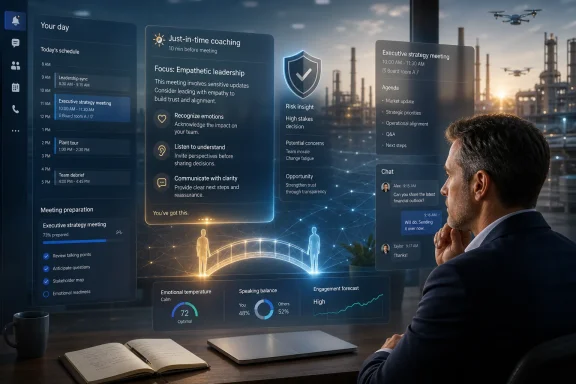
Regal Rexnord is piloting AI-driven leadership coaching inside Microsoft Teams in 2026, using workflow data and just-in-time prompts to help roughly 4,000 global leaders practice emotional intelligence before high-stakes management conversations. The move matters because it reframes generative AI not as a content factory, but as a behavioral infrastructure layer inside the enterprise. If the experiment works, it could make personalized leadership coaching less like an executive perk and more like an operational utility.
The most interesting thing about Regal Rexnord’s leadership AI project is not that a large manufacturer is using generative AI. By 2026, that is table stakes for any company with a Microsoft 365 footprint, a customer service operation, and a mandate to squeeze more productivity out of distributed teams. The interesting thing is where Regal Rexnord has chosen to point the technology: not first at code, contracts, or customer tickets, but at the messy human layer where managers make or break execution.
That choice cuts against the usual caricature of industrial AI adoption. Manufacturers are supposed to use AI for predictive maintenance, demand forecasting, quality inspection, and customer support deflection. Regal Rexnord does all the expected digital-transformation things too, but Kriste Goldsmith’s leadership development work suggests a more provocative thesis: emotional intelligence is not a decorative management trait; it is production infrastructure.
That is a jarring idea only if one imagines factories, supply chains, and engineering organizations as purely mechanical systems. They are not. They are networks of people interpreting priorities, absorbing stress, resolving conflicts, escalating failures, and deciding whether to tell the truth early enough for leaders to act. In that environment, a manager who cannot build trust or conduct a difficult conversation is not merely “bad with people.” That manager is a risk surface.
Regal Rexnord’s bet is that AI can reduce that risk surface by putting coaching into the same digital channels where management work already happens. The company is not simply asking leaders to take another course, watch another video, or attend another offsite. It is trying to insert a small, timely behavioral checkpoint just before the moment when a leader’s habits matter most.
That mismatch is not just unfair. It is operationally irrational. Frontline and middle managers translate strategy into work, absorb employee frustration, enforce policy, identify risk, and maintain morale during reorganizations, supply shocks, labor shortages, and technology rollouts. If leadership quality is uneven at that layer, the company’s best strategy degrades before it reaches the floor.
The reason companies tolerate this gap is not mysterious. Human coaching is expensive, hard to schedule, culturally uneven, and difficult to scale across countries and functions. A global manufacturer with tens of thousands of employees cannot put a seasoned executive coach beside every supervisor before a tense performance conversation. Even if it could afford the bill, it could not coordinate the logistics.
That is the opening generative AI now exploits. The value of AI in leadership development is not primarily that it can produce more learning material. Corporate systems are already drowning in material. The scarcity is not content; it is context.
Goldsmith’s project, as described in the source material, is aimed directly at that scarcity. The ambition is to make leadership development adapt to a manager’s role, documented strengths, growth areas, and immediate situation. That is a far more consequential use case than “generate five tips for better listening,” because it moves AI from the library into the workday.
That gives AI systems a powerful new position. Instead of waiting for a manager to search for advice, the system can infer that a sensitive moment is coming. A scheduled development meeting, a one-on-one after a difficult project, or a performance discussion creates a context window. The AI does not need to replace the manager; it needs to interrupt the autopilot.
This is where the phrase in the flow of work stops being HR jargon and becomes a design principle. Traditional training assumes people will learn an abstraction today and remember to apply it under stress next month. Just-in-time nudging assumes the opposite: people forget, react, and default to habit unless the environment helps them pause.
A well-designed prompt before a difficult conversation can be small and still useful. It might remind a leader to ask before telling, describe the outcome plainly, listen for defensiveness, or separate the person from the performance issue. None of that is magical. The value lies in timing.
The challenge, of course, is that Microsoft Teams is also where too much of modern office life already feels mediated, measured, and nudged. A leadership coach in Teams can be helpful. A synthetic conscience in Teams can become creepy. Regal Rexnord’s experiment sits precisely on that boundary.
That distinction no longer holds. A leader who cannot regulate their own reaction can derail a meeting. A manager who lacks courage can let a corrosive performance problem fester. A supervisor who cannot create clarity can turn a strategy shift into rumor, resentment, and rework.
In a manufacturing enterprise, those failures have measurable consequences. Confusion slows throughput. Low trust suppresses bad news. Poor conversations increase turnover risk. Defensive leadership turns small operational problems into late-stage surprises.
This is why Regal Rexnord’s approach deserves attention from IT pros as well as HR leaders. The company is not merely digitizing a training curriculum. It is trying to operationalize a behavioral model by wiring it into collaboration infrastructure. That makes emotional intelligence a workflow concern, a data concern, and eventually a governance concern.
Once a company treats empathy, courage, resilience, and self-awareness as performance skills, it must decide what evidence counts. Is the system measuring attendance at training sessions, completion of coaching prompts, employee sentiment, meeting outcomes, retention, promotion readiness, or manager effectiveness scores? Each answer carries a different ethical and operational burden.
Regal Rexnord’s proposed model is more interesting because it points toward a system rather than a bot. The useful version of this technology would combine leadership competency data, role expectations, learning history, calendar context, and perhaps feedback signals into a recommendation engine for managerial behavior. That is not a toy. It is enterprise software.
But software does not become wise merely because it has access to more data. If the underlying competency model is vague, the prompts will be vague. If performance data is biased, the coaching may reinforce bias. If the system rewards polished language over genuine accountability, managers will learn to perform empathy rather than practice it.
This is the central risk in hard-coding emotional intelligence into workflows. The enterprise may confuse behavioral compliance with human growth. A leader can click through a nudge and still avoid the hard conversation. A manager can use emotionally intelligent language while delivering a decision that was opaque, unfair, or already predetermined.
The best version of Regal Rexnord’s approach would not pretend AI creates empathy. It would use AI to create repeated moments of reflection, and then rely on human systems to evaluate whether those moments are changing behavior. That distinction matters.
Microsoft has spent years knitting Teams, Outlook, SharePoint, Viva, Power Platform, Copilot Studio, Entra ID, Purview, and Graph-based context into a single enterprise fabric. Once that fabric understands who is meeting, what the meeting is about, what documents are attached, what role each person plays, and what policy governs the interaction, it becomes possible to build systems that intervene before work happens.
That has obvious productivity implications. It also has cultural implications. The same architecture that can remind a sales rep to update a CRM field can remind a manager to listen before responding. The same identity and policy systems that govern data access can govern which coaching signals an AI assistant may use.
Regal Rexnord’s project belongs to this larger shift. AI is moving from a destination to a substrate. Employees will not always “go to AI” to ask for help; AI will increasingly appear inside the workflow, armed with just enough context to shape the next action.
For IT departments, that means HR technology is no longer safely off to the side. Leadership nudges inside Teams touch data retention, permissions, privacy, auditability, model governance, prompt design, and employee trust. A coaching pilot can become an information governance project faster than many HR teams expect.
Employees may accept a tool that reminds their manager to prepare thoughtfully for a development discussion. They may not accept a tool that appears to infer emotional volatility, risk of attrition, or interpersonal conflict from private communications. The line between support and surveillance is not defined by vendor messaging. It is defined by system design and organizational trust.
This is especially important because leadership development data is intimate in a way that ordinary productivity telemetry is not. It concerns judgment, confidence, conflict, resilience, and interpersonal behavior. When that data becomes machine-readable and workflow-integrated, companies must decide who can see it, how long it persists, and whether it can influence promotion, compensation, or discipline.
A serious deployment should separate coaching from punishment wherever possible. If managers believe every prompt becomes a record of deficiency, they will game the system or avoid it. If employees believe AI is quietly profiling their conversations with supervisors, they will withhold candor.
That does not mean companies should avoid this technology. It means they should treat it as high-trust infrastructure. The safeguards need to be visible, not buried in a policy portal no one reads.
The promise is real. A supervisor in a plant, a regional sales manager, or a newly promoted team lead could receive practical guidance at the moment of need without waiting for a formal program. For companies expanding across Africa, Asia, Latin America, and Eastern Europe, that could accelerate management maturity in places where executive coaching capacity is thin.
But global scale complicates the emotional intelligence story. A prompt that reads as direct and courageous in one culture may read as blunt or disrespectful in another. A coaching model trained on North American corporate norms may mishandle hierarchy, saving face, labor relations, or local communication styles elsewhere.
Localization cannot be reduced to translation. If AI is going to coach managers on trust, conflict, and clarity, it must understand the social meaning of those behaviors in context. Otherwise, “global leadership standards” become a polite name for cultural flattening.
Regal Rexnord’s advantage is that it is already a global manufacturer with real operational complexity. If the company can build feedback loops from leaders in different regions, its system may become more grounded than a generic HR tech product. If it simply pushes a single leadership script everywhere, the same scale that makes the project powerful could make it brittle.
Just-in-time AI coaching tries to close that gap. It turns development from an event into a pattern. The leader gets a nudge, enters the meeting, practices a behavior, reflects, and eventually receives another nudge in a different context.
That rhythm aligns better with how adults actually build skill. People do not become better listeners because they once attended a session on active listening. They improve because they practice in real interactions, receive feedback, notice the consequences, and repeat the behavior until it becomes less artificial.
AI can help create the repetition. It can notice moments, personalize reminders, and reduce the friction of reflection. It can make the desired behavior harder to forget.
Still, the company must avoid automating away the discomfort that leadership requires. A manager cannot outsource courage to a prompt. The system can prepare the leader for a difficult conversation, but the leader still has to have it.
IT leaders should evaluate these tools with the same skepticism they bring to security products and endpoint agents. What data does the product ingest? Where is the model hosted? Can the organization control retention? Does the tool train on customer data? Can prompts and outputs be audited? How does it handle regulated conversations, works councils, union environments, and cross-border data transfers?
The integration surface matters too. A tool that lives inside Teams may require Microsoft Graph permissions, calendar access, chat context, meeting metadata, or connectors into HR systems. Each permission grant should be justified. “Better coaching” is not a sufficient reason to over-collect.
There is also the question of model behavior. Emotional intelligence advice can sound plausible while being wrong for the situation. A generic recommendation to “show empathy” may be useless before a termination meeting. A suggestion to “be transparent” may conflict with legal constraints, confidentiality obligations, or an active investigation.
That means AI coaching systems need guardrails that are specific to management work. They should know when to defer to HR, legal, compliance, or employee relations. They should not improvise policy. In the enterprise, the most dangerous AI answer is often the one that sounds reasonable enough to follow.
A manager must weigh facts, policy, timing, emotion, power, and consequence. AI can help structure that thinking, but it cannot own the outcome. The person in the room with authority still carries the responsibility for how authority is used.
This matters because enterprises are prone to hiding behind systems. If a bad performance conversation follows an AI-generated script, the company cannot blame the tool. If an employee feels manipulated by formulaic empathy, the manager cannot say the prompt told them to do it. AI assistance does not dilute managerial accountability.
The best leaders may use these systems lightly, as reminders rather than crutches. The weakest leaders may over-rely on them, mistaking scripted emotional language for trust. That is why measurement has to look beyond tool usage.
The real metric is whether teams experience more clarity, fairness, courage, and follow-through. If the system increases prompt compliance but employees still distrust management, it has failed. If it helps managers slow down before consequential conversations and act with more discipline, it has earned its place.
That shift should excite and worry Windows enterprises in equal measure.
 Regal Rexnord Is Treating Empathy Like Plant Uptime
The most interesting thing about Regal Rexnord’s leadership AI project is not that a large manufacturer is using generative AI. By 2026, that is table stakes for any company with a Microsoft 365 footprint, a customer service operation, and a mandate to squeeze more productivity out of distributed teams. The interesting thing is where Regal Rexnord has chosen to point the technology: not first at code, contracts, or customer tickets, but at the messy human layer where managers make or break execution.That choice cuts against the usual caricature of industrial AI adoption. Manufacturers are supposed to use AI for predictive maintenance, demand forecasting, quality inspection, and customer support deflection. Regal Rexnord does all the expected digital-transformation things too, but Kriste Goldsmith’s leadership development work suggests a more provocative thesis: emotional intelligence is not a decorative management trait; it is production infrastructure.
That is a jarring idea only if one imagines factories, supply chains, and engineering organizations as purely mechanical systems. They are not. They are networks of people interpreting priorities, absorbing stress, resolving conflicts, escalating failures, and deciding whether to tell the truth early enough for leaders to act. In that environment, a manager who cannot build trust or conduct a difficult conversation is not merely “bad with people.” That manager is a risk surface.
Regal Rexnord’s bet is that AI can reduce that risk surface by putting coaching into the same digital channels where management work already happens. The company is not simply asking leaders to take another course, watch another video, or attend another offsite. It is trying to insert a small, timely behavioral checkpoint just before the moment when a leader’s habits matter most.
The Old Coaching Model Was Built for Scarcity
Corporate leadership development has always had a distribution problem. The employees most likely to need skilled coaching are often the least likely to receive it. Senior executives get external coaches, structured assessments, and facilitated retreats; frontline supervisors get mandatory e-learning and a PDF.That mismatch is not just unfair. It is operationally irrational. Frontline and middle managers translate strategy into work, absorb employee frustration, enforce policy, identify risk, and maintain morale during reorganizations, supply shocks, labor shortages, and technology rollouts. If leadership quality is uneven at that layer, the company’s best strategy degrades before it reaches the floor.
The reason companies tolerate this gap is not mysterious. Human coaching is expensive, hard to schedule, culturally uneven, and difficult to scale across countries and functions. A global manufacturer with tens of thousands of employees cannot put a seasoned executive coach beside every supervisor before a tense performance conversation. Even if it could afford the bill, it could not coordinate the logistics.
That is the opening generative AI now exploits. The value of AI in leadership development is not primarily that it can produce more learning material. Corporate systems are already drowning in material. The scarcity is not content; it is context.
Goldsmith’s project, as described in the source material, is aimed directly at that scarcity. The ambition is to make leadership development adapt to a manager’s role, documented strengths, growth areas, and immediate situation. That is a far more consequential use case than “generate five tips for better listening,” because it moves AI from the library into the workday.
Microsoft Teams Becomes the New Management Nerve Center
The Teams angle is crucial because it explains why this kind of coaching is suddenly plausible. Managers already live in collaboration software. Their calendars, chats, meetings, files, and workflows pass through the same platforms that enterprise AI vendors are now trying to turn into orchestration layers.That gives AI systems a powerful new position. Instead of waiting for a manager to search for advice, the system can infer that a sensitive moment is coming. A scheduled development meeting, a one-on-one after a difficult project, or a performance discussion creates a context window. The AI does not need to replace the manager; it needs to interrupt the autopilot.
This is where the phrase in the flow of work stops being HR jargon and becomes a design principle. Traditional training assumes people will learn an abstraction today and remember to apply it under stress next month. Just-in-time nudging assumes the opposite: people forget, react, and default to habit unless the environment helps them pause.
A well-designed prompt before a difficult conversation can be small and still useful. It might remind a leader to ask before telling, describe the outcome plainly, listen for defensiveness, or separate the person from the performance issue. None of that is magical. The value lies in timing.
The challenge, of course, is that Microsoft Teams is also where too much of modern office life already feels mediated, measured, and nudged. A leadership coach in Teams can be helpful. A synthetic conscience in Teams can become creepy. Regal Rexnord’s experiment sits precisely on that boundary.
Emotional Intelligence Gets Recast as an Execution Discipline
Goldsmith’s most important move is rhetorical as much as technical. By calling emotional intelligence a performance skill rather than a soft skill, she changes the conversation about what managers owe the business. “Soft skill” has always been a quietly dismissive phrase, a way to praise behavior while keeping it outside the realm of hard accountability.That distinction no longer holds. A leader who cannot regulate their own reaction can derail a meeting. A manager who lacks courage can let a corrosive performance problem fester. A supervisor who cannot create clarity can turn a strategy shift into rumor, resentment, and rework.
In a manufacturing enterprise, those failures have measurable consequences. Confusion slows throughput. Low trust suppresses bad news. Poor conversations increase turnover risk. Defensive leadership turns small operational problems into late-stage surprises.
This is why Regal Rexnord’s approach deserves attention from IT pros as well as HR leaders. The company is not merely digitizing a training curriculum. It is trying to operationalize a behavioral model by wiring it into collaboration infrastructure. That makes emotional intelligence a workflow concern, a data concern, and eventually a governance concern.
Once a company treats empathy, courage, resilience, and self-awareness as performance skills, it must decide what evidence counts. Is the system measuring attendance at training sessions, completion of coaching prompts, employee sentiment, meeting outcomes, retention, promotion readiness, or manager effectiveness scores? Each answer carries a different ethical and operational burden.
The AI Coach Is Only as Good as the System Around It
The phrase “AI coach in your pocket” is compelling, but it can also mislead. A chatbot that dispenses generic leadership advice is not coaching in any serious sense. Coaching requires context, feedback, accountability, and an understanding of the person being coached.Regal Rexnord’s proposed model is more interesting because it points toward a system rather than a bot. The useful version of this technology would combine leadership competency data, role expectations, learning history, calendar context, and perhaps feedback signals into a recommendation engine for managerial behavior. That is not a toy. It is enterprise software.
But software does not become wise merely because it has access to more data. If the underlying competency model is vague, the prompts will be vague. If performance data is biased, the coaching may reinforce bias. If the system rewards polished language over genuine accountability, managers will learn to perform empathy rather than practice it.
This is the central risk in hard-coding emotional intelligence into workflows. The enterprise may confuse behavioral compliance with human growth. A leader can click through a nudge and still avoid the hard conversation. A manager can use emotionally intelligent language while delivering a decision that was opaque, unfair, or already predetermined.
The best version of Regal Rexnord’s approach would not pretend AI creates empathy. It would use AI to create repeated moments of reflection, and then rely on human systems to evaluate whether those moments are changing behavior. That distinction matters.
The Windows Enterprise Stack Is Quietly Becoming a Coaching Platform
For WindowsForum readers, the Microsoft Teams component should set off a broader recognition. The modern Windows enterprise stack is no longer just an operating system, productivity suite, identity platform, and endpoint management environment. It is becoming a behavioral platform.Microsoft has spent years knitting Teams, Outlook, SharePoint, Viva, Power Platform, Copilot Studio, Entra ID, Purview, and Graph-based context into a single enterprise fabric. Once that fabric understands who is meeting, what the meeting is about, what documents are attached, what role each person plays, and what policy governs the interaction, it becomes possible to build systems that intervene before work happens.
That has obvious productivity implications. It also has cultural implications. The same architecture that can remind a sales rep to update a CRM field can remind a manager to listen before responding. The same identity and policy systems that govern data access can govern which coaching signals an AI assistant may use.
Regal Rexnord’s project belongs to this larger shift. AI is moving from a destination to a substrate. Employees will not always “go to AI” to ask for help; AI will increasingly appear inside the workflow, armed with just enough context to shape the next action.
For IT departments, that means HR technology is no longer safely off to the side. Leadership nudges inside Teams touch data retention, permissions, privacy, auditability, model governance, prompt design, and employee trust. A coaching pilot can become an information governance project faster than many HR teams expect.
The Privacy Question Is Not a Footnote
Any system that nudges leaders before sensitive conversations must answer a blunt question: what does it know, and how did it learn it? Calendar metadata alone may be relatively benign. Performance management records, sentiment scores, employee relations history, and prior feedback introduce much higher stakes.Employees may accept a tool that reminds their manager to prepare thoughtfully for a development discussion. They may not accept a tool that appears to infer emotional volatility, risk of attrition, or interpersonal conflict from private communications. The line between support and surveillance is not defined by vendor messaging. It is defined by system design and organizational trust.
This is especially important because leadership development data is intimate in a way that ordinary productivity telemetry is not. It concerns judgment, confidence, conflict, resilience, and interpersonal behavior. When that data becomes machine-readable and workflow-integrated, companies must decide who can see it, how long it persists, and whether it can influence promotion, compensation, or discipline.
A serious deployment should separate coaching from punishment wherever possible. If managers believe every prompt becomes a record of deficiency, they will game the system or avoid it. If employees believe AI is quietly profiling their conversations with supervisors, they will withhold candor.
That does not mean companies should avoid this technology. It means they should treat it as high-trust infrastructure. The safeguards need to be visible, not buried in a policy portal no one reads.
The Global Angle Is Bigger Than One Manufacturer
The source material frames Regal Rexnord’s work as relevant to global companies and emerging markets, and that point is worth taking seriously. Leadership coaching has been concentrated in wealthy corporate centers partly because it requires scarce human expertise. AI-mediated coaching could lower that barrier for distributed organizations operating across languages, regions, and management cultures.The promise is real. A supervisor in a plant, a regional sales manager, or a newly promoted team lead could receive practical guidance at the moment of need without waiting for a formal program. For companies expanding across Africa, Asia, Latin America, and Eastern Europe, that could accelerate management maturity in places where executive coaching capacity is thin.
But global scale complicates the emotional intelligence story. A prompt that reads as direct and courageous in one culture may read as blunt or disrespectful in another. A coaching model trained on North American corporate norms may mishandle hierarchy, saving face, labor relations, or local communication styles elsewhere.
Localization cannot be reduced to translation. If AI is going to coach managers on trust, conflict, and clarity, it must understand the social meaning of those behaviors in context. Otherwise, “global leadership standards” become a polite name for cultural flattening.
Regal Rexnord’s advantage is that it is already a global manufacturer with real operational complexity. If the company can build feedback loops from leaders in different regions, its system may become more grounded than a generic HR tech product. If it simply pushes a single leadership script everywhere, the same scale that makes the project powerful could make it brittle.
The Real Disruption Is Continuous Leadership Development
The most radical part of this model is not AI. It is continuity. Corporate leadership development has long been episodic: a workshop, a cohort, a retreat, a performance cycle. Work, by contrast, is continuous.Just-in-time AI coaching tries to close that gap. It turns development from an event into a pattern. The leader gets a nudge, enters the meeting, practices a behavior, reflects, and eventually receives another nudge in a different context.
That rhythm aligns better with how adults actually build skill. People do not become better listeners because they once attended a session on active listening. They improve because they practice in real interactions, receive feedback, notice the consequences, and repeat the behavior until it becomes less artificial.
AI can help create the repetition. It can notice moments, personalize reminders, and reduce the friction of reflection. It can make the desired behavior harder to forget.
Still, the company must avoid automating away the discomfort that leadership requires. A manager cannot outsource courage to a prompt. The system can prepare the leader for a difficult conversation, but the leader still has to have it.
Vendors Will Sell This as Magic, but IT Should Read the Fine Print
The market will not be subtle about this category. Expect a flood of “AI leadership coach,” “manager copilot,” and “empathy intelligence” products, many of them wrapped around familiar collaboration platforms. Some will be useful. Some will be glorified prompt packs with dashboards.IT leaders should evaluate these tools with the same skepticism they bring to security products and endpoint agents. What data does the product ingest? Where is the model hosted? Can the organization control retention? Does the tool train on customer data? Can prompts and outputs be audited? How does it handle regulated conversations, works councils, union environments, and cross-border data transfers?
The integration surface matters too. A tool that lives inside Teams may require Microsoft Graph permissions, calendar access, chat context, meeting metadata, or connectors into HR systems. Each permission grant should be justified. “Better coaching” is not a sufficient reason to over-collect.
There is also the question of model behavior. Emotional intelligence advice can sound plausible while being wrong for the situation. A generic recommendation to “show empathy” may be useless before a termination meeting. A suggestion to “be transparent” may conflict with legal constraints, confidentiality obligations, or an active investigation.
That means AI coaching systems need guardrails that are specific to management work. They should know when to defer to HR, legal, compliance, or employee relations. They should not improvise policy. In the enterprise, the most dangerous AI answer is often the one that sounds reasonable enough to follow.
The Human Leader Remains the Accountability Layer
Goldsmith’s framing that AI is an enabler rather than a replacement is more than obligatory reassurance. It is the only defensible way to deploy this technology. Leadership is not merely information retrieval; it is judgment under constraint.A manager must weigh facts, policy, timing, emotion, power, and consequence. AI can help structure that thinking, but it cannot own the outcome. The person in the room with authority still carries the responsibility for how authority is used.
This matters because enterprises are prone to hiding behind systems. If a bad performance conversation follows an AI-generated script, the company cannot blame the tool. If an employee feels manipulated by formulaic empathy, the manager cannot say the prompt told them to do it. AI assistance does not dilute managerial accountability.
The best leaders may use these systems lightly, as reminders rather than crutches. The weakest leaders may over-rely on them, mistaking scripted emotional language for trust. That is why measurement has to look beyond tool usage.
The real metric is whether teams experience more clarity, fairness, courage, and follow-through. If the system increases prompt compliance but employees still distrust management, it has failed. If it helps managers slow down before consequential conversations and act with more discipline, it has earned its place.
The Regal Rexnord Experiment Redraws the Manager’s Desktop
The concrete lessons from Regal Rexnord’s pilot are less about one company’s HR program and more about where enterprise AI is heading. The desktop is becoming anticipatory. The collaboration suite is becoming contextual. The boundary between learning software and management software is eroding.That shift should excite and worry Windows enterprises in equal measure.
- AI coaching is most valuable when it appears immediately before a real management moment, not weeks earlier in a training module.
- Emotional intelligence becomes operationally meaningful only when companies connect it to execution, trust, clarity, retention, and change management.
- Microsoft Teams and similar platforms are becoming natural delivery channels for behavioral nudges because they already contain the rhythm of managerial work.
- Privacy, permissioning, and data retention must be designed before leadership coaching tools ingest sensitive HR or collaboration signals.
- Global deployments will need cultural adaptation, not just language localization, if AI is going to coach human behavior credibly.
- The strongest use of AI is to reinforce human accountability, not to replace the judgment and courage leadership demands.
References
- Primary source: streamlinefeed.co.ke
Published: 2026-06-29T11:42:12.679914
How Regal Rexnord is Hard-Coding Emotional Intelligence into AI Workflows | Streamline
Regal Rexnord's Kriste Goldsmith is scaling leadership development for 4,000 managers by integrating AI coaching directly into Microsoft Teams workflows.streamlinefeed.co.ke - Related coverage: regal.ai
REGAL | Voice AI Agent Platform
Regal helps businesses build, improve, and manage voice AI Agents.www.regal.ai - Official source: microsoft.com
Regal Rexnord goes all in with Microsoft Copilot Studio to streamline operational efficiency and support customers | Microsoft Customer Stories
An enterprise-wide agent is already saving employees over 2,400 hours a yearwww.microsoft.com
- Related coverage: manufacturing.net
How One Manufacturer Took AI to Prime Time and It Worked | Manufacturing.net
Discover how Regal Rexnord leveraged AI to drive growth, transform customer interactions, and create real business value in industrial manufacturing. www.manufacturing.net
- Related coverage: sitecore.com
Regal Rexnord drives global transformation with AI | Sitecore
Discover how Regal Rexnord is unifying brands and digital experiences with AI to drive global transformation, innovation, and measurable business impact.www.sitecore.com - Related coverage: forbes.com
Digital Innovation Fuels Regal Rexnord’s Industrial Evolution
Since joining Regal Rexnord, Tim Dickson has been instrumental in advancing global digital capabilities, enhancing e-commerce experiences and fostering innovation.www.forbes.com