

Trust3 AI announced on June 29, 2026, that its Agent Control Plane now integrates with Microsoft Copilot Studio, giving enterprise security and AI platform teams a centralized way to discover, observe, and govern Copilot Studio agents. The announcement is not really about one more dashboard attaching itself to Microsoft’s fast-growing AI stack. It is about the uncomfortable next phase of enterprise AI: once every department can build agents, somebody has to know what those agents are doing. For WindowsForum readers, the real story is less “Copilot gets an add-on” than “Copilot Studio is moving from experimentation into the same governance territory as endpoints, identities, apps, and data loss prevention.”
Microsoft has spent the last several years turning Copilot from a product into a platform. Copilot Studio is a key part of that strategy because it lets organizations build and publish their own AI agents without forcing every workflow through a traditional software development pipeline. That is the pitch: low-code automation, workplace context, connectors, business data, and AI reasoning bundled into something a business unit can shape for itself.
But democratized agent creation has an obvious side effect. If a finance analyst, HR operations manager, sales enablement lead, and support team can all build agents, the enterprise does not merely gain productivity experiments. It gains a new population of software-like actors that can read data, invoke tools, trigger workflows, answer users, and sometimes make decisions at a speed and scale that normal approval processes were not designed to track.
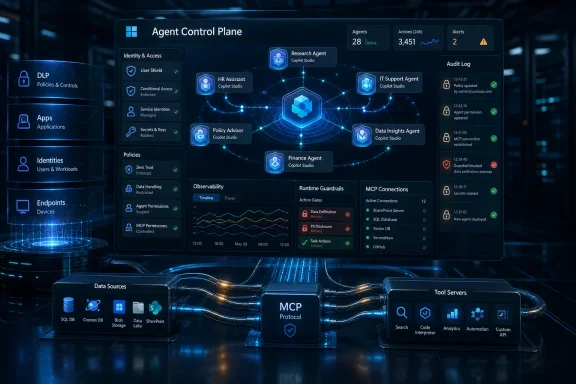
That is where Trust3 AI is placing its bet. Its Agent Control Plane is being positioned as an operational layer for agent governance: discovery, observability, runtime guardrails, content firewalls for Model Context Protocol activity, and identity-aware policies. In plain English, Trust3 wants to be the place where security teams can see which agents exist, what they are connected to, what they are doing, and whether their behavior is drifting outside approved boundaries.
The timing matters. Microsoft already has governance machinery around Copilot Studio through Power Platform administration, Microsoft 365 admin controls, Purview, Defender integrations, tenant policies, environment management, and publishing approvals. The fact that a vendor such as Trust3 sees room for a dedicated control plane says something important: the native tooling may be necessary, but many enterprises are starting to suspect it will not be sufficient on its own.
The difference is that agents are not merely apps that users open. They are semi-autonomous intermediaries that can combine identity, instructions, enterprise data, model reasoning, and external tools. A poorly governed agent is not just a chatbot giving a bad answer; it can become a confused clerk with access to internal systems.
That makes discovery the first governance problem. You cannot secure what you cannot inventory, and the phrase “shadow agents” is likely to become as familiar to administrators as shadow IT. Copilot Studio reduces the friction of creation, which is exactly why governance must not depend on quarterly audits, screenshots, or spreadsheet inventories.
Trust3’s pitch is that it can continuously discover Copilot Studio agents and govern behavior without sitting directly in the data path. That last caveat is important because security products that insert themselves inline can create performance, reliability, and architectural objections. A control plane that observes and enforces through platform integrations has an easier story to tell to enterprises that are allergic to breaking production workflows in the name of visibility.
Still, the promise should be treated with healthy skepticism. Every governance vendor wants to be “centralized,” “continuous,” and “policy-aware.” The hard part is whether the system can explain agent behavior at a level that satisfies security teams without overwhelming them with another stream of noisy telemetry.
Microsoft’s own guidance around Copilot Studio governance leans heavily on the familiar Power Platform model. Administrators are expected to segment environments, apply data policies, manage sharing, review agent usage, and use admin centers to govern what appears across Microsoft 365 surfaces. That is not glamorous, but it reflects an important reality: Microsoft wants agent governance to look like the rest of enterprise Microsoft administration.
The company has also been pushing toward runtime protection and deeper monitoring hooks. That matters because pre-publication review alone is not enough for agents. An agent can be safe at design time and risky at runtime if its connected data changes, its tool permissions expand, its instructions are manipulated, or its usage pattern shifts from benign helper to business-critical automation.
So Trust3’s integration should not be read as an indictment of Microsoft’s platform. It is better understood as a sign that agent governance is becoming a layered market. Microsoft provides the platform-native controls; third-party vendors try to unify, extend, and specialize around the gaps that appear in messy enterprise deployments.
That layered model is familiar to IT pros. Windows has Defender, but enterprises still buy EDR, SIEM, identity security, DLP, posture management, and asset discovery tools. The existence of native protection does not eliminate the market for specialized oversight. It often creates it.
Copilot Studio agents can become valuable precisely because they connect to business data and workflows. An agent that summarizes public web pages is useful; an agent that can query internal documents, inspect customer records, generate responses, and trigger a Power Automate flow is much more valuable. It is also much harder to govern.
Identity-aware policy enforcement is therefore one of the more meaningful parts of Trust3’s announcement. In enterprise security, “who is asking” is often as important as “what is being asked.” The same agent action may be acceptable for a payroll administrator, risky for a contractor, and forbidden for a broad employee group.
The trouble is that agents blur identity boundaries. Is an action being taken by the user, the agent, the owner who published it, the service connection behind it, or some delegated identity chain? Administrators need answers that are specific enough to survive an audit and operational enough to fix a problem quickly.
That is where observability becomes more than a buzzword. If an agent accesses sensitive content, calls a tool, or produces an answer based on restricted data, security teams need a trace that explains the path. “The AI did it” is not an acceptable incident report. Neither is “the user clicked Copilot.”
Once agents can call external tools through standardized protocols, governance stops being only about the agent itself. It becomes about the chain of context, tool calls, permissions, prompts, responses, and side effects. A safe-looking agent can become risky if it connects to an unreviewed tool server, accepts malicious content, or passes sensitive material through a channel that was never meant for regulated data.
That is why content firewalls are likely to become part of the agent security vocabulary. Enterprises already inspect email, web traffic, file transfers, and endpoint behavior. It is not a stretch to imagine similar inspection layers for agent-to-tool interactions, especially when those interactions can include business records, credentials, generated code, customer data, or operational commands.
But MCP governance will test the industry’s appetite for standardization. If every vendor implements its own partial view of agent activity, the result will be another fractured security market with impressive demos and painful deployments. If common logging, policy, and control patterns emerge, agents may become governable in a way that resembles modern identity and endpoint management.
The Trust3 integration is therefore not only a Copilot Studio story. It is part of a broader contest over where agent control should live: inside the AI development platform, inside the identity provider, inside the security operations stack, inside the data governance layer, or in a dedicated agent control plane.
An out-of-band control plane can be easier to adopt. It can discover agents, ingest metadata, correlate activity, flag risk, enforce policies through APIs, and provide audit trails without forcing every prompt and response through a proxy. That makes procurement and deployment less frightening, particularly in organizations already wary of adding another opaque layer to AI workflows.
The trade-off is that out-of-band governance can struggle with immediacy. Runtime guardrails sound strongest when enforcement happens in the moment, before an unsafe action completes. If a system is not in the data path, the details of how it enforces in real time matter enormously.
This is where buyers should press for architecture rather than slogans. Does the platform block actions, revoke access, quarantine agents, alter permissions, trigger admin workflows, or merely alert? How quickly does it detect a newly created agent? What happens if the Trust3 service is unavailable? Which Copilot Studio events are visible, and which remain inside Microsoft’s own telemetry walls?
The answers will determine whether this is a serious operational control or mainly an inventory and audit layer with some policy hooks. Both can be valuable. They are not the same thing.
That sprawl is not accidental; it reflects real product boundaries. Agents are built in one place, authenticated through another, published into another, governed by tenant policies somewhere else, protected by security tooling elsewhere, and audited through still more systems. The problem is that an agent incident will not respect those console boundaries.
This is the opening for an agent control plane. If Trust3 can present a coherent view across Copilot Studio agents, identities, tool access, data exposure, runtime behavior, and compliance posture, it solves a problem admins feel immediately. If it merely adds one more dashboard that points back to Microsoft portals for remediation, its value becomes narrower.
For WindowsForum’s sysadmin audience, the practical test is simple: does this reduce the number of places an admin must check to answer a hard question? If the CISO asks which agents can access HR data, which ones changed behavior in the last week, and which users invoked high-risk actions, the answer cannot require a scavenger hunt.
The broader enterprise AI market is now converging on that exact pain point. Everyone wants agent adoption. Nobody wants an audit finding that says the company deployed autonomous business workflows without a reliable inventory, approval process, or evidence trail.
That is why tamper-evident observability stands out in Trust3’s announcement. Logs are useful, but audit-grade logs are different. A compliance team wants records that are complete, trustworthy, time-bound, and resistant to quiet alteration after the fact. In AI agent systems, that means recording not just user access but agent decisions, tool invocations, policy evaluations, and data interactions.
This will be uncomfortable for organizations that have treated Copilot Studio as a productivity sandbox. Once agents become part of revenue operations, finance workflows, customer support, procurement, legal review, or HR processes, they inherit the governance expectations of those domains. The agent may be new; the compliance obligation is not.
There is also a cultural mismatch. Low-code tools encourage speed, experimentation, and local ownership. Compliance frameworks reward documentation, change control, and repeatability. The enterprises that succeed with agents will be the ones that reconcile those instincts rather than pretending one can eliminate the other.
A centralized control plane can help, but it cannot substitute for governance design. Someone still has to define which agents are allowed, what data they may access, who can publish them, what approvals are required, how exceptions are handled, and when a prototype becomes production.
That means agent discovery is politically sensitive. If security teams use discovery primarily to shut things down, users will route around the process. If they use it to bring agents into a governed path, the organization has a chance to convert local innovation into manageable automation.
The best governance programs will distinguish between experimentation and production. A personal agent that helps draft internal meeting summaries is not the same as an agent that updates customer records or initiates purchase orders. Treating them identically creates friction without improving security.
Microsoft’s environment and sharing model already nudges organizations toward this kind of zoned governance. Trust3’s integration could reinforce that model if it helps classify agents by risk, usage, data access, and operational importance. The danger is that centralized oversight becomes a blunt instrument, where every agent is viewed as a potential incident rather than a manageable asset.
The politics matter because Copilot Studio’s value proposition depends on adoption beyond the IT department. If governance makes the tool feel like a locked cabinet, business units will lose interest or look elsewhere. If governance is invisible until something goes wrong, security teams will reject it. The middle path is risk-based control with enough transparency that both sides trust the process.
This is particularly true for AI agents because few enterprises will standardize on one framework forever. Copilot Studio may be the Microsoft-friendly path for many business users, but developers may use Azure AI Foundry, Semantic Kernel, GitHub Copilot workflows, open-source agent frameworks, Databricks tools, Amazon Bedrock, Google tooling, custom Python services, or vendor-supplied copilots. Governance that only sees one platform will be incomplete.
Trust3’s broader positioning appears to be cross-platform agent control. The Copilot Studio integration gives it a Microsoft anchor, but the larger ambition is to govern agents across frameworks and clouds. That is the right ambition if the enterprise AI estate develops the way cloud and SaaS estates did: heterogeneous, politically fragmented, and full of exceptions.
For Microsoft, the risk is different. If customers decide that meaningful agent governance must live outside Microsoft’s stack, Microsoft could lose some control over the management narrative. The company wants Copilot, Copilot Studio, Agent 365-style management concepts, Purview, Defender, and Entra to form a coherent governance fabric. Third-party control planes will have to coexist with that fabric, not simply sit above it.
The likely outcome is not winner-take-all. Native Microsoft controls will govern core platform behavior; third-party tools will specialize in cross-platform visibility, deeper runtime analysis, audit evidence, or security operations integration. The admin experience may improve, but only if vendors resist the temptation to create parallel policy universes that conflict with one another.
A real control plane needs authority. It must not only see agents but influence their behavior. It must not only display risk but help reduce it. It must not only collect logs but make those logs usable during an incident, an audit, or a board-level review.
For Copilot Studio specifically, administrators should evaluate how Trust3 maps into Microsoft’s existing controls. If Microsoft already handles publishing approvals, data policies, environment segmentation, and app availability, Trust3 needs to show where it adds distinct value. Continuous discovery, runtime guardrails, identity-aware policy, MCP inspection, and tamper-evident observability are plausible differentiators, but the details matter.
There is also the question of operational ownership. Will the AI platform team manage Trust3? The SOC? The Power Platform center of excellence? The compliance team? The CISO’s office? Agent governance crosses all of those domains, and tools that lack a clear owner often become expensive shelfware.
The best evaluation will start with concrete scenarios. Find every Copilot Studio agent that can access sensitive SharePoint sites. Identify agents shared broadly across the tenant. Show which agents invoked external tools in the last 30 days. Prove who approved a production agent and what changed since approval. Block or contain an agent that begins making risky calls. If a control plane can answer those questions quickly, it is solving a real problem.
That will frustrate executives who thought Copilot licensing was the main cost. The reality is that enterprise AI agents behave more like a new application tier than a feature toggle. They require lifecycle management, identity design, risk classification, monitoring, and support. The license gets you the capability; governance makes it survivable.
This is not necessarily bad news for customers. A mature governance ecosystem can make adoption safer and faster. The alternative is either uncontrolled sprawl or centralized paralysis, both of which waste the promise of low-code AI development.
But vendors will need to earn trust with clarity. AI governance is already crowded with overlapping claims. Some products focus on model risk, some on data protection, some on prompt security, some on agent observability, and some on compliance workflows. Buyers need to know which layer they are purchasing and which problems remain unsolved.
Trust3’s Copilot Studio integration is credible because it targets an identifiable pain point: enterprises need visibility and policy enforcement around agents created in Microsoft’s low-code environment. Its challenge will be proving that the control plane is not just a clever label for another monitoring surface.
Many organizations will discover that they do not yet have a reliable answer to basic questions. How many Copilot Studio agents exist? Which environments are they in? Who owns them? Which ones are published? Which ones are shared broadly? Which connectors do they use? Which data sources can they reach? Which agents are still experiments, and which have become part of a business process?
Those questions sound mundane because good governance usually does. The glamorous part of AI is the demo. The durable part is the control model.
Trust3 is betting that enterprises will want those answers from a centralized agent control plane rather than stitching them together from Microsoft admin centers and local process documents. That is a reasonable bet. Whether it becomes a standard part of enterprise Copilot deployments will depend on how painful agent sprawl becomes over the next year.
Governance tools do not create that trust by existing. They create it by making agent behavior visible, explainable, bounded, and correctable. If an enterprise cannot answer what an agent did, why it did it, and under whose authority, it has not governed the agent in any meaningful sense.
This is the larger significance of Trust3’s move into Copilot Studio. Microsoft has made agent creation easier. Now the ecosystem is trying to make agent operation defensible. That shift is essential if AI agents are going to move from clever assistants to durable enterprise infrastructure.
The irony is that the most successful AI governance tools may be the ones users rarely notice. Like endpoint management or identity policy, they will work best when they allow normal work to continue while catching the dangerous exceptions. That is harder than selling fear, but far more useful.
 The Copilot Studio Boom Has Reached the Governance Hangover
Microsoft has spent the last several years turning Copilot from a product into a platform. Copilot Studio is a key part of that strategy because it lets organizations build and publish their own AI agents without forcing every workflow through a traditional software development pipeline. That is the pitch: low-code automation, workplace context, connectors, business data, and AI reasoning bundled into something a business unit can shape for itself.But democratized agent creation has an obvious side effect. If a finance analyst, HR operations manager, sales enablement lead, and support team can all build agents, the enterprise does not merely gain productivity experiments. It gains a new population of software-like actors that can read data, invoke tools, trigger workflows, answer users, and sometimes make decisions at a speed and scale that normal approval processes were not designed to track.
That is where Trust3 AI is placing its bet. Its Agent Control Plane is being positioned as an operational layer for agent governance: discovery, observability, runtime guardrails, content firewalls for Model Context Protocol activity, and identity-aware policies. In plain English, Trust3 wants to be the place where security teams can see which agents exist, what they are connected to, what they are doing, and whether their behavior is drifting outside approved boundaries.
The timing matters. Microsoft already has governance machinery around Copilot Studio through Power Platform administration, Microsoft 365 admin controls, Purview, Defender integrations, tenant policies, environment management, and publishing approvals. The fact that a vendor such as Trust3 sees room for a dedicated control plane says something important: the native tooling may be necessary, but many enterprises are starting to suspect it will not be sufficient on its own.
Agent Governance Is Becoming the New Endpoint Management
The Windows enterprise has seen this movie before. PCs entered the workplace as productivity devices, then became managed endpoints. Mobile phones entered as executive convenience, then became MDM estates. SaaS apps entered as departmental shortcuts, then became identity, compliance, and data-governance problems. AI agents are following the same path, only faster.The difference is that agents are not merely apps that users open. They are semi-autonomous intermediaries that can combine identity, instructions, enterprise data, model reasoning, and external tools. A poorly governed agent is not just a chatbot giving a bad answer; it can become a confused clerk with access to internal systems.
That makes discovery the first governance problem. You cannot secure what you cannot inventory, and the phrase “shadow agents” is likely to become as familiar to administrators as shadow IT. Copilot Studio reduces the friction of creation, which is exactly why governance must not depend on quarterly audits, screenshots, or spreadsheet inventories.
Trust3’s pitch is that it can continuously discover Copilot Studio agents and govern behavior without sitting directly in the data path. That last caveat is important because security products that insert themselves inline can create performance, reliability, and architectural objections. A control plane that observes and enforces through platform integrations has an easier story to tell to enterprises that are allergic to breaking production workflows in the name of visibility.
Still, the promise should be treated with healthy skepticism. Every governance vendor wants to be “centralized,” “continuous,” and “policy-aware.” The hard part is whether the system can explain agent behavior at a level that satisfies security teams without overwhelming them with another stream of noisy telemetry.
Microsoft’s Native Controls Are Stronger Than the Market Gives Them Credit For
It would be wrong to frame this announcement as a sign that Microsoft forgot governance. Copilot Studio is built into an ecosystem that already contains many of the enterprise controls admins expect: environment strategy, data policies, access controls, publishing flows, administrative review, and Microsoft 365 app management. For organizations already deep in Power Platform, Defender, Entra, Purview, and Intune, Microsoft’s native story is not thin.Microsoft’s own guidance around Copilot Studio governance leans heavily on the familiar Power Platform model. Administrators are expected to segment environments, apply data policies, manage sharing, review agent usage, and use admin centers to govern what appears across Microsoft 365 surfaces. That is not glamorous, but it reflects an important reality: Microsoft wants agent governance to look like the rest of enterprise Microsoft administration.
The company has also been pushing toward runtime protection and deeper monitoring hooks. That matters because pre-publication review alone is not enough for agents. An agent can be safe at design time and risky at runtime if its connected data changes, its tool permissions expand, its instructions are manipulated, or its usage pattern shifts from benign helper to business-critical automation.
So Trust3’s integration should not be read as an indictment of Microsoft’s platform. It is better understood as a sign that agent governance is becoming a layered market. Microsoft provides the platform-native controls; third-party vendors try to unify, extend, and specialize around the gaps that appear in messy enterprise deployments.
That layered model is familiar to IT pros. Windows has Defender, but enterprises still buy EDR, SIEM, identity security, DLP, posture management, and asset discovery tools. The existence of native protection does not eliminate the market for specialized oversight. It often creates it.
The Real Risk Is Not the Rogue Robot, but the Over-Permissioned Helper
Much of the AI conversation still leans on theatrical fears: autonomous agents running wild, models plotting against users, or an office full of software interns making unsupervised decisions. Enterprise risk is usually more boring and more dangerous. The likely failure mode is an agent that does exactly what someone asked it to do, using permissions nobody fully understood.Copilot Studio agents can become valuable precisely because they connect to business data and workflows. An agent that summarizes public web pages is useful; an agent that can query internal documents, inspect customer records, generate responses, and trigger a Power Automate flow is much more valuable. It is also much harder to govern.
Identity-aware policy enforcement is therefore one of the more meaningful parts of Trust3’s announcement. In enterprise security, “who is asking” is often as important as “what is being asked.” The same agent action may be acceptable for a payroll administrator, risky for a contractor, and forbidden for a broad employee group.
The trouble is that agents blur identity boundaries. Is an action being taken by the user, the agent, the owner who published it, the service connection behind it, or some delegated identity chain? Administrators need answers that are specific enough to survive an audit and operational enough to fix a problem quickly.
That is where observability becomes more than a buzzword. If an agent accesses sensitive content, calls a tool, or produces an answer based on restricted data, security teams need a trace that explains the path. “The AI did it” is not an acceptable incident report. Neither is “the user clicked Copilot.”
MCP Turns Agent Governance Into a Supply Chain Problem
Trust3’s mention of MCP content firewalls is easy to skim past, but it points to a larger shift. The Model Context Protocol has emerged as one of the major ways for AI agents and applications to connect with tools, data sources, and external services. It is often described as a kind of USB-C for AI context, which is useful shorthand even if the security implications are more complicated.Once agents can call external tools through standardized protocols, governance stops being only about the agent itself. It becomes about the chain of context, tool calls, permissions, prompts, responses, and side effects. A safe-looking agent can become risky if it connects to an unreviewed tool server, accepts malicious content, or passes sensitive material through a channel that was never meant for regulated data.
That is why content firewalls are likely to become part of the agent security vocabulary. Enterprises already inspect email, web traffic, file transfers, and endpoint behavior. It is not a stretch to imagine similar inspection layers for agent-to-tool interactions, especially when those interactions can include business records, credentials, generated code, customer data, or operational commands.
But MCP governance will test the industry’s appetite for standardization. If every vendor implements its own partial view of agent activity, the result will be another fractured security market with impressive demos and painful deployments. If common logging, policy, and control patterns emerge, agents may become governable in a way that resembles modern identity and endpoint management.
The Trust3 integration is therefore not only a Copilot Studio story. It is part of a broader contest over where agent control should live: inside the AI development platform, inside the identity provider, inside the security operations stack, inside the data governance layer, or in a dedicated agent control plane.
“Without Sitting in the Data Path” Is a Promise and a Constraint
Trust3 says its platform governs Copilot Studio agents without sitting in the data path. That phrase is doing real work. Enterprises like governance tools that do not become bottlenecks, single points of failure, or new latency sources. Security teams may want inline control; platform teams often fear it.An out-of-band control plane can be easier to adopt. It can discover agents, ingest metadata, correlate activity, flag risk, enforce policies through APIs, and provide audit trails without forcing every prompt and response through a proxy. That makes procurement and deployment less frightening, particularly in organizations already wary of adding another opaque layer to AI workflows.
The trade-off is that out-of-band governance can struggle with immediacy. Runtime guardrails sound strongest when enforcement happens in the moment, before an unsafe action completes. If a system is not in the data path, the details of how it enforces in real time matter enormously.
This is where buyers should press for architecture rather than slogans. Does the platform block actions, revoke access, quarantine agents, alter permissions, trigger admin workflows, or merely alert? How quickly does it detect a newly created agent? What happens if the Trust3 service is unavailable? Which Copilot Studio events are visible, and which remain inside Microsoft’s own telemetry walls?
The answers will determine whether this is a serious operational control or mainly an inventory and audit layer with some policy hooks. Both can be valuable. They are not the same thing.
The Admin Center Sprawl Problem Is Not Going Away
Microsoft’s strength in enterprise software is also its administrative burden. A modern Microsoft 365 estate can involve the Microsoft 365 admin center, Power Platform admin center, Teams admin center, Entra admin center, Defender portal, Purview portal, Intune admin center, Azure portal, and assorted workload-specific consoles. Copilot Studio agents touch several of those worlds at once.That sprawl is not accidental; it reflects real product boundaries. Agents are built in one place, authenticated through another, published into another, governed by tenant policies somewhere else, protected by security tooling elsewhere, and audited through still more systems. The problem is that an agent incident will not respect those console boundaries.
This is the opening for an agent control plane. If Trust3 can present a coherent view across Copilot Studio agents, identities, tool access, data exposure, runtime behavior, and compliance posture, it solves a problem admins feel immediately. If it merely adds one more dashboard that points back to Microsoft portals for remediation, its value becomes narrower.
For WindowsForum’s sysadmin audience, the practical test is simple: does this reduce the number of places an admin must check to answer a hard question? If the CISO asks which agents can access HR data, which ones changed behavior in the last week, and which users invoked high-risk actions, the answer cannot require a scavenger hunt.
The broader enterprise AI market is now converging on that exact pain point. Everyone wants agent adoption. Nobody wants an audit finding that says the company deployed autonomous business workflows without a reliable inventory, approval process, or evidence trail.
Compliance Will Drag AI Agents Into the Boring World of Evidence
The first wave of enterprise AI was sold on productivity. The second wave will be governed by evidence. Regulated organizations do not only need to prevent bad outcomes; they need to prove what controls existed, when they were applied, who approved access, and what happened when something changed.That is why tamper-evident observability stands out in Trust3’s announcement. Logs are useful, but audit-grade logs are different. A compliance team wants records that are complete, trustworthy, time-bound, and resistant to quiet alteration after the fact. In AI agent systems, that means recording not just user access but agent decisions, tool invocations, policy evaluations, and data interactions.
This will be uncomfortable for organizations that have treated Copilot Studio as a productivity sandbox. Once agents become part of revenue operations, finance workflows, customer support, procurement, legal review, or HR processes, they inherit the governance expectations of those domains. The agent may be new; the compliance obligation is not.
There is also a cultural mismatch. Low-code tools encourage speed, experimentation, and local ownership. Compliance frameworks reward documentation, change control, and repeatability. The enterprises that succeed with agents will be the ones that reconcile those instincts rather than pretending one can eliminate the other.
A centralized control plane can help, but it cannot substitute for governance design. Someone still has to define which agents are allowed, what data they may access, who can publish them, what approvals are required, how exceptions are handled, and when a prototype becomes production.
The Shadow Agent Problem Will Be Political, Not Just Technical
“Shadow agents” is a useful phrase because it captures a real governance concern, but it also risks becoming a scare term. Not every agent created outside a central team is malicious or irresponsible. In many cases, shadow AI emerges because business users have urgent needs and central IT cannot move quickly enough.That means agent discovery is politically sensitive. If security teams use discovery primarily to shut things down, users will route around the process. If they use it to bring agents into a governed path, the organization has a chance to convert local innovation into manageable automation.
The best governance programs will distinguish between experimentation and production. A personal agent that helps draft internal meeting summaries is not the same as an agent that updates customer records or initiates purchase orders. Treating them identically creates friction without improving security.
Microsoft’s environment and sharing model already nudges organizations toward this kind of zoned governance. Trust3’s integration could reinforce that model if it helps classify agents by risk, usage, data access, and operational importance. The danger is that centralized oversight becomes a blunt instrument, where every agent is viewed as a potential incident rather than a manageable asset.
The politics matter because Copilot Studio’s value proposition depends on adoption beyond the IT department. If governance makes the tool feel like a locked cabinet, business units will lose interest or look elsewhere. If governance is invisible until something goes wrong, security teams will reject it. The middle path is risk-based control with enough transparency that both sides trust the process.
Microsoft Benefits Even When a Third Party Fills the Gap
At first glance, a third-party governance layer might appear to expose a weakness in Microsoft’s platform. In practice, it may strengthen Microsoft’s enterprise case. Large customers often prefer ecosystems where independent vendors can extend native capabilities, validate usage patterns, and provide specialized controls for complex environments.This is particularly true for AI agents because few enterprises will standardize on one framework forever. Copilot Studio may be the Microsoft-friendly path for many business users, but developers may use Azure AI Foundry, Semantic Kernel, GitHub Copilot workflows, open-source agent frameworks, Databricks tools, Amazon Bedrock, Google tooling, custom Python services, or vendor-supplied copilots. Governance that only sees one platform will be incomplete.
Trust3’s broader positioning appears to be cross-platform agent control. The Copilot Studio integration gives it a Microsoft anchor, but the larger ambition is to govern agents across frameworks and clouds. That is the right ambition if the enterprise AI estate develops the way cloud and SaaS estates did: heterogeneous, politically fragmented, and full of exceptions.
For Microsoft, the risk is different. If customers decide that meaningful agent governance must live outside Microsoft’s stack, Microsoft could lose some control over the management narrative. The company wants Copilot, Copilot Studio, Agent 365-style management concepts, Purview, Defender, and Entra to form a coherent governance fabric. Third-party control planes will have to coexist with that fabric, not simply sit above it.
The likely outcome is not winner-take-all. Native Microsoft controls will govern core platform behavior; third-party tools will specialize in cross-platform visibility, deeper runtime analysis, audit evidence, or security operations integration. The admin experience may improve, but only if vendors resist the temptation to create parallel policy universes that conflict with one another.
Enterprises Should Ask Harder Questions Before Buying the Control Plane Story
The phrase “control plane” has become fashionable in AI infrastructure, and for good reason. It suggests a single place to define policy, observe behavior, and coordinate action. But enterprises should not confuse the metaphor with proof.A real control plane needs authority. It must not only see agents but influence their behavior. It must not only display risk but help reduce it. It must not only collect logs but make those logs usable during an incident, an audit, or a board-level review.
For Copilot Studio specifically, administrators should evaluate how Trust3 maps into Microsoft’s existing controls. If Microsoft already handles publishing approvals, data policies, environment segmentation, and app availability, Trust3 needs to show where it adds distinct value. Continuous discovery, runtime guardrails, identity-aware policy, MCP inspection, and tamper-evident observability are plausible differentiators, but the details matter.
There is also the question of operational ownership. Will the AI platform team manage Trust3? The SOC? The Power Platform center of excellence? The compliance team? The CISO’s office? Agent governance crosses all of those domains, and tools that lack a clear owner often become expensive shelfware.
The best evaluation will start with concrete scenarios. Find every Copilot Studio agent that can access sensitive SharePoint sites. Identify agents shared broadly across the tenant. Show which agents invoked external tools in the last 30 days. Prove who approved a production agent and what changed since approval. Block or contain an agent that begins making risky calls. If a control plane can answer those questions quickly, it is solving a real problem.
The Copilot Studio Add-On That Reveals the Next IT Budget Fight
The Trust3 announcement is relatively narrow, but it points toward a bigger budget fight inside enterprises. AI spending has moved from experimentation to platformization, and platformization always creates secondary markets. Once companies buy the AI builder, they need monitoring, governance, testing, red-teaming, data controls, prompt management, evaluation, and incident response.That will frustrate executives who thought Copilot licensing was the main cost. The reality is that enterprise AI agents behave more like a new application tier than a feature toggle. They require lifecycle management, identity design, risk classification, monitoring, and support. The license gets you the capability; governance makes it survivable.
This is not necessarily bad news for customers. A mature governance ecosystem can make adoption safer and faster. The alternative is either uncontrolled sprawl or centralized paralysis, both of which waste the promise of low-code AI development.
But vendors will need to earn trust with clarity. AI governance is already crowded with overlapping claims. Some products focus on model risk, some on data protection, some on prompt security, some on agent observability, and some on compliance workflows. Buyers need to know which layer they are purchasing and which problems remain unsolved.
Trust3’s Copilot Studio integration is credible because it targets an identifiable pain point: enterprises need visibility and policy enforcement around agents created in Microsoft’s low-code environment. Its challenge will be proving that the control plane is not just a clever label for another monitoring surface.
The Practical Read for Windows Admins Is Inventory First, Enforcement Second
For administrators, the immediate lesson is not to rush into a new product category blindly. It is to start treating AI agents as managed assets. That means inventory, ownership, permissions, lifecycle state, data access, publication scope, usage patterns, and retirement plans.Many organizations will discover that they do not yet have a reliable answer to basic questions. How many Copilot Studio agents exist? Which environments are they in? Who owns them? Which ones are published? Which ones are shared broadly? Which connectors do they use? Which data sources can they reach? Which agents are still experiments, and which have become part of a business process?
Those questions sound mundane because good governance usually does. The glamorous part of AI is the demo. The durable part is the control model.
Trust3 is betting that enterprises will want those answers from a centralized agent control plane rather than stitching them together from Microsoft admin centers and local process documents. That is a reasonable bet. Whether it becomes a standard part of enterprise Copilot deployments will depend on how painful agent sprawl becomes over the next year.
The Security Story Is Really a Trust Story
The most important word in enterprise AI is not “agent.” It is “trust.” Users must trust that agents will help them. Administrators must trust that agents will not bypass policy. Executives must trust that AI adoption will not create regulatory exposure. Customers must trust that their data is not being mishandled by a system nobody can explain.Governance tools do not create that trust by existing. They create it by making agent behavior visible, explainable, bounded, and correctable. If an enterprise cannot answer what an agent did, why it did it, and under whose authority, it has not governed the agent in any meaningful sense.
This is the larger significance of Trust3’s move into Copilot Studio. Microsoft has made agent creation easier. Now the ecosystem is trying to make agent operation defensible. That shift is essential if AI agents are going to move from clever assistants to durable enterprise infrastructure.
The irony is that the most successful AI governance tools may be the ones users rarely notice. Like endpoint management or identity policy, they will work best when they allow normal work to continue while catching the dangerous exceptions. That is harder than selling fear, but far more useful.
The Agent Sprawl Era Has Already Started
The Trust3 AI integration with Microsoft Copilot Studio should be read as an early marker of enterprise AI’s next stage: not the invention of agents, but the management of them. The organizations that prepare now will have an easier time scaling Copilot Studio without creating an ungoverned automation layer under the business.- Enterprises should begin by building a live inventory of Copilot Studio agents, owners, environments, permissions, connectors, publication status, and usage patterns.
- Microsoft’s native governance controls remain foundational, but many organizations will still want third-party visibility across runtime behavior, identity context, audit evidence, and multi-platform agent estates.
- Runtime guardrails matter because an agent that was safe at approval time can become risky when data, permissions, prompts, tools, or usage patterns change.
- MCP and other tool-connection standards will make agent governance look increasingly like supply chain security, not just chatbot administration.
- The strongest buying test for an agent control plane is whether it can answer concrete incident and audit questions faster than existing admin centers and manual processes.
- Business units should not be punished for experimenting with agents, but production-grade agents need ownership, approval, monitoring, and retirement discipline.
References
- Primary source: Redmond Channel Partner
Published: 2026-06-29T23:50:39.728714
Loading…
rcpmag.com - Related coverage: prnewswire.com
Trust3 AI Brings Its Agent Control Plane to Microsoft Copilot Studio
/PRNewswire/ -- Trust3 AI today announced that its Agent Control Plane, the operational core of the company's Agent DOS (Discovery, Observability, Security)... www.prnewswire.com
- Official source: learn.microsoft.com
Implement a zoned governance strategy - Microsoft Copilot Studio | Microsoft Learn
Establish a secure Copilot Studio environment strategy with tenant isolation, ALM processes, and advanced security features like Azure Private Link and MFA.learn.microsoft.com - Related coverage: trust3.ai
Loading…
trust3.ai - Official source: microsoft.com
Strengthen agent security with real-time protection in Microsoft Copilot Studio | Microsoft Copilot Blog
Get advanced real-time protection during agent runtime for enhanced security - including with external monitoring systems - only in Copilot Studio.www.microsoft.com - Related coverage: webdisclosure.com
Trust3 AI |
Trust3 AI integrates its Agent Control Plane with Microsoft Copilot Studio, enabling security teams to discover, observe, and secure all agents from a central platformwww.webdisclosure.com
- Official source: support.microsoft.com
Use a screen reader to explore and navigate Microsoft Copilot Studio | Microsoft Support
Learn how to open Copilot Studio, move through the homepage, navigate between areas such as Agents, Flows, and Tools, and explore available settings.support.microsoft.com - Related coverage: windowscentral.com
Microsoft Copilot Wave 3 adds AI agents and E7 Frontier Suite | Windows Central
Microsoft Copilot is rolling out more agentic AI control and model support in a new subscription tier for Microsoft 365.www.windowscentral.com - Related coverage: tomsguide.com
Biggest Microsoft Build 2026 announcements — agentic AI, RTX Spark Dev Box, GitHub Copilot app, new MAI models, and more | Tom's Guide
All the big news from Microsoft's AI-focused eventwww.tomsguide.com - Official source: adoption.microsoft.com
- Related coverage: aigl.blog
- Official source: microsoft.github.io
- Official source: fpc.microsoft.com
Loading…
fpc.microsoft.com - Related coverage: pages.aviatrix.com
Containment Plugin for Microsoft Agent Control Specification Solution Brief
PDF documentpages.aviatrix.com