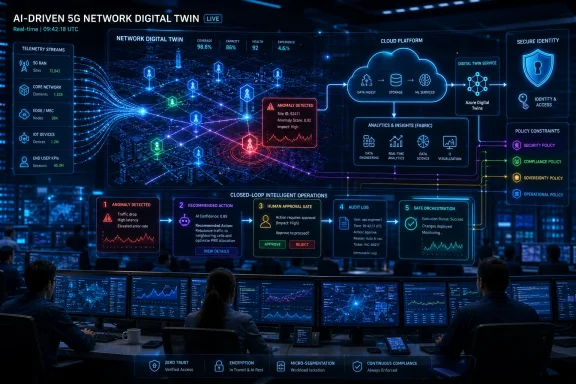
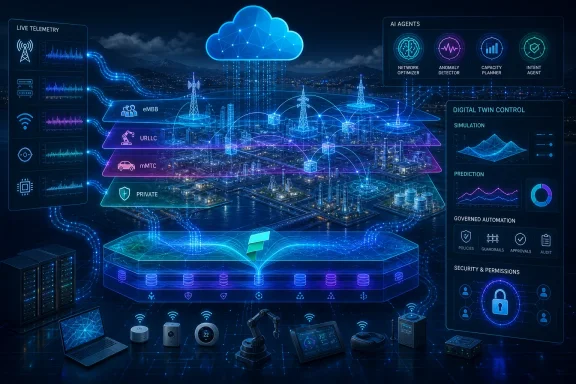
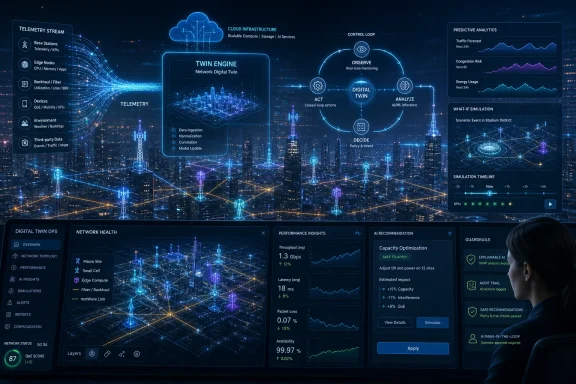
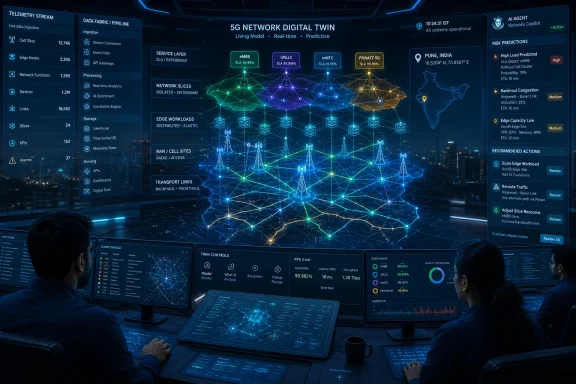
Tech Mahindra said on June 30, 2026, that it has partnered with Microsoft to advance telecom modernization through an AI-driven 5G Network Digital Twin, combining Tech Mahindra’s telecom services expertise with Microsoft’s cloud, data, and AI platforms for communications service providers. The announcement is not just another “AI for telcos” press release; it is a sign that the telecom industry’s software-defined future is being packaged as a managed, cloud-native operating model. The pitch is simple enough: build a living replica of a 5G network, feed it real-time data, and let AI help operators predict faults, optimize performance, and test changes before touching production infrastructure. The harder question is whether carriers, after years of expensive 5G buildouts and uneven monetization, are ready to trust a digital mirror with operational judgment.
For years, telecom modernization has been sold as a migration story: move network functions to the cloud, virtualize the core, automate provisioning, and eventually arrive at something resembling an autonomous network. The Tech Mahindra-Microsoft collaboration reframes that arc around a more concrete artifact: the network digital twin, a virtual representation of live telecom infrastructure that can be queried, simulated, and optimized.
That matters because 5G networks are not merely faster versions of 4G. They are denser, more software-driven, more dependent on edge placement, and more fragmented across radio, transport, core, cloud, and enterprise slices. A carrier trying to troubleshoot service quality across that stack is no longer looking at one network; it is looking at a shifting mesh of dependencies.
The promise of a 5G Network Digital Twin is that operators can move from reactive dashboards to predictive operations. Instead of waiting for congestion, failed handovers, degraded slice performance, or customer-impacting outages, a digital twin can model how those issues may emerge. In the best version of the idea, the system becomes a rehearsal stage for the network itself.
Microsoft’s role is to provide the hyperscale substrate: Azure infrastructure, data services, AI tooling, and integration points with the broader Microsoft Cloud for Telecommunications strategy. Tech Mahindra’s role is the industry-specific glue: telecom domain models, managed services, network operations experience, and implementation work with operators whose environments are too customized to be solved by a generic cloud template.
That combination is not accidental. Telecom is one of the few industries where hyperscale cloud providers need systems integrators as much as systems integrators need hyperscale cloud providers. The network is too regulated, too latency-sensitive, and too operationally idiosyncratic for a pure software-as-a-service model to land cleanly.
That is a more ambitious claim. Hosting a network function on cloud infrastructure is one thing; using AI to infer network state, recommend remediation, and eventually automate interventions is another. The first is an architecture decision. The second is an operational power shift.
Microsoft’s competition is not abstract. AWS, Google Cloud, Oracle, and specialized network vendors all want pieces of the same telecom modernization budget. Carriers are under pressure to extract more value from 5G investments, but they are wary of replacing vendor lock-in from traditional network equipment suppliers with lock-in from cloud platforms.
That is why Microsoft increasingly talks about “trusted” AI platforms, governance, and partner ecosystems. The telecom buyer is not simply purchasing compute capacity; it is asking whether the platform can meet expectations around sovereignty, resiliency, security, observability, and regulatory compliance. In telecom, an AI misfire is not just a bad recommendation. It can become an outage, a dropped emergency call, a breach of a service-level agreement, or a national infrastructure headache.
The Tech Mahindra partnership gives Microsoft another route into that conversation. Rather than asking a carrier to buy Azure as an abstract modernization platform, the pitch becomes a targeted operational use case: a digital twin for 5G networks that can help reduce outages, speed up optimization, and create a foundation for autonomous operations.
Carriers do not operate pristine greenfield environments. They run old OSS and BSS platforms, inherited network inventory systems, multi-vendor RAN estates, hybrid cores, regulatory reporting processes, field operations workflows, and bespoke customer commitments. A digital twin that cannot ingest that mess is just a demo.
This is where Tech Mahindra’s long telecom background matters. The company has spent decades in network engineering, managed services, IT modernization, and operator transformation programs. Its pitch to carriers is not simply that AI can reason about networks; it is that Tech Mahindra can help build the data and process foundations required before AI can be trusted.
That foundation is often the unglamorous part of AI transformation. Network inventory must be accurate. Telemetry must be normalized. Fault data must be correlated across systems. Business rules must be represented in a form an AI system can use. Human escalation paths must be encoded without flattening the judgment of engineers who understand local exceptions.
The digital twin, then, is not a standalone product so much as a forcing function. To create a useful virtual replica of a 5G network, an operator has to confront the quality of its operational data. That may be the hidden value of the partnership: not magic autonomy, but a structured path toward cleaning up the informational debt that has accumulated across generations of telecom systems.
But the language also deserves scrutiny. An AI agent operating in a telecom environment is not like a chatbot summarizing a contract. It may be asked to evaluate congestion, propose configuration changes, prioritize alarms, trigger workflows, or simulate capacity planning decisions. The closer it gets to production action, the more important guardrails become.
The safest early use cases are advisory. A digital twin can tell engineers what may happen if traffic shifts, if a cell site is degraded, if a software update is rolled out, or if a network slice is reconfigured. That alone could be valuable, especially for large operators managing sprawling 5G footprints.
The more transformative use cases involve closed-loop operations. In that model, the AI system does not merely recommend; it acts within approved constraints. It might reroute traffic, adjust parameters, open service tickets, or initiate remediation workflows. That is where the economics become attractive and the risk profile changes.
A carrier will not hand over control overnight. Telecom automation tends to advance through trust zones: observe, recommend, automate low-risk tasks, automate bounded high-value workflows, and only later approach broader autonomy. The Tech Mahindra-Microsoft digital twin is best understood as infrastructure for that progression, not proof that fully autonomous networks have arrived.
That creates pressure to make networks cheaper to run and easier to monetize. AI-driven operations speak to the first problem; digital twins and service modeling speak to the second. If an operator can model a network slice, test performance assumptions, and validate service behavior before selling it to an enterprise customer, 5G becomes more programmable as a business platform.
This is where the digital twin concept becomes more than an engineering tool. It can become a commercial simulation environment. A carrier could model what it would take to support a factory automation deployment, a smart port, a connected hospital, or a media production network. It could test coverage, latency, resilience, and cost before committing field resources.
That is the version of telecom modernization vendors want operators to believe in: networks that are not just maintained by AI but sold through AI-assisted modeling. Whether that becomes common practice will depend on data quality, integration depth, and the ability to translate network state into business commitments.
For now, the conservative interpretation is safer. Digital twins are likely to help operators improve planning, assurance, and troubleshooting before they radically change telecom monetization. But in a sector starved for clearer 5G returns, even incremental operational gains will get attention.
Tech Mahindra and Microsoft have already been discussing ontology-driven and data-mesh approaches for telecom modernization. That context matters because a digital twin is fundamentally a semantic problem. The system must understand what a network element is, how it relates to a service, which customers depend on it, which policies constrain it, and what remediation steps are permitted.
Without that structure, AI becomes a pattern-matching overlay on fragmented systems. It may detect anomalies, but it will struggle to explain them. It may recommend fixes, but it will lack confidence about dependencies. It may automate workflows, but it will be brittle when confronted with exceptions.
Microsoft’s data and AI platforms can help standardize parts of that stack, but the hard work lives in mapping carrier-specific reality into reusable operational models. That is why the systems integrator remains central. The cloud platform can provide the tools, but someone has to reconcile the operator’s real-world inventory, service catalog, topology, and governance model.
In practice, the data layer may become the most durable outcome of the partnership. A carrier that builds a clean, governed, AI-ready operational data foundation can use it for more than a 5G digital twin. It can support fraud detection, churn prediction, revenue assurance, customer care automation, service assurance, and enterprise product design.
Microsoft’s telecom strategy increasingly intersects with Windows, Azure Arc, Entra, Defender, Copilot, and edge management. A private 5G deployment in a factory or hospital is not just a radio project; it is an IT integration project. Devices need identity, policy, monitoring, patching, segmentation, and security operations. That is familiar terrain for Microsoft-oriented administrators.
If 5G digital twins become practical, enterprise IT teams may eventually see similar modeling applied to private wireless networks and edge estates. Imagine validating how a Windows-based handheld fleet, industrial IoT devices, cameras, sensors, and edge workloads would behave under different network conditions before a plant-floor rollout. That is not science fiction; it is the logical enterprise extension of the telecom digital twin idea.
The security angle is equally important. AI-assisted network operations can improve detection and response, but they also create new attack surfaces. If an AI system can recommend or trigger network changes, then access control, prompt integrity, model governance, audit logs, and change-management integration become critical. Telecom-grade AI needs enterprise-grade skepticism.
For admins, the lesson is not to become radio engineers. It is to recognize that networks, cloud platforms, endpoints, and AI governance are collapsing into one operational surface. The people who understand identity, observability, automation, and change control will be the ones asked to make these systems safe enough to use.
A digital twin might be accurate in a modernized urban 5G deployment but less reliable in a hybrid rural network with older equipment and incomplete inventory. It might optimize for network efficiency while creating undesirable customer impacts. It might identify correlations that are statistically useful but operationally misleading. It might perform well during normal load and poorly during rare events.
Telecom systems are full of edge cases because telecom networks are literally edge-heavy. Geography, weather, backhaul, device mix, spectrum conditions, regulatory obligations, and customer behavior all matter. A digital twin that abstracts away too much will produce elegant but dangerous simplifications.
This is why human-in-the-loop operations will remain important. The goal should not be to remove engineers from network operations, but to give them better foresight and reduce the volume of low-value manual work. The best AI systems in telecom will make expert judgment more scalable, not pretend that expertise is obsolete.
Vendors will naturally emphasize autonomy. Operators should emphasize accountability. Every recommendation needs traceability. Every automated action needs rollback. Every model needs monitoring. Every workflow needs a clear boundary between simulation, recommendation, and production change.
That may sound less glamorous than the language of autonomous networks, but it is more believable. Telecom operators are conservative for good reasons. Their networks carry emergency services, financial transactions, industrial systems, government communications, consumer connectivity, and critical enterprise workloads. They do not need AI theater; they need controlled modernization with measurable outcomes.
The announcement also reflects a broader market reality. Hyperscalers want carrier workloads, but carriers do not want to become passive tenants inside someone else’s cloud. Systems integrators want modernization programs, but they need the scale and AI platforms of hyperscalers. Network equipment vendors want to protect their control points, but open, cloud-native, software-defined models are pushing against traditional boundaries.
In that contested space, digital twins are attractive because they promise value without demanding immediate surrender of production control. An operator can begin with simulation, planning, and assurance before moving toward automation. That gives vendors a sales wedge and operators a risk-managed adoption path.
The real test will be deployment evidence. Press releases are easy; carrier-grade proof is hard. The market will want to see reduced mean time to repair, fewer outages, faster rollout cycles, better slice assurance, lower operating costs, or new enterprise revenue. Without those metrics, the digital twin remains a polished metaphor.
 The 5G Digital Twin Is Becoming the New Control Room
For years, telecom modernization has been sold as a migration story: move network functions to the cloud, virtualize the core, automate provisioning, and eventually arrive at something resembling an autonomous network. The Tech Mahindra-Microsoft collaboration reframes that arc around a more concrete artifact: the network digital twin, a virtual representation of live telecom infrastructure that can be queried, simulated, and optimized.That matters because 5G networks are not merely faster versions of 4G. They are denser, more software-driven, more dependent on edge placement, and more fragmented across radio, transport, core, cloud, and enterprise slices. A carrier trying to troubleshoot service quality across that stack is no longer looking at one network; it is looking at a shifting mesh of dependencies.
The promise of a 5G Network Digital Twin is that operators can move from reactive dashboards to predictive operations. Instead of waiting for congestion, failed handovers, degraded slice performance, or customer-impacting outages, a digital twin can model how those issues may emerge. In the best version of the idea, the system becomes a rehearsal stage for the network itself.
Microsoft’s role is to provide the hyperscale substrate: Azure infrastructure, data services, AI tooling, and integration points with the broader Microsoft Cloud for Telecommunications strategy. Tech Mahindra’s role is the industry-specific glue: telecom domain models, managed services, network operations experience, and implementation work with operators whose environments are too customized to be solved by a generic cloud template.
That combination is not accidental. Telecom is one of the few industries where hyperscale cloud providers need systems integrators as much as systems integrators need hyperscale cloud providers. The network is too regulated, too latency-sensitive, and too operationally idiosyncratic for a pure software-as-a-service model to land cleanly.
Microsoft Wants the Telco Cloud to Speak AI Before AWS Owns the Room
Microsoft has spent years trying to make Azure credible inside carrier networks, not merely adjacent to them. Its telecom push has included Azure Operator Nexus, private 5G, edge computing, cloud-native network functions, and partnerships with vendors and operators looking to modernize network operations. The new Tech Mahindra announcement fits neatly into that strategy because it moves the conversation from “can cloud host telecom workloads?” to “can cloud intelligence run telecom workflows?”That is a more ambitious claim. Hosting a network function on cloud infrastructure is one thing; using AI to infer network state, recommend remediation, and eventually automate interventions is another. The first is an architecture decision. The second is an operational power shift.
Microsoft’s competition is not abstract. AWS, Google Cloud, Oracle, and specialized network vendors all want pieces of the same telecom modernization budget. Carriers are under pressure to extract more value from 5G investments, but they are wary of replacing vendor lock-in from traditional network equipment suppliers with lock-in from cloud platforms.
That is why Microsoft increasingly talks about “trusted” AI platforms, governance, and partner ecosystems. The telecom buyer is not simply purchasing compute capacity; it is asking whether the platform can meet expectations around sovereignty, resiliency, security, observability, and regulatory compliance. In telecom, an AI misfire is not just a bad recommendation. It can become an outage, a dropped emergency call, a breach of a service-level agreement, or a national infrastructure headache.
The Tech Mahindra partnership gives Microsoft another route into that conversation. Rather than asking a carrier to buy Azure as an abstract modernization platform, the pitch becomes a targeted operational use case: a digital twin for 5G networks that can help reduce outages, speed up optimization, and create a foundation for autonomous operations.
Tech Mahindra Is Selling Telecom Memory as Much as AI
Tech Mahindra’s advantage here is not that it has discovered digital twins before everyone else. The concept is already widely discussed across manufacturing, energy, logistics, and networking research. Its advantage is that telecom operators often prefer partners who understand the messy operational history of carrier networks.Carriers do not operate pristine greenfield environments. They run old OSS and BSS platforms, inherited network inventory systems, multi-vendor RAN estates, hybrid cores, regulatory reporting processes, field operations workflows, and bespoke customer commitments. A digital twin that cannot ingest that mess is just a demo.
This is where Tech Mahindra’s long telecom background matters. The company has spent decades in network engineering, managed services, IT modernization, and operator transformation programs. Its pitch to carriers is not simply that AI can reason about networks; it is that Tech Mahindra can help build the data and process foundations required before AI can be trusted.
That foundation is often the unglamorous part of AI transformation. Network inventory must be accurate. Telemetry must be normalized. Fault data must be correlated across systems. Business rules must be represented in a form an AI system can use. Human escalation paths must be encoded without flattening the judgment of engineers who understand local exceptions.
The digital twin, then, is not a standalone product so much as a forcing function. To create a useful virtual replica of a 5G network, an operator has to confront the quality of its operational data. That may be the hidden value of the partnership: not magic autonomy, but a structured path toward cleaning up the informational debt that has accumulated across generations of telecom systems.
Agentic AI Raises the Stakes From Recommendation to Action
The announcement lands in a year when “agentic AI” has become the enterprise technology phrase of choice. In telecom, the idea is especially potent because network operations already involve repetitive decision loops: detect anomaly, correlate events, identify probable cause, recommend fix, validate impact, and close the ticket. AI agents promise to compress those loops.But the language also deserves scrutiny. An AI agent operating in a telecom environment is not like a chatbot summarizing a contract. It may be asked to evaluate congestion, propose configuration changes, prioritize alarms, trigger workflows, or simulate capacity planning decisions. The closer it gets to production action, the more important guardrails become.
The safest early use cases are advisory. A digital twin can tell engineers what may happen if traffic shifts, if a cell site is degraded, if a software update is rolled out, or if a network slice is reconfigured. That alone could be valuable, especially for large operators managing sprawling 5G footprints.
The more transformative use cases involve closed-loop operations. In that model, the AI system does not merely recommend; it acts within approved constraints. It might reroute traffic, adjust parameters, open service tickets, or initiate remediation workflows. That is where the economics become attractive and the risk profile changes.
A carrier will not hand over control overnight. Telecom automation tends to advance through trust zones: observe, recommend, automate low-risk tasks, automate bounded high-value workflows, and only later approach broader autonomy. The Tech Mahindra-Microsoft digital twin is best understood as infrastructure for that progression, not proof that fully autonomous networks have arrived.
The Telecom Industry Has Been Waiting for a Better 5G Business Case
The timing is not incidental. Operators around the world have spent heavily on spectrum, RAN upgrades, core modernization, and 5G rollouts while struggling to produce the kind of revenue expansion that 5G marketing once implied. Consumer 5G has improved performance, but the premium pricing story has been uneven. Enterprise 5G, private networks, slicing, and ultra-low-latency applications remain promising but unevenly deployed.That creates pressure to make networks cheaper to run and easier to monetize. AI-driven operations speak to the first problem; digital twins and service modeling speak to the second. If an operator can model a network slice, test performance assumptions, and validate service behavior before selling it to an enterprise customer, 5G becomes more programmable as a business platform.
This is where the digital twin concept becomes more than an engineering tool. It can become a commercial simulation environment. A carrier could model what it would take to support a factory automation deployment, a smart port, a connected hospital, or a media production network. It could test coverage, latency, resilience, and cost before committing field resources.
That is the version of telecom modernization vendors want operators to believe in: networks that are not just maintained by AI but sold through AI-assisted modeling. Whether that becomes common practice will depend on data quality, integration depth, and the ability to translate network state into business commitments.
For now, the conservative interpretation is safer. Digital twins are likely to help operators improve planning, assurance, and troubleshooting before they radically change telecom monetization. But in a sector starved for clearer 5G returns, even incremental operational gains will get attention.
The Data Layer Is the Real Product
Every AI telecom announcement eventually runs into the same wall: the model is only as good as the data estate beneath it. A 5G network generates enormous telemetry, but volume is not the same as usability. Operators need common data models, consistent semantics, event correlation, governance, and lineage before AI can produce reliable operational intelligence.Tech Mahindra and Microsoft have already been discussing ontology-driven and data-mesh approaches for telecom modernization. That context matters because a digital twin is fundamentally a semantic problem. The system must understand what a network element is, how it relates to a service, which customers depend on it, which policies constrain it, and what remediation steps are permitted.
Without that structure, AI becomes a pattern-matching overlay on fragmented systems. It may detect anomalies, but it will struggle to explain them. It may recommend fixes, but it will lack confidence about dependencies. It may automate workflows, but it will be brittle when confronted with exceptions.
Microsoft’s data and AI platforms can help standardize parts of that stack, but the hard work lives in mapping carrier-specific reality into reusable operational models. That is why the systems integrator remains central. The cloud platform can provide the tools, but someone has to reconcile the operator’s real-world inventory, service catalog, topology, and governance model.
In practice, the data layer may become the most durable outcome of the partnership. A carrier that builds a clean, governed, AI-ready operational data foundation can use it for more than a 5G digital twin. It can support fraud detection, churn prediction, revenue assurance, customer care automation, service assurance, and enterprise product design.
WindowsForum Readers Should Watch the Edge, Not Just the Cloud
For Windows enthusiasts and IT pros, telecom AI can sound distant from the concerns of desktops, servers, and enterprise management. It is not. The same modernization wave that pulls 5G operations into cloud-native platforms also pushes intelligence toward the edge, where enterprise devices, private networks, industrial systems, and identity-managed endpoints converge.Microsoft’s telecom strategy increasingly intersects with Windows, Azure Arc, Entra, Defender, Copilot, and edge management. A private 5G deployment in a factory or hospital is not just a radio project; it is an IT integration project. Devices need identity, policy, monitoring, patching, segmentation, and security operations. That is familiar terrain for Microsoft-oriented administrators.
If 5G digital twins become practical, enterprise IT teams may eventually see similar modeling applied to private wireless networks and edge estates. Imagine validating how a Windows-based handheld fleet, industrial IoT devices, cameras, sensors, and edge workloads would behave under different network conditions before a plant-floor rollout. That is not science fiction; it is the logical enterprise extension of the telecom digital twin idea.
The security angle is equally important. AI-assisted network operations can improve detection and response, but they also create new attack surfaces. If an AI system can recommend or trigger network changes, then access control, prompt integrity, model governance, audit logs, and change-management integration become critical. Telecom-grade AI needs enterprise-grade skepticism.
For admins, the lesson is not to become radio engineers. It is to recognize that networks, cloud platforms, endpoints, and AI governance are collapsing into one operational surface. The people who understand identity, observability, automation, and change control will be the ones asked to make these systems safe enough to use.
The Risk Is Not That AI Fails, but That It Works Unevenly
Skepticism around AI in telecom often focuses on whether the technology can work at all. That is too blunt. AI will work in parts of the network, for certain workflows, under controlled constraints, and with measurable benefits. The more serious risk is uneven performance.A digital twin might be accurate in a modernized urban 5G deployment but less reliable in a hybrid rural network with older equipment and incomplete inventory. It might optimize for network efficiency while creating undesirable customer impacts. It might identify correlations that are statistically useful but operationally misleading. It might perform well during normal load and poorly during rare events.
Telecom systems are full of edge cases because telecom networks are literally edge-heavy. Geography, weather, backhaul, device mix, spectrum conditions, regulatory obligations, and customer behavior all matter. A digital twin that abstracts away too much will produce elegant but dangerous simplifications.
This is why human-in-the-loop operations will remain important. The goal should not be to remove engineers from network operations, but to give them better foresight and reduce the volume of low-value manual work. The best AI systems in telecom will make expert judgment more scalable, not pretend that expertise is obsolete.
Vendors will naturally emphasize autonomy. Operators should emphasize accountability. Every recommendation needs traceability. Every automated action needs rollback. Every model needs monitoring. Every workflow needs a clear boundary between simulation, recommendation, and production change.
The Partnership Is a Bet on Managed Complexity
The Tech Mahindra-Microsoft partnership is ultimately a bet that telecom modernization will not be solved by a single product. It will be solved by managed complexity: cloud infrastructure, AI models, network data, digital twins, integration services, governance, and operational change stitched into something carriers can actually deploy.That may sound less glamorous than the language of autonomous networks, but it is more believable. Telecom operators are conservative for good reasons. Their networks carry emergency services, financial transactions, industrial systems, government communications, consumer connectivity, and critical enterprise workloads. They do not need AI theater; they need controlled modernization with measurable outcomes.
The announcement also reflects a broader market reality. Hyperscalers want carrier workloads, but carriers do not want to become passive tenants inside someone else’s cloud. Systems integrators want modernization programs, but they need the scale and AI platforms of hyperscalers. Network equipment vendors want to protect their control points, but open, cloud-native, software-defined models are pushing against traditional boundaries.
In that contested space, digital twins are attractive because they promise value without demanding immediate surrender of production control. An operator can begin with simulation, planning, and assurance before moving toward automation. That gives vendors a sales wedge and operators a risk-managed adoption path.
The real test will be deployment evidence. Press releases are easy; carrier-grade proof is hard. The market will want to see reduced mean time to repair, fewer outages, faster rollout cycles, better slice assurance, lower operating costs, or new enterprise revenue. Without those metrics, the digital twin remains a polished metaphor.
The Details That Will Decide Whether This Becomes More Than a Demo
The immediate announcement is less important than the operational questions it raises. If Tech Mahindra and Microsoft can answer those questions in production environments, the partnership could become a meaningful piece of telecom’s AI transition. If not, it will join a long shelf of telecom transformation stories that sounded right but landed softly.- The partnership announced on June 30, 2026, centers on an AI-driven 5G Network Digital Twin for telecom operators.
- The most practical early uses are likely to be network planning, service assurance, fault prediction, and simulation of changes before production deployment.
- Microsoft gains another telecom-specific route for Azure, AI, and data services, while Tech Mahindra brings implementation depth and operator-domain knowledge.
- The success of the effort will depend less on generic AI capability than on clean network data, accurate topology, governed automation, and carrier-specific integration.
- Enterprise IT teams should watch the technology because private 5G, edge computing, identity, endpoint management, and AI governance are increasingly becoming the same operational conversation.
- The strongest near-term measure of success will be whether operators can show measurable improvements in reliability, repair time, rollout speed, or 5G monetization.
References
- Primary source: ZAWYA
Published: Tue, 30 Jun 2026 09:37:42 GMT
Tech Mahindra partners with Microsoft to advance telecom modernization with AI-driven 5G network digital twin
Integrating Microsoft Azure, Microsoft Fabric, and Azure Digital Twin services to unify high-volume network telemetry into a real-time, AI-ready data estatewww.zawya.com
- Official source: microsoft.com
MWC 2026: Microsoft Helps Telecoms Realize AI ROI | The Microsoft Cloud Blog
At MWC 2026, Microsoft shares new AI investments enabling telecoms to move from pilots to real return on intelligence. Read more. www.microsoft.com
- Related coverage: techmahindra.com
Tech Mahindra & Microsoft Partner to Advance Telecom Modernization
The solution will enable telecom operators to transition from traditional network simulation approaches to cloud-scale digital twinswww.techmahindra.com
- Related coverage: mahindra.com
Tech Mahindra Collaborates with Microsoft to Launch Ontology-Driven Agentic AI Platform to Accelerate Telecom and Data Mesh Transformation
Tech Mahindra Collaborates with Microsoft to Launch Ontology-Driven Agentic AI Platform to Accelerate Telecom and Data Mesh Transformationwww.mahindra.com - Official source: marketplace.microsoft.com
Microsoft Marketplace | cloud solutions, AI apps, and agents
marketplace.microsoft.com
- Related coverage: worldmediaorganization.com
Tech Mahindra collaborates with Microsoft to launch ontology-driven Agentic AI platform | World Media Organization
Tech Mahindra collaborates with Microsoft to launch ontology-driven Agentic AI platformwww.worldmediaorganization.com
- Related coverage: scanx.trade
Tech Mahindra Partners with Microsoft to Develop Agentic AI Platform for Telecom Sector
Tech Mahindra has partnered with Microsoft to develop an agentic AI platform for the telecommunications industry and data mesh applications. The collaboration combines Tech Mahindra's telecom expertise with Microsoft's AI and cloud technologies to create autonomous decision-making solutions for...scanx.trade - Related coverage: business-standard.com
- Related coverage: prnewswire.co.uk
Tech Mahindra Partners with Microsoft to Advance Telecom Modernization with AI-Driven 5G Network Digital Twin
/PRNewswire/ -- Tech Mahindra (NSE: TECHM), a leading global provider of technology consulting and digital solutions to enterprises across industries,... www.prnewswire.co.uk
- Related coverage: cache.techmahindra.com
Tech Mahindra Announces Multi Year Agreement to Accelerate AT T s Technology Transformation
PDF documentcache.techmahindra.com
- Related coverage: event-assets.gsma.com
TR GRP-ad-19 dec 26
Close up of businessman hand holding a phone with a 5G hologram in coffee shop. 5G network wireless systems.The concept of 5G network, high-speed mobile Internet, new generation networks.event-assets.gsma.com