

TPG Telecom is building a real‑time “digital twin” of parts of its 5G network to model how extreme weather, power loss and other disasters could degrade coverage and critical services — a project the company says is funded in part by a roughly $1.3 million federal grant and developed in partnership with university researchers and emergency services partners.
Background / Overview
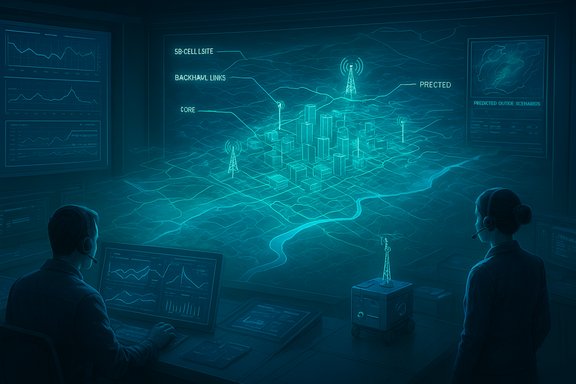
Digital twins — live, data‑driven virtual replicas of physical systems — have moved from industrial shop‑floors into city planning, utilities management and now telecommunications. The idea is straightforward: fuse spatial mapping, sensor and telemetry feeds, and predictive analytics into a single, interactive model that mirrors the present state of a real network and lets operators run “what if” scenarios. For a mobile operator, that means representing radio sites, fibre and microwave backhaul, core and edge functions, power dependencies and environment layers such as river basins, floodplains, roads and electricity networks.TPG Telecom’s program, developed with academic partners, aims to use that model to predict where and how outages and service degradations will occur during disasters — giving engineers and responders time to act before users lose service. The carrier intends to ingest real‑time operational telemetry from its 5G RAN and transport, and to layer on external datasets (emergency services situational feeds, energy utility status, weather and hydrology), then run simulations that identify vulnerable sites, forecast coverage gaps and propose mitigations such as traffic rerouting or rapid deployment of temporary cells.
The initiative is being positioned as a proof‑of‑concept with trials planned prior to a staged production rollout. Public statements from the company indicate trial activity beginning in mid‑2026 and a view toward production deployment in 2027. Those timetable and funding figures come from company and reporting summaries; some granular items (for example the precise grant paperwork on public rolls) are not fully visible in the public domain and should be treated as company‑reported commitments rather than independently audited milestones.
Why telco digital twins matter now
Climate‑driven extremes — floods, wildfire‑induced power failures, storms — are increasing the frequency and severity of incidents that threaten telecommunications. Mobile networks are inherently distributed and interdependent: a single base station can rely on multiple systems that may fail during a disaster (local power, backhaul fibre, cooling, site access). Traditional monitoring and post‑event recovery methods are reactive; a digital twin promises anticipatory insight.- Predictive visibility: A twin can combine weather forecasts and river models with cell telemetry to predict where radio coverage will evaporate as power or signal propagation changes.
- Faster response: Operators can identify high‑impact sites, pre‑position portable generators or cells on wheels (COWs), and orchestrate traffic rerouting to preserve emergency communications.
- Cross‑agency coordination: Shared situational models help emergency services and utilities see the same picture — where communications are likely to fail and where to prioritise resources.
- Operational planning: Beyond emergency reaction, twins support resilience planning: prioritising hardened sites, staging resilient power assets, and testing contingency strategies without touching live networks.
What TPG’s digital twin is expected to model
TPG’s program reportedly focuses initially on a geographically limited portion of its footprint for proof‑of‑concept work. The components the twin will need to model include:- Radio access network topology: individual cell sites (latitude/longitude/elevation), antenna patterns, transmit power and carrier configuration.
- Transport and backhaul: fibre routes, microwave links, capacity, and single‑points of failure.
- Core and edge functions: logical service chains for voice, SMS, emergency alerting, and data services.
- Power dependencies: mains supply, backup batteries, diesel generators, and any proposed renewable/hybrid backup systems.
- Environmental hazards: flood zones, river catchments, storm surge areas, bushfire buffers, storm drains and historical incident footprints.
- Real‑time telemetry feeds: site alarms, traffic volumes, radio metrics (SINR, RSRP/RSRQ), power alarms, and any sensor data (for example, if 5G channel behaviour is being used as a proxy flood sensor).
- Third‑party inputs: energy utility switchgear status, road closures, emergency responder footprints, and meteorological forecasts.
- Physics‑based models (hydrology, radio propagation): to rigidly estimate environmental and RF interactions.
- Data‑driven AI/ML models: to detect anomalous signal propagation patterns and to predict chain‑reaction failures from historic and real‑time telemetry.
How it could work in a flood scenario
- Weather service issues heavy rainfall forecast for a catchment above a populated area.
- Hydrodynamic model, linked to the twin, simulates water rise and likely road closures.
- The twin overlays that simulation on TPG’s site map and backhaul routes to identify sites at risk of inundation or access loss.
- Radio propagation models adjust predicted coverage as antennas become water‑obstructed and backhaul latency increases.
- The operator receives a ranked list of likely service impacts and recommended mitigations: boost capacity at alternate sites, deploy portable power or temporary cells, and inform emergency services about predicted blackspots.
- Emergency services get the same map to coordinate evacuations knowing where communications may fail.
Practical benefits and immediate use cases
- Early detection of infrastructure risks (flooding, erosion, fires) affecting sites.
- Automated impact simulations for service continuity planning and prioritisation.
- Better coordination with emergency services and utilities for joint response.
- Optimised deployment of temporary coverage (COWs, satellite uplinks, portable batteries).
- Pre‑emptive traffic steering to preserve vital voice and messaging services.
- Post‑event reconstruction and forensics to improve future resilience planning.
- Real‑time dashboards with geospatial overlays.
- Scenario libraries (flood, wildfire, mass‑evacuation) to run rapid impact assessments.
- APIs for third‑party data exchange and stakeholder access control.
- Automated playbooks that tie simulation outputs to operational actions (dispatch crews, reroute traffic).
Technical and operational challenges
A promising twin is also a complex engineering project. The main hurdles are:- Data integration and quality: Network telemetry lives in multiple OSS/BSS systems, with different schemas and latency characteristics. Environment and utility data are heterogeneous and may be inaccessible in real time.
- Latency and scale: Timely predictions require low‑latency ingestion, processing and simulation across many sites. Hydrodynamic and RF propagation models can be compute‑intensive.
- Model accuracy and false positives: Over‑sensitive models generate alerts that exhaust engineers; under‑sensitive models miss critical events. Balancing precision and recall requires continuous calibration and ground truthing.
- Interoperability: Emergency services and utilities use different data standards and access regimes. Building secure, standards‑based interfaces is not trivial.
- Security and exposure: A twin that contains network topology, site capabilities and critical dependencies can be a high‑value target. Strict access controls and segmentation are necessary.
- Privacy and legal constraints: Sharing spatial data and service impact predictions may implicate privacy laws, contractual obligations and critical infrastructure regulations.
- Cost and sustainment: Building and operating a twin (data pipelines, compute resources, licensing, modelling expertise) is expensive — ongoing funding beyond initial grants must be justified.
Cybersecurity and governance risks — and mitigations
A digital twin of telecom infrastructure is dual‑use: hugely beneficial for resilience, and simultaneously introducing potential new risks if misconfigured or inadequately governed.Principal risks
- Unauthorized access to network topology and site capabilities could aid targeted attacks on critical infrastructure.
- APIs exposing operational state to external partners may leak sensitive telemetry.
- Overreliance on a single model could create a false sense of security if the twin is not independently validated.
- Implement zero‑trust access principles for twin data: least privilege, multifactor authentication, and strong audit trails.
- Separate staging/test instances from production twins; use synthetic data for third‑party demos.
- Apply role‑based data masking so emergency responders see operationally relevant information without exposing sensitive internal configuration details.
- Conduct regular adversarial testing (red teaming) on twin interfaces and data pipelines.
- Maintain independent validation channels — operational rules should not be blindly auto‑executed without human review for critical interventions.
Governance, data sharing and policy considerations
Putting a telco twin into operational use requires careful governance frameworks:- Data sharing agreements: Clearly define what datasets are shared with emergency services, utilities and local government, including retention, re‑use and redaction rules.
- Critical infrastructure marking: Some twin elements will be classified as national‑critical; that affects storage, access and disclosure rules.
- Regulatory oversight and standards: Align twin outputs with regulatory reporting requirements for outage notifications and emergency communications.
- Liability and decision rights: Who takes operational responsibility when a twin recommends an action? Legal frameworks and playbooks must assign decision ownership.
- Transparency and community trust: Public‑facing uses (for example, community flood prediction dashboards) require careful user communication about model uncertainty.
Implementation roadmap — practical steps
A realistic deployment typically follows phased steps:- Select a confined geographic proof‑of‑concept area (critical / high‑risk corridor).
- Inventory and model network assets and dependencies.
- Establish secure, real‑time telemetry feeds from RAN, transport and power systems.
- Ingest environmental and third‑party data — weather, river gauges, energy utility status, road closures.
- Build the geospatial platform and integrate physics and ML models.
- Validate models against historical incidents and live telemetry; calibrate thresholds.
- Run controlled exercises with emergency services and utilities to refine workflows.
- Expand footprint and harden governance, security and operational playbooks for production rollout.
The broader digital‑twin and telco landscape
Spatial digital twins are increasingly part of state‑level resilience programs and utility planning efforts. Governments are investing in statewide platforms to coordinate assets, plan infrastructure and model hazard exposure. For telcos, embedding network twins into that wider public digital twin ecosystem creates opportunities for richer cross‑sector resilience planning but also raises the complexity of data integration and governance.Telcos already have the raw ingredients for a twin: distributed sensors (site alarms, 5G measurements), broad spatial coverage, and operational experience. The novelty is blending those network feeds with environmental models and third‑party operational data to produce actionable foresight rather than raw telemetry.
Critical analysis — strengths and limitations of TPG’s approach
Strengths- Leverages existing infrastructure: Using live 5G telemetry and prior research into network sensing maximises existing investments.
- Academic partnership: Collaborating with university researchers gives access to specialised modelling expertise, and helps validate experimental sensing approaches (for example, using RF behaviour as a proxy for water levels).
- Public funding: Grant support defrays early development costs and facilitates cross‑agency experimentation.
- Inter‑agency orientation: Planning to partner with emergency services and utilities increases the twin’s utility beyond internal operations.
- Overpromising versus operational readiness: Ambitious timelines (trial mid‑2026; production 2027) are plausible but challenging; real‑world validation and integration often take longer than pilot schedules imply.
- Data dependency: The twin’s fidelity depends on timely access to utility and emergency services feeds, which may have contractual or technical barriers.
- Model risk: Predicting complex interactions (power outages leading to multi‑site failures, or radio propagation changes during storms) is inherently uncertain; false negatives or false positives have real consequences.
- Security surface growth: A richer shared model means critical details may transit between agencies — a target list for adversaries.
- Sustainment funding: Initial grant funding can start the program, but continuous operating budgets for model maintenance, compute and data feeds are required long term.
Recommendations for operators and emergency planners
- Treat the twin as a decision‑support tool, not an automated arbiter for critical actions. Human‑in‑the‑loop validation is essential.
- Prioritise data governance early: legal agreements for data sharing and retention must be in place before live integration.
- Implement tiered access control and masking for sensitive topology or configuration data shared with external parties.
- Run regular cross‑agency exercises to test twin outputs against real operational decisions and refine escalation playbooks.
- Invest in model explainability and uncertainty metrics so decision‑makers understand confidence levels of predictions.
- Design the twin for modularity — permit model swaps and iterative upgrades without rebuilding the entire platform.
- Plan for ongoing funding and resource allocation for model retraining, software updates and cybersecurity maintenance.
Conclusion
TPG Telecom’s digital twin effort — pairing live 5G network modelling with environmental and utility data — is a natural evolution of modern telco resilience strategy. If well executed, such twins can provide genuine lead time on outages, enable smarter pre‑positioning of resources and materially improve coordination between carriers and emergency responders. The project’s academic partnership and public grant backing reduce early technology and financial barriers, and the prior work on 5G‑based sensing provides a technical foundation.That said, turning a promising proof‑of‑concept into an operational, secure and trusted resilience platform requires more than modelling expertise. It demands robust governance, hardened interfaces, continuous validation against real events, and sustainable funding. The twin’s success will ultimately be measured not by the sophistication of its models but by the practical reductions in outage duration, faster emergency responses, and demonstrable improvements in community outcomes during disasters.
Readers should view company timelines and grant figures as reported commitments that will require public and operational confirmation as the trials progress. The core opportunity remains compelling: a well‑designed telco digital twin could become the new frontline for anticipating and managing the complex failures that disasters bring to modern communications networks.
Source: iTnews TPG Telecom hopes 'digital twin' can predict network, service disaster impacts
