

On June 29, 2026, Windows Central argued that Linux has become a plausible refuge for Windows 10 users facing Windows 11’s hardware requirements, rising component costs, and Microsoft’s extended but still temporary Windows 10 security lifeline. The irony is thick enough to survive even Microsoft’s own marketing department: the operating system Steve Ballmer once treated as an existential contaminant is now the escape hatch Microsoft’s oldest Windows loyalists are being told to consider. This is not because Linux suddenly became Windows, or because the desktop wars have been retroactively won by open source. It is because Microsoft has spent five years making Windows 11 feel less like an upgrade path and more like a toll gate.
The Ballmer quote has survived because it captured an era, not merely a temper. In 2001, Microsoft saw Linux as a legal, commercial, and philosophical threat to the Windows business model. Open source was not just a competing engineering method; it was a direct challenge to the idea that platform power should be monetized through licenses, APIs, and control.
That Microsoft is now the steward of Azure Linux, a Fedora-derived distribution used across its own cloud infrastructure, would have sounded absurd in that world. The company that once fought Linux in server rooms now depends on Linux in data centers, developer tooling, containers, cloud services, and increasingly the substrate underneath modern enterprise computing. The cultural U-turn is real, even if it was driven less by idealism than by market gravity.
But the Windows 10 situation gives that reversal a sharper consumer edge. Linux is no longer merely the thing Microsoft had to tolerate because developers and cloud customers demanded it. For some users, it is becoming the thing that keeps perfectly usable PCs out of the recycling stream when Windows itself declares them unworthy.
That does not mean 2026 is finally the fabled “year of the Linux desktop.” That phrase has been overworked into parody. The more precise claim is smaller and more damaging to Microsoft: Linux no longer has to beat Windows broadly to hurt Windows strategically. It only has to become credible enough for the users Microsoft has stranded.
The controversy is not that Microsoft ended support. Every operating system has a lifecycle. The controversy is that Windows 10’s end collided with Windows 11’s unusually restrictive hardware baseline, leaving a large number of still-functional machines outside the official upgrade path.
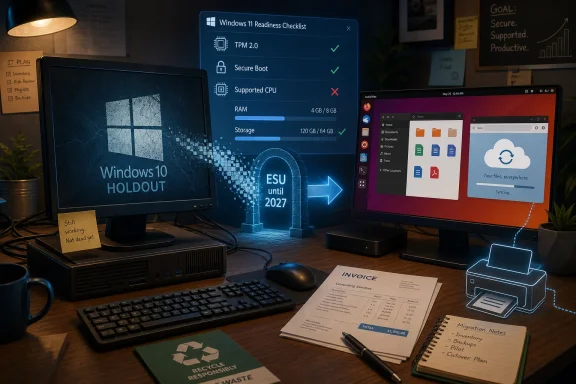
Windows 11 requires TPM 2.0, Secure Boot-capable firmware, supported processors, 4GB of RAM, and 64GB of storage. Some of those requirements have defensible security logic. TPM-backed security, virtualization-based protections, and modern firmware expectations are not invented problems.
The trouble is that lifecycle policy does not land in a security white paper. It lands on a kitchen table, a school desk, a small-business front counter, or a spare PC in a garage. A device that browses the web, runs Office, prints invoices, joins Zoom calls, and handles homework does not feel obsolete to its owner just because it missed Microsoft’s processor list.
Microsoft’s answer has been Extended Security Updates, and the company has now stretched the consumer runway further than originally expected. That helps. It also concedes the basic problem: the installed base is not moving fast enough, and the hard cutoff Microsoft wanted is politically, environmentally, and commercially uncomfortable.
Microsoft can frame the extension as customer care, and to some extent it is. Security updates are better than abandonment. A patched Windows 10 machine is preferable to millions of unpatched PCs idling on home networks and small-business LANs.
But ESU is not a future. It is a holding pattern. Users enrolled in the program are being told, in effect, that the operating system they prefer or require will remain safe for now, but only while Microsoft waits for them to make a different decision.
That is where Linux enters the story. The extra year does not eliminate the choice between buying new hardware, moving to Windows 11, paying for continued support in some contexts, accepting risk, or switching platforms. It merely changes the deadline. Deadlines have a way of focusing attention, and the next year will give Linux advocates more time to do what they have historically struggled to do: meet ordinary Windows users at the moment they are actually shopping for alternatives.
That distinction matters because Windows loyalty has long depended on continuity. One of the platform’s strengths was that old software and old hardware kept staggering forward. The Windows ecosystem was messy, but it was forgiving.
Windows 11 broke that expectation for a portion of the installed base. Microsoft can say, correctly, that unsupported hardware was not designed for the security assumptions of the new OS. But users can also say, correctly, that many of those machines remain practically useful.
The rise in RAM and NAND prices sharpened the grievance. If replacement hardware becomes more expensive because AI infrastructure is absorbing memory and storage supply, then Microsoft’s upgrade path feels less like natural modernization and more like forced participation in a market distortion. Users who might have grudgingly bought a cheap new laptop in 2024 or 2025 may be less willing to do so in 2026.
The result is not simply resistance to Windows 11. It is suspicion of Microsoft’s motives. Once users start asking whether an upgrade is really for them or for the vendor, the platform relationship has changed.
The case for Linux is strongest where the PC is a general-purpose appliance. Web, email, documents, streaming, light photo management, messaging, remote access, and basic development are no longer Windows-exclusive tasks. A decade ago, switching to Linux often meant immediately negotiating missing apps. Today, many users live in browsers and cloud services before the operating system even enters the discussion.
That does not make Linux frictionless. It makes it plausible. Plausibility is the threshold Microsoft should worry about.
For years, Linux advocates asked users to switch for philosophical reasons: freedom, openness, privacy, control. Those arguments resonated with enthusiasts but rarely moved mainstream behavior. The stronger pitch in 2026 is more practical: keep your machine, keep getting updates, avoid Windows 11’s hardware gate, and escape some of the advertising, telemetry, account nudging, and AI features that have made Windows feel less like a neutral workspace.
That pitch is not universally fair to Windows, which remains more polished and more compatible in many contexts. But it is emotionally powerful because it turns Microsoft’s own decisions into the Linux marketing campaign. When a user feels pushed, the alternative that says “you can stay on your hardware” gains moral force.
Microsoft embraced open source because the center of gravity moved. Developers were using Git, Linux servers, containers, Python, Node.js, Kubernetes, and open-source databases whether Microsoft approved or not. Azure needed to run customer workloads, not win a 1990s ideology contest. Visual Studio Code, PowerShell Core, .NET’s open-source evolution, WSL, and Microsoft’s GitHub ownership all reflect the same reality: Microsoft followed the developers and the cloud money.
Azure Linux 4.0 fits that pattern. It is not Microsoft joining the desktop Linux crusade. It is Microsoft building and maintaining a controlled Linux distribution for cloud and server workloads where predictability, security, and Azure integration matter.
Still, symbolism has a life of its own. Once Microsoft becomes a Linux distributor, it becomes harder to sell Linux as reckless or exotic. Once Microsoft tells enterprises that Linux is stable enough for Azure infrastructure, users are entitled to ask why Linux is too strange for a five-year-old home PC that mostly runs a browser.
That is the bind. Microsoft normalized Linux for its own business reasons. Now that normalization can be used against Windows in the consumer lifecycle debate.
But the deeper issue is that Windows 11 arrived after Microsoft had already exhausted some user patience. Windows 10 was originally framed as the last version of Windows, or at least as part of a shift toward Windows as a continuously updated service. Whether that phrasing was overinterpreted or not, many users internalized the idea that Windows 10 was the stable long-term base.
Windows 11 disrupted that assumption, then attached itself to a hardware reset. That made ordinary UI annoyances feel like evidence in a larger indictment. Every unwanted prompt became part of the story that Microsoft was taking control away.
Copilot intensified the reaction because AI is not a neutral feature in 2026. For some users, it is useful. For others, it represents surveillance anxiety, resource consumption, subscription pressure, and corporate fashion chasing. When people already feel that Windows 11 is an imposed upgrade, AI integration can look less like innovation and more like one more reason to stay away.
Microsoft’s reported efforts under broader Windows design and simplification initiatives may reduce some of this friction. But cleaning up surfaces is not the same as rebuilding trust. Trust was damaged at the policy layer.
That makes mass Linux desktop migration rare. Windows remains deeply embedded in corporate workflows, especially where Microsoft 365, Entra ID, Intune, Defender, Office macros, legacy apps, and Windows-only management tools dominate. Even organizations that run Linux extensively in servers and cloud environments may have little appetite for Linux on employee desktops.
Yet the Windows 10 deadline still matters to IT. It forces inventory work, exception handling, budget requests, and risk decisions. Machines that cannot move to Windows 11 must be replaced, isolated, enrolled in ESU, repurposed, or retired. That is operational drag.
Linux can play a role at the margins. It may extend the life of kiosks, lab machines, developer workstations, training devices, or noncritical endpoints. It may also become more attractive for organizations already invested in browser-based workflows and zero-trust web access.
The more important enterprise consequence is leverage. Microsoft wants organizations to accept Windows 11, Copilot, cloud management, and newer hardware as part of one modernization arc. If even a small number of customers respond by segmenting workloads away from Windows, Microsoft’s desktop monopoly becomes less total in practice, even if its market share remains dominant.
Microsoft can argue that secure computing also has a social cost. Unsupported PCs become botnet fodder, ransomware targets, and weak links in networks. That is true. But the binary Microsoft created — new Windows hardware or a temporary ESU reprieve — leaves an obvious opening for Linux advocates.
A lightweight Linux distribution can turn an unsupported Windows 10 machine into a supported general-purpose computer. Not always, not for every user, and not without tradeoffs. But often enough to make the environmental argument credible.
This is where Linux’s traditional weakness becomes a strength. Because Linux is not tied to a single vendor’s hardware certification calendar, it can support older hardware long after Microsoft has moved on. That flexibility can be messy, but it is also humane in a way lifecycle charts are not.
For WindowsForum readers, the practical question is not whether every old PC should be saved. Some hardware is slow, insecure, power-hungry, or simply worn out. The question is whether Microsoft should be the only party deciding when a machine’s useful life is over.
But Windows does not need to lose everyone to suffer a strategic loss. The risk is that Microsoft trains users to think of Windows as optional at exactly the moment more of their computing has already moved above the OS layer. If your documents are in the cloud, your email is in a browser, your photos are on a phone, and your apps are web apps, the operating system becomes less identity and more plumbing.
That helps Linux. It also helps ChromeOS, tablets, and any future thin-client model that abstracts away the local desktop. Microsoft knows this, which is why Windows increasingly serves as a front door to Microsoft accounts, Microsoft 365, OneDrive, Edge, Bing, Defender, Copilot, and cloud services. The OS is not just an OS; it is distribution.
That is exactly why user resentment matters. If Windows is the front door, users must not feel locked in the foyer. The more Windows behaves like a funnel, the more some users will look for an exit.
Linux’s great opportunity is not to become the dominant consumer OS. It is to become the credible aftermarket operating system for the PCs Microsoft no longer wants to carry. That market is fragmented, support-heavy, and commercially awkward — but culturally potent.
The best switch candidates are users whose needs are simple or whose technical confidence is high. The worst candidates are users dependent on Windows-only software, kernel-level anti-cheat games, specialized accessibility tools, proprietary business apps, or local Office workflows with complex macros. For them, Linux may be a science project masquerading as liberation.
There is also a support gap. Microsoft’s ecosystem may be annoying, but it gives users a familiar chain of responsibility: OEM, Microsoft, app vendor, workplace IT, or local repair shop. Linux support is more community-driven and uneven. That is fine for enthusiasts and sysadmins; it can be intimidating for ordinary users.
Still, those caveats do not erase the shift. In the Windows XP and Windows 7 eras, Linux migration was often framed as a last resort for aging machines. In the Windows 10 era, it is increasingly framed as a rational refusal: a way to reject a hardware cutoff, an account model, or an AI-heavy product direction.
That difference matters. A reluctant user looking for rescue is one thing. A dissatisfied user making a choice is another.
Those goals are not always compatible. A mass-market OS must respect the diversity of old hardware and user habits. A security-hardened platform wants modern firmware, modern chips, cloud identity, telemetry, and rapid deprecation. A monetized service endpoint wants engagement surfaces, subscriptions, defaults, nudges, and data flows.
Windows 11 sits at the collision point. It is not a bad operating system in the simple sense. On supported hardware, it can be fast, secure, attractive, and productive. But it carries the burden of Microsoft’s broader strategy, and users can feel that weight.
Linux benefits because it offers a different bargain. It is not as commercially unified, not as polished in every corner, and not as universally compatible. But it asks for less. On an old Windows 10 machine in 2026, that restraint can feel like respect.
That diversity makes the migration problem hard. Microsoft cannot solve it with one message. Security arguments work on IT departments but not always on retirees with a 2018 laptop. Design improvements help enthusiasts but not businesses with app compatibility concerns. ESU helps everyone briefly but resolves nothing permanently.
Linux campaigns such as End of 10 exploit this fragmentation by offering a simple counter-message: if Microsoft says your PC is done, install something that says it is not. That message will not convert the masses. But it will convert some users who previously would never have considered leaving Windows.
The danger for Microsoft is not a sudden desktop exodus. It is gradual permission. Once a household has one Linux laptop that works well enough, the next Windows purchase is less automatic. Once a small business repurposes old PCs with Linux for limited roles, Windows is no longer assumed for every endpoint. Once enthusiasts install Linux for relatives and the world does not end, the myth of impossibility weakens.
That is how platform shifts often begin: not with a grand replacement, but with exceptions that stop feeling exceptional.
This period will reward practical communication, not ideology. Users do not need lectures about software freedom before they can safely open a browser. They need to know whether their printer works, whether their banking site works, whether their photos are safe, whether they can open Word documents, and whether someone can help if the screen goes black.
For Windows enthusiasts, the healthiest response is not tribalism. It is inventory. Know which machines can move to Windows 11, which should stay on Windows 10 under ESU, which deserve replacement, and which could become Linux candidates. Treat the operating system as a tool, not a religion.
Microsoft should do the same. If the company wants users to choose Windows 11, it has to make that choice feel beneficial rather than coerced. Extending ESU was necessary. Making Windows 11 feel less extractive is the harder work.
 Microsoft’s Old Enemy Now Looks Like the Exit Ramp
The Ballmer quote has survived because it captured an era, not merely a temper. In 2001, Microsoft saw Linux as a legal, commercial, and philosophical threat to the Windows business model. Open source was not just a competing engineering method; it was a direct challenge to the idea that platform power should be monetized through licenses, APIs, and control.That Microsoft is now the steward of Azure Linux, a Fedora-derived distribution used across its own cloud infrastructure, would have sounded absurd in that world. The company that once fought Linux in server rooms now depends on Linux in data centers, developer tooling, containers, cloud services, and increasingly the substrate underneath modern enterprise computing. The cultural U-turn is real, even if it was driven less by idealism than by market gravity.
But the Windows 10 situation gives that reversal a sharper consumer edge. Linux is no longer merely the thing Microsoft had to tolerate because developers and cloud customers demanded it. For some users, it is becoming the thing that keeps perfectly usable PCs out of the recycling stream when Windows itself declares them unworthy.
That does not mean 2026 is finally the fabled “year of the Linux desktop.” That phrase has been overworked into parody. The more precise claim is smaller and more damaging to Microsoft: Linux no longer has to beat Windows broadly to hurt Windows strategically. It only has to become credible enough for the users Microsoft has stranded.
Windows 10 Did Not Fail; Microsoft Retired It
Windows 10 reached end of support on October 14, 2025, after a decade in which it became one of Microsoft’s most durable operating systems. It was not universally loved, but it became familiar, stable enough, and broadly compatible across an enormous hardware base. For businesses, schools, families, hobbyists, and cash-constrained users, that combination matters more than a redesigned Start menu or another pass at AI integration.The controversy is not that Microsoft ended support. Every operating system has a lifecycle. The controversy is that Windows 10’s end collided with Windows 11’s unusually restrictive hardware baseline, leaving a large number of still-functional machines outside the official upgrade path.
Windows 11 requires TPM 2.0, Secure Boot-capable firmware, supported processors, 4GB of RAM, and 64GB of storage. Some of those requirements have defensible security logic. TPM-backed security, virtualization-based protections, and modern firmware expectations are not invented problems.
The trouble is that lifecycle policy does not land in a security white paper. It lands on a kitchen table, a school desk, a small-business front counter, or a spare PC in a garage. A device that browses the web, runs Office, prints invoices, joins Zoom calls, and handles homework does not feel obsolete to its owner just because it missed Microsoft’s processor list.
Microsoft’s answer has been Extended Security Updates, and the company has now stretched the consumer runway further than originally expected. That helps. It also concedes the basic problem: the installed base is not moving fast enough, and the hard cutoff Microsoft wanted is politically, environmentally, and commercially uncomfortable.
The ESU Extension Is a Pressure Valve, Not a Strategy
The latest Windows 10 ESU extension buys time through October 2027 for eligible consumers. That is meaningful for users who need security patches but are not ready to replace hardware. It is also a tacit admission that Windows 11 adoption has not cleanly absorbed the Windows 10 population.Microsoft can frame the extension as customer care, and to some extent it is. Security updates are better than abandonment. A patched Windows 10 machine is preferable to millions of unpatched PCs idling on home networks and small-business LANs.
But ESU is not a future. It is a holding pattern. Users enrolled in the program are being told, in effect, that the operating system they prefer or require will remain safe for now, but only while Microsoft waits for them to make a different decision.
That is where Linux enters the story. The extra year does not eliminate the choice between buying new hardware, moving to Windows 11, paying for continued support in some contexts, accepting risk, or switching platforms. It merely changes the deadline. Deadlines have a way of focusing attention, and the next year will give Linux advocates more time to do what they have historically struggled to do: meet ordinary Windows users at the moment they are actually shopping for alternatives.
The Hardware Rules Became a Trust Problem
Microsoft’s Windows 11 requirements were always partly about security, but they also became a symbol of unilateral platform power. Users did not experience the policy as a nuanced argument about root-of-trust protections. They experienced it as a message that a machine which worked yesterday had been demoted today.That distinction matters because Windows loyalty has long depended on continuity. One of the platform’s strengths was that old software and old hardware kept staggering forward. The Windows ecosystem was messy, but it was forgiving.
Windows 11 broke that expectation for a portion of the installed base. Microsoft can say, correctly, that unsupported hardware was not designed for the security assumptions of the new OS. But users can also say, correctly, that many of those machines remain practically useful.
The rise in RAM and NAND prices sharpened the grievance. If replacement hardware becomes more expensive because AI infrastructure is absorbing memory and storage supply, then Microsoft’s upgrade path feels less like natural modernization and more like forced participation in a market distortion. Users who might have grudgingly bought a cheap new laptop in 2024 or 2025 may be less willing to do so in 2026.
The result is not simply resistance to Windows 11. It is suspicion of Microsoft’s motives. Once users start asking whether an upgrade is really for them or for the vendor, the platform relationship has changed.
Linux Wins When Windows Makes the Default Feel Expensive
Linux desktop distributions have improved in the places that matter for displaced Windows 10 users. Installation is less hostile. Hardware support is better. Browsers are excellent. Office-compatible productivity suites are adequate for many households and small organizations. Steam, Proton, and broader driver support have changed the gaming conversation, even if anti-cheat systems and specialty software still complicate the picture.The case for Linux is strongest where the PC is a general-purpose appliance. Web, email, documents, streaming, light photo management, messaging, remote access, and basic development are no longer Windows-exclusive tasks. A decade ago, switching to Linux often meant immediately negotiating missing apps. Today, many users live in browsers and cloud services before the operating system even enters the discussion.
That does not make Linux frictionless. It makes it plausible. Plausibility is the threshold Microsoft should worry about.
For years, Linux advocates asked users to switch for philosophical reasons: freedom, openness, privacy, control. Those arguments resonated with enthusiasts but rarely moved mainstream behavior. The stronger pitch in 2026 is more practical: keep your machine, keep getting updates, avoid Windows 11’s hardware gate, and escape some of the advertising, telemetry, account nudging, and AI features that have made Windows feel less like a neutral workspace.
That pitch is not universally fair to Windows, which remains more polished and more compatible in many contexts. But it is emotionally powerful because it turns Microsoft’s own decisions into the Linux marketing campaign. When a user feels pushed, the alternative that says “you can stay on your hardware” gains moral force.
Microsoft’s Open-Source Turn Was Real, but It Was Not a Gift
It is tempting to tell this as a redemption story: Microsoft hated Linux, then Microsoft learned humility, and now Linux is helping users whom Windows has left behind. The truth is more transactional and more interesting.Microsoft embraced open source because the center of gravity moved. Developers were using Git, Linux servers, containers, Python, Node.js, Kubernetes, and open-source databases whether Microsoft approved or not. Azure needed to run customer workloads, not win a 1990s ideology contest. Visual Studio Code, PowerShell Core, .NET’s open-source evolution, WSL, and Microsoft’s GitHub ownership all reflect the same reality: Microsoft followed the developers and the cloud money.
Azure Linux 4.0 fits that pattern. It is not Microsoft joining the desktop Linux crusade. It is Microsoft building and maintaining a controlled Linux distribution for cloud and server workloads where predictability, security, and Azure integration matter.
Still, symbolism has a life of its own. Once Microsoft becomes a Linux distributor, it becomes harder to sell Linux as reckless or exotic. Once Microsoft tells enterprises that Linux is stable enough for Azure infrastructure, users are entitled to ask why Linux is too strange for a five-year-old home PC that mostly runs a browser.
That is the bind. Microsoft normalized Linux for its own business reasons. Now that normalization can be used against Windows in the consumer lifecycle debate.
Windows 11’s Design Problem Is Not Just Design
Complaints about Windows 11 often land on visible annoyances: the Start menu, taskbar limitations, context menus, account prompts, ads, recommended content, Copilot placements, and a general sense that the OS is trying too hard to become a service surface. Some of these problems have been improved. Others remain subjective.But the deeper issue is that Windows 11 arrived after Microsoft had already exhausted some user patience. Windows 10 was originally framed as the last version of Windows, or at least as part of a shift toward Windows as a continuously updated service. Whether that phrasing was overinterpreted or not, many users internalized the idea that Windows 10 was the stable long-term base.
Windows 11 disrupted that assumption, then attached itself to a hardware reset. That made ordinary UI annoyances feel like evidence in a larger indictment. Every unwanted prompt became part of the story that Microsoft was taking control away.
Copilot intensified the reaction because AI is not a neutral feature in 2026. For some users, it is useful. For others, it represents surveillance anxiety, resource consumption, subscription pressure, and corporate fashion chasing. When people already feel that Windows 11 is an imposed upgrade, AI integration can look less like innovation and more like one more reason to stay away.
Microsoft’s reported efforts under broader Windows design and simplification initiatives may reduce some of this friction. But cleaning up surfaces is not the same as rebuilding trust. Trust was damaged at the policy layer.
Enterprise IT Sees a Different Linux Story
For large organizations, the Linux escape narrative is more complicated. A consumer can install Linux Mint, Ubuntu, Fedora, or another distribution on a spare laptop and adapt. An enterprise has identity systems, endpoint management, compliance policies, VPN clients, line-of-business apps, device encryption requirements, help desk scripts, procurement cycles, and auditors.That makes mass Linux desktop migration rare. Windows remains deeply embedded in corporate workflows, especially where Microsoft 365, Entra ID, Intune, Defender, Office macros, legacy apps, and Windows-only management tools dominate. Even organizations that run Linux extensively in servers and cloud environments may have little appetite for Linux on employee desktops.
Yet the Windows 10 deadline still matters to IT. It forces inventory work, exception handling, budget requests, and risk decisions. Machines that cannot move to Windows 11 must be replaced, isolated, enrolled in ESU, repurposed, or retired. That is operational drag.
Linux can play a role at the margins. It may extend the life of kiosks, lab machines, developer workstations, training devices, or noncritical endpoints. It may also become more attractive for organizations already invested in browser-based workflows and zero-trust web access.
The more important enterprise consequence is leverage. Microsoft wants organizations to accept Windows 11, Copilot, cloud management, and newer hardware as part of one modernization arc. If even a small number of customers respond by segmenting workloads away from Windows, Microsoft’s desktop monopoly becomes less total in practice, even if its market share remains dominant.
The E-Waste Argument Gives Linux a Moral Advantage
The public-interest criticism of Windows 10’s retirement has focused heavily on waste. If hundreds of millions of PCs are unable or unlikely to move to Windows 11, the environmental stakes are not rhetorical. Manufacturing replacement computers consumes materials and energy; disposing of old ones creates a long tail of recycling, export, and landfill problems.Microsoft can argue that secure computing also has a social cost. Unsupported PCs become botnet fodder, ransomware targets, and weak links in networks. That is true. But the binary Microsoft created — new Windows hardware or a temporary ESU reprieve — leaves an obvious opening for Linux advocates.
A lightweight Linux distribution can turn an unsupported Windows 10 machine into a supported general-purpose computer. Not always, not for every user, and not without tradeoffs. But often enough to make the environmental argument credible.
This is where Linux’s traditional weakness becomes a strength. Because Linux is not tied to a single vendor’s hardware certification calendar, it can support older hardware long after Microsoft has moved on. That flexibility can be messy, but it is also humane in a way lifecycle charts are not.
For WindowsForum readers, the practical question is not whether every old PC should be saved. Some hardware is slow, insecure, power-hungry, or simply worn out. The question is whether Microsoft should be the only party deciding when a machine’s useful life is over.
The Desktop War Is Over, but the Aftermarket Is Wide Open
Windows still has the software ecosystem Linux envies. Adobe workflows, many commercial engineering tools, niche peripherals, enterprise management stacks, and a long list of games remain easier or only possible on Windows. For many users, switching would be irrational.But Windows does not need to lose everyone to suffer a strategic loss. The risk is that Microsoft trains users to think of Windows as optional at exactly the moment more of their computing has already moved above the OS layer. If your documents are in the cloud, your email is in a browser, your photos are on a phone, and your apps are web apps, the operating system becomes less identity and more plumbing.
That helps Linux. It also helps ChromeOS, tablets, and any future thin-client model that abstracts away the local desktop. Microsoft knows this, which is why Windows increasingly serves as a front door to Microsoft accounts, Microsoft 365, OneDrive, Edge, Bing, Defender, Copilot, and cloud services. The OS is not just an OS; it is distribution.
That is exactly why user resentment matters. If Windows is the front door, users must not feel locked in the foyer. The more Windows behaves like a funnel, the more some users will look for an exit.
Linux’s great opportunity is not to become the dominant consumer OS. It is to become the credible aftermarket operating system for the PCs Microsoft no longer wants to carry. That market is fragmented, support-heavy, and commercially awkward — but culturally potent.
The Cure Is Real, but It Comes With Side Effects
Linux advocates should resist declaring victory too early. The same users angry about Windows 11 requirements may not enjoy troubleshooting Wi-Fi drivers, printer quirks, fractional scaling, sleep problems, or app substitutions. A smooth Linux experience depends heavily on hardware, distribution choice, and expectations.The best switch candidates are users whose needs are simple or whose technical confidence is high. The worst candidates are users dependent on Windows-only software, kernel-level anti-cheat games, specialized accessibility tools, proprietary business apps, or local Office workflows with complex macros. For them, Linux may be a science project masquerading as liberation.
There is also a support gap. Microsoft’s ecosystem may be annoying, but it gives users a familiar chain of responsibility: OEM, Microsoft, app vendor, workplace IT, or local repair shop. Linux support is more community-driven and uneven. That is fine for enthusiasts and sysadmins; it can be intimidating for ordinary users.
Still, those caveats do not erase the shift. In the Windows XP and Windows 7 eras, Linux migration was often framed as a last resort for aging machines. In the Windows 10 era, it is increasingly framed as a rational refusal: a way to reject a hardware cutoff, an account model, or an AI-heavy product direction.
That difference matters. A reluctant user looking for rescue is one thing. A dissatisfied user making a choice is another.
Microsoft’s Linux Problem Is Really a Windows Problem
The story that Ballmer’s “cancer” became Microsoft’s cure is satisfying, but it risks making Linux the protagonist. The protagonist is Windows. More specifically, it is Microsoft’s struggle to reconcile Windows as a mass-market operating system with Windows as a managed, monetized, security-hardened service endpoint.Those goals are not always compatible. A mass-market OS must respect the diversity of old hardware and user habits. A security-hardened platform wants modern firmware, modern chips, cloud identity, telemetry, and rapid deprecation. A monetized service endpoint wants engagement surfaces, subscriptions, defaults, nudges, and data flows.
Windows 11 sits at the collision point. It is not a bad operating system in the simple sense. On supported hardware, it can be fast, secure, attractive, and productive. But it carries the burden of Microsoft’s broader strategy, and users can feel that weight.
Linux benefits because it offers a different bargain. It is not as commercially unified, not as polished in every corner, and not as universally compatible. But it asks for less. On an old Windows 10 machine in 2026, that restraint can feel like respect.
The Windows 10 Holdout Map Is Also a Map of Microsoft’s Limits
The most interesting Windows 10 holdouts are not all Luddites. Many are rational actors. They have working hardware, known workflows, limited budgets, or low tolerance for platform churn. Some dislike Windows 11’s interface. Some distrust Copilot and cloud-account pressure. Some cannot upgrade because Microsoft says their PC is unsupported. Some simply do not see enough benefit.That diversity makes the migration problem hard. Microsoft cannot solve it with one message. Security arguments work on IT departments but not always on retirees with a 2018 laptop. Design improvements help enthusiasts but not businesses with app compatibility concerns. ESU helps everyone briefly but resolves nothing permanently.
Linux campaigns such as End of 10 exploit this fragmentation by offering a simple counter-message: if Microsoft says your PC is done, install something that says it is not. That message will not convert the masses. But it will convert some users who previously would never have considered leaving Windows.
The danger for Microsoft is not a sudden desktop exodus. It is gradual permission. Once a household has one Linux laptop that works well enough, the next Windows purchase is less automatic. Once a small business repurposes old PCs with Linux for limited roles, Windows is no longer assumed for every endpoint. Once enthusiasts install Linux for relatives and the world does not end, the myth of impossibility weakens.
That is how platform shifts often begin: not with a grand replacement, but with exceptions that stop feeling exceptional.
The 2027 Deadline Gives Both Camps One More Campaign Season
The extra Windows 10 security runway changes the tempo of the fight. Microsoft gets more time to improve Windows 11, reduce friction, make hardware replacement more attractive, and persuade users that the new platform is worth accepting. Linux advocates get more time to prepare migration guides, community install events, hardware compatibility lists, and plain-English explanations for people who do not care about kernels.This period will reward practical communication, not ideology. Users do not need lectures about software freedom before they can safely open a browser. They need to know whether their printer works, whether their banking site works, whether their photos are safe, whether they can open Word documents, and whether someone can help if the screen goes black.
For Windows enthusiasts, the healthiest response is not tribalism. It is inventory. Know which machines can move to Windows 11, which should stay on Windows 10 under ESU, which deserve replacement, and which could become Linux candidates. Treat the operating system as a tool, not a religion.
Microsoft should do the same. If the company wants users to choose Windows 11, it has to make that choice feel beneficial rather than coerced. Extending ESU was necessary. Making Windows 11 feel less extractive is the harder work.
The Machines Microsoft Left Behind Now Have a Second Ballot
The concrete lesson of this moment is that Windows 10’s long goodbye is no longer just a Microsoft lifecycle story. It is a referendum on what users think they own when they buy a PC.- Windows 10 reached end of support on October 14, 2025, but consumer Extended Security Updates have pushed the practical security deadline into October 2027 for eligible users.
- Windows 11’s TPM 2.0, supported-CPU, firmware, memory, and storage requirements remain the central reason many otherwise usable PCs cannot follow the official upgrade path.
- Rising memory and storage costs make replacement hardware a harder sell, especially for users whose current PCs still satisfy everyday needs.
- Linux is most compelling for Windows 10 holdouts whose computing lives mostly in browsers, cloud apps, email, documents, streaming, and light local software.
- Linux remains a poor fit for users tied to Windows-only applications, specialized peripherals, complex Office workflows, or games blocked by anti-cheat and compatibility limits.
- Microsoft’s own embrace of Linux in Azure and developer tooling has made it harder to portray desktop Linux as fringe, even if Microsoft’s Linux strategy is aimed primarily at cloud and server workloads.
References
- Primary source: Windows Central
Published: Tue, 30 Jun 2026 13:57:25 GMT
Loading…
www.windowscentral.com - Related coverage: tomshardware.com
Microsoft extends free Windows 10 security updates for a second year — program now ends on October 12, 2027 | Tom's Hardware
Just as the memory shortage pushes PC prices even higher.www.tomshardware.com - Related coverage: techradar.com
Microsoft extends Windows 10 support out of the blue — consumers now get updates for another year to October 2027 | TechRadar
Windows 10 stays alive for another year with an extension for extended supportwww.techradar.com - Official source: microsoft.com
End of support for Windows 10, Windows 8.1, and Windows 7 | Microsoft Windows
Make a smooth transition to Windows 11 from your unsupported operating system with help from Microsoft. Enjoy the benefits of upgrading to a Windows 11 PC.www.microsoft.com - Official source: learn.microsoft.com
Windows 10 - release information | Microsoft Learn
Learn release information for Windows 10 releaseslearn.microsoft.com - Related coverage: techspot.com
Windows 10's free security updates now extend to October 2027 | TechSpot
Microsoft's support page explaining how to continue receiving security updates on Windows 10 now states that the company will continue providing patches through October 12, 2027 –...www.techspot.com
- Official source: techcommunity.microsoft.com
Announcing Azure Linux 4.0: Purpose-Built for Azure, Now in Public Preview | Microsoft Community Hub
Today at Microsoft Build, we're announcing the public preview of Azure Linux 4.0 - Microsoft's first party Linux distribution, purpose-built for Azure. Azure... techcommunity.microsoft.com
- Related coverage: windowslatest.com
Microsoft called Linux a cancer, now ships its own free distro that's nothing like Ubuntu or Fedora
Azure Linux 4.0 is Microsoft's own Fedora-derived Linux distro for Azure cloud workloads. Here is how it compares to Ubuntu, Fedora, and RHEL www.windowslatest.com
- Related coverage: infoq.com
Microsoft Announces Azure Linux 4.0, Its First General-Purpose Server Linux Distribution
Microsoft announced Azure Linux 4.0 and Azure Container Linux at Open Source Summit. Azure Linux 4.0 is a Fedora-based general-purpose server distribution for Azure VMs, the first time Microsoft has offered a supported Linux beyond container hosting. Azure Container Linux is an immutable...www.infoq.com
- Related coverage: aha.org
</rdf:Alt> </dc:title> <dc:description> <rdf:Alt> <rdf:li xml:lang="x-default"/> </rdf:Alt> </dc:description> <dc:creator> <rdf:Seq> <rdf:li>Katheri
</rdf:Alt> </dc:description> <dc:creator> <rdf:Seq> <rdf:li>Katherine Higgins (SLALOM INC)www.aha.org
- Related coverage: euroconsumers.org
- Official source: support.microsoft.com
Windows 11 System Requirements | Microsoft Support
Learn about Windows 11 minimum system requirements and how to assess your upgrade eligibility.support.microsoft.com - Related coverage: dir.md
Windows 11 System Requirements 2026: Check If Your PC Is Compatible (Avoid Upgrade Failures!)
Can your PC run Windows 11? Discover official system requirements, compatibility checks, and expert tips before upgrading. Check your device now! dir.md
- Official source: download.microsoft.com