

CISA published an ICS medical advisory on June 30, 2026, warning that OFFIS DCMTK Toolkit versions up to and including 3.7.0 are affected by five newly disclosed vulnerabilities that can enable file writes, unauthorized information access, memory exhaustion, and crashes in DCMTK client or server processes. The advisory matters because DCMTK is not a flashy front-end product; it is plumbing. In healthcare, plumbing is where risk hides longest, because it sits beneath PACS workflows, imaging gateways, research tools, import/export scripts, and vendor integrations that nobody wants to disturb during clinical hours.
The OFFIS DCMTK Toolkit is one of those open-source components that rarely appears in boardroom risk slides but often turns up when administrators start inventorying medical imaging workflows. It implements substantial parts of the DICOM standard, giving developers and operators libraries and command-line tools for reading, writing, sending, receiving, querying, and converting medical imaging data. That makes it useful, mature, and broadly embedded — exactly the kind of component whose vulnerabilities create operational headaches out of proportion to its public profile.
CISA’s advisory identifies five CVEs affecting DCMTK 3.7.0 and earlier: CVE-2026-50003, CVE-2026-50254, CVE-2026-35505, CVE-2026-52868, and CVE-2026-44628. The stated impact is broad rather than exotic: an attacker could write files, access information they should not see, exhaust memory, or crash affected DCMTK client or server processes. In security terms, this is not a single cinematic exploit chain so much as a cluster of failure modes that attack the assumptions medical imaging systems make about files, memory, and trust boundaries.
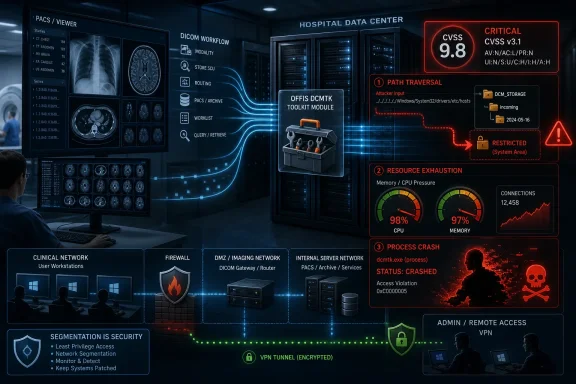
The headline number is severe. CISA lists the vulnerabilities under a vendor CVSS v3 score of 9.8, which puts the advisory in the critical range. That rating does not mean every hospital running a DCMTK-derived tool is one packet away from disaster, but it does mean the affected code paths should be treated as urgent until an organization proves otherwise.
The most important sentence in the advisory may be the least dramatic one: CISA says it has not received reports of known public exploitation specifically targeting these vulnerabilities. That should lower panic, not priority. The history of healthcare security is full of components that were considered uninteresting until someone mapped them to exposed services, weak segmentation, old appliances, or forgotten integration servers.
DCMTK lives in that ecosystem. It can be used by commercial vendors, research groups, hospital IT teams, academic labs, radiotherapy workflows, migration scripts, test harnesses, and custom services written years ago by the one engineer everyone hopes still answers email. In many environments, it is not installed as “the DCMTK server” with a clean asset tag. It is bundled, renamed, statically linked, containerized, copied into a tools directory, or invoked from a scheduled job.
That makes vulnerability response harder than simply checking a package manager. A Linux host may report one DCMTK version, while a Windows imaging workstation may contain another copy inside a vendor application folder. A research VM may have a compiled binary sitting outside normal patch channels. A PACS migration tool may use DCMTK utilities only during a nightly import job, but that still counts if it processes attacker-controlled DICOM input.
This is why the advisory’s healthcare context matters. The affected critical infrastructure sector is Healthcare and Public Health, with worldwide deployment and a Germany-based vendor. That global footprint is less about national boundaries than about supply-chain depth. DICOM tooling crosses borders because scanners, archives, viewers, and hospital software stacks cross borders.
A path traversal vulnerability in a medical imaging tool is not merely an abstract file-system bug. DICOM workflows regularly involve receiving files from external devices, naming studies, writing output directories, transforming metadata, and exporting derived objects. If software mishandles paths, an attacker may be able to steer a write operation somewhere the operator did not intend.
That can be especially dangerous where DICOM receivers run on multipurpose servers. A write primitive on a narrowly confined appliance is bad; a write primitive on a server that also hosts web applications, integration scripts, service accounts, or shared directories can become much more consequential. Even when arbitrary code execution is not stated, unauthorized file placement can create stepping stones.
The memory exhaustion angle is more operationally blunt. Healthcare systems do not need a ransomware banner to suffer real harm; a crashing receiver, hung import service, or unstable query/retrieve process can delay care, disrupt reading workflows, and force manual workarounds. Denial of service is often underrated by people who do not run clinical infrastructure, because the damage is measured in missed appointments, delayed reads, and staff improvisation rather than in stolen credentials alone.
Type confusion belongs to the same family of bugs that security teams have learned to treat with suspicion. When software accesses a resource using an incompatible type, the consequences can range from crashes to deeper memory safety problems depending on implementation details. CISA’s wording does not claim remote code execution here, but a critical combined score means administrators should not wait for exploit write-ups before acting.
For another, advisories change attacker economics. Once a critical advisory names affected versions and vulnerability classes, the search space narrows. Researchers, criminal groups, and opportunistic scanners can begin looking for exposed DICOM receivers, old DCMTK builds, and vendor products that quietly package the toolkit.
The uncomfortable truth is that healthcare is full of systems that are both mission-critical and awkward to patch. Imaging platforms may require vendor validation, downtime coordination, change-control review, and compatibility testing with modalities that cannot simply be rebooted on demand. That creates a window in which defenders know the risk but cannot instantly eliminate it.
This is where segmentation becomes more than boilerplate. CISA’s familiar guidance — minimize network exposure, keep control-system devices off the open internet, place sensitive systems behind firewalls, isolate them from business networks, and use properly maintained VPNs for remote access — can sound generic. In the medical imaging world, it is often the difference between a vulnerability being reachable only by a known modality subnet and being reachable from every compromised workstation in the hospital.
That means Windows administrators should search the estate rather than wait for the OS to speak up. Look for
The version question is equally messy. CISA identifies DCMTK 3.7.0 and earlier as affected, but embedded copies may not expose clean version metadata to standard inventory tools. Administrators may need to run binaries with version flags, inspect package documentation, check vendor release notes, or ask vendors directly whether their product includes affected DCMTK code.
The right question for a vendor is not just “Are you affected?” It is “Do you ship, link, invoke, or otherwise include OFFIS DCMTK, and if so, which version and which mitigation applies to your supported configuration?” That wording matters because a support desk may answer narrowly if asked whether “the DCMTK application” is installed.
These are the environments where DCMTK is most likely to be both useful and forgotten. A one-time migration server may remain powered on because someone might need it again. A research workstation may process studies from removable media or external collaborators. A custom listener may be reachable from more networks than anyone remembers because it once had to “just work” during a go-live.
The vulnerabilities in this advisory reward exactly that kind of drift. File write issues matter more when output directories are loose. Memory exhaustion matters more when services are supervised poorly or crash without alerting. Information access matters more when logs, temporary directories, and study folders contain protected health information.
Asset discovery therefore has to include workflow discovery. Ask where DICOM files enter the organization, where they are transformed, where they are temporarily staged, and which tools touch them before they reach the primary archive. Security teams that only inspect the named PACS platform may miss the DCMTK copies doing the unglamorous work around it.
That does not make open source the villain. DCMTK’s longevity is a strength, and open tooling has helped make DICOM workflows inspectable, portable, and automatable. The problem is that healthcare organizations often consume open-source components indirectly, through products and scripts whose dependency chain is poorly documented.
This advisory is a reminder that a software bill of materials is not paperwork for auditors; it is a map for days like this. If an organization can quickly identify where DCMTK exists, who owns each instance, whether it is exposed, and how it is patched, the advisory becomes a manageable change event. Without that map, it becomes a scavenger hunt across clinical, research, vendor, and infrastructure teams.
The uncomfortable middle ground is where many organizations live. They may have decent vulnerability scanning for servers, decent endpoint visibility for managed Windows devices, and decent vendor contacts for major systems. But DCMTK may fall between those categories because it is a library, a utility set, and a dependency rather than a neatly licensed enterprise application.
Network exposure is the first control to revisit. DICOM services should not be reachable from the internet, and they should not be broadly reachable from ordinary user subnets unless there is a clear clinical reason. Modality networks, PACS servers, integration engines, and administrative workstations should have defined paths, not flat-network convenience.
File-system permissions deserve equal attention. If a DICOM receiver or converter writes files, run it under a service account with the minimum rights needed, write into constrained directories, and avoid sharing directories with web roots, administrative scripts, or sensitive system paths. A path traversal bug is less useful when the process is jailed by permissions and directory design.
Process supervision also matters. If a DCMTK-based service crashes or consumes memory, administrators need logs, alerts, restart policies, and rate-limiting controls that distinguish a bad study from a repeated attack. Silent failure is especially dangerous in imaging because staff may route around a broken service before security ever sees the signal.
Finally, remote access must be treated realistically. VPNs are better than exposed services, but VPN access is not a magic trust boundary. If a compromised vendor laptop or weakly protected remote account can reach a DICOM listener, the listener is still exposed to an attacker from inside the perimeter.
Still, “clinical caution” can become a blanket excuse for leaving known critical vulnerabilities in place. The better approach is risk-based sequencing. Internet-exposed or broadly reachable systems come first. Systems that receive DICOM objects from external partners, removable media, research pipelines, or less trusted networks deserve priority. Internal-only tools on tightly restricted subnets can follow, but they should not vanish from the plan.
Hospitals should also distinguish between patching and compensating controls. If a vendor cannot provide an immediate update, that does not mean the organization does nothing. Restrict source IPs. Tighten firewall rules. Disable unneeded listeners. Move temporary workflows behind jump hosts. Reduce write permissions. Increase monitoring around DICOM association failures, unusual file paths, repeated crashes, and memory pressure.
The operational goal is not perfection by tomorrow morning. It is to shorten the time during which an attacker can reach vulnerable code and to reduce the blast radius if they do.
A good response starts with ownership. Radiology IT, clinical engineering, security operations, infrastructure teams, application owners, and vendors may each hold part of the answer. If the organization treats the advisory as solely a security-ticket problem, it will miss workflow realities. If it treats it solely as a clinical-app problem, it may miss network exposure and host-level controls.
The second test is repeatability. If the organization has to invent a DCMTK discovery process from scratch this week, it should preserve the result for the next advisory. The same inventory that helps today will help with future DICOM, OpenSSL, zlib, image codec, and XML parser issues. Medical imaging stacks are dependency-rich environments, and this will not be the last critical component advisory.
The third test is evidence. “We think we do not use it” is not the same as “We searched managed endpoints, scanned servers, queried vendors, inspected application directories, and reviewed DICOM workflows.” In a regulated healthcare environment, that difference matters for security, operations, and audit readiness.
 A Quiet DICOM Toolkit Just Became a Loud Security Problem
The OFFIS DCMTK Toolkit is one of those open-source components that rarely appears in boardroom risk slides but often turns up when administrators start inventorying medical imaging workflows. It implements substantial parts of the DICOM standard, giving developers and operators libraries and command-line tools for reading, writing, sending, receiving, querying, and converting medical imaging data. That makes it useful, mature, and broadly embedded — exactly the kind of component whose vulnerabilities create operational headaches out of proportion to its public profile.CISA’s advisory identifies five CVEs affecting DCMTK 3.7.0 and earlier: CVE-2026-50003, CVE-2026-50254, CVE-2026-35505, CVE-2026-52868, and CVE-2026-44628. The stated impact is broad rather than exotic: an attacker could write files, access information they should not see, exhaust memory, or crash affected DCMTK client or server processes. In security terms, this is not a single cinematic exploit chain so much as a cluster of failure modes that attack the assumptions medical imaging systems make about files, memory, and trust boundaries.
The headline number is severe. CISA lists the vulnerabilities under a vendor CVSS v3 score of 9.8, which puts the advisory in the critical range. That rating does not mean every hospital running a DCMTK-derived tool is one packet away from disaster, but it does mean the affected code paths should be treated as urgent until an organization proves otherwise.
The most important sentence in the advisory may be the least dramatic one: CISA says it has not received reports of known public exploitation specifically targeting these vulnerabilities. That should lower panic, not priority. The history of healthcare security is full of components that were considered uninteresting until someone mapped them to exposed services, weak segmentation, old appliances, or forgotten integration servers.
Medical Imaging Security Fails at the Edges First
DICOM is a workhorse standard, not a modern zero-trust protocol dropped into a clean cloud-native architecture. It was built for a world where imaging devices, archives, workstations, and hospital networks had to exchange studies reliably across decades of equipment. That durability is one of medicine’s great technical successes, but it also means the surrounding ecosystem carries a lot of historical trust.DCMTK lives in that ecosystem. It can be used by commercial vendors, research groups, hospital IT teams, academic labs, radiotherapy workflows, migration scripts, test harnesses, and custom services written years ago by the one engineer everyone hopes still answers email. In many environments, it is not installed as “the DCMTK server” with a clean asset tag. It is bundled, renamed, statically linked, containerized, copied into a tools directory, or invoked from a scheduled job.
That makes vulnerability response harder than simply checking a package manager. A Linux host may report one DCMTK version, while a Windows imaging workstation may contain another copy inside a vendor application folder. A research VM may have a compiled binary sitting outside normal patch channels. A PACS migration tool may use DCMTK utilities only during a nightly import job, but that still counts if it processes attacker-controlled DICOM input.
This is why the advisory’s healthcare context matters. The affected critical infrastructure sector is Healthcare and Public Health, with worldwide deployment and a Germany-based vendor. That global footprint is less about national boundaries than about supply-chain depth. DICOM tooling crosses borders because scanners, archives, viewers, and hospital software stacks cross borders.
The Vulnerabilities Are Ordinary in Name and Serious in Context
The advisory groups the weaknesses under three familiar classes: pathname restriction failures, memory not released after effective lifetime, and type confusion. None of those categories is new. What matters is where they land.A path traversal vulnerability in a medical imaging tool is not merely an abstract file-system bug. DICOM workflows regularly involve receiving files from external devices, naming studies, writing output directories, transforming metadata, and exporting derived objects. If software mishandles paths, an attacker may be able to steer a write operation somewhere the operator did not intend.
That can be especially dangerous where DICOM receivers run on multipurpose servers. A write primitive on a narrowly confined appliance is bad; a write primitive on a server that also hosts web applications, integration scripts, service accounts, or shared directories can become much more consequential. Even when arbitrary code execution is not stated, unauthorized file placement can create stepping stones.
The memory exhaustion angle is more operationally blunt. Healthcare systems do not need a ransomware banner to suffer real harm; a crashing receiver, hung import service, or unstable query/retrieve process can delay care, disrupt reading workflows, and force manual workarounds. Denial of service is often underrated by people who do not run clinical infrastructure, because the damage is measured in missed appointments, delayed reads, and staff improvisation rather than in stolen credentials alone.
Type confusion belongs to the same family of bugs that security teams have learned to treat with suspicion. When software accesses a resource using an incompatible type, the consequences can range from crashes to deeper memory safety problems depending on implementation details. CISA’s wording does not claim remote code execution here, but a critical combined score means administrators should not wait for exploit write-ups before acting.
“No Known Exploitation” Is Not a Maintenance Window
CISA’s note that no known public exploitation has been reported is welcome, but it is not a reason to slow-walk remediation. For one thing, public exploitation is a lagging indicator. Attackers do not need to announce targeting, and defenders often do not have telemetry deep enough inside medical imaging networks to distinguish malformed studies, failed associations, and exploit attempts.For another, advisories change attacker economics. Once a critical advisory names affected versions and vulnerability classes, the search space narrows. Researchers, criminal groups, and opportunistic scanners can begin looking for exposed DICOM receivers, old DCMTK builds, and vendor products that quietly package the toolkit.
The uncomfortable truth is that healthcare is full of systems that are both mission-critical and awkward to patch. Imaging platforms may require vendor validation, downtime coordination, change-control review, and compatibility testing with modalities that cannot simply be rebooted on demand. That creates a window in which defenders know the risk but cannot instantly eliminate it.
This is where segmentation becomes more than boilerplate. CISA’s familiar guidance — minimize network exposure, keep control-system devices off the open internet, place sensitive systems behind firewalls, isolate them from business networks, and use properly maintained VPNs for remote access — can sound generic. In the medical imaging world, it is often the difference between a vulnerability being reachable only by a known modality subnet and being reachable from every compromised workstation in the hospital.
Windows Shops Should Look Beyond Windows Update
For WindowsForum readers, the practical trap is assuming that a critical software advisory maps neatly to Windows Update, Defender signatures, or a vendor patch notification. DCMTK is not a Windows feature. It is a toolkit that may be present because somebody installed it, because a vendor bundled it, or because a developer built an internal workflow around it.That means Windows administrators should search the estate rather than wait for the OS to speak up. Look for
dcmtk, storescp, movescu, getscu, findscu, dcmrecv, dcmdump, and related binaries on imaging servers, research workstations, radiology integration hosts, lab systems, and file-transfer boxes. On Windows, those binaries may live in predictable program directories, but they may also sit in custom folders used by scripts or legacy scheduled tasks.The version question is equally messy. CISA identifies DCMTK 3.7.0 and earlier as affected, but embedded copies may not expose clean version metadata to standard inventory tools. Administrators may need to run binaries with version flags, inspect package documentation, check vendor release notes, or ask vendors directly whether their product includes affected DCMTK code.
The right question for a vendor is not just “Are you affected?” It is “Do you ship, link, invoke, or otherwise include OFFIS DCMTK, and if so, which version and which mitigation applies to your supported configuration?” That wording matters because a support desk may answer narrowly if asked whether “the DCMTK application” is installed.
The Worst Asset Is the One Built for a One-Time Migration
Hospitals and imaging centers often accumulate small tools around big systems. A PACS replacement creates export scripts. A research project creates a de-identification pipeline. A radiotherapy workflow creates a listener that receives plans or images from another system. A vendor troubleshooting session leaves a utility directory behind.These are the environments where DCMTK is most likely to be both useful and forgotten. A one-time migration server may remain powered on because someone might need it again. A research workstation may process studies from removable media or external collaborators. A custom listener may be reachable from more networks than anyone remembers because it once had to “just work” during a go-live.
The vulnerabilities in this advisory reward exactly that kind of drift. File write issues matter more when output directories are loose. Memory exhaustion matters more when services are supervised poorly or crash without alerting. Information access matters more when logs, temporary directories, and study folders contain protected health information.
Asset discovery therefore has to include workflow discovery. Ask where DICOM files enter the organization, where they are transformed, where they are temporarily staged, and which tools touch them before they reach the primary archive. Security teams that only inspect the named PACS platform may miss the DCMTK copies doing the unglamorous work around it.
Healthcare’s Open-Source Dependency Problem Is Not the Same as Big Tech’s
The software industry has spent the last few years learning to talk about open-source supply-chain risk, but healthcare has its own version of the problem. Big technology companies can often rebuild containers, redeploy services, and pin dependencies through centralized pipelines. A hospital may depend on a vendor appliance, an aging Windows Server, a university-built tool, and a modality that cannot be modified without regulatory or support consequences.That does not make open source the villain. DCMTK’s longevity is a strength, and open tooling has helped make DICOM workflows inspectable, portable, and automatable. The problem is that healthcare organizations often consume open-source components indirectly, through products and scripts whose dependency chain is poorly documented.
This advisory is a reminder that a software bill of materials is not paperwork for auditors; it is a map for days like this. If an organization can quickly identify where DCMTK exists, who owns each instance, whether it is exposed, and how it is patched, the advisory becomes a manageable change event. Without that map, it becomes a scavenger hunt across clinical, research, vendor, and infrastructure teams.
The uncomfortable middle ground is where many organizations live. They may have decent vulnerability scanning for servers, decent endpoint visibility for managed Windows devices, and decent vendor contacts for major systems. But DCMTK may fall between those categories because it is a library, a utility set, and a dependency rather than a neatly licensed enterprise application.
Patching Is Only Half the Fix
The obvious mitigation is to move away from affected versions once fixed builds or vendor updates are available. But because DCMTK is often embedded, the operational response has to be layered. A patched command-line toolkit on one server does not remediate a vendor product that ships its own copy.Network exposure is the first control to revisit. DICOM services should not be reachable from the internet, and they should not be broadly reachable from ordinary user subnets unless there is a clear clinical reason. Modality networks, PACS servers, integration engines, and administrative workstations should have defined paths, not flat-network convenience.
File-system permissions deserve equal attention. If a DICOM receiver or converter writes files, run it under a service account with the minimum rights needed, write into constrained directories, and avoid sharing directories with web roots, administrative scripts, or sensitive system paths. A path traversal bug is less useful when the process is jailed by permissions and directory design.
Process supervision also matters. If a DCMTK-based service crashes or consumes memory, administrators need logs, alerts, restart policies, and rate-limiting controls that distinguish a bad study from a repeated attack. Silent failure is especially dangerous in imaging because staff may route around a broken service before security ever sees the signal.
Finally, remote access must be treated realistically. VPNs are better than exposed services, but VPN access is not a magic trust boundary. If a compromised vendor laptop or weakly protected remote account can reach a DICOM listener, the listener is still exposed to an attacker from inside the perimeter.
The Advisory Lands in a Sector Where Downtime Has a Clinical Cost
Healthcare patching is often caricatured as slow, but the reality is more complicated. Imaging systems are deeply interconnected, and a bad update can interrupt patient care just as surely as an exploit can. That is why change windows, validation, rollback planning, and vendor coordination exist.Still, “clinical caution” can become a blanket excuse for leaving known critical vulnerabilities in place. The better approach is risk-based sequencing. Internet-exposed or broadly reachable systems come first. Systems that receive DICOM objects from external partners, removable media, research pipelines, or less trusted networks deserve priority. Internal-only tools on tightly restricted subnets can follow, but they should not vanish from the plan.
Hospitals should also distinguish between patching and compensating controls. If a vendor cannot provide an immediate update, that does not mean the organization does nothing. Restrict source IPs. Tighten firewall rules. Disable unneeded listeners. Move temporary workflows behind jump hosts. Reduce write permissions. Increase monitoring around DICOM association failures, unusual file paths, repeated crashes, and memory pressure.
The operational goal is not perfection by tomorrow morning. It is to shorten the time during which an attacker can reach vulnerable code and to reduce the blast radius if they do.
The Real Test Is Whether Anyone Knows Where DCMTK Runs
This advisory’s practical lesson is that dependency visibility is now part of healthcare resilience. DCMTK is not obscure to imaging professionals, but it may be invisible to centralized IT risk programs. That gap is where critical vulnerabilities become prolonged exposures.A good response starts with ownership. Radiology IT, clinical engineering, security operations, infrastructure teams, application owners, and vendors may each hold part of the answer. If the organization treats the advisory as solely a security-ticket problem, it will miss workflow realities. If it treats it solely as a clinical-app problem, it may miss network exposure and host-level controls.
The second test is repeatability. If the organization has to invent a DCMTK discovery process from scratch this week, it should preserve the result for the next advisory. The same inventory that helps today will help with future DICOM, OpenSSL, zlib, image codec, and XML parser issues. Medical imaging stacks are dependency-rich environments, and this will not be the last critical component advisory.
The third test is evidence. “We think we do not use it” is not the same as “We searched managed endpoints, scanned servers, queried vendors, inspected application directories, and reviewed DICOM workflows.” In a regulated healthcare environment, that difference matters for security, operations, and audit readiness.
The June 30 Advisory Leaves IT With a Short, Concrete Job List
The immediate story is five CVEs in OFFIS DCMTK Toolkit through version 3.7.0, but the more durable story is how quickly an organization can translate a component advisory into clinical risk reduction. The work is not glamorous, but it is specific.- Organizations should identify every directly installed, bundled, or scripted use of OFFIS DCMTK across imaging servers, Windows workstations, research systems, vendor applications, and migration utilities.
- Administrators should treat DCMTK 3.7.0 and earlier as affected unless a vendor or maintainer provides clear evidence that a specific build is not vulnerable.
- Security teams should reduce DICOM network exposure by limiting reachable hosts, enforcing firewall rules, and separating imaging workflows from ordinary business networks.
- System owners should harden file-write paths, service-account permissions, temporary directories, and restart behavior so that file-write and denial-of-service bugs have less room to cause damage.
- Vendor managers should ask suppliers directly whether their products include DCMTK and when patched or mitigated versions will be available for supported deployments.
- Incident responders should watch for suspicious DICOM traffic patterns, unexpected file writes, repeated service crashes, memory exhaustion, and malformed input around DCMTK-based processes.
References
- Primary source: CISA
Published: 2026-06-30T12:00:00+00:00
OFFIS DCMTK Toolkit | CISA
www.cisa.gov
- Related coverage: radar.offseq.com
CVE-2026-12805: Heap-based Buffer Overflow in OFFIS DCMTK - Live Threat Intelligence - Threat Radar | OffSeq.com
Detailed information about CVE-2026-12805: Heap-based Buffer Overflow in OFFIS DCMTK affecting OFFIS DCMTK. Get real-time updates, technical details, and mitigaradar.offseq.com - Related coverage: security-tracker.debian.org
- Related coverage: support.dcmtk.org
- Related coverage: securityvulnerability.io
offis Cyber Security Vulnerability Stats and Metrics
SecurityVulnerability.io is a live platform that curates, summarizes, and explains critical Cyber Security vulnerabilities (CVEs).securityvulnerability.io - Related coverage: breachandbuild.com
CVE-2026-5663: Critical OS Command — Breach & Build
Cve-2026-5663 dcmtk vulnerability: CVE-2026-5663 (HIGH severity) details a remote OS command injection flaw in OFFIS DCMTK up to 3.7.0. Immediate patching www.breachandbuild.com
- Related coverage: redpacketsecurity.com
- Related coverage: app.opencve.io
Dcmtk CVEs and Security Vulnerabilities - OpenCVE
Explore the latest vulnerabilities and security issues of Dcmtk in the CVE databaseapp.opencve.io - Related coverage: advisories.ncsc.nl
- Related coverage: dcmtk.org
Download DCMTK Tools - dicom.offis.de
dcmtk.org
- Related coverage: anaconda.org
dcmtk - conda-forge | Anaconda.org
Install dcmtk with Anaconda.org. OFFIS DICOM toolkitanaconda.org
- Related coverage: ports.macports.org
dcmtk | MacPorts
ports.macports.org
