

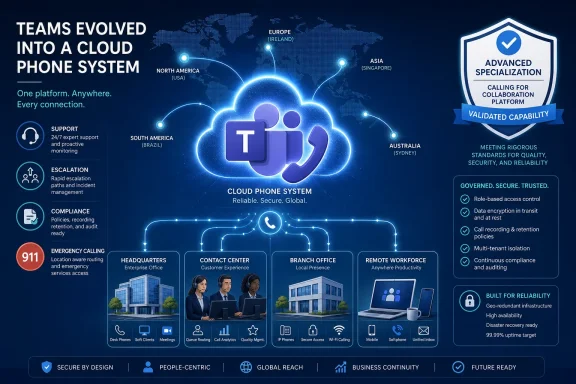
CallTower announced on July 1, 2026, that Microsoft has awarded it the Calling for Microsoft Teams Advanced Specialization, validating the company’s ability to deploy, manage, and support enterprise voice services inside Microsoft Teams for customers across global cloud communications environments. The announcement is not just another partner badge for the trophy case. It is a signal that Teams Phone has moved from “collaboration add-on” to core business infrastructure, where customers increasingly want proof that the people touching dial tone know what they are doing.
The bigger story is Microsoft’s continued transformation of Teams into the front door for workplace communications. Chat, meetings, files, apps, telephony, contact center integrations, compliance, and increasingly AI all now converge in the same client. That makes partner competence less decorative than operational: when Teams becomes the phone system, outages stop being an inconvenience and become a business continuity problem.
Microsoft has spent years making Teams the default collaboration layer for Microsoft 365 customers, but voice has always been the harder sell. Messaging and meetings can be migrated with training, governance, and some patience. Telephony carries decades of muscle memory, regulatory expectations, emergency calling requirements, number-porting headaches, reception workflows, call queues, analog edge cases, and executives who still expect a phone call to work exactly like a phone call.
That is why the Calling for Microsoft Teams specialization matters. It is Microsoft’s way of saying that not every reseller, integrator, or managed service provider should be treated equally when a customer wants to replace or modernize its phone estate. The designation requires more than marketing alignment; Microsoft’s program ties it to a Modern Work partner designation, measurable Teams Phone user growth, certified staff, and either audit or customer-reference validation depending on the specialization pathway.
For CallTower, the designation reinforces a message it has been selling for years: enterprise voice is not merely an application feature. It is a managed communications fabric involving carriers, Microsoft tenant configuration, number management, support escalation, user adoption, and global reach. The company’s announcement emphasizes precisely that mix, positioning itself as a cloud communications provider that can help organizations extend Teams into reliable calling rather than merely switch on a license.
The nuance is important. Microsoft Teams Phone can look deceptively simple from inside an admin portal, especially for smaller environments with uncomplicated needs. But the moment a business spans countries, call-center workflows, compliance obligations, shared phones, branch offices, or complicated porting histories, “Teams calling” becomes less a product purchase than a migration program.
A failed email migration is painful. A botched phone migration can strand sales teams, reception desks, service departments, clinics, field offices, and emergency procedures. The phone system is one of those technologies that many companies ignore until the moment it does not work, at which point it instantly becomes the most important system in the building.
Microsoft’s specialization framework is designed to create a filter. It does not guarantee perfection, and customers should not treat it as a substitute for due diligence. But it does indicate that a partner has met Microsoft-defined thresholds for technical staffing, customer execution, and demonstrated Teams Phone deployment activity.
That matters because the Teams Phone market is crowded. Customers can choose Microsoft Calling Plans, Operator Connect, Direct Routing, Teams Phone Mobile, or hybrids across those models. Each option shifts responsibilities among Microsoft, the customer, carriers, and managed providers. A specialization helps Microsoft steer customers toward partners that have already shown they can navigate that complexity at scale.
CallTower’s value proposition sits squarely in that space. The company promotes Microsoft Teams services alongside Webex, Zoom, Genesys Cloud CX, Five9, and its own Connect platform. That multi-platform portfolio is not incidental; it reflects the reality that most enterprise communications environments are not clean-room Microsoft diagrams. They are layered histories of PBXs, SIP trunks, contact centers, conferencing services, regional carriers, and newly consolidated collaboration tools.
That argument is especially compelling for distributed workforces. A Teams-native phone experience follows the user across desktop, mobile, web, and compatible devices. It can integrate with identity, policy, compliance, and the broader Microsoft admin stack. It can make the corporate phone number less dependent on a desk, a building, or an aging PBX contract.
But the same consolidation that makes Teams attractive also increases blast radius. When Teams becomes the calling client, administrators inherit new dependencies across licensing, network quality, tenant policy, device firmware, emergency location data, carrier configuration, and support boundaries. A Teams outage, a carrier issue, or a misconfigured voice route can become a user-facing crisis very quickly.
That is the uncomfortable truth behind the cheerful language of “modern work.” Modern work is simpler for the user only when the layers below it are expertly hidden. A provider earning Microsoft’s Calling for Teams specialization is being recognized for work that most users will never see — and that is precisely the point.
CallTower has leaned into that model while continuing to support Direct Routing scenarios. That duality is important because Operator Connect is not a magic wand. It streamlines some parts of the deployment and lifecycle, but it does not eliminate the need for dial plans, number strategy, emergency calling design, support workflows, device choices, user training, and governance.
Direct Routing also remains relevant for organizations with specialized routing needs, existing carrier contracts, regulatory constraints, analog dependencies, or contact-center architectures that do not fit neatly into a standardized operator model. Many enterprises do not choose one path forever; they mix approaches by geography, business unit, or legacy requirement.
That is where a provider’s real maturity shows. A superficial Teams Phone deployment treats the PSTN connection as the whole job. A serious one treats it as one layer in a broader communications architecture, with migration planning, carrier management, identity integration, operational monitoring, and support readiness all in scope.
CallTower’s announcement highlights its global carrier relationships and managed services posture because those are the areas where customers often discover the difference between “Teams can do calling” and “our business can run calling on Teams.”
But Microsoft also knows enterprise voice is messy. Number portability is messy. Emergency services are messy. Regional telecom regulation is messy. Contact center integration is messy. Supporting a global customer with offices in multiple countries and varied calling needs is messier still.
The partner ecosystem exists partly to absorb that mess. Microsoft can define the platform, set certification requirements, approve operator models, and provide administrative surfaces. Partners like CallTower then package the human work: assessment, migration, carrier coordination, support, training, and exception handling.
That arrangement is good business for Microsoft because it reduces friction for Microsoft 365 customers considering voice consolidation. It is good business for partners because it creates services revenue around a platform customers already own or are already expanding. It can be good for customers, too, if the partner genuinely brings expertise rather than simply reselling licenses.
The risk is that Microsoft’s ecosystem language can blur the lines of accountability. Customers should be clear about who owns first-line support, who handles carrier escalations, who manages number inventory, who is responsible for emergency calling compliance, and what service levels apply when calls fail. A specialization is a promising signal, not a complete contract.
The first answer is validation. If an organization is already considering CallTower for Teams Phone, the specialization gives IT leaders a reason to treat the provider as a more serious candidate. Microsoft’s requirements around certifications, deployment experience, and customer validation are meant to distinguish partners with repeatable delivery from those merely chasing the Teams Phone market.
The second answer is scrutiny. A serious buyer should use the specialization as the opening of a deeper technical conversation, not the end of one. Ask how the provider handles multi-country number porting, emergency calling, shared devices, analog endpoints, call queues, auto attendants, contact-center integration, reporting, and after-hours escalation.
The third answer is fit. CallTower’s broad communications portfolio may be an advantage for organizations that are not purely Microsoft shops or that need to integrate Teams with contact center and collaboration systems beyond Microsoft’s stack. But that same breadth should be mapped carefully against the customer’s actual requirements. The best provider is not always the one with the longest product list; it is the one whose operating model matches the customer’s risk profile.
This is especially true for organizations migrating from legacy PBX systems. Those environments often contain undocumented behaviors that users consider business-critical: executive assistant workflows, hunt groups, fax lines, door phones, elevator phones, overhead paging, shared numbers, call recording practices, and informal routing rules that were never written down. A Teams Phone migration succeeds or fails on whether those realities are discovered before cutover.
That shift raises the stakes. A phone system used to be judged mostly on dial tone, call quality, uptime, and cost. Those still matter, but modern communications platforms now promise insight into conversations and workflows. The line between unified communications and contact center intelligence is becoming thinner.
For IT administrators, this creates both opportunity and governance pressure. If Teams calls are recorded, transcribed, summarized, or integrated with customer systems, then identity, retention, consent, privacy, eDiscovery, and regional compliance requirements become central design concerns. The phone migration is no longer just about replacing handsets; it is about deciding what the organization is allowed to know, store, search, and automate from human conversations.
That is another reason partner maturity matters. A provider that only understands SIP trunks is not enough for the next phase of enterprise communications. Customers need help connecting the old discipline of telecom reliability with the newer disciplines of cloud governance, data protection, and AI-era workplace policy.
A resilient Teams Phone deployment requires decisions that the portal cannot make for the business. Which users need direct numbers, shared lines, queues, or call delegation? Which sites require emergency location mapping? Which countries need local carrier support? Which departments need call recording? Which analog devices still exist? Which support desk takes the first call when calls stop working?
Those questions are organizational as much as technical. They require coordination among IT, facilities, security, legal, finance, HR, operations, and business unit leaders. That is why migration partners continue to matter even as cloud platforms become more self-service.
CallTower’s specialization recognition should therefore be understood as part of a larger market correction. The first wave of Teams adoption was about rapid collaboration deployment. The next wave is about operationalizing Teams as infrastructure. Voice is one of the clearest tests of whether that transition is real.
Microsoft’s advantage is that Teams is already present in many of those organizations. The client is installed, users know the interface, and administrators already manage Microsoft 365 identities and policies. That lowers the psychological barrier to voice modernization.
But the status quo has one powerful argument: it works today. Legacy systems may be clunky, but they often have years of accumulated operational knowledge behind them. Receptionists know the quirks. Facilities teams know the wiring. Telecom vendors know the handoffs. Users know which odd workaround solves which odd problem.
A successful Teams Phone provider has to defeat that argument carefully. It cannot simply promise modernization; it must preserve the business behaviors users depend on while removing the technical debt underneath. That is harder than a product demo, and it is where validated deployment experience becomes commercially meaningful.
That lifecycle favors providers that can operate after the cutover. CallTower’s statement emphasizes deploying, managing, and supporting Teams calling solutions, not merely implementing them. That distinction matters because the operational tail is long.
For sysadmins, the question becomes whether they want to own that tail internally. Some will, especially in large enterprises with mature telecom and Microsoft 365 teams. Others will decide that carrier management, Teams voice policy, and support escalation are better handled by a specialist provider.
Neither answer is universally correct. What has changed is that Teams Phone gives organizations more ways to draw the boundary. They can rely heavily on Microsoft Calling Plans, choose an Operator Connect provider, maintain Direct Routing, or use a hybrid model. The specialization badge is one way Microsoft tries to make that partner selection less of a blind gamble.
That is a sign of platform maturity. Early cloud products are sold as simple replacements. Mature cloud platforms generate ecosystems, certifications, implementation patterns, managed services, and governance frameworks. Teams Phone has crossed that threshold.
It also shows how Microsoft’s Modern Work strategy is becoming less about individual apps and more about control planes. Teams is no longer just where people meet. It is where calls arrive, workflows surface, contact-center handoffs occur, Copilot features listen and summarize, and administrators enforce policy. Voice is another workload in that control plane.
For customers, the promise is consolidation. For administrators, the burden is integration. For partners, the opportunity is to make the consolidation survivable.
The bigger story is Microsoft’s continued transformation of Teams into the front door for workplace communications. Chat, meetings, files, apps, telephony, contact center integrations, compliance, and increasingly AI all now converge in the same client. That makes partner competence less decorative than operational: when Teams becomes the phone system, outages stop being an inconvenience and become a business continuity problem.
 Microsoft’s Phone Ambition Now Runs Through Its Partner Bench
Microsoft has spent years making Teams the default collaboration layer for Microsoft 365 customers, but voice has always been the harder sell. Messaging and meetings can be migrated with training, governance, and some patience. Telephony carries decades of muscle memory, regulatory expectations, emergency calling requirements, number-porting headaches, reception workflows, call queues, analog edge cases, and executives who still expect a phone call to work exactly like a phone call.That is why the Calling for Microsoft Teams specialization matters. It is Microsoft’s way of saying that not every reseller, integrator, or managed service provider should be treated equally when a customer wants to replace or modernize its phone estate. The designation requires more than marketing alignment; Microsoft’s program ties it to a Modern Work partner designation, measurable Teams Phone user growth, certified staff, and either audit or customer-reference validation depending on the specialization pathway.
For CallTower, the designation reinforces a message it has been selling for years: enterprise voice is not merely an application feature. It is a managed communications fabric involving carriers, Microsoft tenant configuration, number management, support escalation, user adoption, and global reach. The company’s announcement emphasizes precisely that mix, positioning itself as a cloud communications provider that can help organizations extend Teams into reliable calling rather than merely switch on a license.
The nuance is important. Microsoft Teams Phone can look deceptively simple from inside an admin portal, especially for smaller environments with uncomplicated needs. But the moment a business spans countries, call-center workflows, compliance obligations, shared phones, branch offices, or complicated porting histories, “Teams calling” becomes less a product purchase than a migration program.
The Badge Is Really About Risk Transfer
Advanced specializations are often dismissed as partner-channel wallpaper, and sometimes that cynicism is earned. Vendor ecosystems produce badges the way conferences produce lanyards. But in the case of voice, certification has a sharper edge because customers are effectively deciding who gets to help carry their operational risk.A failed email migration is painful. A botched phone migration can strand sales teams, reception desks, service departments, clinics, field offices, and emergency procedures. The phone system is one of those technologies that many companies ignore until the moment it does not work, at which point it instantly becomes the most important system in the building.
Microsoft’s specialization framework is designed to create a filter. It does not guarantee perfection, and customers should not treat it as a substitute for due diligence. But it does indicate that a partner has met Microsoft-defined thresholds for technical staffing, customer execution, and demonstrated Teams Phone deployment activity.
That matters because the Teams Phone market is crowded. Customers can choose Microsoft Calling Plans, Operator Connect, Direct Routing, Teams Phone Mobile, or hybrids across those models. Each option shifts responsibilities among Microsoft, the customer, carriers, and managed providers. A specialization helps Microsoft steer customers toward partners that have already shown they can navigate that complexity at scale.
CallTower’s value proposition sits squarely in that space. The company promotes Microsoft Teams services alongside Webex, Zoom, Genesys Cloud CX, Five9, and its own Connect platform. That multi-platform portfolio is not incidental; it reflects the reality that most enterprise communications environments are not clean-room Microsoft diagrams. They are layered histories of PBXs, SIP trunks, contact centers, conferencing services, regional carriers, and newly consolidated collaboration tools.
Teams Phone Is No Longer a Sidecar
The timing of this recognition lands in a market where Teams Phone is increasingly treated as part of the Microsoft 365 estate rather than a separate telephony experiment. Microsoft now sells Teams Phone as a cloud-based phone system with PSTN connectivity options through Calling Plans, Operator Connect, Direct Routing, and mobile partnerships. For many customers, the strategic pitch is straightforward: if employees already live in Teams all day, why force voice into a separate silo?That argument is especially compelling for distributed workforces. A Teams-native phone experience follows the user across desktop, mobile, web, and compatible devices. It can integrate with identity, policy, compliance, and the broader Microsoft admin stack. It can make the corporate phone number less dependent on a desk, a building, or an aging PBX contract.
But the same consolidation that makes Teams attractive also increases blast radius. When Teams becomes the calling client, administrators inherit new dependencies across licensing, network quality, tenant policy, device firmware, emergency location data, carrier configuration, and support boundaries. A Teams outage, a carrier issue, or a misconfigured voice route can become a user-facing crisis very quickly.
That is the uncomfortable truth behind the cheerful language of “modern work.” Modern work is simpler for the user only when the layers below it are expertly hidden. A provider earning Microsoft’s Calling for Teams specialization is being recognized for work that most users will never see — and that is precisely the point.
Operator Connect Changed the Sales Conversation, Not the Engineering Reality
Microsoft’s Operator Connect model has made Teams telephony easier to consume. Instead of building and managing every Direct Routing component themselves, organizations can work with approved operators through the Teams admin center, with the operator handling portions of the voice network and PSTN service. For many IT teams, that is a cleaner operational model than rolling their own session border controller architecture or juggling a traditional carrier relationship outside the Microsoft experience.CallTower has leaned into that model while continuing to support Direct Routing scenarios. That duality is important because Operator Connect is not a magic wand. It streamlines some parts of the deployment and lifecycle, but it does not eliminate the need for dial plans, number strategy, emergency calling design, support workflows, device choices, user training, and governance.
Direct Routing also remains relevant for organizations with specialized routing needs, existing carrier contracts, regulatory constraints, analog dependencies, or contact-center architectures that do not fit neatly into a standardized operator model. Many enterprises do not choose one path forever; they mix approaches by geography, business unit, or legacy requirement.
That is where a provider’s real maturity shows. A superficial Teams Phone deployment treats the PSTN connection as the whole job. A serious one treats it as one layer in a broader communications architecture, with migration planning, carrier management, identity integration, operational monitoring, and support readiness all in scope.
CallTower’s announcement highlights its global carrier relationships and managed services posture because those are the areas where customers often discover the difference between “Teams can do calling” and “our business can run calling on Teams.”
Microsoft Benefits When Partners Absorb the Mess
Microsoft has a strong incentive to make Teams Phone look native, seamless, and inevitable. The company wants Teams to sit at the center of collaboration, communications, workflow, and AI-assisted productivity. Telephony strengthens that gravitational pull because it moves another historically separate budget and operational function into Microsoft’s orbit.But Microsoft also knows enterprise voice is messy. Number portability is messy. Emergency services are messy. Regional telecom regulation is messy. Contact center integration is messy. Supporting a global customer with offices in multiple countries and varied calling needs is messier still.
The partner ecosystem exists partly to absorb that mess. Microsoft can define the platform, set certification requirements, approve operator models, and provide administrative surfaces. Partners like CallTower then package the human work: assessment, migration, carrier coordination, support, training, and exception handling.
That arrangement is good business for Microsoft because it reduces friction for Microsoft 365 customers considering voice consolidation. It is good business for partners because it creates services revenue around a platform customers already own or are already expanding. It can be good for customers, too, if the partner genuinely brings expertise rather than simply reselling licenses.
The risk is that Microsoft’s ecosystem language can blur the lines of accountability. Customers should be clear about who owns first-line support, who handles carrier escalations, who manages number inventory, who is responsible for emergency calling compliance, and what service levels apply when calls fail. A specialization is a promising signal, not a complete contract.
The Enterprise Buyer Should Read This as a Due-Diligence Prompt
For WindowsForum readers who administer Microsoft 365 tenants, the practical question is not whether CallTower has earned a Microsoft-recognized credential. It has. The practical question is what that credential should trigger in a procurement or migration conversation.The first answer is validation. If an organization is already considering CallTower for Teams Phone, the specialization gives IT leaders a reason to treat the provider as a more serious candidate. Microsoft’s requirements around certifications, deployment experience, and customer validation are meant to distinguish partners with repeatable delivery from those merely chasing the Teams Phone market.
The second answer is scrutiny. A serious buyer should use the specialization as the opening of a deeper technical conversation, not the end of one. Ask how the provider handles multi-country number porting, emergency calling, shared devices, analog endpoints, call queues, auto attendants, contact-center integration, reporting, and after-hours escalation.
The third answer is fit. CallTower’s broad communications portfolio may be an advantage for organizations that are not purely Microsoft shops or that need to integrate Teams with contact center and collaboration systems beyond Microsoft’s stack. But that same breadth should be mapped carefully against the customer’s actual requirements. The best provider is not always the one with the longest product list; it is the one whose operating model matches the customer’s risk profile.
This is especially true for organizations migrating from legacy PBX systems. Those environments often contain undocumented behaviors that users consider business-critical: executive assistant workflows, hunt groups, fax lines, door phones, elevator phones, overhead paging, shared numbers, call recording practices, and informal routing rules that were never written down. A Teams Phone migration succeeds or fails on whether those realities are discovered before cutover.
Voice Modernization Is Becoming an AI Story, Whether IT Asked for It or Not
The announcement itself focuses on Teams calling, but the broader communications market is already moving toward AI-assisted operations. CallTower’s portfolio includes AI-first contact center offerings such as Genesys Cloud CX and Five9 Intelligent CX Platform, and Microsoft is increasingly weaving Copilot capabilities through Teams and Microsoft 365. Voice is becoming another data stream for transcription, summarization, coaching, routing, analytics, and compliance review.That shift raises the stakes. A phone system used to be judged mostly on dial tone, call quality, uptime, and cost. Those still matter, but modern communications platforms now promise insight into conversations and workflows. The line between unified communications and contact center intelligence is becoming thinner.
For IT administrators, this creates both opportunity and governance pressure. If Teams calls are recorded, transcribed, summarized, or integrated with customer systems, then identity, retention, consent, privacy, eDiscovery, and regional compliance requirements become central design concerns. The phone migration is no longer just about replacing handsets; it is about deciding what the organization is allowed to know, store, search, and automate from human conversations.
That is another reason partner maturity matters. A provider that only understands SIP trunks is not enough for the next phase of enterprise communications. Customers need help connecting the old discipline of telecom reliability with the newer disciplines of cloud governance, data protection, and AI-era workplace policy.
The Microsoft 365 Admin Center Is Not a Migration Strategy
One of the enduring traps in cloud IT is confusing a friendly admin interface with a finished operating model. Teams Phone can be provisioned, configured, and managed through Microsoft tooling, and Operator Connect has made carrier activation more accessible. But accessibility is not the same thing as readiness.A resilient Teams Phone deployment requires decisions that the portal cannot make for the business. Which users need direct numbers, shared lines, queues, or call delegation? Which sites require emergency location mapping? Which countries need local carrier support? Which departments need call recording? Which analog devices still exist? Which support desk takes the first call when calls stop working?
Those questions are organizational as much as technical. They require coordination among IT, facilities, security, legal, finance, HR, operations, and business unit leaders. That is why migration partners continue to matter even as cloud platforms become more self-service.
CallTower’s specialization recognition should therefore be understood as part of a larger market correction. The first wave of Teams adoption was about rapid collaboration deployment. The next wave is about operationalizing Teams as infrastructure. Voice is one of the clearest tests of whether that transition is real.
The Real Competition Is the Status Quo
CallTower is not only competing with other Teams Phone partners. It is competing with inertia. Many organizations still run phone systems that are expensive, awkward, and aging, but familiar enough to avoid executive attention. The case for change often emerges only when contracts renew, hardware reaches end of life, offices consolidate, remote work patterns persist, or contact-center needs outgrow the old system.Microsoft’s advantage is that Teams is already present in many of those organizations. The client is installed, users know the interface, and administrators already manage Microsoft 365 identities and policies. That lowers the psychological barrier to voice modernization.
But the status quo has one powerful argument: it works today. Legacy systems may be clunky, but they often have years of accumulated operational knowledge behind them. Receptionists know the quirks. Facilities teams know the wiring. Telecom vendors know the handoffs. Users know which odd workaround solves which odd problem.
A successful Teams Phone provider has to defeat that argument carefully. It cannot simply promise modernization; it must preserve the business behaviors users depend on while removing the technical debt underneath. That is harder than a product demo, and it is where validated deployment experience becomes commercially meaningful.
The Teams Phone Market Is Maturing Into a Managed-Service Market
The CallTower announcement also reflects a broader shift away from one-time migration projects and toward ongoing managed communications. Teams Phone is not deployed once and forgotten. Users join and leave. Numbers are added and ported. Policies change. New sites open. Contact-center requirements evolve. Microsoft changes features. Devices age. Compliance obligations shift.That lifecycle favors providers that can operate after the cutover. CallTower’s statement emphasizes deploying, managing, and supporting Teams calling solutions, not merely implementing them. That distinction matters because the operational tail is long.
For sysadmins, the question becomes whether they want to own that tail internally. Some will, especially in large enterprises with mature telecom and Microsoft 365 teams. Others will decide that carrier management, Teams voice policy, and support escalation are better handled by a specialist provider.
Neither answer is universally correct. What has changed is that Teams Phone gives organizations more ways to draw the boundary. They can rely heavily on Microsoft Calling Plans, choose an Operator Connect provider, maintain Direct Routing, or use a hybrid model. The specialization badge is one way Microsoft tries to make that partner selection less of a blind gamble.
The Announcement Says More About Teams Than About CallTower
CallTower naturally frames the recognition as a company milestone, and it is one. But viewed from the Windows and Microsoft ecosystem, the more interesting point is what Microsoft is implicitly admitting: Teams Phone deployments are important enough, complicated enough, and differentiated enough to require a specialized partner tier.That is a sign of platform maturity. Early cloud products are sold as simple replacements. Mature cloud platforms generate ecosystems, certifications, implementation patterns, managed services, and governance frameworks. Teams Phone has crossed that threshold.
It also shows how Microsoft’s Modern Work strategy is becoming less about individual apps and more about control planes. Teams is no longer just where people meet. It is where calls arrive, workflows surface, contact-center handoffs occur, Copilot features listen and summarize, and administrators enforce policy. Voice is another workload in that control plane.
For customers, the promise is consolidation. For administrators, the burden is integration. For partners, the opportunity is to make the consolidation survivable.
The Fine Print Behind CallTower’s New Microsoft Credential
CallTower’s July 2026 recognition is concrete, but its practical meaning depends on how customers use it. The specialization should move the company higher on a shortlist, not exempt it from technical questioning.- CallTower has earned Microsoft’s Calling for Microsoft Teams Advanced Specialization, a designation tied to demonstrated Teams Phone deployment and support capability.
- Microsoft’s specialization requirements are designed to separate experienced Teams Phone partners from general Microsoft resellers.
- Teams Phone projects often fail or succeed on operational details such as number porting, emergency calling, call queues, support ownership, and regional carrier coverage.
- Operator Connect can simplify Teams telephony consumption, but it does not remove the need for architecture, governance, and migration planning.
- Enterprises should treat the badge as evidence of capability while still demanding clear service levels, escalation paths, and design accountability.
References
- Primary source: The Manila Times
Published: Wed, 01 Jul 2026 07:21:15 GMT
CallTower Earns Microsoft Calling for Teams Advanced Specialization | The Manila Times
Recognition validates CallTower's expertise in deploying and managing Microsoft Teams calling solutions for organizations worldwide www.manilatimes.net
- Official source: learn.microsoft.com
Set up the common area phones for Microsoft Teams - Microsoft Teams | Microsoft Learn
Learn how to set up common area phones for lobbies, reception areas, and conference rooms.learn.microsoft.com - Official source: microsoft.com
Your request has been blocked. This could be due to several reasons.
www.microsoft.com
- Official source: partner.microsoft.com
Calling for Microsoft Teams specialization
Prove your expertise in deploying and managing Microsoft 365 Phone System to drive customer business value.partner.microsoft.com
- Official source: news.microsoft.com
Advanced specialization – a label for expertise, success and partnership
Advanced specializations and their significance for Microsoft Customers and Partners – first-hand experience story by Ivan Musiienko, Head of Cloud Center of Excellence at Infopulsenews.microsoft.com - Related coverage: entergrade.com
Entergrade | Entergrade Earns Advanced Calling for Microsoft Teams…
Entergrade is a Microsoft Partner and provider of software designed to help businesses get the most out of their Microsoft 365 services. We increase the… entergrade.com
- Official source: adoption.microsoft.com
- Official source: microsoft.github.io
Loading…
microsoft.github.io - Related coverage: info.calltower.com
- Official source: info.microsoft.com
- Official source: download.microsoft.com
- Related coverage: calltower.com
Operator Connect for Microsoft Teams
Explore Operator Connect for Microsoft Teams to enhance contact center efficiency and reduce operational costs.www.calltower.com - Official source: marketplace.microsoft.com
Operator Connect for Microsoft Teams
Delivers PSTN access to Microsoft Teams users, to deliver an enhanced customer experiencemarketplace.microsoft.com
- Related coverage: callroute.com
Direct Routing Vs Operator Connect: The Only Guide You’ll Ever Need | Callroute
Direct routing vs Operator Connect is the biggest decision you'll make for your Microsoft Teams telephony deployment. Get it right, here. callroute.com
- Related coverage: uc.solutions
Customer Directed Migration from Direct Routing to Operator Connect
www.uc.solutions