

CVE-2026-55967 is a wolfSSL vulnerability published on June 25, 2026, affecting wolfSSL versions 4.8.0 through 5.9.1, where AES-GCM streaming APIs failed to reject cumulative single-message sizes above 64 GiB, allowing counter wrap, keystream reuse, and possible plaintext recovery. The broken Microsoft MSRC page in the prompt is the least interesting part of the story, because the actual trail points to wolfSSL’s advisory, NVD enrichment, and a patch merged for wolfSSL 5.9.2. The important lesson is not that every Windows machine is suddenly exposed, but that modern crypto failures increasingly hide in the boring boundary conditions between “mathematically safe” and “API ergonomically convenient.” This is a bug about scale, streaming, and trust in library defaults — exactly the kind of thing enterprise software stacks tend to inherit without noticing.
AES-GCM has become one of the default answers to the question of how to encrypt data while also authenticating it. It is fast, widely accelerated in hardware, standardized, and embedded deep inside TLS stacks, storage systems, VPNs, embedded devices, file-transfer software, and countless application protocols. That familiarity can make it feel almost mundane.
But GCM is not magic; it is a carefully bounded construction. Under the hood, encryption uses counter mode, generating a keystream from AES outputs and combining that stream with plaintext. If the same keystream is ever reused under the same key, the cryptographic floor can drop away quickly.
That is why the size limit matters. In the vulnerable wolfSSL streaming APIs, a single cumulative AES-GCM message larger than 64 GiB was not rejected properly. Once the internal counter wraps, the implementation can begin reusing keystream blocks, giving an attacker who can observe or influence the encrypted stream a path toward recovering plaintext.
This is not the cinematic version of a vulnerability, with a packet fired at a port and shells raining from the sky. It is more uncomfortable than that. It is the kind of bug that says the primitive was sound, the broad design was familiar, and the failure still happened because the implementation let an impossible size become possible.
The public records identify wolfSSL as the source and vendor. The affected product is wolfSSL itself, with versions from 4.8.0 through 5.9.1 listed as vulnerable and 5.9.2 carrying the fix. The NVD entry also links to wolfSSL’s own security vulnerability page and to the GitHub pull request that fixed the issue.
That distinction matters for WindowsForum readers because Windows environments are full of non-Microsoft security dependencies. A Windows server, desktop application, agent, appliance console, backup tool, VPN client, embedded management service, or cross-platform product may rely on third-party crypto libraries even when the operating system itself is not the vulnerable component.
The Windows ecosystem is often discussed as if Microsoft owns the whole security boundary. It does not. Modern Windows fleets are dependency forests, and vulnerabilities in OpenSSL, wolfSSL, zlib, curl, SQLite, Electron, Chromium, Java runtimes, and hardware vendor SDKs routinely matter more to actual exposure than Patch Tuesday headlines.
So the 404 is not the story, but it is a symptom. If your vulnerability workflow starts and ends with MSRC, you will miss risks that arrive through the software supply chain rather than through Windows Update.
Streaming APIs are different. They exist because real software cannot always hold the full message in memory. Backup streams, file transfer tools, logging pipelines, media archives, update packages, database exports, and embedded telemetry flows often process data in chunks. The library may not know at the first call whether the application is encrypting 4 MiB or 400 GiB.
That is where the bug becomes more than a number. A streaming interface has to maintain cumulative state across update calls, enforce the mode’s maximum size, and fail before the counter space is exhausted. If that accounting is missing or wrong, the API allows a caller to walk past the cryptographic guardrail one ordinary chunk at a time.
This is the recurring pattern in security engineering: abstractions that make dangerous operations pleasant often become dangerous in new ways. Streaming AEAD is useful, sometimes necessary, and perfectly defensible when designed carefully. But it also asks the library to turn a cryptographic theorem into a stateful software contract.
CVE-2026-55967 is best understood as a contract failure. The library exposed an interface that implied it would safely handle streaming AES-GCM messages. But for extremely large cumulative single messages, the API failed to reject the point at which safety assumptions no longer held.
AES-GCM inherits this risk because its encryption side is built on counter mode. Each block uses a distinct counter value under a given key and nonce, producing a distinct keystream block. The system depends on never repeating that input combination.
Counter wrap breaks the promise from the inside. Even if the caller chose a unique nonce, even if the key management was otherwise sane, even if the application did not intentionally reuse anything, the stream can eventually circle back to a previous counter value. At that point, the implementation may generate a keystream block it already used earlier in the same giant message.
That is why this vulnerability is different from the usual nonce-reuse lecture. Many AES-GCM warnings focus on applications choosing bad IVs or reusing nonces across messages. CVE-2026-55967 is about the library failing to enforce the per-message limit that prevents reuse within a message.
It is also why “single message” is the load-bearing phrase. Encrypting many separate chunks as separate AEAD messages, each with its own nonce and tag, is not the same thing as feeding a massive logical message into one streaming GCM context. The former can be designed safely. The latter must respect the counter limit.
That disagreement is not just bureaucratic noise. It reflects two different mental models of the bug. One model asks how hard it is to actually trigger the condition in a real wolfSSL-using application: can an attacker make the victim encrypt or decrypt more than 64 GiB as one AES-GCM message under conditions useful to the attacker? The other model focuses on the cryptographic consequence if the vulnerable behavior occurs: plaintext recovery is a confidentiality failure, and confidentiality failures score heavily.
Both views have merit, but neither is enough by itself. A bug that requires a >64 GiB single message is not the same operational class as a trivially exploitable remote memory corruption flaw. It is also not harmless merely because it requires scale. Enterprises routinely move objects, archives, backups, VM images, disk snapshots, and telemetry streams that exceed old assumptions about what “large” means.
The right reading is conditional severity. If a product uses wolfSSL AES-GCM streaming only for small records, the practical risk may be negligible. If it uses the affected APIs for large object encryption, backup streams, encrypted archives, long-lived channels, or data ingestion pipelines, the risk deserves real attention.
Security teams should resist the instinct to let a single score make the decision. This is a scoping problem first and a patching problem second. The vulnerable versions are known; the fixed version is known; the hard work is finding where the affected pattern exists.
That may include software running on Windows, but also the infrastructure Windows admins manage indirectly: firewall appliances, VPN gateways, remote management tools, backup servers, embedded controllers, IoT devices, developer tools, and cross-platform services. wolfSSL has long been popular in embedded and performance-sensitive environments, which means the dependency can appear in places that do not resemble a traditional Windows application.
This is where software inventory proves its worth or reveals its absence. If an organization has a software bill of materials program, it can search for wolfSSL versions before the security meeting turns into guesswork. If it does not, administrators are left checking vendor advisories, scanning installed binaries, and asking suppliers whether wolfSSL is present and how it is used.
Windows Defender, WSUS, Intune, Configuration Manager, and vulnerability scanners can help only if the vulnerable component is detectable and the vendor packaging exposes it clearly. Bundled libraries buried inside application directories are a familiar blind spot. Statically linked libraries are worse.
The practical question is not “Is Windows vulnerable?” It is “Which software in the Windows estate uses affected wolfSSL AES-GCM streaming APIs for large single messages?” That is a narrower question, but it is also the only one that maps to actual risk.
For enterprise users, the path is rarely direct. Most organizations do not deploy wolfSSL as a standalone package that can be upgraded like a browser. They consume it through vendors, products, firmware images, SDKs, containers, or application bundles. The patch has to move from upstream wolfSSL into those downstream products, then into release channels, then through testing, then into production.
That delay is the software supply chain in miniature. Upstream fixes can exist while customers remain exposed because the affected library is hidden inside a product whose vendor has not yet shipped an update. In some environments, the vulnerable wolfSSL version may be compiled into firmware that updates quarterly, annually, or never.
The good news is that the exploit conditions here are specific enough to guide prioritization. Not every wolfSSL user is equally exposed. Products that never process large AES-GCM streams as a single message are unlikely to offer a useful attack surface. Products that encrypt large files, disk images, backups, or archives are the ones to examine first.
Developers can also mitigate by enforcing their own message-size ceilings and chunking large data into independently authenticated records with unique nonces. That is not a substitute for updating the library, but it is a useful defense-in-depth measure and a design correction for future systems.
Record-based encryption is not exotic. TLS does it. Many storage systems do it. Secure file formats often do it. Each chunk gets its own nonce or derived subkey context and its own authentication tag, so corruption or tampering is localized and implementation limits stay visible.
The trade-off is complexity. Chunking requires a format, sequencing, final-block handling, metadata authentication, replay considerations, and careful nonce construction. A naive chunked design can create its own disasters. But that complexity is explicit, reviewable, and testable.
By contrast, a monolithic streaming AEAD interface can seduce developers into thinking they have avoided format design. Feed bytes in, get bytes out, call final, and move on. CVE-2026-55967 is a reminder that the format did not disappear; it was delegated to the library’s internal state machine.
For Windows developers building backup tools, sync clients, encrypted upload services, or enterprise agents, the lesson is direct. Do not assume “streaming AES-GCM” means “unbounded AES-GCM.” It means the API can process data incrementally while still obeying the finite limits of the mode.
For defenders, that creates a weird mix of better visibility and worse overload. More bugs are found, which is good. More CVEs appear in rapid clusters, which is exhausting. Scoring disagreements, incomplete downstream advisories, and duplicate-looking issue summaries make it harder to decide what should interrupt a maintenance window.
CVE-2026-55967 is a good example of why triage cannot be outsourced entirely to severity labels. A low-scored crypto boundary bug might be irrelevant to one organization and urgent to another. The deciding factor is not the CVE title alone; it is whether the affected API pattern exists in the environment.
This also pressures vendors to describe impact in operational terms. “AES-GCM streaming APIs do not reject >64 GiB cumulative single messages” is technically precise, but downstream customers need to know which product features use those APIs. Does encrypted backup use them? Does TLS? Does firmware update packaging? Does large-object storage? Does the OpenSSL compatibility layer matter?
The better vendors will answer those questions quickly. The worse ones will ship a generic “we are investigating” notice and leave customers to reverse-engineer exposure from file names.
Backup systems are the obvious candidate. They handle large volumes, often run with high privileges, and may encrypt archives or transfer streams using bundled crypto libraries. If a backup product used affected wolfSSL APIs to treat a massive backup as one AES-GCM message, the theoretical boundary condition starts to look less theoretical.
Encrypted file-transfer and object-storage gateways deserve similar scrutiny. Large artifacts are normal in software distribution, media production, scientific computing, database migration, VM management, and disaster recovery. Systems that encrypt such objects client-side before upload need to be careful about per-message limits.
Embedded appliances complicate matters further. wolfSSL is common in constrained and embedded contexts, and appliance vendors often bundle crypto libraries deeply. Windows admins may encounter the exposure not on a Windows host but in the VPN concentrator, out-of-band management controller, storage appliance, or industrial gateway that Windows clients depend on.
The attacker model still matters. To recover useful plaintext, an adversary generally needs visibility into ciphertext and favorable conditions around known or controlled plaintext. But large enterprise workflows often contain predictable headers, file formats, repeated structures, and attacker-influenced content. Cryptographic failures do not need perfect conditions to become uncomfortable.
CVE-2026-55967 is not about an application developer ignoring a clearly documented limit. The reported issue is that the streaming APIs did not properly reject a cumulative size beyond the safe boundary. That is precisely the sort of rule the library is supposed to enforce because the library is the component tracking the counter.
Good cryptographic APIs fail early, fail loudly, and fail before the dangerous state occurs. They make limits explicit. They return errors that cannot be mistaken for success. They document whether streaming means one AEAD message or a sequence of independently authenticated records.
They also test the weird edges. Crypto testing cannot stop at known-answer vectors and ordinary message sizes. It has to include counter exhaustion, length overflows, finalization errors, tag truncation behavior, zero-length inputs, multi-call update paths, and API misuse. The bugs that matter often live where the test suite assumed no one would go.
The frustrating part is that the 64 GiB boundary is not obscure to cryptographers. The failure is in carrying that knowledge all the way into a practical API. That last mile is where software security repeatedly bleeds.
Developers should review any code that treats very large files or streams as one AEAD operation. If the design requires large encrypted objects, chunking should be explicit, authenticated, and bounded. If compatibility requires a monolithic format, the implementation needs hard size checks that fail before the AES-GCM counter space is exhausted.
Administrators should also be careful with scanner output. A vulnerability scanner may flag wolfSSL versions without knowing whether the vulnerable API is reachable. Conversely, it may miss statically linked copies entirely. Neither result should be treated as the final word.
The most productive vendor question is specific: “Do any supported versions of your product include wolfSSL 4.8.0 through 5.9.1, and if so, do any features use AES-GCM streaming APIs for cumulative single messages larger than 64 GiB?” That question is harder to dodge than “Are you affected by CVE-2026-55967?”
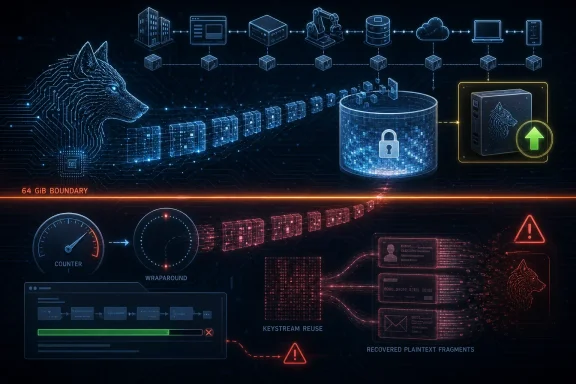 The 64 GiB Line Was Not a Suggestion
AES-GCM has become one of the default answers to the question of how to encrypt data while also authenticating it. It is fast, widely accelerated in hardware, standardized, and embedded deep inside TLS stacks, storage systems, VPNs, embedded devices, file-transfer software, and countless application protocols. That familiarity can make it feel almost mundane.But GCM is not magic; it is a carefully bounded construction. Under the hood, encryption uses counter mode, generating a keystream from AES outputs and combining that stream with plaintext. If the same keystream is ever reused under the same key, the cryptographic floor can drop away quickly.
That is why the size limit matters. In the vulnerable wolfSSL streaming APIs, a single cumulative AES-GCM message larger than 64 GiB was not rejected properly. Once the internal counter wraps, the implementation can begin reusing keystream blocks, giving an attacker who can observe or influence the encrypted stream a path toward recovering plaintext.
This is not the cinematic version of a vulnerability, with a packet fired at a port and shells raining from the sky. It is more uncomfortable than that. It is the kind of bug that says the primitive was sound, the broad design was familiar, and the failure still happened because the implementation let an impossible size become possible.
The MSRC 404 Is a Red Herring With a Useful Warning Label
The prompt points to a Microsoft Security Response Center page that returns a 404. That does not mean the vulnerability is fictional, nor does it mean Microsoft silently withdrew an advisory. It means the Microsoft page named in the prompt is not the authoritative source for this CVE.The public records identify wolfSSL as the source and vendor. The affected product is wolfSSL itself, with versions from 4.8.0 through 5.9.1 listed as vulnerable and 5.9.2 carrying the fix. The NVD entry also links to wolfSSL’s own security vulnerability page and to the GitHub pull request that fixed the issue.
That distinction matters for WindowsForum readers because Windows environments are full of non-Microsoft security dependencies. A Windows server, desktop application, agent, appliance console, backup tool, VPN client, embedded management service, or cross-platform product may rely on third-party crypto libraries even when the operating system itself is not the vulnerable component.
The Windows ecosystem is often discussed as if Microsoft owns the whole security boundary. It does not. Modern Windows fleets are dependency forests, and vulnerabilities in OpenSSL, wolfSSL, zlib, curl, SQLite, Electron, Chromium, Java runtimes, and hardware vendor SDKs routinely matter more to actual exposure than Patch Tuesday headlines.
So the 404 is not the story, but it is a symptom. If your vulnerability workflow starts and ends with MSRC, you will miss risks that arrive through the software supply chain rather than through Windows Update.
Streaming APIs Turn a Crypto Limit Into an Operational Risk
A one-shot encryption API has an obvious failure mode: the application hands the library a buffer, and the library can inspect the size before it begins. If the message is too large for the mode’s safety bounds, the call can fail immediately. Developers may grumble, but the failure is clean.Streaming APIs are different. They exist because real software cannot always hold the full message in memory. Backup streams, file transfer tools, logging pipelines, media archives, update packages, database exports, and embedded telemetry flows often process data in chunks. The library may not know at the first call whether the application is encrypting 4 MiB or 400 GiB.
That is where the bug becomes more than a number. A streaming interface has to maintain cumulative state across update calls, enforce the mode’s maximum size, and fail before the counter space is exhausted. If that accounting is missing or wrong, the API allows a caller to walk past the cryptographic guardrail one ordinary chunk at a time.
This is the recurring pattern in security engineering: abstractions that make dangerous operations pleasant often become dangerous in new ways. Streaming AEAD is useful, sometimes necessary, and perfectly defensible when designed carefully. But it also asks the library to turn a cryptographic theorem into a stateful software contract.
CVE-2026-55967 is best understood as a contract failure. The library exposed an interface that implied it would safely handle streaming AES-GCM messages. But for extremely large cumulative single messages, the API failed to reject the point at which safety assumptions no longer held.
Keystream Reuse Is the Old Disaster in a New Suit
The phrase keystream reuse sounds clinical, but it is one of the classic ways to destroy confidentiality in stream-like encryption modes. If two plaintexts are encrypted with the same keystream, XOR relationships between the plaintexts leak through the ciphertexts. With enough structure, known plaintext, or attacker control, the result can move from theoretical leakage to practical recovery.AES-GCM inherits this risk because its encryption side is built on counter mode. Each block uses a distinct counter value under a given key and nonce, producing a distinct keystream block. The system depends on never repeating that input combination.
Counter wrap breaks the promise from the inside. Even if the caller chose a unique nonce, even if the key management was otherwise sane, even if the application did not intentionally reuse anything, the stream can eventually circle back to a previous counter value. At that point, the implementation may generate a keystream block it already used earlier in the same giant message.
That is why this vulnerability is different from the usual nonce-reuse lecture. Many AES-GCM warnings focus on applications choosing bad IVs or reusing nonces across messages. CVE-2026-55967 is about the library failing to enforce the per-message limit that prevents reuse within a message.
It is also why “single message” is the load-bearing phrase. Encrypting many separate chunks as separate AEAD messages, each with its own nonce and tag, is not the same thing as feeding a massive logical message into one streaming GCM context. The former can be designed safely. The latter must respect the counter limit.
The Severity Scores Tell Two Different Stories
The public scoring around this CVE is awkward in the way crypto bugs often are. The CNA score from wolfSSL treats it as low severity under CVSS 4.0, emphasizing local attack vector, high complexity, attacker prerequisites, and limited confidentiality impact. NVD’s CVSS 3.1 enrichment, meanwhile, lists a high 7.5 score with network attack vector and high confidentiality impact.That disagreement is not just bureaucratic noise. It reflects two different mental models of the bug. One model asks how hard it is to actually trigger the condition in a real wolfSSL-using application: can an attacker make the victim encrypt or decrypt more than 64 GiB as one AES-GCM message under conditions useful to the attacker? The other model focuses on the cryptographic consequence if the vulnerable behavior occurs: plaintext recovery is a confidentiality failure, and confidentiality failures score heavily.
Both views have merit, but neither is enough by itself. A bug that requires a >64 GiB single message is not the same operational class as a trivially exploitable remote memory corruption flaw. It is also not harmless merely because it requires scale. Enterprises routinely move objects, archives, backups, VM images, disk snapshots, and telemetry streams that exceed old assumptions about what “large” means.
The right reading is conditional severity. If a product uses wolfSSL AES-GCM streaming only for small records, the practical risk may be negligible. If it uses the affected APIs for large object encryption, backup streams, encrypted archives, long-lived channels, or data ingestion pipelines, the risk deserves real attention.
Security teams should resist the instinct to let a single score make the decision. This is a scoping problem first and a patching problem second. The vulnerable versions are known; the fixed version is known; the hard work is finding where the affected pattern exists.
Windows Shops Should Look Past Windows Update
For Windows administrators, the most tempting move is to ask whether Microsoft has shipped a fix. In this case, that framing is too narrow. The vulnerable component is wolfSSL, and exposure depends on applications and products that bundle or link against affected wolfSSL versions.That may include software running on Windows, but also the infrastructure Windows admins manage indirectly: firewall appliances, VPN gateways, remote management tools, backup servers, embedded controllers, IoT devices, developer tools, and cross-platform services. wolfSSL has long been popular in embedded and performance-sensitive environments, which means the dependency can appear in places that do not resemble a traditional Windows application.
This is where software inventory proves its worth or reveals its absence. If an organization has a software bill of materials program, it can search for wolfSSL versions before the security meeting turns into guesswork. If it does not, administrators are left checking vendor advisories, scanning installed binaries, and asking suppliers whether wolfSSL is present and how it is used.
Windows Defender, WSUS, Intune, Configuration Manager, and vulnerability scanners can help only if the vulnerable component is detectable and the vendor packaging exposes it clearly. Bundled libraries buried inside application directories are a familiar blind spot. Statically linked libraries are worse.
The practical question is not “Is Windows vulnerable?” It is “Which software in the Windows estate uses affected wolfSSL AES-GCM streaming APIs for large single messages?” That is a narrower question, but it is also the only one that maps to actual risk.
The Patch Is Simple; The Inventory Is Not
wolfSSL lists the issue as fixed in PR 10709 and in version 5.9.2. From the outside, that sounds reassuringly straightforward: upgrade to the fixed release. For developers directly consuming wolfSSL, that is the correct answer.For enterprise users, the path is rarely direct. Most organizations do not deploy wolfSSL as a standalone package that can be upgraded like a browser. They consume it through vendors, products, firmware images, SDKs, containers, or application bundles. The patch has to move from upstream wolfSSL into those downstream products, then into release channels, then through testing, then into production.
That delay is the software supply chain in miniature. Upstream fixes can exist while customers remain exposed because the affected library is hidden inside a product whose vendor has not yet shipped an update. In some environments, the vulnerable wolfSSL version may be compiled into firmware that updates quarterly, annually, or never.
The good news is that the exploit conditions here are specific enough to guide prioritization. Not every wolfSSL user is equally exposed. Products that never process large AES-GCM streams as a single message are unlikely to offer a useful attack surface. Products that encrypt large files, disk images, backups, or archives are the ones to examine first.
Developers can also mitigate by enforcing their own message-size ceilings and chunking large data into independently authenticated records with unique nonces. That is not a substitute for updating the library, but it is a useful defense-in-depth measure and a design correction for future systems.
Giant Messages Are a Design Smell
The phrase “single message larger than 64 GiB” should make architects uneasy. It is not that large encrypted objects are inherently wrong; modern systems handle enormous data all the time. The smell is treating a huge stream as one cryptographic message when the safer engineering pattern is usually to divide it into bounded records.Record-based encryption is not exotic. TLS does it. Many storage systems do it. Secure file formats often do it. Each chunk gets its own nonce or derived subkey context and its own authentication tag, so corruption or tampering is localized and implementation limits stay visible.
The trade-off is complexity. Chunking requires a format, sequencing, final-block handling, metadata authentication, replay considerations, and careful nonce construction. A naive chunked design can create its own disasters. But that complexity is explicit, reviewable, and testable.
By contrast, a monolithic streaming AEAD interface can seduce developers into thinking they have avoided format design. Feed bytes in, get bytes out, call final, and move on. CVE-2026-55967 is a reminder that the format did not disappear; it was delegated to the library’s internal state machine.
For Windows developers building backup tools, sync clients, encrypted upload services, or enterprise agents, the lesson is direct. Do not assume “streaming AES-GCM” means “unbounded AES-GCM.” It means the API can process data incrementally while still obeying the finite limits of the mode.
The AI-Era Vulnerability Flood Makes Triage Harder
The wolfSSL vulnerability page around this issue contains a striking cluster of recent CVEs, many credited to researchers working in collaboration with AI systems or security research groups. That context matters less for attribution than for velocity. The industry is entering a period where code review, variant discovery, and vulnerability reporting can scale faster than traditional advisory processing.For defenders, that creates a weird mix of better visibility and worse overload. More bugs are found, which is good. More CVEs appear in rapid clusters, which is exhausting. Scoring disagreements, incomplete downstream advisories, and duplicate-looking issue summaries make it harder to decide what should interrupt a maintenance window.
CVE-2026-55967 is a good example of why triage cannot be outsourced entirely to severity labels. A low-scored crypto boundary bug might be irrelevant to one organization and urgent to another. The deciding factor is not the CVE title alone; it is whether the affected API pattern exists in the environment.
This also pressures vendors to describe impact in operational terms. “AES-GCM streaming APIs do not reject >64 GiB cumulative single messages” is technically precise, but downstream customers need to know which product features use those APIs. Does encrypted backup use them? Does TLS? Does firmware update packaging? Does large-object storage? Does the OpenSSL compatibility layer matter?
The better vendors will answer those questions quickly. The worse ones will ship a generic “we are investigating” notice and leave customers to reverse-engineer exposure from file names.
The Real Risk Lives in Backups, Archives, and Appliances
If this vulnerability becomes exploitable in the wild, the likely path is not an attacker casually sending a 65 GiB request to a web server and reading secrets. The more plausible risk sits where huge encrypted streams are already normal.Backup systems are the obvious candidate. They handle large volumes, often run with high privileges, and may encrypt archives or transfer streams using bundled crypto libraries. If a backup product used affected wolfSSL APIs to treat a massive backup as one AES-GCM message, the theoretical boundary condition starts to look less theoretical.
Encrypted file-transfer and object-storage gateways deserve similar scrutiny. Large artifacts are normal in software distribution, media production, scientific computing, database migration, VM management, and disaster recovery. Systems that encrypt such objects client-side before upload need to be careful about per-message limits.
Embedded appliances complicate matters further. wolfSSL is common in constrained and embedded contexts, and appliance vendors often bundle crypto libraries deeply. Windows admins may encounter the exposure not on a Windows host but in the VPN concentrator, out-of-band management controller, storage appliance, or industrial gateway that Windows clients depend on.
The attacker model still matters. To recover useful plaintext, an adversary generally needs visibility into ciphertext and favorable conditions around known or controlled plaintext. But large enterprise workflows often contain predictable headers, file formats, repeated structures, and attacker-influenced content. Cryptographic failures do not need perfect conditions to become uncomfortable.
This Is Why Crypto APIs Need Hostile Guardrails
There is a school of thought that says crypto libraries should expose sharp tools and expect developers to know the rules. That position has not aged well. Developers are already juggling protocols, memory safety, concurrency, error handling, deployment environments, compliance rules, and performance constraints. A safe crypto API should make the wrong thing difficult or impossible.CVE-2026-55967 is not about an application developer ignoring a clearly documented limit. The reported issue is that the streaming APIs did not properly reject a cumulative size beyond the safe boundary. That is precisely the sort of rule the library is supposed to enforce because the library is the component tracking the counter.
Good cryptographic APIs fail early, fail loudly, and fail before the dangerous state occurs. They make limits explicit. They return errors that cannot be mistaken for success. They document whether streaming means one AEAD message or a sequence of independently authenticated records.
They also test the weird edges. Crypto testing cannot stop at known-answer vectors and ordinary message sizes. It has to include counter exhaustion, length overflows, finalization errors, tag truncation behavior, zero-length inputs, multi-call update paths, and API misuse. The bugs that matter often live where the test suite assumed no one would go.
The frustrating part is that the 64 GiB boundary is not obscure to cryptographers. The failure is in carrying that knowledge all the way into a practical API. That last mile is where software security repeatedly bleeds.
The wolfSSL Fix Should Trigger a Dependency Hunt
The immediate technical answer is to update wolfSSL to 5.9.2 or later where applicable. But the more useful operational answer is to start with dependency discovery and work outward. Security teams should identify products containing wolfSSL, map versions, and ask whether AES-GCM streaming APIs are used for large single-message encryption or decryption.Developers should review any code that treats very large files or streams as one AEAD operation. If the design requires large encrypted objects, chunking should be explicit, authenticated, and bounded. If compatibility requires a monolithic format, the implementation needs hard size checks that fail before the AES-GCM counter space is exhausted.
Administrators should also be careful with scanner output. A vulnerability scanner may flag wolfSSL versions without knowing whether the vulnerable API is reachable. Conversely, it may miss statically linked copies entirely. Neither result should be treated as the final word.
The most productive vendor question is specific: “Do any supported versions of your product include wolfSSL 4.8.0 through 5.9.1, and if so, do any features use AES-GCM streaming APIs for cumulative single messages larger than 64 GiB?” That question is harder to dodge than “Are you affected by CVE-2026-55967?”
The Practical Read for WindowsForum Readers
CVE-2026-55967 is not a reason to panic, but it is a reason to stop treating cryptographic library bugs as someone else’s dependency hygiene. The affected versions and fixed release are clear, while the real exposure depends on how downstream software uses wolfSSL.- Organizations should verify whether wolfSSL versions 4.8.0 through 5.9.1 exist anywhere in their Windows application estate, appliances, containers, SDKs, or vendor-supplied tools.
- Developers using wolfSSL should move to 5.9.2 or later and add independent size checks around any AES-GCM streaming design that can process very large data.
- Security teams should prioritize backup, archive, file-transfer, object-storage, and appliance workflows where single encrypted streams can plausibly exceed 64 GiB.
- Scanner findings should be validated against actual product behavior, because the difference between bundled presence and reachable vulnerable API use is material.
- New encrypted file or stream formats should prefer bounded, independently authenticated chunks over one enormous AEAD message.
- The broken MSRC link should not be read as a Microsoft advisory; the authoritative trail points to wolfSSL, NVD, and the upstream patch.
References
- Primary source: MSRC
Published: 2026-07-01T01:04:04-07:00
Security Update Guide - Microsoft Security Response Center
 msrc.microsoft.com
- Related coverage: mondoo.com
CWE-323 Vulnerabilities | Mondoo Vulnerability Intelligence
Security vulnerabilities related to CWE-323.mondoo.com