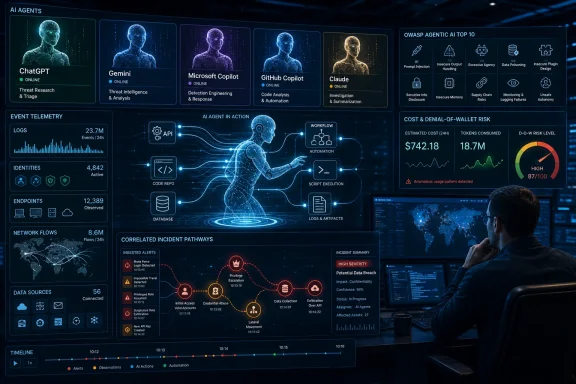
Exabeam announced on July 1, 2026, that it is expanding its Behavior Intelligence platform with new AI-agent detections, broader enterprise AI telemetry, OWASP-aligned coverage mapping, Claude support, and an open source observability project called Observra. The move is less about adding another acronym to the SOC console than about admitting that the enterprise security perimeter now includes software that can act, spend, query, approve, retrieve, and change things at machine speed. For Windows-heavy organizations already juggling Microsoft Copilot, GitHub Copilot, cloud identity, phishing queues, and SIEM modernization, the announcement lands in a familiar place: the tools have arrived before the operating model has caught up. Exabeam is betting that behavior, not static policy, is the only durable way to watch this new class of non-human insider.
The last decade of enterprise security was built around a blunt but useful distinction: users did things, systems logged them, and attackers tried to impersonate users or compromise systems. AI agents complicate that model because they are neither traditional users nor passive software services. They may hold delegated permissions, execute workflows, call APIs, summarize documents, open tickets, invoke plugins, and move across SaaS and cloud environments in ways that look authorized in isolation.
That is why Exabeam’s framing matters. The company is not merely saying that AI tools create new alerts. It is saying that agents behave, and that their behavior should be profiled with the same seriousness security teams have long applied to privileged users, service accounts, endpoints, and identities.
This is a natural extension of user and entity behavior analytics, the category Exabeam helped popularize. UEBA was built for the uncomfortable truth that credentialed activity can still be malicious. Agent behavior analytics applies the same idea to a stranger problem: activity may be credentialed, policy-compliant, and initiated by a sanctioned AI workflow, yet still wrong in context.
That shift is particularly relevant for WindowsForum readers because Microsoft’s ecosystem is becoming one of the main deployment surfaces for agentic work. Copilot in Microsoft 365, GitHub Copilot in development workflows, Azure-connected automation, Entra ID permissions, Teams, SharePoint, Exchange, and Windows endpoints all create paths where AI-assisted activity can touch sensitive enterprise data. A SOC that sees only the application name or the identity token will miss the story.
Exabeam’s new AI and agent-related behavioral detections reportedly double its AI-focused detection coverage to 90. The examples are telling: suspicious prompt behavior, unusual tool invocation sequences, abnormal consumption patterns, unauthorized configuration changes, denial-of-wallet indicators, shadow AI activity, and other signs of misuse or compromise. This is not classic malware detection wearing an AI hat. It is an attempt to capture the strange middle ground where a legitimate agent starts behaving like an unsafe operator.
The phrase tool invocation sequence may sound like vendor jargon, but it is one of the most important concepts in agent security. An agent that searches a knowledge base, summarizes a ticket, and drafts a response may be doing normal work. An agent that searches a knowledge base, queries sensitive HR records, exports a file, calls an external API, and then deletes logs is telling a very different story.
Static allowlists struggle with that distinction. So do traditional SIEM rules that trigger on single events. Behavior analytics has a better chance because the risky signal is often temporal, relational, and contextual: who started the workflow, what the agent normally accesses, which tools it called, how much it consumed, and whether the sequence deviated from prior behavior.
Many enterprises do not have a clean answer to which AI tools are in use, which departments adopted them, which identities connect to them, and what data flows through them. Shadow IT was annoying when it meant a SaaS expense and a forgotten admin account. Shadow AI is more dangerous because the tool may be ingesting internal data, invoking enterprise services, or quietly becoming part of business process.
For a security team, visibility across multiple AI platforms is not about preferring one model provider over another. It is about refusing to let the AI layer become an unlogged parallel workplace. If users are copying source code into one assistant, summarizing customer data in another, using Copilot inside Microsoft 365, and relying on GitHub Copilot inside development environments, the SOC needs a normalized way to understand that activity.
This is where Exabeam’s claim intersects with a broader enterprise reality. The AI market is fragmenting even as adoption accelerates. Business users may prefer ChatGPT or Claude, developers may live in GitHub Copilot, executives may lean into Microsoft Copilot, and data teams may test Gemini. Security teams do not get to secure only the vendor standardized in a policy memo.
The hard part is that AI usage is not a single control plane. It is a set of user experiences, APIs, plugins, browser sessions, IDE extensions, service integrations, and delegated permissions. Exabeam’s value proposition is that behavior intelligence can sit above some of that fragmentation and give analysts a coherent view of how humans and agents interact.
That matters because agent telemetry is still immature. Traditional logs tell you that an API call happened, an authentication succeeded, or a file was accessed. They often do not explain the agentic chain: the instruction, the intermediate reasoning or plan, the tool call, the context retrieved, the cost incurred, the data redacted, the duplicate action suppressed, and the risk signal generated along the way.
If Observra can make those events consumable without forcing every organization to invent its own schema, it could solve a practical problem that is easy to underestimate. Security teams cannot detect what developers do not emit. Developers will not emit useful telemetry if every framework, agent runtime, and SOC platform demands different glue code.
The open source angle is also a credibility play. Exabeam sells a platform, but the agent ecosystem is too broad and too young for any vendor to own the telemetry layer alone. A library that normalizes signals across frameworks has a better chance of adoption if teams believe they can inspect it, extend it, and route data where they choose.
There is a catch, of course. Open source telemetry projects succeed when they become boring infrastructure. They fail when they are thin vendor funnels. Observra will need useful schemas, real framework integrations, documentation that developers can tolerate, and a governance model that invites contributions beyond Exabeam’s immediate product roadmap.
OWASP’s agentic AI work gives the industry a shared taxonomy for risks such as goal hijacking, tool misuse, identity and privilege abuse, supply chain weaknesses, unexpected code execution, memory and context poisoning, insecure inter-agent communication, cascading failures, human-agent trust exploitation, and rogue agents. The value is not that every organization will agree on the exact wording. The value is that security teams can stop arguing from scratch.
Mapping detections to OWASP categories helps answer a simple but politically powerful question: where are we covered, and where are we guessing? For CISOs, that matters because AI adoption is increasingly being driven from the business side. Security teams are expected to enable it, not block it. Coverage maps give them a way to say yes with conditions.
This also changes how AI security products will be judged. Vendors can no longer merely claim that they detect “AI threats.” They will be pushed to show which threat classes they cover, which telemetry they require, which controls are preventive rather than detective, and which gaps remain. That is healthy pressure.
For Windows and Microsoft-centric shops, the OWASP mapping may also help reconcile overlapping control planes. Microsoft Purview, Defender, Entra, Sentinel, GitHub Advanced Security, Copilot controls, endpoint telemetry, and third-party SIEM analytics can all see pieces of the puzzle. A risk taxonomy offers a way to map those pieces without pretending one console owns the whole story.
This is where the announcement becomes less futuristic and more practical. Security operations teams are already overloaded. Adding AI-agent telemetry without improving detection engineering and triage would simply create a more modern alert swamp.
Natural-language rule creation is not magic, and mature teams should be skeptical of any system that implies otherwise. Detection logic still needs validation, tuning, testing, ownership, and review. But converting analyst intent into a starting point faster is useful, especially when threats are evolving faster than hand-built content libraries.
Sigma conversion is similarly pragmatic. Many detection engineers already use Sigma as a portable rule format across SIEMs and telemetry backends. If Exabeam can reduce the friction of adapting Sigma content into its analytics model, it gives teams a bridge between community detection work and platform-specific behavior analytics.
Related-case surfacing may prove even more valuable in day-to-day SOC work. Analysts rarely suffer from a lack of individual events. They suffer from fragmented context. If an AI agent’s odd behavior, a phishing report, an identity anomaly, and a strange host connection are related, the system needs to help the analyst see that relationship before the attacker’s dwell time becomes the attacker’s advantage.
Security platforms live or die by ingestion, parsing, context, and search. If the data does not arrive, the analytic never fires. If identity linking is stale, the case points to the wrong person. If parser transparency is weak, administrators lose trust in the pipeline. If reporting is painful, the security program struggles to show progress.
Phishing ingest is especially relevant because phishing remains a major entry point for identity compromise, and AI tools can amplify both sides of the fight. Attackers use generative systems to scale credible lures. Defenders use automation to cluster, parse, and investigate reported messages. Folding that workflow into broader case management is not novel, but it is necessary.
Attack Surface Insights improvements also fit the agentic story. Agents expand the effective attack surface because they combine identity, data access, application workflows, and automation. Entity health, identity linking, context freshness, and rule preview testing all become more important when detections depend on whether behavior is normal for a particular user, agent, host, or service.
The LogRhythm SIEM ecosystem expansion is another reminder that Exabeam is still digesting and extending a broader security operations portfolio. After Exabeam and LogRhythm combined under the Exabeam name, the company needed to prove that it could modernize without stranding existing SIEM customers. Broader integrations across Microsoft, cloud, identity, email, and security technologies are part of that proof.
The old service-account problem is instructive. Enterprises accumulated privileged accounts tied to applications, scripts, integrations, and forgotten jobs. Many were overprivileged, under-monitored, poorly documented, and hard to rotate. AI agents could recreate that problem at a higher speed and with more ambiguous intent.
A sanctioned agent that can read tickets, query documents, access CRM data, invoke a workflow, and write to a repository is not just a chatbot. It is an operational actor. If it is compromised, misdirected, overdelegated, or manipulated through poisoned context, the resulting activity may look like business automation until somebody reviews the behavioral chain.
This is why human-to-agent interactions matter. A user asking an agent to summarize a document is one thing. A user repeatedly prompting an agent to bypass policy, retrieve restricted data, or chain tools in an unusual way is another. The user, the agent, and the downstream systems all need to be part of the same analytic picture.
For administrators, the lesson is uncomfortable but clear: AI governance cannot live only in acceptable-use policy. It must connect to identity management, logging, data classification, endpoint controls, SaaS administration, developer tooling, and incident response.
They are well-positioned because Microsoft has strong native security telemetry across identity, endpoint, cloud, email, and collaboration. They are exposed because Copilot-style experiences sit directly on top of sensitive enterprise data and user permissions. If data governance is messy, AI can make the mess easier to query.
GitHub Copilot adds a different kind of exposure. Developer environments are high-value because code, credentials, build systems, infrastructure definitions, and deployment workflows often sit close together. An assistant that helps write code can also influence what dependencies are added, what commands are suggested, and how quickly changes move from idea to production.
Exabeam’s broader AI platform visibility is therefore relevant even if a company is deeply committed to Microsoft tooling. Most real environments are hybrid at the AI layer. Developers may use one assistant, analysts another, executives a third, and business units whatever tool helped them ship a project fastest.
The administrative challenge is not to ban all of this. It is to establish visibility before exceptions become the norm. That means knowing where AI tools are used, what identities and data they touch, and which behaviors would indicate misuse.
Traditional denial-of-service attacks aim to exhaust availability. Denial of wallet aims to exhaust budget. Agentic systems make this risk sharper because autonomous workflows can consume resources quickly and because many AI services are priced by usage.
This is not just a concern for model APIs. Agents may trigger cloud functions, query databases, call third-party services, run builds, launch jobs, or repeatedly process large files. A malicious instruction, poisoned memory, bad retry loop, or compromised tool could produce a bill before the SOC understands the incident.
Behavior analytics is a reasonable fit for this problem because the anomaly may be a consumption pattern rather than a blocked signature. A sudden spike in tool calls, token usage, API spend, or repeated failed workflows can be a security signal. It can also be an engineering bug, which is why context and case correlation matter.
The practical takeaway for IT teams is that cost telemetry should not be isolated in finance dashboards. For AI agents, spending patterns belong in the security conversation.
That lifecycle framing is stronger than a one-off detection pitch. Agent security will not be solved at a single point. Pre-deployment review can catch overbroad permissions, missing governance, unsafe tool access, and configuration mistakes. Runtime observability can catch drift, compromise, misuse, and emergent behavior. Post-incident analysis can harden the next version.
The question is whether organizations will adopt the discipline. Many are still in the phase where AI projects are sponsored as productivity experiments, not treated as production systems. That creates an incentive to move fast with weak controls, especially when business leaders see competitors announcing AI-driven efficiencies.
Security teams should resist the false choice between blocking AI and rubber-stamping it. A lifecycle approach gives them a middle path. It says agents can be deployed, but they must be verified, instrumented, monitored, and retired like other production actors.
That will require collaboration among developers, platform engineers, security operations, identity teams, legal, compliance, and business owners. The agent may be new; the governance challenge is not.
The risk is that AI security becomes the next alerting land rush. Every vendor now has an incentive to relabel existing telemetry as agentic visibility and existing anomaly detection as AI defense. Buyers should demand specifics: what events are collected, how agents are identified, how human-to-agent actions are linked, what detections are behavioral rather than static, and how false positives are managed.
Signal quality will be decisive. A SOC does not need 90 detections if 70 of them are noisy, vague, or unactionable. It needs a smaller number of high-confidence signals that explain why behavior is suspicious and what the analyst should do next.
That is especially true for autonomous workflows, where the difference between innovation and incident may be subtle. An unusual tool sequence could indicate a clever new business process. It could also indicate compromised instructions, privilege abuse, or data exfiltration. The platform must help analysts distinguish those possibilities without requiring a forensic expedition for every alert.
Exabeam’s long experience in UEBA gives it a credible starting point. But agent behavior analytics will need to prove itself against real enterprise messiness: incomplete logs, inconsistent agent naming, hybrid AI adoption, overlapping permissions, and business units that deploy first and document later.
That is a humbler model than the usual security marketing promise. It admits that agents will operate in complex environments. It accepts that approved tools can be abused. It assumes that valid identities can perform invalid behavior. It recognizes that analysts need timelines, relationships, and normalized evidence more than another dashboard with a glowing AI badge.
For Windows administrators and enterprise defenders, the message is immediate. Copilot rollouts, GitHub Copilot adoption, third-party AI assistants, and internal agents should be inventoried now. Waiting until after an incident to decide what an agent is, where it logs, and who owns it is how service-account sprawl becomes agent sprawl.
The more mature organizations will treat agents as governed participants in the enterprise. They will assign ownership, define permissions, instrument activity, map risks, watch behavior, and test response processes. The less mature ones will discover agents through invoices, audit findings, or breach investigations.
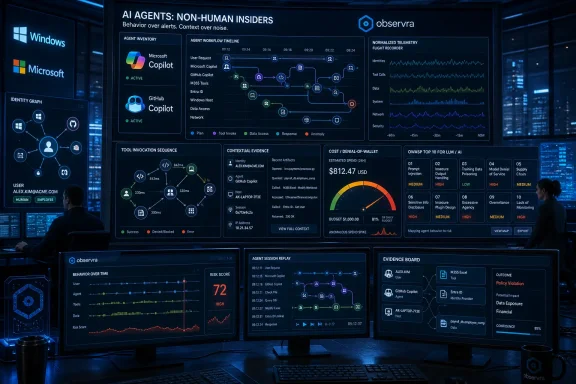 AI Agents Have Become the New Insider Problem
The last decade of enterprise security was built around a blunt but useful distinction: users did things, systems logged them, and attackers tried to impersonate users or compromise systems. AI agents complicate that model because they are neither traditional users nor passive software services. They may hold delegated permissions, execute workflows, call APIs, summarize documents, open tickets, invoke plugins, and move across SaaS and cloud environments in ways that look authorized in isolation.That is why Exabeam’s framing matters. The company is not merely saying that AI tools create new alerts. It is saying that agents behave, and that their behavior should be profiled with the same seriousness security teams have long applied to privileged users, service accounts, endpoints, and identities.
This is a natural extension of user and entity behavior analytics, the category Exabeam helped popularize. UEBA was built for the uncomfortable truth that credentialed activity can still be malicious. Agent behavior analytics applies the same idea to a stranger problem: activity may be credentialed, policy-compliant, and initiated by a sanctioned AI workflow, yet still wrong in context.
That shift is particularly relevant for WindowsForum readers because Microsoft’s ecosystem is becoming one of the main deployment surfaces for agentic work. Copilot in Microsoft 365, GitHub Copilot in development workflows, Azure-connected automation, Entra ID permissions, Teams, SharePoint, Exchange, and Windows endpoints all create paths where AI-assisted activity can touch sensitive enterprise data. A SOC that sees only the application name or the identity token will miss the story.
The Security Question Has Moved From Prompt Abuse to Operational Drift
The first wave of generative AI security focused heavily on prompts: prompt injection, jailbreaks, data leakage, and model output risks. Those problems have not disappeared, but agents push the risk into the operational layer. The issue is no longer only what a model says; it is what connected software is allowed to do after the model decides what comes next.Exabeam’s new AI and agent-related behavioral detections reportedly double its AI-focused detection coverage to 90. The examples are telling: suspicious prompt behavior, unusual tool invocation sequences, abnormal consumption patterns, unauthorized configuration changes, denial-of-wallet indicators, shadow AI activity, and other signs of misuse or compromise. This is not classic malware detection wearing an AI hat. It is an attempt to capture the strange middle ground where a legitimate agent starts behaving like an unsafe operator.
The phrase tool invocation sequence may sound like vendor jargon, but it is one of the most important concepts in agent security. An agent that searches a knowledge base, summarizes a ticket, and drafts a response may be doing normal work. An agent that searches a knowledge base, queries sensitive HR records, exports a file, calls an external API, and then deletes logs is telling a very different story.
Static allowlists struggle with that distinction. So do traditional SIEM rules that trigger on single events. Behavior analytics has a better chance because the risky signal is often temporal, relational, and contextual: who started the workflow, what the agent normally accesses, which tools it called, how much it consumed, and whether the sequence deviated from prior behavior.
Exabeam Is Trying to Make AI Visibility Boring, Which Is the Point
The announcement expands visibility across Anthropic Claude, OpenAI ChatGPT, Google Gemini, Microsoft Copilot, and GitHub Copilot. In marketing language, that sounds like platform coverage. In operational language, it is an inventory problem.Many enterprises do not have a clean answer to which AI tools are in use, which departments adopted them, which identities connect to them, and what data flows through them. Shadow IT was annoying when it meant a SaaS expense and a forgotten admin account. Shadow AI is more dangerous because the tool may be ingesting internal data, invoking enterprise services, or quietly becoming part of business process.
For a security team, visibility across multiple AI platforms is not about preferring one model provider over another. It is about refusing to let the AI layer become an unlogged parallel workplace. If users are copying source code into one assistant, summarizing customer data in another, using Copilot inside Microsoft 365, and relying on GitHub Copilot inside development environments, the SOC needs a normalized way to understand that activity.
This is where Exabeam’s claim intersects with a broader enterprise reality. The AI market is fragmenting even as adoption accelerates. Business users may prefer ChatGPT or Claude, developers may live in GitHub Copilot, executives may lean into Microsoft Copilot, and data teams may test Gemini. Security teams do not get to secure only the vendor standardized in a policy memo.
The hard part is that AI usage is not a single control plane. It is a set of user experiences, APIs, plugins, browser sessions, IDE extensions, service integrations, and delegated permissions. Exabeam’s value proposition is that behavior intelligence can sit above some of that fragmentation and give analysts a coherent view of how humans and agents interact.
Observra Is the More Interesting Announcement Than the Detection Count
The most strategically important part of the release may be Observra, the new open source project and library that Exabeam says will capture and normalize AI agent telemetry. The project is pitched as a clean telemetry layer for developers, security practitioners, and platform teams, with support for routing events into security operations platforms.That matters because agent telemetry is still immature. Traditional logs tell you that an API call happened, an authentication succeeded, or a file was accessed. They often do not explain the agentic chain: the instruction, the intermediate reasoning or plan, the tool call, the context retrieved, the cost incurred, the data redacted, the duplicate action suppressed, and the risk signal generated along the way.
If Observra can make those events consumable without forcing every organization to invent its own schema, it could solve a practical problem that is easy to underestimate. Security teams cannot detect what developers do not emit. Developers will not emit useful telemetry if every framework, agent runtime, and SOC platform demands different glue code.
The open source angle is also a credibility play. Exabeam sells a platform, but the agent ecosystem is too broad and too young for any vendor to own the telemetry layer alone. A library that normalizes signals across frameworks has a better chance of adoption if teams believe they can inspect it, extend it, and route data where they choose.
There is a catch, of course. Open source telemetry projects succeed when they become boring infrastructure. They fail when they are thin vendor funnels. Observra will need useful schemas, real framework integrations, documentation that developers can tolerate, and a governance model that invites contributions beyond Exabeam’s immediate product roadmap.
The OWASP Mapping Shows Security Buyers Want a Rosetta Stone
Exabeam’s Outcomes Navigator now maps detections to the OWASP Top 10 for Agentic AI. That detail may sound procedural, but it reveals something important about the market. Security leaders are trying to translate a fast-moving technical threat into a language boards, auditors, and budget committees can understand.OWASP’s agentic AI work gives the industry a shared taxonomy for risks such as goal hijacking, tool misuse, identity and privilege abuse, supply chain weaknesses, unexpected code execution, memory and context poisoning, insecure inter-agent communication, cascading failures, human-agent trust exploitation, and rogue agents. The value is not that every organization will agree on the exact wording. The value is that security teams can stop arguing from scratch.
Mapping detections to OWASP categories helps answer a simple but politically powerful question: where are we covered, and where are we guessing? For CISOs, that matters because AI adoption is increasingly being driven from the business side. Security teams are expected to enable it, not block it. Coverage maps give them a way to say yes with conditions.
This also changes how AI security products will be judged. Vendors can no longer merely claim that they detect “AI threats.” They will be pushed to show which threat classes they cover, which telemetry they require, which controls are preventive rather than detective, and which gaps remain. That is healthy pressure.
For Windows and Microsoft-centric shops, the OWASP mapping may also help reconcile overlapping control planes. Microsoft Purview, Defender, Entra, Sentinel, GitHub Advanced Security, Copilot controls, endpoint telemetry, and third-party SIEM analytics can all see pieces of the puzzle. A risk taxonomy offers a way to map those pieces without pretending one console owns the whole story.
Nova Points to the SOC Labor Problem Behind the AI Hype
Exabeam is also extending Exabeam Nova, its AI-assisted layer, with a Rules Creator that can create and tune correlation and New-Scale Analytics rules using natural language. It supports conversion from Sigma rules, and a Related Cases capability in early access is designed to surface linked cases through shared entities such as IPs and hosts.This is where the announcement becomes less futuristic and more practical. Security operations teams are already overloaded. Adding AI-agent telemetry without improving detection engineering and triage would simply create a more modern alert swamp.
Natural-language rule creation is not magic, and mature teams should be skeptical of any system that implies otherwise. Detection logic still needs validation, tuning, testing, ownership, and review. But converting analyst intent into a starting point faster is useful, especially when threats are evolving faster than hand-built content libraries.
Sigma conversion is similarly pragmatic. Many detection engineers already use Sigma as a portable rule format across SIEMs and telemetry backends. If Exabeam can reduce the friction of adapting Sigma content into its analytics model, it gives teams a bridge between community detection work and platform-specific behavior analytics.
Related-case surfacing may prove even more valuable in day-to-day SOC work. Analysts rarely suffer from a lack of individual events. They suffer from fragmented context. If an AI agent’s odd behavior, a phishing report, an identity anomaly, and a strange host connection are related, the system needs to help the analyst see that relationship before the attacker’s dwell time becomes the attacker’s advantage.
The Platform Plumbing Is Less Glamorous but More Necessary
The release includes a cluster of SOC workflow improvements: phishing email ingest, Attack Surface Insights enhancements, cloud collectors, custom REST API context collection, Site Collector health notifications, Log Stream improvements, dashboard authoring, biweekly reporting, and Global Search updates. None of these will generate the same excitement as AI-agent detection. Many will matter more on Tuesday morning.Security platforms live or die by ingestion, parsing, context, and search. If the data does not arrive, the analytic never fires. If identity linking is stale, the case points to the wrong person. If parser transparency is weak, administrators lose trust in the pipeline. If reporting is painful, the security program struggles to show progress.
Phishing ingest is especially relevant because phishing remains a major entry point for identity compromise, and AI tools can amplify both sides of the fight. Attackers use generative systems to scale credible lures. Defenders use automation to cluster, parse, and investigate reported messages. Folding that workflow into broader case management is not novel, but it is necessary.
Attack Surface Insights improvements also fit the agentic story. Agents expand the effective attack surface because they combine identity, data access, application workflows, and automation. Entity health, identity linking, context freshness, and rule preview testing all become more important when detections depend on whether behavior is normal for a particular user, agent, host, or service.
The LogRhythm SIEM ecosystem expansion is another reminder that Exabeam is still digesting and extending a broader security operations portfolio. After Exabeam and LogRhythm combined under the Exabeam name, the company needed to prove that it could modernize without stranding existing SIEM customers. Broader integrations across Microsoft, cloud, identity, email, and security technologies are part of that proof.
Agent Security Is Becoming an Identity Story
One of the most important implications of Exabeam’s announcement is that AI agents should be treated as identity-bearing actors. That does not necessarily mean every agent maps cleanly to a traditional user account. It means agents need accountable permissions, observable behavior, and lifecycle governance.The old service-account problem is instructive. Enterprises accumulated privileged accounts tied to applications, scripts, integrations, and forgotten jobs. Many were overprivileged, under-monitored, poorly documented, and hard to rotate. AI agents could recreate that problem at a higher speed and with more ambiguous intent.
A sanctioned agent that can read tickets, query documents, access CRM data, invoke a workflow, and write to a repository is not just a chatbot. It is an operational actor. If it is compromised, misdirected, overdelegated, or manipulated through poisoned context, the resulting activity may look like business automation until somebody reviews the behavioral chain.
This is why human-to-agent interactions matter. A user asking an agent to summarize a document is one thing. A user repeatedly prompting an agent to bypass policy, retrieve restricted data, or chain tools in an unusual way is another. The user, the agent, and the downstream systems all need to be part of the same analytic picture.
For administrators, the lesson is uncomfortable but clear: AI governance cannot live only in acceptable-use policy. It must connect to identity management, logging, data classification, endpoint controls, SaaS administration, developer tooling, and incident response.
Microsoft Shops Will Feel This First Through Copilot and GitHub
The Windows enterprise is not a single product anymore. It is a mesh of Windows endpoints, Microsoft 365, Entra ID, Defender, Azure, Intune, SharePoint, Exchange, Teams, Power Platform, GitHub, and a growing Copilot layer. That makes Microsoft customers both well-positioned and exposed.They are well-positioned because Microsoft has strong native security telemetry across identity, endpoint, cloud, email, and collaboration. They are exposed because Copilot-style experiences sit directly on top of sensitive enterprise data and user permissions. If data governance is messy, AI can make the mess easier to query.
GitHub Copilot adds a different kind of exposure. Developer environments are high-value because code, credentials, build systems, infrastructure definitions, and deployment workflows often sit close together. An assistant that helps write code can also influence what dependencies are added, what commands are suggested, and how quickly changes move from idea to production.
Exabeam’s broader AI platform visibility is therefore relevant even if a company is deeply committed to Microsoft tooling. Most real environments are hybrid at the AI layer. Developers may use one assistant, analysts another, executives a third, and business units whatever tool helped them ship a project fastest.
The administrative challenge is not to ban all of this. It is to establish visibility before exceptions become the norm. That means knowing where AI tools are used, what identities and data they touch, and which behaviors would indicate misuse.
Denial of Wallet Deserves More Attention Than It Gets
One of the more interesting detection examples in Exabeam’s announcement is denial of wallet. In cloud and AI systems, cost is not merely an accounting concern; it is an attack surface. If an agent can be tricked or compromised into generating excessive calls, invoking expensive tools, or looping through resource-intensive tasks, the blast radius can include real financial damage.Traditional denial-of-service attacks aim to exhaust availability. Denial of wallet aims to exhaust budget. Agentic systems make this risk sharper because autonomous workflows can consume resources quickly and because many AI services are priced by usage.
This is not just a concern for model APIs. Agents may trigger cloud functions, query databases, call third-party services, run builds, launch jobs, or repeatedly process large files. A malicious instruction, poisoned memory, bad retry loop, or compromised tool could produce a bill before the SOC understands the incident.
Behavior analytics is a reasonable fit for this problem because the anomaly may be a consumption pattern rather than a blocked signature. A sudden spike in tool calls, token usage, API spend, or repeated failed workflows can be a security signal. It can also be an engineering bug, which is why context and case correlation matter.
The practical takeaway for IT teams is that cost telemetry should not be isolated in finance dashboards. For AI agents, spending patterns belong in the security conversation.
The Open Source Pairing of Praxen and Observra Hints at a Lifecycle Model
Exabeam also points to Praxen, an earlier open source project intended to support Agent Behavior Verification before deployment. With Observra now focused on runtime telemetry, the company is sketching a lifecycle: verify agents before they go live, observe them once they operate, analyze their behavior over time, and improve detections as threats evolve.That lifecycle framing is stronger than a one-off detection pitch. Agent security will not be solved at a single point. Pre-deployment review can catch overbroad permissions, missing governance, unsafe tool access, and configuration mistakes. Runtime observability can catch drift, compromise, misuse, and emergent behavior. Post-incident analysis can harden the next version.
The question is whether organizations will adopt the discipline. Many are still in the phase where AI projects are sponsored as productivity experiments, not treated as production systems. That creates an incentive to move fast with weak controls, especially when business leaders see competitors announcing AI-driven efficiencies.
Security teams should resist the false choice between blocking AI and rubber-stamping it. A lifecycle approach gives them a middle path. It says agents can be deployed, but they must be verified, instrumented, monitored, and retired like other production actors.
That will require collaboration among developers, platform engineers, security operations, identity teams, legal, compliance, and business owners. The agent may be new; the governance challenge is not.
The Vendor Message Is Sensible, but the Proof Will Be in Signal Quality
Exabeam’s announcement is conceptually aligned with where enterprise security is heading. Behavior analytics is a logical model for agentic activity. OWASP mapping is useful. Open telemetry is necessary. Natural-language detection engineering may reduce friction. Wider platform coverage reflects how AI is actually being adopted.The risk is that AI security becomes the next alerting land rush. Every vendor now has an incentive to relabel existing telemetry as agentic visibility and existing anomaly detection as AI defense. Buyers should demand specifics: what events are collected, how agents are identified, how human-to-agent actions are linked, what detections are behavioral rather than static, and how false positives are managed.
Signal quality will be decisive. A SOC does not need 90 detections if 70 of them are noisy, vague, or unactionable. It needs a smaller number of high-confidence signals that explain why behavior is suspicious and what the analyst should do next.
That is especially true for autonomous workflows, where the difference between innovation and incident may be subtle. An unusual tool sequence could indicate a clever new business process. It could also indicate compromised instructions, privilege abuse, or data exfiltration. The platform must help analysts distinguish those possibilities without requiring a forensic expedition for every alert.
Exabeam’s long experience in UEBA gives it a credible starting point. But agent behavior analytics will need to prove itself against real enterprise messiness: incomplete logs, inconsistent agent naming, hybrid AI adoption, overlapping permissions, and business units that deploy first and document later.
The Agentic Enterprise Needs a Flight Recorder, Not Just a Firewall
The strongest way to understand this release is to see it as part of a shift from perimeter thinking to flight-recorder thinking. AI agents will make decisions, call tools, and touch data in ways that cannot be fully predicted in advance. The defensive goal is not only to prevent every bad action; it is to preserve enough telemetry, context, and behavioral history to detect, explain, and contain what happens.That is a humbler model than the usual security marketing promise. It admits that agents will operate in complex environments. It accepts that approved tools can be abused. It assumes that valid identities can perform invalid behavior. It recognizes that analysts need timelines, relationships, and normalized evidence more than another dashboard with a glowing AI badge.
For Windows administrators and enterprise defenders, the message is immediate. Copilot rollouts, GitHub Copilot adoption, third-party AI assistants, and internal agents should be inventoried now. Waiting until after an incident to decide what an agent is, where it logs, and who owns it is how service-account sprawl becomes agent sprawl.
The more mature organizations will treat agents as governed participants in the enterprise. They will assign ownership, define permissions, instrument activity, map risks, watch behavior, and test response processes. The less mature ones will discover agents through invoices, audit findings, or breach investigations.
Exabeam’s AI Security Bet Comes Down to Five Operational Tests
Exabeam’s release gives security teams a useful lens, but it also gives them a checklist for separating product substance from AI-era branding. The important question is not whether a vendor says “agentic.” It is whether the platform can help a SOC understand non-human activity well enough to act.- Organizations should inventory AI tools and agents across sanctioned and unsanctioned environments before trying to tune detections around them.
- Security teams should treat agent activity as identity-linked behavior, not as generic application noise.
- AI telemetry should include tool calls, context access, consumption patterns, permission changes, and human-to-agent interactions.
- OWASP-aligned coverage mapping is useful only if it exposes gaps as clearly as it advertises strengths.
- Open telemetry projects such as Observra will matter if they earn developer trust and produce security-ready events without locking teams into one vendor path.
References
- Primary source: 01net
Published: 2026-07-01T16:00:09.958173
Exabeam Expands Behavior Intelligence to Secure the Agentic Enterprise
New AI agent detections, extended telemetry, Claude support, OWASP coverage insights, and Exabeam Nova-assisted detection engineering help security teams reduce AI blind spots and keep pace with AI-driven activity. Observra, new open source project an... www.01net.it
- Related coverage: genai.owasp.org
OWASP Top 10 for Agentic Applications - The Benchmark for Agentic Security in the Age of Autonomous AI - OWASP Gen AI Security Project
Introducing the OWASP Top 10 for Agentic AI Applications - our community’s actionable framework for securing autonomous, tool-using AI systems. Built at global scale informed by real incidents, and based on our work already adopted across industry, this release marks a pivotal moment in turning...genai.owasp.org - Related coverage: owasp.org
OWASP Agentic Skills Top 10 | OWASP Foundation
Security Risks and Mitigations for AI Agent Skillsowasp.org - Related coverage: xor.tech

OWASP Agentic Top 10 - Security Reference | XOR
OWASP Top 10 for Agentic Applications mapped to real attack data from MCPSecBench, Pillar Security, and Snyk. Reference for security teams.
www.xor.tech
- Related coverage: runesec.dev
OWASP Top 10 for Agentic AI (2026): Complete Guide | Rune | Rune
The OWASP Top 10 for Agentic Applications 2026 — all 10 risk categories with attack examples, detection patterns, and prevention code. By Rune, runtime ADR.runesec.dev
- Related coverage: exabeam.com
Securing the Agentic Enterprise with Behavioral Analytics and AI Visibility | Exabeam
Detect risky AI agent behavior and insider threats with behavioral analytics and visibility into AI activity.www.exabeam.com
- Related coverage: channelinsider.com
Exabeam Adds AI Agent Security Capabilities in Platform
Exabeam expanded its SOC platform with AI agent security detections, Observra telemetry, and broader support for enterprise AI tools. www.channelinsider.com
- Related coverage: pipelab.org
OWASP Agentic Top 10: Coverage | PipeLab
Pipelock coverage for all 10 risks in the OWASP Top 10 for Agentic Applications 2026 (ASI01-ASI10), with per-threat assessment. pipelab.org