

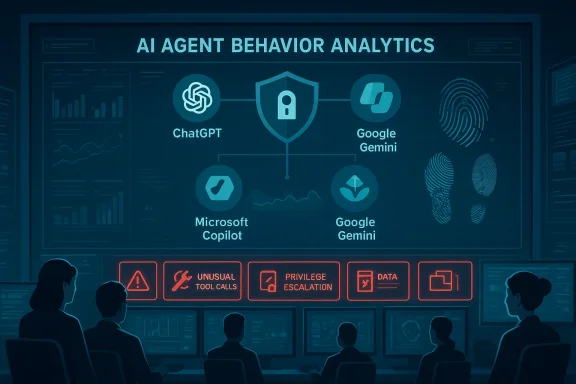
Exabeam is moving decisively to treat AI agents as first-class security subjects, not just another workload class. The company’s expanded Agent Behavior Analytics push adds visibility into ChatGPT, Microsoft Copilot, and Google Gemini, while introducing five new controls aimed at spotting risky agent activity before it turns into a breach. That shift matters because enterprises are rapidly giving AI assistants access to identity, data, and tools, which means machine-speed mistakes can now create human-scale damage. It also signals a broader security market adjustment: the next insider threat may not be a disgruntled employee, but an autonomous agent behaving within the boundaries of a valid identity.
For years, security teams have relied on behavioral analytics to detect deviations in human user activity. Exabeam built much of its reputation in that market, using timelines, scoring, and investigation workflows to make sense of suspicious insider behavior. The company is now applying the same logic to AI agents, arguing that agent activity deserves the same scrutiny as human logins, privilege changes, and lateral movement. Exabeam’s own platform description says ABA extends New-Scale Analytics to secure human and non-human identities, with centralized visibility across AI platforms and automated workflows. (exabeam.com)
That framing reflects how quickly the AI security problem has evolved. In 2024, security teams were still asking whether generative AI belonged in the SOC. By 2025 and 2026, the question has become how do we govern agents that can read, write, act, and chain tool calls on behalf of a user or service account? Microsoft’s recent security guidance is a useful parallel: the company has been expanding protections around identity, data loss prevention, and AI threat detections because organizations now need controls across the full AI lifecycle, including agent behavior. (microsoft.com)
Exabeam’s latest move sits squarely in that transition. The company says agent telemetry is being fed directly into detection, investigation, and response workflows so analysts can spot subtle deviations and potential insider threats. In practical terms, that means a security team can treat an AI assistant’s unusual prompt patterns, role changes, or access behavior much like they would an employee suddenly copying files at 2 a.m. The difference is that the agent can do it faster, at scale, and sometimes with a misleading aura of legitimacy. (exabeam.com)
There is also a strategic market angle. Security vendors are racing to define the default control plane for AI agents, and the winners will likely be the platforms that can connect identity, data, posture, and behavior into one workflow. Microsoft is pushing that direction with Entra, Purview, Defender, and Sentinel. Exabeam is making its own bid through behavioral analytics and SOC-centric response. The result is a competitive field where every major vendor is trying to become the place where agent risk is not only observed, but operationalized. (microsoft.com)
The security challenge is not limited to outright compromise. Agents can drift, overreach, or be manipulated by prompt injection, tool poisoning, or weak guardrails. Microsoft’s own AI security guidance has repeatedly highlighted risks such as indirect prompt injection, sensitive data exposure, and unsafe use of AI apps, underscoring that the threat model includes both external attackers and policy failures inside the enterprise. Exabeam’s new coverage for OWASP agentic AI risks suggests the company sees the same pattern emerging in its customer base. (microsoft.com)
The practical implication is that behavioral analytics must now do two jobs at once. First, they must identify threats that look like abuse. Second, they must filter out normal automation so teams are not buried in false positives. That is one of the central promises of agent behavior analytics: distinguish legitimate automation from risky behavior rather than assuming all machine activity is benign.
Key reasons this matters:
The company also says the platform now monitors AI agent activity across ChatGPT, Microsoft Copilot, and Google Gemini. That breadth matters because the enterprise AI landscape is fragmented. Many companies are standardizing on one productivity suite while allowing specialized teams to use another, and the security stack has to understand all of them simultaneously. Exabeam’s own documentation states that New-Scale Analytics collects and correlates activity from AI platforms, custom agents, and automation workflows into a unified view. (exabeam.com)
This is important because AI systems often look confident even when they are wrong. A sudden expansion in document access, a change in response patterns, or a new sequence of tool calls may not be visually dramatic, but it can indicate a drift in authorization or behavior. A well-tuned baseline can catch those shifts earlier than static rule-based controls.
That is also where behavioral analytics offers an advantage over purely content-based screening. Content filters can catch known bad phrases, but agent security often depends on sequence and context. A safe-looking prompt can still trigger a dangerous chain of actions if the surrounding tool calls or identity transitions are abnormal. The ability to correlate those signals is what turns scattered telemetry into a meaningful investigation.
For security teams, this is a crucial evolution. A compromised agent account can be more damaging than a compromised user because the agent may have access to data sources, automation tools, and downstream workflows all at once. If those privileges are poorly governed, one weak link can become an enterprise-wide exposure. Exabeam says its monitoring looks for first-time role assignments, unexpected privilege escalations, and unusual permission changes, which is precisely the sort of control surface that matters in this new environment.
Lifecycle visibility also helps distinguish sanctioned innovation from shadow AI. If a team launches a workflow agent outside central governance, the security team needs a way to discover it, profile it, and either bring it into policy or shut it down. That is why lifecycle tracking is not just a technical feature; it is a control mechanism for AI sprawl.
The enterprise payoff is straightforward: if privilege anomalies can be tied to agent activity in real time, organizations can interrupt suspicious access before sensitive data or tooling is abused. The consumer side is less visible, but the same logic will eventually reach personal and small-business AI environments as agents become embedded in productivity apps and cloud services.
The advantage of framework alignment is consistency. If a vendor maps detections to known AI risk classes, customers can evaluate coverage more easily and demonstrate governance to auditors or executives. Exabeam’s feature brief also says the agentic AI security use case helps benchmark readiness, track coverage over time, and align with frameworks like MITRE ATT&CK. That suggests the company is trying to make agent security legible in the same way modern SOC metrics are. (exabeam.com)
That matters because many organizations are still stuck at the awareness stage. They know AI agents are risky, but they do not yet have a standard playbook for detecting prompt injection, suspicious tool use, or agent impersonation. By anchoring detections to a known framework, Exabeam is attempting to turn a fast-moving problem into something a SOC can actually govern.
The integration with investigation workflows is particularly important. Exabeam says agent detections appear in user timelines and that machine-built timelines correlate agent behavior automatically. In other words, the company is trying to preserve the analyst’s existing mental model while extending it to non-human actors. That is a more practical approach than forcing security teams to learn a separate AI governance toolchain. (exabeam.com)
This is where the broader market is heading. Microsoft’s recent security roadmap similarly emphasizes coordinated, intelligence-driven operations across identity, data, and threat response, with Sentinel acting as an agentic defense platform. The convergence suggests vendors are no longer treating AI as a separate feature; they are trying to make it the connective tissue of modern security operations. (microsoft.com)
For smaller teams, however, the challenge will be operational maturity. More telemetry is not automatically more security. If the organization lacks ownership for AI governance, even a strong behavioral analytics layer may simply generate better warnings without clear accountability.
Exabeam’s differentiation is narrower but sharper: behavioral analytics for agent misuse, woven into SOC workflows. That focus may matter because security teams often struggle more with detection fidelity than with checklists of possible controls. If Exabeam can reliably spot deviation patterns that others miss, it has a credible market position even if it lacks the breadth of a hyperscaler. (exabeam.com)
That could be appealing to security operations teams already overloaded by tool sprawl. They want one place to see suspicious behavior, not another silo for AI governance. In that sense, Exabeam is competing on operational practicality more than on conceptual novelty.
That fragmentation is not necessarily bad for customers. It may produce better specialization and clearer category boundaries. But it also means buyers will need to decide whether they want posture, data protection, runtime defense, or behavioral analytics to be the primary control layer.
Microsoft’s recent AI security roadmap suggests the broader industry is converging on a layered model: identity control, data protection, threat detection, and operational orchestration. Exabeam is carving out a specialized place inside that model, and the question is whether behavioral analytics becomes the decisive layer or merely one component in a larger stack. The answer will depend on how quickly enterprises institutionalize AI governance. (microsoft.com)
If Exabeam executes well, it could become one of the more credible behavioral-security voices in the emerging AI agent market. If the industry matures as expected, the most effective programs will likely combine Exabeam-style detection with platform-native controls from vendors like Microsoft and governance processes built by the customer. In that future, the winners will be the organizations that treat AI agents as managed insiders from day one.
Exabeam is betting that the SOC will be the place where that discipline becomes real. That is a sensible bet, and probably an inevitable one, because the moment agents can act on behalf of users, the question stops being whether they are intelligent and starts being whether they are trustworthy.
Source: Let's Data Science https://letsdatascience.com/news/ex...avior-analytics-to-secure-ai-agents-99d463d1/
 Overview
For years, security teams have relied on behavioral analytics to detect deviations in human user activity. Exabeam built much of its reputation in that market, using timelines, scoring, and investigation workflows to make sense of suspicious insider behavior. The company is now applying the same logic to AI agents, arguing that agent activity deserves the same scrutiny as human logins, privilege changes, and lateral movement. Exabeam’s own platform description says ABA extends New-Scale Analytics to secure human and non-human identities, with centralized visibility across AI platforms and automated workflows. (exabeam.com)That framing reflects how quickly the AI security problem has evolved. In 2024, security teams were still asking whether generative AI belonged in the SOC. By 2025 and 2026, the question has become how do we govern agents that can read, write, act, and chain tool calls on behalf of a user or service account? Microsoft’s recent security guidance is a useful parallel: the company has been expanding protections around identity, data loss prevention, and AI threat detections because organizations now need controls across the full AI lifecycle, including agent behavior. (microsoft.com)
Exabeam’s latest move sits squarely in that transition. The company says agent telemetry is being fed directly into detection, investigation, and response workflows so analysts can spot subtle deviations and potential insider threats. In practical terms, that means a security team can treat an AI assistant’s unusual prompt patterns, role changes, or access behavior much like they would an employee suddenly copying files at 2 a.m. The difference is that the agent can do it faster, at scale, and sometimes with a misleading aura of legitimacy. (exabeam.com)
There is also a strategic market angle. Security vendors are racing to define the default control plane for AI agents, and the winners will likely be the platforms that can connect identity, data, posture, and behavior into one workflow. Microsoft is pushing that direction with Entra, Purview, Defender, and Sentinel. Exabeam is making its own bid through behavioral analytics and SOC-centric response. The result is a competitive field where every major vendor is trying to become the place where agent risk is not only observed, but operationalized. (microsoft.com)
Why AI Agents Have Become a Security Problem
AI agents are different from chatbots because they do something, not just say something. Once an agent is given access to emails, tickets, documents, APIs, or cloud consoles, it begins to resemble an employee with delegated authority. That makes agent behavior harder to distinguish from legitimate business activity, especially when it operates through sanctioned credentials and approved platforms. Exabeam’s ABA materials emphasize exactly this problem: trusted access can be misused, and behavioral analytics are needed to expose risky non-human activity. (exabeam.com)The security challenge is not limited to outright compromise. Agents can drift, overreach, or be manipulated by prompt injection, tool poisoning, or weak guardrails. Microsoft’s own AI security guidance has repeatedly highlighted risks such as indirect prompt injection, sensitive data exposure, and unsafe use of AI apps, underscoring that the threat model includes both external attackers and policy failures inside the enterprise. Exabeam’s new coverage for OWASP agentic AI risks suggests the company sees the same pattern emerging in its customer base. (microsoft.com)
The new insider threat model
The phrase insider threat used to imply a human actor with malicious intent or compromised credentials. That definition is no longer sufficient. An AI agent can inherit privileges, move faster than a person, and repeat harmful actions with mechanical consistency once misconfigured or hijacked. Exabeam’s messaging leans heavily into this idea, describing AI agents as a fresh class of insider risk and emphasizing first-time actions, privilege shifts, and anomalies. (exabeam.com)The practical implication is that behavioral analytics must now do two jobs at once. First, they must identify threats that look like abuse. Second, they must filter out normal automation so teams are not buried in false positives. That is one of the central promises of agent behavior analytics: distinguish legitimate automation from risky behavior rather than assuming all machine activity is benign.
Key reasons this matters:
- Agents can operate using valid enterprise credentials.
- Agent actions may look like legitimate workflow automation.
- Abuse can occur through prompts, tools, or permissions.
- Human analysts often lack visibility into agent decision paths.
- Subtle deviations may be more important than obvious alarms.
What Exabeam Says It Added
Exabeam’s expansion is built around five major capability areas: behavior baselining, prompt/model abuse detection, identity and privilege monitoring, agent lifecycle tracking, and OWASP agentic AI coverage. The vendor says these detections are meant to surface agent telemetry inside its investigation and response workflows, making AI activity visible in the same operational plane as other security signals. That is a significant design choice because it avoids creating a separate AI security island that analysts must check manually.The company also says the platform now monitors AI agent activity across ChatGPT, Microsoft Copilot, and Google Gemini. That breadth matters because the enterprise AI landscape is fragmented. Many companies are standardizing on one productivity suite while allowing specialized teams to use another, and the security stack has to understand all of them simultaneously. Exabeam’s own documentation states that New-Scale Analytics collects and correlates activity from AI platforms, custom agents, and automation workflows into a unified view. (exabeam.com)
Behavior baselining in practice
Behavior baselining is a familiar security technique, but applying it to AI agents introduces new nuance. A human user’s routine can be compared with the same person’s prior activity; an agent’s routine must often be compared with the workflow it was intended to perform. That means the baseline is less about identity alone and more about intent, context, and expected tool usage. Exabeam’s feature brief says its behavioral models are designed to catch high-risk activity including first-time actions and guardrail violations. (exabeam.com)This is important because AI systems often look confident even when they are wrong. A sudden expansion in document access, a change in response patterns, or a new sequence of tool calls may not be visually dramatic, but it can indicate a drift in authorization or behavior. A well-tuned baseline can catch those shifts earlier than static rule-based controls.
Prompt and model abuse detection
Prompt abuse and model manipulation are especially dangerous because they target the reasoning layer rather than the perimeter. Attackers can coerce an agent into revealing data, ignoring policy, or invoking tools in unintended ways. Exabeam’s new detection focus appears aimed at spotting that kind of misuse before it escalates into a broader incident.That is also where behavioral analytics offers an advantage over purely content-based screening. Content filters can catch known bad phrases, but agent security often depends on sequence and context. A safe-looking prompt can still trigger a dangerous chain of actions if the surrounding tool calls or identity transitions are abnormal. The ability to correlate those signals is what turns scattered telemetry into a meaningful investigation.
Identity, Privilege, and the Non-Human Workforce
Identity has always been the spine of enterprise security, and AI agents are now part of that identity fabric. Exabeam’s expansion places identity and privilege monitoring at the center of ABA, reflecting a reality that Microsoft has also emphasized in its own security messaging: both human and non-human identities need continuous, adaptive control. Microsoft’s March 2026 guidance highlighted unified identity security, identity risk scoring, and real-time decisions spanning human and non-human identities. (microsoft.com)For security teams, this is a crucial evolution. A compromised agent account can be more damaging than a compromised user because the agent may have access to data sources, automation tools, and downstream workflows all at once. If those privileges are poorly governed, one weak link can become an enterprise-wide exposure. Exabeam says its monitoring looks for first-time role assignments, unexpected privilege escalations, and unusual permission changes, which is precisely the sort of control surface that matters in this new environment.
Lifecycle tracking as a governance tool
Agent lifecycle tracking is an underappreciated control. Security teams often focus on what an agent did today, but governance questions also include when it was created, who approved it, when permissions changed, and whether its purpose still matches its behavior. Those questions are essential for auditability, especially when AI projects grow quickly and informal pilots become production dependencies. (exabeam.com)Lifecycle visibility also helps distinguish sanctioned innovation from shadow AI. If a team launches a workflow agent outside central governance, the security team needs a way to discover it, profile it, and either bring it into policy or shut it down. That is why lifecycle tracking is not just a technical feature; it is a control mechanism for AI sprawl.
Why privilege monitoring is different for agents
For human users, privilege monitoring often focuses on least privilege, escalation, and access review. For agents, the problem includes delegated authority, machine-to-machine handoffs, and the possibility that a single agent can act across multiple applications. That creates a more fluid trust model than traditional identity systems were built for. Exabeam’s messaging suggests the company wants to narrow that gap by treating agents as governable identities with measurable behavior. (exabeam.com)The enterprise payoff is straightforward: if privilege anomalies can be tied to agent activity in real time, organizations can interrupt suspicious access before sensitive data or tooling is abused. The consumer side is less visible, but the same logic will eventually reach personal and small-business AI environments as agents become embedded in productivity apps and cloud services.
Why OWASP Agentic AI Coverage Matters
Exabeam’s inclusion of OWASP agentic AI coverage is a smart signaling move because OWASP has become a common language for AI risk categorization. Security leaders increasingly use OWASP-style frameworks to align product controls with recognized threat classes, and that helps translate AI security from abstract concern into a concrete control map. Microsoft has already used OWASP’s generative AI risks as a reference point for new detections, including indirect prompt injection and sensitive data exposure. (microsoft.com)The advantage of framework alignment is consistency. If a vendor maps detections to known AI risk classes, customers can evaluate coverage more easily and demonstrate governance to auditors or executives. Exabeam’s feature brief also says the agentic AI security use case helps benchmark readiness, track coverage over time, and align with frameworks like MITRE ATT&CK. That suggests the company is trying to make agent security legible in the same way modern SOC metrics are. (exabeam.com)
From checklist to operational control
Framework coverage only matters if it changes operations. The real value of OWASP alignment is that it can shape detection logic, tuning, reporting, and incident response. A checkbox approach would be useless; a mapped control set can help teams prioritize the riskiest behaviors first and show progress over time. (exabeam.com)That matters because many organizations are still stuck at the awareness stage. They know AI agents are risky, but they do not yet have a standard playbook for detecting prompt injection, suspicious tool use, or agent impersonation. By anchoring detections to a known framework, Exabeam is attempting to turn a fast-moving problem into something a SOC can actually govern.
Competitive implication for the market
This also sets up a quiet contest among security vendors. Some will emphasize posture, some will emphasize data controls, and some will emphasize runtime or behavioral detection. Exabeam is clearly betting that the winning story is behavior plus investigation plus response. That may resonate with SOC teams that want fewer disconnected dashboards and more actionable timelines.How This Fits Into Exabeam’s Larger Platform Strategy
Exabeam is not introducing ABA as a standalone curiosity; it is embedding it into its broader New-Scale Analytics and New-Scale Fusion strategy. The company says ABA adds behavioral analytics to any SIEM, while New-Scale Fusion offers a fully integrated platform for organizations that want a more complete modernization path. That dual-path positioning is clever because it reduces adoption friction for customers who are not ready for a platform replacement. (exabeam.com)The integration with investigation workflows is particularly important. Exabeam says agent detections appear in user timelines and that machine-built timelines correlate agent behavior automatically. In other words, the company is trying to preserve the analyst’s existing mental model while extending it to non-human actors. That is a more practical approach than forcing security teams to learn a separate AI governance toolchain. (exabeam.com)
The role of generative AI in security operations
Exabeam is also using generative AI inside the security platform itself. Its product page says Exabeam Nova can summarize threats, recommend next steps, and help analysts investigate complex incidents involving both human and non-human identities. That creates a layered proposition: AI agents are both the thing being secured and part of the toolset used to secure them. (exabeam.com)This is where the broader market is heading. Microsoft’s recent security roadmap similarly emphasizes coordinated, intelligence-driven operations across identity, data, and threat response, with Sentinel acting as an agentic defense platform. The convergence suggests vendors are no longer treating AI as a separate feature; they are trying to make it the connective tissue of modern security operations. (microsoft.com)
Enterprise deployment implications
For enterprises, Exabeam’s approach may be attractive because it promises incremental adoption. Organizations can keep their SIEM investments and add AI-agent visibility on top, rather than ripping out core infrastructure. That lowers procurement friction and could speed deployment in heavily regulated environments. (exabeam.com)For smaller teams, however, the challenge will be operational maturity. More telemetry is not automatically more security. If the organization lacks ownership for AI governance, even a strong behavioral analytics layer may simply generate better warnings without clear accountability.
Comparing Exabeam’s Approach With Microsoft and the Broader Ecosystem
Exabeam’s announcement lands in a market where major vendors are rapidly hardening their AI stories. Microsoft has recently expanded protections across identity, data loss prevention, posture management, and AI detections, with coverage that includes Gemini, Gemma, Meta Llama, Mistral, and custom models in its ecosystem. It has also tied those controls to Entra, Purview, Defender, and Sentinel, giving it a broad platform narrative that spans productivity, cloud, and security. (microsoft.com)Exabeam’s differentiation is narrower but sharper: behavioral analytics for agent misuse, woven into SOC workflows. That focus may matter because security teams often struggle more with detection fidelity than with checklists of possible controls. If Exabeam can reliably spot deviation patterns that others miss, it has a credible market position even if it lacks the breadth of a hyperscaler. (exabeam.com)
Where Exabeam is likely strongest
Exabeam looks strongest where analysts need correlation, timelines, and incident context. Its core heritage is in user and entity behavior analytics, so extending that model to agents is a logical product move. The company is effectively saying that AI agents should be handled as a special case of entity behavior, not a completely separate discipline. (exabeam.com)That could be appealing to security operations teams already overloaded by tool sprawl. They want one place to see suspicious behavior, not another silo for AI governance. In that sense, Exabeam is competing on operational practicality more than on conceptual novelty.
Where competitors may counter
Larger vendors may counter with tighter integration into identity and data control planes. Microsoft’s advantage is that it can bind agent security directly to Entra, Purview, and Defender. Other vendors may also target SaaS-specific agent risk, data governance, or custom-agent runtime protections. The market is likely to fragment before it consolidates. (microsoft.com)That fragmentation is not necessarily bad for customers. It may produce better specialization and clearer category boundaries. But it also means buyers will need to decide whether they want posture, data protection, runtime defense, or behavioral analytics to be the primary control layer.
Strengths and Opportunities
Exabeam’s announcement has several strengths that could make it attractive to security buyers, especially those already invested in SIEM-centric operations. The biggest opportunity is that it maps a new risk class onto an existing workflow rather than forcing a parallel toolchain. That is the kind of product design that tends to win adoption in real enterprises, where security teams are already stretched thin.- Unified visibility across human and non-human activity.
- Behavioral baselining that can catch subtle misuse.
- Investigation timelines that reduce analyst context switching.
- Framework alignment with OWASP and MITRE-style governance.
- Incremental deployment through New-Scale Analytics on top of existing SIEMs.
- Better executive reporting for AI oversight and audit readiness.
- Stronger detection fidelity for agent-specific anomalies.
Why this could resonate now
The timing is favorable because organizations are moving from AI experimentation to operational deployment. As more workflows become semi-autonomous, security teams need signals they can trust, not just policy statements. Exabeam is positioning ABA as a practical answer to that need, and that makes the offering more than a feature update. (exabeam.com)Risks and Concerns
The most obvious risk is overpromising. AI agents are a moving target, and no vendor can fully guarantee coverage across every model, platform, prompt chain, and workflow. If customers believe behavioral analytics alone will solve agent risk, they may underinvest in identity governance, data controls, and secure development practices. That would be dangerously incomplete.- False positives may increase as organizations tune baselines.
- Blind spots may persist in custom or niche agent frameworks.
- Policy drift can outpace detection rule maintenance.
- Vendor overlap may create confusion with other security stacks.
- Operational overload could follow if teams lack AI governance ownership.
- Integration gaps may limit value in heterogeneous environments.
- Overreliance on analytics may delay stronger preventive controls.
The human factor still matters
A second concern is organizational readiness. If a company does not know who owns AI oversight, then agent telemetry may simply become another stream of alerts with no clear action path. Security tooling is only as effective as the people and processes behind it. Exabeam can surface risk, but it cannot assign accountability inside the business.What to Watch Next
The next phase of this story will be measured less by announcement language and more by operational proof. Buyers will want to know whether Exabeam can reduce time to detect, improve investigation fidelity, and identify real agent abuse without flooding analysts with noise. They will also want clarity on how well the platform handles custom agents, shadow AI, and multicloud deployments.Microsoft’s recent AI security roadmap suggests the broader industry is converging on a layered model: identity control, data protection, threat detection, and operational orchestration. Exabeam is carving out a specialized place inside that model, and the question is whether behavioral analytics becomes the decisive layer or merely one component in a larger stack. The answer will depend on how quickly enterprises institutionalize AI governance. (microsoft.com)
Key signals to monitor
- Whether Exabeam publishes concrete reduction metrics for agent-related incidents.
- Whether enterprise customers extend ABA beyond ChatGPT, Copilot, and Gemini.
- Whether integration partners emerge around custom agent frameworks.
- Whether OWASP-aligned detections become a de facto buyer requirement.
- Whether competitors respond with stronger agent identity and lifecycle controls.
Looking Ahead
Exabeam’s expansion is a sign that AI security is no longer about preventing employees from pasting secrets into chatbots. The center of gravity is shifting toward autonomous and semi-autonomous systems that can access data, invoke tools, and act with delegated authority. That makes behavior monitoring, identity governance, and lifecycle control central concerns rather than niche add-ons.If Exabeam executes well, it could become one of the more credible behavioral-security voices in the emerging AI agent market. If the industry matures as expected, the most effective programs will likely combine Exabeam-style detection with platform-native controls from vendors like Microsoft and governance processes built by the customer. In that future, the winners will be the organizations that treat AI agents as managed insiders from day one.
Exabeam is betting that the SOC will be the place where that discipline becomes real. That is a sensible bet, and probably an inevitable one, because the moment agents can act on behalf of users, the question stops being whether they are intelligent and starts being whether they are trustworthy.
Source: Let's Data Science https://letsdatascience.com/news/ex...avior-analytics-to-secure-ai-agents-99d463d1/
Last edited:
