

Exabeam’s move to extend Agent Behaviour Analytics to ChatGPT and Microsoft Copilot marks another sign that enterprise security is shifting from human-centric monitoring to digital workforce oversight. The company is now treating AI assistants and autonomous agents as observable identities inside the enterprise, with telemetry designed to feed detection, investigation and response workflows. That matters because the more capable these tools become, the more their activity resembles legitimate business work rather than obvious abuse. In other words, the better the agent, the harder it can be to spot when something is wrong.
The security industry has spent years refining controls for users, devices and applications, but AI agents complicate that model by blending identity, automation and decision-making into one operating layer. Exabeam’s earlier work focused on user and entity behaviour analytics, and the company has now extended that logic to the AI layer, beginning with Google Gemini and now expanding to ChatGPT and Copilot. This is not just a product feature update; it is a framing statement about where modern enterprise risk now lives.
The timing is important. Generative AI has moved from novelty to operational dependence in a remarkably short period, with organisations deploying assistants in customer service, software development, internal search, document drafting and workflow automation. As these tools begin to invoke APIs, access internal systems and perform multi-step tasks, the traditional boundary between a user action and a machine action becomes blurry. That makes old assumptions about audit trails and anomaly detection less reliable than they used to be.
Exabeam is responding to a market-wide problem: security teams can no longer assume that every action behind a corporate login corresponds to a human making a conscious decision. The rise of non-human identities and agentic workflows means a system may need to baseline not just users, but also the software personas acting on their behalf. That is a big change for security operations, and it is still early days.
OpenAI and Microsoft both already provide enterprise controls around their AI products, including admin management, role-based access, auditability and privacy features. OpenAI says ChatGPT Enterprise includes SAML SSO, SCIM, role-based access controls and usage analytics, while Microsoft’s Copilot control model similarly emphasizes governance, lifecycle visibility and access controls for agents and Copilot use cases. Exabeam’s pitch is that native vendor controls are necessary but not sufficient, because organisations still need cross-platform behavioural visibility to understand whether an agent is acting normally or drifting into risk.
This is where behavioural analytics becomes more valuable than a rules-only approach. The security value lies in knowing what “normal” looks like for a given agent, then detecting drift before the drift turns into an incident. That approach also aligns with the broader insider-risk playbook, where context often matters more than a single high-risk event.
The idea of dynamic profiling is especially important for mixed human-agent environments. A person may work irregular hours; an agent may run continuously; a shared workflow may involve both. Security teams therefore need a model that can distinguish the routine from the unusual without treating every automation spike as a breach.
The company’s mention of “shadow AI” at the point of entry is also telling. Many organisations are already struggling to inventory which AI services employees are using, let alone how those services are being chained into workflows. The ability to detect unsanctioned AI activity early is likely to become a major buying criterion for enterprise buyers who do not want AI adoption to outpace governance.
The focus on first-agent-creation and invocation as auditable signals is a useful step because it creates a traceable beginning for each digital worker. That helps teams answer basic questions such as who created the agent, what permissions it received and whether it has changed in ways that deserve review. Those are simple questions, but in agentic security they can be surprisingly hard to answer.
Exabeam is clearly betting that security teams want a vendor-neutral lens across these ecosystems. Native controls tell you what the platform itself sees, but a security operations platform can correlate that with identity, endpoint, network and cloud activity. That broader context matters when AI use is no longer isolated to a single application.
That divide also explains why security vendors are leaning so hard into agent governance. Consumer AI risk is often about mistakes or privacy leakage; enterprise AI risk includes those issues, but also privilege escalation, workflow sabotage and data movement across systems. The latter is where detection and response tooling becomes essential.
That said, framework alignment should never be mistaken for full protection. OWASP guidance can define risk areas, but a vendor still has to prove it can detect real behaviour in real environments. A framework is a compass, not a shield.
For Exabeam, aligning to OWASP is therefore both practical and defensive. It helps anchor the company’s product story in familiar security language while the market decides what “good” AI governance actually looks like.
This is why behavioural baselining matters so much. If a given agent usually performs a narrow set of actions at predictable intervals, a sudden change in timing, destination or approval path becomes a stronger signal than the action itself. The best monitoring systems will therefore focus on drift, not just density.
Exabeam’s move suggests it wants to be the platform that turns this complexity into something legible. The question is whether the company can make the output operationally useful, rather than just data-rich.
Exabeam’s advantage is that behavioural analytics gives it a coherent narrative across human and non-human entities. That narrative is compelling because it reduces the need to bolt together multiple point tools just to answer basic questions about suspicious AI activity. Still, competitors will push their own claims about native controls and platform depth.
OpenAI, Microsoft and the rest of the enterprise AI ecosystem will continue to add native admin and compliance features, but that will not eliminate the need for external behavioural visibility. In large organisations, no single vendor sees everything, and that is especially true when AI workflows cross SaaS, identity, cloud and security boundaries. The future of AI security will almost certainly be layered, not singular.
Source: SecurityBrief Australia https://securitybrief.com.au/story/exabeam-expands-ai-agent-analytics-to-chatgpt-copilot/
 Background
The security industry has spent years refining controls for users, devices and applications, but AI agents complicate that model by blending identity, automation and decision-making into one operating layer. Exabeam’s earlier work focused on user and entity behaviour analytics, and the company has now extended that logic to the AI layer, beginning with Google Gemini and now expanding to ChatGPT and Copilot. This is not just a product feature update; it is a framing statement about where modern enterprise risk now lives.The timing is important. Generative AI has moved from novelty to operational dependence in a remarkably short period, with organisations deploying assistants in customer service, software development, internal search, document drafting and workflow automation. As these tools begin to invoke APIs, access internal systems and perform multi-step tasks, the traditional boundary between a user action and a machine action becomes blurry. That makes old assumptions about audit trails and anomaly detection less reliable than they used to be.
Exabeam is responding to a market-wide problem: security teams can no longer assume that every action behind a corporate login corresponds to a human making a conscious decision. The rise of non-human identities and agentic workflows means a system may need to baseline not just users, but also the software personas acting on their behalf. That is a big change for security operations, and it is still early days.
OpenAI and Microsoft both already provide enterprise controls around their AI products, including admin management, role-based access, auditability and privacy features. OpenAI says ChatGPT Enterprise includes SAML SSO, SCIM, role-based access controls and usage analytics, while Microsoft’s Copilot control model similarly emphasizes governance, lifecycle visibility and access controls for agents and Copilot use cases. Exabeam’s pitch is that native vendor controls are necessary but not sufficient, because organisations still need cross-platform behavioural visibility to understand whether an agent is acting normally or drifting into risk.
Why agent behaviour analytics matters
The core logic behind Exabeam’s update is straightforward: if an AI agent can authenticate, call tools, and trigger business processes, then it can also be compromised, misused or over-privileged. Behavioural analytics is useful here because a compromised agent may not look “malicious” in the way classic malware or credential theft does. Instead, it may simply look efficient — fast, confident and entirely within the boundaries of an allowed workflow.From chatbot to worker
Steve Wilson’s description of AI agents as “autonomous digital workers” captures the shift well. A chatbot answers; a worker acts. That distinction matters because action introduces state, permissions, side effects and accountability, all of which create security exposures that are far richer than a prompt-response exchange. Once an AI tool can book, create, modify, delete or publish, it becomes part of the operational attack surface.- AI agents can invoke tools without a human watching every step.
- They may inherit broad permissions from the account or service principal they use.
- Their actions can appear legitimate even when the underlying intent is compromised.
- Traditional alerting may miss subtle deviations in token use, session patterns or call volume.
- A security team needs baseline behaviour, not just event logging.
Why classic controls are not enough
The problem with purely policy-based controls is that they often answer only one question: “Was this action allowed?” They do not always answer the more important one: “Was this action expected?” That gap matters in agentic environments, where malicious use can stay inside the lines of the policy while still producing harmful results.This is where behavioural analytics becomes more valuable than a rules-only approach. The security value lies in knowing what “normal” looks like for a given agent, then detecting drift before the drift turns into an incident. That approach also aligns with the broader insider-risk playbook, where context often matters more than a single high-risk event.
What Exabeam actually added
Exabeam says the expanded capability now converts activity in ChatGPT and Microsoft Copilot into telemetry that can be consumed by its threat detection, investigation and response workflows. The company’s framing suggests it is not only collecting access events, but also interpreting them as part of a larger behavioural picture. That makes the release less about raw logging and more about security context.Telemetry and dynamic profiling
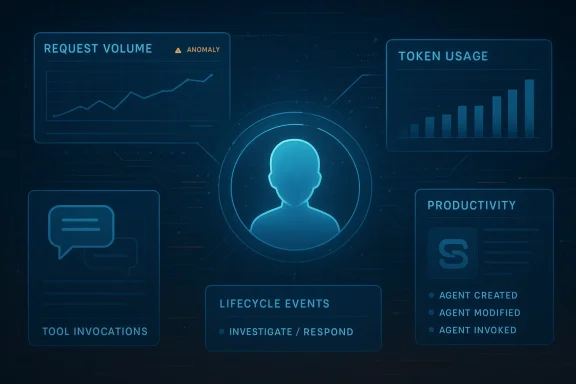
According to the announcement, Exabeam can build dynamic profiles for users and AI agents by tracking request volume, token usage, tool invocations, web sessions and outbound activity. Those signals are useful because they describe both intensity and intent. A large burst of requests might be benign, but paired with unfamiliar destinations or unusual tool chains, it becomes more meaningful.The idea of dynamic profiling is especially important for mixed human-agent environments. A person may work irregular hours; an agent may run continuously; a shared workflow may involve both. Security teams therefore need a model that can distinguish the routine from the unusual without treating every automation spike as a breach.
- Request volume can show workload drift.
- Token usage can flag unexpected depth or scale of model interaction.
- Tool invocation patterns can reveal whether an agent is taking a new path.
- Web session data can help correlate browser-driven activity.
- Outbound activity can expose possible data movement or exfiltration.
New detections and a larger library
Exabeam also says it expanded detection for prompt injection, model manipulation and tool exploitation, with a detection library that is now five times larger than before. That is a meaningful claim because agent security is still a young discipline, and teams are trying to separate genuinely dangerous patterns from generic AI noise. More coverage is useful, but only if it is tuned well enough to avoid drowning analysts in false positives.The company’s mention of “shadow AI” at the point of entry is also telling. Many organisations are already struggling to inventory which AI services employees are using, let alone how those services are being chained into workflows. The ability to detect unsanctioned AI activity early is likely to become a major buying criterion for enterprise buyers who do not want AI adoption to outpace governance.
Lifecycle visibility and identity controls
Another important update is lifecycle monitoring for AI agents, including visibility into their creation, modification and use. This is conceptually similar to identity governance in traditional IAM, but applied to software entities that may be born in a low-friction self-service workflow and then become powerful quickly. If an agent can be created, altered and activated by different people or systems, those transitions become security events in their own right.The focus on first-agent-creation and invocation as auditable signals is a useful step because it creates a traceable beginning for each digital worker. That helps teams answer basic questions such as who created the agent, what permissions it received and whether it has changed in ways that deserve review. Those are simple questions, but in agentic security they can be surprisingly hard to answer.
ChatGPT, Copilot and the enterprise AI stack
The decision to support both ChatGPT and Microsoft Copilot is strategically smart because those platforms sit near the center of enterprise AI adoption. ChatGPT Enterprise is positioned as a controlled business workspace with admin tools, enterprise privacy and audit features, while Microsoft’s Copilot ecosystem is increasingly embedded into Microsoft 365 and related admin surfaces. Supporting both allows Exabeam to speak to two of the most visible enterprise AI channels in the market.Why these platforms matter
ChatGPT Enterprise has become a benchmark for managed generative AI deployments, with controls such as SSO, SCIM and usage insights that give organisations a structured way to roll out AI at scale. Microsoft Copilot, meanwhile, benefits from deep integration into the productivity stack many enterprises already run. That makes Copilot especially important in environments where AI usage is likely to be widespread, permissioned and tied directly to employee workflows.Exabeam is clearly betting that security teams want a vendor-neutral lens across these ecosystems. Native controls tell you what the platform itself sees, but a security operations platform can correlate that with identity, endpoint, network and cloud activity. That broader context matters when AI use is no longer isolated to a single application.
Enterprise versus consumer impact
For consumers, this announcement is mostly invisible. Most individual users will never think about their prompt volume as a security metric, and they probably should not have to. For enterprises, however, the stakes are higher because AI usage is now tied to corporate accounts, proprietary data and workflow automation. The enterprise use case demands oversight, auditability and accountability in ways consumer AI never really does.That divide also explains why security vendors are leaning so hard into agent governance. Consumer AI risk is often about mistakes or privacy leakage; enterprise AI risk includes those issues, but also privilege escalation, workflow sabotage and data movement across systems. The latter is where detection and response tooling becomes essential.
A signal of platform consolidation
There is another layer here: by extending into ChatGPT and Copilot, Exabeam is also strengthening its place in a crowded market of security platforms trying to own AI governance. That market includes identity vendors, cloud security vendors, SIEM providers and specialist AI security firms. The more AI becomes embedded in normal operations, the more every one of those vendors will claim a role in monitoring it.- ChatGPT gives Exabeam visibility into a fast-growing enterprise AI workspace.
- Microsoft Copilot ties the story to productivity and admin governance.
- Google Gemini visibility gives the company multi-platform coverage.
- Cross-platform analytics help avoid siloed security decisions.
- Vendor-neutral monitoring is attractive to large, heterogeneous organisations.
Why the OWASP alignment matters
Exabeam says the product has been aligned with the OWASP Top 10 for Agentic AI, which is a meaningful signal even if the category is still evolving. OWASP frameworks often matter less because they are final and more because they become a shared vocabulary for practitioners, auditors and vendors. In that sense, alignment is as much about legitimacy as it is about technical coverage.Frameworks create buying language
In emerging security categories, buyers rarely purchase against a complete standard. They buy against a framework that helps them compare tools and justify risk-reduction choices. If an AI security product can map itself to a recognised set of agentic risks, that can simplify procurement conversations and help security leaders explain why new controls are necessary.That said, framework alignment should never be mistaken for full protection. OWASP guidance can define risk areas, but a vendor still has to prove it can detect real behaviour in real environments. A framework is a compass, not a shield.
Why the category is still unsettled
Agentic AI security is still in a formative phase because the technology stack itself is moving quickly. New agent frameworks, new tool invocation models and new integrations appear faster than standards can stabilise. OWASP’s recent work on agentic and MCP-related risks underlines the same reality: the attack surface is already broad, but the vocabulary for defending it is still catching up.For Exabeam, aligning to OWASP is therefore both practical and defensive. It helps anchor the company’s product story in familiar security language while the market decides what “good” AI governance actually looks like.
The analytics challenge for security teams
Exabeam’s pitch is attractive because it promises clarity in a very messy domain. But the practical challenge for security teams is not simply collecting more signals. It is determining which signals actually matter, how to correlate them and how to present them to analysts without overwhelming them.Signal quality versus signal volume
AI environments can generate huge volumes of low-value activity. A single agent might call multiple tools, retry failed actions, query external sources and cycle through intermediate steps before it produces a final answer. That means raw volume alone is a poor proxy for risk, because high activity can be normal by design. Security teams need context-rich analytics that distinguish healthy agent orchestration from chaotic or malicious behaviour.This is why behavioural baselining matters so much. If a given agent usually performs a narrow set of actions at predictable intervals, a sudden change in timing, destination or approval path becomes a stronger signal than the action itself. The best monitoring systems will therefore focus on drift, not just density.
Human and machine together
Dayforce’s endorsement in the source material gets at one of the hardest problems facing enterprises: humans and autonomous agents now interact with the same systems at scale. That means security teams must reason about blended behaviour in which the human may initiate the task, the agent may execute it and a third system may approve or log it. Untangling responsibility in that chain is hard even when everything is working properly.- Human intent may be benign while agent execution is risky.
- Agent intent may be opaque even when the output looks useful.
- Shared accounts and service identities complicate attribution.
- Legacy SIEM models may not understand agent lifecycle events.
- Security teams need a single narrative across all actors, not separate dashboards.
Why investigation workflows need to change
Traditional incident response assumes a relatively stable mapping between user identity and action. With agents, the investigator may need to ask who created the workflow, which prompts it used, what tools it touched, what data it accessed and whether the behaviour deviated from prior runs. That is a much richer investigative flow, and it requires platforms that can retain and correlate the right metadata.Exabeam’s move suggests it wants to be the platform that turns this complexity into something legible. The question is whether the company can make the output operationally useful, rather than just data-rich.
Competitive implications
This release also tells us something about where the broader security market is heading. Vendors are racing to own the language of AI visibility, agent governance and digital worker security, because these terms may become the next major category boundary in enterprise cybersecurity. Whoever frames the problem best may control the budget line that follows.A crowded and expanding field
The competitive field is no longer just SIEM and XDR. It now includes identity providers, cloud security platforms, data loss prevention tools, browser security vendors and specialist AI governance startups. Each of these vendors can plausibly argue that it sees part of the AI risk picture. The strategic question is whether customers want many narrow tools or one behavioural system that stitches them together.Exabeam’s advantage is that behavioural analytics gives it a coherent narrative across human and non-human entities. That narrative is compelling because it reduces the need to bolt together multiple point tools just to answer basic questions about suspicious AI activity. Still, competitors will push their own claims about native controls and platform depth.
What rivals may do next
Expect other security vendors to expand their own AI-monitoring language quickly. Some will emphasize endpoint-level visibility, others SaaS posture, and others cloud entitlement monitoring. A few will likely create agent-specific risk models or marketplaces of AI detections. The key competitive question is whether those features remain demos or become durable enterprise capabilities.- Identity vendors will stress permissions and access governance.
- SIEM vendors will stress correlation and case management.
- Cloud vendors will stress native telemetry and control.
- DLP vendors will stress data exposure and exfiltration paths.
- Specialist AI security vendors will stress prompt, model and tool abuse.
The market is moving from hype to control
There is a healthy dose of marketing in every new security category, and agentic AI is no exception. But the market is also moving toward practical deployment issues: who can create agents, what they can access, how they are audited and what happens when they misbehave. Those are procurement-grade questions, which means the vendors who answer them best will likely win the early enterprise deals.Strengths and Opportunities
Exabeam’s expansion has several real strengths. It builds on the company’s existing behavioural analytics base rather than forcing customers into a completely new security model, and that continuity should help adoption. It also positions Exabeam well for the next phase of enterprise AI governance, when organisations will need to track both activity and accountability across multiple AI platforms.- Cross-platform coverage across ChatGPT, Copilot and Gemini reduces blind spots.
- Behavioural baselining is a practical way to spot subtle misuse.
- Lifecycle monitoring gives security teams a cleaner audit trail.
- OWASP alignment helps the product map to a growing industry vocabulary.
- Digital worker framing matches how enterprises are increasingly using AI.
- Security operations integration makes the telemetry more actionable than standalone logs.
- Vendor-neutral positioning may appeal to large, mixed environments.
Risks and Concerns
The biggest risk is that the market may move faster than the controls can mature. Agentic AI systems change quickly, which means detection libraries, baselines and policy logic can become outdated almost as soon as they are deployed. There is also a danger that security teams will be inundated with noisy alerts if the vendor over-indexes on volume and under-indexes on context.- False positives could create analyst fatigue.
- Model drift may make baselines stale.
- Shadow AI can be hard to inventory completely.
- Tool sprawl may fragment governance across products.
- Overlapping controls can produce confusion rather than clarity.
- Rapid platform change may outpace the product roadmap.
- Privacy concerns could arise if monitoring feels too invasive.
Looking Ahead
The next phase of this story will be less about whether AI agents need monitoring and more about who can monitor them in a way that is operationally meaningful. Enterprises are quickly discovering that governance for human users and governance for digital workers are related but not identical problems. The vendors that succeed will be the ones that can translate technical telemetry into risk decisions that security, identity and AI platform teams can all understand.OpenAI, Microsoft and the rest of the enterprise AI ecosystem will continue to add native admin and compliance features, but that will not eliminate the need for external behavioural visibility. In large organisations, no single vendor sees everything, and that is especially true when AI workflows cross SaaS, identity, cloud and security boundaries. The future of AI security will almost certainly be layered, not singular.
- Watch for more vendors to announce agent lifecycle and tool-use monitoring.
- Expect stronger demand for audit trails tied to AI creation and modification events.
- Look for greater emphasis on identity-to-agent mapping in enterprise security.
- Monitor whether framework alignment, especially OWASP, turns into procurement language.
- Pay attention to whether customers report measurable reductions in AI-related investigation time.
Source: SecurityBrief Australia https://securitybrief.com.au/story/exabeam-expands-ai-agent-analytics-to-chatgpt-copilot/
Last edited:
