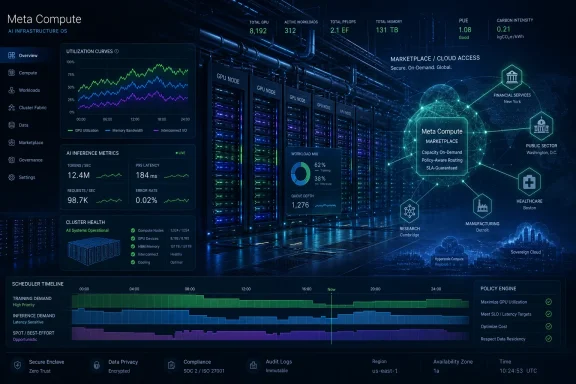
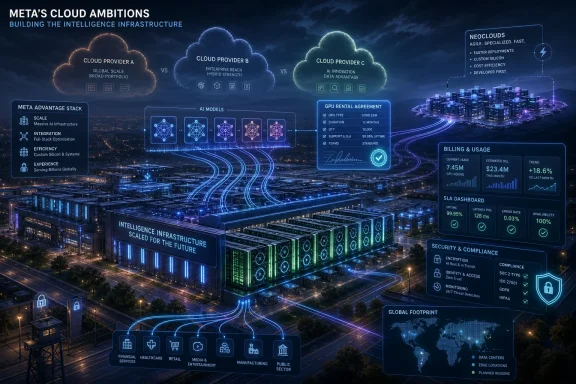
Meta Platforms is developing plans for an AI cloud business that would sell outside customers access to computing power and hosted models, according to reporting published July 1, 2026, putting the Facebook parent on a collision course with Amazon Web Services, Microsoft Azure and Google Cloud. The move is not a finished product announcement, and Meta has not publicly committed to launch terms, pricing, regions or enterprise support. But the outline is clear enough to matter: Mark Zuckerberg’s giant AI infrastructure buildout may become not only a cost center for “superintelligence,” but a commercial cloud business in its own right. For Windows users, developers and IT departments, that means the AI cloud market is starting to look less like a three-hyperscaler race and more like a fight over who can turn scarce GPU capacity into durable platform power.
The most generous reading of Meta’s plan is that it is classic cloud arbitrage. The company is buying or leasing staggering amounts of AI infrastructure for its own models, apps and assistants; when that capacity is not fully consumed internally, it can be sold to developers and enterprises at a premium. That is not a side hustle if the numbers get big enough. It is a way to convert speculative capital expenditure into revenue while preserving the option to pull capacity back when Meta needs it.
The less generous reading is that Meta is trying to explain away the anxiety that naturally follows a massive AI spending binge. Investors have watched the company commit enormous sums to data centers, power, networking and accelerator capacity without the same clean monetization story that advertising once offered. “We might rent the extra compute” is therefore more than an operational idea. It is a narrative patch for the uncomfortable possibility that the industry is building faster than its near-term demand can absorb.
That tension is exactly why the report moved markets. Meta shares jumped, while several AI infrastructure specialists fell, because Wall Street heard two things at once. First, Meta may have a new revenue stream. Second, companies whose whole pitch is “we have the GPUs” may face competition from a platform giant with deeper pockets, broader distribution and no need to make cloud rental its only business.
That is where Meta’s possible entry is interesting. It is unlikely to replicate AWS, Azure or Google Cloud overnight, and it does not need to. If the first product is access to hosted AI models, it competes less with a full hyperscaler account and more with the API layer where developers already buy tokens. If the second product is raw AI compute, it competes with neocloud vendors that rent clusters to AI labs, startups and enterprises priced out of or waitlisted by the big three.
Microsoft is the most directly implicated from a WindowsForum perspective because Azure has become the enterprise bridge between Microsoft 365, Windows, identity, security and AI services. Azure’s AI story is not just “we rent GPUs.” It is “your users, your tenant, your compliance posture and your developer workflows already live here.” Meta can challenge the supply side of that equation, but it will have to prove that raw capacity and model access are enough to overcome the gravitational pull of enterprise integration.
AWS has a different problem. It remains the default cloud vendor for a huge share of the market, but AI has reduced the advantage of general-purpose breadth in some buying decisions. A startup training or serving models may care more about accelerator availability, price and interconnect performance than about an encyclopedic catalog of managed services. Google, meanwhile, has its own AI research pedigree, TPU infrastructure and cloud ambitions. Meta’s move would pressure all three, but it would do so most sharply in the narrow band of workloads where GPU supply is the product.
If Meta hosts its own models and potentially third-party models, it can sell convenience rather than just capacity. Developers do not necessarily want to negotiate data center contracts, tune clusters, manage drivers or build inference pipelines. They want endpoints, rate limits, billing, monitoring and assurances that the service will not vanish during the next internal priority shift. The cloud business, in other words, is not the GPUs. It is the operating model around the GPUs.
That is where Meta’s consumer DNA cuts both ways. The company knows how to run infrastructure at planetary scale, and its engineering history includes some of the most demanding social, messaging and recommendation systems ever built. But enterprise cloud customers buy more than technical competence. They buy account teams, service-level commitments, audit paperwork, procurement compatibility, regional guarantees and a support culture that does not treat external developers as an afterthought.
Meta has tried developer platforms before. Some became essential for a time, and some were eventually constrained, deprecated or reshaped around Meta’s own strategic needs. A CIO evaluating Meta Compute, should it become a public product, will remember that history. The question will not be whether Meta can run the machines. The question will be whether Meta can behave like a long-term infrastructure vendor when its core business incentives still revolve around advertising, consumer engagement and internal AI advantage.
But AI compute is not perfectly fungible. Training clusters depend on networking, storage, scheduling, reliability and software maturity. Inference depends on latency, geographic placement, model optimization and predictable scaling. A cheap cluster that is difficult to use or unreliable under load is not cheap for long.
This is why neocloud providers have grown quickly but remain exposed. Their value proposition is strongest when demand outstrips hyperscaler supply. If Meta, xAI-linked infrastructure, Oracle, Google, Microsoft, Amazon and specialist GPU clouds all chase the same external customers, the market could move from shortage to segmentation. Premium buyers will pay for reliable, integrated platforms. Experimental buyers will chase price. The weakest middle may get squeezed.
Meta’s advantage is that it can subsidize ambiguity. A pure-play cloud provider has to make the rental business work on its own economics. Meta can justify infrastructure for internal AI, advertising, ranking, content generation, assistants and research, then sell surplus when it exists. That makes it dangerous to competitors because it does not have to price like a company whose only product is compute rental.
This is a striking inversion of traditional cloud planning. The hyperscalers usually build around expected external demand, internal platform needs and long-term regional expansion. Meta’s framing starts from an internal AI arms race and treats external cloud sales as an option embedded in the capital plan. That does not make it irrational. It makes it a hedge.
The hedge matters because nobody knows the durable demand curve for AI compute. Today’s appetite looks insatiable because every major lab, enterprise vendor and well-funded startup is racing to train or serve larger systems. But if model efficiency improves, specialized chips proliferate, inference costs fall or customers balk at AI subscription sprawl, some capacity could become less scarce than expected. In that world, the companies with the best monetization channels will fare better than those holding undifferentiated GPU leases.
Meta is effectively telling investors that its infrastructure spending has multiple exits. The best outcome is that internal AI products become so valuable that Meta uses all the capacity itself. The fallback is that outside developers and enterprises pay to use what Meta does not need. The risk is that neither internal monetization nor external rental produces returns matching the scale of the buildout.
If Meta exposes hosted models through conventional APIs, Windows developers could consume those services from .NET, Python, JavaScript, PowerShell-driven automation or any other runtime that can make authenticated web requests. The operating system becomes less important than the development pipeline. Visual Studio, GitHub Actions, Azure DevOps, Windows Subsystem for Linux and container tooling can all target external AI endpoints if the service is documented and stable.
The catch is trust. Enterprise developers need to know what happens to prompts, embeddings, fine-tuning data, logs and outputs. They need clarity on retention, training use, tenant isolation, encryption, access controls and compliance certifications. Microsoft has spent years tying Azure AI to the broader Microsoft trust, identity and compliance stack. Meta would have to earn that confidence from a different starting point.
For smaller developers, the calculus may be more opportunistic. If Meta offers aggressive pricing, strong open-model support or access to models that perform well in consumer, social, media or multilingual use cases, experimentation will follow. The first wave of adoption may not come from Fortune 500 procurement teams. It may come from builders who treat AI providers as interchangeable endpoints and route workloads based on price and performance.
The Windows enterprise is already absorbing AI through Microsoft 365 Copilot, Azure OpenAI, GitHub Copilot, endpoint security tools, CRM systems, service desks and shadow IT browser use. Meta’s possible cloud entry would add a new pressure point: employees and developers may want access because the models are attractive or the compute is available, even if the organization has standardized elsewhere.
That creates a familiar governance problem with a new cost profile. In the old SaaS era, the danger was an employee putting company data into an unsanctioned web app. In the AI cloud era, the danger includes developers building production workflows around unsanctioned model APIs, teams training or evaluating models on external clusters, and business units creating dependencies before security teams have reviewed the terms.
IT departments should not respond by pretending the market will simplify. It probably will not. The more realistic posture is to build AI vendor governance that assumes multiple providers. That means policy controls at the browser, endpoint, identity, network and procurement layers, plus clear internal guidance about which AI services are approved for which data classes. Meta’s name may be new in cloud infrastructure, but the governance muscle is the same one administrators have been building since the first wave of SaaS sprawl.
Meta has been moving aggressively on that front. Its AI ambitions require enormous data center capacity, and its infrastructure organization has been formalized around long-term compute planning. Selling surplus capacity would therefore be more like selling electricity back into a grid than launching another developer tool. When you build for peak internal demand, the off-peak periods become an economic opportunity.
That analogy has limits, because compute cannot be stored like inventory and AI workloads are not evenly shaped. Training runs may consume huge clusters for defined periods. Inference demand may spike unpredictably. Internal product launches may suddenly absorb capacity that had seemed available. A cloud customer buying from Meta would need confidence that “excess” does not mean “revocable whenever Menlo Park gets busy.”
The strongest version of Meta’s business would therefore require reservable capacity, transparent scheduling and predictable commitments. The weakest version would be opportunistic spot-market access that customers use only for noncritical workloads. Both could make money, but only one threatens the hyperscalers at the strategic level.
That advantage is especially powerful in regulated and security-conscious environments. A company already standardizing on Microsoft identity and compliance tooling may prefer to keep AI workloads inside Azure even if another provider offers cheaper tokens or faster access to certain models. The cost of stitching together governance across vendors can outweigh savings on compute, particularly when sensitive data is involved.
But Microsoft’s strength can become complacency if Azure capacity is constrained or pricing feels punitive. Developers and AI teams are impatient. If they cannot get the GPUs, quotas or model access they need, they will look elsewhere. Meta’s opening is not to replace Azure wholesale. It is to exploit the moments when Azure cannot say yes quickly enough.
That is why this market will not be decided by brand architecture alone. It will be decided by availability, pricing, model quality, latency, governance and developer experience. Microsoft has a deep moat, but AI demand has a way of finding any gap in the wall.
A Meta cloud service could turn that goodwill into a commercial wedge. If developers already build with Meta-origin models locally or on third-party infrastructure, a hosted Meta service could offer a convenient production path. The pitch would be simple: use the models you know, on infrastructure operated by the company that built them, without waiting for GPU allocations elsewhere.
This is also where Meta could differentiate from AWS, Microsoft and Google. The hyperscalers increasingly sell access to a menu of models, but their strategic incentives are complicated by partnerships, proprietary platforms and enterprise bundling. Meta could position itself as the high-scale home for certain open or semi-open model families, especially if it offers fine-tuning, evaluation and deployment tools that feel less locked down.
Still, open-model credibility does not automatically translate into enterprise cloud credibility. Developers may like Meta’s models and still distrust Meta as a custodian of corporate data. The company’s challenge is to separate its AI infrastructure brand from the baggage of its consumer advertising empire. That is possible, but not automatic.
Neoclouds have thrived because the hyperscalers could not instantly satisfy every AI buyer. They offered focused access to accelerators, often with a willingness to structure deals around the frantic needs of model companies and startups. In a scarcity market, that is powerful. In a market where every giant with spare capacity becomes a seller, specialization has to become more than “we have chips.”
That does not mean Meta will crush them. Some customers will prefer neutral infrastructure rather than renting from a company that also develops competing AI products. Some will need configurations, support models or geographic options Meta does not offer. Others may value a provider whose entire business depends on serving external compute customers, not a social media giant’s shifting internal priorities.
But pricing pressure is real. If Meta sells capacity at the margin to offset costs, it can make life uncomfortable for providers that need higher utilization and margins to justify their own infrastructure commitments. The AI boom has created a class of companies built around scarcity. Meta’s plan hints at what happens when scarcity starts attracting sellers from every direction.
There is logic in that view. In the current AI race, the company with insufficient capacity cannot simply conjure clusters when a model breakthrough or product opportunity appears. Hardware supply chains, energy connections and data center construction move slowly compared with software ambition. Overbuilding can be wasteful, but underbuilding can be fatal if the next platform shift really does depend on compute scale.
The difficulty is that optionality can become a euphemism for uncertainty. If a company cannot clearly explain how hundreds of billions in AI infrastructure will translate into profits, “we can rent it out” may soothe investors without solving the deeper question. Cloud customers are not a dumping ground for excess capital expenditure. They are demanding, expensive to support and quick to punish unreliability.
Meta’s reported plan is therefore both strategically plausible and operationally brutal. It takes advantage of real market demand, but it pushes Meta into a business where trust, support and enterprise discipline matter as much as engineering scale. The company can afford to enter. Whether it can endure is a different question.
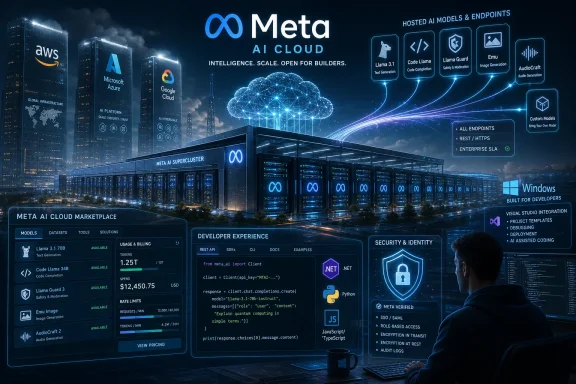 Meta Is Trying to Turn Overbuilding Into Strategy
The most generous reading of Meta’s plan is that it is classic cloud arbitrage. The company is buying or leasing staggering amounts of AI infrastructure for its own models, apps and assistants; when that capacity is not fully consumed internally, it can be sold to developers and enterprises at a premium. That is not a side hustle if the numbers get big enough. It is a way to convert speculative capital expenditure into revenue while preserving the option to pull capacity back when Meta needs it.The less generous reading is that Meta is trying to explain away the anxiety that naturally follows a massive AI spending binge. Investors have watched the company commit enormous sums to data centers, power, networking and accelerator capacity without the same clean monetization story that advertising once offered. “We might rent the extra compute” is therefore more than an operational idea. It is a narrative patch for the uncomfortable possibility that the industry is building faster than its near-term demand can absorb.
That tension is exactly why the report moved markets. Meta shares jumped, while several AI infrastructure specialists fell, because Wall Street heard two things at once. First, Meta may have a new revenue stream. Second, companies whose whole pitch is “we have the GPUs” may face competition from a platform giant with deeper pockets, broader distribution and no need to make cloud rental its only business.
The Cloud Giants Now Face a Different Kind of Rival
Amazon, Microsoft and Google built cloud businesses over many years by selling primitives first and platforms later. Compute, storage, identity, networking, databases, observability, security tooling and compliance machinery became the foundation on which higher-level developer services were layered. AI has compressed that history. The new customer may not want to assemble an entire cloud architecture; they may simply want enough GPU capacity, a model endpoint and predictable latency.That is where Meta’s possible entry is interesting. It is unlikely to replicate AWS, Azure or Google Cloud overnight, and it does not need to. If the first product is access to hosted AI models, it competes less with a full hyperscaler account and more with the API layer where developers already buy tokens. If the second product is raw AI compute, it competes with neocloud vendors that rent clusters to AI labs, startups and enterprises priced out of or waitlisted by the big three.
Microsoft is the most directly implicated from a WindowsForum perspective because Azure has become the enterprise bridge between Microsoft 365, Windows, identity, security and AI services. Azure’s AI story is not just “we rent GPUs.” It is “your users, your tenant, your compliance posture and your developer workflows already live here.” Meta can challenge the supply side of that equation, but it will have to prove that raw capacity and model access are enough to overcome the gravitational pull of enterprise integration.
AWS has a different problem. It remains the default cloud vendor for a huge share of the market, but AI has reduced the advantage of general-purpose breadth in some buying decisions. A startup training or serving models may care more about accelerator availability, price and interconnect performance than about an encyclopedic catalog of managed services. Google, meanwhile, has its own AI research pedigree, TPU infrastructure and cloud ambitions. Meta’s move would pressure all three, but it would do so most sharply in the narrow band of workloads where GPU supply is the product.
The Bedrock Comparison Reveals Meta’s Real Ambition
The reported model-hosting plan sounds similar to AWS Bedrock: developers get managed access to models without running the infrastructure themselves. That comparison matters because it shows Meta is not merely thinking about renting idle servers. It is thinking about becoming a broker between model makers, developers and the expensive machinery needed to serve AI workloads.If Meta hosts its own models and potentially third-party models, it can sell convenience rather than just capacity. Developers do not necessarily want to negotiate data center contracts, tune clusters, manage drivers or build inference pipelines. They want endpoints, rate limits, billing, monitoring and assurances that the service will not vanish during the next internal priority shift. The cloud business, in other words, is not the GPUs. It is the operating model around the GPUs.
That is where Meta’s consumer DNA cuts both ways. The company knows how to run infrastructure at planetary scale, and its engineering history includes some of the most demanding social, messaging and recommendation systems ever built. But enterprise cloud customers buy more than technical competence. They buy account teams, service-level commitments, audit paperwork, procurement compatibility, regional guarantees and a support culture that does not treat external developers as an afterthought.
Meta has tried developer platforms before. Some became essential for a time, and some were eventually constrained, deprecated or reshaped around Meta’s own strategic needs. A CIO evaluating Meta Compute, should it become a public product, will remember that history. The question will not be whether Meta can run the machines. The question will be whether Meta can behave like a long-term infrastructure vendor when its core business incentives still revolve around advertising, consumer engagement and internal AI advantage.
Raw Compute Is a Commodity Until It Isn’t
The second reported path — selling raw computing capacity — sounds simpler but may be harder to defend. On paper, a GPU hour is a GPU hour. If Meta can offer access to powerful accelerators at a competitive price, some customers will come. The current AI market has been defined by scarcity, and scarcity makes buyers pragmatic.But AI compute is not perfectly fungible. Training clusters depend on networking, storage, scheduling, reliability and software maturity. Inference depends on latency, geographic placement, model optimization and predictable scaling. A cheap cluster that is difficult to use or unreliable under load is not cheap for long.
This is why neocloud providers have grown quickly but remain exposed. Their value proposition is strongest when demand outstrips hyperscaler supply. If Meta, xAI-linked infrastructure, Oracle, Google, Microsoft, Amazon and specialist GPU clouds all chase the same external customers, the market could move from shortage to segmentation. Premium buyers will pay for reliable, integrated platforms. Experimental buyers will chase price. The weakest middle may get squeezed.
Meta’s advantage is that it can subsidize ambiguity. A pure-play cloud provider has to make the rental business work on its own economics. Meta can justify infrastructure for internal AI, advertising, ranking, content generation, assistants and research, then sell surplus when it exists. That makes it dangerous to competitors because it does not have to price like a company whose only product is compute rental.
Zuckerberg’s “On the Table” Comment Was the Tell
Zuckerberg had already signaled the logic before the July report. During a shareholder call in May, he said that selling excess compute or standing up an API service was “definitely on the table,” while also saying Meta had not done so because it believed it had a use for the capacity. That is the entire strategy in miniature. Build aggressively because compute is the constraint; if the company overbuilds, monetize the excess.This is a striking inversion of traditional cloud planning. The hyperscalers usually build around expected external demand, internal platform needs and long-term regional expansion. Meta’s framing starts from an internal AI arms race and treats external cloud sales as an option embedded in the capital plan. That does not make it irrational. It makes it a hedge.
The hedge matters because nobody knows the durable demand curve for AI compute. Today’s appetite looks insatiable because every major lab, enterprise vendor and well-funded startup is racing to train or serve larger systems. But if model efficiency improves, specialized chips proliferate, inference costs fall or customers balk at AI subscription sprawl, some capacity could become less scarce than expected. In that world, the companies with the best monetization channels will fare better than those holding undifferentiated GPU leases.
Meta is effectively telling investors that its infrastructure spending has multiple exits. The best outcome is that internal AI products become so valuable that Meta uses all the capacity itself. The fallback is that outside developers and enterprises pay to use what Meta does not need. The risk is that neither internal monetization nor external rental produces returns matching the scale of the buildout.
Windows Developers Should Watch the API Layer, Not the Logo
For developers working on Windows, the practical question is not whether Meta becomes “the next AWS.” It is whether Meta creates an API or compute service compelling enough to add to the stack. Most application developers do not choose clouds out of brand loyalty. They choose based on SDK quality, pricing, latency, model capability, data handling rules and how cleanly the service fits into their deployment workflow.If Meta exposes hosted models through conventional APIs, Windows developers could consume those services from .NET, Python, JavaScript, PowerShell-driven automation or any other runtime that can make authenticated web requests. The operating system becomes less important than the development pipeline. Visual Studio, GitHub Actions, Azure DevOps, Windows Subsystem for Linux and container tooling can all target external AI endpoints if the service is documented and stable.
The catch is trust. Enterprise developers need to know what happens to prompts, embeddings, fine-tuning data, logs and outputs. They need clarity on retention, training use, tenant isolation, encryption, access controls and compliance certifications. Microsoft has spent years tying Azure AI to the broader Microsoft trust, identity and compliance stack. Meta would have to earn that confidence from a different starting point.
For smaller developers, the calculus may be more opportunistic. If Meta offers aggressive pricing, strong open-model support or access to models that perform well in consumer, social, media or multilingual use cases, experimentation will follow. The first wave of adoption may not come from Fortune 500 procurement teams. It may come from builders who treat AI providers as interchangeable endpoints and route workloads based on price and performance.
Enterprise IT Will See Another Vendor to Govern
The arrival of another AI cloud provider is not automatically good news for administrators. More choice can mean better pricing and redundancy, but it also means another set of controls to evaluate. Every new model endpoint is a potential data exfiltration path. Every new compute environment is another identity boundary. Every new vendor relationship is another legal, compliance and incident-response dependency.The Windows enterprise is already absorbing AI through Microsoft 365 Copilot, Azure OpenAI, GitHub Copilot, endpoint security tools, CRM systems, service desks and shadow IT browser use. Meta’s possible cloud entry would add a new pressure point: employees and developers may want access because the models are attractive or the compute is available, even if the organization has standardized elsewhere.
That creates a familiar governance problem with a new cost profile. In the old SaaS era, the danger was an employee putting company data into an unsanctioned web app. In the AI cloud era, the danger includes developers building production workflows around unsanctioned model APIs, teams training or evaluating models on external clusters, and business units creating dependencies before security teams have reviewed the terms.
IT departments should not respond by pretending the market will simplify. It probably will not. The more realistic posture is to build AI vendor governance that assumes multiple providers. That means policy controls at the browser, endpoint, identity, network and procurement layers, plus clear internal guidance about which AI services are approved for which data classes. Meta’s name may be new in cloud infrastructure, but the governance muscle is the same one administrators have been building since the first wave of SaaS sprawl.
The AI Cloud Is Becoming a Power Market
One reason the Meta story feels different from an ordinary product rumor is that AI infrastructure is no longer just a software platform story. It is a power, land, water, permitting, chip allocation and supply-chain story. Data centers have become physical manifestations of AI ambition, and companies are increasingly judged by their ability to secure energy and hardware as much as by their model demos.Meta has been moving aggressively on that front. Its AI ambitions require enormous data center capacity, and its infrastructure organization has been formalized around long-term compute planning. Selling surplus capacity would therefore be more like selling electricity back into a grid than launching another developer tool. When you build for peak internal demand, the off-peak periods become an economic opportunity.
That analogy has limits, because compute cannot be stored like inventory and AI workloads are not evenly shaped. Training runs may consume huge clusters for defined periods. Inference demand may spike unpredictably. Internal product launches may suddenly absorb capacity that had seemed available. A cloud customer buying from Meta would need confidence that “excess” does not mean “revocable whenever Menlo Park gets busy.”
The strongest version of Meta’s business would therefore require reservable capacity, transparent scheduling and predictable commitments. The weakest version would be opportunistic spot-market access that customers use only for noncritical workloads. Both could make money, but only one threatens the hyperscalers at the strategic level.
Microsoft’s Defense Is the Enterprise Stack
Microsoft should not dismiss Meta, but it should also not panic. Azure’s AI business is tied to an enterprise machine that Meta does not currently possess in the same form. Entra ID, Microsoft 365, Windows, Defender, Purview, Fabric, Power Platform, GitHub and the rest of the Microsoft estate give Azure a distribution advantage that raw GPU supply cannot easily replicate.That advantage is especially powerful in regulated and security-conscious environments. A company already standardizing on Microsoft identity and compliance tooling may prefer to keep AI workloads inside Azure even if another provider offers cheaper tokens or faster access to certain models. The cost of stitching together governance across vendors can outweigh savings on compute, particularly when sensitive data is involved.
But Microsoft’s strength can become complacency if Azure capacity is constrained or pricing feels punitive. Developers and AI teams are impatient. If they cannot get the GPUs, quotas or model access they need, they will look elsewhere. Meta’s opening is not to replace Azure wholesale. It is to exploit the moments when Azure cannot say yes quickly enough.
That is why this market will not be decided by brand architecture alone. It will be decided by availability, pricing, model quality, latency, governance and developer experience. Microsoft has a deep moat, but AI demand has a way of finding any gap in the wall.
Meta’s Open-Model Reputation Could Become a Cloud Wedge
Meta’s strongest developer asset may not be Facebook, Instagram or WhatsApp. It may be the company’s reputation for releasing influential open AI models and tooling. Even when critics argue about licensing, safety or strategic motives, Meta has cultivated goodwill among developers who want capable models outside the fully closed API economy.A Meta cloud service could turn that goodwill into a commercial wedge. If developers already build with Meta-origin models locally or on third-party infrastructure, a hosted Meta service could offer a convenient production path. The pitch would be simple: use the models you know, on infrastructure operated by the company that built them, without waiting for GPU allocations elsewhere.
This is also where Meta could differentiate from AWS, Microsoft and Google. The hyperscalers increasingly sell access to a menu of models, but their strategic incentives are complicated by partnerships, proprietary platforms and enterprise bundling. Meta could position itself as the high-scale home for certain open or semi-open model families, especially if it offers fine-tuning, evaluation and deployment tools that feel less locked down.
Still, open-model credibility does not automatically translate into enterprise cloud credibility. Developers may like Meta’s models and still distrust Meta as a custodian of corporate data. The company’s challenge is to separate its AI infrastructure brand from the baggage of its consumer advertising empire. That is possible, but not automatic.
The Neoclouds Just Got a Warning Shot
The sharp moves in CoreWeave and Nebius shares show how investors interpreted the news. If Meta rents out compute, the specialist AI cloud providers face a more crowded field. They are not doomed, but their story becomes less clean.Neoclouds have thrived because the hyperscalers could not instantly satisfy every AI buyer. They offered focused access to accelerators, often with a willingness to structure deals around the frantic needs of model companies and startups. In a scarcity market, that is powerful. In a market where every giant with spare capacity becomes a seller, specialization has to become more than “we have chips.”
That does not mean Meta will crush them. Some customers will prefer neutral infrastructure rather than renting from a company that also develops competing AI products. Some will need configurations, support models or geographic options Meta does not offer. Others may value a provider whose entire business depends on serving external compute customers, not a social media giant’s shifting internal priorities.
But pricing pressure is real. If Meta sells capacity at the margin to offset costs, it can make life uncomfortable for providers that need higher utilization and margins to justify their own infrastructure commitments. The AI boom has created a class of companies built around scarcity. Meta’s plan hints at what happens when scarcity starts attracting sellers from every direction.
The Real Product Is Optionality
The most important word in this story is not “cloud.” It is optionality. Meta is buying the right to decide later whether its AI infrastructure becomes internal fuel, external revenue, strategic leverage or some combination of all three. That optionality is expensive, but Zuckerberg appears convinced that being short compute is more dangerous than being long compute.There is logic in that view. In the current AI race, the company with insufficient capacity cannot simply conjure clusters when a model breakthrough or product opportunity appears. Hardware supply chains, energy connections and data center construction move slowly compared with software ambition. Overbuilding can be wasteful, but underbuilding can be fatal if the next platform shift really does depend on compute scale.
The difficulty is that optionality can become a euphemism for uncertainty. If a company cannot clearly explain how hundreds of billions in AI infrastructure will translate into profits, “we can rent it out” may soothe investors without solving the deeper question. Cloud customers are not a dumping ground for excess capital expenditure. They are demanding, expensive to support and quick to punish unreliability.
Meta’s reported plan is therefore both strategically plausible and operationally brutal. It takes advantage of real market demand, but it pushes Meta into a business where trust, support and enterprise discipline matter as much as engineering scale. The company can afford to enter. Whether it can endure is a different question.
The Compute Bet Now Has a Customer-Facing Clock
The near-term lesson is not that Meta has already become a hyperscaler. It has not. The lesson is that the AI infrastructure race is spilling out of internal labs and into the commercial cloud market faster than many enterprise plans assumed.- Meta is reportedly exploring both hosted AI model access and raw AI compute rental, which would place it between hyperscale cloud platforms and specialist GPU clouds.
- The plan appears designed to monetize surplus capacity from Meta’s own AI buildout, not to recreate the full AWS, Azure or Google Cloud catalog on day one.
- Microsoft’s strongest defense is its enterprise stack, where Windows, identity, security, compliance, developer tools and Azure services reinforce one another.
- Developers may try Meta’s service quickly if pricing, model quality and API design are attractive, but enterprise adoption will depend on trust, governance and support commitments.
- Neocloud providers face the clearest competitive pressure because Meta could sell marginal capacity without relying on cloud rental as its primary business.
- IT departments should prepare for a multi-provider AI environment rather than assuming all approved AI workloads will remain inside one hyperscaler.
References
- Primary source: Los Angeles Times
Published: Wed, 01 Jul 2026 16:02:04 GMT
Meta plots AI cloud business to challenge Amazon, Microsoft and Google
Meta plots AI cloud business to challenge Amazon, Microsoft and Googlewww.latimes.com - Related coverage: investing.com
Meta building cloud business to sell excess AI capacity, Bloomberg News reports By Reuters
Meta building cloud business to sell excess AI capacity, Bloomberg News reportswww.investing.com - Related coverage: techcrunch.com
Meta, like SpaceX, looks to turn excess AI compute into cash | TechCrunch
Meta is developing plans for a cloud infrastructure business, selling access to AI compute power and models. The move would pit it against the big cloud providers like Amazon Web Services, Google Cloud, and Microsoft Azure.techcrunch.com - Related coverage: drawpie.com
Why Meta Is Selling Its 'Excess' AI Compute — and Why the Stock Jumped · Drawpie
Meta's stock jumped more than 6% after a report it's building a cloud business to sell its 'excess' AI computing power. Here's why Meta has spare compute to sell, why investors cheered, and why some analysts are skeptical. drawpie.com
- Related coverage: streetinsider.com
Meta Platforms (META) Is Building A Cloud Business To Sell Excess Ai Compute - Bloomberg
(Updated - July 1, 2026 8:37 AM EDT) Meta Is Building A Cloud Business To Sell Excess Ai Compute - BloombergMeta is forming a business to generate revenue from excess computing power sold to outside customers.www.streetinsider.com - Related coverage: news.bloomberglaw.com
Meta Is Planning a Cloud Business to Sell AI Computing Power
Meta Platforms Inc. is developing plans for a cloud infrastructure business that will sell access to AI computing power and models, setting up a new vector of competition with industry leaders like Amazon Web Services, Microsoft Azure and Google Cloud.news.bloomberglaw.com
- Related coverage: techzine.eu
Meta plans to sell excess AI computing power as a cloud service - Techzine Global
According to Bloomberg, Meta is working on a cloud business to sell excess AI computing power and models, in direct competition with AWS and Azure. www.techzine.eu
- Related coverage: thetechportal.com
Meta plans to sell unused AI compute capacity, creating a new revenue stream: Report - The Tech Portal
Meta is reportedly preparing to launch a cloud computing business that would rent out its unused AI computing power to outside customers. thetechportal.com
- Related coverage: easternherald.com
Meta Launches Cloud Business to Monetize Excess AI Compute
Meta is building Meta Compute, a cloud business to sell surplus AI infrastructure capacity, threatening CoreWeave and Nebius while targeting AWS, Azure, and Google Cloud.easternherald.com - Related coverage: bloomberg.com
- Related coverage: moneycheck.com
Meta (META) Stock Climbs 6% on Cloud Infrastructure Business Plans - MoneyCheck
Meta (META) stock rises 6% pre-market on reports of new cloud business to sell AI computing power. CoreWeave and Nebius shares drop on the news.moneycheck.com - Related coverage: coincentral.com
Meta Stock Surges 6% After Report It's Building Its Own Cloud Business - CoinCentral
Meta stock surges 6% pre-market after Bloomberg reports plans to sell AI computing power to outside customers, hitting CoreWeave and Nebius hard.coincentral.com - Related coverage: ts2.tech
Meta Platforms (NASDAQ:META) cloud report sends shares higher, weighs on CoreWeave (NASDAQ:CRWV), Nebius (NASDAQ:NBIS)
Meta Platforms (NASDAQ:META) cloud report sends shares higher, weighs on CoreWeave (NASDAQ:CRWV), Nebius (NASDAQ:NBIS) - TechStock²ts2.tech - Related coverage: techradar.com
Meta cloud computing business ‘definitely on the table’, Mark Zuckerberg says – excess data center capacity could be used to enter the market | TechRadar
Zuckerberg wouldn't rule out a cloud businesswww.techradar.com - Related coverage: androidcentral.com
Meta's Q1 2026 earnings are in, and it looks like Zuckerberg's blank check for AI spending is raising some eyebrows | Android Central
Meta's AI efforts are paying off with record-high growth, but the company is spending more than ever on infrastructure costs.www.androidcentral.com - Related coverage: tomshardware.com
Mark Zuckerberg says Meta is cutting 8,000 jobs to pay for AI infrastructure — insatiable compute demand means the company can't rule out further headcount reductions | Tom's Hardware
Compute costs are crowding out headcount at the company that just raised its 2026 capex forecast to $145 billion.www.tomshardware.com - Related coverage: axios.com
Meta launches new "Meta Compute" initiative to build AI infrastructure
Zuckerberg said Meta plans to build tens of gigawatts of AI infrastructure this decade, "and hundreds of gigawatts or more over time."www.axios.com