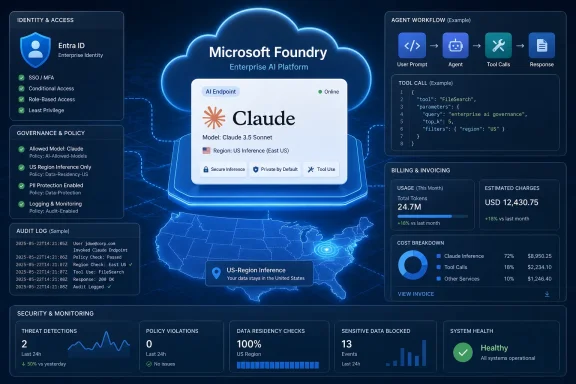
Anthropic made Claude generally available in Microsoft Foundry on June 29, 2026, allowing Azure customers to deploy selected Claude models through Microsoft’s cloud environment while Anthropic continues to operate the inference service behind them. That is not just another model listing in a marketplace. It is Microsoft turning Foundry into a diplomatic layer between enterprises and competing AI labs. The bet is that buyers do not want a theology of model allegiance; they want procurement, identity, networking, governance, and invoices that already fit the machinery of IT.
The most important part of the Claude launch is not that enterprises can now call another large language model from a Microsoft endpoint. They could already reach Claude through Anthropic’s own API, and Microsoft had already been widening Foundry into a catalog of first-party and partner models. The shift is that Claude can now be consumed through the systems that Azure customers already use to decide who is allowed to run what, where data is processed, and which budget line pays the bill.
That sounds bureaucratic because it is. But in enterprise software, bureaucracy is distribution. A model that requires a separate vendor onboarding process, a separate contract review, a separate network exception, and a separate audit trail is a model that may never make it past experimentation. A model that appears inside Azure’s existing controls has a much better chance of being tested by the same developers and approved by the same governance boards that already manage cloud services.
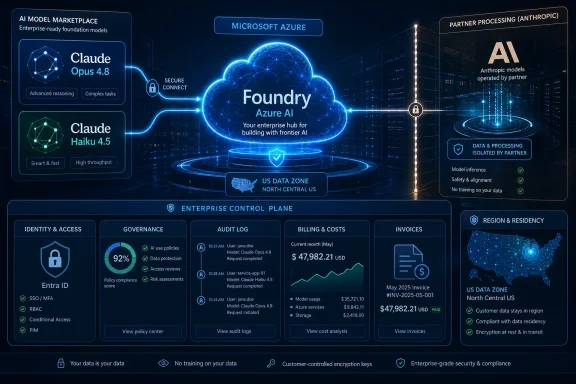
This is why the announcement matters even if the initial model list is narrow. The Azure-hosted Claude option begins with Claude Opus 4.8 and Claude Haiku 4.5 through the Messages API. Anthropic is positioning those models for coding, agents, and complex reasoning, but the larger story is that Microsoft is making model pluralism feel less like vendor sprawl.
Microsoft has spent years trying to make Azure the default enterprise platform for AI workloads, with OpenAI as its marquee partner. Claude in Foundry complicates that narrative in a useful way. It tells customers that Azure is not merely the home of Microsoft’s preferred model family, but a venue where rival frontier labs can be made operationally tolerable.
Claude on Azure is therefore a control-plane story. Administrators can use existing Microsoft identity arrangements, networking configurations, billing relationships, and governance tools instead of building a parallel operating model around Anthropic. Microsoft Foundry customers receive Claude usage through their Azure account rather than establishing a separate billing arrangement with Anthropic.
That matters for universities, public-sector organizations, regulated industries, and large companies with centralized cloud commitments. Some eligible organizations with Microsoft Enterprise Agreements can apply Claude consumption against existing Azure spend commitments. In plain English: the purchase can look less like adding a new AI vendor and more like consuming more of the cloud contract the organization already negotiated.
This does not erase vendor risk. Anthropic remains the seller and operator of the Claude models in Foundry, and the customer’s use of Claude remains subject to Anthropic’s terms. But it changes the adoption conversation from “Should we bring in another AI platform?” to “Can we enable this model under controls we already understand?” That is a much easier meeting for an IT leader to have.
That split is the whole product. Microsoft supplies the cloud environment, account relationship, infrastructure path, and governance surface. Anthropic supplies the model operation and the safety systems attached to it. For many customers, that is the best available compromise: the model is not simply disappearing into an external SaaS black box, but it is also not becoming a Microsoft-owned model.
The launch includes a US data zone option, which gives organizations with data residency requirements a way to keep processing within a defined geography. Microsoft’s documentation also indicates specific supported deployment locations and distinguishes between global standard and data-zone standard deployment choices. That is a meaningful improvement over a purely external API for customers that need more say over where inference processing happens.
But the same arrangement will raise questions for security, privacy, and compliance teams. Azure hosting does not mean Anthropic vanishes from the data chain. Microsoft’s own documentation states that Anthropic remains an independent data processor for prompts and outputs associated with Claude models in Foundry. Automatic safeguards may flag content for Anthropic Trust & Safety review on an exceptions basis, subject to applicable terms.
That is not necessarily a red flag; it is the reality of partner-operated frontier models. But it means the right enterprise reaction is not “Claude is now inside Azure, therefore our existing Azure risk assessment covers everything.” The right reaction is: “Claude is now deployable through Azure, so we can evaluate the remaining Anthropic-specific risk in a more structured way.”
That distinction will shape early adoption. Enterprises that prioritize production governance will be drawn to Azure hosting even if the model and feature set is smaller. Teams that need the fullest Anthropic API surface may stay with the Anthropic-hosted option, accepting that processing may occur outside Azure and outside the selected Azure region.
This is a familiar cloud pattern. The cleaner enterprise integration is not always the most complete developer surface on day one. Over time, the platform vendor and the model provider try to collapse that gap, but the early version forces customers to choose between operational neatness and feature velocity.
Anthropic says it intends to bring models and features closer to parity over time. That promise is useful but vague. There is no disclosed schedule, no complete public roadmap for supported processing locations, and no pricing detail in the original announcement beyond the Azure billing path. For production teams, that means the deployment decision should be made against today’s capabilities rather than tomorrow’s implied convergence.
The model list also matters. Claude Opus 4.8 is the flagship reasoning and coding option in this launch, while Haiku 4.5 is the lower-latency, more economical member of the pair. But anyone expecting the entire Claude family to arrive in Azure-hosted form at once will be disappointed. The enterprise cloud version begins as a curated subset, not a mirror of Anthropic’s native platform.
But the frontier AI market is no longer just about sending a prompt and receiving a response. The competitive terrain is shifting toward tools, long context, memory, computer use, citations, prompt caching, context management, and controllable reasoning budgets. Microsoft’s documentation for Claude in Foundry lists a wide range of capabilities across the platform, but also notes that the Anthropic-hosted route supports more APIs and features than the Azure-hosted version in some areas.
That makes the first release feel like a production door opening rather than the final shape of the product. Prompt caching and extended thinking are important, especially for workloads that repeatedly reuse the same background context or ask the model to spend more effort on complex tasks. But organizations building sophisticated agents will need to inspect the exact feature set available for the model and hosting route they select.
There is also a developer ergonomics angle. Microsoft supports Anthropic SDKs, direct REST calls, and authentication using Microsoft Entra ID or API keys depending on the model and endpoint. That is the right direction: developers should not have to rewrite every abstraction just because procurement wants Azure billing. Still, the practical burden will fall on platform teams to standardize how internal applications call Claude, log usage, handle failures, and compare behavior across models.
For WindowsForum’s audience, the interesting parallel is the way Windows administration matured. The winning technology is rarely the one with the cleanest isolated feature list. It is the one that can be governed through existing identity, policy, telemetry, and lifecycle tools without requiring every team to improvise.
That language can get slippery. “Agent” is now applied to everything from a scripted workflow with an LLM step to a semi-autonomous system that plans, calls tools, edits code, and monitors its own progress. But enterprises are clearly moving beyond simple chat pilots. They want systems that can triage tickets, inspect code, generate tests, search internal knowledge, draft remediation plans, and act across business applications with human oversight.
Claude has been positioned strongly in coding and reasoning, which makes it attractive for those workloads. Microsoft Foundry gives it a path into organizations that already build with Azure DevOps, GitHub, Microsoft 365, Entra ID, and Azure networking. NVIDIA gets to point at the deployment as evidence that its newest GPU systems are powering not just model training spectacle, but everyday enterprise inference.
The hardware claim should not distract from what customers can verify. Anthropic has not published usage figures for this Microsoft Foundry release, service-level performance data, or independent comparisons between the Azure-hosted and Anthropic-hosted routes. Customer statements in launch materials are useful anecdotes, not benchmarks.
In that sense, the NVIDIA angle is both important and incomplete. It says the deployment is serious enough to merit modern accelerator capacity. It does not tell customers what latency, throughput, regional availability, or cost curves will look like under their own workloads.
There is an obvious commercial reason. Enterprise customers do not want to bet every AI workload on one provider’s model roadmap, safety posture, pricing, or outage profile. They want optionality. Microsoft would rather provide that optionality inside Azure than watch customers build model-broker layers elsewhere.
There is also a political reason inside large organizations. Different teams will prefer different models. Developers may like one model for code generation, legal teams may prefer another for careful drafting, analysts may want long-context document review, and security teams may care most about control and auditability. If Microsoft can make those choices available under a shared governance model, it becomes the platform of compromise.
This does not mean Microsoft is model-neutral in any pure sense. It has its own models, its OpenAI relationship, its Copilot products, and its broader cloud economics. But in enterprise AI, neutrality is often less important than interoperability. Customers do not need Microsoft to be indifferent; they need it to make rival options usable without creating an administrative mess.
Claude in Foundry is an admission that the future of enterprise AI will not be one model family, one interface, or one vendor’s doctrine. It will be a managed portfolio. The vendor that controls the portfolio interface gets leverage even when it does not control every model inside it.
The procurement angle is especially important for education and public-sector environments, which often have lengthy vendor approval cycles and strict data handling requirements. An EdTech organization or university already standardized on Azure may find the Foundry route more palatable than setting up a direct Anthropic relationship. Consolidated billing and potential application of Azure consumption commitments are not glamorous features, but they are adoption accelerants.
The same is true for large enterprises with cloud centers of excellence. If an internal platform team can expose Claude as an approved model option inside an Azure-managed environment, individual product teams do not need to reinvent the vendor relationship. That reduces shadow AI pressure, where teams quietly use external tools because central IT cannot approve options quickly enough.
Still, procurement convenience should not be confused with architectural maturity. Organizations will need policies for model selection, data classification, prompt logging, output review, safety escalation, and cost management. They will also need to decide when Claude is the right choice versus OpenAI, Microsoft’s own models, smaller open models, or domain-specific systems.
The risk is that Foundry’s convenience leads to model shopping without discipline. A mature AI platform team should make it easy to use approved models, but not so easy that every application selects a frontier model because it is fashionable. The bill, latency, and governance burden will arrive later.
But data residency is only one piece of the trust puzzle. Customers still need to understand who processes prompts and outputs, what telemetry is collected, how abuse monitoring works, which personnel can review flagged content, and which terms govern the relationship. Microsoft and Anthropic have made some of those boundaries explicit, which is good. The remaining work belongs to the customer’s risk, legal, and security teams.
The distinction between data at rest and inference processing also matters. Many AI services do not store prompts for training, but still process them through complex infrastructure and safety systems. A data-zone statement helps define geography, but it does not answer every question about subprocessors, exceptional review, retention, logging, or access controls.
That is why Azure integration is valuable but not sufficient. Entra ID, networking, and billing make Claude easier to place within an enterprise architecture. They do not eliminate the need for a model-specific data protection review. For sensitive workloads, the correct posture is not blanket trust but documented constraint.
This is where Microsoft’s platform role becomes powerful. If Foundry can make these details visible, configurable, and auditable, it will become more than a model catalog. It will become the place where AI vendors are translated into enterprise-operable services.
That is not unusual for a new cloud service, but it is a warning. AI applications are often built around model-specific behavior, context windows, tool semantics, error patterns, and pricing assumptions. Moving from one hosting route to another may not be as simple as changing an endpoint if the supported features differ.
IT leaders should therefore resist designing too tightly around a single model route unless the workload justifies it. Internal abstraction layers, evaluation suites, prompt/version control, and fallback strategies are not bureaucratic luxuries. They are defenses against a market where models, names, capabilities, and regional availability change constantly.
At the same time, over-abstraction can neuter the very capabilities teams want from frontier models. If every model is forced through the lowest common denominator, developers lose access to the features that made Claude attractive in the first place. The art is to standardize the parts that should be boring — authentication, logging, billing tags, safety review, deployment policy — while allowing model-specific capabilities where they create real value.
Microsoft Foundry is trying to be that middle layer. The Claude launch shows both the promise and the friction of that approach. It gives customers a safer runway, but the runway does not yet reach every destination.
The right first projects are bounded and measurable. They should have clear inputs, defined data classifications, human review points, and a way to compare Claude’s outputs with existing processes or other models. “Let’s add Claude to everything” is not a strategy. “Let’s test Claude Opus 4.8 against our hardest code review and incident-analysis tasks under Azure governance” is.
Cost scrutiny should begin early. Prompt caching can reduce repeated processing when applications reuse the same context, but only if the workload is designed to take advantage of it. Extended thinking can improve results on complex tasks, but it may also change latency and token consumption. The features that make a model more capable can also make it easier to overspend.
The deployment model should also be documented from day one. Teams need to know whether they are using hosted on Azure or hosted on Anthropic infrastructure, which region or data zone applies, which authentication method is in use, and what terms govern processing. Those details are not paperwork after the fact; they are part of the architecture.
 Microsoft Turns Model Choice Into an Azure Feature
The most important part of the Claude launch is not that enterprises can now call another large language model from a Microsoft endpoint. They could already reach Claude through Anthropic’s own API, and Microsoft had already been widening Foundry into a catalog of first-party and partner models. The shift is that Claude can now be consumed through the systems that Azure customers already use to decide who is allowed to run what, where data is processed, and which budget line pays the bill.That sounds bureaucratic because it is. But in enterprise software, bureaucracy is distribution. A model that requires a separate vendor onboarding process, a separate contract review, a separate network exception, and a separate audit trail is a model that may never make it past experimentation. A model that appears inside Azure’s existing controls has a much better chance of being tested by the same developers and approved by the same governance boards that already manage cloud services.
This is why the announcement matters even if the initial model list is narrow. The Azure-hosted Claude option begins with Claude Opus 4.8 and Claude Haiku 4.5 through the Messages API. Anthropic is positioning those models for coding, agents, and complex reasoning, but the larger story is that Microsoft is making model pluralism feel less like vendor sprawl.
Microsoft has spent years trying to make Azure the default enterprise platform for AI workloads, with OpenAI as its marquee partner. Claude in Foundry complicates that narrative in a useful way. It tells customers that Azure is not merely the home of Microsoft’s preferred model family, but a venue where rival frontier labs can be made operationally tolerable.
The Enterprise AI Fight Is Moving From Benchmarks to Control Planes
The public AI conversation still gravitates toward model scores, release names, and who is briefly ahead on coding or reasoning. Enterprise buyers are listening, but they are also asking a more durable question: can this thing be governed? A model that wins a benchmark but cannot be integrated into identity management, logging, billing, and regional controls is not a production platform. It is a demo with a procurement problem.Claude on Azure is therefore a control-plane story. Administrators can use existing Microsoft identity arrangements, networking configurations, billing relationships, and governance tools instead of building a parallel operating model around Anthropic. Microsoft Foundry customers receive Claude usage through their Azure account rather than establishing a separate billing arrangement with Anthropic.
That matters for universities, public-sector organizations, regulated industries, and large companies with centralized cloud commitments. Some eligible organizations with Microsoft Enterprise Agreements can apply Claude consumption against existing Azure spend commitments. In plain English: the purchase can look less like adding a new AI vendor and more like consuming more of the cloud contract the organization already negotiated.
This does not erase vendor risk. Anthropic remains the seller and operator of the Claude models in Foundry, and the customer’s use of Claude remains subject to Anthropic’s terms. But it changes the adoption conversation from “Should we bring in another AI platform?” to “Can we enable this model under controls we already understand?” That is a much easier meeting for an IT leader to have.
Azure Hosting Solves One Problem and Exposes Another
The phrase “hosted on Azure” will do a lot of work in this launch, and it deserves careful reading. Under the Azure-hosted route, Azure infrastructure processes requests and GPU inference, and customers can select from available global or data-zone deployment options. Anthropic still operates the inference service and acts as a data processor for prompts and outputs associated with Claude.That split is the whole product. Microsoft supplies the cloud environment, account relationship, infrastructure path, and governance surface. Anthropic supplies the model operation and the safety systems attached to it. For many customers, that is the best available compromise: the model is not simply disappearing into an external SaaS black box, but it is also not becoming a Microsoft-owned model.
The launch includes a US data zone option, which gives organizations with data residency requirements a way to keep processing within a defined geography. Microsoft’s documentation also indicates specific supported deployment locations and distinguishes between global standard and data-zone standard deployment choices. That is a meaningful improvement over a purely external API for customers that need more say over where inference processing happens.
But the same arrangement will raise questions for security, privacy, and compliance teams. Azure hosting does not mean Anthropic vanishes from the data chain. Microsoft’s own documentation states that Anthropic remains an independent data processor for prompts and outputs associated with Claude models in Foundry. Automatic safeguards may flag content for Anthropic Trust & Safety review on an exceptions basis, subject to applicable terms.
That is not necessarily a red flag; it is the reality of partner-operated frontier models. But it means the right enterprise reaction is not “Claude is now inside Azure, therefore our existing Azure risk assessment covers everything.” The right reaction is: “Claude is now deployable through Azure, so we can evaluate the remaining Anthropic-specific risk in a more structured way.”
Foundry Now Offers Two Claudes, and That Choice Will Matter
Microsoft Foundry now presents organizations with two routes for Claude: hosted on Azure and hosted on Anthropic infrastructure. The Azure-hosted route is the one with tighter Azure integration, including Microsoft identity, networking, billing, governance, and data-zone options. The Anthropic-hosted route is the continuity path from the earlier Foundry preview and currently offers broader API feature coverage and access to models not yet available in the Azure-hosted service.That distinction will shape early adoption. Enterprises that prioritize production governance will be drawn to Azure hosting even if the model and feature set is smaller. Teams that need the fullest Anthropic API surface may stay with the Anthropic-hosted option, accepting that processing may occur outside Azure and outside the selected Azure region.
This is a familiar cloud pattern. The cleaner enterprise integration is not always the most complete developer surface on day one. Over time, the platform vendor and the model provider try to collapse that gap, but the early version forces customers to choose between operational neatness and feature velocity.
Anthropic says it intends to bring models and features closer to parity over time. That promise is useful but vague. There is no disclosed schedule, no complete public roadmap for supported processing locations, and no pricing detail in the original announcement beyond the Azure billing path. For production teams, that means the deployment decision should be made against today’s capabilities rather than tomorrow’s implied convergence.
The model list also matters. Claude Opus 4.8 is the flagship reasoning and coding option in this launch, while Haiku 4.5 is the lower-latency, more economical member of the pair. But anyone expecting the entire Claude family to arrive in Azure-hosted form at once will be disappointed. The enterprise cloud version begins as a curated subset, not a mirror of Anthropic’s native platform.
The Messages API Is Enough to Start, Not Enough to Settle the Platform
The initial Azure-hosted launch centers on the Messages API, the core interface for sending structured conversational input and receiving model output. For many applications, that is enough to start. Chat interfaces, summarization workflows, code assistance, analysis tools, and many agentic prototypes can be built around a messages endpoint.But the frontier AI market is no longer just about sending a prompt and receiving a response. The competitive terrain is shifting toward tools, long context, memory, computer use, citations, prompt caching, context management, and controllable reasoning budgets. Microsoft’s documentation for Claude in Foundry lists a wide range of capabilities across the platform, but also notes that the Anthropic-hosted route supports more APIs and features than the Azure-hosted version in some areas.
That makes the first release feel like a production door opening rather than the final shape of the product. Prompt caching and extended thinking are important, especially for workloads that repeatedly reuse the same background context or ask the model to spend more effort on complex tasks. But organizations building sophisticated agents will need to inspect the exact feature set available for the model and hosting route they select.
There is also a developer ergonomics angle. Microsoft supports Anthropic SDKs, direct REST calls, and authentication using Microsoft Entra ID or API keys depending on the model and endpoint. That is the right direction: developers should not have to rewrite every abstraction just because procurement wants Azure billing. Still, the practical burden will fall on platform teams to standardize how internal applications call Claude, log usage, handle failures, and compare behavior across models.
For WindowsForum’s audience, the interesting parallel is the way Windows administration matured. The winning technology is rarely the one with the cleanest isolated feature list. It is the one that can be governed through existing identity, policy, telemetry, and lifecycle tools without requiring every team to improvise.
NVIDIA Gets Its Enterprise Agent Showcase
The launch also gives NVIDIA a neat enterprise AI story. Anthropic says the Azure deployment runs on NVIDIA GB300 Blackwell Ultra GPU systems, and NVIDIA’s Justin Boitano framed the release around autonomous AI agents for technical work. The quote is predictably polished, but the strategic point is real: the next phase of AI infrastructure is being sold less as “chatbot capacity” and more as the substrate for agentic workloads.That language can get slippery. “Agent” is now applied to everything from a scripted workflow with an LLM step to a semi-autonomous system that plans, calls tools, edits code, and monitors its own progress. But enterprises are clearly moving beyond simple chat pilots. They want systems that can triage tickets, inspect code, generate tests, search internal knowledge, draft remediation plans, and act across business applications with human oversight.
Claude has been positioned strongly in coding and reasoning, which makes it attractive for those workloads. Microsoft Foundry gives it a path into organizations that already build with Azure DevOps, GitHub, Microsoft 365, Entra ID, and Azure networking. NVIDIA gets to point at the deployment as evidence that its newest GPU systems are powering not just model training spectacle, but everyday enterprise inference.
The hardware claim should not distract from what customers can verify. Anthropic has not published usage figures for this Microsoft Foundry release, service-level performance data, or independent comparisons between the Azure-hosted and Anthropic-hosted routes. Customer statements in launch materials are useful anecdotes, not benchmarks.
In that sense, the NVIDIA angle is both important and incomplete. It says the deployment is serious enough to merit modern accelerator capacity. It does not tell customers what latency, throughput, regional availability, or cost curves will look like under their own workloads.
Microsoft’s Multi-Model Strategy Is Becoming Less Awkward
For years, Microsoft’s AI identity was tightly associated with OpenAI. That relationship remains central, but Microsoft has been steadily building a broader model marketplace through Foundry. Claude’s general availability on Azure makes that pluralism harder to dismiss as window dressing.There is an obvious commercial reason. Enterprise customers do not want to bet every AI workload on one provider’s model roadmap, safety posture, pricing, or outage profile. They want optionality. Microsoft would rather provide that optionality inside Azure than watch customers build model-broker layers elsewhere.
There is also a political reason inside large organizations. Different teams will prefer different models. Developers may like one model for code generation, legal teams may prefer another for careful drafting, analysts may want long-context document review, and security teams may care most about control and auditability. If Microsoft can make those choices available under a shared governance model, it becomes the platform of compromise.
This does not mean Microsoft is model-neutral in any pure sense. It has its own models, its OpenAI relationship, its Copilot products, and its broader cloud economics. But in enterprise AI, neutrality is often less important than interoperability. Customers do not need Microsoft to be indifferent; they need it to make rival options usable without creating an administrative mess.
Claude in Foundry is an admission that the future of enterprise AI will not be one model family, one interface, or one vendor’s doctrine. It will be a managed portfolio. The vendor that controls the portfolio interface gets leverage even when it does not control every model inside it.
The Procurement Win May Be Bigger Than the Developer Win
Developers will understandably ask what they can build now that they could not build yesterday. The honest answer is: fewer things than the launch rhetoric implies, but more things that can survive enterprise review. Claude was not unreachable before. Claude through Azure governance is a different adoption proposition.The procurement angle is especially important for education and public-sector environments, which often have lengthy vendor approval cycles and strict data handling requirements. An EdTech organization or university already standardized on Azure may find the Foundry route more palatable than setting up a direct Anthropic relationship. Consolidated billing and potential application of Azure consumption commitments are not glamorous features, but they are adoption accelerants.
The same is true for large enterprises with cloud centers of excellence. If an internal platform team can expose Claude as an approved model option inside an Azure-managed environment, individual product teams do not need to reinvent the vendor relationship. That reduces shadow AI pressure, where teams quietly use external tools because central IT cannot approve options quickly enough.
Still, procurement convenience should not be confused with architectural maturity. Organizations will need policies for model selection, data classification, prompt logging, output review, safety escalation, and cost management. They will also need to decide when Claude is the right choice versus OpenAI, Microsoft’s own models, smaller open models, or domain-specific systems.
The risk is that Foundry’s convenience leads to model shopping without discipline. A mature AI platform team should make it easy to use approved models, but not so easy that every application selects a frontier model because it is fashionable. The bill, latency, and governance burden will arrive later.
Data Residency Is a Door Opener, Not a Magic Shield
The US data zone option is one of the launch’s most concrete enterprise features. For organizations with data residency requirements, being able to scope processing to a defined geography can determine whether a workload is possible at all. In regulated sectors, “where does the data go?” is not a philosophical question; it is a deployment blocker.But data residency is only one piece of the trust puzzle. Customers still need to understand who processes prompts and outputs, what telemetry is collected, how abuse monitoring works, which personnel can review flagged content, and which terms govern the relationship. Microsoft and Anthropic have made some of those boundaries explicit, which is good. The remaining work belongs to the customer’s risk, legal, and security teams.
The distinction between data at rest and inference processing also matters. Many AI services do not store prompts for training, but still process them through complex infrastructure and safety systems. A data-zone statement helps define geography, but it does not answer every question about subprocessors, exceptional review, retention, logging, or access controls.
That is why Azure integration is valuable but not sufficient. Entra ID, networking, and billing make Claude easier to place within an enterprise architecture. They do not eliminate the need for a model-specific data protection review. For sensitive workloads, the correct posture is not blanket trust but documented constraint.
This is where Microsoft’s platform role becomes powerful. If Foundry can make these details visible, configurable, and auditable, it will become more than a model catalog. It will become the place where AI vendors are translated into enterprise-operable services.
The Early Gaps Are a Warning Against AI Cloud Lock-In
The two-route structure of Claude in Foundry is useful, but it also exposes how immature the enterprise AI stack still is. The Azure-hosted option gives stronger operational integration. The Anthropic-hosted option gives broader feature access. Customers are being asked to decide which compromise hurts less.That is not unusual for a new cloud service, but it is a warning. AI applications are often built around model-specific behavior, context windows, tool semantics, error patterns, and pricing assumptions. Moving from one hosting route to another may not be as simple as changing an endpoint if the supported features differ.
IT leaders should therefore resist designing too tightly around a single model route unless the workload justifies it. Internal abstraction layers, evaluation suites, prompt/version control, and fallback strategies are not bureaucratic luxuries. They are defenses against a market where models, names, capabilities, and regional availability change constantly.
At the same time, over-abstraction can neuter the very capabilities teams want from frontier models. If every model is forced through the lowest common denominator, developers lose access to the features that made Claude attractive in the first place. The art is to standardize the parts that should be boring — authentication, logging, billing tags, safety review, deployment policy — while allowing model-specific capabilities where they create real value.
Microsoft Foundry is trying to be that middle layer. The Claude launch shows both the promise and the friction of that approach. It gives customers a safer runway, but the runway does not yet reach every destination.
The June 29 Launch Gives IT a Practical Test Case
For Windows admins, Azure architects, and enterprise developers, the immediate question is not whether Claude is “better” than another model in the abstract. The question is whether the Azure-hosted Claude option can satisfy a production use case that was previously stuck in pilot mode. That might be a coding assistant constrained to internal repositories, a document analysis workflow with data residency requirements, or an agent that helps triage operational tickets.The right first projects are bounded and measurable. They should have clear inputs, defined data classifications, human review points, and a way to compare Claude’s outputs with existing processes or other models. “Let’s add Claude to everything” is not a strategy. “Let’s test Claude Opus 4.8 against our hardest code review and incident-analysis tasks under Azure governance” is.
Cost scrutiny should begin early. Prompt caching can reduce repeated processing when applications reuse the same context, but only if the workload is designed to take advantage of it. Extended thinking can improve results on complex tasks, but it may also change latency and token consumption. The features that make a model more capable can also make it easier to overspend.
The deployment model should also be documented from day one. Teams need to know whether they are using hosted on Azure or hosted on Anthropic infrastructure, which region or data zone applies, which authentication method is in use, and what terms govern processing. Those details are not paperwork after the fact; they are part of the architecture.
The Fine Print Is Where This Launch Becomes Real
The practical impact of Claude in Microsoft Foundry will be determined less by launch-day slogans than by the constraints teams discover during implementation. That is not a criticism; it is how enterprise platforms become real. The announcement opens the door, but production work begins in the fine print.- Claude Opus 4.8 and Claude Haiku 4.5 are the initial Azure-hosted models available through Microsoft Foundry, with Anthropic indicating that more models and features will come later.
- The Azure-hosted route gives customers Microsoft identity, networking, billing, governance, and data-zone options, but Anthropic remains the operator of the Claude inference service and a data processor.
- The Anthropic-hosted route currently offers broader API and model access, so some teams may choose it for feature coverage despite weaker Azure-native data locality guarantees.
- The US data zone is a meaningful deployment option for residency-sensitive workloads, but it does not replace a full review of Anthropic’s processing role, safety systems, and applicable terms.
- The biggest near-term value is likely in organizations that already buy heavily through Azure and need a cleaner path to approve Claude for coding, reasoning, and agentic workloads.
- The absence of public performance comparisons, detailed pricing disclosures in the launch story, and a parity schedule means customers should test against their own workloads before standardizing.
References
- Primary source: EdTech Innovation Hub
Published: Tue, 30 Jun 2026 23:05:07 GMT
Claude launches in Microsoft Foundry on Azure | ETIH EdTech News — EdTech Innovation Hub
Enterprise AI and developer tools move deeper into Azure as Anthropic makes Claude Opus 4.8 and Haiku 4.5 generally available in Microsoft Foundry. ETIH edtech news explains Azure hosting, US data residency, governance controls, consolidated billing and the two deployment routes available to organizwww.edtechinnovationhub.com
- Related coverage: axios.com
Anthropic's Sonnet 5 offer less cybersecurity risk than Mythos, Fable
It says the model can use browsers, plan, code and do knowledge work while posing fewer risks than Mythos and Fable.www.axios.com
- Official source: azure.microsoft.com
- Official source: techcommunity.microsoft.com
- Official source: learn.microsoft.com
Deploy and use Claude models in Microsoft Foundry - Microsoft Foundry | Microsoft Learn
Deploy Claude models in Microsoft Foundry and integrate powerful AI into your applications. Discover how to use Claude Mythos, Fable, Opus, Sonnet, and Haiku.learn.microsoft.com - Official source: support.claude.com
Use Claude in Microsoft Foundry | Claude Help Center
support.claude.com
- Related coverage: dataconomy.com
Anthropic Claude launches on Microsoft Azure Foundry
Anthropic announced that its Claude AI models are now available in Microsoft Foundry on Azure, marking the first deployment ondataconomy.com - Official source: anthropic.com
Claude Opus \ Anthropic
Hybrid reasoning model built for serious coding and AI agents, featuring a 1M context window.www.anthropic.com - Related coverage: techtimes.com
Microsoft Build 2026: MAI-Thinking-1 Is First In-House Reasoning Model, Trained Without OpenAI Data
Microsoft Build 2026 launched MAI-Thinking-1, the company’s first in-house reasoning model, trained without OpenAI data. MAI-Code-1-Flash rolls out to all GitHub Copilot plans today. Independentwww.techtimes.com - Related coverage: tech-noisy.com
Microsoft Foundry - Claude が GA、Azure 上で Opus 4.8 提供開始
Microsoft Foundry で Claude が 2026 年 6 月 29 日に一般提供を開始。Messages API 経由で Claude Opus 4.8 と Haiku 4.5 が使え、Azure でホストと Anthropic でホストの 2 方式から選べます。tech-noisy.com - Official source: microsoft.com
Bridging the gap between AI and medicine: Claude in Microsoft Foundry advances capabilities for healthcare and life sciences customers | The Microsoft Cloud Blog
Transform healthcare and life sciences with Claude on Microsoft Foundry—trusted AI for compliance, workflows, and innovation. www.microsoft.com
- Related coverage: techradar.com
Anthropic's Claude Sonnet 4.5 is available now - ‘the best AI model in the world for real-world agents, coding, and computer use’ | TechRadar
The next generation of Claudewww.techradar.com - Related coverage: windowscentral.com
NVIDIA joins Microsoft’s push on Claude — piling billions into Anthropic’s future | Windows Central
Claude’s arrival on Azure signals a major shift in the competitive AI cloud landscape.www.windowscentral.com - Related coverage: tomshardware.com
Microsoft adds Grok 4 to Azure AI Foundry following cautious trials — Elon Musk's latest AI model is now available to deploy for "frontier‑level reasoning" | Tom's Hardware
Comes with a 128K-token context window.www.tomshardware.com - Related coverage: tomsguide.com
Claude Opus 4.8 just launched — and Anthropic says it's far less likely to ‘fake’ answers | Tom's Guide
Anthropic just launched Claude Opus 4.8 with new reasoning controls, dynamic AI workflows and a major focus on reducing fake or overconfident AI answers.www.tomsguide.com - Related coverage: livescience.com
Microsoft says its newest AI chip Maia 200 is 3 times more powerful than Google's TPU and Amazon's Trainium processor | Live Science
The Maia 200 AI chip is described as an inference powerhouse — meaning it could lead AI models to apply their knowledge to real-world situations much faster and more efficiently. www.livescience.com
- Official source: cdn-dynmedia-1.microsoft.com
- Official source: www-cdn.anthropic.com