

Anthropic’s reported beta of Claude for Microsoft Word is more than a neat productivity add-on; it is a deliberate attempt to move the company from a chat interface into the center of enterprise document work. By embedding Claude inside Word, Anthropic is targeting the exact workflows where trust, formatting, and review discipline matter most, especially in legal, finance, and corporate environments. The reported feature set — clickable citations, tracked changes, comment-thread handling, and formatting-preserving edits — suggests the company understands that enterprise AI adoption rises or falls on workflow fidelity, not just model quality. The broader strategic message is clear: Claude is being repositioned as an in-app assistant that can live where deals are drafted, clauses are reviewed, and internal approvals happen, rather than as a separate chatbot that employees consult on the side.
The enterprise AI market has moved quickly past the first wave of novelty. Early generative AI tools impressed users with drafting and summarization, but many organizations discovered that standalone chat products created friction: users had to copy content in and out, lost formatting in the process, and still had to reconcile revisions manually. That made the jump from “interesting demo” to daily utility surprisingly hard. Anthropic’s Word integration reads like a response to that failure mode, and it arrives at a moment when Microsoft, Google, and Anthropic are all trying to make AI feel native inside the software where work already happens.
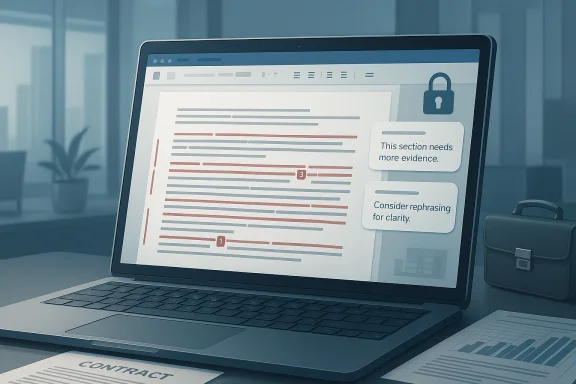
What matters here is not simply that Claude can appear inside Word, but that it appears with safeguards designed for professional use. The reported support for clickable citations is especially important because it gives users a way to inspect the source of an answer rather than trusting a black box. Tracked changes, preserved formatting, and comment resolution all point to a product designed for reviewable output, which is the language of enterprise adoption. In regulated environments, that kind of design can matter as much as raw model performance.
Anthropic’s move also fits a larger competitive pattern. Microsoft has spent years turning Word, Excel, PowerPoint, Outlook, and Teams into an integrated AI surface, while Anthropic has leaned into enterprise controls and secure deployment across business systems. The result is a contest over distribution, trust, and speed. In that contest, being the smartest model is useful, but being the assistant that IT will approve and employees will actually use is often more valuable.
For legal and finance teams, the timing is notable. Those users tend to care less about flashy generative features than about clause consistency, formatting preservation, and the ability to audit every meaningful change. Word remains the default workspace for contracts, memos, policies, and internal approvals, which means an AI assistant that works inside the document lifecycle can become part of the business process rather than a novelty beside it. That is the real strategic prize Anthropic is chasing.
That shift matters because enterprise software is bought on the basis of control as much as capability. In the early phase of AI adoption, teams experimented with standalone tools for drafting, summarizing, and brainstorming. But these tools often struggled with document fidelity, governance, and data boundaries. Microsoft responded by deepening its own native integrations, while Anthropic built a reputation around enterprise controls such as SSO, SCIM, audit logs, role-based permissions, and retention controls. The latter set of features is not glamorous, but it is the kind of plumbing that makes procurement teams comfortable.
Word itself remains a critical surface because so much high-value work still flows through it. Contracts are negotiated there, internal policies are edited there, and board materials are often refined there. If an AI assistant can preserve numbering, styles, headers, and track changes without mangling the document, it is no longer an outside tool; it becomes an in-process assistant. That distinction is subtle, but it is also the difference between a pilot and a platform.
Anthropic’s expansion into Word also reflects a broader enterprise strategy that has been visible in other integrations. The company has been pushing Claude closer to workplace tools and sensitive business systems, aiming to sit where teams already collaborate rather than asking users to form new habits around a separate destination. In a market where friction kills adoption, proximity can be a moat. That is why the reported Word beta should be understood as distribution strategy as much as product development.
The most interesting part of this evolution is that Microsoft is not standing still. Microsoft’s own AI strategy continues to embed assistants into Word, Excel, PowerPoint, Outlook, Teams, and adjacent enterprise surfaces. That means Anthropic is not entering an empty field; it is walking into a crowded house owned by one of the most powerful software platforms in the world. The fact that Claude is doing so inside Microsoft Word is what makes the move strategically bold.
The choice of Word also reflects a sober understanding of where enterprise AI has struggled. Users dislike losing formatting, fighting with numbering, or manually reapplying styles after a rewrite. They also dislike AI tools that cannot show their work. By emphasizing citations and tracked changes, Anthropic is signaling that it wants to be judged on editorial reliability rather than rhetorical flourish. That is a smart positioning move in legal and finance, where precision outranks creativity.
A Word-native assistant can also reduce the distance between drafting and review. Instead of using a separate AI interface for brainstorming and then returning to Word for cleanup, users can revise in place. That lowers cognitive overhead and makes adoption more likely because it respects existing habits. In enterprise software, the best tools are often the ones that change behavior the least while improving output the most.
Key reasons Word is such a strong target:
Clickable citations are especially important here. They give users a path from answer to evidence, which is essential when the output influences a deal term, a risk assessment, or a compliance review. In practice, citations reduce the perception that the model is inventing answers out of thin air. They do not eliminate error, but they do make error easier to inspect and challenge.
The ability to interact with comment threads further reinforces that review-first philosophy. Comments are where many enterprise documents are actually negotiated; they are not just annotations, they are the work itself. If AI can respond to comments or help resolve them, it becomes part of the collaboration loop rather than a one-off drafting helper. That is a meaningful shift from chat to participation.
Operational trust will still depend on the usual enterprise controls:
In legal work, a clause-level assistant can help identify outliers, standardize language, and flag potential deal breakers. That does not mean the model replaces a lawyer; it means it can accelerate first-pass review and surface items that deserve human attention. In finance, the same logic applies to memos, internal summaries, and recurring reporting tasks where consistency and speed matter. A model that can preserve structure while rewriting content is especially attractive in those settings.
There is also a broader market logic here. Vertical credibility often spreads horizontally. If a Word add-in can win over legal and finance teams, it may then become acceptable in adjacent departments that are less risk-averse but still want enterprise-grade assurance. That creates a landing path from a narrow pilot into a wider organizational standard.
Potential enterprise wins in these workflows include:
Microsoft’s advantage is distribution. Word is already everywhere, and Microsoft has spent years tightening integration across Microsoft 365. That gives it a natural head start in user familiarity, admin controls, and cross-app context. Anthropic’s answer appears to be specialization: provide a cleaner, more reviewable assistant that excels at document workflows and enterprise trust. The race is therefore not just about who has the best model, but who can define the default behavior inside the document.
This is why Anthropic’s move is less about one feature and more about proving a category. It wants enterprises to see Claude as the best available assistant for document-centric work, even when the document lives inside Microsoft software. That is a difficult proposition, but if it works, it gives Anthropic leverage far beyond this single add-in.
What Microsoft offers that rivals struggle to match:
For enterprises, the impact is immediate and more strategic. This is a deployment story, not just a feature story. Anthropic is signaling that Claude belongs in managed environments, inside standard productivity tooling, under admin oversight, and in document workflows that matter to the business. That is exactly where enterprise AI vendors want to be when procurement decisions are made.
There is also a likely sales angle. A Word integration can make Claude easier to justify in procurement conversations because it is tied to a concrete workflow rather than a vague productivity promise. That can help Anthropic move from “interesting AI vendor” to “approved workplace tool,” which is a much more valuable status.
Enterprise adoption advantages include:
This approach has a logic to it. If Word proves the value of Claude in high-stakes text workflows, Excel can cover structured analysis, and PowerPoint can cover executive communication. Together, those surfaces span a large portion of knowledge work. A vendor that can operate consistently across them becomes more than a chatbot provider; it becomes an enterprise workflow layer.
There is a reason this matters so much. Enterprise buyers increasingly want fewer AI vendors, not more. They want predictable governance, consistent behavior, and tools that are easy to explain to compliance, legal, and security stakeholders. A coherent suite of embedded assistants is easier to buy than a pile of disconnected tools, and that makes the strategic logic of Anthropic’s expansion compelling.
A second concern is trust. Citations and tracked changes help, but they do not eliminate the possibility of hallucinations, overconfident rewrites, or subtle legal misstatements. In regulated environments, one serious mistake can outweigh weeks of productivity gains. That is why human review must remain central, even as AI becomes more embedded.
The second watch item is Microsoft’s response. Microsoft has already shown a willingness to deepen AI inside Word and the rest of Microsoft 365, which means Claude’s success could accelerate Microsoft’s own counterpositioning. If Microsoft improves Copilot’s document-review features quickly, the differentiation window may stay narrow. If it moves slowly, Anthropic could gain an opening with enterprise teams that want an alternative.
The third issue is whether Anthropic can maintain a consistent story across Word, Excel, and PowerPoint. One-off integrations are useful; a coherent suite is more powerful. If the company can make Claude feel like one trusted assistant across the document, spreadsheet, and presentation layers, it will have taken a real step toward becoming an enterprise productivity platform rather than just an AI model vendor.
Source: Infomance From Chat to Contracts: Claude AI’s Big Enterprise Push
 Overview
The enterprise AI market has moved quickly past the first wave of novelty. Early generative AI tools impressed users with drafting and summarization, but many organizations discovered that standalone chat products created friction: users had to copy content in and out, lost formatting in the process, and still had to reconcile revisions manually. That made the jump from “interesting demo” to daily utility surprisingly hard. Anthropic’s Word integration reads like a response to that failure mode, and it arrives at a moment when Microsoft, Google, and Anthropic are all trying to make AI feel native inside the software where work already happens.What matters here is not simply that Claude can appear inside Word, but that it appears with safeguards designed for professional use. The reported support for clickable citations is especially important because it gives users a way to inspect the source of an answer rather than trusting a black box. Tracked changes, preserved formatting, and comment resolution all point to a product designed for reviewable output, which is the language of enterprise adoption. In regulated environments, that kind of design can matter as much as raw model performance.
Anthropic’s move also fits a larger competitive pattern. Microsoft has spent years turning Word, Excel, PowerPoint, Outlook, and Teams into an integrated AI surface, while Anthropic has leaned into enterprise controls and secure deployment across business systems. The result is a contest over distribution, trust, and speed. In that contest, being the smartest model is useful, but being the assistant that IT will approve and employees will actually use is often more valuable.
For legal and finance teams, the timing is notable. Those users tend to care less about flashy generative features than about clause consistency, formatting preservation, and the ability to audit every meaningful change. Word remains the default workspace for contracts, memos, policies, and internal approvals, which means an AI assistant that works inside the document lifecycle can become part of the business process rather than a novelty beside it. That is the real strategic prize Anthropic is chasing.
Background
The enterprise productivity market has been reorganizing around AI for more than two years. Microsoft’s Copilot was one of the earliest high-profile attempts to make generative AI a native layer in Word and the rest of Microsoft 365, and that launch established a new expectation: users now want context-aware assistance directly inside the apps they already trust. Google’s Workspace rollout followed a similar logic. Once the market accepted that AI belonged in office software, the competition shifted from “Can we add chat?” to “Can we make the assistant fit the workflow?”That shift matters because enterprise software is bought on the basis of control as much as capability. In the early phase of AI adoption, teams experimented with standalone tools for drafting, summarizing, and brainstorming. But these tools often struggled with document fidelity, governance, and data boundaries. Microsoft responded by deepening its own native integrations, while Anthropic built a reputation around enterprise controls such as SSO, SCIM, audit logs, role-based permissions, and retention controls. The latter set of features is not glamorous, but it is the kind of plumbing that makes procurement teams comfortable.
Word itself remains a critical surface because so much high-value work still flows through it. Contracts are negotiated there, internal policies are edited there, and board materials are often refined there. If an AI assistant can preserve numbering, styles, headers, and track changes without mangling the document, it is no longer an outside tool; it becomes an in-process assistant. That distinction is subtle, but it is also the difference between a pilot and a platform.
Anthropic’s expansion into Word also reflects a broader enterprise strategy that has been visible in other integrations. The company has been pushing Claude closer to workplace tools and sensitive business systems, aiming to sit where teams already collaborate rather than asking users to form new habits around a separate destination. In a market where friction kills adoption, proximity can be a moat. That is why the reported Word beta should be understood as distribution strategy as much as product development.
The most interesting part of this evolution is that Microsoft is not standing still. Microsoft’s own AI strategy continues to embed assistants into Word, Excel, PowerPoint, Outlook, Teams, and adjacent enterprise surfaces. That means Anthropic is not entering an empty field; it is walking into a crowded house owned by one of the most powerful software platforms in the world. The fact that Claude is doing so inside Microsoft Word is what makes the move strategically bold.
Why Word Matters
Word is not just a writing app; in enterprise settings it is often the final mile where ideas turn into approved business artifacts. That makes it an unusually valuable surface for AI. If Claude can review a draft, propose edits, and explain those edits in the context of the document, it becomes useful in a way that a generic chatbot never quite can. The product is no longer answering questions in the abstract — it is helping shape the documents that govern money, risk, and decision-making.The choice of Word also reflects a sober understanding of where enterprise AI has struggled. Users dislike losing formatting, fighting with numbering, or manually reapplying styles after a rewrite. They also dislike AI tools that cannot show their work. By emphasizing citations and tracked changes, Anthropic is signaling that it wants to be judged on editorial reliability rather than rhetorical flourish. That is a smart positioning move in legal and finance, where precision outranks creativity.
Document Fidelity as a Product Feature
Document fidelity is not a minor UX issue; it is the core of the enterprise value proposition. A model that writes beautifully but strips out tables, renumbers sections incorrectly, or breaks the logic of a structured memo will lose trust quickly. In a contract workflow, one broken heading can create hours of cleanup, and in a finance memo one misplaced edit can alter meaning. Anthropic’s emphasis on preserving layout and styles suggests it understands that format is part of the data.A Word-native assistant can also reduce the distance between drafting and review. Instead of using a separate AI interface for brainstorming and then returning to Word for cleanup, users can revise in place. That lowers cognitive overhead and makes adoption more likely because it respects existing habits. In enterprise software, the best tools are often the ones that change behavior the least while improving output the most.
Key reasons Word is such a strong target:
- It is the default home for contracts, memos, policies, and approvals.
- It already supports collaboration workflows that AI can enhance.
- It rewards tools that preserve format, not just generate prose.
- It creates a natural bridge between drafting and review.
- It is a high-frequency surface where small efficiency gains compound quickly.
The Enterprise Trust Layer
Enterprise AI is not won by model benchmarks alone. It is won by the ability to fit into governance frameworks, document controls, and security expectations. Anthropic’s enterprise posture has long emphasized admin-friendly features, and the Word integration seems designed to extend that same philosophy into a familiar front end. That matters because IT departments do not buy novelty; they buy controllability.Clickable citations are especially important here. They give users a path from answer to evidence, which is essential when the output influences a deal term, a risk assessment, or a compliance review. In practice, citations reduce the perception that the model is inventing answers out of thin air. They do not eliminate error, but they do make error easier to inspect and challenge.
Tracked Changes and Review Culture
Tracked changes is one of the smartest parts of the reported feature set because it aligns AI with a workflow professionals already understand. Lawyers, editors, and analysts are used to reviewing proposed changes before accepting them. If Claude operates through that familiar mechanism, it lowers the psychological barrier to use and preserves human oversight. That is critical in settings where blind automation is unacceptable.The ability to interact with comment threads further reinforces that review-first philosophy. Comments are where many enterprise documents are actually negotiated; they are not just annotations, they are the work itself. If AI can respond to comments or help resolve them, it becomes part of the collaboration loop rather than a one-off drafting helper. That is a meaningful shift from chat to participation.
Operational trust will still depend on the usual enterprise controls:
- Clear permission boundaries.
- Robust auditability.
- Controlled rollout through Team and Enterprise plans.
- Predictable behavior in shared documents.
- Human approval before critical edits are finalized.
Legal and Finance Use Cases
Anthropic’s reported focus on legal contracts and financial memos is strategically astute. Those are two of the most document-heavy, revision-heavy, and risk-sensitive workflows in the modern enterprise. They also happen to be areas where the value of AI is obvious if — and only if — the tool is precise enough to avoid introducing errors that create downstream liability.In legal work, a clause-level assistant can help identify outliers, standardize language, and flag potential deal breakers. That does not mean the model replaces a lawyer; it means it can accelerate first-pass review and surface items that deserve human attention. In finance, the same logic applies to memos, internal summaries, and recurring reporting tasks where consistency and speed matter. A model that can preserve structure while rewriting content is especially attractive in those settings.
Why These Verticals Are Different
Legal and finance are not just “more serious” versions of general office work. They are environments with explicit review norms, high stakes, and a deep tolerance for process friction when that friction protects against mistakes. A tool that drops into those workflows must therefore be conservative, explainable, and easy to supervise. Anthropic’s product framing suggests it knows this by design, not as an afterthought.There is also a broader market logic here. Vertical credibility often spreads horizontally. If a Word add-in can win over legal and finance teams, it may then become acceptable in adjacent departments that are less risk-averse but still want enterprise-grade assurance. That creates a landing path from a narrow pilot into a wider organizational standard.
Potential enterprise wins in these workflows include:
- Faster first-pass contract review.
- More consistent clause standardization.
- Better memo drafting with preserved formatting.
- Reduced manual cleanup after revisions.
- Faster resolution of comment threads.
Competitive Positioning Against Microsoft
The competitive irony is obvious: Anthropic is bringing Claude into Microsoft Word, one of the crown jewels of Microsoft’s productivity empire. That makes the integration both a partnership and a challenge. On the one hand, Anthropic gains access to a ubiquitous surface where enterprise work already lives. On the other hand, it is competing inside an ecosystem where Microsoft already has strong reasons to keep users close to Copilot.Microsoft’s advantage is distribution. Word is already everywhere, and Microsoft has spent years tightening integration across Microsoft 365. That gives it a natural head start in user familiarity, admin controls, and cross-app context. Anthropic’s answer appears to be specialization: provide a cleaner, more reviewable assistant that excels at document workflows and enterprise trust. The race is therefore not just about who has the best model, but who can define the default behavior inside the document.
The Moat Question
A product like Claude for Word raises an important strategic question: can a third-party assistant build a durable moat inside a platform it does not own? The answer depends on whether users value the assistant enough to prefer it over the platform-native option. If Claude delivers better reviewability, clearer citations, and stronger formatting preservation, it can win on utility. If not, Microsoft’s own integrated assistant will remain the safer default.This is why Anthropic’s move is less about one feature and more about proving a category. It wants enterprises to see Claude as the best available assistant for document-centric work, even when the document lives inside Microsoft software. That is a difficult proposition, but if it works, it gives Anthropic leverage far beyond this single add-in.
What Microsoft offers that rivals struggle to match:
- Native identity and admin integration.
- Deep app-to-app context across Microsoft 365.
- Familiarity among enterprise users.
- A broad install base that lowers adoption friction.
- A platform story that connects documents, meetings, and files.
Consumer vs Enterprise Impact
The consumer impact of this launch is indirect, but it still matters. Even if only Team and Enterprise users can access the beta today, the design choices may shape expectations across the broader market. When users see AI embedded in Word with citations, tracked changes, and formatting safety, they begin to expect the same discipline from consumer-facing tools. That raises the bar for every productivity assistant, not just Claude.For enterprises, the impact is immediate and more strategic. This is a deployment story, not just a feature story. Anthropic is signaling that Claude belongs in managed environments, inside standard productivity tooling, under admin oversight, and in document workflows that matter to the business. That is exactly where enterprise AI vendors want to be when procurement decisions are made.
Organizational Adoption Dynamics
Team and Enterprise gating is not accidental. It allows Anthropic to test the product in environments that are already accustomed to governance, identity management, and policy controls. It also means the company can gather feedback from users whose needs are much closer to real production use than to casual experimentation. In enterprise software, the first real proving ground is often not scale, but repeatability.There is also a likely sales angle. A Word integration can make Claude easier to justify in procurement conversations because it is tied to a concrete workflow rather than a vague productivity promise. That can help Anthropic move from “interesting AI vendor” to “approved workplace tool,” which is a much more valuable status.
Enterprise adoption advantages include:
- Easier justification for procurement teams.
- Better fit with existing review workflows.
- Lower behavior change for employees.
- Stronger appeal to regulated industries.
- A clearer path from pilot to policy adoption.
Ecosystem Strategy and Product Expansion
The Word beta does not look like an isolated experiment. It appears to be part of a broader push by Anthropic to become a more complete enterprise productivity layer. The company’s move into Excel and PowerPoint, as described in the user-provided report, suggests a strategy of following the work across the Microsoft 365 stack rather than trying to win only in a single app. That is a much more ambitious proposition, and it mirrors the broader industry trend toward embedded AI in familiar office environments.This approach has a logic to it. If Word proves the value of Claude in high-stakes text workflows, Excel can cover structured analysis, and PowerPoint can cover executive communication. Together, those surfaces span a large portion of knowledge work. A vendor that can operate consistently across them becomes more than a chatbot provider; it becomes an enterprise workflow layer.
From Assistant to Platform
The platform ambition is visible in the way these products are framed. It is not enough for the model to answer questions; it has to help produce output inside the applications employees already live in. That means the competitive field is no longer just model quality, but integration breadth and workflow continuity. Anthropic’s reported expansion into Microsoft Office surfaces is one of the clearest signs that the industry has entered that phase.There is a reason this matters so much. Enterprise buyers increasingly want fewer AI vendors, not more. They want predictable governance, consistent behavior, and tools that are easy to explain to compliance, legal, and security stakeholders. A coherent suite of embedded assistants is easier to buy than a pile of disconnected tools, and that makes the strategic logic of Anthropic’s expansion compelling.
Strengths and Opportunities
Anthropic’s Word beta has a number of genuine strengths, and they largely stem from choosing a use case where utility is visible immediately. By focusing on document editing, review, and clause-level work, Claude enters a workflow where AI can earn trust through measurable time savings and cleaner output. The opportunity is not merely to impress users, but to become part of the operating rhythm of knowledge work.- Native workflow fit inside Word reduces context switching.
- Clickable citations improve transparency and reviewability.
- Tracked changes align AI with familiar editorial practice.
- Formatting preservation lowers cleanup cost and user frustration.
- Legal and finance targeting gives the product a high-value entry point.
- Enterprise-only rollout supports controlled adoption and IT oversight.
- Cross-suite expansion hints at a broader productivity platform strategy.
Risks and Concerns
The biggest risk is that the integration succeeds technically but fails strategically if users default back to Microsoft’s own tools. Anthropic is entering a surface that Microsoft already owns, so even a strong product may struggle against distribution gravity. There is also the risk that enterprise buyers will see the beta as useful but not differentiated enough to justify another vendor in an already crowded stack.A second concern is trust. Citations and tracked changes help, but they do not eliminate the possibility of hallucinations, overconfident rewrites, or subtle legal misstatements. In regulated environments, one serious mistake can outweigh weeks of productivity gains. That is why human review must remain central, even as AI becomes more embedded.
- Platform dependence on Microsoft Word could limit Anthropic’s control.
- Feature parity pressure from Microsoft may erode differentiation.
- Hallucination risk remains a serious concern in legal and finance use cases.
- IT adoption barriers may slow rollout despite useful features.
- Workflow complexity could increase if the tool is added without clear governance.
- User trust may be fragile if the assistant makes formatting or semantic mistakes.
- Vendor sprawl can become a procurement issue in larger organizations.
Looking Ahead
The most important thing to watch is whether Anthropic can convert a promising Word beta into measurable enterprise usage. That will depend on adoption, not applause. If teams begin using Claude repeatedly for reviews, edits, and clause analysis, then the company will have proven that embedded AI can win on proximity and trust even inside Microsoft’s backyard.The second watch item is Microsoft’s response. Microsoft has already shown a willingness to deepen AI inside Word and the rest of Microsoft 365, which means Claude’s success could accelerate Microsoft’s own counterpositioning. If Microsoft improves Copilot’s document-review features quickly, the differentiation window may stay narrow. If it moves slowly, Anthropic could gain an opening with enterprise teams that want an alternative.
The third issue is whether Anthropic can maintain a consistent story across Word, Excel, and PowerPoint. One-off integrations are useful; a coherent suite is more powerful. If the company can make Claude feel like one trusted assistant across the document, spreadsheet, and presentation layers, it will have taken a real step toward becoming an enterprise productivity platform rather than just an AI model vendor.
- Expansion into Excel and PowerPoint will test whether the Word strategy generalizes.
- Enterprise admin feedback will reveal whether the rollout is operationally scalable.
- Legal and finance adoption will show whether the product earns trust in high-stakes workflows.
- Microsoft’s Copilot roadmap will determine how much room Anthropic has to differentiate.
- Citation quality and edit fidelity will be the practical benchmark users care about most.
Source: Infomance From Chat to Contracts: Claude AI’s Big Enterprise Push
