

Anthropic’s Claude is making a very visible move into the heart of Microsoft’s productivity stack, and that matters far beyond one new add-in. The company’s new Claude for Word beta gives Team and Enterprise customers an alternative AI assistant inside Word itself, with document drafting, editing, comment analysis, and contract review workflows all baked into the experience. It is another sign that the AI assistant market is shifting from standalone chatbots toward embedded, work-specific copilots that live where users already spend their day. Anthropic’s timing is especially notable because Microsoft has already been broadening its own multi-model strategy, including bringing Anthropic models into Microsoft 365 Copilot experiences and Microsoft Foundry.
The significance of Claude in Word is not just that it exists, but where it exists. Word remains one of the most important enterprise applications in the world, especially for contracts, policies, proposals, reports, and internal communications. When an AI assistant arrives directly in that environment, it stops being a novelty and becomes a workflow layer, which is where the real productivity battle now lives.
Anthropic’s public messaging around Claude has increasingly emphasized exactly this kind of contextual work. The company has been expanding Claude into productivity suites, collaboration tools, and enterprise platforms, including Google Workspace, Slack, Microsoft Foundry, and Microsoft 365 Copilot-related scenarios. That broader pattern suggests Anthropic is no longer content to be seen only as a model provider; it wants to be a visible layer in day-to-day business software.
Microsoft, meanwhile, has been steadily moving toward a more model-agnostic posture. The company’s own documentation now says Anthropic models are available across Microsoft 365 Copilot experiences in Word, Excel, and PowerPoint for certain regions and settings, with Word support described as arriving in summer 2026 in one document and Word, Excel, and PowerPoint agents already available in other related Microsoft materials. That mixed picture reflects a fast-moving rollout, but the strategic direction is clear: Microsoft is willing to let more than one AI family power its productivity stack.
For users, that means the old binary of “use Microsoft’s assistant or nothing” is breaking down. For administrators, it means more policy choices, more governance questions, and more model-selection decisions. For competitors, it means the distribution war is becoming just as important as model quality, because the biggest advantage may now be who gets embedded inside the software people already trust.
At the same time, Anthropic was building a reputation around Claude as a serious work assistant, especially for writing, reasoning, and enterprise use cases. Its consumer and business positioning increasingly highlighted not just chat, but document understanding, file analysis, and connected workflows. Anthropic’s own product pages have long emphasized that Claude connects to users’ documents and tools, while recent release notes show a rapid cadence of new app integrations and workspace-oriented features.
The deeper historical context matters because Word has always been a battleground for user experience. Clippy became iconic precisely because it represented an early attempt to put an assistant inside the document workflow, but it also became infamous for being intrusive and unhelpful. The new generation of AI assistants is trying to solve the same problem with a much more capable engine, better context handling, and a far quieter user interface. That makes the current moment less about novelty and more about redemption for a long-standing software idea.
Microsoft’s own AI strategy also helps explain why Anthropic’s arrival in Word is not as surprising as it first sounds. In September 2025, Microsoft said it was expanding model choice in Microsoft 365 Copilot to include Anthropic models, beginning with Researcher and Copilot Studio. By November 2025, Anthropic announced that Claude models were available in Microsoft Foundry and Microsoft 365 Copilot-related scenarios, including Office workflows. That sequence shows a deliberate move toward multi-model flexibility rather than a one-vendor AI posture.
Another important backdrop is the changing competitive environment for enterprise AI assistants. Users want AI inside the apps they already use, but they also want control over cost, privacy, compliance, output quality, and administrative policy. The vendors that can solve those friction points will win more often than the vendors with the loudest marketing. That is why a Word add-in matters so much: it is a product feature, but it is also a distribution and trust test.
Anthropic’s announcement, as reflected in reporting and related LinkedIn commentary, suggests Claude for Word is designed around those expectations. The assistant can generate new content from templates, refine existing paragraphs, and respond to comments. More importantly, it can work with the document as a document, not as a pasted text blob detached from page structure. That is a meaningful shift in how AI gets used in office software.
That matters because the more “native” the assistant feels, the more likely users are to trust it with real work. In enterprise software, convenience is not a soft metric; it is a conversion mechanism. Every click that disappears increases adoption, and every preserved formatting rule reduces the feeling that AI is a toy.
That is also why this move is strategically important for Anthropic. If Claude becomes the assistant people choose when they open a document, then the company has inserted itself into one of the most valuable moments in the productivity lifecycle. It is not just competing for queries; it is competing for the first thought after the document opens.
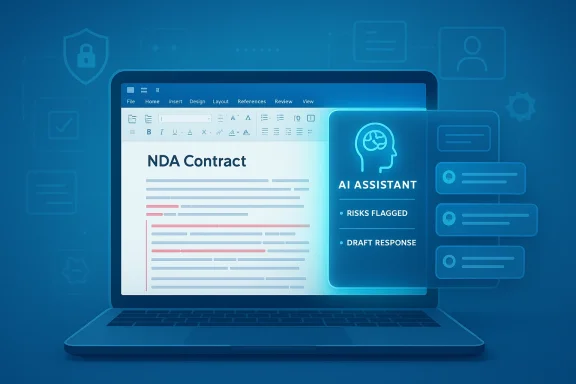
The more compelling part is document analysis. In the example Anthropic highlighted, Claude reviewed comments on an NDA, summarized what opposing counsel changed, flagged potential dealbreakers, and then helped draft a response. That is a strong signal that the tool is aimed at high-friction work where professionals are already spending too much time stitching together revisions manually.
Revision also exposes model quality more clearly. A bad draft can be fixed by a human, but a bad edit can subtly alter legal meaning, policy intent, or client tone. That makes careful editing support a high-stakes feature, not just a convenience. This is where AI assistants either become trusted collaborators or stay novelty features.
That could be especially useful in contract workflows, where revision comments often reflect competing priorities rather than simple grammar corrections. An assistant that can summarize those disputes clearly can save hours. It can also reduce the risk that one stakeholder misses a change buried in a longer review thread.
This matters because Copilot has had to fight a perception problem as much as a technical one. Many users still see it as a default feature rather than a must-have assistant, and some commercial buyers remain cautious about value, pricing, and governance. Anthropic’s presence inside Word gives those users a second reference point, which can either sharpen Copilot’s value proposition or expose its weaknesses more quickly.
That shift is huge for the market. Once the platform supports multiple model families, the value migrates from raw model branding to workflow fit, enterprise controls, and user preference. In other words, the assistant becomes modular, and modular assistants are harder to monopolize.
That said, openness cuts both ways. If users find Claude more helpful than Copilot in Word, the comparison could become awkward for Microsoft’s own product narrative. Still, from a platform perspective, making room for Anthropic may be preferable to letting customers leave the Microsoft stack entirely.
That means IT leaders are likely to evaluate Claude in Word the same way they evaluate any other business app extension: identity integration, policy enforcement, document handling, and data boundaries. If the add-in behaves like a consumer toy, it will struggle. If it behaves like a governed business tool, it has a shot at meaningful adoption.
Microsoft’s documentation also shows that Anthropic-related capabilities are being introduced gradually and may not be available everywhere at once. That gradual rollout is prudent from a systems perspective, but it also means organizations may see uneven access by region, license, or policy setting. That kind of partial availability is a classic enterprise rollout headache.
But legal and regulated industries will also be the most skeptical. They will ask whether the model can introduce subtle meaning changes, whether comments are interpreted correctly, and whether sensitive text is handled within approved boundaries. In those environments, speed is useful, but precision is decisive.
Consumers also tend to value AI differently. They want ease, affordability, and a low learning curve more than enterprise-grade policy controls. If Claude eventually reaches broader Office audiences, the company will need to explain why it is better than the assistant already bundled into their subscription.
That matters because distribution is increasingly as valuable as model quality. A strong model sitting outside the workflow is easy to admire but hard to monetize. A good-enough model sitting inside Word, Excel, or PowerPoint may become the assistant people actually use every day.
This is especially important because work software is where habits form. If Claude becomes the assistant people reach for when revising contracts or summarizing comment threads, that behavior could expand into adjacent workflows over time. In AI, habit formation is often a stronger moat than marketing.
That dynamic also pressures specialized software vendors. If a general-purpose assistant can handle a large share of drafting and review work inside Word, smaller point solutions must justify themselves with deeper specialization, compliance features, or workflow orchestration. The AI stack is getting more crowded, but also more hierarchical.
The real lesson from Clippy is not that assistants in Word are doomed. It is that assistants in Word must be useful, subtle, and easy to ignore when not needed. If Claude can strike that balance, it will feel like a serious productivity enhancement rather than a mascot with opinions.
If Anthropic gets the tone right, Claude could become the anti-Clippy: present when needed, invisible when not, and helpful enough that users stop thinking of it as an add-on at all. That is probably the strongest compliment any embedded assistant can receive. The best AI helper is the one that feels like part of the workflow, not a visitor in it.
That also makes the beta label important. It gives Anthropic permission to refine the experience before broader release, while signaling to users that the product is still evolving. In enterprise software, beta is not just a development stage; it is a promise that the vendor is still listening.
Another thing to watch is whether Anthropic extends the same pattern into other Office apps with equal depth. Word is a logical first stop because it is heavily text-centric and revision-heavy, but Excel and PowerPoint present different expectations around structure, calculation, and presentation. If Claude can prove itself in Word, the company will almost certainly use that credibility to press further into the rest of the productivity suite.
Source: CNET Anthropic's AI Assistant Claude Is Now Available in Microsoft Word
 Overview
The significance of Claude in Word is not just that it exists, but where it exists. Word remains one of the most important enterprise applications in the world, especially for contracts, policies, proposals, reports, and internal communications. When an AI assistant arrives directly in that environment, it stops being a novelty and becomes a workflow layer, which is where the real productivity battle now lives.Anthropic’s public messaging around Claude has increasingly emphasized exactly this kind of contextual work. The company has been expanding Claude into productivity suites, collaboration tools, and enterprise platforms, including Google Workspace, Slack, Microsoft Foundry, and Microsoft 365 Copilot-related scenarios. That broader pattern suggests Anthropic is no longer content to be seen only as a model provider; it wants to be a visible layer in day-to-day business software.
Microsoft, meanwhile, has been steadily moving toward a more model-agnostic posture. The company’s own documentation now says Anthropic models are available across Microsoft 365 Copilot experiences in Word, Excel, and PowerPoint for certain regions and settings, with Word support described as arriving in summer 2026 in one document and Word, Excel, and PowerPoint agents already available in other related Microsoft materials. That mixed picture reflects a fast-moving rollout, but the strategic direction is clear: Microsoft is willing to let more than one AI family power its productivity stack.
For users, that means the old binary of “use Microsoft’s assistant or nothing” is breaking down. For administrators, it means more policy choices, more governance questions, and more model-selection decisions. For competitors, it means the distribution war is becoming just as important as model quality, because the biggest advantage may now be who gets embedded inside the software people already trust.
Background
Microsoft first introduced Copilot as its flagship AI assistant in 2023, and it quickly became one of the company’s defining product bets. Over time, Microsoft pushed Copilot into consumer subscriptions, commercial Microsoft 365 plans, and specialized experiences in Word, Excel, PowerPoint, Outlook, and beyond. That made Copilot not simply an app, but a platform-wide strategy for AI assistance.At the same time, Anthropic was building a reputation around Claude as a serious work assistant, especially for writing, reasoning, and enterprise use cases. Its consumer and business positioning increasingly highlighted not just chat, but document understanding, file analysis, and connected workflows. Anthropic’s own product pages have long emphasized that Claude connects to users’ documents and tools, while recent release notes show a rapid cadence of new app integrations and workspace-oriented features.
The deeper historical context matters because Word has always been a battleground for user experience. Clippy became iconic precisely because it represented an early attempt to put an assistant inside the document workflow, but it also became infamous for being intrusive and unhelpful. The new generation of AI assistants is trying to solve the same problem with a much more capable engine, better context handling, and a far quieter user interface. That makes the current moment less about novelty and more about redemption for a long-standing software idea.
Microsoft’s own AI strategy also helps explain why Anthropic’s arrival in Word is not as surprising as it first sounds. In September 2025, Microsoft said it was expanding model choice in Microsoft 365 Copilot to include Anthropic models, beginning with Researcher and Copilot Studio. By November 2025, Anthropic announced that Claude models were available in Microsoft Foundry and Microsoft 365 Copilot-related scenarios, including Office workflows. That sequence shows a deliberate move toward multi-model flexibility rather than a one-vendor AI posture.
Another important backdrop is the changing competitive environment for enterprise AI assistants. Users want AI inside the apps they already use, but they also want control over cost, privacy, compliance, output quality, and administrative policy. The vendors that can solve those friction points will win more often than the vendors with the loudest marketing. That is why a Word add-in matters so much: it is a product feature, but it is also a distribution and trust test.
Why Word Matters So Much
Word is not just another desktop app; it is a place where businesses encode decisions, legal language, client-facing language, and institutional memory. In that environment, AI has to do more than generate prose. It has to preserve formatting, maintain context, respect tracked changes, and avoid making a document feel like it was assembled by a disconnected chatbot.Anthropic’s announcement, as reflected in reporting and related LinkedIn commentary, suggests Claude for Word is designed around those expectations. The assistant can generate new content from templates, refine existing paragraphs, and respond to comments. More importantly, it can work with the document as a document, not as a pasted text blob detached from page structure. That is a meaningful shift in how AI gets used in office software.
The document-native advantage
This is where many AI products still stumble. Users do not want to copy text into a separate window, wait for a response, and then manually reformat the result. They want the assistant to understand headings, sections, references, revisions, and the conversational thread around a file. Claude for Word is trying to meet that expectation in a way that feels native to professional writing.That matters because the more “native” the assistant feels, the more likely users are to trust it with real work. In enterprise software, convenience is not a soft metric; it is a conversion mechanism. Every click that disappears increases adoption, and every preserved formatting rule reduces the feeling that AI is a toy.
Why this is different from chatbots
A chatbot can summarize a document, but Word users often need more than summary. They need tone changes, legal caution, structural edits, and consistency with prior drafts. In other words, they need a writing collaborator that understands the page, the audience, and the revision history.That is also why this move is strategically important for Anthropic. If Claude becomes the assistant people choose when they open a document, then the company has inserted itself into one of the most valuable moments in the productivity lifecycle. It is not just competing for queries; it is competing for the first thought after the document opens.
- Word is a high-value workflow surface, not a generic editor.
- Native document context reduces friction and increases trust.
- AI inside Word can influence real business outcomes, not just drafts.
- Better formatting preservation makes the assistant feel professional rather than experimental.
What Claude for Word Can Actually Do
Anthropic says Claude can help users create new content and edit existing documents. In practice, that means a user can start from a template, describe what they need, and ask Claude to produce a first draft. It also means users can highlight sections and request edits like shortening prose, changing tone, or removing passive voice.The more compelling part is document analysis. In the example Anthropic highlighted, Claude reviewed comments on an NDA, summarized what opposing counsel changed, flagged potential dealbreakers, and then helped draft a response. That is a strong signal that the tool is aimed at high-friction work where professionals are already spending too much time stitching together revisions manually.
Drafting versus revision
Drafting is useful, but revision is often where AI creates real leverage. First drafts are easy to generate and easy to ignore; the harder task is reshaping an existing document while retaining voice and intent. Claude’s ability to work on a paragraph-by-paragraph basis is therefore more interesting than generic “write me a document” prompts.Revision also exposes model quality more clearly. A bad draft can be fixed by a human, but a bad edit can subtly alter legal meaning, policy intent, or client tone. That makes careful editing support a high-stakes feature, not just a convenience. This is where AI assistants either become trusted collaborators or stay novelty features.
Comments and collaboration
Claude’s ability to read comments and respond to them is potentially more important than its marketing examples suggest. Modern Word workflows are rarely solitary; they are embedded in review chains involving legal, finance, HR, sales, and leadership. If the assistant can interpret the commentary thread, it can help turn a document from a static file into a living negotiation surface.That could be especially useful in contract workflows, where revision comments often reflect competing priorities rather than simple grammar corrections. An assistant that can summarize those disputes clearly can save hours. It can also reduce the risk that one stakeholder misses a change buried in a longer review thread.
- Generate a first draft from a template.
- Tighten, shorten, or re-tone existing paragraphs.
- Preserve formatting and tracked-change workflows.
- Interpret comments and summarize changes.
- Surface risks in business or legal text.
The Competitive Meaning for Copilot
The obvious headline is that Claude is arriving in the same application where Copilot already lives. That creates a striking dynamic: Microsoft is effectively allowing another AI brand to sit inside one of its crown-jewel products. The result is not necessarily a zero-sum substitution, but it does create a more visible comparison point for users who are already Copilot-curious or Copilot-skeptical.This matters because Copilot has had to fight a perception problem as much as a technical one. Many users still see it as a default feature rather than a must-have assistant, and some commercial buyers remain cautious about value, pricing, and governance. Anthropic’s presence inside Word gives those users a second reference point, which can either sharpen Copilot’s value proposition or expose its weaknesses more quickly.
Multi-model reality
Microsoft has already acknowledged that customers want choice. Its documentation and blog posts describe Anthropic models in Microsoft 365 Copilot, Copilot Studio, Microsoft Foundry, and agents across Word, Excel, and PowerPoint. That means the competitive conversation is no longer “Copilot versus Claude” in the old sense; it is increasingly “which model, in which workflow, under which governance rules?”That shift is huge for the market. Once the platform supports multiple model families, the value migrates from raw model branding to workflow fit, enterprise controls, and user preference. In other words, the assistant becomes modular, and modular assistants are harder to monopolize.
A test of Microsoft’s openness
There is also a subtler strategic signal here. Microsoft can either be seen as protecting Copilot’s primacy or as embracing a broader ecosystem in which the best model wins the task. The more it leans into the second framing, the more credible its AI platform story becomes to enterprise buyers who already distrust vendor lock-in.That said, openness cuts both ways. If users find Claude more helpful than Copilot in Word, the comparison could become awkward for Microsoft’s own product narrative. Still, from a platform perspective, making room for Anthropic may be preferable to letting customers leave the Microsoft stack entirely.
- Claude gives customers a live alternative inside Word.
- Microsoft’s model-choice strategy reduces lock-in but raises competition inside its own ecosystem.
- Copilot must now win on trust, usability, and output quality, not just default placement.
- Enterprise buyers gain bargaining power when multiple AI options exist.
Enterprise Buyers Will Care About Governance More Than Hype
For enterprise customers, the biggest question is not whether Claude can write a nicer paragraph. It is whether the assistant fits into existing security, compliance, and procurement requirements. Microsoft’s own documentation on Anthropic models in Microsoft 365 Copilot highlights admin controls, regional availability, and phased rollout rules, which are exactly the kinds of details large organizations care about first.That means IT leaders are likely to evaluate Claude in Word the same way they evaluate any other business app extension: identity integration, policy enforcement, document handling, and data boundaries. If the add-in behaves like a consumer toy, it will struggle. If it behaves like a governed business tool, it has a shot at meaningful adoption.
Procurement and deployment friction
One big advantage for Anthropic is that it is arriving where the users already are, rather than asking them to adopt a new standalone platform. That reduces behavioral friction, but it does not eliminate procurement friction. Enterprise buyers still need to know who can use it, where the data goes, and how it is administered.Microsoft’s documentation also shows that Anthropic-related capabilities are being introduced gradually and may not be available everywhere at once. That gradual rollout is prudent from a systems perspective, but it also means organizations may see uneven access by region, license, or policy setting. That kind of partial availability is a classic enterprise rollout headache.
Legal and contract-heavy workflows
The legal-style example in Anthropic’s announcement is a strong clue about the intended audience. Word is already central to contract review, policy drafting, and procurement workflows, so an AI assistant that can understand comments and flag risky changes has a natural enterprise home. Those are the kinds of tasks that justify paid licenses faster than generic content generation.But legal and regulated industries will also be the most skeptical. They will ask whether the model can introduce subtle meaning changes, whether comments are interpreted correctly, and whether sensitive text is handled within approved boundaries. In those environments, speed is useful, but precision is decisive.
Consumer users are a different story
For consumer Word users, the picture is less straightforward. Anthropic’s current Word add-in appears focused on Team and Enterprise plans, which means most home users will not be first in line. That lowers the immediate consumer impact but raises the likelihood that this feature becomes a signal for business adoption first and consumer adoption later.Consumers also tend to value AI differently. They want ease, affordability, and a low learning curve more than enterprise-grade policy controls. If Claude eventually reaches broader Office audiences, the company will need to explain why it is better than the assistant already bundled into their subscription.
- Governance matters more than feature demos.
- Regional rollout and admin controls will shape adoption.
- Legal, finance, and procurement use cases are the most promising.
- Consumer uptake depends on pricing and simplicity, not just capability.
Why This Could Matter for the Broader AI Market
The AI market is moving away from the idea that the winner is the best chatbot in isolation. Instead, the winner may be the assistant that fits cleanly into the workflow software people already depend on. Claude for Word is a strong example of that shift, because it does not demand a new destination; it inserts itself into an existing one.That matters because distribution is increasingly as valuable as model quality. A strong model sitting outside the workflow is easy to admire but hard to monetize. A good-enough model sitting inside Word, Excel, or PowerPoint may become the assistant people actually use every day.
The platform war is getting more complex
Microsoft’s collaboration with Anthropic shows that platform companies may not be betting on a single model future. They are betting on a portfolio future, where different models are selected for different tasks. That is a more resilient strategy, but it also means model vendors must compete not only on benchmarks but on fit, trust, and integration quality.This is especially important because work software is where habits form. If Claude becomes the assistant people reach for when revising contracts or summarizing comment threads, that behavior could expand into adjacent workflows over time. In AI, habit formation is often a stronger moat than marketing.
A signal to rivals
OpenAI, Google, and other enterprise AI vendors will read this as a warning shot. The best model is no longer enough if it is not embedded where work happens. Rivals now have to think in terms of connectors, add-ins, admin consoles, and trust boundaries as much as model quality.That dynamic also pressures specialized software vendors. If a general-purpose assistant can handle a large share of drafting and review work inside Word, smaller point solutions must justify themselves with deeper specialization, compliance features, or workflow orchestration. The AI stack is getting more crowded, but also more hierarchical.
- Workflow proximity is becoming a core competitive advantage.
- Model quality alone is no longer enough to win enterprise adoption.
- Integration layers may matter more than the chatbot interface.
- Specialized vendors will need sharper differentiation.
Where Clippy Fits Into the Story
The Clippy comparison is irresistible because it captures both nostalgia and caution. Clippy was ahead of its time in the sense that it imagined an assistant inside Word, but it was also proof that a poorly timed, poorly tuned helper can frustrate users instead of helping them. Claude inherits the same symbolic stage, but with a much more mature underlying capability.The real lesson from Clippy is not that assistants in Word are doomed. It is that assistants in Word must be useful, subtle, and easy to ignore when not needed. If Claude can strike that balance, it will feel like a serious productivity enhancement rather than a mascot with opinions.
Nostalgia versus utility
Nostalgia is powerful in tech culture, but it does not sell enterprise software by itself. People may joke about Clippy, yet what they really want now is a tool that can digest comments, preserve formatting, and reduce document churn. That is a much more demanding standard than the old paperclip ever had to meet.If Anthropic gets the tone right, Claude could become the anti-Clippy: present when needed, invisible when not, and helpful enough that users stop thinking of it as an add-on at all. That is probably the strongest compliment any embedded assistant can receive. The best AI helper is the one that feels like part of the workflow, not a visitor in it.
What “default” means now
Clippy was annoying partly because it showed up by default in ways users did not ask for. Today’s AI assistants face the opposite challenge: they often have to earn enough trust to be invited in. Claude’s Word beta suggests Anthropic is trying to make itself opt-in, not intrusive, which is a much smarter posture in a productivity market scarred by too many overconfident assistants.That also makes the beta label important. It gives Anthropic permission to refine the experience before broader release, while signaling to users that the product is still evolving. In enterprise software, beta is not just a development stage; it is a promise that the vendor is still listening.
- Clippy proved that assistants can be memorable for the wrong reasons.
- Claude has to be helpful, subtle, and non-disruptive.
- Beta status gives Anthropic room to improve before wider rollout.
- User trust will depend on restraint as much as capability.
Strengths and Opportunities
Claude’s arrival in Word has several strengths that could translate into real adoption if Anthropic executes well. It sits inside a high-frequency business app, it targets work that already has clear pain points, and it arrives at a moment when Microsoft itself is validating multi-model flexibility across the 365 ecosystem. That is a rare combination of timing, placement, and market demand.- Native workflow fit inside Word is a major advantage.
- Document editing and comment analysis are concrete, high-value use cases.
- Enterprise plans make the feature easier to monetize.
- Microsoft’s model-choice direction validates the category.
- Legal and contract review workflows offer immediate business value.
- Formatting preservation improves trust and usability.
- Beta status gives Anthropic room to iterate quickly.
Risks and Concerns
The same factors that make Claude attractive also create real risks. Word is a sensitive environment, AI-generated edits can subtly change meaning, and enterprise buyers will be wary of any assistant that is even slightly sloppy with contracts or policy text. Anthropic will need to prove that its assistant is not just clever, but reliably careful.- Hallucinated edits could create serious document risk.
- Governance and regional availability may fragment adoption.
- Beta software can still feel unfinished to users.
- Enterprise security concerns may slow deployment.
- Copilot competition inside Microsoft’s own ecosystem could limit clarity.
- User confusion may grow if multiple AI layers appear in the same app.
- Value perception will depend on measurable time savings, not hype.
Looking Ahead
The next phase will be less about the announcement and more about the rollout details. The most important questions are whether Anthropic expands beyond Team and Enterprise plans, how Microsoft documents the interaction between Claude and Copilot, and whether organizations see enough value to standardize on one assistant or keep multiple tools available. Those answers will determine whether Claude for Word becomes a niche beta or a durable part of the enterprise AI landscape.Another thing to watch is whether Anthropic extends the same pattern into other Office apps with equal depth. Word is a logical first stop because it is heavily text-centric and revision-heavy, but Excel and PowerPoint present different expectations around structure, calculation, and presentation. If Claude can prove itself in Word, the company will almost certainly use that credibility to press further into the rest of the productivity suite.
- Expansion beyond beta to broader plans or regions.
- How Microsoft’s own Anthropic-enabled Copilot experiences evolve.
- Whether businesses adopt Claude for legal and review workflows.
- The degree to which Word users prefer Claude over Copilot.
- Possible extensions into Excel, PowerPoint, or Outlook-like scenarios.
Source: CNET Anthropic's AI Assistant Claude Is Now Available in Microsoft Word
