

On July 1, 2026, President Donald Trump toured the newly built Theodore Roosevelt Presidential Library in Medora, North Dakota, where he interacted with a life-size, AI-powered hologram of Roosevelt before the library’s July 4 public opening. The scene was strange because it was not merely a museum demo; it was political theater staged inside a technological reconstruction of the past. A dead president, trained on his own words, became both exhibit and prop. That is the promise and danger of the modern AI museum: it can make history feel alive, but it can also make editorial choices look like resurrection.
The Theodore Roosevelt Presidential Library has never been a normal presidential-library project. Roosevelt died in 1919, long before the modern presidential library system took shape, and the Medora institution arrives more than a century later as both memorial and reinvention. It is not simply a warehouse for papers, artifacts, and civic nostalgia; it is a deliberate attempt to turn Roosevelt into an experience.
That matters because the library’s opening was tied to America’s 250th anniversary celebrations. The date gives the project a ready-made national frame: Roosevelt as the halfway-point president between founding mythology and contemporary fracture. Medora, the Badlands town where Roosevelt’s conservation identity was forged, becomes the stage for a larger argument about national character.
Then Trump arrived, and the symbolism became much less subtle.
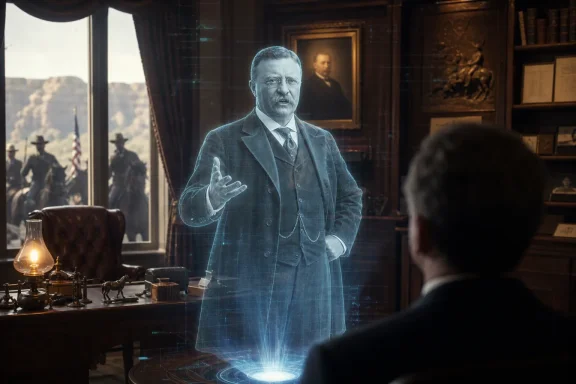
A presidential motorcade moving through a frontier pageant, escorted by riders dressed as Rough Riders, is not accidental imagery. It collapses Roosevelt’s biography into a cinematic shorthand: vigor, nationalism, wilderness, combat, executive force. When Trump then stepped into a recreated Roosevelt White House office and spoke with a holographic Teddy, the museum’s immersive design became part of a live political tableau.
That distinction is important, but it does not make the system neutral. Training a model on a historical archive does not remove interpretation; it relocates interpretation into curation, retrieval, prompting, guardrails, and presentation. Someone decides which documents matter, which tone is authentic, which topics are safe, and how far the avatar may travel beyond the source material.
In museum terms, this is the difference between quoting Roosevelt and performing Roosevelt. A quotation sits on a wall and announces its limits. A hologram answers back, with timing, posture, apparent confidence, and the illusion of presence. The visitor is not just reading history; the visitor is being addressed by it.
That is powerful. It is also precarious.
In this context, the answer landed differently. Trump has repeatedly used Rooseveltian language around strength, nationalism, executive will, and the Panama Canal. Asking an AI Roosevelt about the canal in a replica White House office offered a neat symbolic loop: one president invoking another president’s myth in front of an audience primed for spectacle.
The catch is obvious. The avatar can be designed to avoid endorsement, but it cannot truly dissent. It can contextualize. It can redirect. It can perhaps sound stern. But it cannot walk out of the room, challenge the premise, or object to being used as stagecraft.
That is why the moment felt surreal rather than merely futuristic. The technology enabled a pseudo-conversation in which the dead appeared to participate, while the living controlled the frame.
This is a logical extension of where consumer and enterprise AI have been heading. The interface is no longer a search box; it is a conversational agent. The database is no longer a filing cabinet; it is a model-mediated system that summarizes, retrieves, and narrates. Museums, universities, public archives, and corporate history departments are all obvious targets for this technology.
The best version of that future is genuinely exciting. A student could interrogate primary sources without needing to know which collection contains the relevant material. A visitor could ask a historically grounded avatar about conservation, war, grief, race, labor, or monopoly power and receive an answer tied to documents that would otherwise remain unread. Accessibility could improve, especially for visitors who do not learn well from placards and glass cases.
The worst version is also easy to imagine. Every institution gets its own agreeable ghost. Every founder becomes available for brand-safe dialogue. Every controversial figure is sanded down into an “interactive experience” that says just enough to feel authentic and not enough to threaten the sponsor wall.
Because conversational AI changes the visitor’s relationship to authority. A wall label speaks as the museum. A hologram of Roosevelt speaks as Roosevelt. Even when everyone intellectually understands the difference, the emotional effect is not the same.
The problem is not that the system is fake. The problem is that it is fake in a way designed to feel responsive, intimate, and authoritative. The avatar’s body, voice, and setting all push the visitor toward the impression of encounter. The curatorial layer becomes less visible precisely as it becomes more important.
This is where transparency will matter. Museums using AI historical figures should make clear what sources are being used, where the model is constrained, when answers are paraphrased, and how disputed topics are handled. A synthetic Roosevelt should not just sound like Roosevelt; it should reveal the machinery that lets it speak.
Roosevelt is a particularly contested figure to resurrect. He was a conservationist and imperialist, reformer and nationalist, trust-buster and believer in martial vigor. He offers something to almost every faction of American politics, which is why politicians keep reaching for him. He is useful because he is too large and contradictory to be owned cleanly.
That is also why an AI Roosevelt is so risky. A conventional exhibit can dwell in contradiction. A conversational avatar tends to resolve tension into answer. It must say something now, in a voice that feels coherent, even when the historical Roosevelt was inconsistent, evolving, and often uncomfortable by contemporary standards.
The political staging around Trump sharpened that tension. The library may intend the avatar as educational technology. But the image that traveled was simpler: Trump talking to Teddy Roosevelt and later invoking that exchange in public remarks. The museum built an interface to history; politics immediately converted it into a scene.
But the creepiest part is not the hologram itself. Museums have always used illusion. Wax figures, reenactors, audio tours, projection mapping, and battlefield soundscapes all manipulate presence. The novelty here is the combination of generative response, institutional authority, and political utility.
A wax Roosevelt cannot adapt to the visitor. A reenactor can, but everyone understands there is a human interpreter in costume. An AI Roosevelt occupies a new category: not person, not recording, not actor, not archive, but a synthetic institutional voice wearing a historical face.
That ambiguity is the product. It is also the ethical problem.
That should sound familiar. The same tensions around Copilot, Recall-style memory features, enterprise search, and AI assistants appear here in museum form. What data is ingested? Who controls retrieval? How are hallucinations prevented? What happens when a polished interface makes a probabilistic system feel definitive?
The Roosevelt library may be a carefully managed deployment with a historically rich corpus and institutional oversight. But the broader template will not stay confined to high-budget museums. Expect local history centers, universities, corporate campuses, theme parks, campaign exhibits, and media companies to experiment with similar systems.
Once the cost drops, synthetic historical presence becomes a content format.
That means the avatar must be able to handle hard subjects. Roosevelt’s views on race, empire, labor, masculinity, conservation, and executive power cannot be reduced to patriotic uplift. If the system only produces safe inspirational summaries, it will become a frontier-themed corporate chatbot with a pince-nez.
The library’s source-grounded design gives it a chance to do better. Roosevelt left behind a vast documentary record, and his life intersects with many of the questions still dividing American politics. A good AI exhibit could expose visitors to that complexity in ways a static display cannot.
But this requires restraint. The more lifelike the avatar becomes, the more the institution has a duty to remind visitors that they are not hearing Roosevelt. They are hearing a contemporary system assemble Roosevelt-shaped answers from curated materials.
The result was not simply “Trump talks to hologram.” It was a demonstration of how quickly a cultural technology can become political scenery. The library opened with a high-minded premise about bringing Roosevelt’s archive to life; the first viral image turned that premise into a question about who gets to make the past speak.
That question will outlive this particular news cycle. Every AI historical figure will carry an invisible editorial board behind it. Every answer will be a blend of source material and present-day institutional judgment. Every visitor will have to decide whether the encounter deepens history or merely animates it.
That is the version of AI in museums worth defending: not a machine that flatters the visitor’s premise, but one that uses the archive to complicate it. The danger is that the same machinery can just as easily be tuned in the opposite direction. A historical avatar can broaden the story, or it can narrow it into propaganda with better production values.
The difference will not be determined by the hologram hardware. It will be determined by governance, transparency, scholarship, and institutional courage. Those are less marketable than “talk to Teddy,” but they are what separate public history from themed entertainment.
 The Library Opened With a Thesis, Not Just a Ribbon
The Theodore Roosevelt Presidential Library has never been a normal presidential-library project. Roosevelt died in 1919, long before the modern presidential library system took shape, and the Medora institution arrives more than a century later as both memorial and reinvention. It is not simply a warehouse for papers, artifacts, and civic nostalgia; it is a deliberate attempt to turn Roosevelt into an experience.That matters because the library’s opening was tied to America’s 250th anniversary celebrations. The date gives the project a ready-made national frame: Roosevelt as the halfway-point president between founding mythology and contemporary fracture. Medora, the Badlands town where Roosevelt’s conservation identity was forged, becomes the stage for a larger argument about national character.
Then Trump arrived, and the symbolism became much less subtle.
A presidential motorcade moving through a frontier pageant, escorted by riders dressed as Rough Riders, is not accidental imagery. It collapses Roosevelt’s biography into a cinematic shorthand: vigor, nationalism, wilderness, combat, executive force. When Trump then stepped into a recreated Roosevelt White House office and spoke with a holographic Teddy, the museum’s immersive design became part of a live political tableau.
Holo-Ted Is a Chatbot Wearing the Authority of an Archive
The Roosevelt avatar is not just a prerecorded animatronic with better lighting. It is described as a voice-activated, life-size conversational installation built with LemonSlice AI, Microsoft Azure Conversational AI, and Proto hologram hardware. Its answers are drawn from a large body of Roosevelt’s letters, speeches, books, and historical materials rather than a generic model improvising from the open internet.That distinction is important, but it does not make the system neutral. Training a model on a historical archive does not remove interpretation; it relocates interpretation into curation, retrieval, prompting, guardrails, and presentation. Someone decides which documents matter, which tone is authentic, which topics are safe, and how far the avatar may travel beyond the source material.
In museum terms, this is the difference between quoting Roosevelt and performing Roosevelt. A quotation sits on a wall and announces its limits. A hologram answers back, with timing, posture, apparent confidence, and the illusion of presence. The visitor is not just reading history; the visitor is being addressed by it.
That is powerful. It is also precarious.
Trump Found the One Exhibit That Could Not Interrupt Him
Trump reportedly asked the AI Roosevelt whether the Panama Canal ranked among his greatest achievements. The avatar acknowledged the canal but broadened the answer to Roosevelt’s trust-busting, national parks, food and drug safety, and the Square Deal. In another context, that response would be a clever curatorial correction: yes, the canal mattered, but Roosevelt’s legacy cannot be reduced to imperial engineering.In this context, the answer landed differently. Trump has repeatedly used Rooseveltian language around strength, nationalism, executive will, and the Panama Canal. Asking an AI Roosevelt about the canal in a replica White House office offered a neat symbolic loop: one president invoking another president’s myth in front of an audience primed for spectacle.
The catch is obvious. The avatar can be designed to avoid endorsement, but it cannot truly dissent. It can contextualize. It can redirect. It can perhaps sound stern. But it cannot walk out of the room, challenge the premise, or object to being used as stagecraft.
That is why the moment felt surreal rather than merely futuristic. The technology enabled a pseudo-conversation in which the dead appeared to participate, while the living controlled the frame.
Microsoft’s Museum Pitch Is Bigger Than Roosevelt
For Microsoft, the Roosevelt library is a showcase for a broader argument about AI as an interface to cultural memory. Instead of searching an archive, visitors can ask it questions. Instead of reading a timeline, they can wander through immersive rooms where documents, photographs, and synthetic speech become part of a guided experience.This is a logical extension of where consumer and enterprise AI have been heading. The interface is no longer a search box; it is a conversational agent. The database is no longer a filing cabinet; it is a model-mediated system that summarizes, retrieves, and narrates. Museums, universities, public archives, and corporate history departments are all obvious targets for this technology.
The best version of that future is genuinely exciting. A student could interrogate primary sources without needing to know which collection contains the relevant material. A visitor could ask a historically grounded avatar about conservation, war, grief, race, labor, or monopoly power and receive an answer tied to documents that would otherwise remain unread. Accessibility could improve, especially for visitors who do not learn well from placards and glass cases.
The worst version is also easy to imagine. Every institution gets its own agreeable ghost. Every founder becomes available for brand-safe dialogue. Every controversial figure is sanded down into an “interactive experience” that says just enough to feel authentic and not enough to threaten the sponsor wall.
The Archive Is Real, but the Performance Is Edited
The library’s defenders can fairly argue that all museums are edited. A traditional exhibit also selects, omits, frames, and dramatizes. No visitor mistakes a diorama for the full complexity of the past. Why should a hologram be treated as uniquely suspect?Because conversational AI changes the visitor’s relationship to authority. A wall label speaks as the museum. A hologram of Roosevelt speaks as Roosevelt. Even when everyone intellectually understands the difference, the emotional effect is not the same.
The problem is not that the system is fake. The problem is that it is fake in a way designed to feel responsive, intimate, and authoritative. The avatar’s body, voice, and setting all push the visitor toward the impression of encounter. The curatorial layer becomes less visible precisely as it becomes more important.
This is where transparency will matter. Museums using AI historical figures should make clear what sources are being used, where the model is constrained, when answers are paraphrased, and how disputed topics are handled. A synthetic Roosevelt should not just sound like Roosevelt; it should reveal the machinery that lets it speak.
The Politics Were Built Into the Room
It is tempting to treat the Trump visit as an odd viral footnote to a museum opening. That understates the moment. Presidential libraries are always political spaces, and this one opened under the glare of a sitting president who has made historical comparison part of his brand.Roosevelt is a particularly contested figure to resurrect. He was a conservationist and imperialist, reformer and nationalist, trust-buster and believer in martial vigor. He offers something to almost every faction of American politics, which is why politicians keep reaching for him. He is useful because he is too large and contradictory to be owned cleanly.
That is also why an AI Roosevelt is so risky. A conventional exhibit can dwell in contradiction. A conversational avatar tends to resolve tension into answer. It must say something now, in a voice that feels coherent, even when the historical Roosevelt was inconsistent, evolving, and often uncomfortable by contemporary standards.
The political staging around Trump sharpened that tension. The library may intend the avatar as educational technology. But the image that traveled was simpler: Trump talking to Teddy Roosevelt and later invoking that exchange in public remarks. The museum built an interface to history; politics immediately converted it into a scene.
The Creepy Part Is Not the Hologram
The internet reaction split along predictable lines. Some viewers saw a clever museum installation. Others saw something uncanny, even ghoulish: a dead president simulated for a living president’s photo opportunity. Both reactions are reasonable, because the technology sits exactly on that border.But the creepiest part is not the hologram itself. Museums have always used illusion. Wax figures, reenactors, audio tours, projection mapping, and battlefield soundscapes all manipulate presence. The novelty here is the combination of generative response, institutional authority, and political utility.
A wax Roosevelt cannot adapt to the visitor. A reenactor can, but everyone understands there is a human interpreter in costume. An AI Roosevelt occupies a new category: not person, not recording, not actor, not archive, but a synthetic institutional voice wearing a historical face.
That ambiguity is the product. It is also the ethical problem.
Windows Users Should Recognize This Pattern
For WindowsForum readers, the Roosevelt hologram is not just a culture-war oddity. It is another sign that Microsoft’s AI strategy is moving beyond productivity software and developer tooling into civic infrastructure, education, memory, and public space. Azure is not merely hosting business chatbots; it is becoming part of how institutions package knowledge.That should sound familiar. The same tensions around Copilot, Recall-style memory features, enterprise search, and AI assistants appear here in museum form. What data is ingested? Who controls retrieval? How are hallucinations prevented? What happens when a polished interface makes a probabilistic system feel definitive?
The Roosevelt library may be a carefully managed deployment with a historically rich corpus and institutional oversight. But the broader template will not stay confined to high-budget museums. Expect local history centers, universities, corporate campuses, theme parks, campaign exhibits, and media companies to experiment with similar systems.
Once the cost drops, synthetic historical presence becomes a content format.
The Real Test Is Not Whether Teddy Sounds Like Teddy
Authenticity is not just mimicry. A convincing cadence, period phrasing, and handsome holographic rendering can make an installation impressive without making it honest. The real test is whether the system helps visitors understand Roosevelt more deeply, including the parts that resist easy celebration.That means the avatar must be able to handle hard subjects. Roosevelt’s views on race, empire, labor, masculinity, conservation, and executive power cannot be reduced to patriotic uplift. If the system only produces safe inspirational summaries, it will become a frontier-themed corporate chatbot with a pince-nez.
The library’s source-grounded design gives it a chance to do better. Roosevelt left behind a vast documentary record, and his life intersects with many of the questions still dividing American politics. A good AI exhibit could expose visitors to that complexity in ways a static display cannot.
But this requires restraint. The more lifelike the avatar becomes, the more the institution has a duty to remind visitors that they are not hearing Roosevelt. They are hearing a contemporary system assemble Roosevelt-shaped answers from curated materials.
The Moment in Medora Is a Preview, Not a One-Off
The Medora scene will be remembered because it compressed several 2026 anxieties into one image. AI is moving into public memory. Politics is devouring every symbolic space it enters. Institutions are searching for ways to make history feel immediate to audiences trained by screens. And the dead, inconveniently, cannot consent to their own interactivity.The result was not simply “Trump talks to hologram.” It was a demonstration of how quickly a cultural technology can become political scenery. The library opened with a high-minded premise about bringing Roosevelt’s archive to life; the first viral image turned that premise into a question about who gets to make the past speak.
That question will outlive this particular news cycle. Every AI historical figure will carry an invisible editorial board behind it. Every answer will be a blend of source material and present-day institutional judgment. Every visitor will have to decide whether the encounter deepens history or merely animates it.
The Lesson Hidden Inside the Hologram’s Reply
The Roosevelt avatar’s reported answer to the Panama Canal question may be the most revealing part of the whole episode. Asked about a monumental exercise of power, it widened the lens to domestic reform, conservation, food safety, monopoly power, and ordinary citizens. Whether by design or accident, the system resisted the simplest heroic frame.That is the version of AI in museums worth defending: not a machine that flatters the visitor’s premise, but one that uses the archive to complicate it. The danger is that the same machinery can just as easily be tuned in the opposite direction. A historical avatar can broaden the story, or it can narrow it into propaganda with better production values.
The difference will not be determined by the hologram hardware. It will be determined by governance, transparency, scholarship, and institutional courage. Those are less marketable than “talk to Teddy,” but they are what separate public history from themed entertainment.
Medora’s Talking Roosevelt Leaves a Short Checklist for the AI Museum Era
The Roosevelt library’s debut is a milestone because it makes the next phase of AI feel tangible: not a browser tab, not a sidebar assistant, but a human-scale presence in a civic space. The technology deserves attention, but the governance deserves more.- The Theodore Roosevelt Presidential Library opens to the public on July 4, 2026, after a July 1 dedication visit by President Trump in Medora, North Dakota.
- The Roosevelt avatar is designed as a conversational, life-size AI installation grounded in Roosevelt’s writings and historical collections.
- The Trump interaction turned a museum feature into national political imagery almost immediately.
- The strongest educational use of this technology is not imitation, but source-grounded complication of simplified historical myths.
- Museums adopting AI historical figures will need clear disclosure about sources, limits, curation, and editorial control.
- The same pattern will likely spread beyond presidential libraries into schools, archives, corporate exhibits, and public commemorations.
References
- Primary source: Gadget Review
Published: 2026-07-01T23:30:16.085600
Inside the Surreal Moment a Hologram of Teddy Roosevelt Answered Trump’s Questions
Theodore Roosevelt Presidential Library debuts an AI hologram of Teddy trained on his real words — and Trump showed up to have a chat with it.www.gadgetreview.com - Related coverage: thedailybeast.com
Donald Trump, 80, Gets Roasted by a Hologram in Pep Talk Gone Wrong
The president’s visit with a long-dead predecessor was an odd choice given his progressive credentials.www.thedailybeast.com
- Related coverage: trlibrary.com
Theodore Roosevelt Presidential Library Opening Celebrations on July 4, 2026
Opening weekend to feature “Eyes on the Stars” drone show, immersive AI exhibits, and special guest speakers MEDORA, N.D., March 9, 2026 — The Theodore Roosevelt Presidential Library (TRPL) today announced details for its official grand opening, which will take place on July 4, 2026, aligning...www.trlibrary.com - Related coverage: tech.yahoo.com
Inside the Surreal Moment a Hologram of Teddy Roosevelt Answered Trump’s Questions
Theodore Roosevelt Presidential Library debuts an AI hologram of Teddy trained on his real words - and Trump showed up to have a chat with it.tech.yahoo.com - Official source: news.microsoft.com
AI-powered Theodore Roosevelt Presidential Library opens July 4
The new Theodore Roosevelt Presidential Library uses AI to transform hundreds of thousands of historical documents into interactive experiences, including a digital research tool and a lifelike Roosevelt avatar.news.microsoft.com
- Related coverage: prnewswire.com
Theodore Roosevelt Speaks Again: LemonSlice Powers a Life-Size, Conversational AI Avatar at the Opening of the New Theodore Roosevelt Presidential Library
/PRNewswire/ -- LemonSlice, the AI lab behind the first real-time interactive video model, today announced that its technology powers a live, talking version... www.prnewswire.com
- Related coverage: legion.org
- Related coverage: theguardian.com
Trump to attend opening of Roosevelt library amid overturning conservation efforts | Donald Trump | The Guardian
Theodore Roosevelt protected swathes of land, while Trump has lifted protections from more than 86m acreswww.theguardian.com - Related coverage: freedom250.org
President Donald J. Trump to Join Freedom 250 for the Dedication of the Theodore Roosevelt Presidential Library - Freedom 250
WASHINGTON, D.C. – President Donald J. Trump will join Freedom 250 and distinguished guests on July 1, 2026, for the dedication of the Theodore Roosevelt Presidential Library in...freedom250.org
- Related coverage: governor.nd.gov
Armstrong to welcome President Trump to Medora for Theodore Roosevelt Presidential Library dedication
Gov. Kelly Armstrong will welcome President Donald Trump to North Dakota on Wednesday for the dedication of the Theodore Roosevelt Presidential Library in Medora. The governor also will participate in several library-related events this week, culminating with the grand opening ceremony on Saturday.www.governor.nd.gov

