

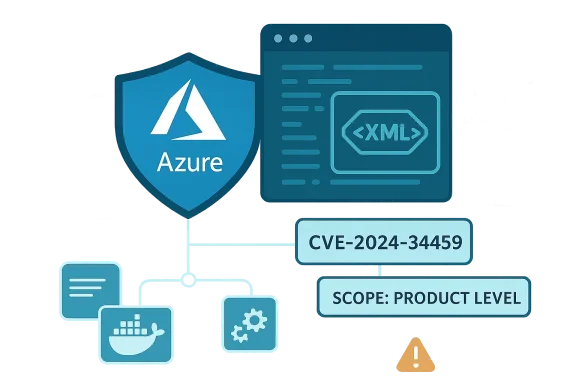
Microsoft’s short public attestation that “Azure Linux includes this open‑source library and is therefore potentially affected” is accurate — but it is a scoped, product‑level inventory statement, not a categorical guarantee that no other Microsoft product or image could contain the same vulnerable libxml2 code. m](Security Update Guide - Microsoft Security Response Center))
CVE‑2024‑34459 is a buffer over‑read flaw in the xmllint utility that’s part of the widely used libxml2 library. The vulnerability manifests when xmllint formats error messages using the --htmlout option: a defect in xmlHTMLPrintFileContext in xmllint.c can allow an out‑of‑bounds read. Upstream advisories identify libxml2 versions before 2.11.8 and 2.12.x before 2.12.7 as vulnerable.
Multiple Linux distributors and security trackers — including the NVD summary, Debian’s tracker and Ubuntu’s USN — have published the same technical description and have documented vendor patches or backports as they became available. These sources show the vulnerability was treated as a medium/high‑severity reliability and information‑exposure risk, typically resulting in denial‑of‑service when xmllint is invoked on crafted input.
Why this matters: libxml2 is not a niche component. It’s a C library used by countless Linux packages, tools and embedded systems; xmllint is the command‑line utility shipped with it. Even if an environment never calls xmllint directly, the library and its tools are frequently present in base images, containers and developer tooling. That ubiquity makes accurate product‑scope mapping — who ships what — essential for operational risk decisions.
Two important interpretive points for defenders and customers:
That approach is consistent with how vendors typically publish VEX/CSAF: start with the products you build and distribute, then expand mappings to other product families as scanning and supply‑chain data become available. It’s practical, but it also leaves a window during which other corporate artifacts may not yet be explicitly mapped.
Plausible places to check:
In short: Microsoft’s statement that Azure Linux includes the affected libxml2 is correct and actionable for Azure Linux customers, but it is a product‑scoped attestation — not a proof that no other Microsoft product contains the vulnerable library. Defenders must treat other Microsoft artifacts as “not yet confirmed” and should run independent inventory, patch where needed, and mitigate automated XML processing paths immediately. (msrc.microsoft.com)
Source: MSRC Security Update Guide - Microsoft Security Response Center
 Background / Overview
CVE‑2024‑34459 is a buffer over‑read flaw in the xmllint utility that’s part of the widely used libxml2 library. The vulnerability manifests when xmllint formats error messages using the --htmlout option: a defect in xmlHTMLPrintFileContext in xmllint.c can allow an out‑of‑bounds read. Upstream advisories identify libxml2 versions before 2.11.8 and 2.12.x before 2.12.7 as vulnerable.Multiple Linux distributors and security trackers — including the NVD summary, Debian’s tracker and Ubuntu’s USN — have published the same technical description and have documented vendor patches or backports as they became available. These sources show the vulnerability was treated as a medium/high‑severity reliability and information‑exposure risk, typically resulting in denial‑of‑service when xmllint is invoked on crafted input.
Why this matters: libxml2 is not a niche component. It’s a C library used by countless Linux packages, tools and embedded systems; xmllint is the command‑line utility shipped with it. Even if an environment never calls xmllint directly, the library and its tools are frequently present in base images, containers and developer tooling. That ubiquity makes accurate product‑scope mapping — who ships what — essential for operational risk decisions.
What Microsoft actually said — and what that wording means
Microsoft’s public entry about CVE‑2024‑34459 identifies Azure Linux as “including this open‑source library and therefore potentially affected” and promises to update the CVE/VEX mapping if additional Microsoft products are found to include the component. That statement is a targeted attestation: it reports the result of an inventory check performed for one Microsod it signals Microsoft’s intent to extend the attestation program via CSAF/VEX data. (msrc.microsoft.com)Two important interpretive points for defenders and customers:
- Attestation ≠ exclusivity. Saying “Azure Linux includes X” does not mean “only Azure Linux includes X.” The attestation confirms Azure Land mapped; it does not certify that other Microsoft artifacts have been exhaustively scanned.
- Attestation is time‑boxed. These mappings reflect the inventory at the time of publication. Microsoft has committed to publish machine‑readable VEX/CSAF records and to update them if additional products are confirmed carriers. That is a welcome transparency step, but it also means customers must treat un‑attested Microsoft artifacts as “not yet confirmed” rather than “safe.”
Short answer to the user question
Is Azure Linux the only Microsoft product that includes libxml2 and is therefore potentially affected by CVE‑2024‑34459?- Short factual reply: **Azure Linux is the only Microsoft product Microsoft has publicly attested (so far) to include the affected libxml2 component fo duct‑level statement.
- Important caveat: That attestation is not a guarantee that no other Microsoft product ships the vulnerable library. Other Microsoft images, distributions and runtime artifacts may still include libxml2; absence of a public mapping does not prove absence of exposure. Treat other Microsoft artifacts as “not yet checked” unless Microsoft publishes a VEX/CSAF mapping stating otherwise.
Why Azure Linux was singled out — operational context
Microsoft’s Azure Linux families are Microsoft‑maintained ributions that Microsoft ships to customers and uses inside Azure. Because Microsoft maintains those images centrally, they make a natural first target for product‑level inventory work (SBOM, VEX/CSAF checks). The attestation reflects that inventory effort. In short: Microsoft checked Azure Linux and found the upstream libxml2 component; they therefore published the product‑scoped advisory.That approach is consistent with how vendors typically publish VEX/CSAF: start with the products you build and distribute, then expand mappings to other product families as scanning and supply‑chain data become available. It’s practical, but it also leaves a window during which other corporate artifacts may not yet be explicitly mapped.
Could other Microsoft products contain libxml2? Practical carriers to consider
While Microsoft named Azure Linux, there are multiple plausible carriers inside Microsoft’s ecosystem that could include libxml2. The presence or absence of the vulnerable code in each carrier depends on packaging choices, build trees and whether vulnerabilities were backported or patched.Plausible places to check:
- CBL‑Mariner and Microsoft package repositories. Microsoft publishes CBL‑Mariner packages (the internal Linux distro Microsoft uses for many services and images), and those repositories clearly contain libxml2 packages. That means any Microsoft image or appliance built from CBL‑Mariner can carry libxml2 depending on the installed packages and version.
- Azure Marketplace images and platform‑provided Linux images beyond Azure Linux. Images built from community or partner sources may carry libxml2 unless the image vendor patched it.
- Container host images used in Microsoft services (managed container hosts, functions runtimes) where a base image or toolchain includes libxml2.
- Microsoft‑maintained tooling or agent images (telemetry, monitoring, provisioning agents) that run in Linux userland and ship a set of libraries.
- Third‑party devices and appliances supported or distributed by Microsoft (appliances, network devices) that embed a Linux stack with libxml2.
- Developer‑facing artifacts: CBL‑Mariner‑based WSL kernels are a separate matter (kernel vs userland), but distributions (WSL distro images) can include libxml2 if the distro maintainers include the package. WSL “userland” is normally the distro owner’s responsibility, not Microsoft’s; that complicates blanket statements about Microsoft coverage. ([gitub.com/microsoft/WSL/issues/11727)
Technical impact: what an attacker can do, and when
The defect is a buffer over‑read in xmllint’s HTML output formatter. The upstream technical descriptions and distributor advisories identify these key impacts:- Denial of service (crash): invoking xmllint on specially crafted XML can crash the tool/process. That’s the most likely and widely reported outcome.
- Possible information disclosure: depending on platform and memory layout, an out‑of‑bounds read can yield data disclosure. Most distributor advisories treat this as a lower‑probability, higher‑impact scenario that merits attention.
- Exploitability constraints: exploitation typically requires that the attacker control input fed to xmllint (or an automated system that runs xmllint) and may require no privileges. Attackers can weaponize build or CI pipelines, user‑facing tools that run xmllint, or otherwise find contexts where xmllint is called on attacker‑controlled files.
Recommended actions for customers and administrators (practical checklist)
If you operate systems that might include libxml2 or xmllint, follow a prioritized remediation plan:- Inventory now
- Check servers, images and containers for libxml2 and xmllint.
- Commands to check common package managers:
- Debian/Ubuntu:
dpkg -l | grep libxml2orapt list --installed | grep libxml2 - RHEL/CentOS/Amazon Linux/CBL‑Mariner:
rpm -q libxml2oryum list installed libxml2 - Alpine:
apk info -I | grep libxml2 - For containers:
docker run --rm <image> sh -c "apk info -I | grep libxml2 || dpkg -l | grep libxml2 || rpm -q libxml2" - For binary builds, check whether packages link against libxml2 (
lddon the binary) or include an embedded copy. Use container/image scanners where available. (Example commands are above; adapt to your environment.) - Prioritize assets where xmllint runs
- Find automated systems that invoke xmllint (CI runners, packaging scripts, validation steps, build servers). Those are high‑value targets for exploitation because they often operate on attacker‑supplied artifacts. Search logs and CI configs for
xmllintusage. - Patch or upgrade
- If your distribution vendor has released updates, apply them promptly. Upstream fixed versions were published (2.11.8 and 2.12.7 or later for 2.12.x), but distributors often backport fixes into their packaged versions; install the vendor update.
- Examples of vendor advisories and update guidance that confirmed fixes: Ubuntu USN and Amazon Linux ALAS advisories recommended updating
libxml2. - If a vendor hasn’t patched your platform, consider mitigation steps listed below.
- Mitigate when patching is not immediately possible
- Restrict who/what can feed files into xmllint. Use access controls to avoid processing untrusted XML on hosts where xmllint is installed.
llint from systems that do not need it: e.g.,apt remove --purge xmllintor uninstall thelibxml2-utils/libxml2tooling package if your environment allows. - Place automated validation steps in sandboxed runners or ephemeral containers that are replaced regularly to reduce blast radius.
- Scan images and CI pipelines
- Add image scanning rules for libxml2 packages and for the
xmllintbinary. - For containers, ensure base images are rebuilt with updated libxml2 packages and redeployed.
- Monitor for Microsoft VEX/CSAF updates
- Microsoft has committed to publish CSAF/VEX attestations and to update mappings when additional products are identified. Track Microsoft’s update guide and product VEX feeds to know when more Microsoft artifacts are specifically mapped. However, do not wait for Microsoft to map every artifact before taking defensive action. (msrc.microsoft.com)
Detection guidance
- Look for crashes or core dumps of
xmllinton systems that process XML automatically. Crash signatures and stack traces that reference xmlHTMLPrintFileContext or xmllint.c are highly indicative. - On Linux hosts, monitor process exits and
dmesg/system logs for OOMs or signals related to a userland process crashing; centralized logging and correlating with automated build events will help. - Use file‑integrity or package‑version baselines to detect unpatched libxml2 instances.
- For containers, scan images and CI caches where packaged versions of libxml2 may linger.
Supply‑chain and disclosure implications — why attestation alone isn’t enough
Microsoft’s attestation practice — naming Azure Linux where an affected component is present and promising to expand machine‑readable mappingsarency model. But it also exposes a recurring supply‑chain reality:- Large vendors ship many artifacts, images and appliance builds. Product‑level scanning is iterative and resource‑bound; vendors typically start with the most widely deployed or centrally managed product lines (e.g., Azure Linux) and then extend coverage.
- A single open‑source component like libxml2 can be packaged multiple ways across the vendor’s ecosystem (different package versions, backports, or even statically linked copies). Product attestation must therefore be combined with local inventory to achieve comprehensive risk reduction.
- Silence ≠ safety. If a vendor has not yet published a VEX mapping for a given product or image, that ing has not been completed — not that the product is known to be clean. Microsoft’s public wording repeatedly clarifies this distinction and promises to update the CVE record if impact to additional products is identified.
Strengths and potential risks in Microsoft’s response
Strengths- Targeted transparency: Microsoft published a product‑level attestation and committed to CSAF/VEX publication. That’s an improvement over old models where vendors only released m The attestation allows customers to act quickly on artifacts Microsoft controls. (msrc.microsoft.com)
- Actionable signal: Confirming Azure Linux as a known carrier lets many Azure customers prioritize patching of images that are most likely to be used in cloud workloads.
- Inventory scope limitation: The attestation covers Azure Linux as a product family, not the full scope of Microsoft’s artifact ecosystem. Without exhaustive, timely mappings for all Microsoft‑distributed artifacts, some customers may be left uncertain about exposure for WSL images, Marketplace distributions, or container host images.
- Operator complacency risk: There’s a real operational hazard: teams may read “Azure Linux is affected” as “Microsoft has finished checking everything,” and deprioritize their own scanning work. That would be a mistake; local inventory remains essential.
- Complex packaging/backport practices: Distributors frequently backport fixes or ship older source versions with local patches. Without close comparison of package changelogs and the patched upstream commits, it can be hard to know whether a given package version is functionally vulnerable. Use vendor advisories (Ubuntu, Debian, Amazon Linux, SUSE) to confirm whether a given package release contains the upstream fix or a backport.
Final guidance for WindowsForum readers (practical takeaway)
- Treat Microsoft’s attestation that Azure Linux includes the vulnerable libxml2 as an authoritative and actionable signal for that product family — patch Azure Linux images and redeploy. (msrc.microsoft.com)
- Simultaneously run your own inventory and remediation for all Linux images and containers in your environment: do not assume other Microsoft products are unaffected just because they aren’t named. Evidence in Microsoft’s package repos shows Microsoft-managed distros such as CBL‑Mariner also carry libxml2 packages, which can be carriers depending on the image composition.
- If you operate CI/build infrastructure that touches untrusted XML, prioritize those systems for mitigation or isolation even if they run patched distributions; attacker‑controlled artifacts and automated tooling create a high‑risk path.
- Monitor Microsoft’s CSAF/VEX feeds and vendor advisories for updates; when Microsoft publishes expanded mappings, revalidate your inventory against the new data. But do not wait for those mappings before taking practical remediation steps.
Appendix — Quick commands and checks
- Check installed libxml2 version:
- Debian/Ubuntu:
dpkg -l libxml2orapt list --installed | grep libxml2 - RHEL/CentOS/Amazon/CBL‑Mariner:
rpm -:apk info -I | grep libxml2` - Check xmllint binary version:
xmllint --versionorxmllint --version 2>&1 | head -n1 - Update examples:
- Debian/Ubuntu:
sudo apt update && sudo apt install --only-upgrade libxml2 - RHEL/CentOS/Amazon Linux:
sudo yum update libxml2orsudo dnf update libxml2 - CBL‑Mariner:
tdnf update libxml2(replace with appropriate package manager and repo config; consult distro docs)
In short: Microsoft’s statement that Azure Linux includes the affected libxml2 is correct and actionable for Azure Linux customers, but it is a product‑scoped attestation — not a proof that no other Microsoft product contains the vulnerable library. Defenders must treat other Microsoft artifacts as “not yet confirmed” and should run independent inventory, patch where needed, and mitigate automated XML processing paths immediately. (msrc.microsoft.com)
Source: MSRC Security Update Guide - Microsoft Security Response Center
