

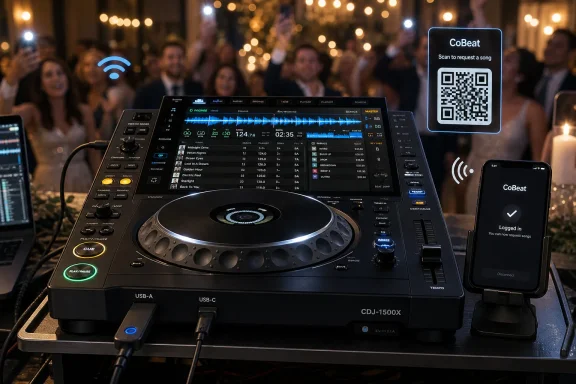
AlphaTheta announced the CDJ-1500X on July 2, 2026, a compact DJ multi-player for smaller booths and mobile setups that brings a 10.1-inch touchscreen, built-in Wi-Fi, cloud and streaming access, NFC login, and the new CoBeat crowd-request system below its flagship CDJ-3000X. The headline is not merely that a smaller CDJ has arrived. It is that AlphaTheta is pushing the modern DJ booth further away from removable media and toward accounts, networks, subscriptions, and audience-facing software. For working DJs, venue owners, and technically minded gear buyers, the CDJ-1500X is less a cut-down flagship than a signal about where the booth is being rebuilt.
The CDJ-1500X lands in a familiar product slot: less imposing than the top-end club player, more serious than an entry-level controller, and aimed at the venues and mobile rigs that cannot justify or physically accommodate a pair of flagship decks. At 3.6 kg and 252.1 × 374.7 × 116.5 mm, it is clearly meant for booths where every centimeter matters. That matters in bars, lounges, wedding rigs, livestream rooms, and home studios, where the “club standard” often has to be negotiated against furniture, budget, and portability.
But the interesting move is not the footprint. AlphaTheta has carried over the 10.1-inch capacitive touchscreen workflow associated with the CDJ-3000X, rather than treating screen size as the obvious place to economize. That decision tells us what the company thinks the center of the modern CDJ experience has become: not the disc slot, not even the jog wheel, but the browser.
That is a profound shift for a product line whose name still carries the ghost of compact discs. The CDJ survived the death of the CD by becoming a USB and rekordbox appliance. Now it is being asked to survive the soft death of the USB stick as the unquestioned default, with cloud libraries, streaming catalogs, and account-based workflows moving from novelty to product architecture.
The CDJ-1500X is therefore not just a cheaper path into AlphaTheta’s current ecosystem. It is a mid-market delivery vehicle for the company’s new operating assumption: DJs will increasingly arrive with credentials, not just media.
This is where the line between “hardware” and “software UI” collapses. A CDJ used to be judged by transport feel, jog response, reliability, and sound. Those still matter, but the act of DJing on contemporary media players has become increasingly dependent on how quickly the player can surface intent: where the breakdown is, whether the vocal clashes, whether the energy step is too abrupt, whether a track has already been prepared properly in rekordbox.
Playlist Edit is a small feature with a large implication. Rearranging tracks directly on the player reduces the back-and-forth between booth hardware and laptop preparation. It also reinforces the idea that the player is no longer just the endpoint for a library created elsewhere; it is becoming part of the library-management loop.
That loop is important for smaller venues and mobile DJs, where the set often changes in response to a room rather than a rider. A wedding DJ, bar resident, or private-event operator may need to reshape the next 30 minutes constantly. If that work can be done on the deck itself, the CDJ becomes less like a playback terminal and more like an operational workstation.
There is a trade-off here, as always. More capability on the touchscreen means more dependence on interface design, responsiveness, and software support. Physical controls remain essential for muscle memory, but the CDJ-1500X makes clear that AlphaTheta believes the information layer is now where much of the performance value lives.
The mid-size jog wheel will be one of the more scrutinized choices. For some DJs, jog size and tension are not cosmetic; they define whether a player feels like a club instrument or a portable approximation. AlphaTheta is clearly reserving some of the flagship aura for the CDJ-3000X, but the CDJ-1500X has to feel credible enough that mobile and small-room DJs do not see it as a downgrade from older full-size units.
The front panel’s USB-C and USB-A ports are a sensible bridge between eras. USB-A remains unavoidable in DJ culture because old drives, old preparation habits, and old venue standards linger for years. USB-C acknowledges the direction of travel without forcing the ecosystem to rip off the bandage.
The RCA output is another reminder of the target market. In larger professional installations, buyers may look for more expansive I/O and rugged integration options. In bars, compact booths, mobile racks, and home studios, RCA is still ordinary and often sufficient. The CDJ-1500X is not pretending to be the universal answer for festival stages; it is trying to be the practical answer for the rooms beneath them.
The promise is powerful. A DJ can arrive, authenticate, pull from a cloud library, and avoid the familiar ritual of duplicated USB sticks and frantic last-minute exports. In a controlled environment, especially a home studio or well-managed mobile rig, that can be a cleaner workflow than carrying multiple drives.
But the booth is not a controlled enterprise office. It is a hostile RF environment filled with phones, lighting systems, concrete, bodies, consumer routers, and venue networks that may have been configured years ago by someone’s cousin. A product that leans into cloud access also leans into the quality of network planning, and many nightlife spaces are not famous for that.
This does not make Wi-Fi a mistake. It makes it a boundary. The CDJ-1500X is arriving in a world where DJs will need to think more like field technicians: cache what matters, carry fallbacks, verify logins before doors open, and never assume the room’s internet connection is part of the performance contract unless someone has explicitly made it so.
The practical outcome is that USB sticks are not dead. They are being demoted from the center of the marketing story to the role of resilient fallback. For serious use, that fallback remains essential.
That is not unique to AlphaTheta. The entire creative-tools market has been moving in this direction for years, from cloud DAWs to subscription plug-ins to sample libraries that behave like streaming catalogs. What is different in DJ hardware is the performance context. If a streaming track disappears, fails to authenticate, or is unavailable in a region, the problem is not abstract. It can happen while people are standing in front of you.
For home users and casual sessions, streaming integration is liberating. It turns the player into an exploratory instrument and lowers the friction of trying music that is not already exported to a drive. For professional sets, it remains a tool that must be treated carefully, especially where licensing, connectivity, and offline availability are not completely under the DJ’s control.
The more subtle issue is library identity. A DJ’s collection used to be a local archive: files, folders, backups, metadata. Streaming pushes that collection toward a permissioned relationship among AlphaTheta, rekordbox, music services, and the user’s account. The benefit is reach. The cost is dependency.
The CDJ-1500X makes that dependency palatable by wrapping it in hardware that still looks and feels like a conventional player. That may be the smartest part of the product. The revolution is easier to accept when it has Hot Cue buttons.
There is a Windows-adjacent way to understand this: the DJ booth is becoming a managed endpoint. The player has network access, user authentication, personal settings, cloud content, service integrations, and software-dependent features. That is not exactly a laptop domain login, but the shape is familiar to anyone who has watched devices become account-centric over the last decade.
This creates a better experience when everything works. It also creates new failure modes. A forgotten login, an expired subscription, a phone battery problem, an app update, a service outage, or a misconfigured network can become part of the performance risk surface. The convenience stack is also an operational stack.
The CDJ-1500X therefore asks buyers to evaluate not just the build and sound, but the surrounding ecosystem. How often does rekordbox need updating? How stable are the mobile apps? How transparent is AlphaTheta about service requirements? How gracefully does the player fail when the network is not there?
Those questions used to sit at the edge of DJ gear reviews. They now belong near the center.
The generous reading is that CoBeat formalizes something that already happens badly. Crowds already make requests. They already hold up phones. They already interrupt the booth, DM the DJ, or pressure the event host. A controlled request layer could let DJs define the available catalog, preserve boundaries, and turn audience feedback into structured data rather than chaos.
The skeptical reading is that it gamifies a job that already suffers from too many distractions. DJs are not jukebox operators, and the best sets often depend on resisting the most obvious request in the room. Putting crowd input directly into the player’s browsing workflow risks turning performance into moderation.
AlphaTheta seems aware of that tension, which is why CoBeat is optional and can be turned off by the DJ. That detail matters. If CoBeat were mandatory, it would be a philosophical statement about surrendering the booth to audience polling. As an optional layer, it is more like a tool for specific contexts: weddings, brand events, bars, livestreams, student nights, or any environment where participation is part of the sell.
Still, optional features have a way of becoming expected features. Once venues and clients discover that “the new CDJ can take requests by QR code,” some DJs will be asked why they are not using it. The power to disable CoBeat may not always belong culturally to the person behind the decks.
For that market, the CDJ-1500X offers a familiar promise: enough flagship workflow to feel current, without the full flagship price or footprint. The listed pricing — £1,469 including VAT, €1,699 including VAT, and US pricing around the mid-$1,000 range before sales tax depending on listing — places it below AlphaTheta’s top professional player but still firmly in serious investment territory.
That pricing matters because compact does not mean cheap. Two players and a mixer still create a significant system cost. The CDJ-1500X may be more attainable than a CDJ-3000X rig, but it is not a casual impulse buy for most working DJs.
The value case depends on the buyer. A bar replacing aging media players may see the CDJ-1500X as a way to modernize without redesigning the booth. A mobile DJ may value the smaller footprint and streaming access more than flagship jog-wheel feel. A home user may see it as a premium practice deck that aligns with club workflows.
For large clubs and festival stages, the CDJ-3000X likely remains the prestige object. For everyone else, the CDJ-1500X may be the more consequential product because it brings the new AlphaTheta software model to many more rooms.
CloudDirectPlay, StreamingDirectPlay, NFC login, CoBeat, rekordbox integration, waveform metadata, and service compatibility all depend on ongoing maintenance. The CDJ-1500X’s long-term value will be shaped by firmware updates, app compatibility, streaming partnerships, and how quickly AlphaTheta fixes bugs that appear only after thousands of real-world gigs.
This is where the comparison with traditional DJ hardware becomes unfair but unavoidable. An older mixer or media player could remain useful for years because its core job was local and self-contained. A cloud-connected player has a broader promise, but also more moving parts outside the owner’s control.
The risk is not that AlphaTheta will abandon the device immediately. The risk is that buyers are now purchasing a relationship as much as a box. If a streaming partner changes terms, if a mobile OS update breaks login behavior, if CoBeat evolves into a paid tier, or if rekordbox support shifts, the hardware experience can change after purchase.
That is the normal condition of modern technology. It is also why gear buyers should be more demanding about roadmaps, offline modes, export compatibility, and failure behavior. A CDJ that can do more should also be judged more harshly when its dependencies falter.
This may be good business. It may also be good product design in many cases. A modern DJ genuinely benefits from carrying less media, accessing more music, and moving settings across devices. The convenience is real, not imaginary.
But subscription economics change incentives. Once a hardware company sees recurring services as part of the product experience, it has reason to design features that make the service layer feel indispensable. That can improve integration, but it can also narrow user choice.
For DJs who prefer local files, open-ended libraries, and minimal dependencies, the CDJ-1500X is both reassuring and cautionary. The USB ports are still there. The traditional controls are still there. But the center of gravity is clearly moving.
The fairest judgment is that AlphaTheta is not forcing a single future yet. It is building a bridge and inviting the market to walk across it. The CDJ-1500X matters because it places that bridge in the middle of the product range, not just at the flagship end.
A resilient setup might use rekordbox exports on USB as the baseline, cloud access for preparation flexibility, streaming for discovery or contingency, NFC login for convenience, and CoBeat only when the event format benefits from audience input. That layered approach treats the new features as tools rather than religion.
A fragile setup would do the opposite. It would assume the venue network is reliable, assume subscriptions are active, assume accounts will authenticate instantly, assume every requested track is legally and technically available, and assume the touchscreen can absorb every new workflow without increasing cognitive load.
The CDJ-1500X can support either model. The difference will come from how DJs, venues, and installers deploy it. AlphaTheta has supplied the platform; users will decide whether it becomes a better booth or a more complicated one.
 AlphaTheta Shrinks the Flagship Without Shrinking the Strategy
The CDJ-1500X lands in a familiar product slot: less imposing than the top-end club player, more serious than an entry-level controller, and aimed at the venues and mobile rigs that cannot justify or physically accommodate a pair of flagship decks. At 3.6 kg and 252.1 × 374.7 × 116.5 mm, it is clearly meant for booths where every centimeter matters. That matters in bars, lounges, wedding rigs, livestream rooms, and home studios, where the “club standard” often has to be negotiated against furniture, budget, and portability.But the interesting move is not the footprint. AlphaTheta has carried over the 10.1-inch capacitive touchscreen workflow associated with the CDJ-3000X, rather than treating screen size as the obvious place to economize. That decision tells us what the company thinks the center of the modern CDJ experience has become: not the disc slot, not even the jog wheel, but the browser.
That is a profound shift for a product line whose name still carries the ghost of compact discs. The CDJ survived the death of the CD by becoming a USB and rekordbox appliance. Now it is being asked to survive the soft death of the USB stick as the unquestioned default, with cloud libraries, streaming catalogs, and account-based workflows moving from novelty to product architecture.
The CDJ-1500X is therefore not just a cheaper path into AlphaTheta’s current ecosystem. It is a mid-market delivery vehicle for the company’s new operating assumption: DJs will increasingly arrive with credentials, not just media.
The Screen Is the Product Now
The 10.1-inch touchscreen is the feature that makes the CDJ-1500X feel less like a minor player and more like a repositioning of the middle of the range. AlphaTheta says the browse view can show up to 15 tracks at once, with waveform previews, vocal position indicators, BPM change markers, and phrase information presented to help DJs read a track before committing to it. In practice, that turns the player into a compact decision console.This is where the line between “hardware” and “software UI” collapses. A CDJ used to be judged by transport feel, jog response, reliability, and sound. Those still matter, but the act of DJing on contemporary media players has become increasingly dependent on how quickly the player can surface intent: where the breakdown is, whether the vocal clashes, whether the energy step is too abrupt, whether a track has already been prepared properly in rekordbox.
Playlist Edit is a small feature with a large implication. Rearranging tracks directly on the player reduces the back-and-forth between booth hardware and laptop preparation. It also reinforces the idea that the player is no longer just the endpoint for a library created elsewhere; it is becoming part of the library-management loop.
That loop is important for smaller venues and mobile DJs, where the set often changes in response to a room rather than a rider. A wedding DJ, bar resident, or private-event operator may need to reshape the next 30 minutes constantly. If that work can be done on the deck itself, the CDJ becomes less like a playback terminal and more like an operational workstation.
There is a trade-off here, as always. More capability on the touchscreen means more dependence on interface design, responsiveness, and software support. Physical controls remain essential for muscle memory, but the CDJ-1500X makes clear that AlphaTheta believes the information layer is now where much of the performance value lives.
Compact Does Not Mean Minimal
The physical control set suggests AlphaTheta is trying to avoid the trap of making the CDJ-1500X feel like a compromised touchscreen box. Eight Hot Cue buttons, a Beat Loop knob, Beat Sync, Beat Jump, and a mid-size jog wheel with a rotation indicator and non-slip surface place it firmly in performance-player territory. This is not a device designed only for library playback.The mid-size jog wheel will be one of the more scrutinized choices. For some DJs, jog size and tension are not cosmetic; they define whether a player feels like a club instrument or a portable approximation. AlphaTheta is clearly reserving some of the flagship aura for the CDJ-3000X, but the CDJ-1500X has to feel credible enough that mobile and small-room DJs do not see it as a downgrade from older full-size units.
The front panel’s USB-C and USB-A ports are a sensible bridge between eras. USB-A remains unavoidable in DJ culture because old drives, old preparation habits, and old venue standards linger for years. USB-C acknowledges the direction of travel without forcing the ecosystem to rip off the bandage.
The RCA output is another reminder of the target market. In larger professional installations, buyers may look for more expansive I/O and rugged integration options. In bars, compact booths, mobile racks, and home studios, RCA is still ordinary and often sufficient. The CDJ-1500X is not pretending to be the universal answer for festival stages; it is trying to be the practical answer for the rooms beneath them.
Wi-Fi Turns the Booth Into an IT Problem
Built-in Wi-Fi is the feature that will excite some DJs and worry the people who have to make venues work. On paper, wireless access to rekordbox, CloudDirectPlay, and supported streaming services is an obvious modernization. In the real world, every sysadmin, AV tech, and club engineer knows that “the Wi-Fi will be fine” is not a plan.The promise is powerful. A DJ can arrive, authenticate, pull from a cloud library, and avoid the familiar ritual of duplicated USB sticks and frantic last-minute exports. In a controlled environment, especially a home studio or well-managed mobile rig, that can be a cleaner workflow than carrying multiple drives.
But the booth is not a controlled enterprise office. It is a hostile RF environment filled with phones, lighting systems, concrete, bodies, consumer routers, and venue networks that may have been configured years ago by someone’s cousin. A product that leans into cloud access also leans into the quality of network planning, and many nightlife spaces are not famous for that.
This does not make Wi-Fi a mistake. It makes it a boundary. The CDJ-1500X is arriving in a world where DJs will need to think more like field technicians: cache what matters, carry fallbacks, verify logins before doors open, and never assume the room’s internet connection is part of the performance contract unless someone has explicitly made it so.
The practical outcome is that USB sticks are not dead. They are being demoted from the center of the marketing story to the role of resilient fallback. For serious use, that fallback remains essential.
Streaming Is Convenient Until the License Becomes the Gear
StreamingDirectPlay support for Apple Music, Beatport Streaming, and Tidal is a major part of the CDJ-1500X pitch, though availability depends on region and subscription requirements. This is where the hardware story becomes a platform story. The deck may be a one-time purchase, but parts of its advertised value depend on services that are rented, licensed, and subject to catalog changes.That is not unique to AlphaTheta. The entire creative-tools market has been moving in this direction for years, from cloud DAWs to subscription plug-ins to sample libraries that behave like streaming catalogs. What is different in DJ hardware is the performance context. If a streaming track disappears, fails to authenticate, or is unavailable in a region, the problem is not abstract. It can happen while people are standing in front of you.
For home users and casual sessions, streaming integration is liberating. It turns the player into an exploratory instrument and lowers the friction of trying music that is not already exported to a drive. For professional sets, it remains a tool that must be treated carefully, especially where licensing, connectivity, and offline availability are not completely under the DJ’s control.
The more subtle issue is library identity. A DJ’s collection used to be a local archive: files, folders, backups, metadata. Streaming pushes that collection toward a permissioned relationship among AlphaTheta, rekordbox, music services, and the user’s account. The benefit is reach. The cost is dependency.
The CDJ-1500X makes that dependency palatable by wrapping it in hardware that still looks and feels like a conventional player. That may be the smartest part of the product. The revolution is easier to accept when it has Hot Cue buttons.
NFC Login Makes the DJ the Roaming Profile
NFC touch login using rekordbox for iOS or Android is one of those features that sounds minor until you think about how many small frictions it removes. Tap a phone, access settings and playlists, and the player becomes less tied to its local state. For DJs who move between booths, that is the dream of a roaming profile translated into nightlife hardware.There is a Windows-adjacent way to understand this: the DJ booth is becoming a managed endpoint. The player has network access, user authentication, personal settings, cloud content, service integrations, and software-dependent features. That is not exactly a laptop domain login, but the shape is familiar to anyone who has watched devices become account-centric over the last decade.
This creates a better experience when everything works. It also creates new failure modes. A forgotten login, an expired subscription, a phone battery problem, an app update, a service outage, or a misconfigured network can become part of the performance risk surface. The convenience stack is also an operational stack.
The CDJ-1500X therefore asks buyers to evaluate not just the build and sound, but the surrounding ecosystem. How often does rekordbox need updating? How stable are the mobile apps? How transparent is AlphaTheta about service requirements? How gracefully does the player fail when the network is not there?
Those questions used to sit at the edge of DJ gear reviews. They now belong near the center.
CoBeat Puts the Crowd Inside the Interface
CoBeat is the flashiest and most culturally loaded part of the announcement. The service lets audience members scan a QR code, browse a pre-selected catalog, vote for tracks, send requests, and send messages, with requests appearing on the player’s browse screen and emoji reactions appearing on the DJ’s smartphone. AlphaTheta says CoBeat and the rekordbox for Mac/Windows update adding support are scheduled for July 9, 2026.The generous reading is that CoBeat formalizes something that already happens badly. Crowds already make requests. They already hold up phones. They already interrupt the booth, DM the DJ, or pressure the event host. A controlled request layer could let DJs define the available catalog, preserve boundaries, and turn audience feedback into structured data rather than chaos.
The skeptical reading is that it gamifies a job that already suffers from too many distractions. DJs are not jukebox operators, and the best sets often depend on resisting the most obvious request in the room. Putting crowd input directly into the player’s browsing workflow risks turning performance into moderation.
AlphaTheta seems aware of that tension, which is why CoBeat is optional and can be turned off by the DJ. That detail matters. If CoBeat were mandatory, it would be a philosophical statement about surrendering the booth to audience polling. As an optional layer, it is more like a tool for specific contexts: weddings, brand events, bars, livestreams, student nights, or any environment where participation is part of the sell.
Still, optional features have a way of becoming expected features. Once venues and clients discover that “the new CDJ can take requests by QR code,” some DJs will be asked why they are not using it. The power to disable CoBeat may not always belong culturally to the person behind the decks.
The Small Booth Is the Real Battleground
It is tempting to evaluate the CDJ-1500X only against the CDJ-3000X, but the more important comparison is against the messy reality of smaller setups. Many bars and mobile operators do not run pristine flagship installations. They run older CDJs, XDJ units, controllers, laptops, tablets, mismatched mixers, and whatever can survive being packed, unpacked, spilled on, and paid off.For that market, the CDJ-1500X offers a familiar promise: enough flagship workflow to feel current, without the full flagship price or footprint. The listed pricing — £1,469 including VAT, €1,699 including VAT, and US pricing around the mid-$1,000 range before sales tax depending on listing — places it below AlphaTheta’s top professional player but still firmly in serious investment territory.
That pricing matters because compact does not mean cheap. Two players and a mixer still create a significant system cost. The CDJ-1500X may be more attainable than a CDJ-3000X rig, but it is not a casual impulse buy for most working DJs.
The value case depends on the buyer. A bar replacing aging media players may see the CDJ-1500X as a way to modernize without redesigning the booth. A mobile DJ may value the smaller footprint and streaming access more than flagship jog-wheel feel. A home user may see it as a premium practice deck that aligns with club workflows.
For large clubs and festival stages, the CDJ-3000X likely remains the prestige object. For everyone else, the CDJ-1500X may be the more consequential product because it brings the new AlphaTheta software model to many more rooms.
The Hardware Is Only Half the Lifecycle
The deeper question is not whether the CDJ-1500X is well specified today. It is how well AlphaTheta supports it over the next five to seven years. Modern DJ players are computers in performance clothing, and computers age through software as much as hardware.CloudDirectPlay, StreamingDirectPlay, NFC login, CoBeat, rekordbox integration, waveform metadata, and service compatibility all depend on ongoing maintenance. The CDJ-1500X’s long-term value will be shaped by firmware updates, app compatibility, streaming partnerships, and how quickly AlphaTheta fixes bugs that appear only after thousands of real-world gigs.
This is where the comparison with traditional DJ hardware becomes unfair but unavoidable. An older mixer or media player could remain useful for years because its core job was local and self-contained. A cloud-connected player has a broader promise, but also more moving parts outside the owner’s control.
The risk is not that AlphaTheta will abandon the device immediately. The risk is that buyers are now purchasing a relationship as much as a box. If a streaming partner changes terms, if a mobile OS update breaks login behavior, if CoBeat evolves into a paid tier, or if rekordbox support shifts, the hardware experience can change after purchase.
That is the normal condition of modern technology. It is also why gear buyers should be more demanding about roadmaps, offline modes, export compatibility, and failure behavior. A CDJ that can do more should also be judged more harshly when its dependencies falter.
The DJ Booth Joins the Subscription Economy
The CDJ-1500X sits at the intersection of two trends that have reshaped consumer and professional technology: hardware margin pressure and recurring software value. AlphaTheta can sell a player, but the richer ecosystem lives in rekordbox, cloud storage workflows, streaming services, and now crowd interaction. The deck becomes a portal.This may be good business. It may also be good product design in many cases. A modern DJ genuinely benefits from carrying less media, accessing more music, and moving settings across devices. The convenience is real, not imaginary.
But subscription economics change incentives. Once a hardware company sees recurring services as part of the product experience, it has reason to design features that make the service layer feel indispensable. That can improve integration, but it can also narrow user choice.
For DJs who prefer local files, open-ended libraries, and minimal dependencies, the CDJ-1500X is both reassuring and cautionary. The USB ports are still there. The traditional controls are still there. But the center of gravity is clearly moving.
The fairest judgment is that AlphaTheta is not forcing a single future yet. It is building a bridge and inviting the market to walk across it. The CDJ-1500X matters because it places that bridge in the middle of the product range, not just at the flagship end.
The Practical Story Is Resilience, Not Hype
The most useful way to think about the CDJ-1500X is not as “cloud DJing in a box” or “a smaller CDJ-3000X.” It is a resilience test for the modern booth. The player is strongest when it expands options without making any one option mandatory.A resilient setup might use rekordbox exports on USB as the baseline, cloud access for preparation flexibility, streaming for discovery or contingency, NFC login for convenience, and CoBeat only when the event format benefits from audience input. That layered approach treats the new features as tools rather than religion.
A fragile setup would do the opposite. It would assume the venue network is reliable, assume subscriptions are active, assume accounts will authenticate instantly, assume every requested track is legally and technically available, and assume the touchscreen can absorb every new workflow without increasing cognitive load.
The CDJ-1500X can support either model. The difference will come from how DJs, venues, and installers deploy it. AlphaTheta has supplied the platform; users will decide whether it becomes a better booth or a more complicated one.
The CDJ-1500X Makes the Middle of the Market Look Like the Future
The lesson of the CDJ-1500X is not that every DJ should rush toward cloud workflows. It is that the middle of the market is no longer being served only with yesterday’s flagship ideas. AlphaTheta is putting its newest assumptions into a smaller player, and that makes the device more strategically important than its compact dimensions suggest.- The CDJ-1500X brings a 10.1-inch touchscreen, Wi-Fi, cloud access, streaming support, NFC login, and CoBeat compatibility to a player aimed at smaller booths and mobile setups.
- The player keeps conventional USB-A and USB-C media access, which remains essential as a fallback for professional use.
- CoBeat could be useful for request-heavy events, but DJs will need to manage expectations carefully because audience interaction can become a demand rather than a choice.
- Streaming support adds flexibility, but it also ties part of the player’s value to subscriptions, regional availability, catalog rights, and network reliability.
- The most important buying question is not whether the CDJ-1500X has enough features today, but whether AlphaTheta’s software and service ecosystem remains dependable over the life of the hardware.
References
- Primary source: Attack Magazine
Published: 2026-07-02T09:22:10.921222
AlphaTheta Release CDJ-1500X With Cloud DJing, Crowd Requests In A Compact Player Format - Attack Magazine
AlphaTheta’s new CDJ-1500X brings CDJ-3000X-style touchscreen workflow, built-in Wi-Fi, streaming access and CoBeat audience requests to smaller boothswww.attackmagazine.com - Related coverage: alphatheta.com
Ya está aquí el CDJ-1500X: un nuevo reproductor de DJ múltiple ideal para quienes tienen poco espacio y buscan flexibilidad
Un rendimiento excepcional y la misma usabilidad del modelo insignia, pero con conectividad en la nube y un nuevo servicio para interactuar con el públicoalphatheta.com - Related coverage: djmag.com
AlphaTheta announces new multi player, CDJ-1500X | DJ Mag
The new unit has many features from the flagship CDJ-3000X unit in a more compact design intended for smaller booths and at-home setupsdjmag.com - Related coverage: musicradar.com
AlphaTheta’s CDJ-1500X is a WiFi equipped DJ player that lets your audience vote on track requests | MusicRadar
The brand’s latest multiplayer distills the essence of the flagship CDJ-3000X into a smaller, more affordable packagewww.musicradar.com - Related coverage: edmtunes.com
AlphaTheta Unveils Compact CDJ-1500X With Cloud Streaming And Wi-Fi - EDMTunes
AlphaTheta has unveiled the new CDJ-1500X, a compact professional media player featuring Wi-Fi, cloud streaming, a 10.1-inch touchscreen, rekordbox CloudDirectPlay, and the new CoBeat crowd interaction service. www.edmtunes.com
- Related coverage: sekbernews.id
AlphaTheta stellt kompakten DJ-Mediaplayer CDJ-1500X vor
AlphaTheta präsentiert den kompakten DJ-Multiplayer CDJ-1500X mit CoBeat-Funktion für Songwünsche per QR-Code für 1.699 Euro.www.sekbernews.id
- Related coverage: oxigenio.fm
A AlphaTheta, antiga pioneer dj, apresenta o novo CDJ-1500X
A AlphaTheta anunciou o lançamento de um novo cdj, um leitor multimédia para DJs que reúne várias funcionalidades do modelo topo de gama da marca, o CDJ-3000X, num formato mais compacto destinado a bares, pequenos clubes, eventos móveis e estúdios domésticos. O novo equipamento foi desenvolvido...www.oxigenio.fm - Related coverage: univers-sons.com
AlphaTheta CDJ-1500X : Test & Avis Platine DJ Compacte - Univers Sons
Test et avis du CDJ-1500X AlphaTheta : écran 10,1" capacitif, cloud rekordbox, CoBeat, format compact issu du CDJ-3000X. Fiche technique, comparatif et prix.www.univers-sons.com
- Related coverage: cultr.com
AlphaTheta Releases the CDJ-3000X — CULTR
AlphaTheta has announced the launch of its new multi-player, the CDJ-3000X. The unit is an update to the CDJ-3000, adding new features related to connectivity, workflow, and performance. The CDJ-3000X is equipped with built-in Wi-Fi, enabling direct connection to the internet for cloud-based...www.cultr.com - Related coverage: downloads.support.alphatheta.com
- Related coverage: allfordj.ru
- Related coverage: expertgeronika.be
